
美联储政策

Search documents
ETO Markets 市场洞察:金价反弹背后的多因素博弈与未来展望
Sou Hu Cai Jing· 2025-05-14 10:48
Core Viewpoint - The fluctuations in gold prices are influenced by multiple factors, including investor behavior, inflation data, geopolitical tensions, and the performance of the US dollar [1][10]. Group 1: Investor Behavior - The phenomenon of buying on dips acts as an invisible "safety net" in the gold market, with significant buying interest emerging when prices drop, reflecting investors' strong belief in gold as a "ultimate safe-haven asset" [3]. - After gold prices fell to a low of $3207.30 per ounce, a surge of buying interest quickly entered the market, indicating a robust demand for gold amidst economic uncertainties [3]. Group 2: Inflation Data - The US Labor Department reported a 0.2% month-on-month increase in the Consumer Price Index (CPI) for April, which was below the expected 0.3%, providing a boost to gold prices [4]. - The mild inflation report is expected to support the Federal Reserve's potential interest rate cuts, enhancing the attractiveness of gold as a hedge against inflation [4]. Group 3: Geopolitical Tensions - Ongoing geopolitical tensions, particularly regarding the potential talks between Ukraine and Russia, continue to provide strong support for gold prices [5][6]. - The uncertainty surrounding geopolitical events reinforces the historical wisdom of buying gold during tumultuous times, as investors seek to protect their assets from potential losses [5]. Group 4: US Dollar Performance - The US dollar index fell by 0.8% to 100.98, contrasting with the rise in gold prices, highlighting the negative correlation between the two [7]. - Despite easing trade tensions between the US and China, the dollar remains lower than its level when tariffs were announced, influencing market expectations for Federal Reserve policy and subsequently gold prices [7]. Group 5: Future Outlook - Gold faces three key variables: the progress of US-China trade negotiations, the direction of Federal Reserve monetary policy, and the evolution of global geopolitical risks [8]. - The market is advised to monitor these factors closely, as they will significantly impact risk appetite and demand for gold [8].


星迈STARTRADER:一日反弹难掩颓势,全球去美元化加速?
Sou Hu Cai Jing· 2025-05-14 09:56
Core Viewpoint - The US dollar index has shown a significant decline after a brief rebound, primarily driven by weaker-than-expected inflation data and underlying concerns about the US macroeconomic framework [3][4]. Fundamental Analysis - The US core CPI increased by only 0.2% month-on-month, providing an opportunity for dollar bears to re-enter the market [3]. - There are growing doubts among traders regarding the resilience of the US economy, with expectations of a 50 basis point rate cut by the end of the year remaining unchanged despite the inflation data [3]. - The 10-year swap spread for the dollar remains elevated, exceeding 50 basis points, indicating market concerns about US Treasury market pressures and fiscal sustainability [3]. Technical Analysis - The dollar index is in a clear downtrend, currently trading around 100.90, with a significant drop from the 110 level [5]. - The MACD indicator has been below the zero line for an extended period, suggesting a weak overall trend despite recent bullish signals [5]. - The Bollinger Bands indicate a wide trading range, with the upper band at 101.92 and the lower band at 98.02, while the price is constrained by the 99.97 midline [5]. Market Sentiment Observation - Market sentiment is characterized by skepticism, with traders increasingly losing confidence in the dollar [7]. - The short-lived rebound in the dollar reflects a cautious attitude among traders, who are quick to capitalize on any upward movement to short the currency [7]. - Overall sentiment remains pessimistic but has not reached extreme panic levels, with short positions on the dollar being the predominant strategy [7]. Market Outlook - In the short term, the dollar index is expected to oscillate within the 100.14 - 101.80 range, with potential support if US economic data exceeds expectations [8]. - A successful breakout above the 101.17 resistance level could lead to a rally towards 102.22 [8]. - Long-term structural pressures on the dollar are significant, with the trend of de-dollarization potentially impacting reserve composition and cross-border settlements [8].
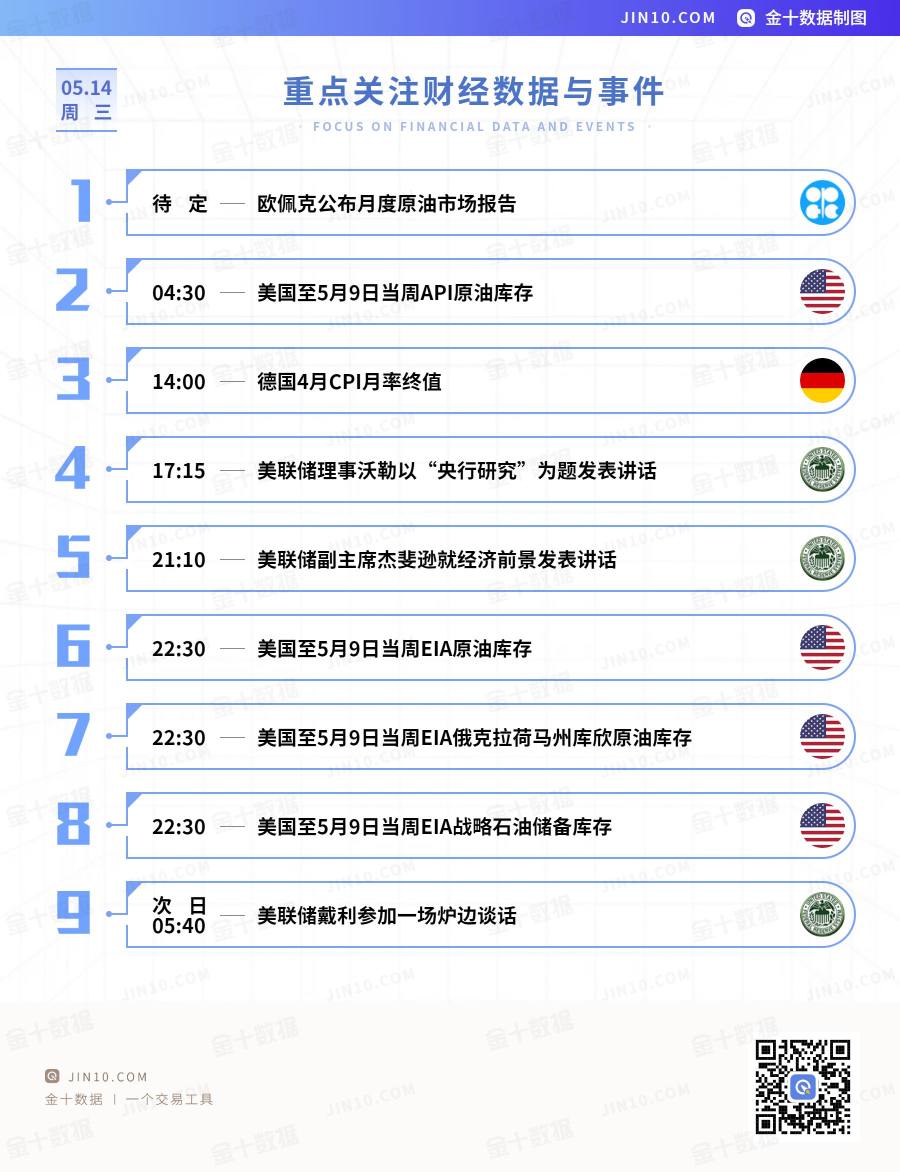
今日重点关注的财经数据与事件:2025年5月14日 周三
news flash· 2025-05-13 16:03
Group 1 - OPEC is set to release its monthly oil market report, which is crucial for understanding global oil supply and demand dynamics [1] - The API crude oil inventory data for the week ending May 9 will be released, providing insights into U.S. oil stock levels [1] - The final CPI month-on-month figure for Germany in April will be published, which is important for assessing inflation trends in the Eurozone [1] Group 2 - Federal Reserve Governor Waller is scheduled to speak, which may influence market expectations regarding U.S. monetary policy [1] - Federal Reserve Vice Chairman Jefferson will also deliver remarks, potentially impacting investor sentiment [1] - EIA will release several key inventory reports, including crude oil, Cushing crude oil, and strategic petroleum reserve inventories for the week ending May 9, which are vital for gauging U.S. oil market conditions [1]
Doo Financial:美元如何通过技术面提前预判?
Sou Hu Cai Jing· 2025-05-13 15:43
Core Insights - The article emphasizes the importance of technical analysis in navigating the fluctuations of the dollar index, likening it to a dynamic ECG that reveals hidden signals in the market [1] - It highlights the effectiveness of trend lines and moving averages in predicting currency movements, particularly during significant market events like the European energy crisis [3] - The article discusses the value of combining technical indicators to enhance predictive capabilities, especially when aligned with fundamental factors such as Federal Reserve policies and geopolitical events [5] Group 1: Technical Analysis - The dollar index's K-line chart serves as a crucial tool for traders to identify key resistance levels and predict strong market trends [1] - The formation of higher peaks and troughs in the dollar index indicates the establishment of an upward channel, particularly noted during the 2022 European energy crisis [3] - The combination of technical indicators, such as MACD and RSI, provides insights into market momentum and trend strength, with specific examples from the dollar/yen exchange rate [3] Group 2: Market Dynamics - Historical price levels often self-validate, as seen when the dollar/euro exchange rate rebounded after hitting a support level [3] - The emergence of specific price patterns, like the head and shoulders bottom, signals potential trend reversals, while prolonged consolidation phases can lead to significant price movements [3] - Market sentiment, indicated by the VIX index, can create trading opportunities when it inversely correlates with the dollar index [3] Group 3: Investment Tools - Doo Financial offers a multi-dimensional analysis framework and real-time monitoring systems to help investors navigate the complexities of the market [5] - The integration of technical signals with fundamental developments is crucial for making informed investment decisions in a rapidly changing environment [5]

全球金融观察|风险资产、避险资产“大逆转”,警报解除了吗?
Sou Hu Cai Jing· 2025-05-13 13:19
21世纪经济报道记者吴斌 上海报道 美国政府滥施关税一度引发全球风险资产暴跌,避险资产光芒四射。但短短一个月后,市场风险偏好回 升,全球资产表现"大逆转"。 当地时间5月12日,风险资产再获青睐,避险资产大幅回调。美股高开高走,三大指数大幅收涨,均收 于3月以来的最高水平。美债下挫,10年期美债收益率逼近4.5%关口。2年期美债收益率一度突破4%。 现货金下跌2.7%,收报每盎司3233.72美元。 据新华社报道,中美经贸高层会谈5月10日至11日在瑞士举行,受到国际社会高度关注。经过双方共同 努力,中美在多个领域进行了坦诚、深入、具有建设性的沟通,达成一系列重要共识,取得实质性进 展,迈出了通过平等对话协商解决分歧的重要一步,为进一步弥合分歧和深化合作打下了基础、创造了 条件。 5月12日,中美双方发布《中美日内瓦经贸会谈联合声明》。商务部新闻发言人就此发表谈话。美方承 诺取消根据2025年4月8日第14259号行政令和2025年4月9日第14266号行政令对中国商品加征的共计91% 的关税,修改2025年4月2日第14257号行政令对中国商品加征的34%的对等关税,其中24%的关税暂停 加征90天,保留剩 ...
关注美国通胀数据,美联储进退两难,黄金关键位在哪?点击观看金十研究员文成直播分析
news flash· 2025-05-13 11:19
黄金实时分析 关注美国通胀数据,美联储进退两难,黄金关键位在哪?点击观看金十研究员文成直播分析 相关链接 ...
4月CPI前瞻:CPI报告或暗藏“炸弹”,四大趋势不得不知!
美股研究社· 2025-05-13 10:58
Core Viewpoint - The article discusses the anticipated release of the U.S. Consumer Price Index (CPI) data for April, highlighting the potential market reactions and the implications of recent U.S.-China trade negotiations on inflation trends [3][4]. CPI Predictions - Wall Street expects the overall CPI month-on-month to record 0.3%, up from -0.1% last month, and the year-on-year CPI to remain steady at 2.4% [4]. - Core CPI month-on-month is predicted to be 0.3%, an increase from 0.1% in March, with a wide forecast range from 0.0% to 0.6% [4]. Trade Impact on Inflation - Economists believe the upcoming CPI report will reflect the impact of recent tariff measures, although the actual effect may be limited due to prior imports [4][5]. - The temporary tariff reduction agreement between the U.S. and China may lead to inventory replenishment by retailers, potentially causing short-term price increases [5]. Sector-Specific Insights - Economists are closely monitoring service categories that reflect discretionary spending, with travel-related prices like airfare and car rentals showing a downward trend [6]. - The housing category, which has the largest weight in CPI, is expected to slow down after a strong increase in March [6]. Price Trends - Goldman Sachs predicts a 0.31% month-on-month increase in overall CPI, driven by rising food and energy prices [6]. - The report anticipates a 0.5% decrease in used car prices, while new car prices are expected to rise by 0.1% due to reduced promotional activities [7]. Insurance Costs - Auto insurance prices are projected to rise by 0.7% month-on-month, reflecting increased costs for insurers due to higher vehicle prices and repair costs [7]. Future Outlook - Goldman Sachs suggests that unless retailers begin to liquidate previously accumulated inventories, tariffs will continue to hinder inflation from falling to the 2% target [8]. - The bank forecasts core CPI month-on-month to be around 0.35% in the coming months, with a potential decline in trend inflation due to reduced contributions from sectors like automotive and housing [8].


ETO MARKETS:周二黄金市场在贸易乐观情绪中受挫 未来走势如何?
Sou Hu Cai Jing· 2025-05-13 09:19
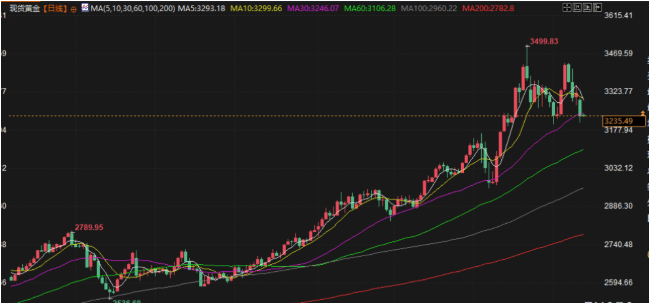
周二(北京时间5月13日),现货黄金交投于3234.88美元附近,金价周一下跌近3%,ETOMARKETS分 析主要原因是贸易缓和降低了市场的避险情绪。此前,两大经济体宣布达成降低关税的临时协议,冒险 情绪逐渐升温,导致黄金价格大幅下跌。现货金报每盎司3225.28美元,下跌3%;美国期金收低3.5%, 报3228美元。这一走势表明,黄金市场对贸易局势的变化极为敏感,而当前市场的乐观情绪对黄金价格 产生了明显的抑制作用。 乐观情绪的可持续性 尽管当前市场对贸易协议的达成表现出乐观情绪,但这种乐观情绪的可持续性仍需观察。贸易协议的最 终实施和未来的贸易政策走向仍存在不确定性,这可能在未来引发市场的波动。黄金市场在当前的乐观 情绪下受到抑制,但如果未来贸易局势出现反复或新的不确定性,黄金价格可能会迅速反弹。 美联储政策的影响 交易员们正在等待周二公布的美国消费者物价指数(CPI)数据,以了解美联储的政策走向。本周还将 公布其他关键数据,包括生产者价格指数(PPI)和零售销售。这些数据将为市场提供关于美国经济状 况和通胀水平的重要信息,进而影响美联储的利率决策。如果数据显示美国经济放缓或通胀压力上升, 美联储可能会 ...
从今晚的CPI看关税:政策冲击下的美国通胀压力有多大?
Sou Hu Cai Jing· 2025-05-13 08:52
周一美国和中国宣布达成暂时削减对等关税的协议后,今晚市场继续迎来本周的重磅数据——美国4月CPI,即便上周美联储决议刚过,但这是首份能够更 加充分体现特朗普关税政策影响的重要通胀报告,所以将从经济和美联储政策前景的指引变化上给市场带来关键的指引。 许多经济学家预计,随着时间的推移,其影响将变得更加明显,关税对通胀的全面影响可能会在未来三到六个月内显现。美国银行将4月份的通胀数据描述 为"关税风暴"前的平静。因关税将大幅推高通胀,可能从今年夏天开始,届时美国企业将耗尽现有库存,需要开始以更高的价格销售新产品。 这有助于解释消费者对通胀、经济和就业市场日益增长的担忧。预计周四公布的美国零售额数据将在一定程度上反映出这种担忧;在第一季度末实现1.5% 的健康增长后,经济学家预测4月份零售额将基本持平,因为前期汽车需求有所降温。 同脏压力跟随关税升温 根据FactSet的普遍预期,预计4月份CPI环比上涨0.3%,同比上涨2.3%。不包括食品和能源成本的核心通胀预计将上涨0.3%,同比上涨2.8%。由于能源价格 拖累通胀压力下降,3月份CPI环比下降,为2020年以来首次。 因此如果数据符合预期,则标志着美国消费者价 ...
长江期货市场交易指引-20250513
Chang Jiang Qi Huo· 2025-05-13 06:15
Report Industry Investment Ratings - **Macro Finance**: Index futures are expected to fluctuate strongly, while treasury bonds are expected to fluctuate upward [1][5]. - **Black Building Materials**: Rebar is recommended for temporary observation, iron ore is expected to fluctuate weakly, and coking coal and coke are expected to fluctuate [1][7][9]. - **Non - ferrous Metals**: Copper is recommended for cautious trading within a range, aluminum is recommended for observation, nickel is recommended for observation or shorting at high prices, tin is recommended for trading within a range, gold is recommended for building positions at low prices after a full price correction, and silver is recommended for trading within a range [1][11][16][18]. - **Energy Chemicals**: PVC, caustic soda, rubber, urea, methanol, and plastic are all expected to fluctuate; soda ash is recommended for observation; and the outlook for soda ash is weakly fluctuating [1][20][28]. - **Cotton Textile Industry Chain**: Cotton and cotton yarn are expected to rebound with fluctuations, apples are expected to fluctuate, and PTA is expected to fluctuate weakly [1][30]. - **Agricultural and Livestock**: Pigs are expected to fluctuate weakly, eggs are expected to show a weak trend, corn is expected to fluctuate strongly, soybean meal is expected to fluctuate at a low level, and oils are expected to fluctuate [1][33][38]. Core Views The report analyzes various futures products based on factors such as Sino - US trade negotiations, domestic policies, supply - demand relationships, and cost - profit situations. It believes that Sino - US trade negotiations have a significant impact on the market, with short - term tariff easing exceeding expectations, but the actual impact on demand is still expected to exist. Different products have different trends due to their own supply - demand and cost characteristics, and investors need to pay attention to relevant factors such as policy changes, supply - demand dynamics, and cost fluctuations [5][20]. Summary by Directory Macro Finance - **Index Futures**: Sino - US trade situation improvement boosts the strong rebound of US stocks. The negotiation process exceeds expectations, and the index futures may fluctuate strongly. However, there are risks of callback after reaching the previous high [5]. - **Treasury Bonds**: Sino - US trade negotiations may reduce the pressure of export decline. The potential downward space of bond yields is limited, but there are still phased opportunities. Short - term attention should be paid to the fermentation of reverse trading [5][6]. Black Building Materials - **Rebar**: The futures price rebounds, and the market expectation improves due to Sino - US negotiations. The supply - demand pattern shows signs of deterioration, and the price is expected to fluctuate under the background of low valuation [7]. - **Iron Ore**: The supply shows a slight decline, and the demand has limited upward space. Considering the approaching traditional off - season and other factors, the price is expected to fluctuate weakly [7][8]. - **Coking Coal and Coke**: The coking coal market is in a state of loose supply and demand, and the coke market has no prominent short - term supply - demand contradictions, but there are adjustment pressures. Both are expected to fluctuate [9][10]. Non - ferrous Metals - **Copper**: The global trade situation eases, but the impact of the trade war on demand may gradually appear. The fundamentals support the price, but the upward space is limited, and it is recommended for cautious trading within a range [11]. - **Aluminum**: The supply of bauxite increases, and the demand has a weakening expectation. It is recommended for observation [13]. - **Nickel**: The supply is in an excess pattern, and it is expected to fluctuate weakly [14][15]. - **Tin**: The supply of tin ore is tight, and the downstream semiconductor industry is expected to recover. It is recommended for trading within a range [16]. - **Gold and Silver**: Sino - US trade negotiations reduce market risk aversion, but the tariff policy is expected to be repeated. Both are expected to fluctuate [18]. Energy Chemicals - **PVC**: The demand is weak, and the supply has new investment plans. The price is expected to fluctuate at a low level, and attention should be paid to tariff progress [20]. - **Caustic Soda**: The price fluctuates strongly in the short term, and the supply is expected to be relatively sufficient in the medium term, with limited demand growth [22]. - **Rubber**: The macro - good news boosts the market sentiment, and the price is expected to fluctuate [23]. - **Urea**: The supply is stable, and the demand is expected to increase. The price is expected to fluctuate at a high level [25][26]. - **Methanol**: The supply is expected to increase, and the downstream demand is weak. The decline is expected to slow down [26][27]. - **Plastic**: The supply pressure is large, and the demand is weak. The short - term news has a certain boost, and attention should be paid to downstream demand [27][28]. - **Soda Ash**: The supply is still at a high level, and the downstream is not optimistic. It is recommended for short - term observation and attention to the 9 - 1 positive spread opportunity [28]. Cotton Textile Industry Chain - **Cotton**: The global supply - demand is still loose, and the price is expected to fluctuate weakly [30]. - **Apples**: The current inventory is low, and the price is expected to fluctuate at a high level. Attention should be paid to the fruit - setting situation [30]. - **PTA**: The cost collapses, and the terminal export orders are poor. The price is not optimistic, and attention should be paid to the support at 4200 [32]. Agricultural and Livestock - **Pigs**: The supply increases and is postponed, and the price is under pressure. It is recommended to short at high prices after a rebound [33][34]. - **Eggs**: The short - term price may be supported, but the long - term supply pressure increases. It is recommended to short at high prices [34]. - **Corn**: The price is expected to fluctuate strongly, and it is recommended to go long at the lower edge of the range [35]. - **Soybean Meal**: The short - term supply is loose, and the price is expected to be weak. The long - term cost increases, and the price is expected to be strong. Different strategies are recommended for different periods [37]. - **Oils**: The short - term rebound is limited, and attention should be paid to the pressure levels. The long - term trend is expected to decline first and then rebound [38][43].