自主可控

Search documents
自主可控逻辑崛起,国防军工ETF(512810)持续溢价交易!长城军工、奥普光电封死涨停板!
Xin Lang Ji Jin· 2025-10-13 06:54
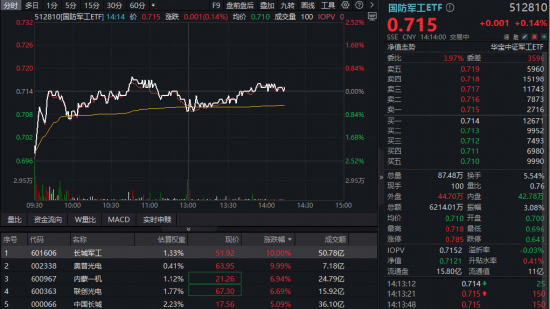
Group 1 - The defense and military industry showed resilience in the market, with the popular defense ETF (512810) experiencing significant trading volume of over 62 million yuan and multiple instances of premium pricing [1] - Key stocks such as Changcheng Military Industry and Aopu Optoelectronics reached their daily limit up, while Inner Mongolia First Machinery Group saw a rise of 6.94% [1] - The AG600 amphibious aircraft entered mass production, marking a breakthrough in domestic large civil aircraft self-supply, with the successful test flight of the second aircraft and the delivery of the third [3] Group 2 - The unveiling of the J-6 drone at the Changchun Airshow highlights the trend towards unmanned and intelligent equipment, which is expected to boost orders in upstream materials and electronics within the defense sector [3] - The defense industry is closely tied to national five-year plans, with upcoming significant meetings likely to clarify the focus areas for the 15th five-year plan, emphasizing the development of unmanned and intelligent equipment [3] - The defense and military sector is benefiting from industrial upgrades and the trend towards self-sufficiency, with sustained high demand for core equipment and an overall high industry prosperity [3] Group 3 - The defense ETF (512810) passively tracks the CSI Military Index, with its top ten weighted stocks including China Shipbuilding, AVIC Shenyang Aircraft, and Guoke Technology [3]


化工行业周报20251012:国际油价、维生素、乙烯价格下跌-20251013
Bank of China Securities· 2025-10-13 06:48
Investment Rating - The report rates the chemical industry as "Outperform" [2] Core Views - The report highlights the decline in international oil prices, vitamin prices, and ethylene prices, suggesting a focus on the third-quarter report trends, undervalued industry leaders, and the impact of "anti-involution" on supply in related sub-industries [2][12] - It emphasizes the increasing importance of self-sufficiency in electronic materials companies under the current geopolitical context [2] Industry Dynamics - During the week of October 6-12, 2025, among 100 tracked chemical products, 20 saw price increases, 32 experienced declines, and 48 remained stable. Month-over-month, 34% of products increased in average price, while 49% decreased [9][31] - The average price of ethylene decreased to 6,530 CNY/ton, down 3.26% from the previous week and down 16.22% year-to-date [12][33] - The report notes a significant drop in vitamin prices, with vitamin A averaging 59 CNY/kg (down 1.67% week-over-week) and vitamin E at 41.5 CNY/kg (down 5.68% week-over-week) [33] Investment Recommendations - The report suggests focusing on the third-quarter earnings season, undervalued industry leaders, and the effects of "anti-involution" on supply in related sub-industries [12] - It recommends a long-term investment strategy centered on the oil price remaining at mid-high levels, the recovery of the oil service industry, and the rapid development of downstream industries, particularly in new materials [12][19] - Specific companies recommended for investment include China Petroleum, China Oilfield Services, and several technology firms in the electronic materials sector [12][19]


外部扰动不改长期向好趋势,稀土永磁、国产软件概念股逆市走强,A500ETF龙头(563800)均衡布局各行业优质龙头
Xin Lang Cai Jing· 2025-10-13 06:39
Group 1 - The A-share market experienced a rebound after a low opening due to tariff disturbance news, with the three major indices narrowing their declines. The rare earth permanent magnet sector saw significant gains, with stocks like Galaxy Magnet and Baogang Co. hitting the daily limit [1] - On October 9, the Ministry of Commerce and the General Administration of Customs announced multiple regulations imposing export controls on rare earth-related items, technologies, and equipment, expanding the scope from domestic to overseas, which now includes technologies related to the recycling of rare earth secondary resources [1] - CITIC Construction Investment Securities noted that the recent export controls on certain medium and heavy rare earths and related production equipment will exacerbate the domestic and international supply-demand imbalance in the short term, leading to price increases domestically. In the long term, this will help curb overseas rare earth production expansion and support a price surge [1] Group 2 - The recent announcement from the Ministry of Commerce regarding export controls on certain overseas rare earth-related items has gained attention, particularly due to the change in the format of the announcement attachment to WPS, which sparked discussions on social media [2] - The Ministry of Industry and Information Technology, along with six other departments, issued a plan for promoting service-oriented manufacturing innovation from 2025 to 2028, focusing on key productive service industries such as technology services, industrial design, and software services [2] - Guotai Junan Securities emphasized that external shocks leading to asset declines present a good opportunity to increase holdings in the Chinese market, highlighting the internal certainty of China's transformation and the ongoing demand for quality assets [3]


自主可控提速再上日程,关注科创半导体设备ETF(588710)布局窗口!
Xin Lang Ji Jin· 2025-10-13 06:21
Core Viewpoint - The semiconductor sector is experiencing significant downward pressure due to intensified international competition, particularly following the U.S. House of Representatives' report on semiconductor export controls related to China, which emphasizes the urgency for domestic semiconductor industry self-sufficiency [1] Group 1: Semiconductor Industry Dynamics - The urgency for domestic semiconductor industry self-sufficiency is reinforced by the recent U.S. report, highlighting the need to accelerate the development of a controllable local chip supply chain [1] - The equipment and materials segments of the semiconductor industry are positioned upstream and are crucial for overall industry development, possessing strong bargaining power and likely to expand first amid the domestic substitution wave [1] Group 2: ETF Performance and Market Trends - The Sci-Tech Semiconductor Equipment ETF (588710) has seen a trading volume of 331 million yuan as of 14:12, indicating strong market interest [1] - The ETF closely tracks the Shanghai Stock Exchange Sci-Tech Board Semiconductor Materials and Equipment Index, with a significant focus on semiconductor equipment and materials, which together account for 84.45% of the index [2] - Since September, the Sci-Tech Semiconductor Equipment ETF has attracted 799 million yuan in new investments, increasing its total size to 1.048 billion yuan, a 516% increase compared to the end of August [2] Group 3: Fund Management and Strategy - The fund manager, Huatai-PB Fund, is one of the first ETF managers in China with over 18 years of experience, managing the largest ETF in the A-share market, the CSI 300 ETF [2] - Huatai-PB Fund has developed a comprehensive suite of ETFs focused on the Sci-Tech sector, including the Sci-Tech Board ETF and others, aiming to help investors benefit from technological advancements [2]
什么是关键软件?美国为何对此出口管制?科技当自立!信创ETF基金一度涨超3%,大数据产业ETF逆市活跃
Xin Lang Ji Jin· 2025-10-13 06:07
Group 1 - The U.S. President announced an additional 100% tariff on Chinese imports starting November 1, along with export controls on "critical software" [1] - Critical software includes operating systems, databases, and various industrial software, highlighting its strategic importance in national security and economic stability [1] - The move is expected to accelerate the domestic production of industrial and foundational software in China, as the country seeks to enhance its self-sufficiency in technology [1][2] Group 2 - The "信创" (Xinchuang) industry is transitioning from policy-driven to a dual-driven approach of policy and market, with significant growth expected in the coming years [2] - By 2026, the market size of the 信创 industry is projected to exceed 2.6 trillion yuan, with growth rates of 17.84% and 26.82% anticipated for 2025 and 2026, respectively [2] - Government procurement standards are being refined to support the replacement of foreign technology with domestic alternatives [2] Group 3 - The domestic software sector is experiencing active trading, with the 信创 ETF fund showing a price increase of over 3.1% at one point, indicating strong buying interest [4] - Key stocks in the sector, such as 华大九天 and 麒麟信安, have seen significant price increases, reflecting investor confidence in the domestic software market [4] - The 大数据产业 ETF is also showing positive performance, with stocks like 中国软件 and 中国长城 experiencing notable gains [6] Group 4 - The 信创 ETF fund tracks the core segments of the 信创 industry, which includes foundational hardware, software, and information security, and is characterized by high growth potential [8] - The current geopolitical climate and the push for self-sufficiency in technology are driving the demand for domestic solutions in the 信创 sector [8] - The 大数据产业 ETF focuses on data centers and cloud computing, with a strong emphasis on companies that are leading in the technology self-reliance movement [9]
转债市场周报:关注关税及三季报扰动-20251013
Guoxin Securities· 2025-10-13 05:42
Report Industry Investment Rating No information provided in the content. Core Viewpoints - The convertible bond market followed the equity market, rising first and then falling in the 4 trading days before and after the holiday. As of October 10, the valuation of convertible bonds in each parity range remained at an absolute high above the 85th percentile since 2023, with poor overall odds for convertible bond assets. The inflow of incremental funds in the convertible bond market slowed down, and the subsequent parity and valuation of convertible bonds depend on the direction of the equity market [3][16]. - The escalation of Sino-US trade frictions due to new US tariff measures may cause short - term disturbances to market sentiment. With the intensive disclosure of the third - quarter reports of listed companies in mid - to late October, market volatility may increase. In terms of allocation, it is not advisable to be overly aggressive [3][16]. Summary by Related Catalogs Market Trends Stock Market - In the 4 trading days from September 29 to October 10, after the holiday, the A - share market continued to rise on the first trading day and then declined. Gold stocks led the rise in the non - ferrous metals sector, and sectors such as steel and building decoration also performed well. The media sector underperformed due to weak box - office data during the National Day holiday [1][8]. - On September 29, the three major A - share indexes rose collectively, with the Shanghai Composite Index up 0.9%, the Shenzhen Component Index up 2.05%, and the ChiNext Index up 2.74%. On September 30, the A - share market continued to rise, with the Shanghai Composite Index up 0.52%, the Shenzhen Component Index up 0.35%, and the ChiNext Index flat. On October 9, the A - share market rose significantly, with the Shanghai Composite Index up 1.32%, the Shenzhen Component Index up 1.47%, and the ChiNext Index up 0.73%. On October 10, the A - share market fell, with the Shanghai Composite Index down 0.94%, the Shenzhen Component Index down 2.7%, and the ChiNext Index down 4.55% [8]. - In the 4 trading days before and after the holiday, most Shenwan first - level industries closed higher, with non - ferrous metals (11.89%), steel (7.89%), basic chemicals (4.62%), building decoration (4.30%), and building materials (4.10%) leading the gains; media (-3.70%), communication (-2.21%), social services (-1.19%), and banks (-0.92%) lagging behind [9]. Bond Market - The funds were relatively stable near the end of the quarter. With the September PMI data still in the contraction range, the bond market strengthened before the holiday. During the National Day holiday, data such as box - office and real - estate transactions were weak, global risk - aversion sentiment increased, and the capital market was generally loose after the quarter, leading to a further decline in bond yields. The 10 - year treasury bond yield closed at 1.85% on Friday, down 3.21bp from September 28 [1][9]. Convertible Bond Market - In the 4 trading days before and after the holiday, most convertible bond issues closed higher. The CSI Convertible Bond Index rose 1.58% for the week, the median price rose 1.39%, the calculated arithmetic average parity fell 0.04% for the week, and the overall market conversion premium rate increased by 0.85% compared with the previous week [2][9]. - In terms of industries, most convertible bond industries closed higher, with beauty care (+4.81%), non - ferrous metals (+4.53%), non - bank finance (+3.84%), and steel (+3.74%) leading the gains; communication (-1.35%), household appliances (-0.24%), textile and apparel (+0.03%), and media (+0.39%) lagging behind [11]. - At the individual bond level, Zhonghuan Zhuan 2 (innovative drugs & change of actual controller), Jingda (controllable nuclear fusion concept), Lingyi (AI terminal hardware), Jingxing (Yushu robot concept), and Shuiyang (skincare products) convertible bonds led the gains; Huicheng (waste catalyst treatment), Tongguang (optical fiber cable), Sheng 24 (robot concept), Yitian (computing power concept), and Mengtai (polypropylene fiber & announced forced redemption) convertible bonds led the losses [2][12]. - The total trading volume of the convertible bond market in the 4 trading days before and after the holiday was 288.445 billion yuan, with an average daily trading volume of 72.111 billion yuan, a decrease compared with the previous week [13]. Valuation Overview - As of October 10, 2025, for equity - biased convertible bonds, the average conversion premium rates for parities in the ranges of 80 - 90 yuan, 90 - 100 yuan, 100 - 110 yuan, 110 - 120 yuan, 120 - 130 yuan, and above 130 yuan were 47.91%, 32.17%, 28.71%, 18.69%, 15.24%, and 9.88% respectively, at the 98%/99%, 88%/82%, 95%/98%, 87%/84%, 91%/91%, and 87%/75% percentiles since 2010/2021 [17]. - For bond - biased convertible bonds, the average YTM for parities below 70 yuan was - 4.86%, at the 0%/1% percentile since 2010/2021. The average implied volatility of all convertible bonds was 40.58%, at the 78%/67% percentile since 2010/2021. The difference between the implied volatility of convertible bonds and the long - term actual volatility of the underlying stocks was - 2.32%, at the 69%/70% percentile since 2010/2021 [17]. Primary Market Tracking - From September 29 to October 10, 2025, Funeng Convertible Bond announced its issuance, and no convertible bonds were listed. The underlying stock is Funeng Co., Ltd., with a market value of 28.302 billion yuan as of October 10. The company focuses on renewable and clean energy and large - scale energy storage projects. The scale of the issued convertible bonds is 3.802 billion yuan, with a credit rating of AA+. After deducting issuance fees, the funds will be invested in the 2×660MW ultra - supercritical cogeneration project in Quanhuixin Petrochemical Industrial Park and the Mulan Pumped - Storage Power Station Project in Xianyou, Fujian [24]. - As of the announcements on October 10, there were no convertible bonds announced for issuance or listing in the coming week (October 13 - 17, 2025). During September 29 - October 10, the exchange accepted the application of one company (Aoshikang), seven companies' plans passed the shareholders' meeting, and one company (Haitian Co., Ltd.) had a board of directors' plan. There were no new companies approved for registration or passed by the listing committee. As of now, there are 90 convertible bonds to be issued, with a total scale of 137.34 billion yuan, including 2 approved for registration with a total scale of 2.68 billion yuan and 8 passed by the listing committee with a total scale of 5.31 billion yuan [25].

港股AI重挫4%,资金逢低抢筹513770,自主可控逻辑强化,金山软件大涨18%
Xin Lang Ji Jin· 2025-10-13 05:28
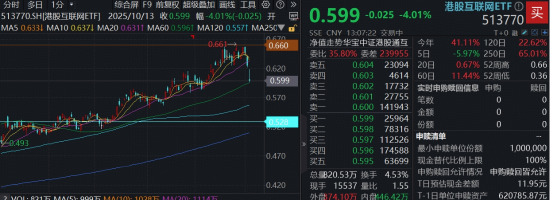
Core Viewpoint - The Hong Kong stock market experienced a collective decline, with the Hang Seng Technology Index dropping by 4.54%, and major tech stocks like Alibaba and Tencent facing significant pullbacks. The Hong Kong Internet ETF (513770) also saw a decrease of 4.17%, indicating a bearish trend in the market [1]. Group 1: Market Performance - The Hong Kong Internet ETF (513770) recorded a trading volume of nearly 500 million yuan, reflecting a significant market activity despite the downturn [1]. - The ETF has seen a net inflow of over 1.1 billion yuan in the past 20 days, indicating a strong interest from investors despite recent volatility [3]. - The ETF's latest scale has surpassed 11 billion yuan, marking a historical high, with an average daily trading volume exceeding 600 million yuan this year [9]. Group 2: Key Holdings - The top three holdings in the Hong Kong Internet ETF are Alibaba-W (18.92%), Tencent Holdings (15.60%), and Xiaomi Group-W (11.54%), collectively accounting for over 73% of the ETF's total weight [5][6]. - The ETF tracks the CSI Hong Kong Internet Index, which has shown significant resilience and outperformance compared to the Hang Seng Technology Index this year [7]. Group 3: Industry Insights - The recent announcement by the Ministry of Commerce regarding the use of WPS format for official documents is seen as a move towards promoting key technology independence and ensuring information security [3]. - The AI industry is expected to see accelerated domestic production processes, with significant capital expenditures anticipated from major tech players, indicating a broad growth potential in the sector [3]. - The valuation of the CSI Hong Kong Internet Index is currently at a PE ratio of 26.69, which is lower than both the US and A-share tech sectors, suggesting a potentially attractive investment opportunity [7].

自主可控逆势走强,新主线涌现?
Sou Hu Cai Jing· 2025-10-13 04:50
Core Viewpoint - The A-share market shows resilience with a rebound after a low opening, while the Hong Kong stock market, particularly the technology sector, faces significant declines, indicating a structural divergence in market performance [1] Market Performance - A-share market exhibits a "strong Shanghai, weak Shenzhen" pattern, with the Shanghai Composite Index closing down 1.3% at 3846.25 points, while the Shenzhen Component Index fell 2.56% and the ChiNext Index dropped 3% below 3020 points [2] - The Hong Kong market experiences a more pronounced decline, with the Hang Seng Index down 3.49% at 25373.43 points, and the Hang Seng Tech Index plunging 4.54% to 5975.52 points, reflecting increased concerns from international investors regarding tech assets [2] Industry Highlights and Driving Logic - The self-sufficient industrial chain emerges as the strongest theme in the A-share market, with the rare earth permanent magnet sector seeing a surge, driven by a 37% price increase for rare earth ore by Northern Rare Earth [3] - The semiconductor and information technology innovation sectors remain active, supported by government policies favoring high-end manufacturing and the acceleration of domestic substitution due to U.S. software export restrictions [3] Underperforming Sectors and Driving Logic - The consumer electronics sector faces severe declines, primarily due to the U.S. imposing a 100% tariff on Chinese goods starting in November, alongside a 2% year-on-year drop in smartphone sales in Q3 [4] - The biopharmaceutical sector experiences widespread declines, with concerns over tariff policies potentially impacting overseas business, despite some analysts noting the industry's ability to pass on costs [4] - The automotive sector shows weakness, particularly in new energy vehicles, with many stocks declining despite expectations of a market rebound due to tax policy adjustments [4] Investment Strategy Recommendations - The current market is characterized by a "external shock + internal policy" dynamic, suggesting that investment strategies should focus on industry trends and policy benefits [5] - In the technology growth sector, opportunities should be sought in self-sufficient logic, particularly in AI infrastructure and innovative pharmaceuticals, while monitoring military industry orders and solid-state battery technology [5] - The rare earth permanent magnet sector is expected to maintain strong performance due to export controls and price increases, while opportunities in non-ferrous metals and chemicals should be considered based on supply-demand dynamics [6]
自主可控产业链逆势爆发,稀土概念狂飙,华虹公司涨近14%
2 1 Shi Ji Jing Ji Bao Dao· 2025-10-13 04:12
Group 1 - The market showed signs of recovery on October 13, with the three major indices narrowing their declines. The Shanghai Composite Index fell by 1.30%, the Shenzhen Component Index by 2.56%, and the ChiNext Index by 3%. The total market turnover reached 1.59 trillion yuan [1] - The self-controlled industrial chain strengthened, with significant gains in rare earth, photolithography machines, EDA, and operating systems. The Wind Rare Earth Index rose by 7.77%, with stocks like Huahong Technology and Baogang Co. hitting the daily limit [2] - The Ministry of Commerce announced export controls on rare earth-related items, expanding the scope to include technologies and equipment, which is expected to enhance the supply-demand dynamics in the rare earth sector [2][3] Group 2 - The domestic software sector saw strong performance, with stocks like China Software hitting the daily limit and Kingsoft Office rising over 18%. This surge is attributed to the increasing demand for self-sufficiency and industrial software [2][3] - The semiconductor industry continued to strengthen, with companies like Huahong and others experiencing significant gains. A report predicts that the global wafer foundry market will reach $270 billion by 2029, with a compound annual growth rate of 8.7% from 2025 to 2029 [3]

港股午评|恒生指数早盘跌3.49% 金力永磁逆市大涨超12%
智通财经网· 2025-10-13 04:08
Group 1 - Hong Kong's Hang Seng Index fell by 3.49%, down 916 points, closing at 25,373 points, while the Hang Seng Tech Index dropped by 4.54%. The morning trading volume reached HKD 281.8 billion [1] - Jinli Permanent Magnet (06680) surged over 12% as a rare earth giant announced price increases, with institutions optimistic about the strengthening strategic position of rare earths [1] - Semiconductor stocks rose against the trend, with Huahong Semiconductor (01347) increasing by 3.6%, driven by escalating competition in the technology sector and multiple catalysts for the semiconductor industry [1] - Kingsoft (03888) saw a rise of over 18% at one point, closing up over 9%, as external frictions escalate, highlighting the trend towards self-controlled industries and investment opportunities in the Xinchuang sector [1] - Gold stocks mostly rose due to risk aversion, with spot gold breaking through USD 4,060. Zijin Mining International (02259) increased by 4.6%, and Chifeng Jilong Gold Mining (06693) rose by 2.5% [1] Group 2 - MicroPort Scientific-B (02252) rose over 2% as its commercialization process accelerated, with overseas orders exceeding 60 units [2] Group 3 - Liqin Resources (02245) increased by over 5% following the implementation of cobalt export quotas in the Democratic Republic of Congo [3] - China Merchants Energy (01138) rose over 4% due to seasonal demand and event disturbances, with institutions expecting stronger freight rates [3] - Domestic insurance stocks fell across the board, with Tianan Insurance announcing a debt default of CNY 5.3 billion, which institutions suggest may mark the beginning of market-driven risk pricing. New China Life Insurance (01336) fell by 5%, China Pacific Insurance (02328) by 3.9%, and China Taiping Insurance (02601) by 3.6% [3] Group 4 - Pharmaceutical stocks continued their recent downward trend, with Junshi Biosciences (01877) dropping nearly 10.6% and Kanglong Chemical (03759) falling over 9% [4] Group 5 - Apple-related stocks experienced significant declines, with Hongteng Precision (06088) dropping over 10%, as institutions stated that the impact of tariffs on the supply chain should not be overestimated [5]