抗通胀

Search documents
全球银行还在狂买黄金,俄罗斯却突然抛售!这轮牛市要结束了吗?
Sou Hu Cai Jing· 2025-11-25 02:56
Core Viewpoint - The Russian Central Bank has begun selling physical gold reserves to address budget deficits, raising concerns about the potential end of the current gold bull market as global central banks continue to purchase gold aggressively [1][3][5]. Group 1: Russian Central Bank Actions - The Russian Central Bank started selling gold reserves in late November 2025 to cover a budget deficit exacerbated by frozen foreign exchange reserves due to sanctions [1][3]. - Russia's oil and gas revenues have decreased by 16.9% year-on-year in the first half of the year, leading to a fiscal deficit of 3.69 trillion rubles, nearing the annual limit [3]. - The sale of gold is a response to the inability to access approximately 300 billion euros of foreign reserves, with about 200 billion euros held in European clearing banks [1][3]. Group 2: Global Gold Market Dynamics - Despite Russia's gold sales, global central banks are expected to increase gold purchases, with Goldman Sachs predicting an average monthly purchase of 80 tons from Q4 2025 to 2026 [5]. - In the first half of 2025, global central banks net purchased 415 tons of gold, with 95% of surveyed central banks planning to increase their gold reserves in the next 12 months [5][7]. - The current gold price has risen over 50% since 2025, influenced by both central bank buying and the recent news of Russia's gold sales, which may prompt some investors to take profits [5][21]. Group 3: Domestic Gold Demand in Russia - Domestic gold demand in Russia is increasing, with citizens purchasing approximately 282 tons of gold over the past four years, and an expected increase of 62.2 tons in 2025 [3][8]. - The Russian government has eliminated VAT on retail gold purchases to stimulate domestic demand, helping sanctioned mining companies find new sales channels [3][8]. - The stability of the ruble has not been significantly affected by the Central Bank's gold sales, indicating a resilient domestic market [8]. Group 4: Broader Implications for Gold as an Asset - Geopolitical tensions and high global debt levels continue to enhance gold's appeal as a safe-haven asset and hedge against inflation [7][12]. - The liquidity and acceptance of gold as an international reserve asset remain unchanged, making it a crucial component of central bank reserves [21][30]. - Historical trends suggest that short-term market reactions to news may be smoothed by long-term trends, with central banks transitioning from net sellers to net buyers of gold post-2008 financial crisis [17][25].


金价“过山车”背后:就业数据暗藏玄机,黄金成生活“救命稻草”?
Sou Hu Cai Jing· 2025-11-20 10:54
Group 1 - The recent U.S. employment data indicates a significant decline in private sector jobs, averaging a decrease of 2,500 jobs per week in the first four weeks of November, compared to an increase of 14,000 jobs in the first half of October, signaling a shift from growth to contraction in the job market [2] - Weak employment data suggests a decrease in economic vitality, leading to increased market expectations for the Federal Reserve to lower interest rates, which typically supports gold prices as a hedge against inflation and a safe-haven asset [2] - Following the employment report, gold prices rebounded, reflecting the market's direct response to the anticipated policy shift [2] Group 2 - Gold's significance extends beyond investment; it serves as a "safety net" for individuals facing financial difficulties, as illustrated by a couple who turned to their gold jewelry for emergency cash to manage their living expenses and debts [3] - The value of gold is highlighted as not just a symbol of wealth but also as a crucial asset that can be liquidated in times of need, providing financial security during market volatility [3][4] - The narrative emphasizes that while gold prices may fluctuate, its intrinsic value remains constant, serving as a reliable resource in challenging times [3][4] Group 3 - Recommendations suggest that individuals should consider allocating a portion of their investments to gold (such as gold bars or ETFs) to combat inflation and diversify risk [5] - In urgent situations, converting idle gold jewelry into cash can help avoid falling into debt traps, showcasing gold's role as a last line of defense against financial uncertainty [5] - The enduring nature of gold as a hard currency reinforces its position as a critical asset for individuals to mitigate risks in an unpredictable market [5]

博时市场点评11月20日:两市继续调整,成交仍趋谨慎
Xin Lang Ji Jin· 2025-11-20 08:35
Market Overview - The three major indices in the A-share market experienced fluctuations and consolidation, with total trading volume decreasing to 1.72 trillion yuan, indicating a growing wait-and-see sentiment among investors [1] - On November 20, the Loan Prime Rate (LPR) remained unchanged at 3.0% for the one-year term and 3.5% for the five-year term, aligning with market expectations [2] - The People's Bank of China is expected to continue implementing moderately accommodative monetary policies to promote economic recovery, with potential for further LPR adjustments [2] Economic Indicators - The U.S. Federal Reserve's October FOMC meeting minutes revealed a significant division among officials regarding future interest rate cuts, with a cautious approach to balancing anti-inflation and recession prevention [1][3] - The market's expectation for a rate cut in December has significantly decreased to about 30% probability, influenced by the Fed's data-dependent stance [1] - The U.S. Bureau of Labor Statistics announced that the October employment report will not be released, delaying key employment data to December 16, which adds uncertainty to the Fed's future decisions [3] Market Performance - On November 20, the A-share market saw declines across major indices: the Shanghai Composite Index fell by 0.40% to 3931.05 points, the Shenzhen Component dropped by 0.76% to 12980.82 points, and the ChiNext Index decreased by 1.12% to 3042.34 points [4] - In terms of sector performance, construction materials, comprehensive services, and banking sectors showed gains, while beauty care, coal, and electrical equipment sectors faced notable declines [4] Fund Flow - The market's trading volume was reported at 17,227.98 billion yuan, reflecting a decrease from the previous trading day [5] - The margin financing balance was recorded at 24,979.40 billion yuan, also showing a decline compared to the prior day [5]

港股异动 | 黄金股延续跌势 美联储12月降息概率走低 机构料贵金属降波调整持续
Xin Lang Cai Jing· 2025-11-18 02:30
Group 1 - Gold stocks continue to decline, with Lingbao Gold down 5.66% at HKD 15.83, Tongguan Gold down 4.3% at HKD 2.67, China Silver Group down 4.55% at HKD 0.63, Zijin Mining International down 4.16% at HKD 133.7, and China Gold International down 3.73% at HKD 131.7 [1] - On Tuesday, gold prices extended their decline for the third consecutive day [1] - The market's expectation for a 25 basis point rate cut by the Federal Reserve in December dropped from 70% to 40% [1] Group 2 - Federal Reserve Vice Chairman Philip Jefferson emphasized the need for caution in further rate cuts to avoid undermining anti-inflation efforts [1] - The labor market risks are skewed to the downside, but the need for a cautious approach remains as interest rates approach neutral levels [1] - CITIC Futures noted that as the Fed's stance turns more hawkish, the probability of a December rate cut decreases, leading to a continued adjustment phase for precious metals [1]
美股全线下跌,谷歌大涨
Zhong Guo Zheng Quan Bao· 2025-11-17 23:58
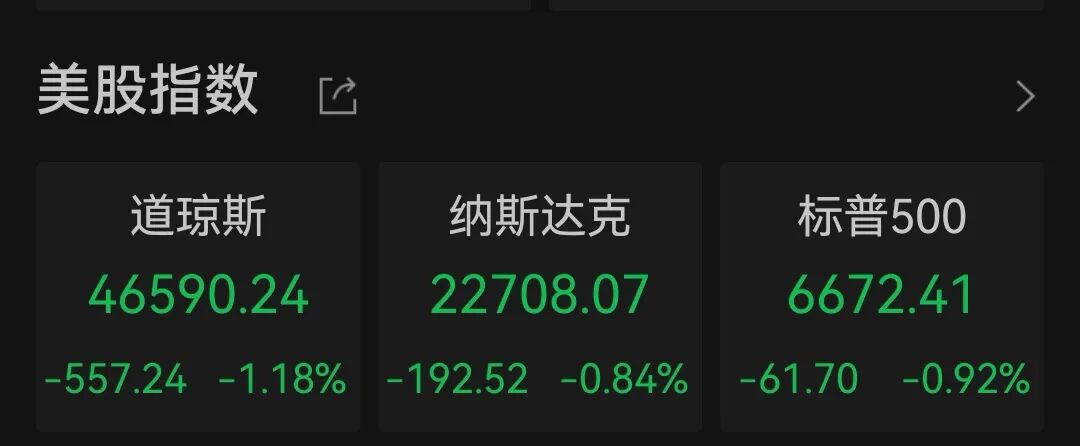
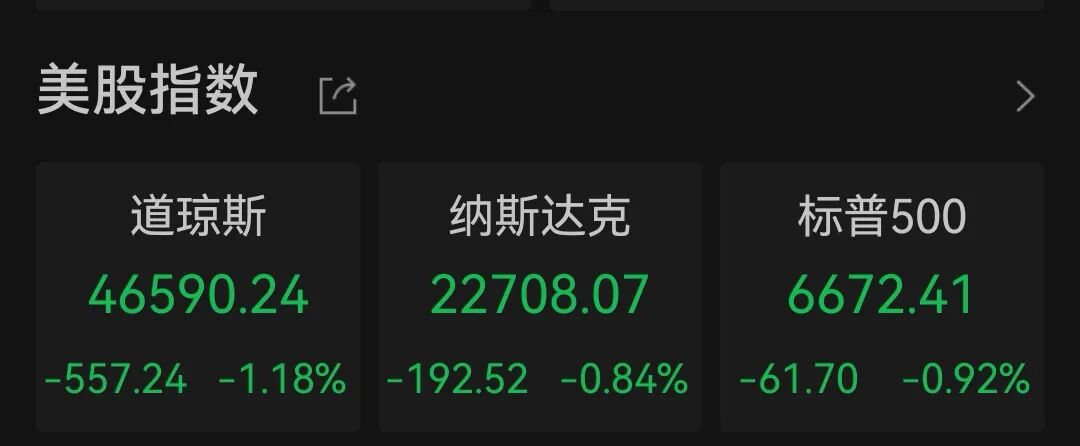
数据显示,当地时间11月17日,美股三大股指全线收跌,道指跌1.18%,标普500指数跌0.92%,纳指跌0.84%。美国科技七巨头指数跌0.47%,英伟达、苹 果跌近2%,谷歌涨超3%。中概股多数下跌。 美股三大股指全线收跌 当地时间11月17日,美股三大股指全线收跌。数据显示,截至收盘,道指跌1.18%报46590.24点,标普500指数跌0.92%报6672.41点,纳指跌0.84%报 22708.07点。 美股大型科技股多数下跌,美国科技七巨头指数下跌0.47%。个股方面,谷歌涨超3%,特斯拉涨逾1%,苹果、英伟达跌近2%,亚马逊、微软小幅下跌。 消息层面,此前巴菲特旗下伯克希尔·哈撒韦公司披露2025年第三季度持股报告(13F)显示,伯克希尔三季度新建仓1784万股谷歌母公司Alphabet的股 票,使之一跃成为其第十大持仓股票。 中概股多数下跌,纳斯达克中国金龙指数跌1.21%。个股方面,阿特斯太阳能跌超15%,小鹏汽车跌超10%,禾赛科技跌逾6%,晶科能源涨超13%,金山 云涨近9%,大全新能源涨超3%,阿里巴巴、华住集团涨超2%。 | S | 纳斯达克中国金龙指数(HXC) 11-17 16: ...
美股全线下跌 谷歌大涨
Zhong Guo Zheng Quan Bao· 2025-11-17 23:24
Market Performance - On November 17, US stock indices closed lower, with the Dow Jones down 1.18% at 46,590.24 points, the S&P 500 down 0.92% at 6,672.41 points, and the Nasdaq down 0.84% at 22,708.07 points [2][10] - The Wind US Technology Seven Giants Index fell by 0.47%, with major tech stocks like Nvidia and Apple dropping nearly 2%, while Google rose over 3% [4][10] Chinese Stocks - The Nasdaq Golden Dragon China Index declined by 1.21%, with notable declines in Chinese stocks such as Arctech Solar down over 15% and XPeng Motors down over 10%. However, JinkoSolar rose over 13% and Kingsoft Cloud increased nearly 9% [7][8] Federal Reserve Commentary - Federal Reserve Vice Chairman Jefferson emphasized the need for caution in further interest rate cuts to avoid undermining anti-inflation efforts, indicating a downward risk in the labor market [11] - Another Fed official, Waller, suggested that a rate cut in December could be warranted due to a weak labor market and its impact on low-income consumers [11] Commodity Market - International precious metal futures generally fell, with COMEX gold futures down 1.2% at $4,045.1 per ounce and silver futures down 1.25% at $50.05 per ounce. Crude oil prices also declined, with US oil down 0.62% at $59.72 per barrel [12]





25万美元换30吨硬币抗通胀,真能“躺赢”吗?
2 1 Shi Ji Jing Ji Bao Dao· 2025-11-11 04:18
Core Insights - A financial professional in the U.S. has spent over four months accumulating nearly 30 tons of 5-cent coins, raising questions about the rationale behind this decision and potential arbitrage opportunities [2] Group 1 - The individual chose to accumulate 30 tons of 5-cent coins instead of opting for $250,000 in cash, indicating a strategic decision based on perceived value [2] - The process involved exchanging coins in batches through the banking system, highlighting the logistical challenges and time investment required for such an endeavor [2] - The situation presents an intriguing case for exploring arbitrage opportunities within the coinage system, suggesting potential financial benefits that may not be immediately apparent [2]
美联储穆萨勒姆:美国经济将在明年初强劲反弹 进一步降息空间有限
智通财经网· 2025-11-11 00:07
Group 1 - The core viewpoint is that the Federal Reserve officials should exercise caution regarding further interest rate cuts, as a strong economic rebound is expected in early next year, driven by factors such as the end of government shutdowns and fiscal support [1][2] - The current Federal Reserve policy rate is nearing a level that will not exert downward pressure on inflation, indicating limited room for further rate cuts without risking overly accommodative monetary policy [1] - There is a growing economic pressure on low- and middle-income households, as many are increasingly seeking assistance from food banks and utility payment aid, highlighting the erosion of consumer purchasing power due to inflation [1][2] Group 2 - Approximately 40% of the inflation above the 2% target is attributed to tariff factors, and decision-makers need to address other price-increasing elements, including persistent service sector inflation [2] - Despite a softening labor market and potential increases in unemployment due to government shutdowns, employment is expected to stabilize near full employment levels [2] - Concerns about asset valuations have been raised, with indications that housing prices appear high relative to historical standards and stock prices are also elevated, reflecting the effects of a loose financial environment [2]
金价暴跌后能抄底吗?普通人别瞎折腾,避免“理财”陷阱!
Sou Hu Cai Jing· 2025-11-01 08:59
Core Viewpoint - The recent fluctuations in gold prices are influenced by various factors, including monetary policy, geopolitical tensions, and central bank activities, indicating both short-term volatility and long-term stability in gold as an investment asset [1][3][9]. Group 1: Monetary Policy Impact - Gold prices are highly sensitive to U.S. Federal Reserve's interest rate decisions, with expectations of rate hikes leading to price declines and anticipated rate cuts causing price increases [4][9]. - The market is currently speculating on potential rate cuts in 2025, which adds to the volatility of gold prices as expectations shift [4]. Group 2: Geopolitical and Economic Factors - Ongoing geopolitical conflicts, such as the Israel-Palestine and Russia-Ukraine situations, drive investors towards gold as a safe haven asset during times of uncertainty [7]. - Persistent inflation concerns further enhance gold's appeal, as it is viewed as a hedge against currency devaluation [7]. Group 3: Central Bank Activities - In the first three quarters of 2024, global central banks purchased over 800 tons of gold, with countries like China and India significantly increasing their reserves [9]. - This strategic accumulation by central banks is aimed at securing assets rather than seeking short-term profits, providing a strong support for gold prices [9]. Group 4: Investment Strategies - Investors are advised against speculative strategies such as waiting for gold prices to drop to unrealistic levels, as historical trends show that significant declines are unlikely [11]. - A recommended approach is to adopt a dollar-cost averaging strategy, investing in gold gradually rather than attempting to time the market [11][13]. - Gold should be viewed as a stabilizing asset in an investment portfolio, with a suggested allocation not exceeding 10% of total assets [13].
金价再现关键信号!当前走势与2011年惊人相似,历史能否重现?
Sou Hu Cai Jing· 2025-10-31 04:59
Current Market Overview - Gold prices have surged significantly, with Shanghai Gold Exchange reporting a price of 901.00 CNY per gram, up nearly 33% from 677.5 CNY at the beginning of the year [3] - Internationally, gold reached 4274.6 USD per ounce, marking a 1.74% increase in one day and a rise from 3000 USD to over 4000 USD in just five months, setting 45 historical highs [3][4] - Global gold demand in Q3 reached 1313 tons, totaling 146 billion USD, the highest quarterly record, with central banks net purchasing 220 tons, a 28% increase from the previous quarter [3][5] Historical Context - In 2011, gold prices opened at 1420.80 USD per ounce and peaked at 1920.30 USD, with a yearly increase of 10.08%. Domestic prices also rose, with Shanghai Gold Exchange reaching a high of 395.3 CNY per gram, an 8.19% increase [4] - The 2011 surge was driven by three main factors: the second round of quantitative easing (QE2) by the US, the escalating European debt crisis, and the first downgrade of the US credit rating, leading to increased demand for gold as a safe haven [4] Key Similarities with 2011 - Current monetary policy is characterized by easing, similar to the QE2 in 2011, with the Federal Reserve recently lowering interest rates by 25 basis points to 4.00%-4.25%, reducing the holding cost of gold [5] - Central bank gold purchases are significant, with China’s gold reserves reaching 2303.5 tons and continuous increases over the past 11 months, mirroring the trend seen in 2011 [5] Differences from 2011 - The current support for gold prices is more stable, with central bank purchases being a regular operation rather than a temporary measure as seen in 2011 [6] - The driving factors for gold demand are more robust now, influenced by multiple factors including weakening dollar credit, geopolitical risks, and inflation hedging, compared to the single crisis-driven demand in 2011 [6] - The current market is characterized by a more solid foundation, suggesting a lower risk of a sharp decline compared to the volatility experienced in 2011 [6]