
期限溢价

Search documents
美元基差溢价近乎归零! “大而美法案”与关税重压之下 “抛美债”叙事不断强化
Zhi Tong Cai Jing· 2025-08-25 12:00
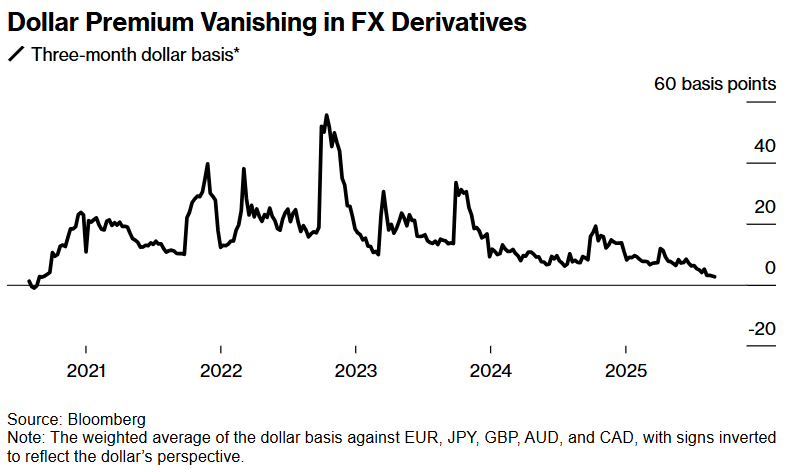
Core Viewpoint - The premium of the US dollar in the currency derivatives market is nearly disappearing, indicating a weakening demand for US Treasury bonds among foreign investors, driven by concerns over fiscal policies and tariffs under Trump's administration [1][2][5]. Group 1: Currency Derivatives Market - Recent statistics show that the weighted average basis of the US dollar against five major global currencies has significantly dropped to just below 3 basis points, moving towards a negative value for the first time since August 2020 [2]. - The decline in the dollar premium reflects a shift in investor sentiment, as foreign investors are increasingly seeking higher yields on US long-term Treasury bonds [1][8]. Group 2: Foreign Investment in US Treasuries - The proportion of US Treasuries held by foreign investors has decreased from a peak of 52% in 2012 to 33% currently, indicating a significant reduction in demand [5]. - Concerns over the US government's expanding fiscal policies and Trump's tariff strategies have led to narratives of "selling US assets" and the collapse of the "American exceptionalism" [5][9]. Group 3: Market Reactions and Future Trends - Analysts suggest that the ongoing high "term premium" and the decline of "American exceptionalism" are prompting foreign investors to seek opportunities in emerging markets, particularly in China [9][12]. - The anticipated increase in budget deficits due to Trump's policies may lead to soaring yields on US Treasuries, especially for longer maturities, potentially breaking historical highs [9][10]. - Major investment firms, including Morgan Stanley and JPMorgan, are increasingly optimistic about emerging markets outperforming US equities as the dollar weakens and the Fed enters a rate-cutting cycle [11][12].

国债利率“基准假设”创下17年新高! 日本长期限国债抛售浪潮又要开始了?
Zhi Tong Cai Jing· 2025-08-22 06:33
Core Viewpoint - Japan's Ministry of Finance plans to set the provisional interest rate for government bonds at 2.6%, the highest level in 17 years, reflecting concerns over the sustainability of the country's massive fiscal deficit [1][2]. Group 1: Interest Rate and Bond Yield - The provisional interest rate of 2.6% is significantly higher than the previous year's rate of 2.1% and exceeds the earlier forecast of 2.2% for fiscal year 2026 [1][2]. - The 10-year Japanese government bond yield reached 1.615%, the highest since 2008, while the 20-year yield hit 2.655%, nearly matching its highest level since 1999 [2]. - The increase in bond yields is linked to rising investor skepticism regarding the sustainability of Japan's fiscal policies, leading to a higher "term premium" in the bond market [1][2]. Group 2: Economic Context and Inflation - Japan's debt service costs are projected to rise by 25% by fiscal year 2028, indicating increasing fiscal pressure [3]. - A deeper price measure, excluding energy and fresh food, rose by 3.4%, suggesting persistent inflationary pressures in the economy [3]. - Market expectations for a potential interest rate hike by the Bank of Japan have increased, with a 51% probability of a rate increase by the end of October [3]. Group 3: Market Reactions and Predictions - The rising yields and fiscal pressures may lead to significant selling pressure on long-term Japanese government bonds, raising concerns of a potential bond market sell-off similar to last summer [3]. - Analysts suggest that while the Bank of Japan could raise rates based on inflation data, they may wait until December or January to assess wage growth and the impact on global markets [4]. - Concerns have been raised about the potential for a "slow-motion crisis" in the government bond market, which could have implications for equity markets if ignored [4][5].
美联储降息将近?债市发出复杂信号:既期待又害怕!
Jin Shi Shu Ju· 2025-08-21 08:09
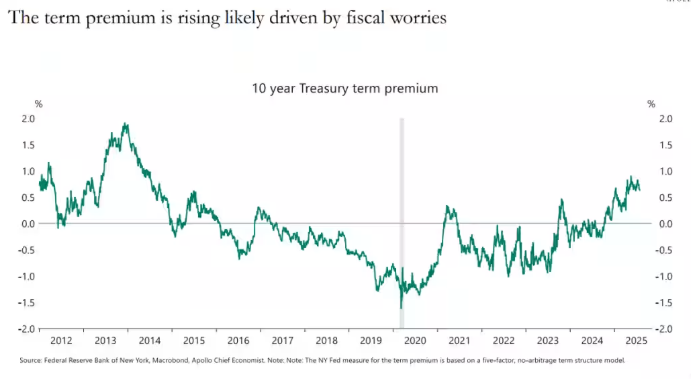
Group 1 - Investors are eagerly anticipating the Federal Reserve to end its wait-and-see approach and initiate interest rate cuts, with a focus on the bond market's movements [1] - The yield curve of the $28 trillion U.S. Treasury market is steepening, reflecting increasing confidence in the resumption of the rate-cutting cycle [1] - The 2-year U.S. Treasury yield has significantly dropped from approximately 4.4% to 3.8% since the last rate cut in December, indicating market optimism [1] Group 2 - The 10-year U.S. Treasury yield remains relatively unchanged at around 4.3%, compared to 3.8% a year ago, despite the Federal Reserve's first rate cut in four years [1][3] - Concerns about inflation are rising, with investors expecting a 3.3% inflation rate a year from now, well above the Federal Reserve's 2% target [2] - The U.S. government's annual debt repayment cost has reached $1 trillion, contributing to upward pressure on long-term Treasury yields [3] Group 3 - The yield spread between the 2-year and 10-year U.S. Treasuries is currently 57 basis points, higher than the 25 basis points observed during the last rate cut in 2024 [6] - The increase in the term premium for long-term Treasuries is attributed to larger Treasury auctions and growing fiscal concerns [3][6] - The potential impact of tariffs and trade policies on global trade may also contribute to the risk premium included in bonds [6]
专访瑞士百达谭思德:全球经济结构性剧震,四大因素塑造未来十年格局
Sou Hu Cai Jing· 2025-08-19 16:14
Group 1 - The concept of "long-term investment" has gained significant attention in recent years, with policies being developed to support it from top-level design to operational details [1] - Swiss private partnership firm, Pictet, has a long-standing commitment to long-term investment, tracing its history back to 1805, and has evolved into Switzerland's second-largest international financial institution [1] - Alexandre Tavazzi, Chief Investment Officer at Pictet, defines long-term investment as a 10-year horizon, with his team analyzing economic conditions and asset class returns over this period [1] Group 2 - The global economic landscape is undergoing "tectonic shifts," with structural impacts being more critical than cyclical ones in the next decade [4][5] - Negative impacts from U.S. policies include tariffs that effectively tax consumers and a government efficiency initiative that has not yielded expected savings [3] - Positive aspects include regulatory relaxations in the financial sector, allowing banks to operate with lower capital ratios, potentially increasing lending [3] Group 3 - The U.S. economy's stability, security guarantees, and high-return assets are being questioned, with increasing policy uncertainty since the Trump administration [6] - The attractiveness of U.S. assets is declining, particularly as competition from emerging sectors in China grows [7] - The long-term U.S. Treasury yield is viewed negatively due to insufficient compensation for risks, leading to a strategy of shortening duration in bond investments [8] Group 4 - Europe is experiencing significant changes, with Germany planning to abolish its debt brake and invest heavily in military and infrastructure, potentially leading to faster growth in the next decade [9] - The forecast for economic growth over the next decade predicts a U.S. growth rate of 1.8% and a Eurozone growth rate of 1.5%, narrowing the gap between the two regions [10] - Key factors shaping the future include deglobalization, decarbonization, demographic changes, and dominance of fiscal policy, with inflation expected to remain elevated [10]

瑞士百达谭思德:全球经济结构性剧震,四大因素塑造未来十年格局
2 1 Shi Ji Jing Ji Bao Dao· 2025-08-19 05:18
Group 1: Long-term Investment Perspective - The concept of long-term investment is emphasized by Swiss private partnership firm Pictet, which has a history dating back to 1805 and focuses solely on asset and wealth management [1] - Alexandre Tavazzi, Chief Investment Officer at Pictet, defines a long-term investment horizon as 10 years, with his team analyzing economic conditions and asset class returns over this period [1] Group 2: Global Economic Shifts - The global economy is experiencing "tectonic shifts," with structural impacts being more significant than cyclical ones [5][6] - The U.S. has historically provided three core supports to the global economy: economic stability, security guarantees, and attractive returns on safe assets, but these supports are now being questioned [6][7] Group 3: U.S. Debt and Investment Outlook - The attractiveness of U.S. long-term government bonds is declining, with the current term premium for 10-year bonds being low at 50 to 70 basis points, insufficient to compensate for long-term risks [8] - The U.S. fiscal deficit is approximately 7%, with half of this deficit attributed to interest payments, raising concerns about the sustainability of U.S. debt [8] Group 4: European Market Potential - There is a positive outlook for the European market, particularly with Germany's shift in debt policy, allowing for increased investment in infrastructure and defense [9] - The projected economic growth rates for the next decade indicate that Europe may experience faster growth compared to the U.S., making European assets more attractive [10] Group 5: Future Economic Growth Predictions - Economic growth predictions for the next decade show the U.S. at 1.8% and the Eurozone at 1.5%, with China expected to grow at 3.5% and India being the fastest-growing economy [10] - Four key factors—deglobalization, decarbonization, demographics, and dominance of fiscal policy—are expected to shape the economic landscape over the next ten years [10]

标普在赤字与收益率波动间维持美国AA+评级:关税收入对冲“大而美”法案冲击
智通财经网· 2025-08-19 04:25
Core Viewpoint - S&P Global Ratings maintains the United States' long-term credit rating at AA+ and short-term rating at A-1+, citing the resilience of the U.S. credit system despite significant fiscal challenges posed by the recent "Big and Beautiful" tax expenditure bill [1][6]. Group 1: Tax Revenue and Fiscal Impact - The increase in effective tariff rates is expected to generate substantial tariff revenue, which will offset potential weaker fiscal outcomes related to recent U.S. fiscal legislation that includes both tax cuts and increased tariff revenues [2]. - In July, U.S. tariff revenue reached a record high of approximately $28 billion, with projections suggesting that annual tariff revenue could exceed 1% of U.S. GDP by 2025 [2]. Group 2: Debt Market Concerns - Investors have been worried about fiscal deficits and broader debt sustainability issues since the return of Trump to the White House, with the 30-year U.S. Treasury yield rising above 5% in May due to concerns over tariffs and tax legislation [3]. - The "term premium" phenomenon indicates ongoing market concerns regarding the increasing interest payments on U.S. debt, with the 30-year Treasury yield remaining at 4.93% and the 10-year yield at 4.33% [4]. Group 3: Future Projections and Ratings Outlook - S&P's stable outlook suggests that while U.S. fiscal deficits are not expected to improve significantly, they also will not worsen, with net government debt projected to exceed 100% of GDP in the next three years [6]. - The average general government deficit is expected to be around 6% from 2025 to 2028, which is lower than the previous year's 7.5% [6].
美联储的“政治危机”与美债风险的“重估”
Shenwan Hongyuan Securities· 2025-08-16 13:49
Group 1: Federal Reserve's Political Crisis - The Federal Reserve is at the center of a political crisis influenced by Trump's efforts to reshape the deep government, raising questions about its ability to manipulate interest rates[2] - As of August 9, the top three candidates for the "shadow Fed chair" are Waller (26.6%), Hassett (13.7%), and Warsh (7.9%) based on market expectations[2][3] - Trump's potential influence includes nominating a "dovish" shadow chair and possibly replacing Powell if he does not remain[3][4] Group 2: Interest Rate Manipulation - The Fed can set but not manipulate policy rates or the yield curve, as rates are endogenous and influenced by macroeconomic factors[4] - The neutral interest rate in the U.S. has risen from around 0% to approximately 1-1.5%, indicating that the Fed's rate cuts may have a terminal point around 300-350 basis points[4] - By July 2025, the Fed's target for the federal funds rate should be between 3.8% and 6.3%, with the current rate at 4.3%, suggesting no restrictive policy at present[4] Group 3: Fiscal Policy and Monetary Coordination - The Fed's ability to cut rates depends more on fiscal consolidation than on board changes, as government deleveraging can lower the neutral rate and support the Fed's anti-inflation efforts[5] - Historically, a 1% reduction in the fiscal deficit can lead to a 12-35 basis point decrease in the 10-year Treasury yield[5] - Sustainable fiscal consolidation can be achieved through economic growth or budget cuts, each with different political costs and implications[5]
三季度直面近5000亿美元新债洪流,调查:哪怕降息美债也难涨
Feng Huang Wang· 2025-08-12 01:32
Group 1 - The core viewpoint indicates that despite recent declines in short-term U.S. Treasury yields due to Federal Reserve rate cut expectations, long-term yields are expected to rise slightly in the coming months due to inflation concerns and significant new debt issuance [1][2][4] - The survey of bond strategists suggests that the 10-year Treasury yield is projected to rise from approximately 4.28% to 4.30% over the next three months, and remain around that level into next year [2][4] - Concerns about inflation being more persistent than anticipated, despite expectations of temporary increases due to tariffs, are highlighted as a key factor influencing long-term yields [2][4] Group 2 - A significant influx of nearly $500 billion in new debt is expected this quarter, which may prevent long-term yields from declining significantly, even if inflation rises less than expected [4][5] - The yield curve is anticipated to steepen, with the spread between short-term and long-term yields widening from approximately 50 basis points to 80 basis points over the next year [4][6] - The lack of a deficit reduction plan is causing the market to demand higher yields, reflecting a structural bet on a steepening yield curve [6]
中金:利率底部在哪 | 漫长的周期系列(二)
中金点睛· 2025-08-05 23:37
Core Viewpoint - The article discusses the ongoing interest rate reduction cycle in China, which began in 2019 and is expected to continue until 2025, drawing parallels with historical cycles and emphasizing the need to analyze the interaction between monetary policy, interest rates, asset prices, and overall demand [2][3]. Group 1: Natural Interest Rate and Monetary Policy - The natural interest rate in China has declined to near zero, indicating that there is significant room for further policy rate reductions to address low inflation [3][4]. - The article highlights two critical blind spots in the natural interest rate framework: the "effectiveness blind spot," which overlooks the impact of risk premiums on the effectiveness of rate cuts, and the "cost blind spot," which considers the financial safety and interests of savers as constraints on rate reductions [4][11]. - The analysis suggests that even with persistent low inflation, the 10-year Chinese government bond yield may not decline to the levels indicated by the natural interest rate due to these blind spots [6][10]. Group 2: Market Dynamics and Bond Pricing - The article argues that the low yield spread in the bond market is primarily due to reduced volatility rather than strong expectations of rate cuts, indicating a "pricing blind spot" in the natural interest rate perspective [5][41]. - The 10-year government bond yield's downward trend over the past three years may not continue, as the costs associated with rate cuts become more apparent and the lower limit of the yield spread is supported [6][70]. - The article emphasizes that the current economic environment and the potential for future rate cuts should be closely monitored, particularly in the context of market expectations and the behavior of financial institutions [61][69]. Group 3: Financial System Constraints - The Chinese banking sector's significant reliance on interest income and the high proportion of bank assets to GDP create constraints on further rate reductions, as banks prioritize maintaining net interest margins [26][29]. - The article notes that the interests of savers will also play a crucial role in determining the extent to which deposit rates can be lowered without causing public discontent [29][30]. - The ongoing global high-interest rate environment poses additional challenges for China's monetary policy, as it complicates the management of capital flows and the stability of the renminbi [32][38]. Group 4: Policy Alternatives and Economic Growth - The article suggests that there are alternative policy measures available to stimulate growth, such as fiscal expansion and structural reforms, which may be more effective than simply lowering interest rates [71][73]. - Recent changes in fiscal policy, including the use of special government bonds for consumption subsidies and an increase in the fiscal deficit ratio, indicate a shift towards more proactive fiscal measures to support economic growth [71][72]. - The potential for further structural reforms to enhance economic vitality is highlighted, with an emphasis on improving incentive mechanisms across various sectors [73].

贝莱德:澳大利亚国债表现可能会优于美债
news flash· 2025-07-29 07:58
Group 1 - Craig Vardy, head of fixed income at BlackRock Australia, suggests that Australian government bonds may outperform U.S. Treasuries as the market digests fiscal risks affecting long-term bonds [1] - The pricing of long-term U.S. Treasuries will likely include more term premium due to issuance and fiscal risks, while the Reserve Bank of Australia may continue to lower interest rates [1] - The yield on Australian 10-year government bonds is approximately 20 basis points lower than that of U.S. Treasuries, indicating a potential lower bound for the spread [1] Group 2 - If the yield on Australian bonds exceeds that of U.S. Treasuries by about 10 basis points, there may be a resurgence in trading activity [1] - The correlation between Australian 10-year government bonds and U.S. Treasuries is expected to remain high, with no significant decoupling anticipated in the future [1]