
逆周期调节

Search documents
宏观周周谈:什么是关税不确定性下的最佳决策
2025-07-16 06:13
Summary of Conference Call Company/Industry Involved - The conference call primarily discusses the macroeconomic environment, trade policies, and their impact on various industries, particularly focusing on the automotive and manufacturing sectors. Core Points and Arguments 1. **Uncertainty from Tariffs** The ongoing uncertainty surrounding U.S. tariffs is highlighted, with references to recent court rulings and potential changes in tariff rates that could affect trade dynamics [4][6][19]. 2. **Impact on Automotive Industry** The automotive sector, particularly in the Yangtze River Delta, is noted for its stability compared to other industries. However, the sector has faced challenges due to tariff changes and the lingering effects of COVID-19 lockdowns, which have impacted production rates [5][6][13]. 3. **Production Rates Fluctuations** The production rates for semi-steel tires dropped significantly during lockdowns, from 70% to 40%, and have not fully recovered post-lockdown, indicating a long-term impact from both the pandemic and tariff uncertainties [5][6]. 4. **Consumer Behavior and Inventory Management** U.S. consumers are observed to be cautious in their purchasing behavior due to tariff uncertainties, leading to a decline in durable goods orders in April, suggesting a shift from aggressive inventory replenishment to a more measured approach [8][10][19]. 5. **Industrial Product Imports** There has been a notable increase in imports of industrial products, with a year-on-year growth of 53%. However, energy imports did not see a similar increase, indicating a selective approach to inventory management in response to tariff pressures [11][12][13]. 6. **Economic Growth Projections** Economic growth is projected to be moderate, with expectations of a slight decline in GDP growth rates in the coming months. The overall economic data suggests a need for supportive policies to maintain growth [20][32]. 7. **Manufacturing PMI Trends** The manufacturing PMI for May showed a slight increase but remained below the neutral level, indicating ongoing challenges in the manufacturing sector. The impact of tariffs and seasonal factors continues to weigh on production [29][30][32]. 8. **Sector-Specific Performance** The performance of various sectors is mixed, with upstream mining profits declining while midstream equipment manufacturing profits are improving due to export policies. Consumer demand remains weak, affecting overall profitability [25][28][32]. 9. **Future Outlook and Policy Recommendations** The call emphasizes the need for further supportive measures to stabilize the economy and manufacturing sector, particularly in light of ongoing tariff uncertainties and global economic pressures [32][33]. Other Important but Possibly Overlooked Content 1. **Historical Context of Economic Cycles** The discussion includes references to historical economic cycles and the potential for a prolonged downturn, drawing parallels to past economic events [23]. 2. **Consumer Goods and Seasonal Effects** The impact of seasonal factors on consumer goods demand and production is noted, with specific mention of how holidays and weather can influence manufacturing output [30][31]. 3. **Investment Sentiment** There is a cautious sentiment regarding investments in certain sectors, particularly in light of inventory management strategies and the potential for demand weakening in the near term [14][19].
上半年GDP同比增长5.3% 消费政策将继续加力
Bei Jing Shang Bao· 2025-07-15 10:24
Economic Overview - The GDP for the first half of the year is reported at 66,053.6 billion yuan, with a year-on-year growth of 5.3% [1] - The economy shows resilience amidst a complex international environment and domestic structural adjustments [1] Contribution to GDP Growth - Final consumption expenditure contributed 52% to GDP growth, making it the primary driver [1][3] - Net exports of goods and services contributed 31.2%, indicating a recovery in external demand [1] - Capital formation contributed 16.8%, with fixed asset investment providing stable support [1] Consumer Market Dynamics - Retail sales of consumer goods reached 24,545.8 billion yuan, growing by 5.0% year-on-year, with a notable acceleration in the second quarter [3][4] - The service consumption sector is recovering rapidly, supported by holiday economies and an increase in the consumption of upgraded goods [4] - The "trade-in" policy for home appliances has significantly boosted consumer activity, with online retail sales of major appliances increasing by 28.0% in the second quarter [4] Investment Trends - Fixed asset investment growth has slowed, but its contribution to GDP remains solid at 16.8%, with a second-quarter contribution of 24.7% [5][6] - Investment in manufacturing and high-tech industries is growing rapidly, with manufacturing investment up by 8.5% and high-tech industry investment by 11.7% [5] - Infrastructure investment grew by 5.4% in the first half of the year, with plans to accelerate major projects in the second half [6] Economic Outlook - Financial institutions predict that China's economic growth rate may remain around 5% for the year, supported by strong internal demand and policy coordination [7] - The government plans to continue enhancing counter-cyclical adjustments to solidify the recovery trend [7][8] - The focus will be on strengthening domestic circulation and ensuring high-quality development to address external uncertainties [8]


超市场预期 上半年GDP增长5.3%的多重含义
Jing Ji Guan Cha Bao· 2025-07-15 08:54
Economic Growth Overview - China's GDP grew by 5.3% year-on-year in the first half of the year, with a growth of 5.4% in Q1 and 5.2% in Q2, indicating a stable economic performance despite external pressures [1][2] - The growth rate exceeded market expectations, reflecting the resilience and potential of the Chinese economy, supported by macroeconomic policies and improvements in exports and service consumption [2][3] Consumption as a Growth Driver - Final consumption expenditure contributed 52% to economic growth in the first half of the year, with projections of 82.5% and 44.5% for 2023 and 2024 respectively [2] - Retail sales of consumer goods increased by 5.0% in the first half, driven by policies promoting consumption, although the growth was still weaker than overall economic growth [3][4] Investment Trends - Fixed asset investment reached 24.9 trillion yuan, with a nominal growth of 2.8%, lower than the previous year, but the actual growth rate adjusted for price changes was 5.3% [5][6] - Investment fluctuations were attributed to external complexities, price declines, and cautious investment decisions by market participants, particularly in traditional industries like real estate [5][6] Challenges and Future Outlook - Experts predict a potential slowdown in GDP growth in the second half due to various internal and external challenges, including weak consumer confidence and ongoing adjustments in the real estate market [8][10] - Recommendations include enhancing fiscal policies, accelerating public investment, and maintaining liquidity to support economic stability and growth [10][11]
央行创纪录操作1.4万亿买断式逆回购,政策工具仍有发力空间
Sou Hu Cai Jing· 2025-07-15 07:37
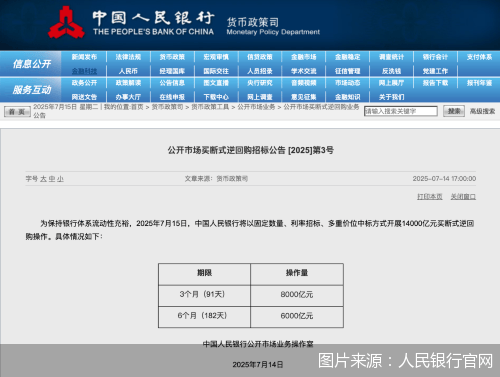
Core Viewpoint - The People's Bank of China (PBOC) has implemented a significant liquidity support measure by conducting a record-high reverse repurchase operation of 1.4 trillion yuan on July 15, 2025, to maintain ample liquidity in the banking system [1][3]. Group 1: Reverse Repo Operations - On July 15, 2025, the PBOC conducted a reverse repurchase operation totaling 1.4 trillion yuan, which includes 800 billion yuan for a 3-month term and 600 billion yuan for a 6-month term, marking the highest single operation since the introduction of this method [1][2]. - The PBOC also executed a 3,425 billion yuan reverse repo operation with a 7-day term at an interest rate of 1.40% on the same day [2][3]. Group 2: Market Liquidity and Economic Impact - As of July 15, 2025, the net liquidity injection from the PBOC's operations amounted to 15,735 billion yuan, following the maturity of 690 billion yuan in reverse repos and 1,000 billion yuan in Medium-term Lending Facility (MLF) [3]. - The PBOC's actions are aimed at ensuring sufficient liquidity in the banking system, especially during a period of high government bond issuance, which is crucial for maintaining economic stability [3][4]. Group 3: Policy Communication and Future Outlook - The PBOC has shifted its announcement of reverse repo operations from the end of the month to mid-month, indicating increased transparency and improved communication mechanisms in monetary policy [4]. - The PBOC's Deputy Governor has stated that the bank will maintain a balance in policy implementation to ensure that the growth of social financing and money supply aligns with economic growth and price level expectations [4][5].
中国经济半年报丨金融总量合理增长 信贷结构持续优化——透视上半年金融数据
Xin Hua Wang· 2025-07-14 14:21
Core Viewpoint - The financial data for the first half of the year indicates a reasonable growth in total financial volume and a continuous optimization of credit structure, supported by a moderately loose monetary policy [1][2]. Group 1: Financial Data Overview - As of the end of June, the balance of RMB loans reached 268.56 trillion yuan, a year-on-year increase of 7.1% [1]. - The total social financing scale was 430.22 trillion yuan, growing by 8.9% year-on-year [1]. - The broad money supply (M2) stood at 330.29 trillion yuan, with an annual growth of 8.3% [1]. Group 2: Credit Structure and Allocation - In the first half of the year, new loans totaled 12.92 trillion yuan, with loans to enterprises accounting for 89.5% of all new loans, an increase of 6.6 percentage points compared to the same period last year [2]. - Medium and long-term loans increased by 7.17 trillion yuan, indicating stable funding support for the real economy [2]. - Loans to the manufacturing sector saw a year-on-year growth of 8.7%, with an increase of 920.7 billion yuan in the first half [2]. - Loans to infrastructure also grew, with a year-on-year increase of 7.4% and an addition of 2.18 trillion yuan [2]. Group 3: Bond Market and Financing Costs - The bond market has shown steady growth, with a total issuance of various bonds reaching 44.3 trillion yuan in the first half of 2025, a year-on-year increase of 16% [3]. - The net financing from bonds was 8.8 trillion yuan, accounting for 38.6% of the increase in social financing scale [3]. - The average interest rate for newly issued corporate loans was approximately 3.3%, down by about 45 basis points from the previous year [4]. - The average interest rate for new personal housing loans was around 3.1%, a decrease of 60 basis points year-on-year [4].
上半年金融数据出炉!社融规模增量近23万亿元,M2增速8.3%
Sou Hu Cai Jing· 2025-07-14 14:09
Core Viewpoint - The People's Bank of China (PBOC) reported that in June 2025, new loans and social financing both exceeded market expectations, indicating a positive trend in credit growth and monetary policy effectiveness [1][2]. Group 1: Credit Growth - In June 2025, new RMB loans amounted to 2.24 trillion yuan, an increase of 1.1 billion yuan year-on-year [1]. - The total social financing scale in June reached 4.1993 trillion yuan, up by 900.8 billion yuan year-on-year [1]. - The balance of RMB loans at the end of June was 268.56 trillion yuan, reflecting a year-on-year growth of 7.1% [2]. Group 2: Monetary Policy and Economic Support - The PBOC has implemented a moderately loose monetary policy, utilizing various tools to support high-quality development of the real economy [2]. - The increase in credit is attributed to the PBOC's actions, including interest rate cuts and liquidity injections, which have improved financing conditions for businesses and households [3][4]. - The government bond issuance peak has also contributed to the rise in social financing data [1]. Group 3: Loan Structure and Sector Focus - The first half of 2025 saw a total loan increase of 12.92 trillion yuan, with significant allocations to manufacturing and infrastructure sectors [4]. - Corporate medium- and long-term loans increased by 400 billion yuan in June, ending a four-month decline [5]. - The demand for medium- and long-term loans is supported by various factors, including financial support measures and ongoing infrastructure investments [5]. Group 4: Social Financing and Government Bonds - The total social financing increment for the first half of 2025 was 22.83 trillion yuan, an increase of 4.74 trillion yuan year-on-year [6][7]. - Government bond financing was a major contributor to the increase, with a year-on-year rise of 4.32 trillion yuan [7]. - In June, new social financing reached 4.20 trillion yuan, reflecting a seasonal increase and a year-on-year growth of 9008 billion yuan [7]. Group 5: Future Outlook - Experts anticipate that the PBOC may continue to implement interest rate cuts and reserve requirement ratio reductions in the second half of 2025 [9][10]. - The growth of M2 money supply is expected to support the financing needs of enterprises and households, with a year-on-year increase of 8.3% [9]. - The ongoing adjustments in monetary policy are aimed at enhancing domestic demand and mitigating external economic pressures [10].
邹澜:货币政策的传导需要时间,已实施的货币政策效果还会进一步显现
Bei Jing Shang Bao· 2025-07-14 07:41
Core Viewpoint - The People's Bank of China (PBOC) is implementing a moderately accommodative monetary policy to support the economy amid a complex external environment and declining global growth momentum [1][2]. Monetary Policy Implementation - The PBOC has intensified counter-cyclical adjustments and introduced a package of financial support measures in May to ensure ample liquidity and promote reasonable growth in monetary credit [1][2]. - A market-oriented interest rate adjustment framework is being established to lower the overall financing costs in society [1][2]. Financial Data Overview - As of June, the total social financing stock grew by 8.9% year-on-year, with M2 money supply increasing by 8.3% and RMB loans rising by 7.1% [2]. - The average interest rate for newly issued corporate loans was approximately 3.3%, down about 45 basis points from the previous year, while the rate for personal housing loans was around 3.1%, down about 60 basis points [2]. Credit Structure Optimization - By the end of May, inclusive small and micro loans increased by 11.6%, medium to long-term loans for manufacturing rose by 8.8%, and technology loans grew by 12%, all exceeding the overall loan growth rate [2]. Financial Market Resilience - Major financial markets, including stocks, bonds, and foreign exchange, have maintained stable operations despite significant changes in the external environment and global financial markets [2]. Future Policy Direction - The PBOC will continue to implement a moderately accommodative monetary policy, closely monitoring the transmission and actual effects of previously implemented policies to better support domestic demand and stabilize market expectations [3].
货币政策适度宽松 工具箱储备充足
Zheng Quan Shi Bao· 2025-07-11 17:17
Monetary Policy Overview - The People's Bank of China (PBOC) has maintained a supportive policy stance with moderate monetary easing, utilizing various tools to ensure stable financial market operations [1][2] - The PBOC's toolbox is well-stocked, and it will continue to adjust policy measures flexibly based on domestic and external economic conditions [1] Recent Developments - In the first half of the year, the bond market experienced a rapid decline in government bond yields due to excessive anticipation of monetary easing, while the strengthening US dollar put pressure on non-US currencies, leading to depreciation pressure on the RMB [1] - The PBOC implemented measures such as pausing government bond purchases and tightening monetary policy to guide market expectations [1] - Since June, macroeconomic performance has stabilized, and the urgency for aggressive monetary policy has decreased, shifting focus to stabilizing market expectations [2] Future Outlook - The PBOC has identified "promoting reasonable price recovery" as a key consideration for monetary policy, with plans to increase the intensity of monetary policy adjustments [3] - If the Federal Reserve lowers interest rates, it may create more room for China to implement further easing measures [3] - Expectations suggest potential cuts in reserve requirements and interest rates in the second half of the year, with a possibility of a 50 basis point reserve requirement cut and a 20 basis point interest rate cut [3]

核心资产延续修复,A500ETF基金(512050)涨近1%,盘中成交额超13亿元位居同类第一
Mei Ri Jing Ji Xin Wen· 2025-07-11 02:46
Group 1 - A-shares main indices experienced a rapid rise, with the A500 ETF (512050) increasing by 0.82% as of 10:14 AM, driven by strong performances from stocks like Baogang Co. and Northern Rare Earth, which hit the daily limit up [1] - Baogang Co. and Northern Rare Earth announced a price increase for rare earth concentrate for Q3, adjusting the price to 19,109 yuan/ton, a 1.5% increase from Q2's 18,825 yuan/ton [1] - The core assets in A-shares are expected to continue their recovery, supported by China's implementation of counter-cyclical adjustments and moderately loose monetary policy, achieving multiple goals of stabilizing growth, controlling prices, preventing risks, and promoting stability [1] Group 2 - The new generation core broad-based A500 ETF (512050) helps investors easily allocate to core A-share assets, tracking the CSI A500 Index with a strategy that combines industry-balanced allocation and leading stock selection [2] - The ETF covers all sectors and integrates both value and growth attributes, with a natural "dumbbell" investment characteristic, overweighting sectors like electronics, pharmaceuticals, and power equipment compared to the CSI 300 [2]


“适度宽松”效果显现 货币政策操作留有后手
Shang Hai Zheng Quan Bao· 2025-07-10 18:30
Core Viewpoint - China's monetary policy has been effectively implemented to achieve multiple goals including stabilizing growth, controlling prices, preventing risks, and promoting stability amid internal and external uncertainties [1][2][4]. Monetary Policy Implementation - The monetary policy has been strategically adjusted to respond to changing economic conditions, maintaining a reasonable space while providing timely support [2]. - In May, the central bank announced ten monetary policy measures, including a 0.5% reserve requirement ratio cut, injecting approximately 1 trillion yuan into the market [2][3]. Policy Tools - Quantity-based policies included a reserve requirement cut that provided long-term liquidity to the market [2]. - Price-based policies saw multiple key interest rates decrease, leading to a reduction in overall financing costs, with personal housing provident fund loan rates lowered by 0.25%, saving residents over 20 billion yuan annually [3]. - Structural policies involved the establishment of new tools and optimization of existing ones, such as a 500 billion yuan re-loan for service consumption and elderly care [3][6]. Economic Indicators - In the first quarter, China's GDP grew by 5.4%, and the financial market showed positive changes, with a significant increase in personal housing loans [4]. - The total social financing increased by 18.63 trillion yuan in the first five months, which is 3.83 trillion yuan more than the same period last year [3]. Support for Key Areas - The monetary policy has effectively supported consumption expansion, technological innovation, and the stabilization of the stock and real estate markets [5][6]. - Specific measures have been introduced to enhance financial support for small and micro enterprises, including an increase of 300 billion yuan in re-loans for agriculture and small businesses [6][7]. Future Outlook - The monetary policy is expected to further adapt to complex economic conditions, focusing on stabilizing growth and preventing risks while enhancing structural adjustments [8]. - There is anticipation for the introduction of new policy financial tools to address capital shortages in project construction, particularly in consumption infrastructure and other key areas [8].