滞胀

Search documents
美股“黑色星期五”,比通胀指标“双杀”更可怕的是……
凤凰网财经· 2025-03-29 14:11
来源|财联社 可以说,自2月中旬创下历史新高以来,标普500指数就一直承压。加上周五的跌幅,这一美国基准股指已经从2月19日的历史最高收盘点位下跌了 约9%。以科技股为代表的纳斯达克指数更是从去年12月16日的历史最高收盘点位下跌了约14%。 在一季度的倒数第二个交易日,美股市场遭遇了年内以来的第二大单日跌幅。由于有迹象表明消费者信心和支出正在下降,人们再度担心一系列关税 将引发通胀,风险资产在本周五集体受到了重创…… 行情数据显示,标普500指数周五收盘下跌了近2%,年内迄今只有3月10日那个"黑色星期一"的跌幅比昨夜更大。 而纳斯达克综合指数遭遇的抛售 则更为严重,隔夜跌幅达到了2.7%。根据Bespoke Investment Group的数据显示,纳指3月迄今已经有多达第五次下跌至少2%,这是自2022年6 月以来单月跌幅最大的一个月。 美股的持续走软,很大程度上要归因于美国总统特朗普关税政策所带来的巨大不确定性。近几周,随着有迹象表明定于4月2日实施的关税不会像威胁 的那样深入或广泛,市场的抛售曾一度有所缓解。 但昨日最新发布的几组数据却又表明,有鉴于特朗普总统的关税政策不断扩大,消费者越来越担心增 ...
风险偏好持续降温! 美国通胀卷土重来叠加关税风暴 信贷恐慌升至七个月新高
智通财经网· 2025-03-29 03:18
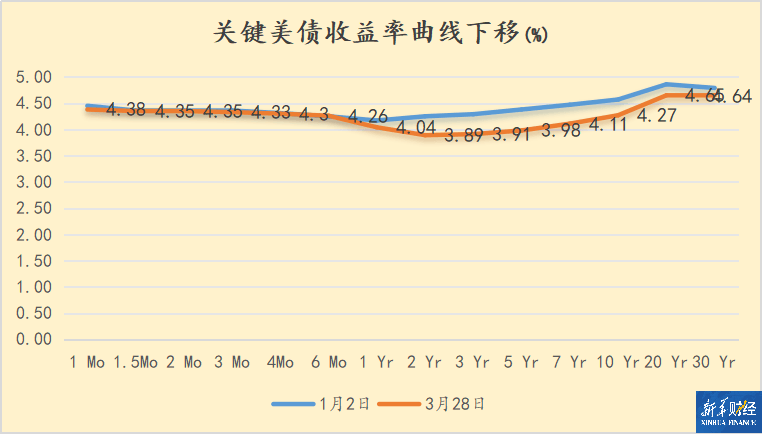
Group 1 - Recent economic data indicates a resurgence of inflation in the U.S., coupled with concerns over the potential impact of the upcoming "reciprocal tariffs" policy from the Trump administration and signs of weak consumer spending [1] - The US Credit Fear Gauge has risen to its most alarming level since August of last year, reflecting a sharp decline in risk appetite within the financial markets [1] - The Markit CDX North America High Yield Index has continued its downward trend, falling 0.6 points to 105.14, indicating an increase in credit default risk and the worst performance in seven months [1] Group 2 - As risk appetite declines, risk assets such as stocks and cryptocurrencies have seen significant weakness, driven by heightened concerns over the impending "reciprocal tariffs" [2] - Major U.S. stock indices experienced substantial declines, with the Nasdaq Composite Index dropping nearly 3% in a single day, marking a "Black Friday" for the markets [2] - The "Magnificent 7" tech giants collectively fell 2.95% this week, with Nvidia experiencing a weekly decline of 6.82% [2] Group 3 - The core PCE, a key inflation measure favored by the Federal Reserve, showed a month-over-month increase of 0.4%, the largest rise in a year, with a year-over-year increase of 2.8%, both exceeding previous values and economist expectations [3] - Consumer confidence in the U.S. has dropped to a two-year low, exacerbating concerns over sustained pressure on consumer spending amid escalating trade tensions [6] - The expectation of "stagflation" has significantly increased, with the long-term inflation expectations reaching a 32-year high, driven by tariff impacts [6]

关键通胀数据显示价格上涨 10年期美债收益率跌破4.3%
Sou Hu Cai Jing· 2025-03-29 02:55
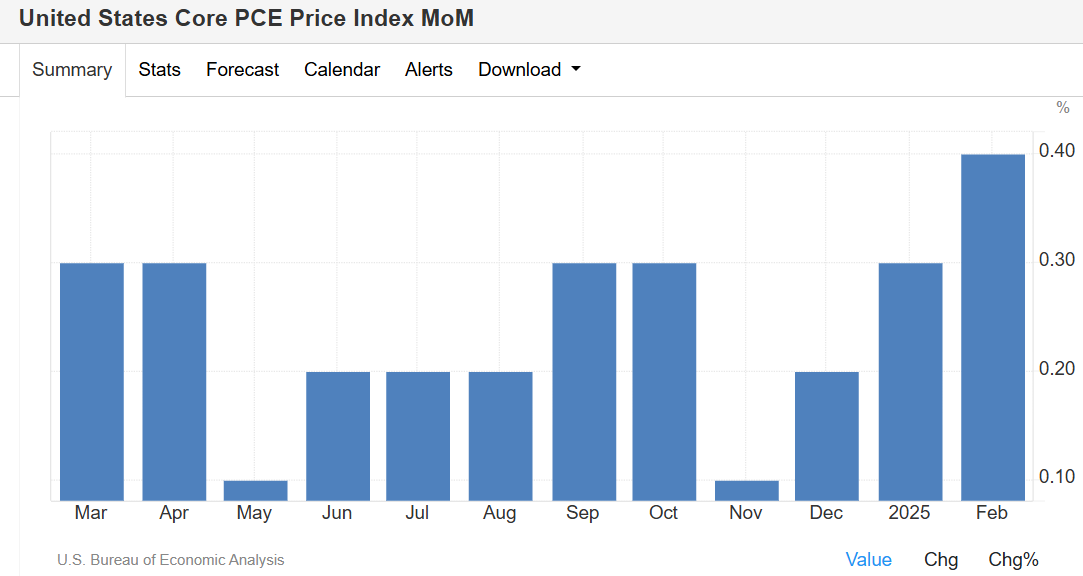
Group 1 - Market risk aversion has increased, leading to a significant drop in key U.S. Treasury yields, indicating investor concerns about economic growth rather than inflation [1] - As of the market close on March 28, the 2-year Treasury yield fell by 8 basis points to 3.89%, the 5-year yield dropped by 9 basis points to 3.98%, and the 10-year yield saw a substantial decline of 11 basis points to 4.27%, marking the largest single-day drop since January 15 [1] - The core personal consumption expenditures price index for February rose by 0.4%, resulting in a 12-month inflation rate of 2.8%, which is above the Federal Reserve's target of 2% [3] Group 2 - Consumer spending growth in February was 0.4%, below the expected 0.5%, while personal income increased by 0.8%, exceeding the forecast of 0.4% [3] - Concerns about tariffs and other factors are contributing to reduced consumer spending, leading to fears of stagflation, characterized by rising inflation and slowing economic growth [3][4] - The Federal Funds futures market indicates a 63.2% probability of the Federal Reserve cutting rates three times or more by 2025, up from 51.1% the previous day [4] Group 3 - The bond market is reacting to concerns over tariffs, particularly those related to the automotive sector, which have intensified worries about stagflation [5] - In the European bond market, German bond yields fell, while Italian bond yields saw slight increases, indicating mixed reactions across different countries [5] - The U.S. Treasury has no bond issuance scheduled for the week, with a total of $144 billion in bonds to be issued on March 31, including $76 billion in 13-week and $68 billion in 26-week short-term bonds [6]
一个「女生潮牌」宣布破产
36氪· 2025-03-28 00:08
Core Viewpoint - Forever 21, a fast-fashion women's clothing brand, has filed for bankruptcy for the second time, highlighting the challenges faced by traditional retail in the face of e-commerce competition and changing consumer behavior [4][11][15]. Company Overview - Forever 21 was founded in 1984 by Korean-American couple Do Won Chang and Jin Sook Chang, initially opening a small store in San Francisco with a focus on affordable fashion for young women [7][9]. - At its peak, Forever 21 operated over 800 stores globally, including a prominent location on Nanjing East Road in Shanghai [4][9]. - The brand's revenue exceeded $4 billion by 2015, with ambitions to reach $8 billion by 2017 [10]. Decline Factors - The rise of e-commerce platforms like SHEIN and Temu, coupled with declining foot traffic in U.S. malls, contributed to Forever 21's struggles [5][11]. - The company's failure to adapt to the digital retail landscape and its aggressive physical expansion led to unsustainable costs and ultimately its first bankruptcy filing in 2019 [11][14]. - Despite a brief recovery after being acquired by a consortium in 2020, Forever 21 faced renewed challenges, leading to its second bankruptcy filing in 2023 [13][14]. Financial Situation - As of the latest filing, Forever 21's estimated liabilities range from $1 billion to $10 billion, while its assets are estimated between $100 million and $500 million [15]. - The brand's decline reflects broader trends in the retail sector, where many companies are struggling under the pressures of inflation and changing consumer spending habits [15][18]. Industry Context - The U.S. bankruptcy rate has reached its highest level since the global financial crisis, with significant impacts on sectors like retail, healthcare, and automotive [18]. - The economic environment, characterized by high inflation and rising interest rates, has led to increased financial strain on many businesses, including those in the fast-fashion sector [19][20].

利息成本猛增 美联储连亏两年
Bei Jing Shang Bao· 2025-03-25 15:21
利息成本猛增 美联储连亏两年 暴力加息后果 美联储的资产负债表包括国债和抵押贷款支持证券等资产,美联储像其他投资者一样从中赚取收 益。负债方面则包括银行在美联储的存款,即所谓的"准备金",美联储需为这些准备金支付利息。 美联储近日发布的2024年财务报表审计结果显示,美联储2024年运营亏损高达776亿美元(约合人 民币5600亿元),连续第二年出现大额亏损,此前2023年亏损额高达1145亿美元。 分析称,美联储遭遇巨额亏损的主要原因是其在2020年和2021年疫情期间大力支持经济,以及在 2022年和2023年为应对高通胀而大幅加息,将基准利率从接近零上升到5.25%—5.5%的区间。 自2022年起,美联储持续暴力加息,不断提高对金融机构支付的准备金利息,因此美联储出现巨额 运营亏损。到2024年,美联储已经连亏两年,亏损合计近2000亿美元。随着短期利率的下降,市场认为 美联储正逼近恢复盈利的临界点。但面对滞胀威胁加剧、通胀再次抬头,美联储今年的降息路径仍不明 朗。 利率下调或能恢复盈利 据了解,美联储是自筹资金机构,通过其持有的证券以及为金融机构提供服务来盈利。根据规定, 美联储运营盈余要上缴美国财 ...
鲍威尔释放了什么新信号?
Zi Jin Tian Feng· 2025-03-25 08:09
Monetary Policy Insights - The Federal Reserve maintained the federal funds rate target range at 4.25%-4.50%, aligning with market expectations[5] - The pace of balance sheet reduction (QT Taper) will slow from $25 billion to $5 billion per month starting April 1, while MBS reduction remains at $35 billion per month[5] - The median GDP growth forecast for 2025 was downgraded from 2.1% to 1.7%, and the unemployment rate forecast was adjusted from 4.3% to 4.4%[5] Inflation and Economic Outlook - The PCE inflation forecast for 2025 was revised up from 2.5% to 2.7%, with core PCE inflation rising from 2.5% to 2.8% due to tariff impacts[5] - The Fed's approach has shifted from preemptive rate cuts to a data-dependent strategy, indicating potential delays in response to economic downturns[11] - Current economic indicators, such as a stable unemployment rate at 4.1%, suggest that the economy remains in reasonable condition despite inflation concerns[10] Global Economic Context - The U.S. liquidity situation is tight, with the Fed's total assets reduced to $6.7 trillion, returning to pre-pandemic levels[7] - China's economic challenges are characterized by deflation rather than inflation, with net exports contributing 30% to GDP in 2024, the highest since the 2008 financial crisis[12] - The need for proactive monetary policy adjustments in China is emphasized, particularly in light of potential U.S. economic downturns and tariff impacts[13]
中美交锋仅2月,特朗普心里直打鼓?美联储一把手说出残酷现实!
Sou Hu Cai Jing· 2025-03-25 06:16
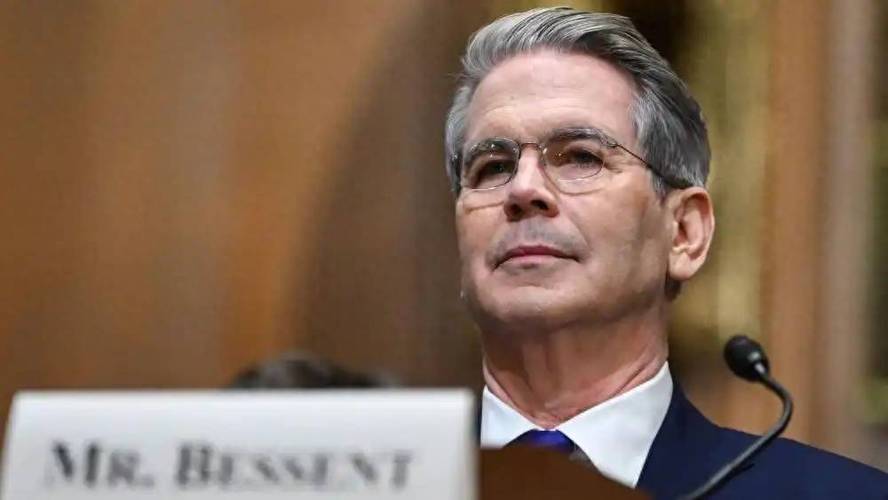
中美交锋仅2月,特朗普心里直打鼓?美联储一把手说出残酷现 实! 据新华社报道,美国财政部长贝森特日前接受媒体采访时说,美国经济可能会有一些"调整",但这是"健康的"。不过,他"无法保 证"美国经济不会在特朗普任期内出现衰退。3月以来,外界围绕美国关税政策加剧经济衰退前景的议论日甚,经济数据疲软和股 市持续下跌进一步强化"特朗普衰退"担忧。美国政府高官轮番在媒体面前为当前政策与经济形势辩解,推出一系列"新概念",引 发议论的同时遭到媒体和专家诟病。 近日美国总统特朗普在接受福克斯新闻台采访时,对美国经济衰退威胁直接提问避而不答。他说,在他执政期间美国经济将是世 界历史上最强的。在直接被问及美国是否会在2025年出现经济衰退时,特朗普说:"我们将拥有全世界、全球有史以来最强大的经 济"。特朗普补充说,现在正在为美国经济投入大量资金。早些时候,美联储主席鲍威尔在媒体负面预测的背景下不排除美国经济 衰退的可能性,同时指出,衰退的可能性一直存在的。他还承认,市场存在异常高的不确定性。 此时从国际关系的角度来看,特朗普也意识到,与中国全面对抗并不是一个明智的选择。中美两国作为全球最大的两个经济体, 其关系的好坏不仅关系到 ...
突发!特朗普签令
证券时报· 2025-03-25 04:28
Core Viewpoint - The U.S. government, under President Trump, has announced a 25% tariff on goods imported from countries that purchase Venezuelan oil, effective April 2, as a response to Venezuela's perceived hostility towards the U.S. [3][4] Group 1: U.S. Tariff Announcement - President Trump signed an executive order imposing "tariff sanctions" on countries importing Venezuelan oil, with a potential 25% tariff on all goods from these nations starting April 2 [3]. - The Secretary of State has the authority to decide on the imposition of the 25% tariff, which will last for one year from the last import date of Venezuelan oil or until an earlier date agreed upon by relevant U.S. officials [3]. - Trump characterized the tariff as a necessary measure against Venezuela, which he claims is hostile towards the U.S. [3]. Group 2: Venezuelan Response - Venezuela's Foreign Ministry condemned the U.S. tariff as "illegal" and "arbitrary," asserting that it violates international trade agreements [4]. - The Venezuelan government plans to take appropriate actions in international institutions to defend its rights against what it views as a new act of aggression by the U.S. [4]. Group 3: Broader Economic Implications - Trump indicated that he may offer tariff exemptions to many countries if they achieve "reciprocal" trade terms, with the EU agreeing to lower auto tariffs to match U.S. levels [6][7]. - Concerns are rising among economists and market participants regarding the potential for a U.S. economic downturn, with a 40% probability of recession predicted for the year, up from an earlier estimate of 30% [7].
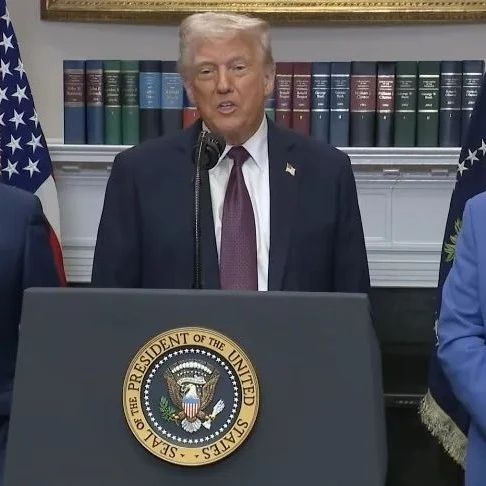
25%关税!刚刚,特朗普签了!
券商中国· 2025-03-25 01:40
Core Viewpoint - The article discusses the recent executive order signed by President Trump imposing a 25% tariff on goods imported from countries that directly or indirectly import Venezuelan oil, effective April 2. This move is expected to impact international oil prices and trade relations significantly [1][3][4]. Group 1: Tariff Implementation - The U.S. will impose a 25% tariff on all goods from countries importing Venezuelan oil starting April 2 [3][4]. - The Secretary of State has the authority to decide on the implementation of these tariffs, which will last for one year from the last import date of Venezuelan oil [3][4]. - Trump referred to this tariff as a "secondary tariff," similar to secondary sanctions aimed at third-party countries [4]. Group 2: Impact on Oil Prices - Following the announcement, international oil prices surged, with WTI crude oil futures rising by 1.21% to $69.11 per barrel, marking the highest level since March 4 [1][4]. - Brent crude oil futures also increased by 1.16%, reaching $73.00 per barrel [1][4]. Group 3: Additional Tariffs - Trump indicated plans to announce additional tariffs on automobiles, wood, and chips in the coming days, suggesting a broader approach to tariffs beyond the Venezuelan oil issue [7][8]. - He mentioned that not all tariffs would take effect on April 2, hinting at potential exemptions for certain countries [7][9]. Group 4: Economic Concerns - Analysts express concerns that escalating tariffs could lead to economic downturns in the U.S., with predictions of a 40% chance of recession this year, up from 30% earlier [10]. - The potential for stagflation, characterized by slow growth and high inflation, is also highlighted as a significant risk [10].
【招银研究】海外资产波动加剧,国内股债震荡波折——宏观与策略周度前瞻(2025.03.24-03.28)
招商银行研究· 2025-03-24 13:11
(二)海外资本市场 近期,美国衰退叙事进入一个无法证明也无法证伪的状态。美债利率低位震荡,美股前期下跌后也进入震荡阶 段,而黄金则继续上涨。外汇市场方面,随着德国财政政策的落地,欧元利多出尽开始下跌,美元低位反弹, 人民币小幅贬值。 美债展望: "美国衰退论"交易略显过头,同时考虑到关税带来的通胀压力,维持美债利率宽幅震荡的判断不 变,配置上建议高配中短久期美债。 汇率展望: 尽管美元经历了一段弱势期,但考虑到美强欧弱的经济格局暂未被撼动,美元在趋势上难以落入 弱势通道,后续随着关税风险的升温,关注美元超跌反弹的可能。人民币仍然面临中美利差倒挂、关税风险等 客观压力,贬值压力仍存。 黄金展望: 建议维持对黄金的标配建议。央行购金将持续给黄金提供支撑,但市场也面临部分风险。第一, 金价连涨2年后估值已逼近历史最高。第二,美国衰退论有所夸大。第三,俄乌局势缓和对金价不利。 海外策略 (一)海外经济与政策 上周美联储召开议息会议,美联储保持政策利率不变,但降低缩表速度。鲍威尔强调,近期衰退预期被夸大, 主要源于调查类"软数据"的波动,而以失业率为代表的"硬数据"仍然稳固。关税引发的通胀更可能是"暂时 的",重要的是 ...