
财政政策

Search documents
国金证券:预计将动用财政政策的储备空间,以弥补发放育儿补贴和养老服务消费补贴带来的收支缺口
Sou Hu Cai Jing· 2025-08-07 01:25
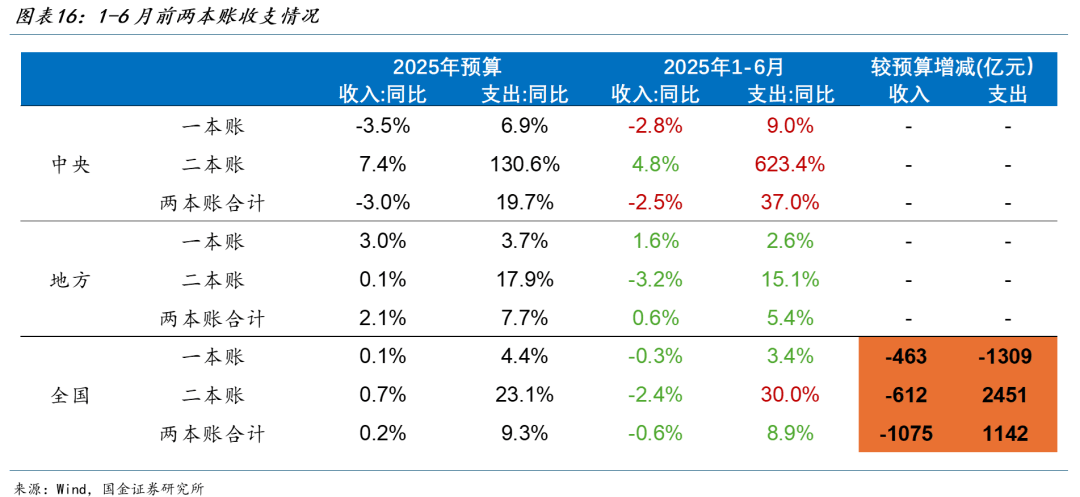
Core Viewpoint - The fiscal revenue and expenditure in the second half of the year are under pressure, but the probability of additional deficits is low. The government is expected to utilize fiscal policy reserves to cover the revenue gap caused by childcare and elderly service subsidies [1][5][11]. Fiscal Revenue and Expenditure Analysis - In the first half of the year, the national fiscal revenue and expenditure deviated slightly from the initial budget, with revenue falling short by 463 billion yuan and expenditure by 1309 billion yuan for the general public budget [2][6]. - The central government's general public budget revenue decreased by 3.5% year-on-year, while expenditure increased by 6.9%. Local governments showed a revenue increase of 3.0% and expenditure increase of 3.7% [3][6]. - For the second half of the year, the expected year-on-year growth rates for the general public budget are -4.5% for revenue and 1.5% for expenditure, leading to a projected revenue shortfall of 516.6 billion yuan and an expenditure shortfall of 547.2 billion yuan compared to the budget [5][11]. Budget Execution and Adjustments - Historically, the completion rate for the general public budget has been over 98%, and significant deviations typically necessitate budget adjustments or additional deficits. However, the flexibility of the special fund budget allows for a completion rate of 80%-90% without strict requirements [2][5]. - The government plans to cover the expected 1200 billion yuan revenue gap from subsidies without increasing the budget by utilizing reserves, including the budget stabilization fund and profits from central financial enterprises [11][12]. Central Financial Enterprises' Role - The profits from central financial enterprises are crucial for offsetting revenue shortfalls. In 2024, these enterprises contributed significantly to the budget, with non-tax revenue showing substantial increases in late 2024 [7][12]. - The central budget stabilization fund had a balance of 2739.22 billion yuan at the end of 2024, with plans to allocate 1000 billion yuan in 2025, leaving a remaining balance of 1739.22 billion yuan [12].


保民生促投资防风险 财政政策积极有为
Zhong Guo Zheng Quan Bao· 2025-08-06 21:09
Group 1 - The current economic growth faces challenges, and fiscal policy will focus on more proactive measures to support key areas, including optimizing expenditure structure and enhancing social welfare [1] - In the first half of the year, social security and employment, education, and health expenditures grew by 9.2%, 5.9%, and 4.3% respectively, all exceeding the general public budget expenditure growth of 3.4% [2] - The issuance of local government bonds reached 2.6 trillion yuan in the first half of the year, supporting major project construction [3] Group 2 - The Ministry of Finance plans to accelerate the issuance and utilization of government bonds, with a focus on special bonds and ultra-long-term special treasury bonds to stabilize investment and promote growth [3] - By the end of July, 2.78 trillion yuan of new special bonds had been issued, accounting for 63% of the annual quota, indicating a faster-than-usual issuance pace [3] - The Ministry of Finance aims to complete the issuance of 1.3 trillion yuan in ultra-long-term special treasury bonds to ensure the implementation of key projects [3] Group 3 - The government is actively working on replacing local government hidden debts, with 1.8 trillion yuan of the 2 trillion yuan replacement bonds for 2025 already issued by June [4] - There is a strong regulatory stance against new hidden debts, with a focus on the orderly exit of local financing platforms to mitigate systemic risks [4][5] - The government emphasizes a market-oriented transformation of financing platforms, gradually pushing for their exit from local government financing roles [5]
沈建光:财政数据背后有哪些信息
Di Yi Cai Jing· 2025-08-06 03:06
全面释放财政政策效力,还需着力促进物价合理回升。同时,做好政策储备,必要时及时出台增量政 策,保障下半年财政支出强度。 二是财政支出向民生倾斜。7月以来,国家育儿补贴实施方案、逐步推行免费学前教育、向失能老年人 发放养老服务消费补贴、财政更大力度支持稳就业等政策措施出台,充分表明财政支出更加注重民生, 更多资金资源将"投资于人"。 财政支出端也体现了上述特征。上半年,一般公共预算支出分项中,社会保障和就业、教育、卫生健康 三大民生类支出增速分别达到9.2%、5.9%、4.3%,均高于总体3.4%的增速,合计占一般公共预算支出 的比重达到40.3%,创2019年以来同期新高;相比之下,农林水事务、城乡社区事务、交通运输三大基 建类的支出增速分别只有-7.8%、-4.2%、-3.1%,合计占比降至18.6%的多年同期低点。 与此同时,上半年,侧重民生兜底、政府运行的一般国债(52%)、地方一般债(57%)发行进度快于 侧重项目建设的地方专项债(49%),也一定程度反映了财政支出向民生倾斜的政策取向。 7月30日,中央政治局会议指出"宏观政策要持续发力、适时加力""在保障改善民生中扩大消费需求"。 此前,国家育儿补 ...
7月新增专项债发行6169亿元创年内新高,同比增长45%助力基建投资提速
Sou Hu Cai Jing· 2025-08-06 01:36
Group 1 - In July, the issuance of new special bonds reached 616.936 billion yuan, an increase of 89.842 billion yuan from the previous month, marking a new high for the year [1] - In the first half of the year, the cumulative issuance of new special bonds amounted to 2.16 trillion yuan, a significant year-on-year increase of 45%, with a noticeable acceleration in the pace of issuance [3] - The acceleration of new special bond issuance is crucial for providing sufficient funding for major project construction, with over 1.6 trillion yuan available for use from August to December [4] Group 2 - The new special bond issuance will significantly support infrastructure investment, with funds primarily directed towards municipal and industrial park infrastructure, transportation infrastructure, and public services [5] - The timely availability of special bond funds helps alleviate the funding pressure on infrastructure projects, playing an important role in stabilizing investment and growth [5] - The acceleration of new special bond issuance is expected to provide strong support for the rebound of infrastructure investment growth in the second half of the year, benefiting related industries such as steel, cement, and construction machinery [5]

多部门密集部署,传递哪些信号?(锐财经)
Ren Min Ri Bao· 2025-08-05 19:15
Macro Policy - The macro policy focus for the second half of the year is "sustained efforts and timely enhancements" [2] - The National Development and Reform Commission emphasizes solid work in development reform, focusing on major changes, important indicators, and significant issues to stabilize employment and expand domestic demand [2][3] Fiscal Policy - The Ministry of Finance aims to utilize a more proactive fiscal policy and increase counter-cyclical adjustments [3] - Plans include accelerating the issuance and use of ultra-long special bonds and local government special bonds to generate physical workload [3] - The fiscal policy will support traditional industry upgrades, emerging industry growth, and future industry layout through various financial tools [3] Monetary Policy - The People's Bank of China will continue to implement a moderately loose monetary policy, ensuring ample liquidity and guiding financial institutions to maintain reasonable credit growth [3] - The focus will be on improving the efficiency of fund usage and enhancing the execution and supervision of interest rate policies [3] Domestic Demand Expansion - Domestic demand contributed 68.8% to economic growth in the first half of the year, continuing to be a primary growth driver [4] - The National Development and Reform Commission plans to stabilize investment and promote consumption, enhancing government investment project management and stimulating private investment [4] - The Ministry of Industry and Information Technology will implement strategies to expand domestic demand and support the industrial economy [4] Consumer Policy - The Ministry of Finance will improve the policy system supporting consumption in services such as elderly care, childcare, culture, and tourism [5] - Policies will include enhancing duty-free shop regulations and promoting healthy development of duty-free retail businesses [5] Employment and Livelihood - Ensuring livelihood security is a key focus for the second half of the year [6] - The Ministry of Human Resources and Social Security will implement job expansion plans in key sectors and promote employment growth in digital, green, and nighttime economies [7] - The Ministry of Agriculture and Rural Affairs will focus on grain production and poverty alleviation, aiming for a grain output target of approximately 1.4 trillion jin [7]
中共中央政治局召开会议;资金面均衡偏松,债市明显回暖
Dong Fang Jin Cheng· 2025-08-05 13:24
Monetary Policy and Economic Outlook - The Central Political Bureau of the Communist Party of China decided to hold the Fourth Plenary Session of the 20th Central Committee in October to discuss the 15th Five-Year Plan for economic and social development, emphasizing the need for stable and flexible policies[5] - The government plans to allocate approximately 90% of the 90 billion yuan budget for childcare subsidies from the central finance[6] Market Trends - The bond market showed signs of recovery, with the yield on the 10-year government bond decreasing by 2.75 basis points to 1.7200%[16] - The U.S. Federal Reserve maintained the federal funds rate at 4.25% to 4.5%, marking the fifth consecutive meeting without changes, while the U.S. GDP grew at an annualized rate of 3% in Q2, surpassing expectations[8][9] Financial Market Performance - The bond market experienced a net cash injection of 158.5 billion yuan on July 30, following a 3,090 billion yuan reverse repurchase operation by the central bank[12] - The weighted average interest rates for various repo transactions showed a downward trend, with DR001 and DR007 rates falling to 1.315% and 1.518%, respectively[13][14] Commodity Prices - International crude oil prices increased, with WTI rising by 1.36% to $70.99 per barrel, while natural gas prices fell by 1.89% to $3.016 per MMBtu[10] Bond Issuance and Trading - The bond auction results indicated a competitive bidding environment, with the 1-year agricultural development bond receiving a bid-to-cover ratio of 2.3[18] - The convertible bond market saw a decline, with major indices dropping, and a total trading volume of 84.376 billion yuan, down by 5.53 billion yuan from the previous day[24]



信用债ETF博时(159396)交投活跃,成交额已近30亿元,机构判断信用债整体走势趋势性下行可能性不大
Sou Hu Cai Jing· 2025-08-05 06:34
Core Viewpoint - The credit bond ETF from Bosera (159396) is experiencing a stable performance with a recent price of 101.12 yuan, showing a 1.05% increase over the past six months, ranking 2nd among comparable funds [1] Group 1: Market Performance - As of August 4, 2025, the credit bond ETF from Bosera has a recent scale of 11.501 billion yuan [2] - The ETF has seen a net value increase of 1.23% over the past six months, ranking 17th out of 480 index bond funds, placing it in the top 3.54% [2] - The ETF's maximum drawdown since inception is 0.89%, with a relative benchmark drawdown of 0.10% [2] Group 2: Trading Activity - The ETF has a trading volume of 28.83 billion yuan with a turnover rate of 25.11%, indicating active market participation [1] - The average daily trading volume over the past month is 4.2 billion yuan, ranking first among comparable funds [1] Group 3: Financial Metrics - The management fee for the credit bond ETF is 0.15%, and the custody fee is 0.05%, which are the lowest among comparable funds [3] - The tracking error for the ETF over the past month is 0.005%, indicating the highest tracking precision among comparable funds [3] Group 4: Investment Environment - The overall trend for credit bonds is not expected to decline significantly, with a supportive stance from the central bank and a favorable environment for positive carry [1] - Institutional investors are likely to gradually enter the market, taking advantage of buying opportunities after recent adjustments [1]
中共中央政治局召开会议,资金面均衡偏松,债市明显回暖
Dong Fang Jin Cheng· 2025-08-05 06:02
Report Industry Investment Rating - Not provided in the content Core Viewpoints - On July 30, the central bank conducted continuous net injections, leading to a balanced and slightly loose liquidity situation. The bond market showed a significant recovery, while the main indices of the convertible bond market closed down collectively, with most individual convertible bonds declining. Yields of U.S. Treasury bonds across various maturities generally increased, and yields of 10-year government bonds in major European economies also mostly rose [1]. Summaries by Directory I. Bond Market News (1) Domestic News - The Political Bureau of the CPC Central Committee decided to hold the Fourth Plenary Session of the 20th CPC Central Committee in October to discuss the 15th Five-Year Plan. It emphasized maintaining policy continuity and stability, implementing proactive fiscal and moderately loose monetary policies, and taking measures in multiple aspects such as supporting innovation, consumption, and resolving local government debt risks [3]. - The CPC Central Committee held a symposium with non - Communist Party personages, with General Secretary Xi Jinping stressing the need to adhere to the general principle of making progress while maintaining stability in the second half of the year, aiming to achieve the annual economic and social development goals [4]. - The central government plans to allocate about 90 billion yuan for child - rearing subsidies this year, with the central finance bearing about 90% of the funds for the national basic standard [4][5]. - The National Development and Reform Commission solicited public opinions on guiding the layout and investment of government investment funds to prevent homogenization and crowding - out effects [5]. - The National Association of Financial Market Institutional Investors issued a notice to regulate the book - building issuance and underwriting in the inter - bank bond market from August 11, 2025 [6]. (2) International News - The Federal Reserve kept the federal funds rate target range at 4.25% - 4.5% for the fifth consecutive meeting. Some members advocated a 25 - basis - point rate cut, and Fed Chairman Powell dampened market expectations of a September rate cut [7]. - The U.S. Q2 real GDP annualized quarterly growth rate was 3%, reversing the Q1 decline and exceeding expectations. The core PCE price index was 2.5%, down from the previous value but higher than expected. However, there are concerns about the economic recovery, such as weakening domestic demand [9]. (3) Commodities - On July 30, international crude oil futures prices continued to rise, while international natural gas prices continued to fall. WTI crude oil rose 1.36% to $70.99 per barrel, Brent crude oil rose 1.47% to $73.47 per barrel, COMEX gold futures fell 1.72% to $3266.90 per ounce, and NYMEX natural gas prices fell 1.89% to $3.016 per ounce [10]. II. Liquidity (1) Open Market Operations - On July 30, the central bank conducted 309 billion yuan of 7 - day reverse repurchase operations at an interest rate of 1.40%. With 150.5 billion yuan of reverse repurchases maturing, the net injection was 158.5 billion yuan [12]. (2) Funding Rates - Due to continuous net injections by the central bank on July 30, the liquidity was balanced and slightly loose, and major repurchase rates continued to decline. For example, DR001 dropped 4.81bp to 1.315%, and DR007 dropped 4.67bp to 1.518% [13]. III. Bond Market Dynamics (1) Interest - Rate Bonds - **Spot Bond Yield Trends**: After the Political Bureau meeting on July 30, the bond market recovered significantly. By 20:00, the yield of the 10 - year Treasury bond active bond 250011 dropped 2.75bp to 1.7200%, and the yield of the 10 - year China Development Bank bond active bond 250210 dropped 3.25bp to 1.8040% [16]. - **Bond Tendering Results**: Details of the tendering results of several agricultural bonds, including the issuance scale, winning yields, and multiples, were provided [17]. (2) Credit Bonds - **Secondary Market Transaction Anomalies**: On July 30, the trading price of one industrial bond, "H0 Yangcheng 04", deviated by more than 10%, rising over 747% [17]. - **Credit Bond Events**: Multiple credit - related events occurred, such as asset freezes of some companies, changes in credit ratings, and cancellations of bond issuances [18]. (3) Convertible Bonds - **Equity and Convertible Bond Indices**: On July 30, the A - share market weakened in the afternoon. The Shanghai Composite Index rose 0.17%, while the Shenzhen Component Index and the ChiNext Index fell 0.77% and 1.62% respectively. The main indices of the convertible bond market closed down collectively, and most individual convertible bonds declined [20]. - **Convertible Bond Tracking**: Companies such as Hang Lung Properties reported their performance, and there were announcements regarding bond payments, revisions of conversion prices, and decisions on early redemptions [23][24][25]. (4) Overseas Bond Markets - **U.S. Bond Market**: On July 30, yields of U.S. Treasury bonds across various maturities generally increased. The 2 - year U.S. Treasury bond yield rose 8bp to 3.94%, and the 10 - year yield rose 4bp to 4.38%. The yield spreads between 2 - year and 10 - year, and 5 - year and 30 - year U.S. Treasury bonds narrowed [26][27]. - **European Bond Market**: On July 30, the 10 - year UK government bond yield dropped 4bp, while yields of 10 - year government bonds in other major European economies mostly rose [29]. - **Daily Price Changes of Chinese - Issued Dollar Bonds**: The daily price changes of Chinese - issued dollar bonds as of July 30 were presented, including the price changes, credit entities, bond codes, and other information of top - rising and top - falling bonds [31].
美国经济-第二季度GDP经济正在降温US Economics-2Q GDP The economy is cooling
2025-08-05 03:20
Summary of Key Points from the Conference Call Industry Overview - The conference call focuses on the **US Economics** sector, specifically analyzing the **2Q GDP** performance and its implications for the economy moving forward [1][6]. Core Insights and Arguments 1. **GDP Growth**: The headline US GDP rose by **3.0%** quarter-over-quarter (q/q) seasonally adjusted annual rate (saar) in 2Q, a significant recovery from a **0.5%** decline in 1Q [1][9]. 2. **Domestic Demand**: Domestic demand was notably weaker, slowing to a **1.2%** pace from **2.7%** over the previous year, indicating a softening in both household and business spending [8][9]. 3. **Trade Volatility**: A **30.3%** drop in imports in 2Q, following frontloading in 1Q, artificially inflated the GDP figure, suggesting that the growth may not be sustainable [9][12]. 4. **Inflation Concerns**: Core PCE price inflation exceeded expectations at **2.54%** q/q annual rate, indicating potential upward risks to inflation forecasts [10][26]. 5. **Consumer Spending**: Real personal consumption rebounded to **1.4%** in Q2, driven by a **2.2%** increase in goods spending, particularly in motor vehicles, which rose **16.2%** [15][16]. 6. **Investment Trends**: Nonresidential fixed investment growth slowed, with structures investment declining by **10.3%** in 2Q, reflecting increased uncertainty in the private sector regarding capital spending [29][30]. 7. **Government Spending**: Government spending added modestly to growth, rising **0.4%** in 2Q, but federal spending fell **3.7%**, indicating a potential drag on future growth [28][37]. 8. **Future Outlook**: The outlook for GDP growth remains cautious, with expectations of a slowdown in the second half of the year due to restrictive trade and immigration policies [9][38]. Additional Important Insights - **Inventory Changes**: Changes in inventories contributed significantly to GDP volatility, with inventories subtracting **3.2 percentage points** from GDP in 2Q [13][39]. - **Weakness in Services**: Services spending showed a modest increase of **1.1%** in Q2, but this was still below the pace seen in 2024, indicating ongoing challenges in the services sector [17][24]. - **Residential Investment Decline**: Households sharply reduced residential investment, which fell by **4.6%** in the quarter, following a modest decline in 1Q [18][39]. - **Economic Factors**: The slowdown in economic activity is attributed to various factors, including payback effects, immigration restrictions, and policy uncertainty affecting spending and hiring plans [37][38]. This summary encapsulates the critical findings and projections discussed during the conference call, providing a comprehensive overview of the current state and future expectations of the US economy.
超6000亿元!7月新增专项债发行规模创年内新高
Zheng Quan Shi Bao· 2025-08-04 23:51
Group 1 - The issuance of new local government special bonds has accelerated since April, with July seeing a record high issuance of 616.936 billion yuan, an increase of 89.842 billion yuan from the previous month [1] - The cumulative issuance of new special bonds in the first half of the year reached 2.16 trillion yuan, a significant year-on-year increase of 45%, supporting major project construction and maintaining resilience in infrastructure investment growth [1] - Market institutions expect the issuance of new special bonds to accelerate in the third quarter, with over 1.6 trillion yuan of quota available for use from August to December [1] Group 2 - The fiscal policy this year has been more proactive, with expectations for continued improvement in investment funding and project support due to the effects of existing policy combinations [2] - The significant supply of government bonds is expected to provide substantial support for social financing scale, with net financing amounts projected to reach 1.29 trillion yuan and 1.41 trillion yuan in July and August, respectively [2]
