关税战

Search documents
电影《大空头》原型Q1精准“逃顶” 关税战前夕做空英伟达(NVDA.US)和中概股
Zhi Tong Cai Jing· 2025-05-16 03:03
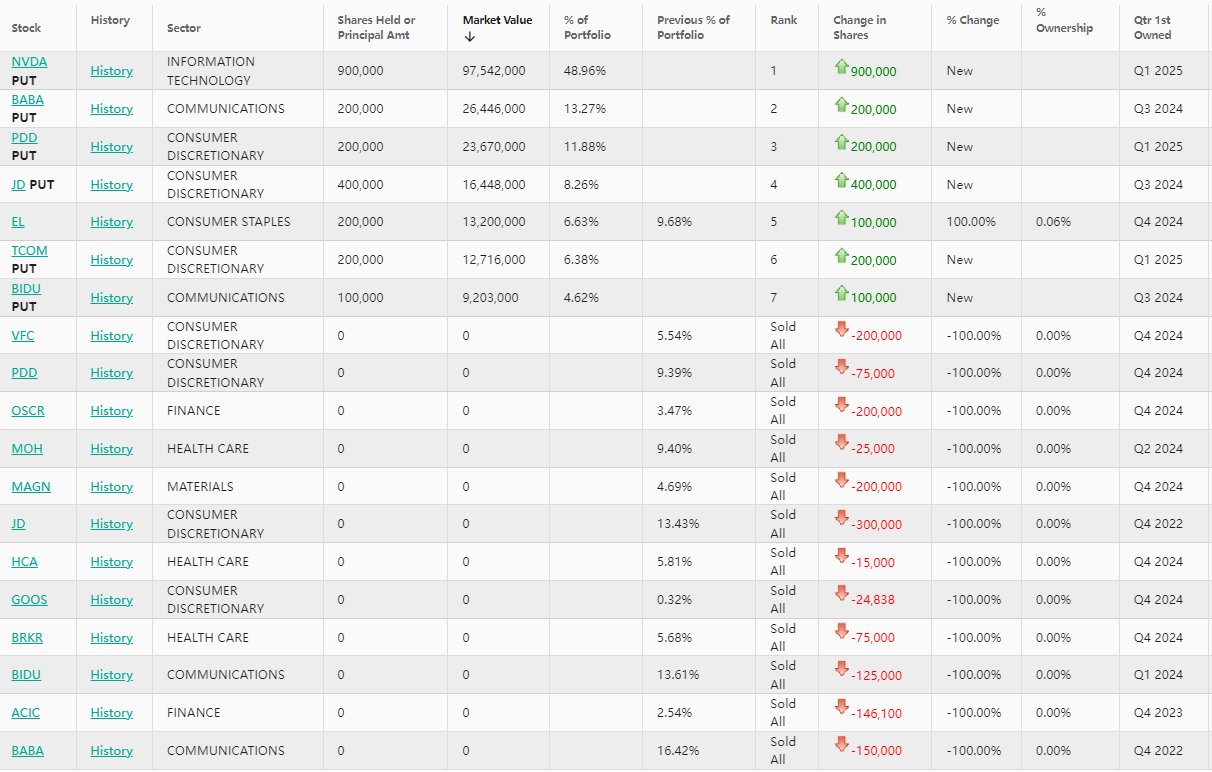
Core Insights - Michael Burry's Scion Asset Management has nearly liquidated all its listed stock holdings in Q1, while establishing bearish positions on Nvidia and Chinese tech stocks ahead of potential trade tensions initiated by Trump [1][2] Group 1: Holdings and Positions - Scion Asset Management's largest position is in Nvidia put options, holding 900,000 shares valued at $97.54 million, representing 48.96% of the portfolio [3] - The second largest position is in Alibaba put options, with 200,000 shares valued at $26.45 million, accounting for 13.27% of the portfolio [3] - Other notable positions include Pinduoduo put options (200,000 shares, $23.67 million, 11.88%) and JD put options (400,000 shares, $16.45 million, 8.26%) [3] Group 2: Changes in Holdings - The only stock held besides put options is Estée Lauder, with 200,000 shares valued at $13.2 million, which has doubled from the previous quarter [2] - Significant reductions in holdings include the complete sale of positions in various companies such as JD, Alibaba, and Pinduoduo, indicating a strategic shift towards bearish positions [3] Group 3: Market Reactions - Following the disclosure of the 13F filing, Nvidia's stock experienced a slight decline in after-hours trading, while Estée Lauder's stock surged nearly 7% [3]


宝城期货股指期货早报-20250516
Bao Cheng Qi Huo· 2025-05-16 02:06
Group 1: Report Industry Investment Rating - Not provided in the given content Group 2: Core Viewpoints of the Report - The overall view of the stock index is range - bound, with a short - term and intraday outlook of oscillating strongly and a medium - term outlook of oscillation [1][5] - Policy support is strong, and the internal policy continues to play a supporting role, while external risk factors are alleviated, leading to a cautiously optimistic market sentiment [1][5] - The continuous upward momentum of the stock index is insufficient, and there is a possibility of short - term pull - back after a rise and repeated oscillations [5] - The performance of the Shanghai 50 and CSI 300 is expected to be stronger than that of the CSI 500 and CSI 1000 [5] Group 3: Summary by Relevant Catalogs Variety Viewpoint Reference - Financial Futures Stock Index Sector - For IH2506, the short - term and medium - term views are oscillation, the intraday view is oscillating strongly, and the overall view is range - bound, with policy support as the core logic [1] Main Variety Price Quotation Driving Logic - Financial Futures Stock Index Sector - The intraday view is oscillating strongly, the medium - term view is oscillation, and the reference view is range - bound [5] - Yesterday, each stock index oscillated and pulled back, and the full - market trading volume of the stock market was 1190.4 billion yuan, a decrease of 159.5 billion yuan from the previous day [5] - The April social financing and credit data were mixed, with significant government bond efforts, but the financing demand of the enterprise and household sectors remained weak [5] - In the second quarter, the external tariff war conflict has eased, and the recent "order - grabbing" in Sino - US trade is expected to improve external demand to some extent [5] - The differentiation of corporate profitability among industries is obvious, and the new public fund regulations are accelerating the flow of funds to large - cap weighted stocks [5]
杨德龙:学习巴菲特之道抓住长期投资机会
Xin Lang Ji Jin· 2025-05-15 10:10
Group 1 - The core investment philosophy of Buffett emphasizes buying great companies at reasonable prices rather than cheap companies, which was influenced by his partner Charlie Munger [1][2] - Buffett's investment portfolio consists of well-known blue-chip stocks such as Apple, Bank of America, and Coca-Cola, demonstrating his focus on companies within his circle of competence [2][3] - Buffett has avoided investing in technology stocks despite their significant growth, prioritizing value investing principles and avoiding speculative investments [2][3] Group 2 - Buffett has passed the investment reins to Greg Abel, who may incorporate more technology stocks, reflecting a generational shift in investment strategy [3][7] - Berkshire Hathaway currently holds over $340 billion in cash, indicating Buffett's cautious approach to high market valuations and his belief in future investment opportunities [3][8] - The Chinese technology sector is gaining recognition globally, with investors acknowledging its potential for innovation and growth, particularly in areas like robotics and artificial intelligence [4][5][6] Group 3 - The Chinese market is seen as having a significant advantage in commercial applications and cost-effective production, particularly in robotics and electric vehicles [5][6][8] - The ongoing trade tensions with the U.S. have highlighted China's growing strength and ability to negotiate from a position of power [9] - There is a belief that value investing in China may yield higher returns compared to the U.S. market, especially as the real estate sector faces challenges [9][10]
日上集团(002593) - 002593日上集团投资者关系管理信息20250515
2025-05-15 10:10
Group 1: Financial Performance - In 2024, the company achieved a revenue of 3.069 billion CNY and a net profit attributable to the parent company of 51.977 million CNY [3] - The company will distribute dividends on May 21, 2025 [2] Group 2: Market and Stock Performance - The company experienced a significant drop of over six points in stock price following a previous surge, attributed to market behavior [2] - As of March 31, 2025, the number of shareholders reached 70,375 [3] Group 3: Business Operations and Strategy - The company focuses on dual main businesses: automotive wheels and steel structures [3] - The overseas production capacity is primarily located in Quang Ninh and Bac Ninh, Vietnam [3] - The U.S. tariff increases have had a certain impact on the company's performance, prompting a faster overseas factory layout to mitigate tariff effects [3]

中国是如何让特朗普低头的? 法国媒体认为,北京做对了四件事
Sou Hu Cai Jing· 2025-05-15 06:41
特朗普的"对等关税"在实施快一个月的时候,近期与中方在《中美日内瓦经贸会谈联合声明》中达成了 多项积极的共识。 其中,美方承诺取消四月八号和九号对中国产品增加的共计百分之九十一的税收,修改了四月二号对中 国产品增加的百分之三十四的对等税收,以及百分之二十四的税收暂停增加九十天,保留剩下百分之十 的税收。 相应的,中方也同样取消和暂停了以上对等税收。 对于美方的行为,很多外媒表示:"美总统与中方达成的条约像是在投降。" 图片来源于网络 要知道,美总统在实施对等税收的时候,中方可是"一步不退"。 那么是什么原因让美方答应降低税收,重新启动贸易谈判磋商了呢? 法媒觉得,中方做对了4件事,才使美方做出了很大的妥协,可为什么会这样去说呢? 在本月十二号,中美发布的联合声明当中,最让人关注的一点就是税收,也就是我们开头所提到的。 图片来源于网络 现如今,声明一出,所有的关税都被取消,美总统加了半天,到头来白忙活一场,虽说还只剩下百分之 十,但这一点税收根本不算什么。 之前在接受记者采访的时候,美总统还说到:"不会为了重新启动谈判而降低税收"。 可现在中方还"一点没有让步",他就主动低头了。 这让各方网民和媒体也是看不懂。 ...
建信期货集运指数日报-20250515
Jian Xin Qi Huo· 2025-05-15 05:40
行业 集运指数日报 日期 2025 年 5 月 15 日 研究员:何卓乔(宏观贵金属) 18665641296 hezhuoqiao@ccb.ccbfutures.com 期货从业资格号:F3008762 研究员:黄雯昕(国债集运) 021-60635739 huangwenxin@ccb.ccbfutures.com 期货从业资格号:F3051589 研究员:聂嘉怡(股指) 021-60635735 niejiayi@ccb.ccbfutures.com 期货从业资格号:F03124070 宏观金融团队 请阅读正文后的声明 #summary# 每日报告 | | | 表1:集运欧线期货5月14日交易数据汇总 | | | | | | | | | --- | --- | --- | --- | --- | --- | --- | --- | --- | --- | | 合约 | 前结算 价 | 开盘价 | 收盘价 | 结算价 | 涨跌 | 涨跌幅 (%) | 成交量 | 持仓量 | 仓差 | | EC2506 | 1,488.0 | 1,502.0 | 1,726.0 | 1,643.9 | 238.0 | 15 ...
宁证期货今日早评-20250515
Ning Zheng Qi Huo· 2025-05-15 05:38
今 日 早 评 重点品种: 【短评-铁矿石】5月14日,山东港口进口铁矿价格较上一 工作日价格偏强运行,累计上涨10-15。目前PB粉主流在778- 780;超特粉主流在645附近;PB块主流在915附近。评:主力期 价持续上行,量仓扩大。现阶段,得益于市场情绪回暖,贴水 修复逻辑支撑下矿价强势上涨,短期维持偏强运行态势,但矿 石需求趋于触顶,且供应维持高位,基本面仍易转弱,上行驱 动不强,高位谨慎看涨,谨防逻辑切换至现实端。 【短评-原油】欧佩克月报显示,4月份,OPEC原油总产量 下降6.2万桶/日,至2671万桶/日,而"欧佩克+"国家总产量 下降10.6万桶/日,至4092万桶/日。哈萨克斯坦4月份石油产量 下降4.1万桶/日,至182万桶/日;欧佩克表示,2025年,欧佩 克+以外国家的供应量将增加约80万桶/日,低于上月预测的90 万桶/日;OPEC预计2025年石油需求将增加130万桶/日,2026年 增加128万桶/日,这一预测高于国际能源署估计的72.6万桶/ 日。评:欧佩克同意增加供应的八个国家上个月总共只增加了 2.5万桶/日,远低于计划的13.8万桶/日,该组织对全球贸易形 势的发展持 ...
中美贸易从对抗走向对话有利于全球
Zhong Guo Fa Zhan Wang· 2025-05-15 03:51
5月12日,《中美日内瓦经贸会谈联合声明》发布,双方互相大幅降低关税,中美贸易局势从对抗走向 对话。联合国秘书长古特雷斯认为这对全球经济是一个"非常积极"的信号;世贸组织总干事伊维拉表示 会谈是向前迈出的重要一步。 如何维护好当前的对话势头,在平等协商中管控分歧、积累共识、强化信任?近日,本报记者对话北京 师范大学教授、经济学家万喆,就上述问题进行分析。 一大进步,风险管控的原则是灵活性加对等性 本报记者:怎么解读5月12日《中美日内瓦经贸会谈联合声明》所透露出的信息?4月2日以来,中美关 税战这一回合"胜负"如何理解? 中国发展改革报社记者 | 季晓莉 万喆:不用理解为哪方赢了或哪方输了,这次会谈能达成共识是一种共赢。美国所谓的"MAGA"("让 美国再次伟大")不能建立在缩减全球其他国家发展空间的基础上。从对抗到对话转轨,双方达成共 识、未来争取共赢,以后才有合作前景和好的预期。会谈进行了危机管控、分层次解决问题,有助于解 决长期性结构性问题。 本报记者:根据特朗普政府上次任期内与中国关税战期间的谈判策略,在本轮关税战中,接下来是否会 出现反复?我们应如何管控这种风险? 万喆:自特朗普今年上任,特别是提出 ...
2025年4月金融数据点评:4月信贷大幅少增,社融、M2增速加快,一揽子金融支持政策将推动金融总量增速持续上行
Dong Fang Jin Cheng· 2025-05-15 03:23
Group 1: Loan and Financing Trends - In April 2025, new RMB loans amounted to 280 billion, a year-on-year decrease of 450 billion, primarily due to the over-issuance in March and ongoing local debt replacement effects[1][4][11] - The total social financing (TSF) in April was 1.1585 trillion, a year-on-year increase of 1.2243 trillion, driven by a low base from the previous year and significant government bond issuance[1][7][11] - The M2 money supply grew by 8.0% year-on-year, an increase of 1.0 percentage points from the previous month, indicating enhanced financial support for the real economy[1][9][11] Group 2: Economic Outlook and Policy Implications - The People's Bank of China announced a series of financial support policies on May 7, including interest rate cuts, which are expected to increase bank lending capacity by approximately 1 trillion[3][12] - The easing of the US-China trade tensions, as noted in the May 12 joint statement, may partially restore bilateral trade, although high tariffs will continue to pose challenges[3][12] - The expectation is for continued year-on-year increases in credit and social financing in May, with M2 growth also anticipated to accelerate[3][12][13] Group 3: Structural Changes in Loan Distribution - From January to April 2025, new loans totaled 10.06 trillion, a year-on-year decrease of 130 billion, largely influenced by local debt replacement factors[1][6][11] - The structure of loans has improved, with the proportion of loans to small and micro enterprises, manufacturing, and key service sectors increasing significantly[1][6]
一财社论:对通胀降温的判断考验美联储
第一财经· 2025-05-14 15:45
Core Viewpoint - The article discusses the recent trends in U.S. inflation data, highlighting a cooling trend that poses a challenge for the Federal Reserve's decision-making process, particularly regarding potential interest rate cuts [1][2]. Group 1: Inflation Data Analysis - In April, the U.S. Consumer Price Index (CPI) showed a year-on-year increase of 2.3%, marking the lowest level since February 2021 and remaining below expectations for three consecutive months [1]. - Month-on-month, the CPI rose by 0.2%, also falling short of market expectations, indicating a potential shift in inflation dynamics [1]. - Core inflation remains at a relatively comfortable level for the market, suggesting a sustained cooling trend [1]. Group 2: Federal Reserve Decision-Making - The article raises the question of whether the Federal Reserve will initiate a rate cut in response to the cooling inflation, which is seen as a favorable condition for such a move [1]. - The Federal Reserve's cautious stance is influenced by uncertainties stemming from the Trump administration's trade policies, particularly the tariff war, which complicates the inflation outlook [2]. - The decision-making framework of the Federal Reserve is under scrutiny, as it continues to rely on past mechanisms that may not be suitable for the current economic environment characterized by volatility and unpredictability [2][3]. Group 3: Market Reactions and Expectations - The article emphasizes that market participants are likely to adjust their behaviors in response to the tariff war, which could lead to immediate inflationary pressures despite the current data showing a cooling trend [3]. - Investors are advised to prepare for potential risks associated with the Federal Reserve's decisions, especially given the unsustainable nature of U.S. deficits and the burden of interest payments on national debt [3]. - The ongoing global economic transformation, driven by factors such as AI and changes in the supply chain, adds complexity to the Federal Reserve's decision-making landscape [3].