
消费业

Search documents
1月政策跟踪观察:积极因素正在累积
Shenwan Hongyuan Securities· 2026-02-11 02:11
宏 观 研 究 政策月报 2026 年 02 月 11 日 积极因素正在累积 —— 1 月政策跟踪观察 开年以来,地产、消费、投资均有积极变化。部委间财政金融政策如何协同发力扩内需、撑民 企?地方政府如何抢抓"最长春节"红利?本文结合部委及地方政策动态深入分析,可供参考。 一、地产最艰难的时段或已过去,供需拖累均有所放缓 地产部分供需数据已呈现边际修复态势,最艰难的时段或已逐步过去。从成交与土地市场数据 来看,供需端同步显现改善迹象,核心指标降幅小幅收窄。节前 3-4 周,全国代表城市二手房 成交面积同比降幅收窄超 5 个百分点至-14.7%。供给端,2025 年 12 月政府性基金收入降幅收 窄至-11.7%;土地出让收入同比-22.9%,较 11 月收窄 3.9 个百分点。 政策层面,多维度支持政策持续发力、协同发力,着力稳定房地产市场运行。房企监管重点更 聚焦于风险处置与民生保障,形成差异化、精准化的监管导向。媒体报道指出,目前多家房企 已不再被监管部门要求每月上报"三道红线"相关指标;部分出险房企需向总部所在城市专项 工作组定期汇报资产负债率等核心财务指标,同时还需上报经营恢复进展、债务化解情况等。 ...
深圳两会聚焦产业升级:立法护航会展经济,科技赋能消费农业
Nan Fang Du Shi Bao· 2026-02-09 10:04
Group 1: Exhibition Economy - The proposal to establish a "Shenzhen Standard" for the exhibition industry aims to provide legal support for high-quality development and clarify the roles of regulatory bodies and inter-departmental collaboration [3] - The suggestion to implement the "Shenzhen Global Promotion Partner Program" seeks to leverage the opportunity of hosting APEC 2026 to cultivate independent overseas exhibition brands and transition from "participating in exhibitions abroad" to "organizing exhibitions abroad" [3] Group 2: Consumer Innovation - The strategy to enhance consumer experiences includes integrating "Shenzhen products" into the city's trade-in subsidy program and developing new scenarios like "drone delivery + smart experience" [4] - The call for systematic development of the "silver economy" targets the aging population, proposing the establishment of age-friendly tourism service standards and cross-border cultural and health tourism products [4] - The promotion of "small stall economy" aims to enhance urban vibrancy by planning night markets with government support for infrastructure [4] Group 3: Agriculture and Health Industry - The proposal to create a "Shenzhen Agricultural Standard Port" focuses on exporting comprehensive solutions in smart agriculture and cold chain logistics [5] - The suggestion to reform the management system for food and medicinal substances aims to establish a full-chain regulatory mechanism for functional food [5] Group 4: Space Reconfiguration and Cross-Industry Integration - The recommendation to transform land use in Nanshan District aims to provide space for high-end functions like headquarters economy and R&D [6] - The proposal for a "Cultural + Technology + Trade" integration model seeks to deepen strategic cooperation between Shenzhen and the Middle East [6] - The initiative to host national-level cultural events aims to enhance Shenzhen's cultural influence and attract talent [6] Group 5: Innovation Ecosystem - The call for opening public computing and data resources aims to create a unified "AI co-creation space" platform to lower barriers for AI innovation [7] - The proposal to reform the "Shenzhen Quality Investment" system seeks to align project evaluations with financing and government funding to support hard technology [7]


海南省2025年GDP达8108.85亿元 同比增长4.0%
Zhong Guo Xin Wen Wang· 2026-01-24 02:12
Economic Growth - Hainan's GDP is projected to reach 810.885 billion yuan in 2025, with a year-on-year growth of 4.0% at constant prices [1] - The primary industry is expected to contribute 164.255 billion yuan, growing by 4.4%, while the secondary industry will add 146.386 billion yuan, with a growth of 1.0% [1] - The tertiary industry is anticipated to generate 500.244 billion yuan, reflecting a growth of 4.6% [1] Agricultural and Industrial Performance - The total output value of agriculture, forestry, animal husbandry, and fishery is projected to be 263.186 billion yuan in 2025, with a year-on-year increase of 4.7% [1] - Industrial growth is accelerating, with a year-on-year increase of 9.9% in the added value of above-scale industries [1] - Equipment manufacturing and high-tech manufacturing sectors are experiencing significant growth, with increases of 103.1% and 28.1%, respectively [1] Service Sector and Tourism - The added value of the service sector is expected to grow by 4.6% year-on-year in 2025 [1] - The tourism market is showing strong performance, with 106.075 million visitors and total tourism expenditure of 225.432 billion yuan, representing growth of 9.1% and 10.5%, respectively [1] Investment and Consumption - Fixed asset investment in Hainan is projected to decline by 16.5% in 2025 [2] - Social retail sales are expected to grow by 5.0%, with significant increases in home appliances (17.6%), communication equipment (56.6%), and automobiles (33.0%), particularly in new energy vehicles, which are expected to grow by 51.3% [2] Trade and Income - The total service import and export value is projected to be 69.255 billion yuan, with a year-on-year increase of 22.1%, while the total goods import and export value is expected to be 276.003 billion yuan, showing a slight decline of 0.7% [2] - Per capita disposable income is expected to reach 36,306 yuan, with a nominal growth of 4.2% and a real growth of 4.3% after adjusting for price factors [2] Long-term Economic Outlook - During the 14th Five-Year Plan period, Hainan's economy is expected to grow at an average annual rate of 5.7%, surpassing the national average by 0.3 percentage points [3] - The economic total is projected to cross three trillion yuan thresholds within five years, exceeding 800 billion yuan [3] - The construction of the Hainan Free Trade Port is entering a new phase, boosting confidence across various sectors and promoting stable economic recovery [3]
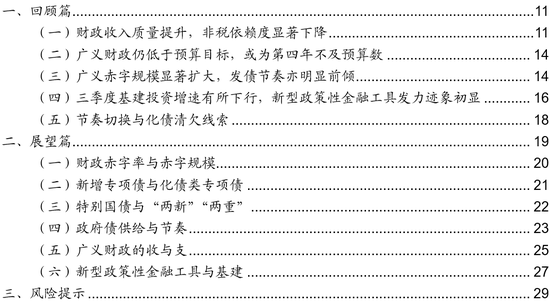
【广发宏观吴棋滢】延续必要强度,优化发力路径:2026年财政政策展望
Xin Lang Cai Jing· 2025-12-25 01:33
Group 1 - The core viewpoint of the report is that the fiscal policy for 2025 will be "more proactive," leading to significant increases in both narrow and broad fiscal deficits, with narrow deficit expected to rise by 39% and broad deficit by 27% [1][13][14] - The issuance of government bonds will be accelerated, with net supply expected to increase by 128% year-on-year in the first half of 2025, while broad fiscal expenditure is projected to show a "U"-shaped trend in 2024 and a "front high and back low" trend in 2025 [1][14] - The structure of fiscal revenue is improving, with a target growth rate for non-tax revenue set at -14.2%, indicating a reduced reliance on non-tax income [2][15][16] Group 2 - The expansion of debt resolution measures and diversification of debt resolution methods are highlighted, including the issuance of special bonds and policies targeting corporate arrears and PPP projects [2][16][17] - The expected slowdown in infrastructure investment growth in the second half of 2025 is attributed to several factors, including the completion of prior funding projects and the diversion of funds to debt resolution [3][18][19] - For 2026, the central economic work conference emphasizes the continuation of a more proactive fiscal policy, with expectations for a slight increase in fiscal strength compared to 2025 [4][20][21] Group 3 - The anticipated fiscal revenue growth for 2026 is projected to rebound to 3%-5%, driven by price increases and tax policy adjustments [5][26][27] - The introduction of new policy financial tools is expected to significantly impact fixed asset investment, with an estimated investment scale of 1.5-2 trillion yuan in 2026 [6][28][29] - The report indicates a structural shift in consumption patterns, with a focus on new types of consumption and service consumption, as traditional durable goods consumption is expected to slow down [8][32][33] Group 4 - The report discusses the expansion of debt resolution to include non-hidden debts, with measures to clear local government arrears to enterprises [9][34][35] - The importance of improving the local tax system is highlighted, with potential reforms in consumption tax expected to accelerate [10][36][37] - The overall impact on the asset side suggests that continued fiscal strength and proactive measures will support nominal growth and micro-activity in 2026 [11][37]
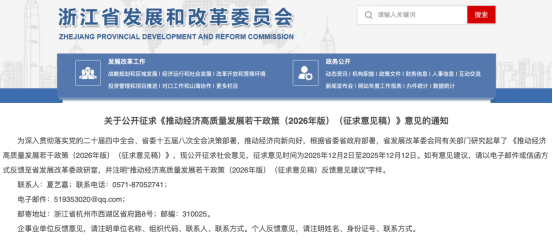
最新发布!刚刚,重磅利好来袭!
Zheng Quan Shi Bao Wang· 2025-12-03 10:26
Core Viewpoint - Zhejiang's draft policy for promoting high-quality economic development outlines 42 specific measures across eight areas, aiming to enhance innovation, manufacturing, and service sectors while supporting consumption upgrades [2][4]. Group 1: Innovation and Technology - The draft emphasizes the importance of original innovation and tackling key core technologies, proposing a collaborative mechanism involving enterprises, government, and platforms [4]. - It plans to implement over 400 major technology projects and achieve more than 100 significant technological outcomes, with at least 80% participation from enterprises [4]. - The policy includes a target of establishing a computing power scale of 200 EFlops in the province and allocating approximately 500 million yuan for artificial intelligence support [5]. Group 2: Advanced Manufacturing - The draft aims to enhance the competitiveness of new quality productivity industries, offering up to 500,000 yuan in subsidies for individual projects [6]. - It proposes to support over 5,000 key industrial technology transformation projects and aims for an increase of over 1.1 trillion yuan in medium to long-term loans for manufacturing [7]. - The policy encourages the establishment of 20 future factories and 200 smart factories, along with the creation of 20 provincial industrial data sets [8]. Group 3: Service Sector and Consumption - The draft seeks to promote consumption upgrades by fostering new consumption models and issuing consumption vouchers to stimulate spending [9]. - It aims to support the transformation of over 50 professional markets and enhance the influence of the "Delicious Zhejiang" brand through various events [9]. - The policy includes measures to support the growth of service industry platforms and the establishment of around 200 leading service enterprises [10]. Group 4: Aviation and Low-altitude Economy - The draft supports the construction and operation of A-class general airports and the opening of over five new international routes and 100 drone routes [10].
恒生指数季度调整 成分股扩容至89只
Jin Rong Shi Bao· 2025-11-25 01:15
Group 1 - The Hang Seng Index Company announced quarterly index adjustments effective after market close on December 5, 2025, with changes to major indices including the Hang Seng Index, Hang Seng China Enterprises Index, and Hang Seng Tech Index [1][2] - The Hang Seng Index will include Innovent Biologics with a weight of 0.91%, increasing the number of constituent stocks from 88 to 89 [1] - The Hang Seng China Enterprises Index will add China Hongqiao, Innovent Biologics, and Yum China with weights of 1.30%, 1.21%, and 0.91% respectively, while removing New Hope Energy and others, maintaining a total of 50 stocks [1][2] Group 2 - The Hang Seng Tech Index will include Leapmotor with a weight of 0.98%, while ASMPT will be removed, keeping the total at 30 stocks [1] - The Hang Seng Composite Index will add six companies, increasing the number of constituent stocks from 503 to 509 [1] - The adjustments are expected to lead to increased trading volumes on December 5, as passive funds may rebalance to minimize tracking errors [3] Group 3 - The adjustments will increase the representation of healthcare and industrial sectors in the Hang Seng Index, with healthcare rising from 2.9% to 4.0% and industrial from 8.8% to 9.1% [3] - Financial and consumer sectors will see a decline in representation, with financial dropping from 33.6% to 32.9% and consumer from 27.4% to 26.4% [3] - Multiple institutions express optimism about the future performance of Hong Kong stocks, particularly in technology and healthcare sectors [3][4] Group 4 - UBS highlights that support for private enterprises and capital markets, along with liquidity and potential inflows from domestic and international investors, will continue to bolster the market [5] - The outlook for 2026 predicts a rise in non-financial profit growth for overseas Chinese stocks from 10% to around 15% [4] - The market is seen as entering a favorable positioning phase, with recommendations to focus on underperforming sectors such as consumer services and construction [4]
要动武?日本股市先"崩"为敬!高市早苗的豪赌,撞上中国经济铁壁
Sou Hu Cai Jing· 2025-11-18 15:22
Group 1: Political Developments - Japanese Prime Minister Sanae Takaichi's recent statements suggest a potential military intervention in the Taiwan Strait, indicating a shift in Japan's defense posture [1] - Takaichi's government plans to accelerate defense spending to 2% of GDP, originally set for fiscal year 2027, raising concerns given Japan's high debt levels [3] - The government is also considering changes to its "Three Non-Nuclear Principles," which could allow for the introduction of nuclear weapons [3] Group 2: Military Capabilities - Japan has been quietly building significant offensive capabilities, including the development of "counterstrike capabilities" and the procurement of 400 Tomahawk cruise missiles [4] - The Japan Maritime Self-Defense Force has modified two Izumo-class destroyers to operate F-35B fighter jets, enhancing its naval power [4] - Plans are underway to establish approximately 130 large ammunition depots across the country by 2035 [4] Group 3: Economic Context - Japan's economic dependency on China is substantial, with a 59.1% increase in investments in China in the first half of 2025, and over 30% reliance on Chinese supplies for key industries like automotive and semiconductors [7] - Japan's energy security is precarious, with 98% of its oil imported and 88% of that reliant on the Strait of Malacca, which is outside Japan's control [7] - The government's debt exceeds twice its GDP, raising concerns about the sustainability of increased defense spending [7] Group 4: Public Reaction - Takaichi's remarks have sparked widespread criticism domestically, with former Prime Minister Shigeru Ishiba and other political figures expressing concern over the implications of such statements [8] - Public protests have occurred, with citizens demanding Takaichi retract her statements and apologize [8] Group 5: Historical Context - Analysts draw parallels between Takaichi's rhetoric and historical narratives used to justify Japan's past military expansions, warning that such language may serve as a pretext for aggressive military policies [10] - The potential shift away from Japan's pacifist constitution could escalate regional tensions rather than enhance national security [10]

恒生指数止跌企稳,大消费和银行涨幅居前,医疗、科技等逆势小跌
Ge Long Hui· 2025-10-30 20:13
Group 1 - The Hang Seng Index opened with a sharp rise and maintained high-level consolidation, increasing by 0.54% by midday [1] - The consumer sector showed signs of recovery, with a slight increase of 0.12% at midday, driven by notable gains in Meituan (up 4%) and XPeng Motors (up 3.22%) [3] - The banking sector opened high but experienced a decline, stabilizing with a 0.18% increase at midday, led by HSBC Holdings (up 1.78%) and Bank of China (up 1.13%) [3] Group 2 - The healthcare sector experienced a sharp drop after opening, followed by a rebound, but ultimately fell by 1.62% at midday, with WuXi AppTec down 4.26% and China Biologic Products down 3.41% [3] - Other healthcare stocks such as Innovent Biologics and CSPC Pharmaceutical Group also saw declines exceeding 2% [3]

“十五五”时期经济大省如何持续挑大梁
Jing Ji Guan Cha Wang· 2025-10-27 09:34
Core Points - The Fourth Plenary Session of the 20th Central Committee of the Communist Party of China outlined the main goals for economic and social development during the "15th Five-Year Plan" period, emphasizing the role of key economic provinces in driving growth and establishing a high-quality regional economic layout [1][10] - Economic provinces, particularly Guangdong, Jiangsu, Shandong, Zhejiang, Sichuan, and Henan, contribute over 40% to the national economy, showcasing their importance in achieving national economic stability and growth [1][2] Economic Growth of Major Provinces - Shandong's GDP reached 98,566 billion yuan in 2024, nearing the 10 trillion yuan mark, while Guangdong became the first province to exceed 14 trillion yuan in GDP [2] - During the "14th Five-Year Plan" period, major economic provinces consistently outperformed the national average GDP growth rate, with Shandong achieving a growth rate of 5.7%, surpassing the national average by 0.7 percentage points [3][4] Role in Domestic Consumption - Major economic provinces have significantly contributed to domestic consumption, with retail sales growth rates exceeding the national average. Shandong's retail sales grew by 5.0% in 2024, with notable increases in both goods and dining sectors [4][5] - The implementation of consumption-boosting policies in Shandong aims to enhance consumer spending across various sectors, laying a solid foundation for future growth [5] Technological and Industrial Advancements - Major economic provinces account for over 70% of China's large-scale industrial and high-tech enterprises, positioning them as key players in driving innovation and economic resilience [6] - The "14th Five-Year Plan" period saw a 42% increase in the value added by high-tech manufacturing compared to the end of the "13th Five-Year Plan," with the "new economy" contributing 18% to GDP [6][7] Future Economic Goals - The "15th Five-Year Plan" period is critical for achieving the long-term goal of doubling GDP per capita by 2035, requiring an average annual GDP growth rate of over 4.4% from 2026 to 2035 [8][9] - Major economic provinces are expected to continue their leadership role in economic growth, supported by robust fiscal strength, extensive financial resources, and a comprehensive industrial system [10][11]
大摩闭门会:邢自强-牛市未歇-[AI 纪要]
2025-08-25 09:13
Summary of Key Points from Conference Call Records Industry Overview - **Chinese Economy**: The Chinese economy is showing a trend of high growth followed by a decline, with GDP growth expected to fall to around 4.5% in Q3 2025. The export rush effect is fading, and the real estate market continues to adjust, with limited effects from fiscal stimulus. High-frequency data indicates persistent economic weakness since July [1][4][9]. Market Dynamics - **Market Liquidity**: The market liquidity is relatively loose, with the Morgan Stanley Free Liquidity Index turning positive since late June. A net inflow of 1.5 to 1.7 trillion RMB into A-shares has been observed in the first half of the year, primarily from large asset allocators due to low bond yields and significant stock market returns [1][5]. - **Structural Market Changes**: There is a notable structural divergence in the Chinese stock market, with the CSI 300 index rising nearly 10%, while the CSI 2000 and ST sectors have seen remarkable gains. This indicates that the market is driven more by liquidity than by fundamental support, necessitating the identification of potential rebound opportunities [1][6]. Investor Sentiment and Risks - **Investor Confidence**: Although investor confidence in China has rebounded, there are significant risks to be cautious of, including challenges in corporate profits, cash flow, consumer confidence, and the real estate sector. Uncertainties in US-China relations and domestic policies, particularly regarding stock market decision-making, are also concerning [1][8]. - **Potential Risks**: Three main risk factors include fundamental challenges in corporate performance, external uncertainties particularly related to US-China relations, and domestic policy issues that could affect market sustainability [1][8]. Economic Projections - **GDP Growth Forecast**: The actual GDP growth rate is projected to decline from 5.3% in the first half of the year to below 4.5% in the second half, influenced by a slowdown in exports and fiscal stimulus tapering [1][9][11]. - **Infrastructure Investment**: Without significant expansion of deficits and prioritization of projects, infrastructure investment growth is expected to be lower in the second half of 2025 compared to the first half [1][11]. Tourism Industry Insights - **Inbound Tourism Growth**: The inbound tourism market in China is expected to grow at an annualized rate of approximately 19% over the next decade, with foreign arrivals increasing by 30% in the first half of 2025. The implementation of visa-free policies has been a significant driver of this growth [2][21]. - **Government Initiatives**: The Chinese government is actively expanding visa-free entry and transit policies, which has led to a rapid recovery in foreign tourist numbers, particularly in major cities like Beijing and Shanghai [22][23]. - **Impact of AI and Technology**: Recent advancements in AI and technology have significantly reduced language barriers in the tourism industry, enhancing the experience for foreign visitors [24]. Transportation Sector Performance - **Airline Industry**: The transportation sector, particularly airlines, has benefited from inbound tourism, with a 16% increase in turnover in the first half of the year, primarily driven by inbound and outbound demand. However, some foreign airlines have reduced their presence in China due to profitability challenges [26]. Consumer Behavior and Shopping - **Shopping Initiatives**: China has implemented measures to facilitate shopping for foreign visitors, such as lowering tax refund thresholds and establishing convenient tax refund counters at various locations, which is expected to enhance the shopping experience for tourists [27]. This summary encapsulates the key insights and projections regarding the Chinese economy, market dynamics, investor sentiment, tourism industry, and consumer behavior, providing a comprehensive overview of the current landscape and future outlook.