
能源资源

Search documents
数据点评 | 出口飙升的“春节效应”(申万宏观·赵伟团队)
赵伟宏观探索· 2026-03-10 16:04
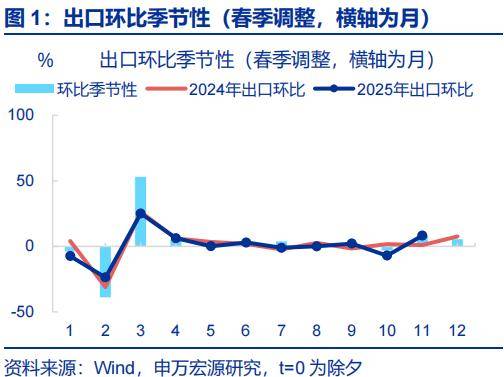
Core Viewpoint - The significant increase in exports in January-February is primarily driven by the "Spring Festival misalignment," contributing 8.4 percentage points, while external demand improvement accounts for an additional 6.8 percentage points [2][9][84] Export Analysis - The export growth in January-February reached 21.8% year-on-year, a substantial improvement of 15.2 percentage points compared to December 2025 [8][9] - The "Spring Festival misalignment" effect is expected to influence export readings, with a long impact period of up to one and a half months, leading to a low base effect from the previous year [2][9] - Labor-intensive industries, such as textiles and furniture, showed significant export rebounds, benefiting directly from the "Spring Festival misalignment" and improved demand from the U.S. [2][19][28] Country-Specific Insights - The recovery in U.S. demand and acceleration in emerging market demand are key drivers for export growth, with exports to the U.S. rebounding by 13.4 percentage points [3][28] - Exports to Africa and ASEAN also showed strong growth, reflecting the industrialization acceleration and domestic demand release in emerging economies [3][29] Import Analysis - Imports in January-February increased by 19.8% year-on-year, with processing trade imports rising significantly by 19.1 percentage points [3][35][71] - The import growth of mechanical and electrical products improved notably, with integrated circuits showing a year-on-year increase of 23.2% [3][71] Future Outlook - The "Spring Festival misalignment" may lead to a decrease in export readings for March, but the overall export growth for the year is expected to remain high due to stable external demand and improved inventory replenishment in the U.S. [4][84] - The strong export data for January-February reflects ongoing improvements in external demand, with expectations of continued high growth throughout the year [4][84] Regular Tracking - Both exports and imports showed strength in January-February, with consumer electronics and light industrial products experiencing notable rebounds [5][54] - Capital goods, intermediate goods, and energy resources also saw increased export growth, indicating a broad-based recovery [5][57]


我省进出口“基本盘”巩固“增长点”抢眼
Shan Xi Ri Bao· 2026-02-09 00:27
Core Insights - During the "14th Five-Year Plan" period, Shaanxi has achieved significant results in enhancing export quality and expanding imports, with exports expected to grow by 22% and imports by 11.2% by 2025, both surpassing national averages [1][2] Export Performance - Shaanxi's exports are heavily dominated by electromechanical products, which account for nearly 90% of total exports and about 70% of total imports, highlighting their critical role in stabilizing foreign trade [1] - The export of "new three items" (electric vehicles, etc.) is a major highlight, with expected exports of 54.79 billion yuan by 2025, representing a 30.4% increase and 2.4 times the value in 2020 [1] - Electric vehicle exports surged from 24 million yuan in 2020 to 33.09 billion yuan by 2025, ranking first in the western region and sixth nationally [1] Import Dynamics - Shaanxi's imports are characterized by advanced and high-quality products, with integrated circuits, semiconductor manufacturing equipment, and automatic data processing equipment consistently ranking as the top three imported goods [2] - By 2025, imports of integrated circuits are projected to reach 72.68 billion yuan, maintaining an annual import value of around 80 billion yuan, which constitutes over 60% of total imports [2] - Significant imports also include 14.04 million tons of iron ore, 5.26 million tons of coal, and 1.421 million tons of crude oil, indicating a strong focus on advanced technology and energy resources to support industrial transformation [2] Trade Diversification - By 2025, the share of Shaanxi's trade with ASEAN countries is expected to rise to 16.2%, while trade with Belt and Road Initiative countries will account for 54.3% of total trade [2] - Notable new exports include Fuping persimmons to the United States, Shangluo strawberries to Singapore, and Shaanxi lamb to Hong Kong, showcasing the diversification of trade partners and products [2] - The evolving trade structure reflects Shaanxi's commitment to deepening economic cooperation and promoting reform through openness [2]
2025年国资央企高质量发展成效显著
Zhong Guo Hua Gong Bao· 2026-02-02 02:46
Core Viewpoint - The State-owned Assets Supervision and Administration Commission (SASAC) highlighted the progress of central enterprises in achieving high-quality development by 2025, focusing on emerging industries, traditional industry transformation, and enhancing supply chain resilience [1] Group 1: Emerging Industries - By 2025, the revenue share of emerging industries in central enterprises is expected to increase by over 10 percentage points compared to 2022 [1] - Central enterprises are developing world-class industrial clusters in fields such as new-generation information technology, new energy, new materials, and high-end equipment [1] - New business formats and models are continuously emerging [1] Group 2: Traditional Industry Transformation - Central enterprises are leading a large-scale equipment upgrade initiative, establishing 70 top-tier smart factories [1] - Six flagship smart factories, including the "Deep Sea No. 1" intelligent gas field with full business twin optimization, have been cultivated [1] - 39 projects have been included in the second batch of national green and low-carbon advanced technology demonstration project lists [1] Group 3: Supply Chain Resilience - Central enterprises are implementing high-quality development action plans for key manufacturing industry chains, achieving breakthroughs in areas such as integrated circuits and industrial mother machines [1] - Significant projects focusing on food security and energy resources are being carried out to strengthen and supplement the supply chain [1] - These efforts are effectively safeguarding the security of China's industrial and supply chains [1]
梳理2025年中国出口结构:20+图看2025年出口结构-20260116
Huachuang Securities· 2026-01-16 12:41
Export Structure Overview - In 2025, China's export structure shows a significant contribution from emerging markets, with a 49.1% share, up 2.5 percentage points from 2024[21] - Exports to the US decreased to 11.1%, down 3.5 percentage points from 2024, while non-US developed markets increased to 39.8%, up 1 percentage point[21] Commodity Contribution - Intermediate goods' export share rose from 41.9% in 2017 to 47.4% in 2025, with an annual increase of 0.7 percentage points[28] - Consumer goods' share fell from 36.6% to 28.7%, with an average annual decline of about 1 percentage point[28] - Capital goods' share slightly decreased from 21.5% to 20.1%, maintaining relative stability[28] Growth Contribution - From 2018 to 2025, the contribution of intermediate goods to export growth increased from 55.8% to 85%, while consumer goods' contribution dropped from 24.7% to -34%[28] - Capital goods' contribution rose from 19.4% to 22.4% during the same period[28] Regional Analysis - In the US, intermediate goods' share increased by 2.7 percentage points to 33.2%, while consumer goods decreased by 1 percentage point to 43.3%[41] - In the EU, intermediate goods remained stable at 39.3%, with consumer goods dropping by 3.1 percentage points to 31.7%[46] - In ASEAN, intermediate goods rose by 3.1 percentage points to 61.6%, while consumer goods fell by 5 percentage points to 19.1%[52] Market Dynamics - Emerging markets are driving growth, with significant contributions from regions like Africa, ASEAN, and Latin America, which collectively boosted exports by 5.6%[22] - The overall export growth for China in 2025 is projected at 5.5%, a slight decline of 0.3 percentage points from the previous year[21]
日本升级与中亚对话模式,学者:中国在该地区的外贸不可替代
Feng Huang Wang Cai Jing· 2026-01-02 11:39
Group 1 - The core viewpoint of the article highlights the ongoing tension in China-Japan relations, with significant challenges for a breakthrough in the short term [1] - There is a noticeable decline in economic and personnel exchanges between China and Japan, evidenced by a 40.4% cancellation rate of flights from mainland China to Japan in January [1] - Japan is actively seeking to expand its economic cooperation with Central Asia to reduce dependence on China, as demonstrated by the recent "Central Asia-Japan" summit in Tokyo [1] Group 2 - Japan plans to invest approximately $20 billion in Central Asia over the next five years, focusing on energy transition, enhancing critical mineral supply chains, supporting international transport routes, and human resource development [1] - More than 150 cooperation documents and project plans have been signed between Japan and the five Central Asian countries, with optimistic prospects for future collaboration [1] - Concerns have been raised that Japan's financial investments may lock in strategic resources such as rare earths, uranium, and oil, potentially diminishing China's influence in Central Asia [1]
国家发展改革委:优化能源资源进口,鼓励企业有序走出去参与能源项目建设
Yang Shi Wang· 2025-12-25 02:03
Core Viewpoint - The National Development and Reform Commission emphasizes enhancing infrastructure functions to support national strategic implementation and high-quality economic development [1] Group 1: Transportation Sector - The focus is on improving the interconnectivity of infrastructure and the quality and efficiency of transportation services to support regional coordinated development strategies and new urbanization initiatives [1] - There is a push to strengthen transportation guarantees in strategic national hinterlands and expand diversified international transportation routes [1] - The development of low-altitude economy, hub economy, and channel economy is encouraged, along with the cultivation of experience economies such as cruise and yacht tourism and automotive camps [1] Group 2: Energy Sector - The strategy involves coordinating domestic and international markets to optimize energy resource imports and encourage enterprises to participate in energy project construction abroad [1] - There is a focus on solidifying coal supply as a foundational support and accelerating the release of high-quality coal production capacity [1] - The plan includes steadily increasing physical reserves of coal, oil, and natural gas, and advancing the construction of national strategic reserves for coal-to-oil and coal-to-gas projects [1]
国资委:明年要加强上市公司质量和市值管理
Sou Hu Cai Jing· 2025-12-24 02:06
Group 1 - The core viewpoint emphasizes the need for state-owned enterprises to focus on stabilizing operations and improving quality and efficiency in 2026 [1] Group 2 - Companies should seize market opportunities by closely monitoring macroeconomic conditions and enhancing structural and trend analysis within industries [1] - There is a call for the use of big data and industry models to accurately capture potential market demand and innovate in product and service quality [1] - The aim is to cultivate new consumption scenarios in sectors such as culture, tourism, digital, and health to create new growth points [1] Group 3 - Companies are encouraged to strengthen management practices to improve development quality, including comprehensive budget management and cost control across all aspects [1] - There is a focus on managing receivables, contract assets, inventory, and payables more effectively [1] - Emphasis is placed on enhancing the quality and market value of listed companies [1] Group 4 - Effective investment is highlighted as a means to accumulate development potential, particularly in key areas such as industrial chain strengthening, infrastructure construction, and energy resource security [1] - Companies are urged to utilize various support policies to plan and implement significant projects and landmark initiatives [1] - The goal is to lay a solid foundation for sustainable development [1]
股市机遇,堪比98年房地产,布局两主线耐心做多
Sou Hu Cai Jing· 2025-12-14 18:14
Group 1 - The core viewpoint of the discussion emphasizes the historical opportunity presented by the current global dynamics, including the weakening of the US dollar and the revitalization of Chinese assets [1] - Zhang Yidong highlights the structural differences in debt between the US and China, indicating that China's approach to resolving its debt issues will require activating assets and capital markets rather than relying on broad monetary stimulus [3][5] - The Chinese stock market is compared to the real estate market post-1998, suggesting that it will play a crucial role in revitalizing the economy by improving cash flow and profit margins, but this requires patience and institutional support [5][7] Group 2 - Zhang Yidong identifies two main investment themes: growth sectors, particularly AI and its supply chain, and value sectors such as high-dividend stocks and traditional industry leaders, which serve as defensive positions [7][9] - He advises investors to manage their emotions and focus on long-term strategies rather than short-term trading, suggesting that the current market sentiment is a time for strategic positioning [9][11] - The transition from "land finance" to "equity finance" in China is seen as a critical direction for the capital market's future, with the potential for structural opportunities despite short-term volatility [11]

出口韧性的“来源”?
Sou Hu Cai Jing· 2025-12-09 00:39
Core Viewpoint - The significant rebound in November exports is primarily attributed to the dissipation of short-term supply disruptions rather than an improvement in external demand [2][7][30] Export Analysis - November exports increased by 5.9% year-on-year (YoY) in USD terms, a notable recovery from a decline of 1.1% in October, driven by factors such as increased working days and the reduction of "production rush" effects [2][6][7] - The increase in working days in November (up by 2 days YoY) and the tapering off of the "production rush" phenomenon contributed significantly to the export rebound [2][7] - Exports to emerging economies showed a marked recovery in November, with exports to Africa and Latin America rising by 17.1 percentage points (pct) and 12.8 pct respectively, despite no significant improvement in demand from these regions [2][11] - The export of goods such as food, steel, and auto parts, which had seen significant declines in October, rebounded in November, with respective increases of 34 pct, 18.7 pct, and 13.6 pct [3][18] Import Analysis - Imports also showed a recovery in November, with a YoY increase of 1.9%, up by 0.9 pct from the previous month [3][25] - Processing trade imports surged by 9.2 pct to 13.9%, exceeding previous growth levels, indicating a rebound in supply conditions [3][25] - Major commodities like crude oil and electromechanical products saw improved import growth rates, with crude oil imports increasing by 8.4 pct to 8.1% [3][25][51] Future Outlook - The easing of supply disruptions, combined with ongoing improvements in external demand and China's competitive export advantages, is expected to support exports for the remainder of the year [4][30] - The potential for improved exports to the U.S. is bolstered by the easing of tariffs and the likelihood of inventory replenishment in the U.S. market [4][30] - Continued industrialization in emerging markets is anticipated to drive demand for imported production materials, further supporting China's export of intermediate and capital goods [4][30] Regular Tracking - In November, both exports and imports showed signs of recovery, with notable increases in consumer electronics and light industrial products [5][37] - Capital goods exports exhibited mixed results, with intermediate goods like auto parts and integrated circuits showing growth [5][40] - Exports to non-U.S. developed economies and emerging markets increased, while exports to the U.S. declined [5][47][48]
外贸数据点评:出口韧性的“来源”?
Shenwan Hongyuan Securities· 2025-12-08 14:40
Group 1: Export Data Overview - November exports increased by 5.9% year-on-year, exceeding the expected 3% and recovering from a previous decline of -1.1% in October[7] - The rise in exports is attributed to the easing of supply disruptions rather than an improvement in external demand[2] - The number of working days in November increased by 2 days compared to the previous year, contributing to the export rebound[2] Group 2: Import Data Overview - November imports rose by 1.9% year-on-year, slightly below the expected 2.9% but up from 1% in October[7] - Processing trade imports surged by 9.2 percentage points to 13.9%, indicating a recovery in trade activity[26] - Major commodities like crude oil saw a rebound in import growth, with an increase of 8.4 percentage points to 8.1%[26] Group 3: Sector-Specific Insights - Consumer electronics exports grew by 5.1 percentage points to 3.3%, with significant contributions from mobile phones and LCD display modules[37] - Capital goods exports showed mixed results, with general machinery and medical instruments increasing, while shipbuilding exports fell significantly[43] - Exports to emerging markets, particularly Africa and Latin America, saw notable increases of 17.1 and 12.8 percentage points, reaching 27.7% and 15% respectively[14] Group 4: Future Outlook - The easing of supply disruptions and ongoing competitive advantages for Chinese exports are expected to support export growth in the coming months[30] - Potential improvements in exports to the U.S. are anticipated due to reduced tariffs and ongoing inventory replenishment needs[30] - Continued industrialization in emerging economies is likely to drive demand for intermediate and capital goods from China[30]