
汽车

Search documents
一分补贴没有,甲醇闯出下一个万亿级赛道
汽车商业评论· 2026-03-29 23:04
Core Viewpoint - The article emphasizes the strategic importance of methanol as a new fuel type in China's energy landscape, particularly in light of rising oil prices and energy security concerns due to geopolitical tensions [3][4]. Group 1: Methanol Fuel Development - The Chinese government has recognized methanol as a key component of the national energy strategy, with significant investments and policy support aimed at integrating it into the energy system [4]. - Geely has made substantial advancements in methanol engine technology, addressing critical issues such as corrosion and cold start performance, with plans to produce engines with a thermal efficiency of 46% by 2026 [4][5]. - The launch of Geely's methanol commercial vehicles in Shenyang is a significant step, with the vehicles capable of stable cold starts at -30°C and offering lower fuel costs compared to traditional vehicles [5][7]. Group 2: Market and Infrastructure - Geely plans to promote around 10,000 methanol vehicles in Shenyang by 2026, alongside the construction of over 40 methanol refueling stations [7]. - The current methanol production in China is predominantly coal-based (approximately 84%), with a future shift towards green methanol produced from renewable energy sources [7][8]. - The article highlights the potential for methanol to serve as a stable energy carrier, particularly in regions with extreme temperatures, making it a viable alternative to electric vehicles in cold climates [21][23]. Group 3: Historical Context and Future Prospects - Methanol vehicle development dates back to the 1970s during oil crises, with renewed interest from major automakers in recent years due to environmental concerns [10][11]. - In China, methanol engine research has a 30-year history, with significant policy support since 2012, leading to successful pilot programs and eventual market entry [12][14]. - The article notes that while there are existing policies supporting methanol, the lack of a unified regulatory framework for refueling stations remains a significant barrier to widespread adoption [27][28].



国内高频 | 生产走势分化(申万宏观·赵伟团队)
申万宏源宏观· 2026-03-29 16:03
Core Viewpoint - The article discusses the recent trends in industrial production, construction, and demand in China, highlighting the recovery in certain sectors while noting weaknesses in others. Group 1: Industrial Production - The blast furnace operating rate remains stable, with a week-on-week increase of 1.2% and a year-on-year stability at 1.5% [2] - Steel apparent consumption increased by 2.2% week-on-week but saw a year-on-year decline of 0.9 percentage points to 4.1% [2] - Steel social inventory decreased by 1.7% week-on-week [2] Group 2: Construction Industry - Cement production and demand have shown signs of recovery, with a week-on-week increase in grinding operating rate of 2.1% and a year-on-year increase of 2.6 percentage points to 14.1% [24] - Cement shipment rate increased by 7.3% week-on-week and a year-on-year increase of 0.2 percentage points to 0.8% [24] - Cement inventory ratio increased by 0.9% week-on-week and a year-on-year increase of 3 percentage points to 7.3% [24] Group 3: Demand Trends - National commodity housing transactions have improved, with a week-on-week increase of 14.8% in average daily transaction area for 30 major cities, and a year-on-year increase to 25.5% [48] - The transaction area for first, second, and third-tier cities increased by 9.1%, 15.5%, and 20.7% respectively week-on-week, with year-on-year increases of 25.3%, 63%, and 33% [48] - Freight volume remains resilient, with railway freight volume and highway truck traffic down by 3.2% and 1.2% year-on-year to 4.3% and 7.6% respectively [60] Group 4: Price Trends - Agricultural product prices are generally weak, with pork, vegetables, and fruit prices decreasing by 1.3%, 0.9%, and 0.7% respectively week-on-week, while egg prices increased by 1.6% [102] - The overall industrial product price index decreased by 0.2% week-on-week, with energy and chemical prices increasing by 1.2% and metal prices decreasing by 0.6% [114]

晓数点丨一周个股动向:最牛股周涨超50% 赣锋锂业获主力加仓居首
Di Yi Cai Jing· 2026-03-29 13:55
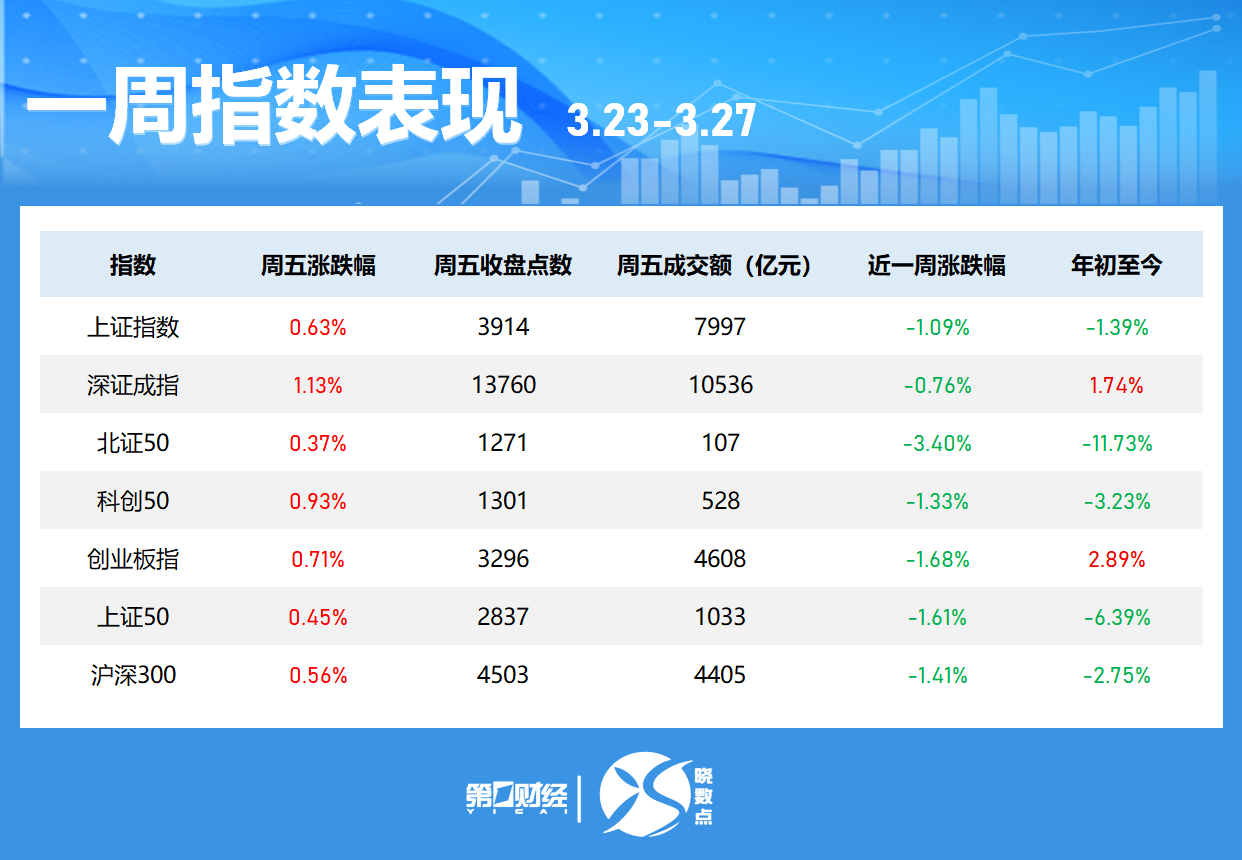
Market Overview - The A-share indices collectively declined during the week from March 23 to March 27, with the Shanghai Composite Index down by 1.09%, the Shenzhen Component Index down by 0.76%, the ChiNext Index down by 1.68%, and the Sci-Tech Innovation Index down by 0.43% [1][2]. Stock Performance - A total of 7 stocks saw gains exceeding 40%, with Haike Xinyuan leading at a weekly increase of 51.02%. Other notable gainers included Lianxiang Co. (48.26%), Rongjie Co. (46.95%), and Huadian Liaoning Energy (43.61%) [3][4]. - Conversely, 30 stocks experienced declines over 20%, with Huada Technology leading the drop at 32.34%, followed by Zhonghuan Hailu (29.59%) and Shenhua Fa A (28.03%) [3][4]. Trading Activity - 47 stocks had a turnover rate exceeding 100%, with Shouhang New Energy at the top with a turnover rate of 236.08%, followed by Nabichuan (199.27%) and Jiuzhou Group (177.88%) [5][6]. - The majority of stocks with high turnover rates were from the electric equipment, public utilities, and basic chemicals sectors [5]. Capital Flow - The sectors that attracted significant capital inflow included non-ferrous metals, basic chemicals, and building materials, while the electronics sector faced a net outflow exceeding 250 billion yuan [8]. - Ganfeng Lithium received the highest net inflow of 27.20 billion yuan, with a weekly increase of 18.15%. Other stocks with notable inflows included Demingli (15.88 billion yuan) and Yunnan Zhiye (14.20 billion yuan) [8][9]. Margin Trading - A total of 1399 stocks received net margin purchases, with 582 stocks having net purchases exceeding 10 million yuan. Luxshare Precision topped the list with a net purchase of 10.94 billion yuan, while NIO and Zijin Mining faced significant net sell-offs [10][11]. Institutional Research - During the week, 163 listed companies were researched by institutions, with Sanhua Intelligent Control receiving the most attention from 284 institutions. Other companies like Yuanjie Technology and Yuntianhua also attracted significant institutional interest [12][14]. Analyst Ratings - Several companies received new ratings from analysts, including Kaige Precision Machinery with a "Buy" rating and a target price of 207.84 yuan, and Daqin Railway with an "Overweight" rating and a target price of 5.95 yuan [15][16].



汽车行业周报:鸿蒙智行密集发布新车,小鹏汽车加速Robotaxi落地-20260329
CMS· 2026-03-29 13:32
Investment Rating - The report maintains a "Recommended" rating for the automotive industry, indicating a positive outlook for the sector's fundamentals and expectations for the industry index to outperform the benchmark index [4][29]. Core Insights - The automotive industry experienced a slight decline of -0.2% during the week of March 23 to March 29, with various segments showing mixed performance. Notably, commercial and passenger vehicle segments saw slight increases of +0.6% and +0.1%, respectively [2][10]. - The report highlights significant developments in the industry, including the launch of multiple new models by Hongmeng Zhixing and the establishment of a Robotaxi division by Xiaopeng Motors, indicating a shift towards advanced mobility solutions [22][23]. - Analysts have adjusted Tesla's sales forecast for the year to 1.69 million units, reflecting a slight increase compared to the previous year's expectations [26]. Market Performance Overview - The overall automotive sector saw a decline of -0.2%, with most secondary segments experiencing downturns, while commercial and passenger vehicle segments showed slight gains [2][10]. - Individual stock performances varied, with notable gainers including Hunan Tianyan (+23.6%) and Jian She Industrial (+19.9%), while significant losers included Huada Technology (-32.3%) and Xuelong Group (-19.1%) [3][13]. Recent Industry Developments - Xiaopeng Motors has launched a three-year strategy for the Latin American market, aiming for comprehensive coverage by 2028, starting with Mexico [25]. - The report notes the expansion of Amazon's Zoox Robotaxi services and strategic partnerships formed by Xiaoma Zhixing with Uber and Verne to enhance commercial Robotaxi services [24][22]. - The introduction of new models, such as the AION UT by GAC Group, signifies ongoing innovation and competition in the electric vehicle market [25].





一周全球宏观与资产复盘:海外高波动环境下的中国资产相对确定性
East Money Securities· 2026-03-29 13:08
Group 1: Global Market Overview - The Iranian situation remains a key macroeconomic factor influencing global markets, leading to high volatility in financial markets during the week of March 23-27, 2026[11] - Oil prices experienced significant fluctuations, with a sharp decline following initial threats from Trump, but rebounded due to renewed tensions, indicating a potential for continued high volatility[11] - The 10-year U.S. Treasury yield surpassed 4.4%, reflecting rising global bond yields amid ongoing energy crises and tightening monetary policies from central banks[12] Group 2: China's Economic Stability - Despite global volatility, China's economy shows relative certainty due to effective price stabilization policies and a robust renewable energy sector, which is expected to reduce reliance on fossil fuels in the long term[13] - China's industrial system remains resilient, providing stability in supply chains amid global disruptions caused by rising oil prices[13] - Economic indicators suggest improvement in China's economy, with signs of recovery in exports and profit margins, enhancing the attractiveness of Chinese assets in uncertain times[13] Group 3: Investment Strategies - Investors should remain cautious of the ongoing "stagflation" risks while focusing on the relative certainty of Chinese assets, particularly in sectors like renewable energy and essential consumer goods[14] - The stock market has faced pressure recently, but the recent downturn may have already priced in negative sentiment, suggesting potential for selective structural opportunities[14] - The bond market lacks fundamental drivers for rate declines, indicating a trading environment characterized by "watching stocks while trading bonds" and a range-bound state[14]
集体大跌!美军地面战方案曝光!伊朗警告:将果断反击
券商中国· 2026-03-29 12:02
Group 1 - The core viewpoint of the article highlights the significant impact of the Iran conflict on the U.S. stock market, particularly the technology sector, which saw a combined market value loss of nearly $860 billion among the "Tech Seven" companies [1][6] - The article notes that Meta experienced a weekly decline of over 11%, while Alphabet and Microsoft saw drops of more than 8% and 6%, respectively, indicating a broader trend of declining stock prices in the tech industry due to rising inflation concerns [1][6] - The Nasdaq index fell by 3.23%, marking its largest weekly decline since April 2025, driven by fears of prolonged high interest rates and specific challenges faced by tech companies [6] Group 2 - The article discusses the geopolitical situation, stating that the U.S. military is preparing for a limited ground operation in Iran, focusing on a strategy that avoids full occupation and aims for quick victories, reminiscent of the Gulf War [3][4] - It emphasizes the strategic importance of the Hormuz Strait and the Khark Island, which is crucial for Iran's oil exports, as the U.S. aims to cut off 90% of Iran's oil exports with minimal military engagement [4][5] - The article mentions that Iran is responding to U.S. military movements by bolstering its defenses around Khark Island, indicating a potential escalation in military tensions [5][6]






当一切都变成利空:美股正在进入系统性再定价
美股研究社· 2026-03-29 11:42
Group 1 - The current market sentiment on Wall Street is characterized by a pervasive sense of oppression, where even positive earnings reports fail to sustain stock price increases, while minor negative news triggers significant sell-offs [1][2] - The narrative around artificial intelligence (AI) that previously allowed investors to overlook flaws is now being challenged by regulatory scrutiny, questions about capital expenditure returns, and a shift from growth belief to risk assessment [2][3] - The market is transitioning from a focus on compelling narratives to a scrutiny of balance sheets, indicating a critical point in investment strategy [3] Group 2 - A concerning trend is observed in the tech sector, where major companies are experiencing simultaneous pressure, indicating a systemic credit crisis rather than isolated incidents [4] - Nvidia, once a leader in the AI space, is facing scrutiny over past financial compliance issues, reflecting a broader vulnerability among tech giants [4][5] - Investors are questioning the sustainability of revenue generated from the intense competition in computing power, as companies like Tesla and Micron also face pressures from regulatory and market dynamics [5][6] Group 3 - The market is shifting from a belief in growth to a focus on risk, with declines affecting multiple segments of the AI industry, suggesting a systemic risk rather than mere sector rotation [7] - AI advancements are paradoxically becoming a variable that suppresses valuations, as efficiency improvements lead to reduced demand for hardware, impacting companies like Micron negatively [9][10] - The fear of "technological deflation" is emerging, as the pace of efficiency gains outstrips demand growth, threatening the high valuations of hardware manufacturers [10] Group 4 - A notable shift in capital flows is occurring, with investors moving away from high-volatility tech assets towards more stable cash-generating companies, such as those in the energy sector [11][12] - The energy sector is increasingly viewed as a safe haven for real returns, contrasting sharply with the tech sector's volatility and uncertainty [12] - This shift may create a self-reinforcing cycle of declining tech stock prices, leading to further liquidity-driven sell-offs and increased market volatility [12][13] Group 5 - The market is entering a new phase where asset prices are determined more by certainty than by compelling narratives, marking a permanent shift in valuation logic [14] - As the market grapples with the absence of a clear anchor in AI's commercial value, traditional financial metrics are regaining importance [14] - The focus is shifting towards survival and maintaining cash flow, especially for companies that have not yet achieved profitability in the AI space [13][14]

宏观周度述评系列:应该如何度过“贝叶斯定价”的阶段-20260329
GF SECURITIES· 2026-03-29 11:28
Market Overview - Global assets have entered a "Bayesian pricing" mode, with oil prices fluctuating around $100 per barrel, impacting inflationary trading in overseas markets[3] - The S&P Global March Flash PMI dropped to an 11-month low, indicating a slowdown in US growth momentum, with employment components contracting for the first time in a year[3] Inflation and Economic Indicators - March CPI is expected to show a slight positive month-on-month increase, while PPI is projected to turn positive year-on-year, with a month-on-month increase of over 0.6%[3] - Estimated Q1 real GDP growth is projected at 5.07%, with nominal GDP growth at 5.47%[3] Asset Performance - The NASDAQ index fell by 2.22% for the week, with tech giants experiencing significant declines, including Meta down 11.44% and Google nearly 9%[3] - The Brent crude oil price ended the week at $112.57 per barrel, reflecting a weekly increase of 0.34%[3] Monetary Policy and Liquidity - The probability of a 25 basis point rate hike in September is currently at 20.4%, with a 77.9% chance of maintaining the current rate[7] - The 10-year US Treasury yield rose by 5 basis points to 4.44%, while the 30-year yield increased to 4.98%[17] Market Sentiment and Volatility - The VIX index rose to 31.05%, indicating increased market volatility, although it remains below extreme levels[13] - The S&P 500 fear and greed index remains in the fear zone, reflecting ongoing market uncertainty[12] Sector Performance - Energy and materials sectors showed gains, with energy stocks rising by 6.2% and materials by 4.2%, while communication and information sectors declined by 7.2% and 3.5% respectively[13] - The lithium battery sector emerged as a strong performer, with significant gains in related indices[19] Investment Strategy Recommendations - Investors are advised to balance asset allocation across various sectors, considering the uncertainty in geopolitical conflicts and oil prices[8] - Utilizing volatility for contrarian trading strategies is recommended, as market reactions to fragmented news can create opportunities[9]
供强需弱下猪肉价格录得18年以来新低
Soochow Securities· 2026-03-29 10:56
Economic Indicators - The weekly ECI supply index is at 50.05%, up 0.02 percentage points from last week, while the demand index is at 49.87%, up 0.01 percentage points[10] - The monthly ECI supply index for March is at 50.02%, up 0.02 percentage points from February, while the demand index is at 49.87%, down 0.01 percentage points[11] Production and Investment - Industrial production shows a recovery trend, with the steel mill blast furnace operating rate at 81.05%, up 1.25 percentage points from last week[19] - The real estate market shows signs of improvement, with the transaction area of new homes in 30 major cities increasing by 14.95% to 211.25 million square meters[32] Consumption Trends - Passenger car retail sales for the week ending March 22 recorded an average of 51,196 units, a year-on-year decline of 16% but showing a trend of improvement[26] - The average ticket revenue for the week is 298 million yuan, down from 329 million yuan last week, but up from 285 million yuan a year ago[26] Export Performance - The SCFI index for container shipping rates is at 1,826.77, up 119.82 points from last week, indicating a recovery in export shipping costs[39] - South Korea's export growth rate for the first 20 days of March is at 50.40%, up 6.10 percentage points from February[39] Price Trends - The average wholesale price of pork is at 15.84 yuan per kilogram, down 0.29 yuan from last week, marking a new low in 18 years[44] - Brent crude oil futures are priced at $112.57 per barrel, up $0.38 from last week, indicating upward pressure on inflation[45]
新股专题:海外局势依然是关键因子,低风险偏好背景下建议关注相对低位方向
Huajin Securities· 2026-03-29 10:24
Investment Rating - The report suggests a cautious approach towards new stocks, recommending to focus on relatively low-priced targets under the current low-risk preference environment [1][2][12] Core Insights - The new stock market has shown continued weakness due to overseas geopolitical disturbances, with the average decline of new stocks since 2025 being approximately -2.6%, and only about 25.5% of new stocks achieving positive returns [1][6][28] - The report emphasizes the importance of monitoring overseas situations, as they significantly impact market sentiment and risk appetite, particularly with the upcoming earnings season [2][12] - Investment opportunities may arise from sectors with high safety margins and from the rotation of capital towards relatively low-priced stocks, especially in industries like AI, commercial aerospace, and energy exports [3][12] Summary by Sections New Stock Insights - The new stock market has been under pressure, with investment enthusiasm nearing an all-time low, and the average first-day gain for new stocks dropping below 100% [1][25][26] - The average issuance price-earnings ratio for new stocks has slightly increased to 21.6X, indicating a stable supply but a cautious market [5][22] Recent New Stock Performance - Last week, the average first-day gain for newly listed stocks was 93.8%, with a significant drop in trading enthusiasm compared to previous months [25][18] - The average secondary market decline for newly listed stocks was -9.6%, reflecting ongoing volatility and a lack of clear undervaluation in the market [26][28] Upcoming New Stocks - Several new stocks are set to be listed soon, including Yuelong Technology and Longyuan Co., with an average issuance price-earnings ratio of 21.8X for upcoming listings [4][35] - The report encourages active participation in new stock subscriptions, despite the current market conditions [36][35]