
新能源车

Search documents
从5.5%增速看广西经济韧性
Guang Xi Ri Bao· 2025-07-22 01:56
Economic Overview - Guangxi's GDP growth rate reached 5.5% in the first half of the year, marking the highest value for the same period in nearly four years, indicating a positive trend in the overall economy [1][7] Three Economic Drivers - The three main economic drivers—consumption, investment, and foreign trade—are performing well, contributing to the stability of Guangxi's economy [2] - Consumer activity has increased significantly due to subsidy policies and promotional activities, leading to a sustained recovery in the consumption market [2] - Fixed asset investment has maintained growth, with industrial investment rising by 9.8%, supported by the acceleration of major projects [2] Industrial Performance - The industrial sector is a strong support for the economy, with significant growth in key areas such as electrical equipment, paper manufacturing, and new energy vehicles [3] - The industrial added value in Guangxi increased by 7.7% year-on-year, with manufacturing added value growing by 9.5% [3] - Manufacturing investment rose by 12.3% year-on-year, outpacing the national average by 4.8 percentage points, indicating robust industrial project development [3] New Productive Forces - The economic characteristics of Guangxi in the first half of the year can be summarized as "new," reflecting the accelerated development of new productive forces and the gathering of new momentum [4] - High-tech manufacturing in Guangxi grew at a rate several times that of ordinary industries, with high-tech manufacturing value added increasing by 29.6% [4][5] - The integration of artificial intelligence and manufacturing is advancing, with significant increases in the production of intelligent products [5] Improvement in Livelihood - A series of policies aimed at employment and consumption have been implemented, leading to stable growth in residents' income and increased consumer confidence [6] - Consumer participation in various promotional activities has surged, with over 581 million consumers engaging in trade-in programs, significantly boosting retail sales [6] Economic Resilience - The 5.5% growth rate is seen as a reflection of Guangxi's resilience and potential, especially in the context of increasing external pressures [7]
最新!公募前十大重仓股出炉!港股数量明显增加
券商中国· 2025-07-21 23:19
Core Viewpoint - The article highlights the latest changes in the top ten holdings of public funds, indicating a significant increase in Hong Kong-listed companies within the core positions of public funds, particularly with the inclusion of Xiaomi Group and Neway Technology in the second quarter [2][3]. Group 1: Top Holdings Overview - As of the end of Q2, the top ten holdings of public funds include Tencent Holdings, CATL, Kweichow Moutai, Midea Group, Zijin Mining, Xiaomi Group-W, Luxshare Precision, Alibaba-W, Neway Technology, and SMIC (HK) [2]. - Tencent Holdings has a total market value held by public funds of approximately 59.2 billion, with 1,039 fund products holding it. CATL follows with a market value of 52.1 billion and 1,150 funds [2]. Group 2: Changes in Holdings - Xiaomi Group and Neway Technology entered the top ten holdings, while BYD and Wuliangye exited. BYD was the most significantly reduced stock by public funds in Q2 [3]. - The white liquor industry saw the largest reductions among sectors, with three white liquor stocks in the top ten most reduced stocks by public funds [3]. Group 3: New Additions and Performance - The top three newly added stocks by public funds in Q2 were Shuyou Shen, Sifang Jingchuang, and Youfang Technology, with respective price increases of 419.94%, 228.21%, and 86.64% [3][4]. - The surge in stock prices for these new additions was supported by significant institutional buying, although some funds did not see a corresponding increase in net value due to not purchasing at lower prices [4]. Group 4: Fund Managers' Insights - Fund managers emphasized the core drivers of stock selection, highlighting advancements in China's AI industry, high-end manufacturing, and consumer trends shifting towards high-value and emotionally connected brands [5]. - The pharmaceutical innovation sector is experiencing a boost, with several large innovative drug companies announcing profitability, significantly enhancing market confidence in this sector [5]. - The technology and internet sectors are closely linked to new consumption trends driven by younger demographics, with significant growth potential emerging from the integration of AI into new consumer segments [6].


7月深圳大厂探秘:新能源+硬科技龙头深度行!
21世纪经济报道· 2025-07-21 04:12
Core Viewpoint - The article emphasizes the transformative impact of AI and the new energy revolution on the manufacturing industry, highlighting the importance of firsthand experience in identifying investment opportunities in this rapidly evolving sector [1]. Group 1: Industry Insights - The article discusses the upcoming "Shenzhen New Energy + Intelligent Manufacturing Industry Chain Deep Dive" event, which aims to explore leading companies in the new energy and manufacturing sectors, including BYD, Yuhua Tian, and Feirongda [1]. - It highlights the significance of being at the forefront of the industry, where opportunities are abundant for those willing to explore and engage directly with transformative companies [1]. - The article mentions BYD as a major player, selling over 6 million electric vehicles annually and controlling the entire supply chain from lithium mining to chips and energy storage [1]. Group 2: Technological Advancements - The article describes advancements in AI and IoT within the urban services sector, particularly in the environmental protection industry, where AI-driven systems are optimizing the management of over 100,000 sanitation devices [2]. - It also touches on cutting-edge electronic cooling technologies, showcasing how a 0.3mm carbon-based material is essential for managing the heat generated by AI servers, with a significant role in the supply chain for electric vehicles [3]. Group 3: Expert Engagement - The event will feature industry experts and seasoned investors who will provide insights into industry trends and potential investment opportunities, fostering high-level discussions [4][5]. - A high-end closed-door dinner will be organized for deeper exchanges of ideas and insights among participants [5].



消费升级 外资提质 外贸攀高 “十四五”期间我国商务发展成效显著
Jin Rong Shi Bao· 2025-07-21 02:42
"十四五"期间,我国人均国内生产总值(GDP)处于人均1万美元到2万美元的区间,消费需求加速分化, 消费结构也加快转变。"这个时候,消费会出现一些新的变化,也会展现一些新的亮点,这符合我们发 展的阶段性特征和规律。"王文涛表示。 从量上看,超大规模市场体量更大。王文涛介绍称,中国全球第二大消费市场的地位更加稳固,社零总 额从2020年的39.1万亿元提升到去年的48.3万亿元,年均增长5.5%。一些细分领域的规模保持"龙头"地 位,如中国网上零售连续12年全球第一,汽车销量也是全球第一。 7月18日,国新办举行"高质量完成'十四五'规划"系列主题新闻发布会,商务部有关负责人介绍"十四 五"商务高质量发展成就,并回答了记者提问。 "十四五"期间,消费主引擎和稳定器作用增强,强大国内市场优势凸显。商务部部长王文涛介绍称,消 费市场规模稳居全球第二,过去4年社零总额年均增长5.5%,今年有望突破50万亿元。服务消费保持较 快增长,居民服务性消费支出占比提升3.5个百分点,达到46.1%。 "十四五"期间,经贸大国地位进一步巩固,高质量发展成效显著。王文涛介绍称,外贸顶住了压力,展 现了韧性,货物贸易稳居全球第一,出 ...
广发基金吴远怡管理产品二季报披露 看好AI、高端制造、医药创新等领域
Zhi Tong Cai Jing· 2025-07-21 00:05
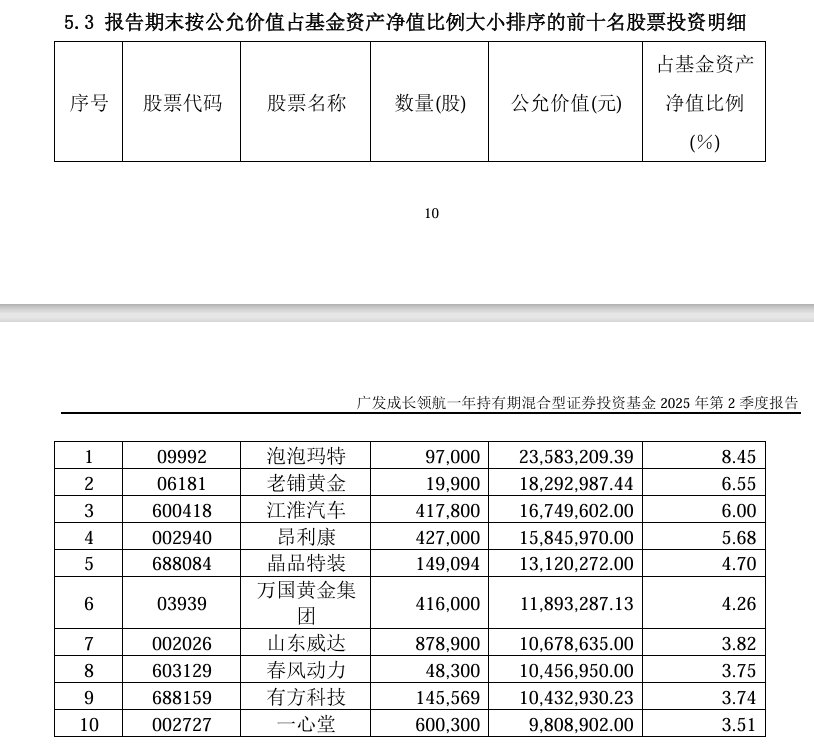
Core Viewpoint - The report highlights that the Federal Reserve's interest rate cut cycle is improving global liquidity, leading to strong performance in high-dividend assets, particularly in the financial and insurance sectors. Additionally, China's technological breakthroughs in AI, high-end manufacturing, and pharmaceutical innovation are expected to create ongoing investment opportunities [1][4]. Fund Performance - The fund reported a profit of 26.49 million yuan in Q2, with a weighted average profit per fund share of 0.26 yuan. The net asset value growth rate for the fund was 20.66%, and the fund size reached 201 million yuan by the end of Q2. The fund achieved a year-to-date return of 67.72%, ranking among the top in the market [1]. Holdings Overview - The fund's top ten holdings are diversified, including: 1. Pop Mart (09992) - 8.45% of net asset value 2. Laopuhuangjin (06181) - 6.55% 3. JAC Motors (600418) - 6.00% 4. Anglikang (002940) - 5.68% 5. Jingpin Special Equipment (688084) - 4.70% 6. World Gold Group (03939) - 4.26% 7. Shandong Weida (002026) - 3.82% 8. Chuangfeng Power (603129) - 3.75% 9. Youfang Technology (688159) - 3.74% 10. Yixintang (002727) - 3.51% [1][3]. - Compared to the previous quarter, new entries in the top ten holdings include JAC Motors, Anglikang, World Gold Group, Shandong Weida, Chuangfeng Power, Youfang Technology, and Yixintang, while New Idea Network, Wangneng Environment (002034), Alibaba-W, Junxin Co. (301109), Zhongchen Technology (603275), and Ningbo Huaxiang (002048) exited the top ten [2][3]. Industry Insights - The global macroeconomic environment is characterized by the Federal Reserve's interest rate cuts, which are driving liquidity improvements and a rally in high-dividend assets, particularly in the financial sector [4]. - In the technology innovation sector, China's AI industry is experiencing significant breakthroughs, enhancing its core competitiveness and leading to explosive growth across the entire industrial chain from robotics to upstream hardware [5]. - In high-end manufacturing, China has made historic leaps to global leadership in precision processing and new energy vehicles, transitioning from a product importer to an exporter [5]. - Consumer trends are shifting towards pet economy and trendy consumer goods, with a preference for high cost-performance, experiential, and emotionally connected brands [5]. - In the pharmaceutical innovation sector, China has successfully transitioned from auxiliary research to becoming a global leader in original innovative drugs through years of technological accumulation and independent research [5]. Future Focus - The fund will concentrate on growth directions that have the potential to change the era, targeting companies with transformative capabilities [6].
帮主郑重:下周A股关键窗口!中长线布局机会在这里
Sou Hu Cai Jing· 2025-07-20 15:32
Market Overview - The three major indices experienced an overall increase, with the ChiNext Index rising by 3.17% and the average stock price index of the entire A-share market increasing by 2.17%, indicating a positive short-term market sentiment [1] Key Factors Influencing Next Week's Market - The manufacturing PMI for June was reported at 49.7%, a slight increase of 0.2 percentage points from the previous month, but still within the contraction zone. However, the high-tech manufacturing PMI has remained in the expansion zone for five consecutive months, indicating resilience in the technology sector [3] - Domestic policies are clearly supportive of technology growth sectors, particularly in AI, new energy vehicles, and innovative pharmaceuticals. Additionally, urban renewal and village renovation policies are expected to bring long-term benefits across multiple industries, including construction, building materials, and real estate [3] - Internationally, there is a high probability (97.4%) that the Federal Reserve will maintain interest rates in July, contributing to a relatively loose market expectation. However, the U.S. imposing anti-dumping duties on Chinese anode-grade graphite may impact related industries [3] Technical Analysis - The Shanghai Composite Index fluctuated around the 3500-point mark this week, with increased trading volume. If the volume continues to expand next week, there is potential for the index to break through 3550 points; otherwise, it may experience increased volatility around 3530 points. The MACD indicator shows strengthening bullish momentum, and the RSI has not yet entered the overbought territory, suggesting further upward potential for the market [3] Capital Flow Insights - In the second quarter, northbound funds increased their positions in the financial, industrial, and healthcare sectors, with significant inflows into leading stocks such as CATL and Heng Rui Pharmaceutical. There is a noticeable rotation of funds from high-dividend sectors to technology growth sectors. The margin trading balance has exceeded 1.8 trillion yuan for 21 consecutive trading days, indicating active leveraged funds [4] Investment Strategies for Long-term Investors - The technology growth sector remains a focal point, with strong policy support and promising industry prospects, particularly in new energy vehicles, which benefit from tax exemptions and subsidies extending to the end of 2025. The Shanghai Intelligent Connected New Energy Vehicle Industry Cluster aims for a market scale exceeding 350 billion yuan by 2030, focusing on L3 autonomous driving and solid-state battery technologies [4] - The financial sector should not be overlooked, as northbound funds have increased their positions in this area, with banks like Ping An Bank and Bank of China receiving notable inflows. Increased market trading volume is expected to boost brokerage performance, making brokerage ETFs worth considering [4] - Urban renewal and village renovation policies will create long-term investment opportunities in construction, building materials, and real estate sectors, with central government support directed towards major cities and key river basins [4] Upcoming Market Considerations - Next week, 43 companies will have lock-up shares released, with a total market value of 87.761 billion yuan, which may exert pressure on stock prices, particularly for companies like Daqo New Energy and Guobang Electronics. Additionally, any adjustments to the Loan Prime Rate (LPR) could influence market expectations, although the consensus is that it will remain unchanged [5] - The upcoming week is seen as a critical window for the A-share market, with ongoing dynamics between policy expectations and actual economic recovery. Long-term investors are advised to remain patient and focus on technology growth, financial, and urban renewal-related sectors, looking for opportunities to enter at lower prices [5]
电新周报:光伏反内卷扎实推进,关注氧化物、聚合物固态电池商业化进展-20250720
SINOLINK SECURITIES· 2025-07-20 11:56
Investment Rating - The report maintains a positive outlook on the photovoltaic and energy storage sectors, highlighting price increases across the supply chain and recommending specific companies that are expected to benefit from these trends [1][5]. Core Insights - The photovoltaic industry is experiencing a price transmission from silicon materials to the midstream silicon wafer and battery segments, with component prices also rising. The report emphasizes the importance of monitoring price control sustainability and potential penalties for violations [1][5]. - In the wind energy sector, the UK AR7 CfD auction reforms are expected to significantly increase the scale of offshore wind tenders, with specific companies recommended for their potential to benefit from this development [1][5]. - The lithium battery sector is seeing advancements in solid-state battery technology, with a focus on oxide and polymer routes that promise better safety and performance without significantly increasing costs [2][6]. Summary by Relevant Sections Photovoltaic & Energy Storage - Silicon material prices have been rising, successfully transmitting price increases to the midstream silicon wafer and battery segments. Recent announcements from silicon material companies indicate strong regulatory oversight in the industry [1][5]. - The price range for polysilicon transactions has been active, with prices between 40,000 to 49,000 RMB per ton, and the futures closing price at 43,850 RMB per ton as of July 18 [5][21]. - The report suggests focusing on the sustainability of price controls, the impact of price increases on demand, and potential supply-side policies [5]. Wind Energy - The UK AR7 CfD auction reforms allow for a broader range of projects to participate, potentially increasing the tender scale from 10GW to 30GW. Companies like 大金重工, 东方电缆, and 明阳智能 are highlighted as key beneficiaries [1][5][9]. Lithium Batteries - The report notes that semi-solid and solid-state batteries are likely to enter commercial promotion soon, with advancements in technology addressing previous limitations in conductivity and performance [2][6]. - The application of lithium metal anodes is expected to enhance energy density in solid-state batteries, with a focus on companies involved in these innovations [2][6]. Hydrogen and Fuel Cells - The application of methanol fuel in shipping opens new opportunities for green hydrogen projects, accelerating project timelines and creating demand for hydrogen production equipment [3][18]. - The report highlights the importance of green shipping in driving demand for green hydrogen and methanol, with significant growth expected in the coming years [18]. Electric Vehicles - The launch of the 理想 i8 has generated significant market interest, with pre-orders indicating strong demand. The report suggests that the performance of the i8 will provide insights into supply and demand dynamics in the high-end electric vehicle market [4][15][17]. - The report emphasizes ongoing regulatory efforts to curb irrational competition in the electric vehicle sector, which may impact short-term demand but is expected to stabilize the market in the long run [15][17]. Power Grid - The National Grid's third tender for ultra-high voltage equipment is projected to reach approximately 1 billion RMB, with significant demand anticipated from various engineering projects [10][11][12]. - The report indicates that the ultra-high voltage sector is expected to maintain a high investment intensity during the 14th Five-Year Plan, with a projected tender amount exceeding 50 billion RMB in 2025 [11][12]. Overall Investment Recommendations - The report recommends specific companies across various sectors, including photovoltaic, energy storage, wind energy, and lithium batteries, highlighting their potential for growth and resilience in the current market environment [5][18].


产业赛道与主题投资风向标:连板空间与主题投资的短期胜率、赔率
Tianfeng Securities· 2025-07-19 07:59
Group 1: Market Sentiment and Investment Strategy - The report identifies the "连板空间" (limit-up space) as a key indicator of short-term market sentiment, categorizing it into four phases: emotional freezing period (2-3 limit-ups), chaotic rotation period (4-6 limit-ups), main upward period (7-9 limit-ups), and market climax period (10 limit-ups and above) [2][8][12] - During the market climax period, theme investment shows superior short-term win rates and odds, followed by the chaotic rotation period. However, for mid-term performance (20 trading days), the main upward period outperforms the chaotic rotation period [2][8][12] Group 2: Key Themes - AIDC (Artificial Intelligence Data Center) is experiencing high demand due to policy support, with expectations for performance to exceed forecasts. The market for intelligent computing centers is projected to grow at an annual rate of over 25%, reaching a market size of over 280 billion yuan by 2028 [34][39] - Urban renewal has been highlighted as a significant focus, with the recent Central Urban Work Conference emphasizing the need for high-quality urban development and structural optimization [42][45] - The stablecoin sector is gaining attention as global regulatory frameworks are being established, with recent legislative actions in the U.S. and Hong Kong promoting the internationalization of the renminbi [47][48] Group 3: Policy Dynamics - The State-owned Assets Supervision and Administration Commission (SASAC) is pushing for state capital to concentrate on forward-looking strategic emerging industries, emphasizing technology innovation and industrial integration [55][56] - The National Development and Reform Commission has announced plans to promote the construction of over 100,000 high-power charging facilities by the end of 2027, focusing on the integration of charging networks with existing infrastructure [58][59] - The recent "Action Plan for Measurement Support for New Quality Productivity Development (2025-2030)" aims to address key measurement technology needs across ten priority industries, including AI and new energy [63]


我国社会消费品零售总额今年有望突破五十万亿元 超大规模市场体量更大(权威发布·高质量完成“十四五”规划)
Ren Min Ri Bao· 2025-07-18 21:35
Core Insights - The Chinese government is focused on achieving high-quality development during the "14th Five-Year Plan" period, with significant progress in various sectors including consumption, trade, and foreign investment [1] Group 1: Consumption Market - The retail sales of consumer goods are projected to grow at an average annual rate of 5.5%, increasing from 39.1 trillion yuan in 2020 to 48.3 trillion yuan in 2024, with expectations to exceed 50 trillion yuan this year [2] - The penetration rate of new energy vehicles is over 50% in the first half of this year, with the number of new energy vehicles expected to grow 5.4 times by 2024 compared to 2020 [2] - Service consumption is also on the rise, with an average annual growth rate of 9.6% from 2020 to 2024, outpacing goods consumption [2] Group 2: Wholesale and Retail Sector - The value added of the wholesale and retail sector is expected to reach 13.8 trillion yuan in 2024, a 40% increase from the end of the "13th Five-Year Plan" period, employing 135 million people [3] - The construction of modern commercial circulation systems has been emphasized, with significant improvements in rural and urban areas, including the establishment of 35 national demonstration pedestrian streets [3] Group 3: Foreign Investment - By mid-2023, actual foreign investment reached 708.73 billion USD, surpassing the target of 700 billion USD set for the "14th Five-Year Plan" period [5] - The number of newly established foreign-funded enterprises has increased by 25,000 compared to the "13th Five-Year Plan," with foreign enterprises contributing significantly to exports, industrial value added, and tax revenue [5] - The proportion of high-tech industry investment has risen to 34.6% in 2024, up 6 percentage points from 2020 [5] Group 4: Trade Performance - China's goods trade has maintained its position as the world's largest for eight consecutive years, with a projected growth of 32.4% from 2020 to 2024 [7] - The share of trade with countries involved in the Belt and Road Initiative has increased from 45.3% in 2021 to 51.8% in the first half of this year [8] - The service trade scale has surpassed 1 trillion USD, ranking second globally, with knowledge-intensive service trade expected to grow by 38% by 2024 compared to 2020 [7] Group 5: New Consumption Trends - There is a notable shift towards quality consumption, with consumers increasingly prioritizing the quality of goods over mere availability [9] - New consumption formats and trends, such as e-commerce and cultural tourism, are expanding the market and attracting younger consumers [9] - The government aims to enhance the supply of quality goods and services to better meet consumer needs and stimulate economic growth [9]
中国市场新势能:“十四五”期间居民服务性消费年均增长9.6%
2 1 Shi Ji Jing Ji Bao Dao· 2025-07-18 12:23
Group 1: Economic Growth and Consumer Trends - The total retail sales of consumer goods in China are expected to exceed 50 trillion yuan this year, with an average annual growth of 5.5% over the past four years [1] - The contribution rate of consumption to economic growth is around 60%, highlighting its role as a main engine for economic development [2] - Service consumption has seen rapid growth, with an average annual increase of 9.6% from 2020 to 2024, outpacing goods consumption [2] Group 2: Trade and Foreign Investment - China's goods trade scale is projected to reach 6.16 trillion USD in 2024, a 32.4% increase from the end of the 13th Five-Year Plan in 2020 [5] - Cumulative foreign investment absorbed since the beginning of the 14th Five-Year Plan has exceeded 700 billion USD, achieving the target six months ahead of schedule [6] - The number of newly established foreign-funded enterprises during the 14th Five-Year Plan period reached 229,000, an increase of 25,000 compared to the previous period [6] Group 3: Policy and Structural Changes - The Ministry of Commerce plans to implement targeted measures to enhance the supply of quality services, including expanding pilot programs in healthcare and reducing restrictive measures [3] - The Ministry emphasizes the need for continuous innovation in business systems and mechanisms to support high-quality economic development [1][3] - Recommendations include extending consumption subsidy policies to service sectors like culture and tourism to address the shortage of quality service supply [4]