
公用事业

Search documents
粤宏远A:8月27日召开董事会会议
Mei Ri Jing Ji Xin Wen· 2025-08-28 18:46
Group 1 - The company, Yuehongyuan A, held its 20th meeting of the 11th board of directors on August 27, 2025, in Dongguan, where it reviewed documents including proposals for revising and approving certain company systems [1] - For the first half of 2025, the revenue composition of Yuehongyuan A was as follows: recycled lead business accounted for 89.02%, real estate (rental) 7.11%, real estate 2.58%, public utilities (water and electricity) 1.25%, and other businesses 0.04% [1]

私营企业利润增速加快 多地加力支持民营经济发展壮大
Di Yi Cai Jing· 2025-08-28 16:40
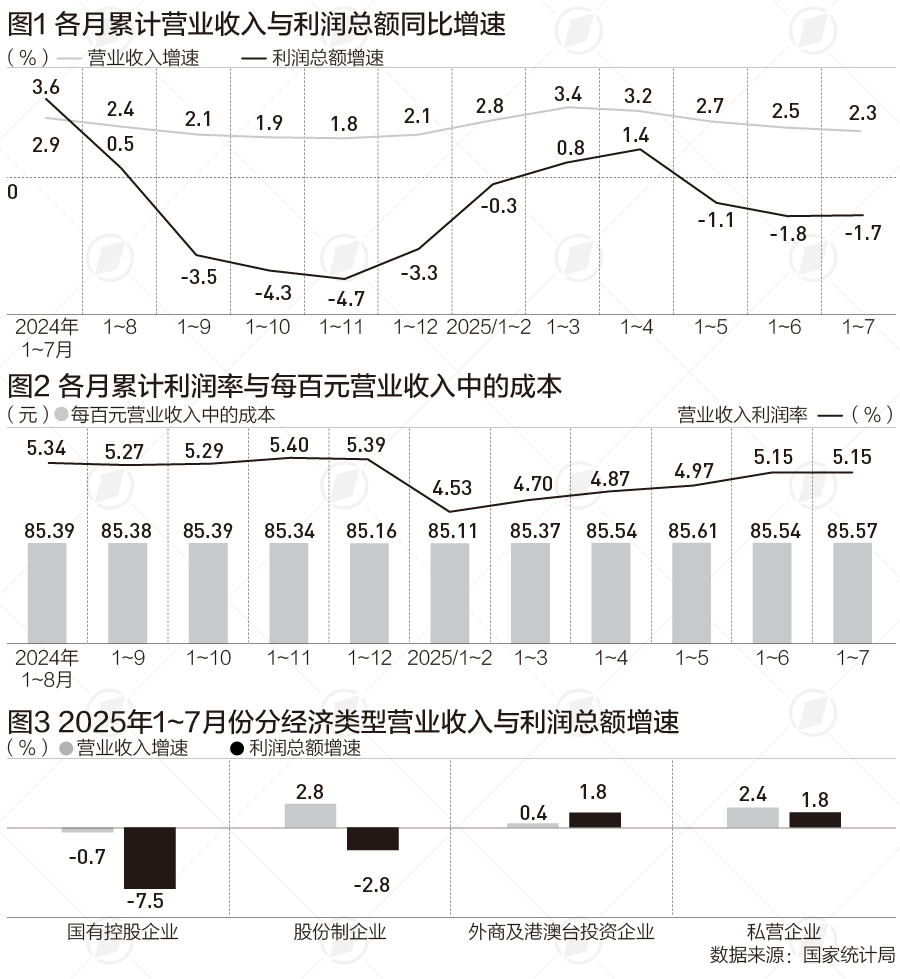
Core Insights - The profitability of industrial enterprises has shown positive improvement due to the implementation of various policies aimed at promoting the private economy and countering "involution" [1][5] Group 1: Industrial Profitability - In July, profits of industrial enterprises above designated size decreased by 1.5% year-on-year, a reduction in the decline by 2.8 percentage points compared to June 2025 [1] - From January to July, cumulative profits of industrial enterprises fell by 1.7%, with a slight narrowing of the decline by 0.1 percentage points compared to the first half of the year [1] - Medium and small-sized enterprises saw a turnaround in profits in July, with increases of 1.8% and 0.5% respectively, compared to declines of 7.8% and 9.7% in June [1] Group 2: Revenue and Cost Dynamics - Industrial enterprise revenue grew by 1.1% year-on-year in July, although this represented a decline of 0.5 percentage points from the previous month [2] - The Producer Price Index (PPI) remained unchanged at -3.6% year-on-year, while the industrial added value decreased by 1.1 percentage points compared to the previous month [2] - Industrial costs increased by 1.2% year-on-year in July, a decrease of 0.8 percentage points from the previous month [2] Group 3: Sector-Specific Performance - Manufacturing and public utilities saw profit growth in July, with manufacturing profits increasing by 6.6% year-on-year, a rise of 5.2 percentage points from June [2] - The mining sector experienced a significant profit decline of 39.2%, worsening by 3.0 percentage points compared to the previous month [2] - High-tech manufacturing profits rose by 18.9%, contributing 2.9 percentage points to the overall improvement in industrial profits [3] Group 4: Private Enterprises - From January to July, private enterprises achieved a total profit of 111.837 billion yuan, growing by 1.8%, with July profits increasing by 2.6%, surpassing the average growth of all industrial enterprises by 4.1 percentage points [5] - Recent policies aimed at enhancing the business environment and providing financial support have positively impacted the profitability of private enterprises [5] - Various local governments have introduced measures to promote the high-quality development of the private economy, signaling a commitment to improving the business environment and stimulating market vitality [5][6]

中国核电(601985):中核电盈利稳健增长,新能源持续承压
Yin He Zheng Quan· 2025-08-28 12:48
Investment Rating - The report assigns a neutral investment rating to the company, indicating a performance expectation within a range of -5% to 5% relative to the benchmark index [12]. Core Insights - The company's projected revenue for 2024 is 77,272.06 million, with an expected growth to 96,171.81 million by 2027, reflecting a compound annual growth rate (CAGR) of approximately 11.13% [8]. - The net profit attributable to the parent company is forecasted to increase from 8,777.34 million in 2024 to 11,274.38 million in 2027, indicating a growth rate of 10.37% in the final year [8]. - The company's EBITDA is expected to rise from 47,337.91 million in 2024 to 63,532.81 million in 2027, showcasing a strong operational performance [8]. Financial Summary - **Income Statement**: - Revenue is projected to grow from 77,272.06 million in 2024 to 96,171.81 million in 2027, with a gross margin decreasing from 42.91% to 39.59% over the same period [8]. - Operating profit is expected to increase from 22,382.02 million in 2024 to 26,157.73 million in 2027 [8]. - **Balance Sheet**: - Total assets are forecasted to grow from 659,739.17 million in 2024 to 862,466.11 million in 2027, with non-current assets increasing significantly [7]. - The total liabilities are expected to rise from 450,371.21 million in 2024 to 602,519.54 million in 2027, indicating a growing leverage [7]. - **Cash Flow Statement**: - Operating cash flow is projected to increase from 40,720.53 million in 2024 to 55,439.92 million in 2027, reflecting improved cash generation capabilities [7]. - The net cash increase is expected to decline from 10,247.40 million in 2024 to a negative 470.45 million in 2027, indicating potential cash flow challenges in the later years [7]. Key Financial Ratios - The report highlights a decrease in the gross margin from 42.91% in 2024 to 39.59% in 2027, while the net profit margin is expected to stabilize around 11% [8]. - The return on equity (ROE) is projected to improve from 7.96% in 2024 to 8.57% in 2027, indicating enhanced profitability relative to shareholders' equity [8]. - The price-to-earnings (P/E) ratio is expected to decrease from 21.25 in 2024 to 16.55 in 2027, suggesting a potentially more attractive valuation over time [8].

2025年7月工业企业利润点评:工业企业盈利水平持续好转,去库存加速
KAIYUAN SECURITIES· 2025-08-28 12:44
1. Report Industry Investment Rating No relevant content provided. 2. Core Viewpoints of the Report - In the second half of 2025, the economic growth rate is not expected to decline significantly, and structural issues such as prices are trending towards improvement [10]. - The allocation between stocks and bonds continues to shift, with bond yields and the stock market expected to rise continuously [10]. - Against the backdrop of revised economic expectations, bond yields are expected to rise trend - wise [9]. 3. Summary by Relevant Catalogs Profit - The cumulative and monthly year - on - year declines in industrial enterprise profits have both narrowed. From January to July, the profits of above - scale industrial enterprises decreased by 1.7% year - on - year, an increase of 0.1 percentage points compared to January - June. In July, the profits of above - scale industrial enterprises decreased by 1.5% year - on - year, an increase of 2.8 percentage points compared to June, indicating continuous improvement in corporate profitability [5]. - Analyzing industrial enterprise profits from the aspects of volume, price, and profit margin, from January to July, the added value of above - scale industries increased by 6.3% year - on - year, and the PPI of all industrial products decreased by 2.9% year - on - year, both decreasing by 0.1 percentage points compared to January - June. The profit margin of above - scale industrial revenue decreased by 4.63% year - on - year, an increase of 0.18 percentage points compared to January - June. The recovery of the profit margin drove the narrowing of the decline in industrial profits [5]. Structure By Industry Category - From January to July, the total profit of the mining industry decreased by 31.6% year - on - year, the profit of the manufacturing industry increased by 4.8% year - on - year, and the profit of the public utilities industry increased by 3.9% year - on - year. The expansion of the profit decline in the mining industry was due to anti - involution and frequent extreme summer weather, while the expansion of the profit increase in the public utilities industry was affected by the widespread high - temperature weather in July [6]. - In July, the profit of the manufacturing industry increased by 6.8% year - on - year, a 5.4 - percentage - point increase compared to June, driving the growth rate of the profits of above - scale industrial enterprises to accelerate by 3.6 percentage points compared to June. The profit of high - tech manufacturing changed from a 0.9% decline in June to an 18.9% increase, driving the growth rate of the profits of above - scale industrial enterprises to accelerate by 2.9 percentage points compared to June [6]. By Enterprise Nature - From January to July, the profits of state - owned enterprises decreased by 7.5% year - on - year, the profits of joint - stock enterprises decreased by 2.8% year - on - year, the profits of foreign - invested and Hong Kong, Macao, and Taiwan - invested enterprises increased by 1.8% year - on - year, and the profits of private enterprises increased by 1.8% year - on - year [7]. - In July, the profits of medium - sized enterprises above designated size increased by 1.8% year - on - year, and the profits of small enterprises increased by 0.5% year - on - year, showing significant improvement in efficiency. The monthly profit of private enterprises increased by 2.6% year - on - year, 4.1 percentage points higher than the average level of the profits of above - scale industrial enterprises [7]. By Industrial Chain Position - From January to July, the proportion of the cumulative profit of upstream raw material mining in the profits of above - scale industrial enterprises was 12.3%, the proportion of mid - stream material manufacturing was 15.4%, the proportion of downstream equipment manufacturing was 38.0%, the proportion of downstream consumer goods manufacturing was 21.1%, the proportion of other manufacturing was 0.6%, and the proportion of public utilities was 12.5% [7]. - Inventory destocking accelerated. At the end of July, the nominal and real inventory year - on - year were 2.4% and 6.0% respectively, both decreasing by 0.7 percentage points. The overall asset - liability ratio of industrial enterprises at the end of July was 57.9%, remaining flat month - on - month [7]. Market - The industrial enterprise profit data was released at 9:30. Although the cumulative and monthly year - on - year declines in industrial enterprise profits both narrowed, the bond market did not trade based on this data, and bond yields fluctuated within a narrow range. After the mid - day break, the A - share market rose first and then fell back, with heavy trading volume and a decline. Under the stock - bond seesaw effect, bond yields first rose and then fell. At the end of the session, due to redemption factors, funds changed from buying to selling, and coupled with tightening funds, bond yields rose again [8].
私营企业利润增速加快,多地加力支持民营经济发展壮大
Di Yi Cai Jing Zi Xun· 2025-08-28 11:48
Group 1 - The core viewpoint is that industrial enterprises' profitability is showing positive improvement due to the implementation of various policies aimed at promoting the private economy and countering "involution" [1][7] - In July, profits of industrial enterprises above designated size decreased by 1.5% year-on-year, but the decline narrowed by 2.8 percentage points compared to June 2025 [1] - From January to July, cumulative profits of industrial enterprises fell by 1.7%, with a slight improvement in the decline rate compared to the first half of the year [1] Group 2 - In July, the revenue of industrial enterprises grew by 1.1% year-on-year, although the growth rate decreased by 0.5 percentage points compared to the previous month [2] - The Producer Price Index (PPI) remained unchanged at -3.6% year-on-year, while the cost of industrial enterprises increased by 1.2%, a decrease of 0.8 percentage points from the previous month [2] - The manufacturing and public utility sectors saw a rebound in profit growth, with manufacturing profits increasing by 6.6% year-on-year, while mining profits fell by 39.2% [2] Group 3 - In the manufacturing sector, profits in raw materials and high-tech manufacturing showed significant improvement, with raw materials manufacturing profits rebounding to a growth of 36.9% year-on-year [3] - High-tech manufacturing profits turned from a decline of 0.9% in June to a growth of 18.9% in July, contributing 2.9 percentage points to the overall profit improvement of industrial enterprises [3] - Specific industries such as electronic and electrical machinery manufacturing saw profits grow by 87.9% and 15.3% respectively, driven by large-scale equipment updates [3] Group 4 - Private enterprises achieved a total profit of 1,118.37 billion yuan from January to July, with a growth of 1.8%, which is 0.1 percentage points faster than the first half of the year [7] - In July, private enterprises' profits grew by 2.6%, exceeding the average growth rate of all industrial enterprises by 4.1 percentage points [7] - Recent policies aimed at improving the business environment and supporting private enterprises have shown positive results, enhancing their operational conditions and profitability [7] Group 5 - Various local governments have introduced measures to promote the development of the private economy, signaling a strong commitment to optimizing the business environment and stimulating market vitality [8] - Specific initiatives include supporting private enterprises in participating in key industrial chains and addressing challenges faced by the private sector [8] - The establishment of local regulations, such as those in Hainan, aims to create a fair competitive environment for private enterprises [8]
工业企业利润点评:反内卷初见成效,低基数下利润迎来修复
Huafu Securities· 2025-08-28 11:37
Profit Trends - In July, the year-on-year decline in industrial enterprise profits narrowed for the second consecutive month, decreasing by 2.8 percentage points to -1.5%[3] - Cumulative year-on-year profit decline was -1.7%, slightly narrowing by 0.1 percentage points compared to June[3] - The main driver for profit recovery in July was a significant reduction in operating costs, which fell by 1.1 percentage points to 0.8%, marking a new low since September 2024[3] Revenue and Costs - July revenue saw a slight year-on-year decline of 0.5%, with cumulative revenue also dropping by 0.2 percentage points to 2.3%, the lowest since the beginning of the year[3] - Cumulative expenses per 100 yuan of revenue remained stable at 8.38 yuan, with operating expenses further dragging down profits by 0.1 percentage points[3] Sector Performance - Manufacturing and public utilities saw slight improvements in cumulative profits, rising by 0.3 and 0.6 percentage points to 4.8% and 3.9% respectively[4] - Conversely, the mining sector experienced a worsening cumulative profit decline of 1.3 percentage points to -31.6%, a new low due to previous price competition pressures[4] Inventory and Market Conditions - Finished goods inventory saw a significant year-on-year decline of 0.7 percentage points to 2.4%, with actual inventory dropping by 0.8 percentage points to 6.2%, the lowest since the beginning of the year[4] - The ongoing downturn in the real estate market and strict control over new hidden debts are suppressing production confidence among industrial enterprises[4] Economic Outlook - The report suggests that effective governance of chaotic price competition and continuous cost reductions are key to the slight recovery in industrial profits[5] - However, insufficient domestic demand and declining revenue growth pose challenges for sustainable profit increases in industrial enterprises[5] - Monetary policy may consider slight interest rate cuts to stabilize the real estate market and support durable consumer goods demand[5]
第一太平(00142) - 2025 H1 - 电话会议演示
2025-08-28 09:00
Financial Performance - First Pacific's gross asset value reached $5.6 billion[8] - Recurring profit increased by 11% to a record high of $375.4 million compared to $339.1 million[19] - Net profit rose 41% to $391.2 million from $277.8 million[19] - The Board approved an interim distribution of 13.0 HK cents (1.67 U S cents) per share[19] Portfolio Highlights - Indofood's net sales rose 4% to a record high of IDR59.8 trillion[31] - MPIC's contribution from investee companies increased by 18% to a record high of ₱17.5 billion[47] - Meralco's core profit increased by 10% to a record high of ₱25.5 billion[58] - MPTC's revenues rose 18% to a record ₱18.1 billion[69] Debt and Ratings - Investment-grade credit ratings are maintained from S&P (BBB- with Stable outlook) and Moody's (Baa3 with Stable outlook)[26] - Fixed-rate borrowings constitute 54% of total borrowings[25] - PLDT's Maya fintech unit delivered its first half-yearly profit with PLDT's share amounting to ₱0.4 billion[93]

盈利结构与2015年有不同之处
Xinda Securities· 2025-08-28 08:03
Group 1: Overall Profit Trends - Industrial enterprise profits showed a mixed performance, with total profits of 4.0 trillion yuan from January to July 2025, a year-on-year decline of 1.7%, narrowing by 0.1 percentage points compared to the first half of the year[5] - The profit margin for industrial enterprises was 5.15% from January to July, indicating a slight improvement compared to the previous year, which is a key driver for the narrowing profit decline[6] - The mining industry experienced a significant decline in profits, with a year-on-year drop of 31.6%[11] Group 2: Ownership Structure Impact - Foreign and private enterprises provided a "dual support" for profit growth, with both types achieving a 1.8% year-on-year profit increase, while state-owned enterprises faced a 7.5% decline, generating approximately 1.3 trillion yuan in profits[8] - Total profits for all joint-stock enterprises were about 3.0 trillion yuan, reflecting a year-on-year decrease of 2.8%[8] Group 3: Sector Performance Comparison - Manufacturing and public utilities showed improvement, while the mining sector worsened, with manufacturing profits accelerating by 5.4 percentage points in July compared to June[11] - High-tech manufacturing significantly contributed to profit growth, with a notable increase of 2.9 percentage points in July compared to the overall industrial profit growth[11] Group 4: Market vs. Fundamentals - Since May 2025, the stock market has risen significantly, with the Shanghai Composite Index increasing by 3.7% in June and 6.4% in July, despite industrial profits remaining in negative growth[14] - This divergence indicates that the stock market's rise is not driven by fundamental profit growth but rather by liquidity factors, similar to trends observed in 2015[15] Group 5: Need for Policy Support - The current "anti-involution" context necessitates the implementation of demand-side policy tools to support the consumer goods manufacturing sector, which has been experiencing negative profit growth since April 2025[26]
【真灼机构观点】美团业绩远逊预期 恒指25,000点攻防战
Xin Lang Cai Jing· 2025-08-28 07:46
来源:市场资讯 至于连日有好表现之中港股市昨日均有所整调。A股方面,上综指及深成指均以全日最低位收市,前者 跌1.76%,报3,800点,后者则早段曾升1.54%,惟午后由升转跌,最终收报12,295点,下跌1.43%,不过 成交持续活跃,达到3.17万亿元人民币。港股表现亦有所转弱,恒指早段曾升近130点,不过午后A股下 挫,恒指亦由升转跌,其后跌幅更进一步扩大至384点,最终收报25,201点,下跌323点或1.3%,连跌第 二个交易日,科指亦跌1.5%,收报5,697点,全日成交显著增加至3,714亿元。成份股跌多升少,当中以 华润万象(01209.HK)表现最差,急挫超过9%,另个别医药股跌势显著,石药集团(01093.HK)及翰森制 药(03692.HK)分别下跌6.4%及5.7%,科技股亦有沽压,$美团-W(HK3690)及快手(01024.HK)均跌超过 3%。上升成份股中则以农夫山泉(09633.HK)表现最佳,升超过7%,公用股如中电(00002.HK)及煤气 (00003.HK)亦靠稳。 由于美团公布之业绩远逊预期,股价今日料会有较大沽压,今日新加坡黑期亦已回落至25,000点之下, 预期 ...


1-7月工企利润数据点评:四季度增量政策或仍值得期待
Bank of China Securities· 2025-08-28 02:34
Profit and Revenue Analysis - From January to July 2025, the total profit of industrial enterprises reached CNY 40,203.5 billion, a year-on-year decrease of 1.7%, with the decline narrowing by 0.1 percentage points compared to the first half of the year[1] - In July 2025, industrial enterprises' profits fell by 1.5% year-on-year, with the decline narrowing by 2.8 percentage points from June[1] - The operating income of industrial enterprises grew by 2.3% year-on-year from January to July, with the growth rate slowing by 0.2 percentage points compared to the first half of the year[1] Cost and Profitability Metrics - The operating income profit margin for industrial enterprises was 5.2% from January to July, unchanged from the first half of the year[2] - Operating costs increased by 2.5% year-on-year during the same period, with the growth rate slowing by 0.3 percentage points compared to the first half[1] - The average revenue per CNY 100 of assets was CNY 74.0, an increase of CNY 0.1 from the first half of the year[1] Industry Performance Insights - The mining industry accounted for 12.3% of total industrial profits, continuing to decline, with profits in this sector dropping by 31.6% year-on-year[9] - High-tech manufacturing contributed positively to the profit growth of industrial enterprises, adding 1.9 percentage points to the cumulative year-on-year profit growth[11] - The overall industrial production value increased by 6.3% year-on-year, slightly slowing by 0.1 percentage points compared to the first half of the year[6] Future Policy Expectations - There are expectations for incremental policies in the fourth quarter to address the weak pricing environment affecting industrial profitability[18] - The negative contribution from the mining and raw materials processing industries to profit growth is anticipated to continue, while traditional and high-tech manufacturing sectors provide some support[18]