家用电器

Search documents
21股受融资客青睐,净买入超亿元
Zheng Quan Shi Bao Wang· 2025-05-07 01:36
Summary of Key Points Core Viewpoint - As of May 6, the total market financing balance reached 1.79 trillion yuan, indicating an increase of 143.81 billion yuan from the previous trading day, with notable contributions from both the Shanghai and Shenzhen stock exchanges [1]. Financing Balances - Shanghai stock exchange financing balance: 908.24 billion yuan, up by 59.40 billion yuan - Shenzhen stock exchange financing balance: 876.71 billion yuan, up by 83.55 billion yuan - Beijing Stock Exchange financing balance: 5.12 billion yuan, up by 86.21 million yuan [1]. Individual Stock Performance - On May 6, 2,239 stocks received net financing purchases, with 566 stocks having net purchases exceeding 10 million yuan, and 21 stocks exceeding 100 million yuan [1]. - Leading net purchases included: - Luxshare Precision: 228 million yuan - Runhe Software: 212 million yuan - Changshan Beiming: 199 million yuan - Other notable stocks: Inspur Information, Sichuan Changhong, and Dongfang Caifu [1][2]. Industry Concentration - The industries with the highest concentration of stocks receiving net financing purchases over 100 million yuan included: - Computer: 5 stocks - Non-ferrous metals: 3 stocks - Electronics: 3 stocks [1]. Financing Balance to Market Value Ratio - The average ratio of financing balance to circulating market value for stocks with significant net purchases was 4.78% - Stocks with the highest ratios included: - Hanyu Group: 9.63% - Guanghetong: 8.53% - Dongfang Caifu: 7.51% - Runhe Software: 7.49% [2][3]. Notable Stock Data - Top net purchases on May 6 included: - Luxshare Precision: 3.11% increase, net purchase of 227.62 million yuan - Runhe Software: 9.55% increase, net purchase of 212.02 million yuan - Changshan Beiming: 10.02% increase, net purchase of 198.69 million yuan - Other significant stocks included Inspur Information, Sichuan Changhong, and Dongfang Caifu [2][3].



一季度规上轻工企业实现营收5.4万亿元 主要行业投资增速均保持两位数增长
Ren Min Ri Bao· 2025-05-06 21:47
1至3月份,家用电器和音像器材类商品零售额增长19.3%,自上年9月份以来保持两位数增长。消费品 以旧换新政策有力促进了产业发展和绿色转型,家用电器和音像器材类中的高能效等级家电和智能家电 销售连续保持高速增长态势,家电市场呈现明显的消费升级趋势。 本报北京5月6日电 (记者韩鑫)记者从中国轻工业联合会获悉:一季度,在系列扩内需、促消费政策 支持下,规模以上轻工企业实现营收5.4万亿元、同比增长4.8%,实现利润超3000亿元、同比增长 1.4%,轻工业经济运行总体平稳、稳中有进。 生产回升向好。一季度,规模以上轻工业增加值同比增长7.3%,增速较去年末加快2.2个百分点。得益 于消费品以旧换新政策,3月份,电动自行车、洗衣机、空调等产品产量实现两位数增长。 投资较快增长。轻工行业发展信心持续增强,一季度,轻工主要行业投资增速均保持两位数增长,投资 增速高于制造业投资增速。 今年以来,消费品以旧换新支持资金规模翻番、商品种类扩围。"随着政策效应持续向供给端传导,轻 工相关产业规模不断扩大,国内市场持续回暖,带动轻工业经济增长。"中国轻工业联合会会长张崇和 表示。 家具、家装厨卫相关行业市场规模迎来快速增长。在 ...
今日56.72亿元主力资金潜入计算机业
Zheng Quan Shi Bao Wang· 2025-05-06 13:44
| 行业名 | 成交量(亿 | 成交量较昨日增减 | 换手率 | 涨跌幅 | 今日主力资金净流入(亿 | | --- | --- | --- | --- | --- | --- | | 称 | 股) | (%) | (%) | (%) | 元) | | 计算机 | 80.08 | 16.11 | 4.54 | 3.65 | 56.72 | | 电子 | 73.37 | 23.97 | 2.68 | 2.64 | 46.98 | | 非银金 融 | 42.19 | 31.55 | 1.02 | 1.38 | 24.29 | | 机械设 备 | 90.99 | 18.74 | 3.40 | 3.04 | 22.76 | | 有色金 属 | 43.08 | 42.69 | 1.97 | 2.57 | 20.75 | | 通信 | 31.97 | 41.66 | 1.85 | 3.59 | 20.12 | | 电力设 备 | 54.55 | 8.54 | 2.26 | 2.16 | 15.08 | | 汽车 | 53.94 | 4.84 | 2.51 | 2.20 | 13.02 | | 传媒 | 41.10 | 1 ...
金融工程定期:券商金股解析月报(2025年5月)-20250506
KAIYUAN SECURITIES· 2025-05-06 13:42
- The report discusses the characteristics of broker-recommended stocks for May, highlighting that Gree Electric Appliances, Kingnet Network, Hygon Information, Zijin Mining, and Proya were among the most frequently recommended stocks[2][13][14] - The report notes that the sectors with the highest weight in broker-recommended stocks for May were electronics, food and beverage, automotive, and pharmaceuticals, with electronics having the highest weight at 10.3%[3][14][17] - The report provides a performance review of broker-recommended stocks for April, showing an overall return of -1.0% for the month and a year-to-date return of 3.7%, with new stocks outperforming repeated stocks[4][19][22] - The report introduces the "Kaiyuan Quantitative Preferred Stock Portfolio," which had a return of -5.1% in April and a year-to-date return of 7.6%, outperforming the CSI 500 index by 9.2%[5][24][27] - The report lists the top-performing stocks for April, with Xianda Co., Wancheng Group, and Minshida leading the monthly returns at 64.3%, 62.9%, and 49.5%, respectively[4][22][23] Quantitative Models and Construction Methods 1. **Model Name: Kaiyuan Quantitative Preferred Stock Portfolio** - **Construction Idea**: The model selects the top 30 new stocks with the highest performance surprise factor (SUE factor) and weights them according to the number of broker recommendations[24] - **Construction Process**: - Select new stocks as samples - Choose the top 30 stocks with the highest SUE factor - Weight the stocks based on the number of broker recommendations[24] - **Evaluation**: The model shows superior stock-picking ability, especially in new stocks with high performance surprises[24] Model Backtest Results 1. **Kaiyuan Quantitative Preferred Stock Portfolio** - **April Return**: -5.1% - **2025 YTD Return**: 7.6% - **Annualized Return**: 20.0% - **Annualized Volatility**: 25.5% - **Return-Volatility Ratio**: 0.78 - **Maximum Drawdown**: 24.6%[27] 2. **All Broker-Recommended Stocks** - **April Return**: -1.0% - **2025 YTD Return**: 3.7% - **Annualized Return**: 10.8% - **Annualized Volatility**: 23.6% - **Return-Volatility Ratio**: 0.46 - **Maximum Drawdown**: 42.6%[22] 3. **New Broker-Recommended Stocks** - **April Return**: -0.9% - **2025 YTD Return**: 7.2% - **Annualized Return**: 13.7% - **Annualized Volatility**: 24.4% - **Return-Volatility Ratio**: 0.56 - **Maximum Drawdown**: 38.5%[22] 4. **Repeated Broker-Recommended Stocks** - **April Return**: -1.1% - **2025 YTD Return**: 1.1% - **Annualized Return**: 8.4% - **Annualized Volatility**: 23.6% - **Return-Volatility Ratio**: 0.36 - **Maximum Drawdown**: 45.0%[22] 5. **CSI 300 Index** - **April Return**: -3.0% - **2025 YTD Return**: -4.2% - **Annualized Return**: 1.3% - **Annualized Volatility**: 21.5% - **Return-Volatility Ratio**: 0.06 - **Maximum Drawdown**: 40.6%[22] 6. **CSI 500 Index** - **April Return**: -3.7% - **2025 YTD Return**: -1.6% - **Annualized Return**: -1.3% - **Annualized Volatility**: 23.9% - **Return-Volatility Ratio**: -0.05 - **Maximum Drawdown**: 37.5%[22]
5月市场观点:关注关税的实际影响幅度-20250506
GOLDEN SUN SECURITIES· 2025-05-06 12:01
Group 1: Tariff Impact Analysis - The report highlights that the actual impact of tariff increases will gradually become evident, with significant concerns regarding the overall tariff rate and its effects on exports and economic growth [1][9][14] - Four scenarios of tariff increases were analyzed, resulting in overall tariff rates of approximately 33.4%, 53.0%, 81.9%, and 105.6% respectively [1][14][18] - The estimated impact on China's overall exports under these scenarios is projected to be a decline of 8.7%, 11.7%, 12.7%, and 12.7%, with actual drag expected to be around 7%-10% when considering potential new transshipment trade and overseas factories [2][16][18] Group 2: Economic Growth Impact - The report estimates that the GDP drag from the four tariff scenarios will be approximately 1.2%, 1.6%, 1.7%, and 1.7%, with actual impacts potentially ranging from 1% to 1.4% when accounting for mitigating factors [2][16][18] - The analysis indicates that the household appliances and light manufacturing sectors will face the most significant pressure, followed by electronics, beauty care, power equipment, machinery, basic chemicals, automotive, textiles, and non-ferrous metals [2][17][18] Group 3: Monthly Market Review - The report notes that in April, global risk appetite experienced significant fluctuations due to unexpected tariff announcements, leading to a sharp decline in stock and bond markets, followed by a gradual recovery [3][19] - A-shares showed a "√" shaped recovery pattern, although most indices ended the month lower, with domestic demand and dividend stocks performing relatively better [3][19][20] Group 4: Market Outlook and Investment Strategy - The report anticipates a continuation of the volatile market pattern, influenced by U.S.-China tensions, liquidity conditions, and policy shifts [4][5] - Investment strategies should focus on sectors with independent industrial trends, such as domestic AI, smart vehicles, and robotics, while also considering policy-driven sectors like domestic consumption and real estate [5]
家电汽车等行业低碳转型,“国家方案”敲定目标
Di Yi Cai Jing· 2025-05-06 11:54
Core Points - China has eliminated approximately 628,000 tons of ozone-depleting substances (ODS), accounting for over half of the total elimination in developing countries [1][2] - The implementation of the "National Plan" aims to strengthen the management of ODS and hydrofluorocarbons (HFCs), promoting green and low-carbon development across various industries [1][2] Group 1: National Plan and Regulatory Framework - The "National Plan" outlines the control of nine substances, including chlorofluorocarbons, halons, and HFCs, with specific reduction targets set for 2025 and 2030 [2][3] - The plan mandates a 67.5% reduction in controlled uses of hydrochlorofluorocarbons (HCFCs) by 2025 and a 97.5% reduction by 2030 [3] - HFCs will see a 10% reduction in controlled uses by 2029 [3] Group 2: Industry Challenges and Opportunities - The fluorochemical industry is a significant part of China's emerging strategic industries, producing over 50% of global fluorochemical products [6] - The household appliance sector has adopted propane (R290) as an environmentally friendly alternative, with over 10 million R290 air conditioners produced by the end of 2024 [6] - The automotive industry is a major user of HFCs, with regulations set to ban high GWP refrigerants in new vehicle air conditioning systems starting July 1, 2029 [5][7] Group 3: Technological Development and Innovation - The refrigeration and air conditioning industry has seen substantial growth, with a total output value of 460 billion yuan in 2023, significantly larger than when the phase-out of CFCs began [10] - The foam industry faces challenges in finding suitable alternatives to HFCs, with various replacement technologies having different cost and safety implications [10][11] - The fire protection industry is also seeking new alternatives to HFC-based extinguishing agents, emphasizing the need for innovation and collaboration between academia and industry [11]

2024年北交所上市公司整体经营保持稳健,超八成公司实现盈利
Xin Jing Bao· 2025-05-06 11:37
Core Insights - The Beijing Stock Exchange (BSE) companies demonstrated stable operating performance in 2024, with total revenue reaching 180.845 billion yuan, maintaining a similar level compared to the previous year [1] - 31 companies reported revenues exceeding 1 billion yuan, with over 60% of companies achieving positive revenue growth [1] - The net profit for BSE companies totaled 11.03 billion yuan, with an 85% profitability rate among 265 listed companies [1] Group 1: Company Performance - BSE companies collectively achieved a revenue of 180.845 billion yuan, with an average revenue of 6.82 million yuan per company [1] - 225 companies reported profits, with 120 companies showing year-on-year net profit growth [1] - The top three companies by revenue were Better Ray (14.237 billion yuan), Yinuowei (6.857 billion yuan), and Tongli Co. (6.145 billion yuan) [1] Group 2: Small and Medium Enterprises (SMEs) - SMEs accounted for 80% of BSE listings, generating a total revenue of 104.778 billion yuan, marking a year-on-year growth of 6.76% [3] - 67% of private enterprises reported revenue growth, with 26 companies achieving over 30% growth [3] - New listings in 2024 were predominantly private enterprises, raising over 4 billion yuan to support innovation [3] Group 3: Sector Performance - The home appliance and textile sectors saw net profit increases of 18.99% and 14.40%, respectively [5] - The engineering machinery sector experienced a profit growth of 13.44%, with Tongli Co. achieving a net profit of 7.93 billion yuan, up 29.03% [5] - The automotive sector's net profit grew by 8.75%, with Taide Co. reporting a 216.53% increase in net profit [5] Group 4: Research and Development - BSE companies increased R&D investment to over 9.1 billion yuan, with more than 60% of companies reporting year-on-year growth in R&D spending [6] - The average R&D intensity reached 5.04%, with 41 companies exceeding 10% [6] - The total number of patents held by BSE companies reached 26,900, reflecting an 8.64% year-on-year increase [6]
A股市场2025年一季报业绩综述:全A净利边际改善,价格和政策有支撑的领域占优
BOHAI SECURITIES· 2025-05-06 10:55
| 略 | | 投资策略 | | --- | --- | --- | | | [Table_MainInfo] 全 A | 净利边际改善,价格和政策有支撑的领域占优 | | 研 | | ——A 股市场 2025 年一季报业绩综述 | | 究 | 分析师: 宋亦威 | SAC NO: S1150514080001 2025 年 05 月 06 日 | | | [Table_Analysis] 证券分析师 | [Table_Summary] | | | 宋亦威 | 投资要点: | | | 022-23861608 | 2025Q1 全 A 单季营收同比增速较 2024Q4 出现回落,而单季归母净利 | | | songyw@bhzq.com | 同比增速由负转正显著改善。具体而言,2025Q1 全 单季营收和净利 A | | | [Table_Author] 严佩佩 | | | | | 同比增速分别为-0.2%/3.7%,前者较 2024Q4 回落 1.7 个百分点,后者 | | | 022-23839070 SAC No:S1150520110001 | 较 2024Q4 回升 17.5 个百分点。 | | ...
“五一”假期全国消费相关行业销售收入同比增长15.2%
news flash· 2025-05-06 10:44
国家税务总局最新增值税发票数据显示,"五一"假期消费需求旺盛,增势良好。全国消费相关行业销售 收入同比增长15.2%。其中,在"以旧换新"政策带动下,家用电器和音像器材销售收入同比增长 167.5%,智能手机等消费电子产品纳入购新补贴范围,通信器材销售收入同比增长118%,家具销售收 入同比增长1.7倍。 ...
已首批上市!中证现金流ETF全解读
Sou Hu Cai Jing· 2025-05-06 07:33
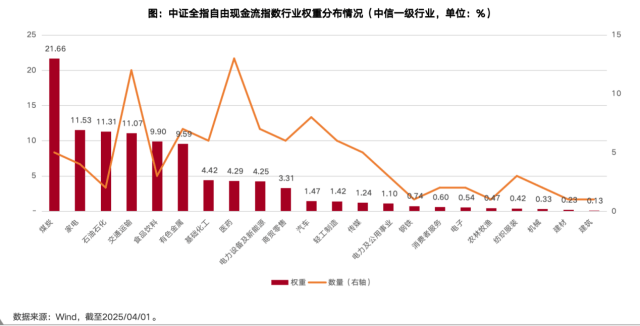
自由现金流这个概念最近非常热门,它是指企业在支付了所有必要的经营费用和资本支出后,剩余的可 用于分配给股东和债权人的现金。 作为衡量企业财务健康状况的关键指标之一,自由现金流的核心优势在于穿透会计迷雾,反映企业真实 盈利能力,并为投资决策提供前瞻性指引。聚焦自由现金流充裕的企业既能规避价值陷阱,又能分享长 期增长红利。是衡量企业真实盈利能力和财务健康的"黄金指标"。 (一)价值的终极源泉 持续经营能力的基石 相比于传统会计统计下的净利润指标,自由现金流至少在四个方面具备显著优势: (二)行业配置自带哑铃策略 中证自由现金流的编制规则,对于成分股筛选有着严苛的标准。 首先,排除金融和地产行业——前者依赖资金周转以及存款并非计入经营现金流,后者受业务模式和政 策影响现金流波动大,难以用统一标准衡量。 其次,连续5年经营活动现金流为正,确保盈利稳定性;盈利质量由高到低排名前80%,即经营现金流 与营业利润匹配度高,避免 "赚利润不赚现金" 的情况。 最终,按自由现金流率(自由现金流/企业价值,且自由现金流和企业价值均为正)从高到低选出 100 只股票,构建自由现金流率集中的高性价比,高现金含量的股票组合。 根据以上 ...