机械

Search documents
德国总理:特朗普30%关税将重创德国工业
Hua Er Jie Jian Wen· 2025-07-14 07:24
美国提高对欧盟贸易关税的威胁正迫使德国展开紧急外交应对。 德国总理弗里德里希·默茨(Friedrich Merz)警告,如果不能在未来几周内与美国达成谈判解决方案, 特朗普威胁征收的30%关税将对德国出口商造成"核心打击"。 综合央视新闻报道,当地时间7月12日,美国总统特朗普宣布自2025年8月1日起,美国将对来自墨西哥 和欧盟的输美产品征收30%的关税。作为回应,欧盟委员会主席冯德莱恩当地时间13日表示,将把对美 国关税的反制措施暂停期延长至8月初。 默茨在周日接受媒体采访时表示,如果美国真的实施这一高额关税,德国政府可能需要推迟部分经济政 策计划。这一潜在关税将"笼罩一切,并且重创德国的出口行业"。 针对德国是否支持对美国采取反制措施的问题,默茨明确表示: 是的,但不会在8月1日之前。 默茨透露,除了周五与特朗普通话外,他还在周末与法国总统马克龙和欧盟委员会主席冯德莱恩就此事 进行了深入讨论。 德国作为欧洲最大的制造业出口国,对美国市场的依赖度极高,尤其是在汽车、机械和化工等关键行 业。特朗普的关税威胁可能会进一步打击已经面临挑战的德国经济,并可能迫使柏林重新评估其经济政 策。 欧美贸易紧张局势进入关键 ...
美威胁对加墨分别征收35%和30%关税,如何影响美墨加产业链?|特朗普关税风云第二季
第一财经· 2025-07-14 06:27
Core Viewpoint - The article discusses the recent tariff increases announced by President Trump on imports from Mexico and Canada, citing drug control issues as the primary reason, while also indicating that the actual impact on trade may be limited due to existing trade agreements [1][6]. Group 1: Tariff Increases - On August 1, a 30% tariff will be imposed on goods imported from Mexico, and a 35% tariff on goods from Canada [1]. - The tariffs are justified by Trump's claims of insufficient action by both countries in controlling drug trafficking, particularly fentanyl [1][6]. - The increase in tariffs is seen as a strategy to pressure Canada and Mexico into further concessions during ongoing trade negotiations [3][12]. Group 2: Trade Relations and Agreements - The USMCA (United States-Mexico-Canada Agreement) provides exemptions for many products, which may limit the actual impact of the new tariffs [4][13]. - Most goods imported from Canada and Mexico currently enjoy low average tariff rates, often below 1% [4]. - The article notes that the trade relationship is heavily interdependent, with Canada and Mexico relying significantly on the US market for exports [12]. Group 3: Economic Implications - If comprehensive tariffs are applied, it could raise US prices by approximately 1.2%, affecting consumer goods and potentially leading to public dissatisfaction [5]. - The tariffs may also influence the automotive industry by increasing local sourcing requirements, although evidence of effective re-industrialization through tariffs is lacking [7]. - The potential for retaliatory tariffs from Canada and Mexico exists, but both countries seem inclined to negotiate rather than escalate tensions [10][12].


海关总署:上半年出口规模历史同期首次突破13万亿元,同比增长7.2%
Yang Shi Wang· 2025-07-14 02:54
Core Viewpoint - Despite external pressures and challenges, China's exports have shown robust growth in the first half of the year, with a historical milestone of over 13 trillion yuan, reflecting a year-on-year increase of 7.2% [1][2] Group 1: Trade Performance - In the first half of the year, exports from private enterprises reached 8.52 trillion yuan, growing by 8.3%, while foreign-funded enterprises exported 3.49 trillion yuan, up by 5.4%, and state-owned enterprises exported 968.73 billion yuan, increasing by 3.8% [1] - The number of exporting enterprises in China has steadily increased, surpassing 500,000 in 2023, with an 8.5% growth in the first half of the year [1] Group 2: Market Dynamics - Exports to both traditional and emerging markets have seen growth, with double-digit increases in exports to ASEAN, Central Asia, and Africa, while maintaining stable growth to traditional markets such as the EU, Japan, and the UK [1] Group 3: Product Innovation - High-tech product exports grew by 9.2% in the first half of the year, with significant increases in high-end machine tools, ships, and marine engineering equipment, all exceeding 20% growth [2] - The proportion of self-owned brands in high-tech product exports reached 32.4%, an increase of 1.2 percentage points compared to the previous year [2] - Companies are increasingly adapting to international market demands by offering customized products, such as solar-powered phones for areas with power shortages and sand-resistant engines for desert regions [2]
机构研究周报:有一点2014年底味道,利率下行趋势或放缓
Wind万得· 2025-07-13 22:42
Core Viewpoints - The current market environment shows similarities to the end of 2014, with a potential for policy changes aimed at stimulating domestic demand and addressing "involution" [5][4]. Economic Indicators - China's June CPI rose by 0.1% year-on-year, marking the first increase after four months of decline; core CPI increased by 0.7%, the highest in 14 months. PPI fell by 0.4% month-on-month and 3.6% year-on-year, with the decline expanding by 0.3 percentage points compared to the previous month [2]. - The shift in CPI is attributed to a recovery in industrial consumer goods prices, which saw a reduction in the year-on-year decline from 1.0% to 0.5% [2]. Equity Market Insights - A-shares are driven by capital rather than traditional macro factors, with significant inflows expected from insurance and public funds, particularly into the technology sector [4]. - Hong Kong stocks are viewed as having high cost-effectiveness and potential for growth, supported by expected inflows from Southbound capital and a favorable earnings outlook [6][7]. Industry Research - The "involution" policy is driving sectors like steel and new energy, while AI is enhancing the performance of technology leaders, suggesting a focus on high-quality stocks and sectors with significant growth potential [9][10]. - The introduction of Grok-4 is expected to significantly enhance AI reasoning capabilities, leading to new investment opportunities in the computing industry [10]. Macro and Fixed Income - The bond market is anticipated to experience a slowdown in the downward trend of interest rates, with a focus on the 10-year government bond yield remaining stable [18]. - The current high valuation of convertible bonds limits their upward potential, with a recommendation to focus on lower-priced strategies [19]. Asset Allocation Strategies - A "dividend base + small-cap growth" strategy is recommended, focusing on high dividend and cash flow assets to mitigate external risks while also investing in high-volatility new stocks [22].

市场形态周报(20250707-20250711):本周指数普遍上涨-20250713
Huachuang Securities· 2025-07-13 09:45
Quantitative Models and Construction 1. Model Name: Heston Model - **Model Construction Idea**: The Heston model is used to calculate the implied volatility of near-month at-the-money options, which serves as a market fear index. It reflects market participants' expectations of future volatility[7]. - **Model Construction Process**: The Heston model is a stochastic volatility model where the variance of the asset price follows a mean-reverting square-root process. The model is defined by the following equations: $ dS_t = \mu S_t dt + \sqrt{v_t} S_t dW_t^1 $ $ dv_t = \kappa (\theta - v_t) dt + \sigma \sqrt{v_t} dW_t^2 $ Here: - \( S_t \): Asset price - \( v_t \): Variance process - \( \mu \): Drift rate of the asset price - \( \kappa \): Rate of mean reversion of variance - \( \theta \): Long-term variance - \( \sigma \): Volatility of volatility - \( W_t^1, W_t^2 \): Two Wiener processes with correlation \( \rho \)[7]. - **Model Evaluation**: The Heston model is widely used in financial markets for its ability to capture the stochastic nature of volatility, making it a robust tool for implied volatility estimation[7]. --- Quantitative Factors and Construction 1. Factor Name: Multi-Industry Timing Factor (Scissor Difference) - **Factor Construction Idea**: This factor is based on the difference between the number of stocks with bullish and bearish signals within an industry. It is used to construct an industry timing strategy[15]. - **Factor Construction Process**: - Define the number of stocks with bullish signals as \( N_{bullish} \) and bearish signals as \( N_{bearish} \). - Compute the scissor difference as: $ \text{Scissor Difference} = N_{bullish} - N_{bearish} $ - Normalize the scissor difference by the total number of stocks in the industry to obtain the scissor difference ratio: $ \text{Scissor Difference Ratio} = \frac{N_{bullish} - N_{bearish}}{N_{total}} $ - Use this ratio to construct an industry timing strategy[15]. - **Factor Evaluation**: The backtesting results show that the timing model outperforms the respective industry indices in all cases, demonstrating excellent historical performance[15]. --- Backtesting Results of Models and Factors 1. Heston Model - **Implied Volatility Results**: - SSE 50: 14.41% (+2.91% WoW)[9] - SSE 500: 15.4% (+0.83% WoW)[9] - CSI 1000: 18.09% (+1.24% WoW)[9] - CSI 300: 14.48% (+3.15% WoW)[9] 2. Multi-Industry Timing Factor - **Performance Metrics**: - The timing model outperformed the respective industry indices in all cases, with a 100% success rate in backtesting[15]. - Specific industries with bullish signals include retail, light manufacturing, home appliances, and others[18].
哪些行业的“反内卷”前景更好?
Hua Er Jie Jian Wen· 2025-07-13 09:21
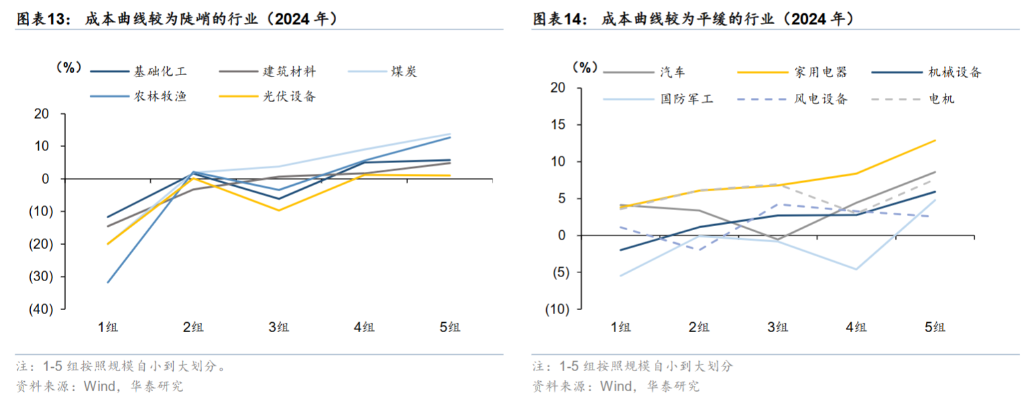
虽然政策"反内卷"方向明确,但不同行业的命运正走向分岔路。7月12日,华泰证券报告显示,不同行业"反内卷"成效将显著分化,光伏电池等亏 损严重行业短期筑底机会明确;钢铁煤炭等国企主导行业期待更高层级的统一指导;而家电机械等民企占比高的行业,产能前景还有待观察。 华泰证券预计光伏、电池等行业企业配合意愿高,有望形成短期的价格底,但是否反复取决于企业能否持续配合、兼并重组等能否顺 利推进;钢铁、煤炭、汽车整车等行业期待更高层级的统一指导,弹性更多在于需求端;家电、机械等行业民企占比较高、利润尚有 坚持余地,产能前景还有待观察。 亏损越严重越愿意"反内卷":比如电池、光伏行业 亏损越严重越愿配合、国企主导行业响应最快、民企密集领域前景待察——华泰证券五维指标揭示"反内卷"政策下的行业生存法则,分别是企业 所有制结构、行业集中度、利润状况、成本曲线、需求前景。 反内卷——今年最热词汇之一,也正在成为当前政策的重要方向。 在企业所有制结构方面,华泰证券认为,国企占比越高的行业,越具备政策协调的优势,在控能耗、淘汰落后产能、减产、收储基金、兼并收购 等各方面的配合度均更高。截至2024年,煤炭行业国企占比高达84%,钢铁 ...
美威胁对加墨分别征收35%和30%关税,如何影响美墨加产业链?|特朗普关税风云第二季
Di Yi Cai Jing· 2025-07-13 09:15
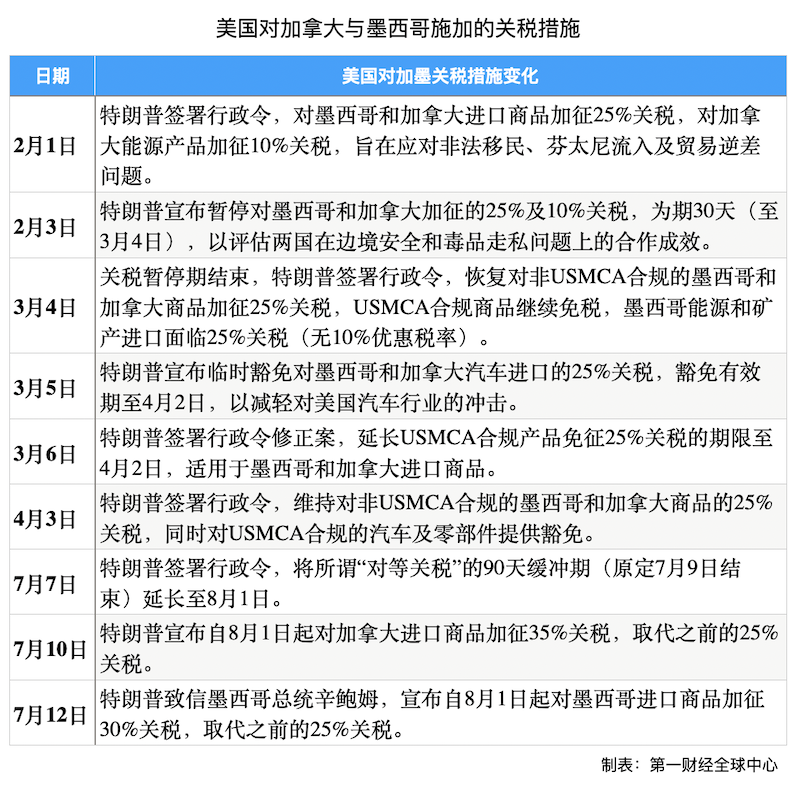
Core Viewpoint - The recent tariff measures imposed by the Trump administration on imports from Mexico and Canada are primarily aimed at addressing drug trafficking issues, but their actual impact may be limited due to exemptions for products that comply with the USMCA rules [1][5]. Group 1: Tariff Details - Starting August 1, a 30% tariff will be imposed on goods imported from Mexico, while a 35% tariff will be applied to goods from Canada [1]. - The tariffs are justified by Trump's claims of insufficient action by both countries in controlling fentanyl trafficking [1][6]. - The tariffs are expected to raise prices by approximately 1.2% due to direct and indirect effects on the economy [6]. Group 2: Economic Impact - The US imports over $100 billion annually in industrial goods from Canada and Mexico, which includes machinery, electronics, and agricultural products [5]. - The tariffs may create new negotiation leverage for the US in trade discussions, particularly regarding dairy and aluminum tariffs [4][6]. - The potential for retaliatory tariffs from Canada and Mexico exists, but both countries are currently focused on demonstrating compliance with USMCA to mitigate the impact [7][8]. Group 3: Political Context - Trump's administration has sent letters to 24 countries and the EU regarding tariff adjustments, indicating a broader strategy of using tariffs as a negotiation tool [3]. - The political implications of these tariffs could lead to public dissatisfaction if prices for well-known consumer goods rise significantly [6]. - Both Canada and Mexico have expressed intentions to negotiate rather than retaliate, given their economic dependence on the US market [8].
340亿美元大单落地,印尼突然变脸?中国稀土底牌,正被慢慢破解
Sou Hu Cai Jing· 2025-07-12 15:46
Core Viewpoint - Indonesia's recent trade agreement with the United States, valued at $34 billion, marks a significant shift in its economic strategy, driven by the need to mitigate economic pressures from U.S. tariffs and to capitalize on its natural resources, particularly nickel, which is crucial for the global renewable energy sector [1][3][9]. Group 1: Trade Agreement Details - The trade agreement includes substantial purchases of natural gas, agricultural products, electronics, machinery, and medical equipment from the U.S., alongside Indonesia's commitment to implement near-zero tariffs on over 1,700 U.S. goods [5][7]. - Indonesia is also easing investment restrictions for U.S. companies, indicating a welcoming stance towards American investments [7]. Group 2: Economic Context - Indonesia's economy heavily relies on its natural resources, with nickel being a key component, as it is one of the world's major suppliers of nickel, which is increasingly in demand for electric vehicle batteries [11][38]. - The U.S. has expressed a need to reduce its dependence on China for rare earth elements, prompting Indonesia to seek collaboration in supplying nickel and other critical minerals [13][34]. Group 3: Regional Implications - The trade dynamics in Southeast Asia are shifting, with countries like Vietnam and Cambodia also making concessions to the U.S. under similar pressures, highlighting a broader trend of smaller nations adapting to the geopolitical landscape [30][50]. - The agreements reflect a strategic pivot in the region, where economic survival often necessitates alignment with larger powers, showcasing the complexities of global trade relationships [32][50]. Group 4: Financial Trends - There is a notable trend towards "de-dollarization" among Southeast Asian nations, as they increasingly seek alternatives to the U.S. dollar for trade settlements, with the Chinese yuan gaining traction [42][46]. - This shift may indicate a significant change in the global financial landscape, driven by the pressures exerted by U.S. policies on these countries [46].

被特朗普征收30%关税的欧盟和墨西哥,是美国两个最大的贸易伙伴
news flash· 2025-07-12 13:38
Group 1 - The European Union, consisting of 27 member states, is the largest trading partner of the United States, importing goods worth $605 billion from the U.S., surpassing Mexico and Canada [1] - The highest value category of imports from the U.S. to the EU is pharmaceuticals, followed by automobiles, aircraft, and other heavy machinery [1] - President Trump has threatened to impose a 200% tariff on any pharmaceuticals imported into the U.S., although this will not be implemented for at least 18 months [1] Group 2 - Mexico is another significant trading partner for the U.S., with imports exceeding $505 billion in 2024 [1] - According to the U.S. Department of Agriculture, Mexico accounted for 69% of U.S. vegetable imports and 51% of fresh fruit imports in recent years [1] - Due to the short shelf life of these products, consumers may experience price increases more rapidly compared to other goods [1]
中国连续15年制造业全球领跑,规模优势创新升级共推高质量发展
Sou Hu Cai Jing· 2025-07-12 02:50
Core Insights - China has maintained its position as the world's largest manufacturing country for 15 consecutive years, driven by scale advantages and innovation upgrades [1][14] Key Data and Global Position - Manufacturing value added is expected to exceed 40.5 trillion yuan in 2024, accounting for approximately 30% of global manufacturing, surpassing the combined totals of the US, Japan, and Germany [1][3] - China leads the world in the production of over 220 major industrial products, including photovoltaic components, new energy vehicles, ships, and construction machinery [1][3] Export Contributions - In 2024, China's total goods exports are projected to reach 6.16 trillion USD, maintaining the top position globally for seven years, with 50% of global steel, 60% of home appliances, and 80% of air conditioners relying on Chinese supply [3] Comprehensive Industrial Chain Advantage - China possesses the most complete industrial system globally, covering 41 major industrial categories and 666 subcategories, with a supply chain self-sufficiency rate exceeding 90% [3][4] Industrial Upgrades and Technological Breakthroughs - High-end manufacturing has achieved significant autonomy, with breakthroughs in key technologies such as the domestically produced electromagnetic catapult aircraft carrier Fujian, C919 aircraft, CR450 high-speed trains, and deep-sea exploration equipment [4][7] - In 2024, the production of new energy vehicles is expected to exceed 13 million units, accounting for 60% of global output, while photovoltaic components will hold an 80% global market share [4] Digital Transformation - China has established the world's largest 5G network with over 4 million base stations and more than 900 million devices connected to the industrial internet; "lighthouse factories" have reached 79, representing 41% of the global total, with an average productivity increase of 34.8% [5] Key Support Factors - Research and development expenditure intensity has risen to 2.68%, nearing OECD levels, with over 460,000 high-tech enterprises, and China holds 26 seats in the global top 100 innovation clusters [7][8] Domestic Demand and Global Layout - Domestic demand contributes 86.4% to economic growth, supported by over 400 million middle-income groups driving consumption upgrades [9] - The export share to Belt and Road countries has increased to 50%, with a semiconductor self-sufficiency rate exceeding 70% [9] Challenges and Future Directions - There is a regional imbalance, with 80% of advanced manufacturing clusters concentrated in the eastern regions, while the central and western regions are gradually rising through new materials [10] - The innovation conversion rate remains low, with less than 10% of university patents being industrialized, indicating a need for improved collaboration between academia and industry [11] Strategic Pathways - Emphasis on technological self-reliance, focusing on quantum computing, biomanufacturing, and deep-sea technology, with a goal to increase the global manufacturing share to 45% by 2030 [12] - A green transition is underway, with a cumulative reduction of 11.6% in energy consumption per unit of GDP over four years, and renewable energy installations exceeding 2.09 billion kilowatts [13] Conclusion - The sustained leadership of China's manufacturing sector is a reflection of both scale effects and innovation-driven transformation, transitioning from "scale expansion" to "quality leap" through technological breakthroughs, green integration, and open cooperation [14]