
农产品

Search documents
“英”有尽有!英德好物为深圳市民提供暖冬年货新选择
Nan Fang Nong Cun Bao· 2025-12-27 07:03
Core Viewpoint - The event "Warm Winter Consumption Season" featuring agricultural products from Yingde is aimed at promoting local specialties to the Shenzhen market, enhancing consumer experience and driving sales during the winter season [3][6][81]. Group 1: Event Overview - The promotional event for Yingde agricultural products was launched at Mingzhu Market in Bao'an District, Shenzhen, gathering local agricultural enterprises, buyers, and media representatives [3][4]. - The theme "Warm Winter Consumption, Taste Yingde" aligns with the provincial initiative to boost consumption and expand domestic demand [6][47]. - The event showcased a variety of high-quality agricultural products from Yingde, providing an immersive shopping experience for Shenzhen residents [14][15]. Group 2: Product Highlights - Featured products included Yingde red tea, Xiniu bamboo shoots, Qingyuan chicken, and other local specialties, attracting significant consumer interest [16][18]. - The event saw strong sales, with many products selling out within hours, indicating high demand for Yingde's agricultural offerings [34][36]. Group 3: Strategic Importance - The event represents a significant step in regional collaborative development, leveraging Shenzhen's market influence to promote Yingde's agricultural products [44][45]. - The timing of the event before the Spring Festival capitalizes on the peak consumption period, enhancing the visibility and sales potential of Yingde products [47][81]. Group 4: Economic Impact - Yingde's agricultural sector has shown robust growth, with a reported 8.5% increase in agricultural output value year-on-year as of Q3 2025 [69]. - The total output value of Yingde red tea is projected to exceed 10.2 billion yuan, with the bamboo shoot industry also showing significant growth [71][72]. - The establishment of a sales point for Yingde products in Shenzhen aims to create a sustainable channel for ongoing market access and collaboration [80][58].


前11个月云南进出口2504.6亿元 同比增长10.5%
Sou Hu Cai Jing· 2025-12-26 15:01
Group 1 - The core viewpoint of the articles highlights the growth of Yunnan's foreign trade, with a total import and export value of 250.46 billion yuan in the first 11 months of 2025, representing a year-on-year increase of 10.5% [1] - Exports reached 86.04 billion yuan, growing by 2.1%, while imports amounted to 164.42 billion yuan, increasing by 15.5% [1] - Yunnan's trade with countries involved in the Belt and Road Initiative has strengthened, with imports and exports to these countries totaling 216.27 billion yuan, a growth of 16.3% [1] Group 2 - The Yunnan Free Trade Zone, established in August 2019, has contributed significantly to foreign trade, with cumulative imports and exports reaching 377.75 billion yuan, accounting for 21.9% of Yunnan's total foreign trade during the same period [2] - From December 1, 2024, China will implement a 100% zero-tariff preferential tax rate for the least developed countries, which is expected to further enhance trade dynamics [2] - In the past year, Yunnan imported 55.29 billion yuan from the least developed countries, marking an increase of 8.9% [2]
贸易顺差超过1万亿美元,为何体感不明显?
首席商业评论· 2025-12-26 12:00
Group 1: Trade Surplus Overview - In the first 11 months of 2025, China's goods trade surplus reached $1.08 trillion, marking the first time any country has surpassed the $1 trillion mark in trade surplus [2] - The strong export performance is driven by key categories such as electromechanical products, which account for approximately 59% of total exports, and new growth areas like electric vehicles and lithium batteries, which continue to see double-digit growth [3][4] - The import demand in 2025 is weak, with nearly zero growth (0.2%), contributing to the maximum trade surplus [4] Group 2: Factors Affecting Perception of Surplus - The perception of the surplus not translating into noticeable benefits for the public can be attributed to several factors, including the "external circulation" of funds where companies are hesitant to convert foreign earnings into RMB [5] - A portion of profits is used to pay off debts rather than being reinvested domestically, indicating a deleveraging trend in the manufacturing sector [5] - Price wars in certain industries lead to profit dilution, making it difficult for companies to significantly increase employee wages despite high export volumes [5] Group 3: Sector-Specific Insights - The automotive sector is highlighted as a profitable area, with a mid-range electric vehicle sold in Europe generating significant revenue for Chinese manufacturers, despite various costs such as tariffs and logistics [5] - The future potential for higher-value exports, particularly in sectors like semiconductors, could lead to more substantial profits for Chinese companies [6] Group 4: Service Trade Developments - China's service trade has historically shown a significant deficit, but in 2025, the deficit narrowed to approximately $108 billion, a reduction of about 26% year-on-year [12][13] - Knowledge-intensive service trade constitutes about 38% of the total, with rapid growth in exports driven by international travel demand and foreign tourists visiting China [13] - The overall trend suggests that service trade may move towards a more balanced state in the future [14] Group 5: Economic Implications - The $1 trillion trade surplus reflects the efficiency of the production system and external structures rather than a direct increase in household income [15] - A portion of the foreign exchange earnings is allocated for stabilizing the currency, addressing external sanctions, and supporting essential imports, which delays immediate benefits to the domestic economy [15]

养殖产业链日报:震荡偏强-20251226
Guan Tong Qi Huo· 2025-12-26 09:42
【冠通期货研究报告】 养殖产业链日报:震荡偏强 发布日期:2025 年 12 月 26 日 大豆:国内大豆市场延续"总量宽松、结构分化"的核心格局,全球供应充 裕背景下,国产高蛋白大豆因货源偏紧与刚需支撑价格坚挺,普通蛋白豆受库存 压力交易平淡;国际大豆期货震荡走弱,进口豆拍卖成交率下滑反映市场情绪趋 于理性,"优质优价"仍是市场核心逻辑。东北大豆整体震荡,优质优价,核心 区间清晰,节奏先抑后扬再回落,政策托底与拍卖放量形成双向牵制。预估豆一 趋势上仍然延续宽幅震荡走势。 玉米:现货方面,市场虽较为平静,但各方均处于博弈观望状态:基层售粮 进度虽快于去年同期(约 45%),但流通粮源减少;港口库存低于去年同期;集 中售卖压力尚未显现,需谨防踩踏式售粮。后续需重点关注基层销售进度及玉米 上市量变化。玉米预估节前保持震荡走势,上方空间短期有限。远月方面或存在 重心略微抬升,在供应压力过后或存在反弹预期。 执业资格证书编号:F03095187/Z0022441 注:本报告有关现货市场的资讯与行情信息,来源于我的钢铁网、中储粮网、 粮达网、金十期货网站。 本报告发布机构 --冠通期货股份有限公司(已获中国证监会许可的 ...
玉米月报:中下游库存逐步回升,玉米偏弱震荡-20251226
Guo Xin Qi Huo· 2025-12-26 09:41
1. Report Industry Investment Rating - No investment rating information is provided in the report. 2. Core Viewpoints of the Report - The global corn supply - demand situation is generally loose in 2025/26, with increased production in the US and Ukraine and relatively stable production in Brazil and Argentina. In China, there is a significant increase in corn production in 2025/26, but the quality of North China corn is poor, leading to more demand from grain - using enterprises shifting to Northeast corn. Currently, the overall corn selling progress is fast, but due to increased production, there is still sufficient grain left at the grassroots level. On the demand side, the breeding industry is continuously losing money, and the production capacity of the pig and egg industries will decline. Feed demand has short - term resilience but is pessimistic in the future. In the deep - processing sector, starch processing profits are poor, and the operating rate is low, while alcohol mainly digests low - quality corn. Regarding the inventory behavior of the mid - and downstream, the inventory of feed and deep - processing enterprises has increased significantly month - on - month, and there is insufficient motivation to further increase inventory substantially. The operation should be treated with a view of oscillation [1][32]. 3. Summary by Relevant Catalogs 3.1 Market Review - Since December, the domestic corn market has declined from a high level, and then the spot market has also adjusted following the futures market. Futures play a leading role in the spot market. The weaker performance of futures than spot has led to a passive strengthening of the basis at the northern ports. After the corn futures reached a high level at the beginning of the month, market fear of high prices increased. Rumors of wheat and imported corn auctions emerged, suppressing the bullish sentiment. Futures fell first, which further increased the enthusiasm of traders to sell and realize profits. Coupled with the fact that high spot prices have indeed inhibited restocking demand, both futures and spot prices declined in a resonant manner [3]. 3.2 International Corn Market Analysis 3.2.1 Increase in US Corn Production and Significant Rebound in Ending Stocks - According to the USDA's December supply - demand report, in 2025/26, the US corn harvested area is 36.44 million hectares, the yield per unit is 11.68 tons per hectare, and the total output is 425 million tons. Feed consumption is 155 million tons, food and processing demand is 177 million tons, exports are 81.28 million tons, and the ending stocks are 51.53 million tons, with a stock - to - use ratio of 12.5%, lower than the November estimate of 13.3% but significantly higher than the previous year's 10.1% and also at a relatively high level since 2020/21. The significant increase in production is the key factor driving the balance sheet to become looser, mainly due to a large increase in area and a recovery - type growth in yield. Exports and domestic consumption have also increased correspondingly due to the supply boost. From the current export sales report, US corn export sales have increased by nearly 10 million tons compared with the same period of the previous year, and the overall completion progress is good [5]. 3.2.2 Brazil and Argentina's Production Expected to Remain Stable at a High Level - According to the USDA's December estimate, Brazil's corn production in 2025/26 is expected to be 131 million tons, slightly lower than the previous year but with little overall change. According to the latest estimate of Brazil's domestic institution CONAB, Brazil's corn production in 2025/26 is expected to be 139 million tons, a decrease of more than 2 million tons compared with the previous year, similar to the change degree estimated by the USDA. In Argentina, according to the USDA estimate, the production in 2025/26 is expected to be 53 million tons, exports are 37 million tons, and the ending stocks are 4.18 million tons. Overall, the production of Brazil and Argentina in South America in 2025/26 is generally stable. As of now, the weather in the producing areas has been good, and the possibility of achieving high - yield expectations in the future is high [7]. 3.2.3 Recovery - type Increase in Ukraine's Production but with a Revised - down Growth Rate - According to the USDA estimate, Ukraine's corn production in 2025/26 is expected to be 29 million tons, an increase of 2.2 million tons compared with the previous year's 26.8 million tons, with an increase rate of 8%. The increase in production is mainly due to a slight increase in area and the recovery of yield. The final ending stocks are 848,000 tons, a slight increase compared with the previous year, and the stock - to - use ratio is 2.92%, at a low level in recent years. Overall, although Ukraine's production has increased, due to the impact of adverse weather later, the production increase rate is lower than the previous expectation [10]. 3.3 Domestic Corn Market Analysis 3.3.1 Increase in New Crop Production and Fast Selling Progress - In terms of new crop production, according to the analysis report of the Ministry of Agriculture and Rural Affairs, the national corn production in 2025/26 is expected to reach 300 million tons, an increase of more than 5 million tons compared with the previous year, mainly due to an increase in yield per unit. In terms of the listing rhythm, due to continuous rainfall during the harvest period in the North China production area, the quality of new corn is poor and the toxin content is high. Grain - using enterprises and grain merchants have a weak enthusiasm for purchasing North China corn, limiting the selling progress. On the other hand, the quality of Northeast corn is good, and there is more procurement from grain merchants in the inland areas, resulting in a fast selling progress of Northeast corn. According to the statistics of myagricultural.com, as of December 25, the selling progress of Northeast corn reached 44%, an increase of 8 percentage points year - on - year; the selling progress of North China corn was 40%, a decrease of 1 percentage point year - on - year; and the national corn selling progress was 45%, an increase of 4 percentage points year - on - year. Due to increased production, there is still sufficient grain left at the grassroots level in China [14]. 3.3.2 Poor Feed Consumption Expectations and Stable Deep - processing Consumption Year - on - Year - According to the calculation data of the Feed Industry Association, the feed output in November 2025 was 28.73 million tons, entering the seasonal decline stage month - on - month but significantly higher than the previous year's 27.1 million tons year - on - year, mainly affected by the expansion of the pig breeding industry's production capacity in 2024. For 2026, since the pig breeding profit has re - entered the loss range, and national policies are focusing on promoting the orderly reduction of production capacity in the pig industry, and the laying - hen breeding industry has also had a very poor year, feed consumption is expected to decline. In deep - processing, according to the sample statistics of myagricultural.com, since 2025/26, the consumption of corn in the national starch industry has decreased year - on - year, mainly because poor processing profits have led to a low operating rate. However, the consumption of corn in the alcohol industry has increased significantly year - on - year, mainly because there is a relatively large proportion of low - quality corn in North China, which is difficult to enter the food processing and feed processing fields and can only be consumed through alcohol processing. From the perspective of the total corn consumption of deep - processing enterprises, the cumulative consumption since this marketing year is similar to that of the previous year [18][19]. 3.3.3 Expected Reduction in the Substitution of Imported Grains and Wheat for Domestic Corn - Since September, the price difference between domestic wheat and corn has been at a relatively high level, giving corn a good cost - performance advantage in the feed field. From the perspective of the corn addition ratio in compound feed statistics of the Feed Industry Association, since September, the corn addition ratio in feed industry production has also continuously rebounded. In terms of import substitution, with the stable growth of China's corn production, the demand for imported substitute grains has decreased, and the volume of imported substitute grains has significantly decreased compared with previous years. The impact of imported substitutes is more reflected in a phased and regional manner [25]. 3.3.4 Rebound in Downstream Enterprise Inventory and Limited Motivation to Further Increase Inventory Significantly - In terms of the inventory of north - south ports, the inventory at northern ports has continuously rebounded and has reached a level close to 2 million tons, but it is still slightly lower than the same period in a neutral sense. Later, with the advancement of the new corn gathering at ports in the Northeast, the inventory at northern ports will also increase seasonally. The grain inventory in the Guangdong sales area is currently at a relatively low level compared with the same period, but with the increase in the arrival of imported grains, the inventory will also be supplemented to some extent. In terms of the raw material inventory of grain - using enterprises, the inventory of North China deep - processing enterprises has increased rapidly, while that of Northeast deep - processing enterprises is still low. From the perspective of the inventory - to - use ratio, the inventory - to - use ratio of national deep - processing enterprises rebounded rapidly in December, and the shortage pattern of raw materials for deep - processing enterprises has improved. The raw material inventory days of feed enterprises have also rebounded significantly to a neutral level compared with the same period. Due to the poor overall profit of the breeding sector and the pessimistic feed demand expectation, feed enterprises have little motivation to further replenish inventory significantly [29].
红枣市场周报-20251226
Rui Da Qi Huo· 2025-12-26 08:59
1. Report Industry Investment Rating - No relevant information provided 2. Core Viewpoints of the Report - This week, the price of the main contract of Zhengzhou jujube futures rose, with a weekly increase of about 0.96%. From the current supply - demand situation, the supply of sub - standard products has increased significantly. The inventory of 36 sample points decreased by 1.30% week - on - week and increased by 37.17% year - on - year. The acquisition in Xinjiang is coming to an end, and the processing enterprises are speeding up production and sales. The sales area is entering the peak consumption season, and the short - term decline in jujube prices may slow down [9][10] 3. Summary According to the Directory 3.1 Week - on - Week Summary - Future trading tips include monitoring spot prices and the consumer side - This week, the price of the main contract of Zhengzhou jujube futures rose, with a weekly increase of about 0.96% - As of December 25, 2025, the physical inventory of 36 sample points of jujubes was 15,898 tons, a decrease of 210 tons from last week, a week - on - week decrease of 1.30% and a year - on - year increase of 37.17% - The acquisition in Xinjiang is coming to an end. Processing enterprises in Xinjiang and the mainland are actively arranging production and accelerating the pace of shipment. The market arrival volume is gradually increasing. The sales area is entering the peak consumption season, and the short - term decline in jujube prices may slow down [9] 3.2 Futures and Spot Market - **Futures price trend**: The price of the Zhengzhou jujube 2605 contract rose this week, with a weekly increase of about 0.96% [10] - **Top 20 positions**: As of this week, the net position of the top 20 in jujube futures was - 15,321 lots [13] - **Warehouse receipts**: As of this week, the number of Zhengzhou jujube warehouse receipts was 1,092 [17] - **Futures price spread**: As of this week, the price spread between the Zhengzhou Commodity Exchange jujube futures 2605 contract and the 2609 contract was - 250 yuan/ton [18] - **Basis**: As of this week, the basis between the spot price of Hebei grey jujubes and the main contract of jujube futures was 580 yuan/ton [23] - **Purchase price of bulk jujubes in the main production areas**: As of December 26, 2025, the bulk jujube price in Aksu was 5.15 yuan/kg, in Alar was 5.65 yuan/kg, and in Kashgar was 6.5 yuan/kg [26] - **Spot price of first - grade jujubes**: As of December 26, 2025, the wholesale price of first - grade grey jujubes in Cangzhou, Hebei was 4.20 yuan/jin, and in Henan was 4.35 yuan/jin [30] - **Spot price of special - grade jujubes**: As of December 26, 2025, the spot price of special - grade grey jujubes in Cangzhou, Hebei was 9.56 yuan/kg, and the wholesale price in Henan was 9.7 yuan/kg [34] 3.3 Industry Chain - **Supply side - Inventory**: As of December 25, 2025, the physical inventory of 36 sample points of jujubes was 15,898 tons, a decrease of 210 tons from last week, a week - on - week decrease of 1.30% and a year - on - year increase of 37.17% [39] - **Supply side - Production decline possibility**: The jujube production in the 2025/26 season is expected to decline [43] - **Demand side - Export volume**: In October 2025, China's jujube export volume was 2,205,220 kg, with an export value of 35,238,139 yuan and an average export price of 15,979.42 yuan/ton. The export volume decreased by 3.44% month - on - month and 33.29% year - on - year. The cumulative export from January to October 2025 was 25,753,622 kg, a cumulative year - on - year increase of 0.18% [47] - **Demand side - BOCE Xinjiang jujube trading**: This week, the BOCE Xinjiang jujube "Good Brand" had a small amount of orders [52] 3.4 Options Market and Futures - Stock Relationship - **Options market**: The implied volatility of at - the - money jujube options this week is presented in the report, but no specific data is summarized here - **Stock market - Haoxiangni**: The report shows the price - to - earnings ratio chart of Haoxiangni, but no specific analysis data is summarized here
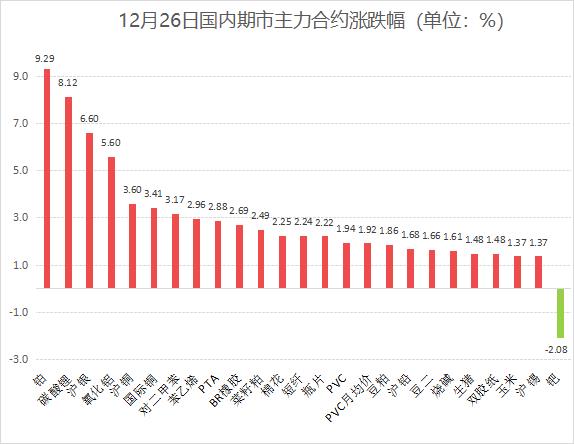
国内商品大面积飘红 贵金属延续强势 沪铜创历史新高【期市日评】
Wen Hua Cai Jing· 2025-12-26 08:34
Group 1: Precious Metals - Silver prices surged by 6.6%, reaching a new historical high, while platinum increased by over 9%, hitting the limit up during trading [2] - The decline in silver warehouse receipts over three consecutive days indicates strong demand, supporting the upward movement in silver prices [2] - The geopolitical uncertainty and continued loose monetary policies from major economies have led to increased investment in silver ETFs, further boosting silver prices [2] Group 2: Non-Ferrous Metals - Copper prices rose by over 3%, reaching a historical high, while alumina saw a significant increase of 5.6%, hitting the limit up during trading [4] - The global copper supply remains tight, raising concerns about potential impacts on the smelting sector, despite weak domestic demand [4] - The influx of 2.6 billion in capital into the non-ferrous metals sector, with 1.7 billion specifically targeting copper, indicates strong investor interest [6] Group 3: Lithium Carbonate - Lithium carbonate prices increased significantly, with the main contract rising by over 8%, driven by market news [3] Group 4: Trading Volume and Market Activity - Overall trading activity in the futures market has increased, with silver maintaining the highest trading volume at 2.88 million contracts [11] - Alumina's trading volume surged to 1.97 million contracts, reflecting heightened market interest following recent price increases [11]
进口玉米回升、拍卖,后期怎么看?
Hong Ye Qi Huo· 2025-12-26 07:31
Report Summary 1. Report Industry Investment Rating - Not provided in the document 2. Core Viewpoint - Imported corn is rapidly increasing, and import auctions address concerns about the shortage of high - quality grains due to grain quality differentiation. Corn sales may slow down in the later stage. Corn is expected to fluctuate in the short term. It is recommended that grain - using enterprises purchase spot goods as needed and maintain a safe reserve, while traders should buy low and sell high [5]. 3. Summary of Each Part Market Price and Basis - The corn main 2603 contract rebounded after a short - term continuous adjustment. The spot price was stable, with the Pingcang price of corn in Bayuquan at 2,290 yuan/ton and the arrival price of corn at Shekou Port dropping from 2,430 yuan/ton to 2,420 yuan/ton. The corn basis fluctuated and strengthened slightly, and the discount of the futures price widened. The starch main 2603 contract stabilized and rebounded. The starch price of Weifang Jinyu was 2,800 yuan/ton, and the basis fluctuated [3]. Supply - related Factors - **New Grain Sales**: Imported corn invitation - bidding sales continued, curbing the bullish sentiment in the market and reducing the enthusiasm of downstream procurement. New grain sales were still relatively fast, but slowed down in some areas. As of December 25, the national grain sales progress was 45%, 4% faster than the same period last year; in Northeast China, it was 44%, 8% faster; in North China, it was 40%, 1% slower; in Northwest China, it was 61%, the same as last year. With the auction of imported corn and the approaching of holidays, the grain sales progress slowed down [3]. - **Inventory**: As of December 19, the corn inventory in northern ports was 1.803 million tons, slightly increasing month - on - month and significantly lower than the same period last year; the weekly shipping volume was 827,000 tons, rising to a high in recent years. The domestic - trade corn inventory in Guangdong Port was 224,000 tons, and the foreign - trade corn inventory was 278,000 tons, both increasing month - on - month due to a large increase in imports. The inventories of downstream deep - processing and feed enterprises continued to increase. As of December 26, the corn inventory of deep - processing enterprises was 3.378 million tons, continuously rising but lower than the same period last year; the corn inventory of feed enterprises was 29.88 days, slightly decreasing month - on - month [3]. - **Import**: The wheat - corn price difference remained at a high level, making substitution unfeasible. In November, China's corn imports increased significantly again. According to customs data, 555,000 tons of corn were imported in November, a 55% month - on - month increase and an 85% year - on - year increase; from January to November, the cumulative import volume was 1.847 million tons, a 86.3% year - on - year decrease. Imports of barley and wheat also increased. The increase in domestic corn imports and auctions supplemented the market's expectation of a shortage of high - quality grains, and imports may continue to increase in the later stage [4]. - **External Market**: The U.S. corn in the external market rebounded recently. The U.S. Department of Agriculture's December supply - demand report increased U.S. corn exports and reduced its ending inventory, but overall, there was still pressure of increased production and inventory compared with last year. The global ending inventory of corn was slightly reduced, a 4.85% year - on - year decrease [4]. Demand - related Factors - **Feed Demand**: The pig price was low, and pig farming continued to suffer large losses. As of December 26, the profit of purchasing piglets for farming was - 162.8 yuan per head, and the loss continued to narrow; the self - breeding and self - raising profit was - 130.11 yuan per head, and the loss also narrowed. The production capacity of sows continued to decline. In October, the national inventory of sows was 39.9 million, 450,000 less than the previous month, and the reduction rate increased. In November, large - scale farms reduced the inventory of sows, the sales volume of piglets declined, but the inventory of commercial pigs increased. It was difficult for the pig inventory to decline in the fourth quarter. In the poultry sector, the egg price was low, and poultry farming continued to suffer losses; in November, the sales volume of chicken chicks stabilized, and the culling of old chickens continued to increase; in November, the inventory of laying hens decreased slightly again. Feed demand may slow down. In November, the national industrial feed output was 28.73 million tons, decreasing month - on - month and increasing 6% year - on - year. If losses continue in the later stage, it may affect spring replenishment and accelerate capacity reduction [5]. - **Deep - processing Demand**: The demand of deep - processing enterprises was insufficient. The operating rate of starch processing enterprises continued to decline. As of December 26, the operating rate of starch processing enterprises was 60.46%, continuing to decline month - on - month. The starch inventory was 1.102 million tons, increasing month - on - month. Alcohol processing enterprises continued to suffer losses, and the operating rate dropped to 65.02%. The operating rate of downstream starch sugar enterprises rebounded, and the operating rate of paper - making enterprises was relatively strong [5].
国贸期货日度策略参考-20251226
Guo Mao Qi Huo· 2025-12-26 07:10
Report Industry Investment Ratings - **Bullish**: Carbonate Lithium, BR Rubber, PTA [1] - **Bearish**: Palm Oil, Rapeseed Oil, Sugar [1] - **Neutral (Oscillating)**: Stock Index, Treasury Bonds, Copper, Aluminum, Alumina, Zinc, Nickel, Stainless Steel, Tin, Gold, Platinum, Industrial Silicon, Polysilicon, Rebar, Hot Rolled Coil, Iron Ore, Ferroalloy, Glass, Coke, Coking Coal, Lumber, Cotton, Live Pigs, Crude Oil, Bitumen, Ethylene Glycol, Short - Fiber, Benzene, Naphtha, Propylene, Butadiene, Container Shipping to Europe [1][2] Core Viewpoints - The market sentiment and liquidity are in a good state, with the short - term stock index breaking through the previous oscillation range and expected to remain strong. The bond futures are favored by the asset shortage and weak economy, but the central bank has recently warned of interest - rate risks. The prices of various commodities are affected by factors such as industry fundamentals, macro - sentiment, and policy changes [1]. Summaries by Categories Financial Products - **Stock Index**: The short - term stock index has broken through the previous oscillation range and is expected to remain strong as the market sentiment and liquidity are good [1]. - **Treasury Bonds**: Asset shortage and weak economy are beneficial for bond futures, but the central bank has warned of short - term interest - rate risks. Attention should be paid to the Bank of Japan's interest - rate decision [1]. Non - ferrous Metals - **Copper**: The industrial situation is weak recently, and the macro - sentiment is fluctuating, leading to high - level oscillations in copper prices [1]. - **Aluminum**: The driving force in the electrolytic aluminum industry is limited, and the macro - sentiment is fluctuating, resulting in oscillating aluminum prices [1]. - **Alumina**: The domestic fundamentals are weak, and the short - term price remains low [1]. - **Zinc**: The fundamentals of zinc have improved, with the cost center rising. Most of the recent negative factors have been realized, and the zinc price is expected to oscillate strongly as market risk appetite improves [1]. - **Nickel**: The global nickel inventory is high, but due to supply concerns, the Shanghai nickel has rebounded significantly recently. The Indonesian policy has not been implemented but is difficult to disprove in the short term. The short - term nickel price may oscillate strongly. In the long - term, the primary nickel market remains in an oversupply situation [1]. - **Stainless Steel**: The raw material nickel - iron price has stabilized, the social inventory of stainless steel has decreased slightly, and steel mills have increased production cuts in December. The stainless - steel futures are expected to oscillate strongly in the short term [1]. - **Tin**: The non - ferrous tin industry association has issued an initiative, causing the short - term tin price to oscillate weakly. Considering the tense situation in Congo and the improved market risk appetite, low - buying opportunities are recommended [1]. Precious Metals and New Energy - **Gold**: Overseas markets are in the Christmas holiday, and the strong US economic data has weakened the expectation of interest - rate cuts. After reaching a new historical high, the gold price may oscillate at a high level in the short term [1]. - **Platinum**: The domestic platinum futures price has a large premium over the spot price and foreign markets, with large expected fluctuations. Rational participation is recommended [1]. - **Industrial Silicon**: The production in the northwest has increased while that in the southwest has decreased. The production schedules of polysilicon and organic silicon have decreased in December [1]. - **Polysilicon**: A capacity storage platform company has been established, with a long - term expectation of capacity reduction. The terminal installation has increased marginally in the fourth quarter, large manufacturers are eager to maintain prices but reluctant to deliver goods, and the short - term speculative sentiment is high [1]. - **Carbonate Lithium**: It is the traditional peak season for new energy vehicles, the energy - storage demand is strong, the supply side has increased production resumption, and the price has exceeded the previous high. Short - term long - position operations are recommended [1]. Building Materials - **Rebar and Hot Rolled Coil**: The basis and production profit are not high, indicating that the price valuation is not high. Short - selling is not recommended. The near - term contracts are restricted by production cuts, but the far - term contracts still have upward potential [1]. - **Iron Ore**: The near - term contracts are restricted by production cuts, but with good commodity sentiment, the far - term contracts have upward opportunities [1]. - **Glass and Glass Products**: They follow the trend of glass, with acceptable supply - demand conditions and low valuation. The downward space is limited, and they may oscillate under pressure [1]. - **Coke and Coking Coal**: Affected by the domestic major meeting and export policy, the black - sector has declined. After the announcement of the steel - export licensing system, there are signs of stabilization. Attention should be paid to the spot situation this week and the winter - storage replenishment by downstream enterprises [1]. Agricultural Products - **Palm Oil**: Although the high - frequency data has improved, it is difficult to change the expectation of a loose supply in the producing areas. Rebound - shorting is recommended [1]. - **Soybean Oil**: It is affected by the decline in the CBOT market and other domestic oils, showing a weak trend [1]. - **Rapeseed Oil**: The short - term positive factors of raw - material shortage are expected to be exhausted, and there is an expectation of a good harvest in the global main producing areas. Short - selling the 05 contract is recommended [1]. - **Cotton**: There is support from the purchase price of seed cotton, but there is currently no driving force. Future attention should be paid to the government's policies, planting - area intentions, weather during the planting period, and peak - season demand [1]. - **Sugar**: There is a consensus among short - sellers due to the global surplus and increased domestic supply. If the price continues to fall, there is strong cost support, but there is a lack of continuous fundamental driving force in the short term [1]. - **Live Pigs**: Affected by snow and rain in the producing areas, the supply is affected, but the spot price is relatively stable. Farmers are reluctant to sell, and downstream enterprises are cautious. There is a certain replenishment demand before the Spring Festival [1]. - **Soybean Meal**: There is an expectation of a good harvest of soybeans, and the later discount is expected to face selling pressure. Recently, the market has oscillated following reserve - related rumors [1]. - **Paper Pulp**: The futures are fluctuating due to the contradiction between weak demand and strong supply expectations. It is recommended to wait and see for single - side operations and consider a 1 - 5 reverse spread for the spread [1]. - **Logs**: Affected by the decline in foreign - market quotes and spot prices, the 01 contract is under pressure as it approaches the delivery month and is expected to oscillate weakly [1]. Energy and Chemical Products - **Crude Oil**: OPEC+ has suspended production increases until the end of 2026, the uncertainty of the Russia - Ukraine peace agreement has an impact, and the US has imposed sanctions on Venezuelan crude - oil exports [1]. - **Bitumen**: The short - term supply - demand contradiction is not prominent, following the trend of crude oil. The cost of raw materials provides strong support, the futures - spot price difference is low, and the mid - stream inventory may start to accumulate [1]. - **BR Rubber**: The trading volume of butadiene has improved, the cost has increased, the operating rate of butadiene rubber is high, and there are rumors of a factory shutdown in South Korea, leading to a strong market sentiment [1]. - **PTA**: The PX price is strong, the PTA device is operating at a high load, the pre - festival stocking and sales of polyester have improved, and the consumption of PTA remains high [1]. - **Ethylene Glycol**: Two MEG plants in Taiwan, China, are planned to shut down next month. The ethylene - glycol price has rebounded rapidly due to supply - side news, and the demand from the polyester downstream is better than expected [1]. - **Benzene and Naphtha**: There is some support from the cost side, the spot - market sentiment has warmed up slightly, and the total inventory remains high without significant de - stocking [1]. - **Propylene**: The export sentiment has eased slightly, the upward space is limited due to insufficient domestic demand, and there is support from anti - involution and the cost side. The maintenance has decreased, the supply has increased, and the downstream demand has weakened. There is an expectation of oversupply in 2026 [2]. - **Butadiene**: The trading volume has improved, and the cost has increased, providing support for downstream products [1]. - **Container Shipping to Europe**: The price increase in December was lower than expected, the expectation of price increase in the peak season was priced in advance, and the shipping capacity supply was relatively loose in December [2].
AmSpec:马来西亚12月1-25日棕榈油出口量为1017897吨
Xin Hua Cai Jing· 2025-12-26 06:42
Core Viewpoint - Malaysia's palm oil exports increased by 3% in the period from December 1 to December 25, reaching 1,017,897 tons compared to 987,978 tons in the same period last month [1] Group 1 - The export volume of palm oil from Malaysia for the specified period was 1,017,897 tons [1] - The increase in export volume reflects a positive trend in the palm oil industry [1]