公用事业

Search documents
品牌工程指数 上周涨3.64%
Zhong Guo Zheng Quan Bao· 2025-08-17 22:07
Market Performance - The market showed strong performance last week, with the China Securities Xinhua National Brand Index rising by 3.64% to 1780.22 points [1][2] - Major indices also saw significant increases, with the Shanghai Composite Index up by 1.70%, Shenzhen Component Index up by 4.55%, and the ChiNext Index up by 8.58% [2] Strong Stock Performances - Notable stocks included Sungrow Power Supply, which rose by 15.54%, and East Money Information, which increased by 15.34% [2] - Other strong performers included Zhongji Xuchuang (up 13.74%), Daren Tang (up 10.92%), and several others that saw gains exceeding 8% [2] Year-to-Date Stock Gains - Zhongji Xuchuang led the year-to-date performance with a 63.20% increase, followed by Kewo Si with a 57.31% rise [3] - Other significant gainers included Wu Biological (up 29.22%) and Heng Rui Pharmaceutical (up 22.16%) [3] Market Trends and Sentiment - The market is transitioning from a defensive to an offensive sentiment, with technology stocks leading the charge while traditional high-dividend sectors like banking are underperforming [4] - The overall market sentiment has improved since July, with a notable increase in risk appetite among investors [4] Future Outlook - The market is expected to continue benefiting from strong liquidity and a potential shift towards fundamental-driven growth as domestic demand stabilizes [5] - Analysts suggest that the current market phase is just the beginning, with fundamental factors set to take over as the main drivers of growth [5]




从“合规答卷”到“价值引擎” ESG评级冲A竞速赛升温
Zhong Guo Zheng Quan Bao· 2025-08-17 22:06
Core Viewpoint - Beijing's Chaoyang District has introduced ESG support policies that provide financial rewards to companies achieving an A-level or equivalent in mainstream ESG ratings, aiming to enhance ESG performance and attract long-term investments [1][4]. Group 1: ESG Rating Landscape - A-rated companies are characterized by high growth, high added value, and low pollution [3]. - The number of companies achieving A-level ESG ratings has been increasing, with a notable trend towards higher ratings among listed companies in Shanghai [2][4]. - As of the end of 2024, 342 listed companies in Shanghai were included in the MSCI ESG rating, with 100 companies receiving upgrades [2]. Group 2: Challenges in Achieving A-Level Ratings - Achieving an A-level rating is challenging, as many companies rely on superficial compliance rather than substantive management improvements [4][5]. - Companies often face shortcomings in information disclosure quality, governance structure, and data governance, which hinder their ESG rating progress [5][6]. - The lack of third-party verification for ESG reports limits the credibility and effectiveness of ESG ratings [5][6]. Group 3: Recommendations for Improvement - Companies should focus on enhancing their ESG management capabilities and improving information disclosure to achieve better ratings [8][9]. - It is recommended that companies adopt a strategy centered on management improvement, using information disclosure as a tool to achieve ESG rating goals [8]. - Regulatory bodies should enhance the independence and transparency of rating agencies to improve the quality of ESG ratings and data products [9][10].
从“合规答卷”到“价值引擎”ESG评级冲A竞速赛升温
Zhong Guo Zheng Quan Bao· 2025-08-17 20:07
Core Viewpoint - Beijing's Chaoyang District has introduced ESG support policies that provide financial rewards to companies achieving an A-level or equivalent in mainstream ESG ratings, indicating a growing emphasis on ESG performance in investment decisions [1][4]. Group 1: ESG Rating Landscape - The number of companies achieving A-level ESG ratings has been increasing, with a notable trend towards higher ratings among listed companies in Shanghai [3][4]. - A-level companies are characterized by high growth, high added value, and low pollution, with significant representation in sectors like finance, renewable energy, and high-end manufacturing [3][4]. - Different ESG rating agencies have varying definitions and criteria for A-level ratings, leading to discrepancies in ratings across different organizations [2][6]. Group 2: Challenges in Achieving A-Level Ratings - Many companies struggle to achieve A-level ratings due to superficial compliance and inadequate management practices, highlighting the need for substantial improvements in governance and data management [4][5]. - The lack of third-party verification for ESG reports limits the credibility and effectiveness of ESG ratings, with less than 5% of A-share and Hong Kong-listed companies undergoing such verification [5][6]. - Discrepancies in ESG rating methodologies between domestic and international agencies can mislead resource allocation and hinder the accurate assessment of companies' ESG performance [6][7]. Group 3: Strategies for Improvement - Companies aiming for A-level ratings should focus on enhancing their ESG management capabilities rather than merely meeting rating criteria, emphasizing the importance of robust governance and transparent reporting [7][8]. - Rating agencies and regulatory bodies must work towards improving the consistency and comparability of ESG ratings, ensuring that methodologies are transparent and aligned with actual corporate practices [8]. - Local governments can implement differentiated management incentives beyond financial rewards, such as tax benefits and support in sustainable development initiatives, to encourage companies to improve their ESG performance [8].
惠理投资盛今:中国资产具备多重核心竞争优势
Shang Hai Zheng Quan Bao· 2025-08-17 13:36
Core Viewpoint - The Hong Kong stock market has shown strong performance this year, driven by multiple core competitive advantages of Chinese assets, which are expected to enhance their attractiveness to international capital [1][2]. Group 1: Factors Driving Hong Kong Stock Market Strength - Three main factors are identified as driving the strength of the Hong Kong stock market: the "hard technology" wave, the rise of the "new economy," and the weakening of the US dollar [2]. - The "hard technology" revolution is expected to bring profound changes to production and lifestyle, with leading Chinese internet companies poised to capitalize on AI applications [2]. - The "new economy" has become a pillar of the Hong Kong stock market, with its market capitalization share increasing from 27% at the end of 2015 to an expected 51% by the end of 2024 [2]. - The weakening US dollar has led to a reallocation of funds, with a slowdown in foreign capital outflow from the Hong Kong market, making it an attractive option for global capital seeking undervalued assets [2]. Group 2: Core Competitive Advantages of Chinese Assets - Chinese assets possess three core competitive advantages: a complete modern industrial system, increased R&D investment leading to brand premium, and significant long-term investments in core technology fields [3]. - The manufacturing sector in China has achieved low-cost, high-efficiency capabilities through vertical integration and scale advantages [3]. - Chinese companies are increasingly recognized for their global competitiveness in areas such as AI, semiconductors, new energy, and aerospace [3]. Group 3: Investment Opportunities in A-Share Market - The A-share market presents four key investment opportunities: stable cash returns in sectors like telecommunications, finance, and utilities; potential in the internet sector and consumer sub-industries due to policy support and AI commercialization; growth in the biopharmaceutical industry driven by improved policies and global competitiveness; and a stabilization in the real estate sector along with improved prospects for chemicals and raw materials [3].
港华智慧能源(01083):25H1业绩符合预期,首次宣布中期派息
Tianfeng Securities· 2025-08-16 13:24
Investment Rating - The report maintains a "Buy" rating for the company, with a target price not specified [6]. Core Insights - The company reported a revenue of approximately 10.437 billion HKD for the first half of 2025, a decrease of 0.6% year-on-year, while the net profit attributable to shareholders was about 758 million HKD, an increase of 2% [1]. - The company announced its first interim dividend of 0.05 HKD per share [1]. - The gas sales volume remained stable at 8.75 billion cubic meters, with retail gas volume increasing by 0.7% year-on-year [2]. - The renewable energy segment achieved a revenue of 762 million HKD, with a net profit of 172 million HKD, reflecting a growth of 5% [3]. - Capital expenditures decreased significantly to 1.4 billion HKD, down by 600 million HKD year-on-year [4]. Summary by Sections Financial Performance - For the first half of 2025, the company reported a revenue of approximately 10.437 billion HKD, a slight decrease of 0.6% year-on-year, and a net profit of about 758 million HKD, which is a 2% increase [1]. - The gas distribution segment generated revenue of 9.674 billion HKD, a decrease of 0.7% year-on-year, while the renewable energy segment's revenue was 762 million HKD, reflecting a 1.1% increase [2][3]. Gas Sales and Pricing - The total gas sales volume was 8.75 billion cubic meters, remaining flat year-on-year, with retail gas volume increasing by 0.7% [2]. - The gross margin improved to 0.57 HKD per cubic meter, up by 0.01 HKD year-on-year, despite a slight decrease in selling price [2]. Renewable Energy - The renewable energy segment's net profit was 172 million HKD, a 5% increase, primarily driven by the photovoltaic business, which saw an 11% increase in revenue [3]. - The photovoltaic capacity reached 2.6 GW, with a significant increase in electricity generation by 44% year-on-year [3]. Capital Expenditure - The company reported a notable decrease in capital expenditures to 1.4 billion HKD, down by 600 million HKD year-on-year, with reductions in both gas and renewable energy segments [4]. Future Guidance - The company updated its full-year guidance, projecting a gas sales volume of 17.3 billion cubic meters, a 1% increase year-on-year, and an increase in the number of users by 630,000 [5].
AI热潮下,电力挑战愈发突出
半导体行业观察· 2025-08-16 03:38
Core Viewpoint - The expansion of AI data centers by major tech companies like Amazon, Google, and Microsoft is expected to significantly increase electricity demand, potentially raising electricity prices for households and small businesses in the U.S. by 2028 [2][4][8]. Group 1: Electricity Demand and Supply - In 2023, data centers operated by major tech companies accounted for 4% of the national electricity consumption, with projections indicating this could rise to 12% by 2028 due to the energy-intensive nature of AI workloads [4][5]. - The demand for electricity from AI data centers is highly unstable, with rapid shifts from peak to minimal loads, posing risks to grid stability [5][6]. Group 2: Infrastructure and Cost Implications - The surge in electricity demand necessitates significant investments in grid infrastructure, raising questions about who will bear these costs [6][8]. - Utility companies warn that tech firms may reserve more capacity than they ultimately use, potentially leading to financial burdens on taxpayers due to idle infrastructure [6]. Group 3: Impact on Consumers - The rapid growth of AI data centers is likely to drive up electricity prices for consumers, with average U.S. electricity prices having already increased by over 30% since 2020, and further increases projected [8]. - In Ohio, households have seen monthly electricity bills rise by at least $15 since June, attributed to the new demand from data centers [8].





经济数据点评(2025.7)暨宏观周报(第17期):消费投资地产降温,政策加码迎来信号-20250815
Huafu Securities· 2025-08-15 11:23
Consumption Data - In July, the total retail sales of consumer goods increased by 3.7% year-on-year, marking a decline of 1.1 percentage points from the previous month and the lowest monthly growth rate this year[3] - Retail sales of automobiles fell by 1.5% year-on-year, a significant drop of 6.1 percentage points compared to June, closely linked to the recent downturn in the real estate market[3] - Retail sales of communication equipment rose by 14.9%, while home appliances and furniture grew by 28.7% and 20.6%, respectively, despite declines from June[3] Investment and Real Estate - Fixed asset investment saw a sharp decline of 5.3% year-on-year in July, the largest drop since April 2020[4] - Real estate development investment fell by 17.0% year-on-year, the lowest since December 2022, indicating a renewed acceleration in market adjustments[4] - The area of residential sales decreased by 7.1% year-on-year, remaining at a low level despite a slight improvement[5] Industrial Production - The industrial added value growth rate fell to 5.7% year-on-year, down 1.1 percentage points, with the mining and manufacturing sectors also experiencing declines[6] - The automotive manufacturing sector saw a significant drop of 2.9 percentage points to 8.5%, the lowest since November 2024, reflecting the combined effects of supply-side policies and demand cooling[6] Policy Implications - The simultaneous cooling of retail, investment, and real estate markets in July may signal the need for policy measures in the second half of the year[6] - The central government may need to implement larger subsidies for durable goods consumption and consider a small interest rate cut of 10 basis points to stabilize the real estate market[6]
8月15日沪深两市强势个股与概念板块
2 1 Shi Ji Jing Ji Bao Dao· 2025-08-15 10:25
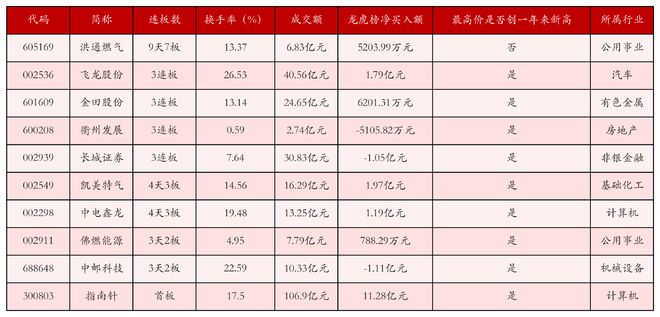
Strong Stocks - As of August 15, the Shanghai Composite Index rose by 0.83% to 3696.77 points, the Shenzhen Component Index increased by 1.6% to 11634.67 points, and the ChiNext Index climbed by 2.61% to 2534.22 points [1] - A total of 104 stocks in the A-share market hit the daily limit up, with the top three strong stocks being Hongtong Gas (605169), Feilong Co., Ltd. (002536), and Jintian Co., Ltd. (601609) [1] - Detailed data for the top 10 strong stocks includes metrics such as the number of limit-up days, turnover rate, trading volume, and net buying amount from the top trading accounts [1] Strong Concept Sectors - The top three concept sectors by increase are PEEK materials, Sci-tech new shares, and liquid cooling servers, with PEEK materials showing a rise of 5.31% [2] - The top 10 concept sectors are listed with their respective increase percentages, limit-up stock ratios, and the proportions of rising and falling stocks [2] - Notably, PEEK materials and Sci-tech new shares had a 100% increase in their rising component stocks, indicating strong market performance [2]


“反内卷”及近期经济专题深度报告:积极因素逐步积累,筑牢A股向好的根基
Caixin Securities· 2025-08-15 10:14
Group 1: Investment Rating - No investment rating information is provided in the report. Group 2: Core Viewpoints - "Anti - involution" will alleviate the dilemma of "increasing revenue without increasing profit", with a greater boost to PPI than CPI, and promote the nominal GDP growth rate to approach the real GDP growth rate [5][21]. - The US economy shows signs of weakness, and the market's expectation of the Fed's interest rate cut is rising, with an expected cumulative rate cut of 75bp in 2025 [5][83]. - China's economic growth rate in 2025 may be high in the first half and low in the second half, but it can achieve the 5% target for the whole year [5]. - The A - share market still has a certain degree of sustainability, and the bond market is likely to fluctuate narrowly, while the commodity market will enter a wide - range shock trend [5]. Group 3: Summary by Directory 1 "Anti - involution": Alleviate the Dilemma of "Increasing Revenue without Increasing Profit" and Improve Market Performance Expectations - **Overview**: "Anti - involution" aims to promote the economy to return from "scale expansion" to "high - quality growth", improve social overall efficiency, and is a key part of building a unified national market [10][11]. - **Approach**: Different from the previous supply - side reform, it focuses on downstream emerging industries, mainly private enterprises, with more moderate and gradual policies using market - based and legal means [18][19]. - **Impact**: It is expected to have a greater impact on PPI than CPI, and promote the nominal GDP growth rate to approach the real GDP growth rate, but there is uncertainty in the transmission of price increases from upstream to downstream [21][24]. - **Style**: From April to September, the market pays more attention to performance, and the "anti - involution" direction has performance release expectations [28]. - **Law**: It may be a key factor supporting the strength of the A - share market, and the current "anti - involution" market is in the policy - expectation stage [32][36]. - **Summary**: It can alleviate the dilemma of "increasing revenue without increasing profit" and improve market performance expectations [46]. 2 Global: The US Economy Shows Signs of Weakness, and the Fed's Interest Rate Cut Expectation is Rising - **Overseas Tariffs**: The US average effective tariff rate has reached the highest level since 1933, reducing global economic growth potential, and tariffs remain a key variable affecting China's exports [49]. - **Overseas Economy**: The global economy has short - term resilience, but the US economy shows signs of weakness in investment, and the Fed has lowered its economic growth forecast [55][60][66]. - **Overseas Inflation**: The short - term impact of tariffs on US inflation is emerging, and the medium - term inflation trend still faces great uncertainty [69][73]. - **Overseas Liquidity**: The inflection point of non - farm data may have arrived, and the market's expectation of the Fed's interest rate cut is rising, with an expected 75bp rate cut in 2025 [77][83]. - **Summary**: The global economy has short - term resilience but increasing uncertainty, and the expectation of the Fed's interest rate cut is rising [83]. 3 China: The Economic Growth Rate May be High in the First Half and Low in the Second Half, and the Spontaneous Recovery Momentum Needs to be Consolidated - **Economic Overview**: China's economic growth rate in 2025 may be high in the first half and low in the second half, with the GDP growth rate in Q3 and Q4 expected to decline compared with Q1 and Q2 [84]. - **Investment End**: The growth rate of fixed - asset investment continues to bottom out, and real estate investment is still the main drag [85]. - **Consumption End**: Consumption data still has resilience, and service consumption may be the key area of development [27]. - **Export End**: Attention should be paid to the impact of tariffs and export over - draw effects [5][28]. - **Liquidity**: The government sector is still the main force for increasing leverage, and the time for reserve requirement ratio and interest rate cuts is expected to be postponed [28]. - **Summary**: The annual economic growth rate is likely to be high in the first half and low in the second half [29]. 4 Market Strategy: Positive Factors are Gradually Accumulating to Strengthen the Foundation for the A - share Market to Improve - **General Trend Judgment**: The subsequent market is expected to have a certain degree of sustainability [30]. - **Policy Trends**: The economic policy in the second half of the year is expected to maintain its stance and act appropriately [32]. - **Allocation Framework**: Gradually increase the allocation of stock assets [33]. - **Investment Advice**: The equity index will run strongly, the bond market may fluctuate narrowly, and the commodity market will enter a wide - range shock trend [5][33].
【国信策略】红利与现金流:买在无人问津处
Xin Lang Cai Jing· 2025-08-15 03:56
Group 1 - The essence of high dividend strategies lies in investing in mature companies with strong profitability and cash flow, which tend to distribute profits as dividends, creating a positive cycle of stable earnings, continuous dividends, and improved ROE [1] - High dividend strategies can be implemented through various indices, including pure dividend indices, broad-based dividend enhancement, and Smart Beta dividend strategies, each differing significantly in weighting methods, sample constraints, and industry distribution [1] - The largest products linked to low dividend volatility and the CSI Dividend Index typically have high dividend yields, but high dividend rates often come at the expense of growth potential [1] Group 2 - There are three key misconceptions about high dividend strategies: they are not just a "safe haven" in bear markets, interest rate fluctuations do not significantly impact their performance, and short-term gains post-dividend distribution are often less than 50% [2] - The allocation of high dividend assets should follow principles of long-termism, quality factor consideration, avoiding crowded trades, and focusing on expected dividends [2] - "Cash cow" companies are defined by their stable cash flows, which depend on their business models, resource allocation, and profit-driving mechanisms [2] Group 3 - Different asset and liability structures create four types of cash cow paradigms: heavy asset high debt industries rely on scale and quality, while light asset brand-driven industries achieve higher ROE through brand premiums and channel efficiency [3] - Heavy asset low debt industries depend on cost control for profitability, while light asset product-driven industries face unstable competition and pressure on free cash flow [3] Group 4 - Investing in cash cows requires understanding their business model paradigms and industry cycles, with defensive characteristics across all four paradigms [4] - The best investment timing is during the transition from growth to clearing phases in the industry cycle, favoring fundamental leaders within the corresponding paradigm [4] - True cash cows exhibit resilience across cycles, and long-term investments should focus on eliminating weaker players during maturity and avoiding those that fail to transform during secondary growth phases [4]