
债券

Search documents
超4500亿资金回流,刷新近十年纪录!中国资产重估,股市迎来上升周期
雪球· 2025-10-25 13:01
Group 1 - The article emphasizes that with the Federal Reserve's interest rate cuts and the implementation of moderately loose monetary policies by central banks, multinational capital will flow back, leading to a rising cycle in the stock market [3][4]. - In September, the overall surplus of foreign exchange settlement and sales reached $51 billion, approximately 362.6 billion RMB, marking a historic high [5]. - The current account surplus was $63.9 billion, about 450 billion RMB, which is the highest in nearly a decade [10]. Group 2 - The difference between profit and cash flow is highlighted, indicating that while profits may appear strong, cash flow issues can hinder economic activity [18][41]. - The article discusses the importance of cash flow in resolving various economic issues, including local government debt and the overall economic recovery [22][40]. - M1 money supply is noted to be rising, which typically correlates with a bullish stock market, suggesting that the stock market's upward trend is expected to continue [25][29]. Group 3 - Foreign capital is observed to be selling domestic bonds while buying stocks, indicating a shift in investment strategy [31][38]. - The article mentions that the capital account recorded a deficit of $12.1 billion, with significant outflows in securities investment [34][35]. - The political factors affecting the capital market are acknowledged, but the overall direction is seen as positive [39].


非金永续策略(一):非金永续债,有收益吗?
Guohai Securities· 2025-10-25 09:26
2025 年 10 月 25 日 固定收益专题研究 研究所: 证券分析师: 颜子琦 S0350525090002 yanzq@ghzq.com.cn 本篇报告解决了以下核心问题:1、非金永续债的发行扩容与融资结构; 2、永续债的条款利差优势;3、永续债行情的滞后性。 投资要点 国海证券研究所 请务必阅读正文后免责条款部分 证券分析师: 杨佩霖 S0350525100004 [Table_Title] 非金永续债,有收益吗? 非金永续策略(一) 最近一年走势 相关报告 | 1、 | 非金永续债的发行特征 4 | | --- | --- | | | 1.1、 年内非金永续债发行扩容,产业债占主导 4 | | | 1.2、 5 年期发行扩容,中高等级占比较高 7 | | 2、 | 永续债已调整出配置价值 8 | | | 2.1、 条款利差处于高位 8 | | | 2.2、 关注永续债利差修复的滞后性 9 | | 3、 | 风险提示 10 | yangpl@ghzq.com.cn 《固定收益点评:赎回新规与税优政策,如何重塑 债市?*颜子琦,刘畅》——2025-10-24 《债券研究周报:当前债市,买方谨慎,卖方乐观 ...
美债:10月回报率或创2月以来最佳,交易员押注降息
Sou Hu Cai Jing· 2025-10-24 22:43
【美国制造业和服务业调查后美债回吐涨幅,市场关注美联储降息动态】美国制造业和服务业调查凸显 坚韧,美债回吐早前因通胀报告疲软引发的涨幅。2年期国债收益率收复大部分跌幅,此前数据显示美 国10月商业活动增速加快。10年期收益率一度跌4个基点,后跌幅收窄至约1个基点。 早些时候,延迟 发布的通胀报告显示消费者价格涨幅低于预估,强化市场对美联储下周和12月降息预期,美债一度走 强。但通胀仍超目标,投资者对进一步拉低收益率心存顾虑。 投资组合经理表示,市场已消化大量宽 松预期,难有进一步跟进走势。利率互换显示,交易员几乎完全消化美联储下周降息25个基点情景,预 计12月再行动,未来12个月累计降息幅度料为120个基点。 9月CPI报告显示,核心CPI环比走高0.2%, 低于预期;整体CPI同比上升3.0%,仍高于美联储目标。投资级信用与宏观策略主管称,报告令人鼓 舞,为美联储短期内继续宽松提供契机。 美债10月截至周三回报率达1.3%,有望创2月以来最佳月度表 现。多重因素推动上涨,此前部分交易员担忧数据超预期拖累债市,有策略师建议退出美债看涨头寸。 本文由 AI算法生成,仅作参考,不涉投资建议,使用风险自担 ...
美国国债:9月CPI低于预期,收益率曲线趋陡
Sou Hu Cai Jing· 2025-10-24 14:21
Core Insights - The overall and core CPI data for September in the U.S. showed a slight rebound but remained below expectations, leading to an increase in U.S. Treasury futures and a steepening yield curve [1] Group 1: Economic Indicators - The yield curve exhibited a bull steepening, with the 2-year and 5-year yields decreasing by approximately 4 basis points compared to Thursday's close [1] - The 10-year Treasury yield fell by 4 basis points, reaching around 3.96% [1] Group 2: Market Expectations - The OIS corresponding to the Federal Reserve's meeting indicates a slightly more dovish stance, with market expectations for a total rate cut of 49 basis points over the remaining two meetings this year [1] - The expectation for the October meeting remains around 24 basis points [1]
配置盘续增,交易盘境外机构续减:——2025年9月份债券托管量数据点评
EBSCN· 2025-10-24 13:27
1. Report Industry Investment Rating No information about the report industry investment rating is provided in the given content. 2. Core Viewpoints of the Report - The total bond custody volume increased less month - on - month. As of the end of September 2025, the total bond custody volume of CCDC and SHCH was 175.46 trillion yuan, with a net monthly increase of 0.92 trillion yuan, 0.58 trillion yuan less than the month - on - month increase at the end of August [1][11]. - The custody volume of interest - rate bonds and credit bonds increased net month - on - month, while that of financial bonds and inter - bank certificates of deposit (NCDs) decreased net month - on - month [1][11]. - This month, the total custody volume of major bonds of allocation accounts continued to increase month - on - month, while that of trading accounts and overseas institutions continued to decrease month - on - month [2][27]. - The balance of bonds to be repurchased increased seasonally, and the bond market leverage ratio rose month - on - month. As of the end of September 2025, the estimated balance of repurchase - style repo was 11.33 trillion yuan, a month - on - month increase of 99.39 billion yuan, and the leverage ratio was 106.90%, a month - on - month increase of 0.03 percentage points and a year - on - year decrease of 1.05 percentage points [4][53]. 3. Summary According to Relevant Catalogs 3.1 Bond Custody Volume and Structure - As of the end of September 2025, the total bond custody volume of CCDC and SHCH was 175.46 trillion yuan, with a net monthly increase of 0.92 trillion yuan, 0.58 trillion yuan less than the month - on - month increase at the end of August [1][11]. - In September 2025, the interest - rate bond custody volume was 122.01 trillion yuan, accounting for 69.54% of the inter - bank bond market custody volume, with a net monthly increase of 1.29 trillion yuan; the credit bond custody volume was 18.74 trillion yuan, accounting for 10.68%, with a net monthly increase of 5.0986 billion yuan; the non - policy financial bond custody volume was 12.76 trillion yuan, accounting for 7.27%, with a net monthly decrease of 4.823 billion yuan; the NCD custody volume was 19.97 trillion yuan, accounting for 11.38%, with a net monthly decrease of 0.41 trillion yuan [1][11]. 3.2 Bond Holder Structure and Changes 3.2.1 Changes in Custody Volume by Institution Month - on - Month - Policy banks and commercial banks increased their holdings of interest - rate bonds and credit bonds and reduced their holdings of NCDs [2][27]. - Insurance institutions increased their holdings of interest - rate bonds, NCDs, and credit bonds across the board [2][27]. - Securities companies increased their holdings of credit bonds and reduced their holdings of interest - rate bonds and NCDs [2][27]. - Credit unions, non - legal entity products, and overseas institutions increased their holdings of interest - rate bonds and reduced their holdings of NCDs and credit bonds [2][27]. 3.2.2 Changes in Custody Volume by Bond Type Month - on - Month - The custody volume of treasury bonds continued to increase month - on - month. Commercial banks continued to significantly increase their holdings, while policy banks continued to reduce their holdings [3][29]. - The custody volume of local government bonds continued to increase month - on - month. Except for commercial banks reducing their holdings, other major institutions increased their holdings [3][29]. - The custody volume of policy - financial bonds continued to increase month - on - month. Commercial banks continued to increase their holdings, while securities companies and non - legal entity products changed to reducing their holdings [3][29]. - The custody volume of NCDs continued to decrease month - on - month. Except for insurance institutions increasing their holdings, other major institutions reduced their holdings [3][29]. - The custody volume of enterprise bonds continued to decrease month - on - month. Commercial banks and non - legal entity products were the main entities reducing their holdings [3][30]. - The custody volume of medium - term notes continued to increase month - on - month. Commercial banks continued to significantly increase their holdings, while non - legal entity products changed to reducing their holdings [3][31]. - The custody volume of short - term financing bills and super - short - term financing bills continued to decrease month - on - month. Non - legal entity products were the main entity reducing their holdings [3][31]. - The custody volume of non - publicly - oriented debt instruments continued to decrease month - on - month. Non - legal entity products were the main entity reducing their holdings [3][31]. 3.2.3 Holder Structure of Major Bond Types - As of the end of September 2025, for treasury bonds, commercial banks held 69.91%, overseas institutions held 5.41%, policy banks held 10.29%, etc. [34]. - For policy - financial bonds, commercial banks held 55.25%, non - legal entity products held 31.66%, overseas institutions held 2.95%, etc. [36]. - For local government bonds, commercial banks held 73.38%, non - legal entity products held 9.50%, policy banks held 10.66%, etc. [39]. - For enterprise bonds, non - legal entity products held 54.98%, commercial banks held 32.02%, securities companies held 9.02%, etc. [41]. - For medium - term notes, non - legal entity products held 60.71%, commercial banks held 24.15%, securities companies held 4.88%, etc. [43]. - For short - term financing bills and super - short - term financing bills, non - legal entity products held 63.46%, commercial banks held 29.83%, etc. [46]. - For non - publicly - oriented debt instruments, non - legal entity products held 62.06%, commercial banks held 20.31%, etc. [49]. - For NCDs, non - legal entity products held 60.68%, commercial banks held 23.57%, etc. [51]. 3.3 Bond Market Leverage Ratio Observation - As of the end of September 2025, the estimated balance of repurchase - style repo was 11.33 trillion yuan, a month - on - month increase of 99.39 billion yuan. The leverage ratio was 106.90%, a month - on - month increase of 0.03 percentage points and a year - on - year decrease of 1.05 percentage points [4][53].
刷屏大涨!这一板块爆发
Zhong Guo Zheng Quan Bao· 2025-10-24 11:48
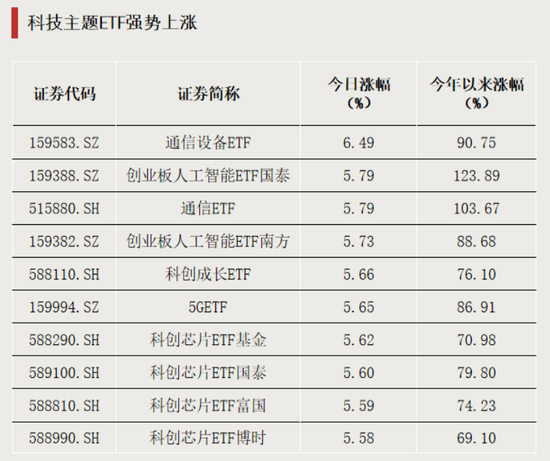
Market Overview - On October 24, A-shares saw all three major indices rise, with total trading volume approaching 2 trillion yuan, an increase of over 330 billion yuan compared to the previous trading day [1] - The Shanghai Composite Index closed at its intraday high of 3950.31 points, with over 1000 of the 1300+ ETFs in the market rising, and more than 130 products gaining over 4% [1] ETF Performance - Technology-themed ETFs performed exceptionally well, with all top ten ETFs by daily gain being technology-focused, each rising over 5% [2] - Some technology-themed ETFs have achieved over 100% returns year-to-date [2] - The Communication Equipment ETF (159583) led the market with a 6.49% increase and a trading volume of 190 million yuan, doubling from the previous day [2][3] - The top-performing stocks within the Communication Equipment ETF included Aerospace Science and Technology, which hit the daily limit, and several others that rose over 10% [2] Sector Analysis - The communication and electronics sectors were the top performers among over 30 industry sectors, with a combined trading volume exceeding 540 billion yuan [2] - Four ETFs linked to the Shanghai Stock Exchange Science and Technology Innovation Board Chip Index also made it to the top ten gainers, with significant increases in stocks related to storage chips [3][4] Fund Flows - On October 23, the ETF market saw a net inflow of approximately 6 billion yuan, with defensive ETFs continuing to attract funds, while some aggressive ETFs also gained interest [7][8] - Defensive ETFs focused on currencies, bonds, banks, and gold saw significant net inflows, with the Hua Bao Tian Yi ETF (511990) leading with a net inflow of 717 million yuan [7][8] - Conversely, some large-cap broad-based products experienced net outflows, with the Coal ETF (515220) seeing a net outflow of 601 million yuan on the same day [9][10] Earnings Outlook - Analysts suggest that the technology growth sector remains a favored investment theme, particularly with the acceleration of AI industry trends [11] - The upcoming third-quarter earnings reports are expected to show strong performance in the electronics and AI sectors, with many companies likely to exceed expectations [11][12] - The overall return on equity (ROE) for A-share listed companies (excluding financials and oil) is expected to rise, indicating improving profitability and market fundamentals [12]
中加基金权益周报︱科技板块高位调整,债市呈现利差压缩行情
Xin Lang Ji Jin· 2025-10-24 07:52
Market Overview and Analysis - The primary market saw the issuance of government bonds, local government bonds, and policy financial bonds amounting to 276 billion, 32.3 billion, and 142.4 billion respectively, with net financing of 16.6 billion, -19.8 billion, and 23.3 billion [1] - Non-financial credit bonds totaled 401.2 billion in issuance, with a net financing amount of 182 billion [1] - One new convertible bond was issued, expected to raise 1.7 billion [1] Secondary Market Review - Long-term interest rate bonds and perpetual bonds performed well, influenced by factors such as the stock-bond relationship, liquidity easing, and institutional behavior [2] Liquidity Tracking - The central bank conducted a 1 trillion buyout reverse repurchase operation for six-month terms, with a total buyout of 4 trillion this month, marking the highest level in nearly seven months, indicating continued liquidity easing [3] Policy and Fundamentals - The Ministry of Finance set a local bond balance limit of 500 billion [4] - September's import and export data and M1 exceeded expectations, while credit, social financing, and CPI were slightly below expectations [4] - In the overseas market, a video call between US and China trade leaders raised concerns about the credit quality of US regional banks, with Powell hinting at the end of balance sheet reduction; US Treasury yields fell, and US stocks initially rose before declining [4] Equity Market - A-shares experienced strong risk aversion, with the Wande All A index dropping 3.45% over the week; the previously high-performing TMT sector led the decline, with electronics down 7.14%, media down 6.27%, and communications down 5.92%, while banks and coal stocks led the gains [5] - Trading volume decreased, with an average daily trading volume of 2.19 trillion, down 234.579 billion week-on-week [5] - As of October 16, 2025, the total financing balance for All A was 2.440123 trillion, an increase of 10.908 billion from October 9 [5] - Future focus includes the progress of US-China negotiations and the sustainability of market style shifts [5] Bond Market Strategy Outlook - Ahead of the Fourth Plenary Session and the upcoming high-level US-China talks, the policy environment is expected to remain stable, with a low likelihood of contractionary measures, providing trading opportunities in the bond market based on changes in risk appetite and expectations of easing policies [6] - However, bond trading space remains highly dependent on fundamental trends and geopolitical developments, necessitating close attention to third-quarter GDP data and policy signals from key meetings and public statements [6] - In the current uncertain environment, the focus should be on controlling volatility, with increased allocation value in reasonably valued bank convertible bonds [6]
历史新高!美国国债首超38 万亿,美股暴跌,这次或又要找中国帮忙
Sou Hu Cai Jing· 2025-10-24 04:23
Core Points - The U.S. national debt has surpassed $38 trillion, leading to significant stock market declines, with each American now bearing a debt of $115,000, an increase of $4 trillion from two years ago [1] - The Trump administration is seeking increased bond purchases from China, reflecting a shift from previous passive acceptance to a more assertive stance from China regarding U.S. debt [1][2] - The U.S. debt situation is largely self-inflicted, driven by excessive spending, including a $4 trillion tax cut and $3 trillion in COVID-19 relief, resulting in a debt-to-GDP ratio exceeding 120% [1] Group 1 - China currently holds $784.3 billion in U.S. Treasury bonds, making it the second-largest foreign holder of U.S. debt, while other potential buyers are reducing their holdings [2] - Japan's holdings have just surpassed $1.1 trillion, but it faces its own demographic challenges, and European buyers are also decreasing their U.S. debt holdings due to energy crises [2] - China has reduced its U.S. Treasury holdings by nearly $280 billion from 2022 to 2024, indicating a strategic shift rather than a willingness to act as a "buyer of last resort" [2] Group 2 - China has made it clear that any assistance in purchasing U.S. debt must come with conditions, including the cessation of restrictions on Chinese companies and respect for China's core interests [3] - The U.S. Treasury is increasingly anxious about its ability to find buyers for new debt issuances, with officials acknowledging that the current debt growth is unsustainable [3] - The Trump administration's contradictory approach of seeking Chinese support while simultaneously imposing trade restrictions is likely to heighten China's caution in engaging with U.S. debt [3]
地方政府债与城投行业监测周报2025年第38期:5000亿地方债结存限额拟盘活侧重化债、清欠、经济大省基建-20251024
Zhong Cheng Xin Guo Ji· 2025-10-24 02:32
1. Report Industry Investment Rating No information provided in the content. 2. Core Viewpoints of the Report - The Ministry of Finance plans to revitalize 50 billion yuan of local government debt balance limits and advance the issuance of new local government debt quotas for 2026, which will help accelerate local debt resolution, government arrears clearance, and support infrastructure construction in the fourth quarter of 2025 and early 2026, while improving the liquidity of relevant urban investment enterprises [6][8]. - Hunan Province has issued a supervision and management method for village - level debt and creditor's rights, aiming to manage village - level debt in a more detailed and targeted manner [6][14]. - This week, 14 urban investment enterprises prepaid bond principal and interest, and 1 urban investment bond was cancelled for issuance [6][16][17]. 3. Summary by Relevant Catalogs 3.1 News Review - **Revitalizing 50 billion yuan of local government debt balance limits and advancing 2026 new local debt quotas**: The 50 - billion - yuan balance limit arrangement features scale expansion, expanded use from debt resolution to project construction with a focus on large economic provinces, and coordinated implementation with 50 - billion - yuan new policy - based financial instruments. The advance - issued 2026 new local debt quota is estimated to be between 176 billion - 264 billion yuan for special bonds and 32 billion - 48 billion yuan for general bonds [6][8][9]. - **Hunan's village - level debt management method**: It includes creditor's rights and investment management, stock debt management, new debt management, etc. Stock debt will be resolved through multiple means, and new debt will be strictly controlled at the source [14]. - **Prepayment of bond principal and interest by urban investment enterprises**: 14 urban investment enterprises prepaid the principal and interest of 15 bonds, with a total scale of 4.353 billion yuan. Most of them are from central regions and have an AA - level credit rating [16]. - **Cancellation of urban investment bond issuance**: The "25 Xianggaosu MTN019" was cancelled due to market fluctuations, with a planned issuance scale of 600 million yuan [17]. 3.2 Issuance of Local Government Bonds and Urban Investment Enterprise Bonds - **Local government bonds**: This week, the issuance and net financing scale of local government bonds decreased. The 2 - trillion - yuan replacement quota has only 7.418 billion yuan left, and only Henan Province has not completed the issuance. The weighted average issuance term was 16.21 years, and the weighted average issuance interest rate decreased to 2.18% [19]. - **Urban investment bonds**: The issuance and net financing scale of urban investment bonds increased this week. The overall issuance interest rate was 2.27%, and the issuance spread narrowed to 76.45BP. The issuance was mainly in the form of private placement bonds and general medium - term notes, with a 3 - year term and AA+ - level issuers [24]. 3.3 Trading of Local Government Bonds and Urban Investment Enterprise Bonds - **Funding situation**: The central bank conducted 637.1 billion yuan of reverse repurchase operations this week, with a net withdrawal of 497.9 billion yuan. Short - term funding rates generally increased [31]. - **Credit rating adjustment**: On September 24, Orient Jincheng upgraded the credit rating of Suqian New City Holdings Group Co., Ltd. from AA to AA+ [31]. - **Credit events and regulatory penalties**: No urban investment credit risk events occurred this week [31]. - **Local government bonds**: The trading volume of local government bonds was 318.178 billion yuan, an increase of 61.64%. The maturity yields fluctuated, with an average increase of 2.20BP [31]. - **Urban investment bonds**: The trading volume of urban investment bonds was 338.483 billion yuan, an increase of 82.88%. Most maturity yields decreased, with an average decline of 1.89BP. The spreads of 1 - year, 3 - year, and 5 - year AA+ urban investment bonds narrowed [32]. - **Abnormal trading of urban investment bonds**: 16 urban investment entities had 16 abnormal bond trades, with an increase in the number of entities, bonds, and trading times compared to last week [32]. 3.4 Important Announcements of Urban Investment Enterprises This week, 58 urban investment enterprises announced changes in senior management, legal representatives, directors, supervisors, etc., as well as changes in controlling shareholders, actual controllers, and equity/asset transfers [35].
信用利差周报2025年第39期:上交所明确绿色金融四大发展方向,熊猫债累计发行规模突破万亿-20251024
Zhong Cheng Xin Guo Ji· 2025-10-24 02:07
1. Report Industry Investment Rating There is no information about the report industry investment rating provided in the content. 2. Core Viewpoints of the Report - The Shanghai Stock Exchange clarifies four development directions to promote the standardized development of green finance, aiming to optimize the policy environment and guide capital to the green - low - carbon field. China's green bond market is in a rapid development stage, but still faces challenges such as term mismatch and insufficient participation of small and medium - sized enterprises [3][11]. - The cumulative issuance scale of panda bonds has exceeded one trillion yuan, with continuous enrichment of issuers and optimization of the institutional environment. Although the market has expanded, there is still room for improvement in market scale, secondary - market liquidity, and foreign - institution participation [4][15]. - In the third quarter, GDP growth slowed down slightly, while import and export data in September exceeded expectations. The central bank net - withdrew funds last week, and the money market maintained a balanced state. The primary market of credit bonds saw a significant recovery in issuance scale and a decline in most issuance costs. The secondary market of credit bonds had significantly increased trading activity, with bond yields showing a mixed trend [5][20][24]. 3. Summary According to the Table of Contents Market Hotspots - **Shanghai Stock Exchange Promotes Green Finance**: On October 16, the Shanghai Stock Exchange announced four directions for green finance development, including supporting green enterprises' equity and bond financing, strengthening sustainable information disclosure of listed companies, enhancing investment - end construction in the sustainable field, and deepening international cooperation. China's green bond market has the largest scale globally, and the exchange is promoting standardized construction in multiple aspects. However, challenges such as term mismatch and insufficient SME participation remain [3][11][12]. - **Panda Bonds' Scale Exceeds One Trillion**: As of October 17, the cumulative issuance scale of panda bonds has exceeded one trillion yuan. The market has grown rapidly since 2023, with diversified issuers. The expansion is driven by low domestic interest rates and optimized regulatory policies. Although it has enhanced the market's depth and internationalization, there is still room for improvement in market scale, liquidity, and foreign - institution participation [4][15][16]. Macroeconomic Data - **GDP Growth**: The year - on - year GDP growth rate in the third quarter was 4.8%, slightly higher than the annual target. The growth rate of the secondary industry slowed down, while that of the primary industry increased [20]. - **Import and Export**: In September, the export volume was $328.57 billion, with a year - on - year growth of 8.3%, and the import volume was $238.12 billion, with a year - on - year growth of 7.4%, both showing significant improvements compared to August [5][20]. - **Social Financing Scale**: The stock of social financing scale in September was 424 trillion yuan, with a year - on - year growth of 8.7%. The new - added social financing scale decreased year - on - year, mainly due to weak credit demand and a slowdown in government - bond issuance [20][21]. - **Money Supply**: In September, M1 reached 7.2%, and M2 was 8.7%. The "scissors gap" between M1 and M2 narrowed to a new low for the year [5][21]. Money Market - The central bank net - withdrew 813.9 billion yuan through open - market operations last week. Although funds were withdrawn, the money market remained balanced, with fluctuating capital prices. The pledged - repo rates of various tenors had both increases and decreases, and the spread between the 3 - month and 1 - year Shibor narrowed to 9bp [6][24]. Primary Market of Credit Bonds - The issuance scale of credit bonds last week was 339.359 billion yuan, a significant recovery compared to the previous period. The issuance scale of each bond type and industry increased. The infrastructure investment and financing industry had a net outflow of 6.067 billion yuan in financing, while half of the industrial bonds had a net inflow. Most of the average issuance costs of credit bonds decreased, with a range of 6bp - 49bp, except for a 5bp increase in the issuance rates of 5 - year AA + and 3 - year AA bonds [7][29]. Secondary Market of Credit Bonds - The secondary - market trading volume of bonds last week was 9.166734 trillion yuan, with the average daily trading volume increasing by 88.1725 billion yuan to 183.3347 billion yuan, indicating a significant increase in trading activity. Bond yields showed a mixed trend. Interest - rate bond yields mostly increased, while credit - bond yields mostly decreased. Credit spreads generally showed a short - term decline and long - term increase, and rating spreads fluctuated within a narrow range of 3bp [37][39][41].