
科技

Search documents
基金双周报:ETF市场跟踪报告-20251110
Ping An Securities· 2025-11-10 07:42
ETF Market Overview - As of November 7, the performance of ETF products varied, with the CSI 2000 showing the highest increase among major broad-based ETFs, while the new energy theme ETF had the largest increase among industry and thematic products [2][9] - In the past two weeks, major broad-based ETFs such as CSI A500, CSI 2000, and Sci-Tech 50 ETF saw net inflows, while the ChiNext ETF experienced the largest net outflow [2][9] - The recent trend indicates a shift from net inflows to net outflows in cyclical and military industry ETFs, while pharmaceutical ETFs saw accelerated inflows [2][16] ETF Fund Flow Analysis - The cumulative fund flow for broad-based ETFs has shown a trend of outflows turning into inflows and then back to outflows since the beginning of 2025, with A-series ETFs consistently experiencing outflows [10] - Recent net outflows for broad-based ETFs have slowed down, with CSI 1000 and CSI 2000 transitioning from net outflows to net inflows [10][16] - As of November 7, the total number of newly established ETFs in the past two weeks was 16, with a total issuance of 6.53 billion units, of which 13 were stock ETFs and 3 were QDII ETFs [24] Thematic ETF Tracking - In the technology theme ETFs, products tracking the Hang Seng Technology index saw the highest net inflows, while those tracking consumer electronics experienced net outflows [30] - For dividend theme ETFs, products tracking the S&P Hong Kong Stock Connect Low Volatility Dividend Index had the highest net inflows, while those tracking the dividend index saw net outflows [32] Popular Thematic ETFs - AI-themed ETFs, which have a high proportion of AI stocks, experienced an average return of -2.99% with a net inflow of 1.56 billion [2] - New energy-themed ETFs had an average return of 7.67% but saw a net outflow of 5.72 billion [2] - The total holdings of ETFs by Central Huijin, Guoxin, and Chengtong reached 391.34 billion units, with a net outflow of 2.11 billion in the past two weeks [2]
美政府停摆危机化解在即,美股史诗级逼空行情一触即发?
Hua Er Jie Jian Wen· 2025-11-10 06:34
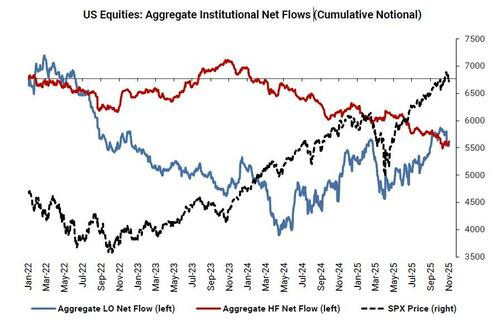
Group 1 - The resolution of the U.S. government shutdown has led to a significant shift in market sentiment towards optimism, with expectations of a strong market rebound [1] - Approximately $1 trillion is expected to flow back into the economy from the U.S. Treasury General Account (TGA), injecting substantial liquidity into the market [1] - The S&P 500 futures saw an increase of $21 billion in open contracts, indicating a rise in long positions rather than short covering [2] Group 2 - Institutional investors' overall positions remain low, similar to levels seen at the end of September, suggesting potential forced buying if market sentiment reverses [4] - The TGA balance has surpassed $1 trillion for the first time since April 2021, indicating a significant liquidity drain from the market over the past three months [4] - The release of liquidity from the TGA could lead to a large-scale buying spree of risk assets, reminiscent of the "invisible quantitative easing" seen in early 2021 [4] Group 3 - Technology stocks have experienced their largest weekly pullback since April, driven by high valuations and macroeconomic uncertainties [5] - Despite a rebound in major tech stocks, investors face ongoing concerns regarding interest rate policies and the performance of AI investments [5] - Consumer sentiment has shifted, with companies failing to meet expectations facing severe penalties, while those exceeding expectations receive minimal rewards [6] Group 4 - The industrial sector is experiencing increased volatility, with a heightened focus on companies' future guidance amid a lack of strong market performance [6] - Goldman Sachs anticipates the government shutdown will likely end around the second week of November, with key pressure points related to payroll for air traffic and airport security personnel [8]

美国经济撑不住了?经济数据发布停滞,消费者信心创三年新低!
Sou Hu Cai Jing· 2025-11-10 05:04
经济数据"断档",消费者信心跌至两年低谷 受政府长期关门影响,关键经济数据发布陷入停滞,劳工部宣布无法按时公布10月就业报告,这已是该 报告连续第二次推迟。 缺少官方数据支撑,美联储、投资者与国际政策制定者只能依赖私人数据或估算,导致货币政策预测的 误差范围扩大,决策难度陡增。 更糟糕的是,消费者信心持续崩塌。密歇根大学11月初调查显示,消费者信心指数从10月的53.6点暴跌 至50.3点,创下2022年年中以来的最低值。 不同收入群体普遍担忧未来收入,支出意愿大幅收缩,对政府治理政策的怀疑情绪也日益加重。这种低 迷的消费预期,进一步拖累了美国国内经济的复苏节奏。 最高法院审查关税合法性,"关税墙"面临坍塌风险 这种冲击的本质是"连锁反应":美国作为全球主要消费市场,其关税政策调整或需求收缩,直接导致依 赖对美出口的国家订单减少。 而供应链的关联性又让这种压力扩散至上下游,从原材料供应到零部件生产,再到终端组装,全球产业 链的每一环都可能因美国政策变动而被迫调整。 引发全球焦虑的核心事件,是美国最高法院对特朗普政府进口关税令合法性的审查。 法院针对《国际紧急经济权力法》征收关税的法律依据提出严厉质疑,这直接让 ...
华夏标普港股通低波红利ETF:低利率时代掘金港股的高股息机会
Quan Jing Wang· 2025-11-10 03:28
Core Viewpoint - The article highlights the increasing attractiveness of the Hong Kong stock market due to its relatively low valuations and the influx of southbound capital, with a focus on the launch of the China Asset Management's Hong Kong Stock Connect Dividend Low Volatility ETF (code: 159118) as a new investment tool for high dividend assets in Hong Kong [1][2][8]. Group 1: Market Conditions - The global low interest rate environment is prompting investors to seek stable returns, with Hong Kong stocks currently at historically low valuations, making them an appealing choice for investment [1][2]. - As of October 21, 2025, the Hang Seng Index's PE (TTM) is approximately 11.94 times and PB (LF) is about 1.22 times, placing it in the 79% and 83% percentiles of the past decade, respectively [2]. - Southbound capital has seen a net inflow of over 12 billion HKD into Hong Kong stocks since the beginning of 2025, marking a significant increase compared to previous years [3]. Group 2: Investment Strategy - The Hong Kong Stock Connect Dividend Low Volatility ETF (159118) utilizes a "dividend + low volatility" dual-factor strategy, selecting high dividend yield stocks with low volatility to provide investors with a streamlined investment option [6][8]. - The index tracks the top 75 stocks with the highest dividend yields from the Hong Kong Stock Connect, further narrowing down to the 50 stocks with the lowest volatility, ensuring a focus on cash flow and liquidity [6]. - Historical performance shows that the index has achieved a cumulative increase of approximately 94.95% since 2021, with an annualized return exceeding 16%, significantly outperforming the Hang Seng Index [6]. Group 3: Sector Distribution - The index maintains a balanced sector distribution, with the top three sectors being real estate (approximately 16%), utilities (about 15%), and banking (around 14%), ensuring no single sector exceeds 25% [7]. - The index includes high dividend leaders across various sectors, such as Jiangxi Copper, China Shenhua, and CNOOC, with a notable valuation discount of approximately 34.5% compared to A-shares, indicating significant potential for valuation recovery [7]. Group 4: Fund Management - China Asset Management is recognized for its expertise in index investment, with a team of 43 professionals and an average industry experience of over 12 years, providing strong support for its index products [7]. - The fund manager for the ETF, Yan Xiaoxian, has 10 years of experience in the securities industry, including over 4 years in public fund management, enhancing the fund's credibility [7]. - The ETF employs a complete replication strategy with low management fees of 0.15% and custody fees of 0.05%, aimed at reducing costs for investors [7].
港股科技30ETF(513160)涨超0.5%,机构:港股科技板块或依然处在布局区
2 1 Shi Ji Jing Ji Bao Dao· 2025-11-10 02:01
Core Viewpoint - The Hong Kong stock market is experiencing a collective rise, particularly in the technology sector, driven by positive sentiment and government support for AI and technology applications [1][2]. Group 1: Market Performance - The Hong Kong Technology 30 ETF (513160) rose by 0.54%, with a turnover rate of 2.58% and a premium/discount rate of 0.1%, indicating active trading [1]. - Key constituent stocks such as Xindong Company and Dongfang Zhenxuan saw gains exceeding 3% [1]. Group 2: Government Policy - The State Council issued implementation opinions to accelerate the cultivation of application scenarios and promote large-scale applications in the AI sector, emphasizing the need for core technology breakthroughs and high-value application development [1]. Group 3: Analyst Insights - Dongwu Securities maintains a long-term bullish outlook on the Hong Kong stock market, particularly in the technology sector, while monitoring the performance of U.S. tech stocks [1]. - Huatai Securities suggests that the technology sector in Hong Kong may still be in a positioning phase, with potential for improved sentiment as the Federal Reserve enters a new round of easing [2].
2025年只有不到2个月了,你的基金收益落在哪个区间?
Sou Hu Cai Jing· 2025-11-10 01:57
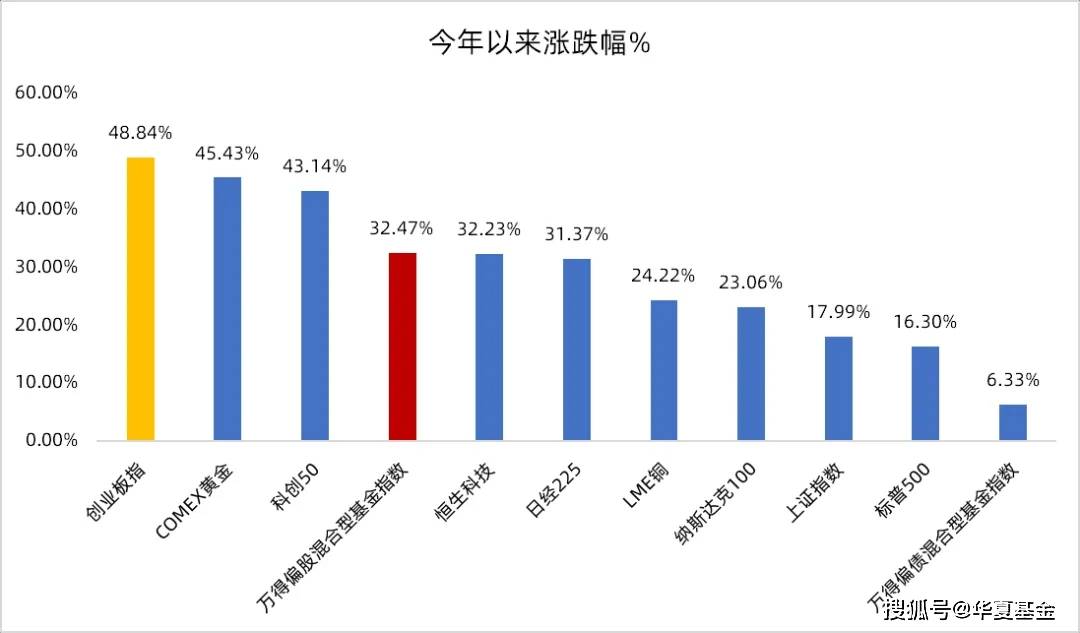
Group 1 - The A-share market has seen a significant increase in investor participation, with 22.46 million new accounts opened in the first ten months of 2025, representing an 11% year-on-year growth, bringing the total number of A-share investors close to 250 million [1] - The A-share and Hong Kong stock markets have performed well in 2025, driven by sectors such as AI computing and innovative pharmaceuticals, with the ChiNext index outperforming gold and the mixed equity fund index achieving a return of 32.47%, surpassing major indices like the Nasdaq [2][3] - Among 31 first-level industries, 30 have recorded positive returns this year, with the only exception being the food and beverage sector, which saw a slight decline, highlighting a significant divergence in sector performance [3] Group 2 - The commodities market has experienced unprecedented performance this year, with commodity funds achieving returns close to 40% and other QDII funds rising by 26.46%, influenced by a declining interest rate environment and geopolitical tensions [7] - Bond funds have underperformed, with an average return of only 2.13%, although convertible bond funds have shown a remarkable increase of over 20%, comparable to equity fund indices [8] - Overall, different types of funds have provided a positive experience for holders, particularly technology-focused funds, which have delivered substantial returns [10]
购物季刚收官 跨年季已接棒 超500场次促消费活动将贯穿今年11月至明年2月
Sou Hu Cai Jing· 2025-11-09 17:53
Core Insights - The "Shopping Season in China 2025" in Shenzhen concluded with over 670 events, followed by the "New Year Consumption Season" featuring more than 500 promotional activities from November to February [1][3] Group 1: Economic Impact - Shenzhen's total retail sales of consumer goods reached 756.08 billion yuan, with a year-on-year growth of 3.6% from January to September [1] - During the shopping season, key commercial districts saw a significant increase in foot traffic and sales, with 26 monitored districts recording 19.49 billion yuan in sales and 19.975 million visitors from October 1 to 8, marking a growth of approximately 20% [3] Group 2: Event Highlights - The shopping season focused on 15 major consumption hotspots, including summer consumption, AI consumption, and duty-free shopping, with monthly themes of "Joyful Shopping in August," "Fashionable Shopping in September," and "Brand Shopping in October" [3] - The opening of Shenzhen's first city duty-free store during the shopping season aimed to attract outbound travelers and promote domestic consumption [3] Group 3: Future Initiatives - The upcoming "Enjoy Winter, Shop Shenzhen" New Year Consumption Season will include four monthly themes, seven new consumer experiences, and over 500 promotional activities [4] - Shenzhen plans to release a "Consumption Map" and "Must-Buy List" to enhance shopping convenience and promote local brands [5] - The city aims to attract 1,200 new flagship stores and concept stores by the end of the year, while also fostering new business models like "AI + Consumption" and digital tourism [5]

全球资产配置每周聚焦(20251031-20251107):美元流动性持续紧张,海外调整A股相对坚挺-20251109
Shenwan Hongyuan Securities· 2025-11-09 13:16
Group 1: Market Overview - The US government shutdown has led to a tightening financial environment, causing global equity markets to mostly decline[4] - The overnight general collateral repurchase rate fluctuated between 4.14% and 4.24%, significantly above the Federal Reserve's 3.9% excess reserve rate[4] - Despite global market adjustments, the CSI 300 and Hang Seng Index recorded positive returns, indicating strong investor confidence in Chinese assets[4] Group 2: Fund Flows - As of November 5, 2025, both domestic and foreign capital flowed into the Chinese stock market, with foreign capital inflows of $20.14 billion and domestic inflows of $68.98 billion[4] - In the past week, overseas active funds saw an outflow of $6.18 billion, while passive funds experienced an inflow of $26.31 billion[4] Group 3: Valuation Metrics - The valuation percentile of the Shanghai Composite Index is at 89.5%, second only to the S&P 500, but still lower than US equities in absolute terms[4] - The risk-adjusted return percentile for the CSI 300 increased from 79% to 83%, indicating improved relative performance[4] Group 4: Risk Sentiment - The S&P 500 closed at 6728.80, below the 20-day moving average, with a put-call ratio of 1.19, reflecting increased hedging demand[4] - The implied volatility structure of the CSI 300 options showed a significant decline, indicating cautious sentiment in the market[4] Group 5: Economic Data - The probability of a 25 basis point rate cut by the Federal Reserve in December has risen to 66.90%, up from 63.00% the previous week[4] - The US September existing home sales increased by 4.1%, marking five consecutive months of marginal improvement[4]
数据宝下周A股调研出炉:新能源板块看好比例大幅提升
Zheng Quan Shi Bao Wang· 2025-11-09 13:08
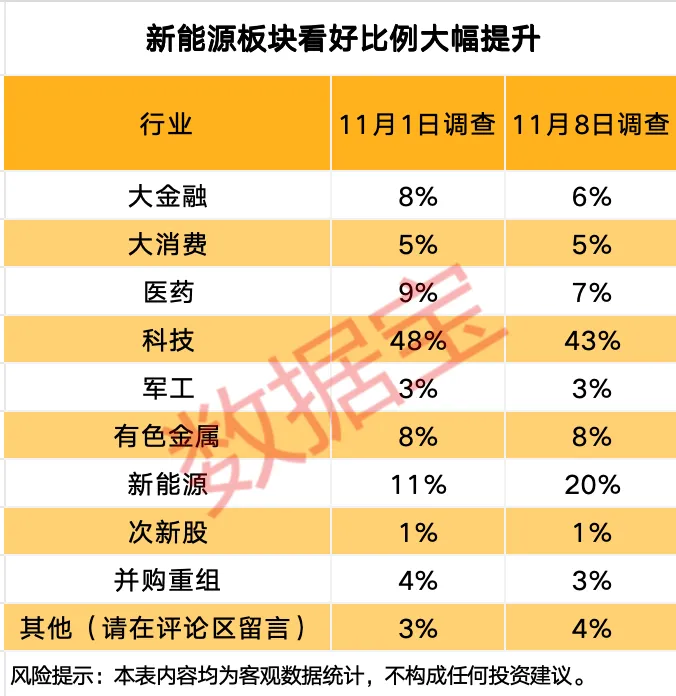
Core Insights - The survey conducted by Securities Times Data Treasure indicates a mixed sentiment among investors regarding A-share market movements, with a notable increase in optimism towards the new energy sector [1] Group 1: Investor Sentiment - 23% of surveyed investors increased their positions, while 18% reduced their holdings, and 5% completely exited their positions; 54% maintained their current holdings [1] - Approximately 52% of respondents believe that A-shares will rise above 4000 points and stabilize, while 28% expect a rise followed by a decline [1] Group 2: Sector Outlook - The proportion of investors optimistic about the new energy sector has significantly increased from 11% to 20%, marking a 9 percentage point rise [2] - Other sectors such as technology, pharmaceuticals, and large financials have seen a decrease in positive sentiment, with technology dropping from 48% to 43%, pharmaceuticals from 9% to 7%, and large financials from 8% to 6% [2]
政府关门冲击美联储的政策平衡选向
Di Yi Cai Jing· 2025-11-09 12:31
Economic Impact of Government Shutdown - The U.S. government shutdown has lasted for 39 days, marking one of the longest shutdowns in history, due to Congress's failure to pass the fiscal year 2026 spending bill [1] - The Congressional Budget Office (CBO) estimates that such shutdowns could lead to a GDP loss of 0.1% to 0.5% annually, amplifying economic uncertainty [3] - Approximately 800,000 federal employees have been forced to take unpaid leave or work without pay, affecting key departments like the Department of Defense and the Department of Homeland Security [3] Labor Market Dynamics - The Challenger report indicates a significant surge in layoffs, with 153,074 job cuts announced in October, a 183% increase from September and the highest monthly figure since October 2003 [5][6] - The ADP report shows a surprising rebound in private sector employment, with a net increase of 42,000 jobs in October, reversing previous losses [7][8] - The labor market is exhibiting a "two-speed" dynamic, with blue-collar sectors holding up while white-collar jobs, particularly in technology and services, face pressure [8] Federal Reserve's Policy Challenges - The Federal Reserve's dual mandate of maximizing employment and price stability is under severe strain, with current inflation around 3.0%, significantly above the 2% target [2][9] - The ongoing government shutdown complicates data collection, leading to a "data black hole" that increases policy-making difficulties for the Fed [4][10] - Internal divisions within the Fed are evident, with some members prioritizing employment while others focus on inflation risks, reflecting a classic policy dilemma [10][13] Market Expectations and Future Outlook - As of November 6, the probability of a 25 basis point rate cut at the December meeting is approximately 58.3%, down from 63.8% a week prior, indicating market uncertainty [12] - The potential for a prolonged government shutdown could lead to a significant drop in consumer spending, further impacting employment [12][13] - The Fed may need to adopt a cautious approach in its December meeting, balancing the risks of rising inflation against the need to support employment [11][13]