电商

Search documents
罗永浩科技春晚迟到40多分钟,本人现场宣布门票全退;小米汽车明年拟推4款新车;消息称快手副总裁周国睿将离职;孟晚舟最新发声丨邦早报
创业邦· 2025-12-31 00:09
Group 1 - Luo Yonghao returned to the tech launch stage after seven years, hosting the "2025 Annual Technology Innovation Sharing Conference" in Shanghai, with over 2 million online viewers on Douyin and Weibo [3][4] - The event showcased over ten innovative Chinese tech products, including exoskeletons, drones, and 3D printers, emphasizing the importance of innovation in the industry [4] - Luo announced a plan to create an "accelerator + crowdfunding community" ecosystem to support local innovation [4] Group 2 - Kuaishou's Vice President Zhou Guorui is reportedly leaving the company, with no official response from Kuaishou as of the report [6] - SoftBank has fully completed its $40 billion investment commitment to OpenAI [6] - Xiaomi plans to launch four new car models in 2026, including two range-extended SUVs [6] Group 3 - Pang Donglai Group reported a sales revenue of approximately 23.41 billion yuan for 2025, with supermarket sales reaching 12.58 billion yuan [6] - Qingtian Rental launched an "instant rental" service for robots at a promotional price of 1 yuan in ten major cities [8] - Zhui Mi Technology announced a "Family Health Protection Plan" for employees and their immediate family members, effective January 1, 2026 [9] Group 4 - Applied Digital plans to spin off its cloud business and merge it with EKSO to form a new entity named "ChronoScale Corporation" [16] - Huawei's rotating chairman Meng Wanzhou outlined the company's strategic focus areas for 2026, including AI integration and enhancing the Hongmeng ecosystem [17] - Cao Cao Mobility announced the acquisition of 100% equity in Weixing Technology for a total cash consideration of 225 million yuan [17] Group 5 - KKR announced the acquisition of the Incheon Cheongro logistics center, marking the largest single-asset logistics transaction in South Korea to date [17] - Hong Kong University issued a statement denying any unauthorized recruitment through intermediaries [17] - Shanghai Tai Xi Micro completed a new round of financing of nearly 100 million yuan for the production and development of automotive-grade SoC chips [19]



隔夜欧美·12月31日
Sou Hu Cai Jing· 2025-12-31 00:00
Market Performance - The three major U.S. stock indices experienced slight declines, with the Dow Jones down 0.2% at 48,367.06 points, the S&P 500 down 0.14% at 6,896.24 points, and the Nasdaq down 0.24% at 23,419.08 points [1] - Major U.S. tech stocks showed mixed results, with Tesla down over 1%, Nvidia down 0.36%, Apple down 0.26%, while Facebook rose over 1%, Amazon up 0.2%, Microsoft up 0.09%, and Google up 0.09% [1] - Chinese concept stocks had mixed performance, with EHang up over 5%, Tiger Brokers up over 4%, Baidu up over 4%, and NIO up over 3%. However, Dingdong Maicai fell over 7%, Vipshop down about 7%, and JD.com down nearly 2% [1] - European stock indices closed higher across the board, with Germany's DAX up 0.57% at 24,490.41 points, France's CAC40 up 0.86% at 8,181.86 points, and the UK's FTSE 100 up 0.87% at 9,952.08 points [1] Commodity Prices - COMEX gold futures rose 0.20% to $4,352.30 per ounce, while COMEX silver futures surged 7.88% to $76.02 per ounce [1] - U.S. oil futures fell 0.22% to $57.95 per barrel, and Brent oil futures dropped 0.24% to $61.34 per barrel [1] - London base metals saw an overall increase, with LME nickel up 6.11% at $16,780.0 per ton, LME copper up 3.69% at $12,673.5 per ton, and LME tin up 3.56% at $42,195.0 per ton [1] Bond Market - U.S. Treasury yields showed mixed movements, with the 2-year yield down 0.40 basis points at 3.448%, while the 10-year yield rose 1.17 basis points to 4.122% [1] - European bond yields collectively increased, with the UK 10-year yield up 1.2 basis points at 4.496%, France's 10-year yield up 3.8 basis points at 3.561%, and Germany's 10-year yield up 2.5 basis points at 2.853% [1]
“退货羽绒服口袋现机票”引争议;2026年“国补”政策来了| 消费早参
Mei Ri Jing Ji Xin Wen· 2025-12-30 23:04
点评:2026 年"两新"政策的延续与扩围,是积极聚焦扩内需、促转型的精准发力,契合消费升级与新 质生产力培育需求,以财政资金撬动居民换新意愿、缓解企业转型压力。是"十五五"开局之年稳增长、 优结构的重要抓手,彰显了以消费牵引供给、以产业升级支撑高质量发展的政策逻辑。 NO.2 东莞首富母子完成交接班 62岁的东阳光联合创始人郭梅兰因"年事已高",将其持有的核心资产全部转让给38岁的儿子张寓帅。至 此,这位38岁的"创二代"成为东阳光唯一实际控制人,独自掌控着价值近700亿的上市公司平台,母子 二人合计400亿元的财富版图实现平稳交接。 点评:这是民营上市公司代际传承浪潮中的典型案例。此次交接以全额资产转让的方式完成控制权过 渡,既符合家族企业传承的常见路径,也让市场将目光聚焦于新任实控人后续在企业研发投入、业务布 局等方面的决策走向,以及这种传承模式对公司长期经营稳定性的影响。 丨 2025年12月31日星期三丨 NO.1 2026年"国补"政策来了 国家发展改革委、财政部印发的《关于2026年实施大规模设备更新和消费品以旧换新政策的通知》30日 对外发布,明确2026年"两新"政策的支持范围、补贴标准和工 ...
12月31日隔夜要闻:美股收跌 台积电2纳米芯片开始量产 美国一货运列车脱轨起火 俄罗斯谈判立场趋于强硬
Xin Lang Cai Jing· 2025-12-30 22:31
欲览更多环球财经资讯,请移步7×24小时实时财经新闻 市场 12月31日收盘:美股收低标普指数连跌三日 联储纪要凸显内部分歧 12月31日美股成交额前20:台积电2纳米芯片开始量产 12月31日热门中概股涨跌不一 百度涨4.39%,唯品会跌6.92% 周二油价小幅下滑 市场关注俄乌和平希望与也门紧张局势 现货黄金涨0.33%,报4346.98美元/盎司 欧洲股市上涨 矿业股在美联储会议纪要发布前走强 美国制裁涉武器贸易的伊朗、委内瑞拉相关组织 美国要求驻西半球的使馆报告大规模移民造成的犯罪 欧洲之星因供电故障被迫暂停伦敦列车服务 俄罗斯谈判立场趋于强硬 欧洲领导人磋商乌克兰局势 公司 美国司法部:迪士尼同意就侵犯儿童隐私支付1000万美元罚款 宏观 美联储会议纪要凸显央行分歧 大多数官员认为适宜进一步降息 美联储会议纪要公布后 交易员仍押注明年两次降息 马斯克证实xAI购入第三栋建筑 训练算力将接近2吉瓦 华纳兄弟计划下周拒绝派拉蒙的收购提议 载有液态硫磺的CSX列车在肯塔基州-田纳西州铁路附近脱轨 美国一货运列车脱轨 一节装载熔融硫黄车厢起火 Rivian股价未能守住20美元关口,进一步印证动能正在减弱 波 ...


3300多万个账户信息被泄露 全国总人口才5100多万!韩国最大电商发补贴“求原谅”:每户5万韩元
Mei Ri Jing Ji Xin Wen· 2025-12-30 16:57
Group 1 - Coupang announced a compensation plan for over 33 million affected users due to a massive data leak, offering 50,000 KRW (approximately 241.5 RMB) per user, totaling 1.685 trillion KRW (approximately 81.39 billion RMB) [1] - The total population of South Korea as of November 1, 2023, is reported to be 51.77 million, indicating that the data leak affected nearly the entire customer base of Coupang [1] - The compensation will be distributed in the form of vouchers starting from January 15, 2024, to users notified of the data breach by the end of November [1] Group 2 - Coupang confirmed the identity of the perpetrator behind the data leak and recovered all devices used in the incident, with only limited user data from 3,000 accounts retained by the leaker [2] - There were rumors suggesting that Coupang's investigation was not conducted under government supervision, which heightened public concern; however, Coupang clarified that the investigation was coordinated with government oversight [2] - A detailed timeline of government coordination was released, showing Coupang's cooperation with authorities from December 1 to December 26, including the recovery of devices and submission of materials for forensic analysis [4] Group 3 - Coupang's founder, Bom Kim, publicly apologized for the incident and committed to full cooperation with the government regarding the investigation [5] - Coupang is one of South Korea's largest e-commerce platforms, having invested billions in its Rocket Delivery service, which ensures 99% of orders are delivered within a day [5] - The company previously faced a fine of 140 billion KRW (approximately 7.3 billion RMB) for manipulating product reviews and search rankings, marking the highest penalty ever imposed on a distribution company in South Korea [7]


“微醺悦己”“送礼犒劳自己”带热跨年消费,美团闪购:精酿啤酒销量翻倍,智能手表销量涨6倍
Feng Huang Wang Cai Jing· 2025-12-30 14:54
Group 1 - The core trend for New Year's Eve consumption among young people is the pursuit of "self-indulgence," with many becoming "New Year's hosts" and focusing on gifts for themselves [1][2] - Popular products for New Year's Eve include various alcoholic beverages, with sales of craft beer and white wine increasing over 100% year-on-year, and brand new low-alcohol products gaining traction [1] - Digital products are also in high demand as gifts, with smart watch sales increasing by 610% and tablet sales rising over 210% in the week leading up to New Year's [1] Group 2 - Innovative fruit and flower arrangements have become popular for enhancing the New Year's celebration, with some products seeing a 13-fold increase in search volume [2] - Young consumers are opting for new styles of flowers, including collaborations with brands like Disney, which have seen rapid sales growth [2] - Platforms are offering promotional discounts for New Year's shopping, with Meituan Flash Sale planning to distribute up to 2026 yuan in coupons for various products [2]


京东全国首个校园“智狼”前置仓投入运营
Bei Jing Shang Bao· 2025-12-30 13:09
未来,京东校园前置仓模式将快速迭代。京东物流已与广东工商职业技术大学计划引入无人车进行校内 短驳,并筹备无人机配送试点,逐步构建"前置仓+无人车+无人机"的立体校园智能配送网络。 据了解,消费者下单后,"智狼"货到人系统会在近500平米的前置仓内精准定位商品,快速完成分拣与 打包,并放至前置仓。骑手取件后进入校区,最终送至消费者手中,整个过程最快10分钟。这一前置仓 不仅服务于校内师生,也实现周边5公里社区30分钟送达。 北京商报讯(记者 何倩)12月30日,北京商报记者从京东获悉,京东全国首个校园"智狼"前置仓已在 广东工商职业技术大学正式投入运营,完整打通从入库、存储、分拣到配送的全链路。 ...

拼多多想好往哪儿走了
远川研究所· 2025-12-30 12:04
Core Insights - Pinduoduo's recent shareholder meeting revealed significant changes, including the introduction of a co-chairman system with Zhao Jiazhen and Chen Lei as co-CEOs, and a strategic focus on enhancing the Chinese supply chain while aiming to create a new Pinduoduo that emphasizes quality and ecosystem [3][4] - Temu has rapidly grown to become one of the largest e-commerce platforms globally, achieving a GMV of 168 billion with a 42% year-on-year increase, and a monthly active user base of 530 million [5][7] Group 1: Strategic Shifts - The shareholder meeting indicated a shift from merely building an e-commerce platform to investing in supply chains and co-creating industry ecosystems, which could significantly impact the Chinese e-commerce sector [4] - Pinduoduo's management expressed ambitions to "recreate Pinduoduo" over the next three years, focusing on leveraging the supply chain to enhance product quality and market reach [3][12] Group 2: Temu's Business Model - Temu's "full management + semi-management" model has set a new standard in cross-border e-commerce, allowing factories to take center stage and reducing intermediary costs while enhancing quality control [7][9] - The model is tailored to connect China's mature supply chain with global consumer markets, facilitating rapid production and distribution [11][18] Group 3: Support for Industry Transformation - Pinduoduo's "New Quality Merchant Support Plan" aims to provide substantial resources for industry transformation, including a 10 billion yuan fund to support merchants in various sectors [12][14] - The plan is designed to empower merchants to transition from low-margin OEM models to developing their own brands, thereby increasing their control over high-value segments [18][20] Group 4: Market Dynamics and Consumer Insights - Pinduoduo's approach focuses on providing certainty to producers by aligning production with consumer demand, thus enabling factories to adopt a more responsive production strategy [20][21] - The platform's data-driven insights have helped merchants identify market opportunities, leading to significant sales growth and brand development [17][21] Group 5: Competitive Landscape - The shift in focus from traffic acquisition to supply chain efficiency distinguishes Pinduoduo from other e-commerce platforms, positioning it to better respond to market demands and provide stability to industry players [24]


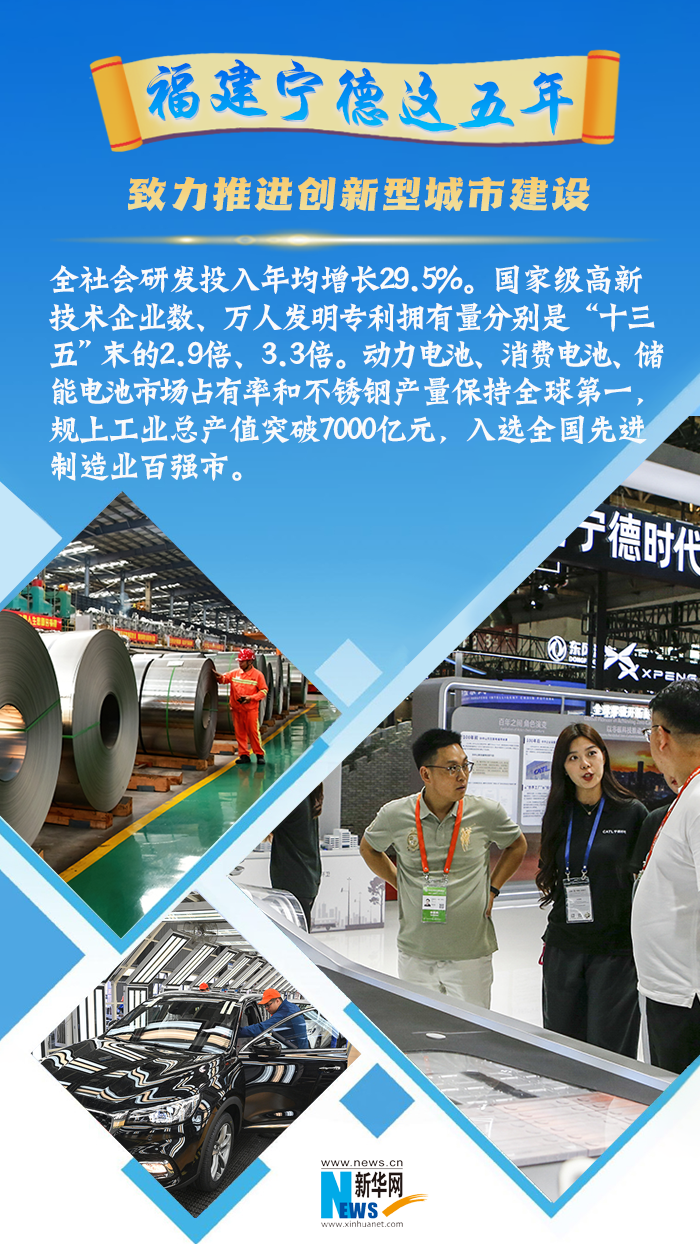
福建宁德这五年:预计GDP年均增长8%以上
Xin Hua Wang· 2025-12-30 10:51
Economic Growth - Ningde City is expected to achieve an average annual GDP growth of over 8% during the 14th Five-Year Plan period, with its economic total share of the province increasing from 5.9% to 6.8%, rising to the 5th position in the province [1] Infrastructure Development - The city has built 19 high-speed interconnections, with 85% of land-based towns achieving "half-hour convenient access to highways" [5] Social Development - The urbanization rate of the permanent population in the central urban area has reached 72.16%, with a noticeable increase in high-level talents and young people under 35 [5] Environmental Quality - The proportion of water quality in major river basins, lakes, and drinking water sources remains at 100% for good quality, with air quality good days ratio at 98.6% [8] Trade and Logistics - Ningde Port's cargo throughput has exceeded 100 million tons, with the port now serving 187 countries and regions globally [11] Public Welfare - Over 70% of the new fiscal revenue each year is directed towards public welfare, with 199 projects implemented for the benefit of the people [12]
京东京喜的2025:持续反内卷 成交额飙10倍 浙江产业带订单量超3亿
Zhong Jin Zai Xian· 2025-12-30 10:46
Core Insights - In 2025, JD's discount shopping brand Jingxi achieved a tenfold increase in transaction volume, serving over 400 million users cumulatively over two years [1][5][15] - Jingxi has deepened its connections with over 260 industrial belts nationwide, with nearly 100 enterprises achieving annual sales exceeding 1 million orders [1][7] - To combat price wars in the low-cost e-commerce sector, Jingxi upgraded its business model, introducing six new initiatives aimed at sustainable growth for merchants [1][9] Group 1: Performance Metrics - Jingxi's self-operated segment reported a tenfold year-on-year increase in transaction volume, reflecting strong growth momentum [5] - The number of merchants on Jingxi's platform exceeded 2 million, with over 20,000 merchants experiencing a doubling of order volume [11][13] - In 2025, five major provinces saw order volumes surpass 100 million, with Zhejiang's orders exceeding 300 million and some provinces experiencing up to a fourfold year-on-year growth [7] Group 2: Business Strategies - Jingxi's new business directions include export-to-domestic sales, brand partnerships, and quality selection, aimed at providing a stable growth path for industrial belt merchants [1][10] - The platform has supported over 2,000 foreign trade factories in entering the domestic market, resulting in 180 million orders, a threefold increase year-on-year [10] - Jingxi's focus on high-quality, cost-effective products aligns with consumer demand, leading to significant sales increases across various categories, including furniture and baby products [7][15] Group 3: Future Outlook - In 2026, Jingxi aims to continue reinforcing its brand identity as a provider of affordable, high-quality products, targeting an additional 150 million new users and expanding its product offerings to 3 million [4][15] - The platform's long-term strategy emphasizes sustainable profit growth for merchants, as demonstrated by the success of specific products like the螺蛳粉, which saw significant sales and profit improvements [15]