
证券业

Search documents
流动性与机构行为周度跟踪260207:DR001时隔1月重回1.3下方存单年内首现净融资-20260208
Huafu Securities· 2026-02-08 07:30
Report Industry Investment Rating No relevant content provided. Core View of the Report - The central bank's over - renewal of repurchase and large - scale 14 - day reverse repurchase reflect its intention to maintain liquidity stability before the Spring Festival. As long as the central bank's attitude remains unchanged, the capital market around the Spring Festival is expected to remain loose. The net financing of certificates of deposit this week may be due to banks' need to maintain stable liabilities before the festival, and it's hard to infer a significant increase in banks' liability pressure. The government bond net payment scale may rise next week, but considering the central bank's measures, the capital market is still expected to be relatively loose [5][38][60]. Summary According to the Table of Contents 1. Money Market 1.1 This Week's Capital Market Review - The central bank carried out a net withdrawal of 756 billion yuan through 7 - day and 14 - day reverse repurchases this week. On Wednesday, it conducted an 800 - billion - yuan 3 - month term repurchase, with an over - renewal of 10 billion yuan. After the month - end, the OMO shifted to net withdrawal, but the capital demand at the beginning of the month was limited. Despite the increasing pressure of government bond payments in the second half of the week, the over - renewal of the 3 - month repurchase and the subsequent 14 - day OMO operations made the capital market looser, and DR001 fell below 1.3% on Friday [3][17]. - After the month - end, the trading volume of pledged repurchase continued to rise, with the average daily trading volume increasing by 0.95 trillion yuan to 8.75 trillion yuan. The overall scale of pledged repurchase rose rapidly at the beginning of the month and then fluctuated, remaining above 13 trillion yuan on Friday. The net lending of large - scale banks continued to rise, while that of small and medium - sized banks decreased slightly. The net lending of non - bank institutions showed different trends, and the capital gap index generally declined [4][24]. - The progress of cross - Spring Festival financing in the inter - bank and exchange markets was at the lowest level in recent years, and the gap compared with previous years in the inter - bank market continued to widen. The overall cross - Spring Festival progress in the whole market was 13.1%, 8.1 percentage points lower than the average of the same period from 2020 - 2025 [29]. 1.2 Next Week's Capital Outlook - This week, the net payment of government bonds was 46.04 billion yuan. Next week, the issuance of 7 - year treasury bonds is about 20 billion yuan, and 8 regions will issue local bonds worth 32.21 billion yuan. Due to the low maturity scale of government bonds next week, the net payment scale of government bonds may rise to 71.41 billion yuan [39][41]. - The central bank's use of 14 - day reverse repurchase operations shows its clear attitude of protecting liquidity. The 6 - month repurchase due next week is expected to be over - renewed, so the capital market is expected to remain relatively loose [60]. 2. Inter - bank Certificates of Deposit - The 1 - year Shibor rate decreased by 1.11 BP to 1.6169% compared with January 30th. The secondary rate of 1 - year AAA - rated inter - bank certificates of deposit decreased by 1 BP to 1.585% compared with last week [61]. - This week, the issuance scale of inter - bank certificates of deposit increased while the maturity scale decreased, resulting in a net financing of 37.27 billion yuan, an increase of 46.29 billion yuan compared with last week. The net financing scales of state - owned banks, joint - stock banks, city commercial banks, and rural commercial banks were 9.46 billion yuan, 8.82 billion yuan, 13.69 billion yuan, and 2.59 billion yuan respectively. The issuance proportion of 9 - month certificates of deposit was the largest, and the issuance proportion of 1 - year certificates of deposit decreased by 17 percentage points to 13% compared with last week. Next week, the maturity scale of certificates of deposit is about 97.82 billion yuan, an increase of 84.43 billion yuan compared with this week [67]. - The issuance success rates of state - owned banks, joint - stock banks, city commercial banks, and rural commercial banks all increased compared with last week, and were around the average level in recent years. The issuance spread of 1 - year certificates of deposit between city commercial banks and joint - stock banks widened [68]. - The willingness of money market funds to increase the holding of certificates of deposit in the primary market recovered, and the willingness of fund companies to reduce the holding in the secondary market weakened. The relative strength index of certificates of deposit rebounded counter - seasonally in the second half of the week, rising by 3.9 percentage points to 19.6% compared with last week. Except for the 9 - month supply - demand index, the supply - demand indexes of other terms increased [75]. 3. Bill Market - This week, bill interest rates first decreased and then increased, with a large decline on Monday. As of February 6th, the 3 - month and 6 - month bill interest rates of state - owned and joint - stock banks decreased by 44 BP and 16 BP respectively compared with January 30th, to 1.01% and 0.95% [82]. 4. Bond Trading Sentiment Tracking - This week, the yields of interest - rate bonds fluctuated downward, and the credit and perpetual bond spreads generally widened passively. Large - scale banks generally tended to reduce their bond holdings, with an increased willingness to reduce local bonds and a decreased willingness to increase inter - bank certificates of deposit, 5 - year policy - financial bonds, 5 - year and 10 - year treasury bonds. Trading - type institutions generally tended to increase their bond holdings, with different trends among different institutions. Allocation - type institutions generally tended to increase their bond holdings, with different trends among different institutions [85].
——信用周报20260207:如何看待近期二永与普信债走势分化?
Huachuang Securities· 2026-02-08 00:20
Group 1: Market Overview - Credit bond yields generally declined this week, with credit spreads widening passively[1] - The overall equity market was weak, while the central bank supported the liquidity ahead of the Spring Festival, leading to a stronger bond market[1] - The 5-year credit spreads for Puxin bonds widened significantly after a previous compression, while 1-2 year AA real estate bonds performed well with a substantial narrowing of spreads[1] Group 2: Divergence in Bond Performance - The overall demand structure for bank perpetual bonds may be weaker compared to Puxin bonds due to regulatory impacts and changing investment preferences[2] - After a compression of excess spreads, the coupon value of perpetual bonds has decreased, influenced by weak market trading sentiment[2] - Concerns over redemption pressures in secondary bond funds have increased due to volatility in the equity market, leading to heightened selling pressure on perpetual bonds[2] Group 3: Investment Strategy - Current market conditions lack a clear trading theme, with short-term pricing factors expected to be neutral[3] - Focus on high convexity products is recommended, particularly in the 3-year and under category, where fund and wealth management demand is high[3] - For 4-5 year products, Puxin bonds near 4 years are highlighted for their high convexity, with yields around 2.5%[3]
连续15个月!金价“史诗级波动”下央行仍在买黄金
Sou Hu Cai Jing· 2026-02-07 12:30
Group 1 - As of the end of January, China's foreign exchange reserves reached $339.91 billion, an increase of $41.2 billion from December 2025, marking a rise of 1.23% [3] - China's foreign exchange reserves have remained above $3.3 trillion for six consecutive months, showing a stable upward trend [3][10] - The increase in foreign exchange reserves is attributed to the decline in the US dollar index and the overall rise in global financial asset prices [11] Group 2 - In January, despite significant fluctuations in international gold prices, the People's Bank of China continued to increase its gold holdings, albeit at a lower volume of 40,000 ounces [5] - The international gold market experienced extreme volatility in January, with prices reaching nearly $5,600 per ounce before a significant drop of 9.25% at the end of the month, the largest single-day decline since 1983 [5] - The increase in gold prices was driven by geopolitical risks, expectations of Federal Reserve policy changes, and shifts in dollar confidence [5] Group 3 - In 2025, China's gold consumption was 950.096 tons, a year-on-year decrease of 3.57%, with gold jewelry consumption dropping by 31.61% [6] - The consumption of gold bars and coins increased by 35.14%, indicating a shift in consumer perception towards gold as an investment [6] - The total annual increase in domestic gold ETFs was 133.118 tons, a significant rise of 149.91% compared to 2024 [6] Group 4 - The World Gold Council reported that global physical gold demand exceeded 5,000 tons in 2025, a historical high, with central bank purchases remaining at elevated levels [7] - Structural factors such as high debt levels and ongoing geopolitical risks are expected to continue driving central bank gold purchases [7] - The long-term price structure of gold has been on a continuous upward trend since 2020, with recent price movements becoming more sensitive to external disturbances [8]

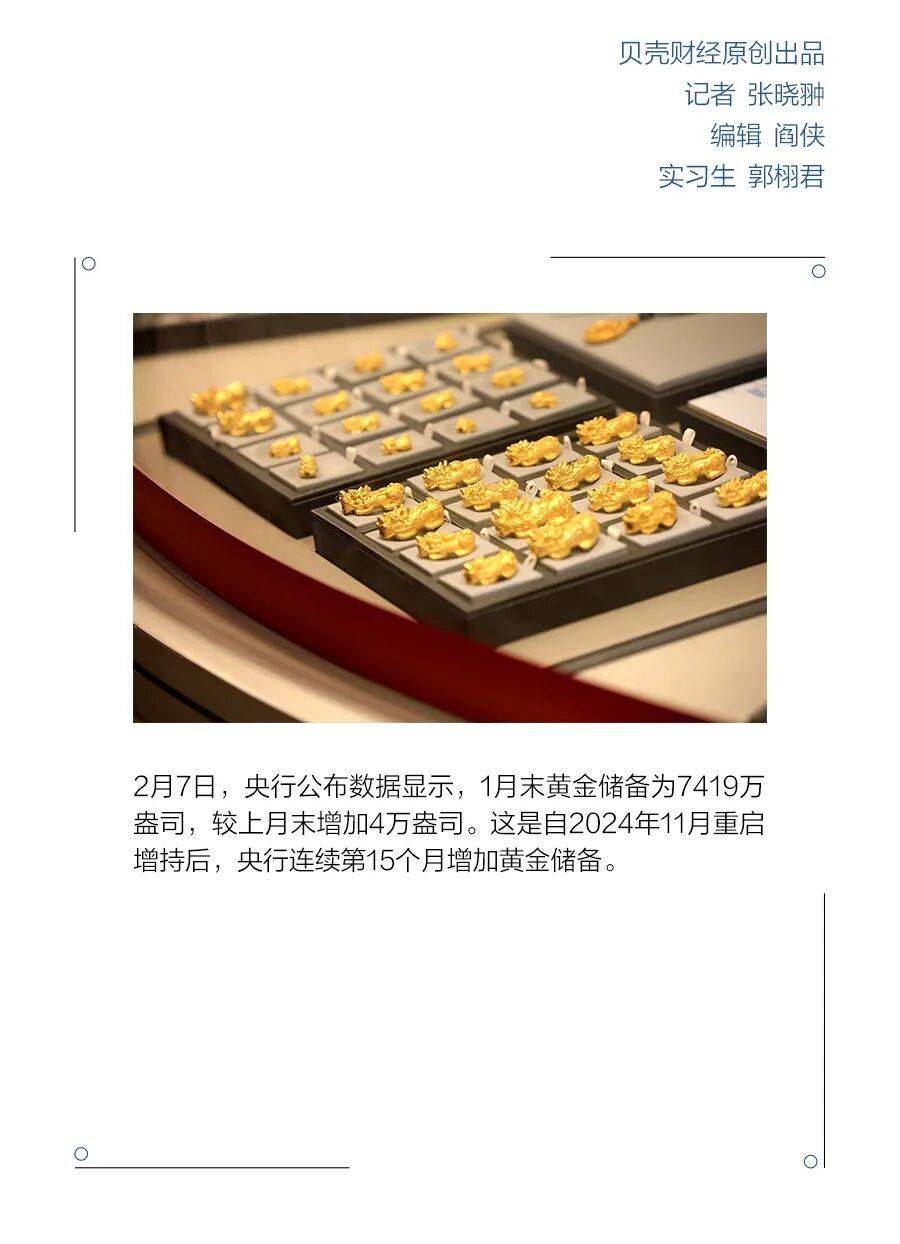
央行连续15个月增持黄金,释放重要信号
21世纪经济报道· 2026-02-07 07:07
Group 1 - As of January 2026, China's foreign exchange reserves reached $3.3991 trillion, an increase of $41.2 billion from December 2025, marking a 1.23% rise and the highest level since December 2015 [1] - The increase in foreign exchange reserves is attributed to the depreciation of the US dollar and the overall rise in global financial asset prices, supported by China's stable economic performance [1][4] - The US dollar index fell 1.4% to 97.0 in January, influenced by geopolitical risks and changes in US monetary policy, leading to a positive valuation effect on non-USD assets [4][6] Group 2 - The People's Bank of China (PBOC) increased its gold reserves for the 15th consecutive month, reaching 7.419 million ounces by the end of January 2026, a slight increase of 40,000 ounces from December 2025 [2][9] - The increase in gold reserves reflects a strategic shift towards enhancing the proportion of "non-credit assets" in foreign reserves, amid a global trend of central banks increasing gold holdings to hedge against dollar volatility and geopolitical risks [2][11] - The global gold price surged over 13% in January, reaching historical highs, which underscores the importance of gold as a strategic asset in the current uncertain global environment [9][10]

光大证券:光大证券和光大银行均为光大集团旗下子公司
Zheng Quan Ri Bao· 2026-02-06 13:38
证券日报网讯 2月6日,光大证券在互动平台回答投资者提问时表示,光大证券和光大银行均为光大集 团旗下子公司,光大证券为光大集团唯一具有证券牌照的子公司。我国金融行业仍为商业银行业、证券 业分业经营的格局,混业经营政策尚未出台。《证券法》总则第六条规定,证券业和银行业、信托业、 保险业实行分业经营、分业管理,证券公司与银行、信托、保险业务机构分别设立。 (文章来源:证券日报) ...


宏观经济点评:一文看懂日本众议院选举与日债、日元波动及影响
KAIYUAN SECURITIES· 2026-02-06 02:25
Group 1: Political Context - Prime Minister Kishi's support rate remains above 60%, the highest in three years, prompting the dissolution of the House of Representatives for new elections[1] - The ruling coalition of the Liberal Democratic Party (LDP) and the Japan Innovation Party holds 49% of seats in both the House of Representatives and the House of Councillors, indicating a lack of absolute majority[1] - Public support for the dissolution is low, with only 36% in favor, while 50% oppose it, highlighting potential electoral risks for Kishi[1] Group 2: Economic Policy and Challenges - Kishi's "responsible active fiscal policy" aims to shift Japan from a deflationary economy to a growth-oriented one, but it raises concerns about fiscal sustainability[2] - Japan's national debt is projected to reach 1,145 trillion yen by 2026, with interest payments amounting to 13 trillion yen, increasing fiscal pressure[2] - The Bank of Japan faces challenges as it begins to raise interest rates while managing the implications of increased government spending and potential inflation[2] Group 3: Market Implications - The Japanese yen has depreciated significantly since 2012, exacerbated by concerns over fiscal sustainability and the need for more government bonds[3] - Long-term government bond yields have risen sharply, with 10-year and 30-year yields increasing by over 150 basis points since 2024[3] - The government may intervene in the foreign exchange market to stabilize the yen, especially if it approaches the 160 yen per dollar mark[4] Group 4: Fiscal Outlook - The 2026 budget requires the issuance of approximately 29.6 trillion yen in new government bonds to cover a fiscal gap of 29.6 trillion yen, reflecting ongoing fiscal challenges[2] - The government’s debt reliance is projected to be 24.2% in 2026, a slight decrease from the previous year, but the overall debt burden remains high[2] - The expansionary fiscal policies may lead to increased inflation, putting further pressure on the bond market and the yen[3]
锚定“三强一优”,加快金融强省建设——14万亿GDP背后的江苏金融力量
Xin Hua Ri Bao· 2026-02-06 00:20
Core Insights - The Jiangsu provincial government emphasizes the importance of financial support for the real economy, aiming to build a strong financial province that aligns financial services with industrial development [1][2]. Financial Performance and Growth - Jiangsu's GDP reached 14.2 trillion yuan, with an average annual growth rate of 5.7%. The province has maintained the highest level of new domestic and foreign currency loans for four consecutive years [1]. - By 2025, Jiangsu's new social financing scale is projected to reach 3.2 trillion yuan, an increase of 316.7 billion yuan year-on-year, maintaining the top position in the country [2]. - The balance of RMB loans in Jiangsu is expected to reach 28.25 trillion yuan by the end of 2025, with an average annual growth rate of 12.8% from 2021 to 2025, consistently outpacing the nominal GDP growth rate [2]. Financial System and Innovation - Jiangsu is focusing on enhancing the financial system to support the modern industrial framework, including the establishment of the Jiangsu National Financial Group and the Jiangsu Rural Commercial Bank [4]. - The province's financial enterprises have total assets exceeding 15 trillion yuan, doubling since the end of 2018, with Jiangsu Bank leading among city commercial banks [4]. - The introduction of innovative financial products and services is aimed at supporting technology-driven enterprises, with a focus on integrating financial services throughout the lifecycle of these companies [3][5]. Support for Enterprises - By the end of 2025, the balance of loans to private enterprises in Jiangsu is expected to be around 8 trillion yuan, with inclusive loans for small and micro enterprises exceeding 4 trillion yuan [3]. - The province has implemented a combination of "Torch Innovation Credit Loan + Trade Financing" to address financing challenges for innovative companies [2]. Financial Ecosystem and Governance - Jiangsu is committed to creating a favorable financial ecosystem by enhancing information sharing, risk control, and collaborative governance among various departments [8]. - The province has established a financial regulatory coordination mechanism and innovative judicial cooperation models to ensure a stable financial environment [8]. - Recent measures have been introduced to optimize the financial ecosystem, focusing on improving the financial business environment and enhancing the legal framework for finance [8].
金价单日狂跌3.49%又回弹?最新报价曝光,普通人该不该抄底?
Sou Hu Cai Jing· 2026-02-05 17:35
Core Insights - The recent sharp decline in gold prices is primarily triggered by changes in the Federal Reserve's leadership, raising concerns about potential tightening of monetary policy [5][12] - The gold market is experiencing significant volatility, with professional investors and ordinary consumers showing differing responses to price changes [7][20] Group 1: Market Performance - On February 5, gold T+D dropped by 39.4 yuan per gram, a decline of 3.49%, while ICBC's gold bars increased by 2.58% [1] - The London gold price fell below $4900 per ounce, with a maximum intraday drop of $152.06, reaching a low of $4783.15 per ounce [3] - The gold price has seen a significant drop of nearly $700, or 12.81%, from its historical high of $5598.75 per ounce [3] Group 2: Investor Behavior - There is a noticeable divide in consumer behavior, with some rushing to sell gold while others are eager to buy at lower prices [7][20] - Ordinary investors are often misled by common misconceptions, such as treating gold jewelry as an investment, which can lead to significant losses [9] - The demand for gold from retail consumers is increasing, particularly among younger buyers and during festive seasons [13] Group 3: Supply and Demand Dynamics - The global gold supply is tightening, with major North American gold miners expected to see a decline in production and rising mining costs [13] - Central banks globally have increased their gold purchases, with a net acquisition of 863 tons in 2025, providing a support level for gold prices [12] - The World Gold Council reported that global gold demand surpassed 5000 tons for the first time in history, with investment demand surging by 84% [11] Group 4: Market Predictions and Strategies - Analysts predict that gold prices could reach $6000 per ounce, but caution exists due to the potential for significant short positions in the market [5][11] - Investment strategies vary, with recommendations for consumers to buy gold in smaller increments during price dips and for long-term investors to maintain a balanced portfolio [15][22] - The volatility in gold prices has led to a recommendation for investors to adopt a systematic investment approach to mitigate risks [22][24]

2.5犀牛财经晚报:上交所公布2026年春节休市安排
Xi Niu Cai Jing· 2026-02-05 10:22
Group 1: Smartphone Market - The global smartphone market revenue reached $143 billion in Q4 2025, marking a 13% year-on-year increase and setting a record for single-quarter revenue [2] - The average selling price (ASP) of smartphones surpassed $400 for the first time, reflecting an 8% year-on-year growth, driven by a trend towards higher-end devices and rising material costs [2] - Smartphone shipment volume grew by 5% year-on-year, indicating a market growth driven by "value expansion" rather than "scale expansion" [2] Group 2: MLCC Market - The global MLCC market is experiencing polarization, with high-end demand driven by AI applications, while the mid-to-low-end market faces pressure due to rising raw material costs and weak demand [2] - Major manufacturers in Japan and South Korea are operating at full capacity due to increased orders for high-end MLCCs, while the consumer electronics sector is struggling [2] - The supply chain is expected to reflect a trend of "AI heat, consumer cold" in Q1 2026, necessitating suppliers to focus on high-end AI products and manage traditional product inventory and cost risks [2] Group 3: 3D Printing Industry - The domestic 3D printing industry has seen a positive start in 2026, with numerous companies reporting increased performance and ongoing mergers and acquisitions [4] - The application of 3D printing technology is expanding into various fields, including aerospace, consumer electronics, and biomedicine, highlighting its value in customization and efficiency [4] Group 4: NAND Flash Market - NAND flash memory prices surged by 80%-90% in Q1 2026, driven by a sharp increase in general server DRAM prices and a similar rise in NAND prices after a relatively stable Q4 [3] - The overall market is experiencing a comprehensive price increase, influenced by rising prices of certain HBM3e products [3] Group 5: Financial and Investment Activities - New City Development raised HKD 473 million by placing 198 million shares at HKD 2.39 each, with funds aimed at business development and improving liquidity [7] - The China Securities Regulatory Commission approved the IPO registration of Aitec, a company specializing in automotive electronics [7] - Hengwei Technology reported a 30.13% year-on-year increase in net profit for 2025, despite a 6.31% decline in revenue [14]
结构性政策工具利率调降落地,监管上调融资保证金比例:政策双周报(0109-0203)-20260205
Huachuang Securities· 2026-02-05 06:48
1. Report Industry Investment Rating There is no information provided regarding the industry investment rating in the given content. 2. Core Viewpoints of the Report The report focuses on the policy trends and developments in multiple fields from January 9th to February 3rd, 2026, including macro - economic policies, fiscal policies, monetary policies, financial regulations, and real estate policies. The government is implementing a series of coordinated policies to promote economic development, stimulate consumption, and support key industries, while also strengthening financial supervision and risk prevention [1][2][3]. 3. Summary by Directory 3.1 Macro - Tone - Strengthen fiscal - financial coordination and deploy a package of policies to boost domestic demand. The State Council meeting emphasized the combination of fiscal and financial policies to guide social capital into consumption and investment. Policies such as loan interest subsidies for service providers and individuals were optimized [9][12]. - The National Development and Reform Commission allocated 93.6 billion yuan in ultra - long - term special treasury bonds to support equipment renewal, targeting about 4,500 projects in multiple fields and driving over 460 billion yuan in total investment [10][13]. - The Ministry of Commerce deployed key work for 2026, with the special consumption - boosting action as the top priority. The State Council issued a work plan to cultivate new growth points in service consumption [11][13]. 3.2 Fiscal Policy - Clarify the orientation of an active fiscal policy and optimize the tax structure. In 2026, a "hard - core" active fiscal policy will be implemented, and ultra - long - term special treasury bonds will continue to be used for "two important" and "two new" tasks. Tax system reform will be deepened [14]. - Multiple fiscal interest - subsidy policies were introduced to support equipment renewal and financing for small and medium - sized enterprises and service providers. The implementation period of the personal consumption loan interest - subsidy policy was extended to the end of 2026 [15]. - The export tax rebate for photovoltaic products was cancelled, and the export tax rebate rate for battery products was adjusted [15]. - Special bonds for clearing arrears will be issued as soon as possible, and the pilot of "self - review and self - issuance" of special bonds may be expanded [16][17]. 3.3 Monetary Policy - The central bank lowered the interest rates of structural policy tools on January 15th, and there is still room for reserve requirement ratio cuts and interest rate cuts this year [20][24]. - The central bank may create new tools to support non - bank liquidity, with reference to SRF and some temporary tools [21]. - The central bank's bond - buying volume in January increased to 100 billion yuan, and the bond - buying scale is affected by factors such as base money supply and bond market supply - demand [22]. - The construction of the Hong Kong offshore RMB market will be steadily promoted, including increasing the RMB business fund arrangement scale of the Hong Kong Monetary Authority from 100 billion yuan to 200 billion yuan [23]. 3.4 Financial Supervision - Financial regulatory authorities such as the Financial Regulatory Administration, the China Securities Regulatory Commission, and the central bank held their 2026 work meetings, emphasizing risk prevention and market stability [26]. - The Shanghai, Shenzhen, and Beijing stock exchanges raised the margin ratio for margin trading, aiming to promote the healthy development of the A - share market [27]. - The use of QDII quotas was regulated, and the first batch of commercial real - estate REITs was accepted by the CSRC [28]. - The CSRC issued guidelines for the performance comparison benchmarks of public funds, strengthening the benchmark's characterization and constraint functions [28][29]. 3.5 Real Estate Policy - The direction of urban renewal was clarified, aiming to build livable cities and accelerate the construction of a new real - estate development model [31]. - Tax incentives for housing were extended, and the minimum down - payment ratio for commercial housing loans was reduced from 50% to 30% [32]. - Projects on the real - estate "whitelist" may have their loans extended, and some real - estate enterprises no longer need to report "three red lines" data monthly [33].