银行等

Search documents
20个行业获融资净买入,医药生物行业净买入金额最多
Zheng Quan Shi Bao Wang· 2025-07-08 02:38
Core Insights - As of July 7, the latest market financing balance reached 1,846.406 billion yuan, an increase of 6.359 billion yuan compared to the previous trading day [1] - The pharmaceutical and biological industry saw the largest increase in financing balance, rising by 1.340 billion yuan [1] - The public utilities sector had the highest percentage increase in financing balance at 1.83% [1] Industry Summary - **Pharmaceutical and Biological**: Latest financing balance is 132.411 billion yuan, increased by 1.340 billion yuan, with a growth rate of 1.02% [1] - **Electronics**: Latest financing balance is 213.330 billion yuan, increased by 0.994 billion yuan, with a growth rate of 0.47% [1] - **Computer**: Latest financing balance is 142.101 billion yuan, increased by 0.912 billion yuan, with a growth rate of 0.65% [1] - **Public Utilities**: Latest financing balance is 43.242 billion yuan, increased by 0.776 billion yuan, with a growth rate of 1.83% [1] - **Coal**: Latest financing balance is 15.418 billion yuan, increased by 0.219 billion yuan, with a growth rate of 1.44% [1] - **Real Estate**: Latest financing balance is 29.696 billion yuan, decreased by 0.189 billion yuan, with a decline rate of 0.63% [2] - **Steel**: Latest financing balance is 14.214 billion yuan, decreased by 0.099 billion yuan, with a decline rate of 0.69% [2] - **Environmental Protection**: Latest financing balance is 14.923 billion yuan, decreased by 0.073 billion yuan, with a decline rate of 0.49% [2]
主力资金动向 9.30亿元潜入轻工制造业
Zheng Quan Shi Bao Wang· 2025-07-07 10:40
Core Insights - The main point of the article is the analysis of capital flow across various industries, highlighting significant net inflows and outflows of funds in today's market [1] Industry Summary - The industry with the largest net capital inflow is Light Industry Manufacturing, with a net inflow of 930 million yuan and a price change of 1.52% [1] - Real Estate follows closely with a net inflow of 917 million yuan and a price change of 1.68% [1] - The industry experiencing the largest net capital outflow is Electronics, with a net outflow of 4.475 billion yuan and a price change of -0.67% [1] - Other notable industries with significant net inflows include Beauty Care (654 million yuan) and Banking (461 million yuan) [1] - Industries with substantial net outflows include Medical Biology (3.430 billion yuan), Computer (1.918 billion yuan), and Communication (239.9 million yuan) [1]
一周市场数据复盘20250704
HUAXI Securities· 2025-07-05 09:20
- The report uses Mahalanobis distance to measure industry crowding based on weekly price and transaction volume changes[3][17][18] - The construction process involves identifying industries where price and transaction volume deviate significantly, with industries outside the ellipse in quadrant 1 indicating short-term significant crowding[17] - Last week, the building materials industry showed significant trading crowding[18]
市场全天震荡反弹,沪指再创年内新高
Dongguan Securities· 2025-07-04 06:57
Market Overview - The A-share market experienced a rebound, with the Shanghai Composite Index reaching a new high for the year at 3461.15, up by 0.18% [1] - The Shenzhen Component Index rose by 1.17% to 10534.58, while the ChiNext Index increased by 1.90% to 2164.09 [1][2] - The overall market showed a trend of more stocks rising than falling, with over 3200 stocks increasing in value and more than 60 stocks hitting the daily limit [2] Sector Performance - The top-performing sectors included Electronics (up 1.69%), Electric Equipment (up 1.38%), and Pharmaceutical Biology (up 1.35%) [1][2] - Conversely, sectors such as Coal, Transportation, and Steel showed declines, with Coal down by 1.16% [1][2] IPO Activity - As of June 30, a total of 43 IPOs were accepted by the three major exchanges, with a total of 152 IPOs accepted throughout June [3] - The increase in IPO acceptance is attributed to changes in the policy environment, calendar effects, and ongoing support for technological innovation in the capital market [3] Market Trends and Outlook - The market is currently in a stable upward trend, supported by core heavyweight stocks, with the Shanghai Composite Index maintaining a position above the 5-day moving average [4] - The upcoming earnings season is expected to shift market focus towards fundamental drivers, with stable profit-generating industries likely to receive valuation premiums [4] - Key sectors to watch include TMT (Technology, Media, and Telecommunications), Electric Equipment, Pharmaceuticals, and Finance [4]
央国企估值修复明确,央企创新驱动ETF(515900)创近1月规模新高
Xin Lang Cai Jing· 2025-07-03 05:49
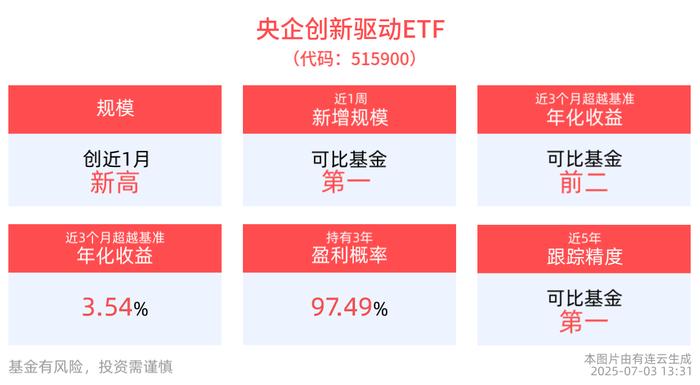
Group 1 - The China Central Enterprise Innovation Driven Index (000861) decreased by 0.13% as of July 3, 2025, with mixed performance among constituent stocks [3] - The top-performing stocks included Shenzhen South Circuit (002916) up 7.32%, and Guangxun Technology (002281) up 2.21%, while China Haifang (600764) led the decline at 6.09% [3] - The Central Enterprise Innovation Driven ETF (515900) fell by 0.14%, with a latest price of 1.46 yuan, and has seen a cumulative increase of 0.83% over the past week [3] Group 2 - The National Bureau of Statistics emphasized the importance of cities in advancing digital China, focusing on the integration of urban governance modernization and industrial system modernization [4] - Huayuan Securities noted a clear valuation recovery for central state-owned enterprises, particularly in the construction sector, benefiting from stable dividends and governance optimization [4] - The latest scale of the Central Enterprise Innovation Driven ETF reached 3.357 billion yuan, marking a one-month high and ranking in the top quarter among comparable funds [4] Group 3 - The Central Enterprise Innovation Driven ETF has seen a net value increase of 5.46% over the past two years, with a maximum monthly return of 15.05% since inception [5] - The ETF's average return in rising months is 3.97%, with a historical three-year profit probability of 97.49% [5] - The management fee of the ETF is 0.15%, and the custody fee is 0.05%, making it the lowest among comparable funds [5] Group 4 - The Central Enterprise Innovation Driven Index is composed of 100 representative listed companies evaluated for innovation and profitability, with the top ten stocks accounting for 34.87% of the index [6] - The top ten weighted stocks include Hikvision (002415) and China Southern Power Grid (600406), among others [6]

二季度港股定价权有何变化
GUOTAI HAITONG SECURITIES· 2025-07-02 12:17
Core Insights - Since the second quarter, southbound capital has continued to flow into Hong Kong stocks, with a cumulative net inflow of HKD 292.5 billion in Q2, leading to a historical high in the market value share of southbound holdings in Hong Kong stocks [3][6] - The proportion of Hong Kong Stock Connect holdings increased from 19.0% at the end of Q1 to 20.7% at the end of Q2, while the foreign capital share decreased from 62.8% to 60.4% [3][6] - From a stock perspective, foreign capital still dominates most sub-sectors in Hong Kong stocks, but with the inflow of southbound capital, the marginal pricing power of southbound investors is significantly increasing in sectors such as consumer services, household products, automotive, commercial services, durable consumption, biopharmaceuticals, medical device services, energy, and banking [3][6] Industry Analysis - The report highlights that the southbound capital's marginal pricing power is notably rising in various sectors, including consumer services, household products, automotive, commercial services, durable consumption, biopharmaceuticals, medical device services, energy, and banking [3][6][13] - The data indicates that foreign capital still holds a dominant position in most sub-sectors of Hong Kong stocks, but the increasing southbound capital is changing the dynamics of pricing power in these industries [3][6][12]
两市主力资金净流出279.07亿元,计算机行业净流出居首
Zheng Quan Shi Bao Wang· 2025-07-01 10:31
Market Overview - On July 1, the Shanghai Composite Index rose by 0.39%, while the Shenzhen Component Index increased by 0.11%. The ChiNext Index fell by 0.24%, and the CSI 300 Index rose by 0.17% [1] - Among the tradable A-shares, 2,628 stocks rose, accounting for 48.64%, while 2,545 stocks declined [1] Capital Flow - The main capital saw a net outflow of 27.907 billion yuan, marking the fourth consecutive trading day of net outflows [1] - The ChiNext experienced a net outflow of 14.059 billion yuan, while the STAR Market had a net outflow of 0.993 billion yuan. The CSI 300 constituents saw a net outflow of 2.990 billion yuan [1] Industry Performance - Out of the 28 primary industries classified by Shenwan, 20 industries saw gains, with the highest increases in the Comprehensive and Pharmaceutical & Biological sectors, which rose by 2.60% and 1.80%, respectively [1] - The industries with the largest declines were Computer and Retail, which fell by 1.18% and 0.79%, respectively [1] Industry Capital Inflows and Outflows - Eight industries had net capital inflows, with the Pharmaceutical & Biological sector leading with a net inflow of 2.422 billion yuan and a daily increase of 1.80%. The Banking sector followed with a net inflow of 0.886 billion yuan and a daily increase of 1.53% [1] - Twenty-three industries experienced net capital outflows, with the Computer sector leading with a net outflow of 8.395 billion yuan and a daily decline of 1.18%. The Power Equipment sector followed with a net outflow of 5.163 billion yuan and a daily decline of 0.37% [1] Individual Stock Performance - A total of 1,928 stocks saw net capital inflows, with 668 stocks having inflows exceeding 10 million yuan. Among these, 70 stocks had inflows exceeding 100 million yuan, with Hongbaoli leading at 0.516 billion yuan and a daily increase of 10.01% [2] - The stocks with the largest net outflows included Inner Mongolia First Machinery, Dongfang Caifu, and Sifang Jingchuang, with outflows of 0.942 billion yuan, 0.787 billion yuan, and 0.731 billion yuan, respectively [2]
ETF复盘0630-A股半年度红盘收官,科创新能源ETF(588830)近五日涨幅达7.31%
Sou Hu Cai Jing· 2025-06-30 10:44
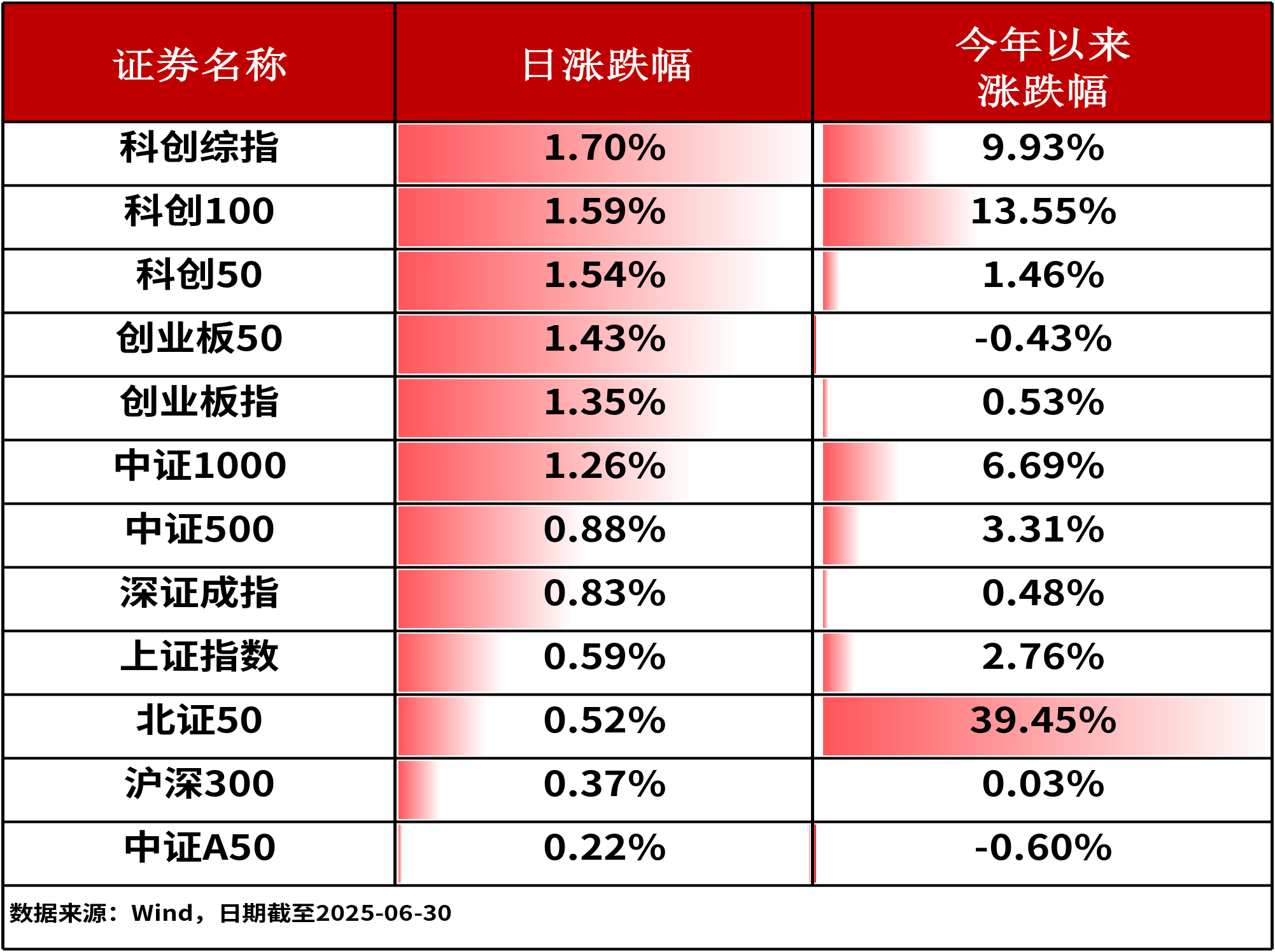
Market Overview - On June 30, A-shares saw all three major indices rise, with the Shanghai Composite Index up by 0.59%, the Shenzhen Component Index up by 0.83%, and the ChiNext Index up by 1.35% [1] - The STAR Market Composite Index led the gains with an increase of 1.70% [2] - Over 4,000 stocks in the market experienced an increase [1] Hong Kong Market - On the same day, major indices in the Hong Kong stock market collectively declined, with the Hang Seng Technology Index down by 0.72% [4] - The Hang Seng Index fell by 0.87% [5] Sector Performance - The defense and military sector saw the highest gains, with an increase of 4.35%, followed by media at 2.82% and telecommunications at 1.90% [7] - In contrast, non-bank financials decreased by 0.77%, banks by 0.34%, and transportation by 0.09% [7] Industry Highlights Solid-State Battery Technology - A pilot project for all-solid-state battery electric bicycles was launched in Beijing, marking a significant step towards the commercialization of solid-state battery products [8] - Century Securities reported that the solid-state battery industry is progressing towards commercialization, with a recent announcement from a U.S. company indicating a 25-fold increase in heat treatment speed, leading to a 76.67% increase in stock prices over two days [8] Defense and Military Sector - There has been a significant inflow of capital into the defense and military sector, with the Defense ETF rising by 4.88% [9] - Northeast Securities highlighted the long-term growth certainty of the defense and military sector, noting that the industry is expected to recover as demand increases and structural capacity improves [9]
公募基金周报(20250623-20250627)-20250630
Mai Gao Zheng Quan· 2025-06-30 06:57
1. Report Industry Investment Rating - Not provided in the content 2. Core Viewpoints of the Report - This week, the A-share market rebounded strongly, with the Shanghai Composite Index breaking through the year's high. The average daily trading volume increased by 22.36% week-on-week. The market risk appetite increased due to the easing geopolitical situation and the introduction of domestic growth-stabilizing policies [1][10]. - The financial technology sector led the rise this week, with both financial and growth styles performing well. The growth style index rose 5.21% this week, and its trading volume accounted for 54.20% of the total, reaching a four-week high [14]. - Looking ahead, the market is expected to maintain a steady upward trend. In July, the market is expected to see an orderly rotation of hot sectors. However, investors should remain cautious before the uncertainties of Sino-US tariff negotiations and the Fed's interest rate decision are eliminated [15]. 3. Summary According to the Directory 3.1 This Week's Market Review 3.1.1 Industry Index - The comprehensive finance, computer, comprehensive, national defense and military industry, and non-bank finance sectors led the gains this week. The trading volume of non-bank finance and bank sectors increased significantly compared to last week, while the trading activity of media, petroleum and petrochemical, medicine, food and beverage, and agriculture, forestry, animal husbandry, and fishery sectors decreased significantly [10]. - COMEX gold fell 2.94%, and the Chinese bond market maintained a narrow range of fluctuations. The basis of stock index futures contracts increased overall, and the net value of stock hedging strategies continued to decline. The average and median returns of neutral hedging funds this week were -0.10% and -0.03% respectively [1][10]. 3.1.2 Market Style - The financial technology sector led the rise this week, driving the market index higher. The growth style index rose 5.21% this week, and its trading volume accounted for 54.20% of the total, reaching a four-week high. The consumer style index rose 1.46%, and its trading volume accounted for 10.93% of the total, reaching a four-week low [14]. - The financial style index rose 3.41%, and its trading volume accounted for 10.07% of the total, reaching a four-week high. The stable style index rose only 0.78%, and its trading volume accounted for 3.45% of the total, reaching a four-week low [14]. - The cyclical style index rose 3.02%, and its trading volume accounted for 21.35% of the total, reaching a four-week low. The CSI 2000 index rose 5.55% this week, but its trading volume accounted for 28.89% of the total, reaching a four-week low [14]. 3.2 Active Equity Funds 3.2.1 Funds with Excellent Performance in Different Theme Tracks This Week - In the single-track fund category, the top five funds in terms of performance this week were Dongcai Value Qihang A, Taixin Development Theme, Chang'an Yusheng A, Huashang Upstream Industry A, and Huitianfu Consumption Upgrade A [20]. - In the double-track fund category, the top five funds in terms of performance this week were China Merchants Securities Technology Theme 6-Month Holding A, Yin Hua Multi-Power, Yongying High-End Equipment Smart Selection A, Huashang Computer Industry Quantitative A, and Hongtu Innovation Selection LOF [20]. 3.2.2 Funds with Excellent Performance in Different Strategy Categories - In the deep undervaluation strategy, the top three funds were Orient Internet Jia, Qianhai Kaiyuan Event-Driven A, and GF Shanghai-Hong Kong-Shenzhen Value Growth A [2][22]. - In the high-growth strategy, the top three funds were China Europe Prosperity Outlook One-Year Holding A, Yuanxin Yongfeng High-End Manufacturing, and Huafu Guotai Min'an A [2][22]. - In the high-quality strategy, the top three funds were Furong Fujin A, Great Wall Jiuxin A, and E Fund New Normal [2][22]. - In the quality undervaluation strategy, the top three funds were Tongtai Financial Selection A, Qianhai Kaiyuan Shengxin A, and Wells Fargo Financial Real Estate Industry A [2][22]. - In the quality growth strategy, the top three funds were AVIC New Takeoff A, SDIC UBS New Energy A, and E Fund National Defense and Military Industry A [2][22]. - In the GARP strategy, the top three funds were Guoshou Anbao Target Strategy A, Guotai Dazhizao Two-Year Holding, and China AMC Panyi One-Year Fixed Open [2][22]. - In the balanced cost-performance strategy, the top three funds were Hongtu Innovation Selection LOF, Chang Sheng State-Owned Enterprise Reform Theme, and Taixin Development Theme [2][22]. 3.3 Index Enhanced Funds 3.3.1 This Week's Excess Return Distribution of Index Enhanced Funds - The average and median excess returns of CSI 300 index enhanced funds were 0.06% and 0.10% respectively [25]. - The average and median excess returns of CSI 500 index enhanced funds were -0.35% and -0.37% respectively [25]. - The average and median excess returns of CSI 1000 index enhanced funds were -0.20% and -0.22% respectively [25]. - The average and median excess returns of CSI 2000 index enhanced funds were -0.04% and -0.06% respectively [25]. - The average and median excess returns of CSI A500 index enhanced funds were 0.11% and 0.13% respectively [25]. - The average and median excess returns of ChiNext index enhanced funds were -0.20% and -0.17% respectively [25]. - The average and median excess returns of STAR Market and ChiNext 50 index enhanced funds were -0.11% and -0.14% respectively [26]. 3.4 This Issue's Bond Fund Selections - The report screened out the medium- and long-term bond fund pool and the short-term bond fund pool based on indicators such as fund size, performance risk indicators, the latest fund size, Wind Fund secondary classification, three-year rolling returns, and three-year maximum drawdowns [42]. 3.5 This Week's High-Frequency Fund Position Detection - Active equity funds significantly increased their positions in the petroleum and petrochemical (0.18%), coal (0.09%), and comprehensive (0.08%) industries this week; they significantly reduced their positions in the machinery (0.19%), automobile (0.13%), and commercial and retail (0.08%) industries [3]. - From a one-month perspective, the position of the pharmaceutical industry increased significantly by 0.71%, while the positions of the machinery and automobile industries decreased significantly by 0.64% and 0.65% respectively [3]. 3.6 This Week's Weekly Tracking of US Dollar Bond Funds - Not provided in the content
【招银研究】海外宏观与策略:韧性与隐忧并存,关注中短美债——2025年中期宏观经济与资本市场展望②
招商银行研究· 2025-06-24 08:58
Core Viewpoint - The article discusses the resilience and challenges of the global economy, particularly focusing on the U.S. economic outlook, fiscal policies, and market strategies for the second half of 2025, highlighting the interplay between fiscal expansion, interest rates, and inflation pressures [1][4]. Overseas Macro: Resilience and Concerns - The article notes that external demand for China may significantly decline, making internal demand crucial for economic stability, with a projected GDP growth of 5% for the year and a potential drop in the GDP deflator index to -1% [1]. - The U.S. economy is expected to show resilience despite concerns about recession, with fiscal policies remaining expansionary and the Federal Reserve's interest rate cuts being limited [5][7]. - The article emphasizes the ongoing challenges posed by tariffs and geopolitical tensions, which may hinder the inflation reduction process [5][8]. U.S. Policy: Fiscal Dominance - The U.S. fiscal policy is characterized by a cyclical expansion, with a low unemployment rate of 4.0-4.2% and a high deficit rate of 6-7%, which is about 3 percentage points above historical averages [7][9]. - The article highlights the negative impacts of high interest rates on private sector financing costs, potentially leading to economic inefficiencies and structural imbalances [8][14]. - The ongoing fiscal expansion is expected to exacerbate the U.S. deficit, with projections indicating a deficit of $1.36 trillion for the 2025 fiscal year, a 13% increase from the previous year [9][11]. Monetary Policy: Reactive Rather Than Proactive - The Federal Reserve's stance is described as reactive, with limited room for interest rate cuts due to persistent inflation and a stable labor market [15][21]. - The article indicates that inflation pressures are shifting from internal to external factors, with tariffs being a significant concern for future inflation [25][29]. - The Fed's cautious approach to rate cuts may lead to a divergence between consumer inflation expectations and financial market predictions [27][29]. U.S. Economic Performance: Behind the Prosperity - The U.S. economy has shown strong performance, with a projected GDP growth rebound to 4% in Q2 2025, driven by a recovery in consumer sentiment and reduced tariff uncertainties [30][33]. - The article notes that while private investment is expanding, it is heavily concentrated in technology sectors, with other sectors facing challenges due to high interest rates [37][41]. - Consumer spending is expected to remain stable, but the underlying financial pressures on households may limit further growth [47][56]. Japan: The Elephant in the Room - Japan's economy is transitioning from deflation to stagflation, with significant challenges to fiscal sustainability and potential risks to global financial markets [61][62]. - The article highlights that Japan's nominal indicators have improved, but actual economic recovery remains weak, with GDP growth at only 1.7% [65][66]. - The potential for rising interest rates in Japan could lead to significant market volatility, impacting global liquidity [75][79]. Overseas Strategy: Favoring Short to Medium-Term U.S. Bonds and Balanced U.S. Equity Allocation - The article suggests maintaining a balanced allocation in U.S. equities, with expectations for a gradual upward trend supported by corporate earnings growth [82][83]. - It recommends holding short to medium-term U.S. bonds while temporarily avoiding long-term bonds due to anticipated high interest rate volatility [88][93]. - The foreign exchange market is expected to see a continued weakening of the U.S. dollar, with non-U.S. currencies gaining strength amid ongoing uncertainties [94][95].