公用事业

Search documents
超长信用债可以考虑逐渐止盈
Orient Securities· 2025-07-21 03:13
Group 1 - The report suggests that for most investors, it is time to gradually take profits on ultra-long credit bonds due to declining odds of capital gains, limited arbitrage opportunities, and weak coupon protection [6][14][18] - The performance of ultra-long credit bonds has been primarily driven by the compression of liquidity premiums in June, but this trend is expected to be difficult to sustain moving forward [7][14] - The report indicates that the current coupon advantage of ultra-long credit bonds is not significant, and their ability to protect against interest rate fluctuations is lacking, leading to a low probability of success for short-term holdings [12][18] Group 2 - The weekly review of credit bonds shows that the issuance volume remained stable, with a slight increase in maturity amounts, resulting in a net inflow of 452 billion yuan, which is a decrease compared to previous weeks [20][22] - The average coupon rates for newly issued AAA and AA+ rated bonds were 1.99% and 2.24%, respectively, indicating a mixed trend in issuance costs [20][21] - The liquidity of credit bonds continues to weaken, with a decrease in turnover rate to 1.76%, reflecting a return to a relatively low level [23]
A股市场大势研判:沪指创年内收盘新高
Dongguan Securities· 2025-07-20 23:31
Market Performance - The Shanghai Composite Index closed at 3534.48, up by 0.50% with an increase of 17.66 points [2] - The Shenzhen Component Index closed at 10913.84, up by 0.37% with an increase of 40.22 points [2] - The CSI 300 Index closed at 4058.55, up by 0.60% with an increase of 24.06 points [2] - The ChiNext Index closed at 2277.15, up by 0.34% with an increase of 7.83 points [2] - The STAR 50 Index closed at 1007.53, up by 0.19% with an increase of 1.88 points [2] - The Beijing Stock Exchange 50 Index closed at 1418.61, down by 0.67% with a decrease of 9.50 points [2] Sector Performance - The top-performing sectors included Nonferrous Metals (up 2.10%), Basic Chemicals (up 1.36%), Steel (up 1.34%), Coal (up 0.94%), and Transportation (up 0.90%) [3] - The underperforming sectors included Media (down 0.98%), Electronics (down 0.49%), Light Industry Manufacturing (down 0.41%), Utilities (down 0.35%), and Communication (down 0.31%) [3] - Concept sectors with notable gains included Lithium Extraction from Salt Lakes (up 3.30%), Rare Earth Permanent Magnets (up 3.15%), Acrylic Acid (up 2.35%), Cobalt (up 2.29%), and Metal Recycling (up 2.08%) [3] - Concept sectors with notable declines included Animal Vaccines (down 0.96%), Avian Influenza (down 0.90%), Low-E Glass (down 0.89%), E-sports (down 0.86%), and Digital Watermarking (down 0.76%) [3] Future Outlook - The report indicates that the A-share market is showing resilience with a GDP growth of 5.3% year-on-year in the first half of the year, suggesting potential for further policy support in the second half [6] - The market is expected to focus on the upcoming Politburo meeting at the end of July, the Federal Reserve's interest rate decisions, and developments in US tariffs [6] - The report suggests that there are still opportunities for upward momentum in the market, but caution is advised due to potential volatility from previous high rebounds [6] - It is recommended to identify long-term trends in high-growth sectors and short-term speculative opportunities, particularly during the mid-year earnings forecast disclosure window [6]
博时基金赵宪成:资金面与基本面共振 港股后市可期
Shang Hai Zheng Quan Bao· 2025-07-20 15:54
Core Viewpoint - The Hong Kong stock market is gaining increasing attention from investors, with a positive outlook for the second half of the year driven by strong fundamentals and capital inflows [1][2]. Group 1: Market Performance - The Hong Kong stock market showed strong performance in the first half of the year, supported by a consensus among domestic and foreign investors on Chinese assets [1]. - As of July 17, net inflows from southbound capital reached over 720 billion yuan, nearly double that of the same period last year [1]. - Public funds are accelerating their investment in the Hong Kong market, with a noticeable increase in the number of Hong Kong-themed funds reported [1]. Group 2: Future Outlook - The EPS growth rate for the Hang Seng Tech Index is projected to be 35% by 2025, with a ROE of 14% [2]. - Despite the Hang Seng Index's valuation returning to a relatively high position after a rebound, there are still many quality investment targets available [2]. - The fundamental drivers for stock price increases are expected to become more apparent over time, with companies that have solid performance support likely to stand out [2]. Group 3: Investment Themes - The technology sector is favored, as it includes many mature and profitable internet giants with strong user bases and stable business models [2]. - The dividend sector, including banks, energy, utilities, and telecom operators, is highlighted for its strong risk resistance and stable cash flow, making it a focus for long-term capital allocation [2]. - The new consumption sector is also promising, with companies like Pop Mart and Lao Pu Gold benefiting from domestic consumption recovery and expanding into international markets [3].
信达策略:周期股异动是牛市主升浪的信号
Ge Long Hui· 2025-07-20 15:19
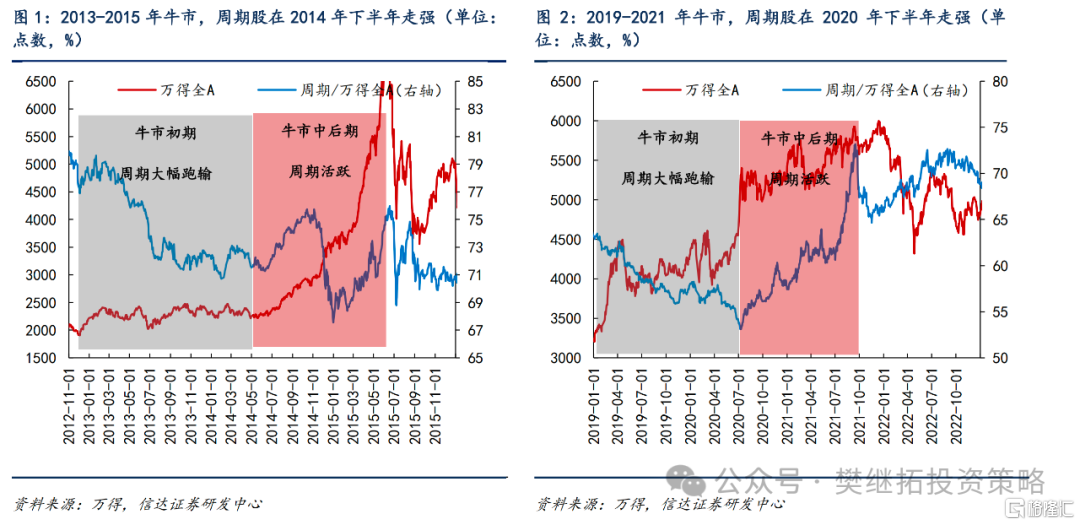
Core Viewpoint - The recent performance of cyclical stocks, such as photovoltaic, steel, and chemicals, indicates a potential signal for the mid-stage main upward wave of the bull market [1][12] Group 1: Historical Context - In previous major bull markets (2013-2015 and 2019-2021), cyclical stocks underperformed in the early stages but became active in the later stages [2][5] - During the mid-stage of the 2014-2015 bull market, cyclical stocks outperformed despite weak economic conditions and declining commodity prices, driven by themes like mergers and acquisitions and state-owned enterprise reforms [2][5] - In the 2020-2021 bull market, cyclical stocks significantly outperformed as the economy stabilized and commodity prices rose [2][5] Group 2: Reasons Behind Performance - The underperformance of cyclical stocks in the early bull market stages is attributed to limited incremental capital, leading to slow price increases, while only a few sectors with strong fundamentals saw gains [9][12] - As the bull market progresses, increased resident capital leads to valuation uplifts across most sectors, with cyclical stocks benefiting from their low valuations in the early stages [9][12] Group 3: Future Outlook - There are two potential scenarios for the future: 1. If economic recovery is weak and supply-side policies take time to impact, cyclical stocks may see 1-2 quarters of excess returns but face volatility afterward [12] 2. If supply-side policies improve quickly and demand-side growth policies show results, cyclical stocks could experience a year-long rally starting from the mid-stage of the bull market [12] - Regardless of the scenario, cyclical stocks are expected to generate excess returns within the next 1-2 quarters [12] Group 4: Current Market Judgments - The current market is characterized by low valuations, weak corporate earnings, and positive policy signals, resembling the early stages of previous bull markets [16] - The market is entering a phase driven by policy improvements and capital inflows, suggesting a broader bull market is likely [16] Group 5: Investment Strategy - The recommendation is to adopt a flexible allocation strategy, increasing exposure to non-bank financials, AI applications, and cyclical stocks, which are expected to show elastic performance in the next six months [18][19] - The focus should shift from a "barbell strategy" to an "elastic strategy," with strong performance anticipated in sectors like new consumption and AI, which are less correlated with the economy [18][19]

【策略】内外因素交织,市场或维持震荡上行——策略周专题(2025年7月第2期)(张宇生)
光大证券研究· 2025-07-20 14:03
Core Viewpoint - The A-share market has shown an overall upward trend, driven by favorable economic data and policy support, with the ChiNext index leading the gains [3][4]. Economic Performance - In Q2 2025, GDP growth reached 5.2% year-on-year, with a cumulative growth of 5.3% in the first half of the year, indicating that a growth rate of 4.7% in the second half is sufficient to meet the annual target of 5% [4]. - Retail sales and exports have shown upward trends, reflecting stable demand and a slowdown in investment growth, which improves the supply-demand relationship in the economy [4]. - Financial data in June was strong, and the willingness of enterprises to expand internally, along with the pace of new fiscal policies, will be key factors influencing social financing growth [4]. Policy Environment - Policies aimed at improving corporate profitability and attracting long-term capital into the market are being implemented. The Ministry of Finance has issued guidelines to encourage insurance funds to invest steadily over the long term [4]. - There is still room for internal policies to exert influence, and rapid policy responses may occur if external uncertainties increase [4]. External Factors - The uncertainty surrounding tariffs is expected to gradually ease, with the 90-day trade tariff suspension between China and the U.S. set to expire on August 12 [5]. - Market expectations suggest that September may be a critical month for potential interest rate cuts by the Federal Reserve, which could lead to increased global liquidity and support the revaluation of Chinese assets [5]. Corporate Earnings - The first quarter saw a significant rebound in the earnings growth of listed companies, with the recovery speed slightly exceeding expectations, and the quarter-on-quarter growth surpassing the average since 2019 [5]. - Continued consumer subsidy policies may support the sustainability of domestic demand improvements [5]. Market Outlook - August is anticipated to be a key month, with attention on the disclosure of mid-year earnings by listed companies, the easing of external uncertainties, and the marginal loosening of overseas liquidity [6]. - The market is expected to shift from policy-driven to fundamentally and liquidity-driven dynamics, with potential for new highs in the second half of the year [7]. - Investment focus should be on sectors with favorable mid-year earnings, and long-term attention should be directed towards three main lines: domestic consumption, technological independence, and dividend stocks [7].

策略周专题(2025年7月第2期):内外因素交织,市场或维持震荡上行
EBSCN· 2025-07-20 11:46
Group 1 - The A-share market experienced an overall increase this week, with the ChiNext Index showing the highest gain of 3.17%, while the Shanghai 50 Index had the smallest increase of 0.28%. The sectors of communication, pharmaceuticals, and automobiles performed relatively well, with increases of 7.6%, 4.0%, and 3.3% respectively, while utilities, real estate, and media sectors saw declines of 1.4%, 2.2%, and 2.2% respectively [1][11][14]. Group 2 - Economic data has shown positive performance recently, with the GDP growth rate for Q2 2025 reaching 5.2% year-on-year, and a cumulative growth rate of 5.3% for the first half of the year. The GDP growth rate for the second half only needs to reach 4.7% to meet the annual target of 5% [2][19]. - The demand side remains stable while the investment side shows a slowdown, indicating an improvement in the supply-demand relationship. Retail sales and exports have both seen an upward trend [2][19]. - Financial data for June showed strong performance, and the willingness of enterprises to expand internally, along with the pace of incremental fiscal policy, will be key factors affecting social financing growth [2][20]. Group 3 - The "anti-involution" policies are being implemented across various industries to alleviate corporate profit pressures. Additionally, the Ministry of Finance has issued guidelines to encourage long-term investments from insurance funds [30][31]. - The internal policy space remains available for further action, especially in response to external uncertainties. The domestic economy has shown signs of improvement, making it feasible to achieve the annual economic goals [31][32]. Group 4 - The market is expected to focus on the performance of listed companies' interim reports, the easing of external uncertainties, and the marginal loosening of overseas liquidity in August [4][39]. - The configuration direction emphasizes three main lines: domestic consumption, technological self-reliance, and dividend stocks. In the domestic consumption sector, attention is drawn to subsidy-related and offline service consumption [4][51].
国泰海通海外:港股迎来增配时机 下半年有望跑赢A股
智通财经网· 2025-07-20 02:37
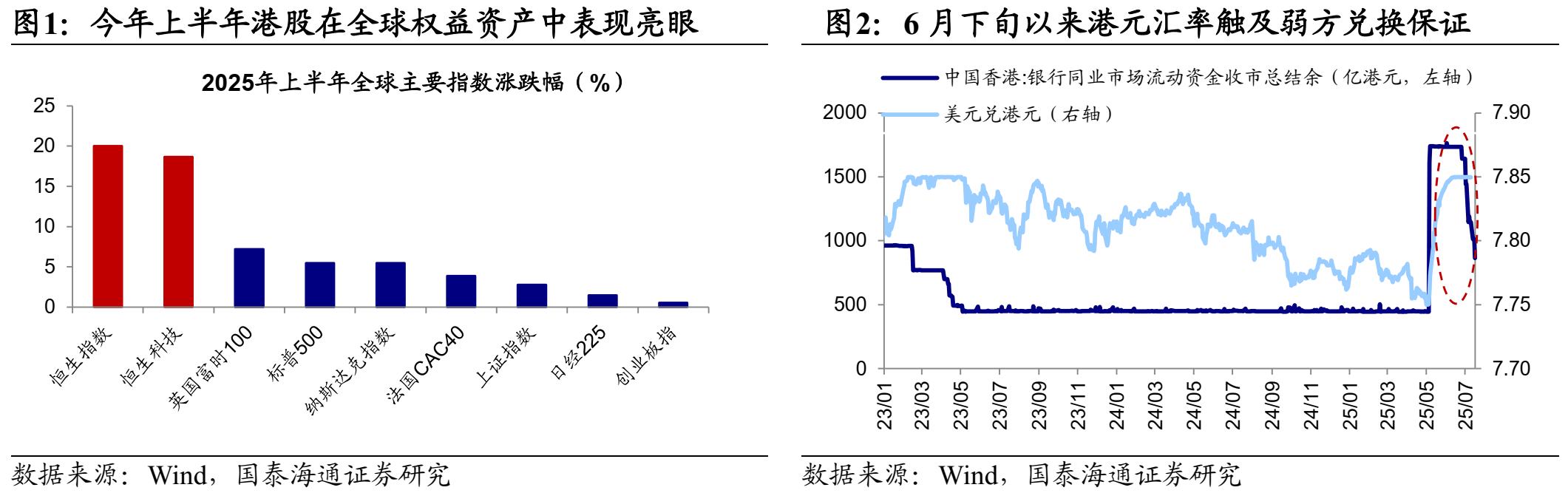
Core Viewpoint - The Hong Kong stock market has experienced fluctuations since the end of June due to tariffs and exchange rate impacts, but is expected to outperform the A-share market in the second half of the year as positive factors accumulate [1][3][13]. Market Performance - Since the end of June, the Hong Kong stock market has shown weaker performance compared to the A-share market, primarily influenced by U.S. tariff policies and the Hong Kong dollar's exchange rate [4][7]. - The Hang Seng Index rose by 20% in the first half of the year, outperforming major global indices, including the S&P 500 (5.5%) and the Shanghai Composite Index (2.8%) [3][4]. Sector Analysis - The technology and dividend sectors in Hong Kong are currently less active compared to A-shares, with the overall market heat slightly below historical averages [7][8]. - The healthcare and consumer sectors in Hong Kong show higher activity levels compared to A-shares, with the healthcare sector's heat at 91%, significantly above A-shares' 77% [9][8]. Investment Opportunities - The easing of U.S. chip export restrictions and the acceleration of AI applications are expected to benefit the Hong Kong technology sector, which is well-positioned to capitalize on the AI industry transformation [17]. - The dividend sector in Hong Kong, despite lower heat compared to A-shares, still holds value due to high dividend yields relative to risk-free rates, making it an attractive option for long-term investors [18]. Future Outlook - The Hong Kong stock market is entering a favorable allocation period, with expectations of continued upward movement in the second half of the year driven by supportive policies and improved capital inflows [13][14]. - The anticipated increase in capital expenditure by Hong Kong internet giants in AI infrastructure is expected to enhance the performance of the technology sector [17].

基金研究周报:A股成长风格占优,板块结构分化明显(7.14-7.18)
Wind万得· 2025-07-19 22:25
Market Overview - A-shares experienced narrow fluctuations last week (July 14 to July 18), with the Shanghai Composite Index slightly rising by 0.28%, indicating a defensive advantage in undervalued blue-chip stocks [2] - The CSI 500, CSI 1000, and ChiNext 50 indices all rose over 1%, reflecting investor preference for small-cap and technology stocks [2] - The Wind first-level average index increased by 0.76%, with 80% of the Wind top 100 concept indices showing gains, particularly in the communication, pharmaceutical, and automotive sectors, which rose by 7.56%, 4.00%, and 3.28% respectively [2] Fund Issuance - A total of 30 funds were issued last week, including 20 equity funds, 6 mixed funds, 3 bond funds, and 1 FOF fund, with total issuance of 21.485 billion units [3][4] Fund Performance - The Wind All Fund Index rose by 1.36% last week, with the ordinary equity fund index increasing by 3.00% and the mixed equity fund index rising by 3.06% [4][7] - The performance of major asset classes showed most global assets increased, with the Hang Seng Technology Index leading the gains in the Asia-Pacific region [4] - The domestic bond market remained stable, with the 10-year government bond futures contract declining by 0.02% [11] Industry Performance - The healthcare sector led the gains with a 3.93% increase, followed by information technology at 2.98%, while financials and real estate sectors showed weakness, with declines of 0.76% and 2.00% respectively [10]

绿色债券周度数据跟踪(20250714-20250718)-20250719
Soochow Securities· 2025-07-19 11:23
Report Summary 1. Report Industry Investment Rating No information about the industry investment rating is provided in the report. 2. Core Viewpoints - In the primary market, 9 green bonds were newly issued in the inter - bank and exchange markets from July 14 to July 18, 2025, with a total issuance scale of about 8.579 billion yuan, a decrease of 26.246 billion yuan compared to the previous week [1]. - In the secondary market, the weekly trading volume of green bonds from July 14 to July 18, 2025, totaled 52.3 billion yuan, a decrease of 10 billion yuan compared to the previous week [2]. - The overall deviation of the weekly average trading price valuation of green bonds from July 14 to July 18, 2025, was not large. The discount trading amplitude was greater than the premium trading, and the proportion of discount trading was higher than that of premium trading [3]. 3. Summary by Relevant Catalogs Primary Market Issuance - **Number and Scale**: 9 green bonds were issued, with a total scale of about 8.579 billion yuan, down 26.246 billion yuan from the previous week [1]. - **Issuance Term**: Most issuance terms were 3 years [1]. - **Issuer Nature**: Included central enterprise subsidiaries, local state - owned enterprises, Sino - foreign joint - ventures, and other enterprises [1]. - **Subject Rating**: Mostly AAA and AA+ grades [1]. - **Issuer Region**: Beijing, Anhui, Sichuan, Zhejiang, Shanghai, and Tianjin [1]. - **Bond Types**: Science and technology innovation bonds, commercial bank ordinary bonds, private placement corporate bonds, credit ABS, and general corporate bonds [1]. Secondary Market Trading - **Total Trading Volume**: The weekly trading volume was 52.3 billion yuan, a decrease of 10 billion yuan compared to the previous week [2]. - **By Bond Type**: The top three in trading volume were non - financial corporate credit bonds (25.6 billion yuan), financial institution bonds (20.8 billion yuan), and interest - rate bonds (4.3 billion yuan) [2]. - **By Issuance Term**: Green bonds with a term of less than 3 years had the highest trading volume, accounting for about 88.61% [2]. - **By Issuer Industry**: The top three industries in trading volume were finance (21.5 billion yuan), public utilities (13.5 billion yuan), and transportation equipment (1.8 billion yuan) [2]. - **By Issuer Region**: The top three regions in trading volume were Beijing (16.8 billion yuan), Guangdong (6 billion yuan), and Hubei (4 billion yuan) [2]. Valuation Deviation of Top 30 Individual Bonds - **Discount Bonds**: The top three discount bonds were 24 Kangfu Leasing ABN001 Priority (Green) (-1.1390%), GK Guoneng 02 (-0.9872%), and 24 Fengdian G2 (-0.4418%). The main industries of the issuers were energy, real estate, and public utilities, and the regions were mainly Beijing, Guangdong, and Guizhou [3]. - **Premium Bonds**: The top four premium bonds were 25 Shuineng G1 (0.3293%), 21 Chongqing Rail Transit GN003 (Carbon - neutral Bond) (0.1777%), Kunpeng 19A2 (0.1201%), and 25 Deda G2 (0.1079%). The main industries of the issuers were finance, public utilities, and transportation, and the regions were mainly Beijing, Guangdong, Yunnan, and Jiangxi [3].
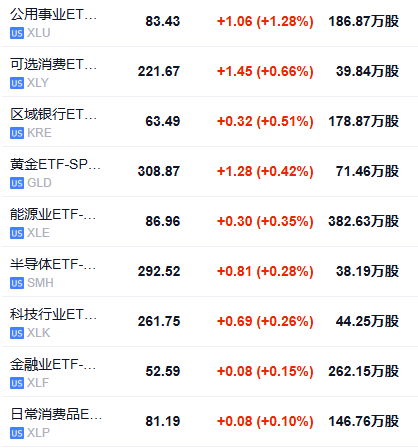
美股盘初,主要行业ETF多数走高,公用事业ETF涨超1%,可选消费ETF涨幅居前。
news flash· 2025-07-18 13:54
Group 1 - The major industry ETFs in the US stock market are mostly rising, with the utilities ETF increasing by over 1% and the consumer discretionary ETF showing the highest gains [1] - The utilities ETF (US XLU) is priced at 83.43, up by 1.06 (+1.28%) with a trading volume of 1.8687 million shares [2] - The consumer discretionary ETF (US XLY) is priced at 221.67, up by 1.45 (+0.66%) with a trading volume of 398,400 shares [2] Group 2 - The regional banks ETF (US KRE) is priced at 63.49, up by 0.32 (+0.51%) with a trading volume of 1.7887 million shares [2] - The gold ETF (US GLD) is priced at 308.87, up by 1.28 (+0.42%) with a trading volume of 714,600 shares [2] - The energy sector ETF (US XLE) is priced at 86.96, up by 0.30 (+0.35%) with a trading volume of 3.8263 million shares [2] Group 3 - The semiconductor ETF (US SMH) is priced at 292.52, up by 0.81 (+0.28%) with a trading volume of 381,900 shares [2] - The technology sector ETF (US XLK) is priced at 261.75, up by 0.69 (+0.26%) with a trading volume of 442,500 shares [2] - The financial sector ETF (US XLF) is priced at 52.59, up by 0.08 (+0.15%) with a trading volume of 2.6215 million shares [2] Group 4 - The consumer staples ETF (US XLP) is priced at 81.19, up by 0.08 (+0.10%) with a trading volume of 1.4676 million shares [2]