债券

Search documents
大类资产早报-20250930
Yong An Qi Huo· 2025-09-30 01:36
Report Information - Report Date: September 30, 2025 [2] - Report Title: Daily Report on Major Asset Classes [9] Global Asset Market Performance 10-Year Treasury Yields of Major Economies - Yields on September 29, 2025: US 4.140%, UK 4.700%, France 3.531%, etc [3] - Latest Changes: US -0.036, UK -0.045, France -0.037, etc [3] - One-Week Changes: US -0.008, UK -0.012, France -0.028, etc [3] - One-Month Changes: US -0.090, UK -0.050, France -0.005, etc [3] - One-Year Changes: US 0.389, UK 0.778, France 0.594, etc [3] 2-Year Treasury Yields of Major Economies - Yields on September 29, 2025: US 3.640%, UK 3.983%, Germany 2.020%, etc [3] - Latest Changes: US 0.070, UK -0.026, Germany -0.007, etc [3] - One-Week Changes: US 0.070, UK 0.008, Germany 0.006, etc [3] - One-Month Changes: US 0.120, UK 0.023, Germany 0.069, etc [3] - One-Year Changes: US 0.050, UK 0.071, Germany -0.126, etc [3] US Dollar Exchange Rates Against Major Emerging Market Currencies - Rates on September 29, 2025: Brazil 5.322, South Africa ZAR 17.273, South Korean Won 1400.400, etc [3] - Latest Changes: Brazil -0.40%, South Africa ZAR -0.37%, South Korean Won -0.72%, etc [3] - One-Week Changes: Brazil -0.24%, South Africa ZAR -0.31%, South Korean Won 0.66%, etc [3] - One-Month Changes: Brazil -2.15%, South Africa ZAR -1.96%, South Korean Won 0.50%, etc [3] - One-Year Changes: Brazil -3.88%, South Africa ZAR -0.45%, South Korean Won 4.88%, etc [3] Stock Indices of Major Economies - Values on September 29, 2025: S&P 500 6661.210, Dow Jones Industrial Average 46316.070, NASDAQ 22591.150, etc [3] - Latest Changes: S&P 500 0.26%, Dow Jones Industrial Average 0.15%, NASDAQ 0.48%, etc [3] - One-Week Changes: S&P 500 -0.49%, Dow Jones Industrial Average -0.14%, NASDAQ -0.87%, etc [3] - One-Month Changes: Mexico Index 6.36%, UK Index 1.13%, France CAC 2.24%, etc [3] - One-Year Changes: S&P 500 16.48%, Dow Jones Industrial Average 9.95%, NASDAQ 25.69%, etc [3] Credit Bond Indices - Values on September 29, 2025: US Investment-Grade Credit Bond Index 3517.910, Eurozone Investment-Grade Credit Bond Index 265.036, etc [3] - Latest Changes: US Investment-Grade Credit Bond Index 0.34%, Eurozone Investment-Grade Credit Bond Index 0.13%, etc [4] - One-Week Changes: US Investment-Grade Credit Bond Index 0.09%, Eurozone Investment-Grade Credit Bond Index 0.08%, etc [4] - One-Month Changes: US Investment-Grade Credit Bond Index 1.56%, Eurozone Investment-Grade Credit Bond Index 0.51%, etc [4] - One-Year Changes: US Investment-Grade Credit Bond Index 3.50%, Eurozone Investment-Grade Credit Bond Index 3.93%, etc [4] Stock Index Futures Trading Data Index Performance - Closing Prices: A-share 3862.53, CSI 300 4620.05, SSE 50 2973.04, etc [5] - Price Changes (%): A-share 0.90%, CSI 300 1.54%, SSE 50 1.09%, etc [5] Valuation - PE(TTM): CSI 300 14.19, SSE 50 11.73, CSI 500 34.92, etc [5] - Month-on-Month Changes: CSI 300 0.15, SSE 50 0.05, CSI 500 0.47, etc [5] Risk Premium - 1/PE - 10-Year Interest Rate: S&P 500 -0.53, Germany DAX 2.40 [5] - Month-on-Month Changes: S&P 500 0.03, Germany DAX 0.04 [5] Fund Flows - Latest Values: A-share 836.51, Main Board 463.46, Small and Medium-Sized Enterprise Board - [5] - Average Values in the Past 5 Days: A-share -302.46, Main Board -264.41, Small and Medium-Sized Enterprise Board - [5] Trading Volume - Latest Values: Shanghai and Shenzhen Stock Exchanges 21614.61, CSI 300 6933.95, SSE 50 1899.69, etc [5] - Month-on-Month Changes: Shanghai and Shenzhen Stock Exchanges 145.76, CSI 300 946.71, SSE 50 397.81, etc [5] Main Contract Premiums or Discounts - Basis: IF -15.45, IH 2.96, IC -118.36 [5] - Premium or Discount Ratios: IF -0.33%, IH 0.10%, IC -1.61% [5] Treasury Bond Futures Trading Data Closing Prices - T00 107.660, TF00 105.485, T01 107.325, TF01 105.360 [6] Price Changes (%) - T00 0.00%, TF00 0.00%, T01 0.00%, TF01 0.00% [6] Money Market - Capital Interest Rates: R001 1.3776%, R007 1.8694%, SHIBOR-3M 1.5800% [6] - Daily Changes (BP): R001 -17.00, R007 32.00, SHIBOR-3M 0.00 [6]
晨会纪要——2025年第168期-20250930
Guohai Securities· 2025-09-30 01:35
Group 1 - The report addresses how to quantify current market implied interest rate cut expectations through interest rate swap pricing and floating rate bond spread analysis, aiming to fill gaps in traditional liquidity analysis [3] - The analysis identifies four stages of interest rate cut expectations evolution since 2024, indicating a significant reversal in market expectations compared to the beginning of the year [4] - Current market pricing does not reflect further easing potential and may even imply a marginal tightening of policy, suggesting that if a rate cut signal is released in Q4, it could create a significant positive impact on the bond market due to the existing low market consensus [4] Group 2 - The report highlights three marginal changes in institutional behavior following the breach of interest rates, indicating a shift in market dynamics [6] - Fund managers have significantly reduced their duration, with the median duration of long-term bond funds dropping to 2.8 years, and net purchases of ultra-long government bonds turning negative since early September [7] - Banks have been actively buying 10-year government bonds, acting as a buffer during the recent bond market correction, while the trading volume of certain bonds has shown a rapid adjustment [8]
前三季度科创债发行1.58万亿元 实现“量质齐升”
Zheng Quan Ri Bao· 2025-09-29 16:19
Core Insights - The issuance of technology innovation bonds (科创债) in China has seen significant growth in 2023, with a total issuance of 1.58 trillion yuan, marking a year-on-year increase of 74.94% [2][3] - The rapid development of the 科创债 market is driven by strong policy support and market demand, leading to a transformation in the structure and quality of issuers and products [3][4] Group 1: Market Growth and Policy Support - The 科创债 market has expanded significantly, with 1,428 bonds issued in the first three quarters of 2023, reflecting a 43.95% increase in the number of issuances compared to the previous year [2] - The introduction of new policies in May 2023 has accelerated the issuance of 科创债, with the monthly issuance reaching 351.38 billion yuan shortly after the policy announcement [2][3] Group 2: Issuer Diversity and Product Innovation - The new policies have diversified the types of issuers, allowing commercial banks, securities firms, and private equity institutions to participate, which has led to a total issuance of 2.53 billion yuan from 29 banks and 766 million yuan from 41 securities firms [3] - There has been a notable increase in long-term bonds, with bonds of 10 years or more accounting for 8.34% of the total issuance, aligning with the long-term funding needs of technology innovation [3] Group 3: Secondary Market Activity - The trading volume of 科创债 in the secondary market reached 792.51 billion yuan in the first three quarters of 2023, a 55.53% increase from the previous year [4] - The introduction of standardized investment tools, such as 科创债 ETFs, has significantly enhanced market liquidity, with the total scale of these ETFs surpassing 240 billion yuan [5][6] Group 4: Future Outlook - Experts predict that the 科创债 market will see further breakthroughs, including the inclusion of more specialized small and medium-sized enterprises and customized products targeting emerging technologies [7] - The interaction between the primary and secondary markets is expected to improve, creating a virtuous cycle of financing convenience, diversified investment, and market expansion [7]
新刊速读 | 首笔中国绿色主权债券:财政金融协同支持绿色低碳发展的制度性突破
Sou Hu Cai Jing· 2025-09-29 13:12
Core Insights - The article discusses the role of green sovereign bonds in supporting green low-carbon development in the context of China's dual carbon goals, highlighting their significance in financing and policy alignment [1][2]. Group 1: Global Green Sovereign Bonds - Since Poland issued the first green sovereign bond in 2016, sovereign governments have become key issuers in the global green bond market, with countries like France, Germany, and the UK establishing a comprehensive green yield curve [2]. - The existence of a green premium (Greenium) has been validated by Germany's "twin bond" design, indicating that capital markets are willing to pay extra for sustainable attributes, thus providing new pricing benchmarks for green finance [2]. - Green sovereign bonds set a standard for market transparency and information disclosure due to their strict monitoring and reporting requirements, enhancing investor confidence and encouraging other issuers to adopt similar practices [2]. Group 2: China's Institutional Breakthrough - China's green bond market has rapidly developed, surpassing RMB 5 trillion in issuance by the end of Q1 2025, but there has been a disconnect between fiscal policy and financial markets [3]. - The introduction of the green sovereign bond framework addresses this gap by incorporating green bond funding into the central fiscal budget, marking the first time green finance is considered in national budget planning [3]. - The framework specifies six categories of green expenditures, emphasizing public welfare, and establishes a mechanism for environmental benefit indicators and external evaluations, setting a standard for domestic green bond information disclosure [3]. Group 3: Practical Significance of the First Green Sovereign Bond - In April 2025, China issued RMB 6 billion in green sovereign bonds in London, with a subscription amount of RMB 41.58 billion, achieving an oversubscription ratio of 6.9 times [4][5]. - The issuance demonstrates China's commitment to global climate governance and enhances the international influence of its bond market while providing a low-cost financing channel for green expenditures [5]. - The issuance serves as a model for domestic green bond markets through strict adherence to funding use, information disclosure, and external evaluations [5]. Group 4: Policy Implications and Conclusion - Future efforts should focus on diversifying green sovereign bond offerings to include various maturities and currencies, creating a systematic yield curve [6]. - There is a need to explore domestic issuance of green national bonds and savings bonds to engage public participation in green development [6]. - Strengthening fiscal-financial collaboration and expanding the scope of sovereign bonds to include new areas like carbon neutrality and rural revitalization will enhance China's sustainable finance framework [6]. - The issuance of the first green sovereign bond marks a significant institutional breakthrough in China's fiscal-financial collaboration for green low-carbon development, with potential for further improvements in various aspects [6].
这只ETF成交额超470亿元
Zhong Guo Zheng Quan Bao· 2025-09-29 12:37
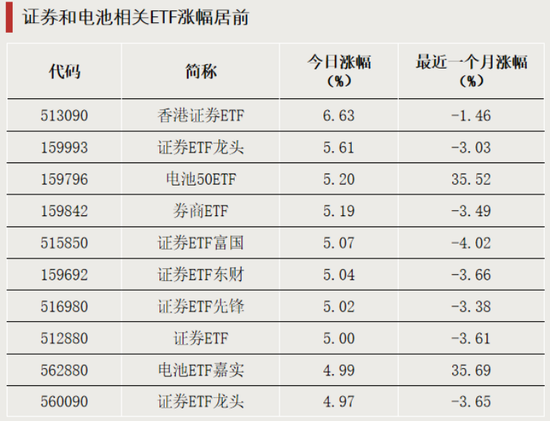
Group 1 - Multiple securities and battery-related ETFs saw significant gains on September 29, with the Hong Kong Securities ETF leading the way, rising over 6% and achieving a trading volume of 475.18 billion yuan, the highest for the day [1][4][10] - The technology innovation bond ETFs were also active, with half of the top ten ETFs by trading volume being such products, including the Guotai and Huatai ETFs, each exceeding 10 billion yuan in trading volume [2][10] - The previous trading day (September 26) saw substantial net inflows into several technology innovation bond ETFs and the CSI A500 ETF, with net inflows exceeding 1 billion yuan [3][12] Group 2 - The technology innovation semiconductor materials and equipment index has surged by 127.17% since September 24, 2024, indicating strong growth potential in the semiconductor sector [6] - The technology innovation semiconductor ETF (588170) experienced over 1.6 billion yuan in net inflows in the past month, reflecting strong investor interest in this segment [7] - The semiconductor equipment and materials industry is expected to enter a rapid growth phase, with established delivery and validation cycles creating a competitive advantage for firms in this space [7] Group 3 - Coal ETFs, along with others like the Saudi ETF and the All-Index Cash Flow ETF, experienced declines, indicating a shift in investor sentiment away from these sectors [8] - The market outlook suggests a continuation of the upward trend in A-shares, driven by technological advancements and supportive policies for AI and innovation sectors [13]


大类资产运行周报(20250922-20250926):美国通胀数据符合预期,大宗商品整体上涨-20250929
Guo Tou Qi Huo· 2025-09-29 11:01
Report Overview - Report Title: Weekly Report on the Operation of Major Asset Classes (20250922 - 20250926) - US Inflation Data Meets Expectations, with Commodities Rising Overall [1] - Timeframe: September 22 - September 26, 2025 1. Report Industry Investment Rating No relevant content provided. 2. Core Viewpoints - Global: The market's performance last week was influenced by economic data. The US 8 - month PCE year - on - year growth rate met market expectations. The dollar index ended the week higher, stocks and bonds declined, and commodities rose. In general, commodities > stocks > bonds in terms of dollar - denominated assets [4][7]. - Domestic: China's industrial enterprise profits returned to positive growth in August year - on - year. The stock market and commodities ended the week higher, and the bond market declined. Overall, commodities > stocks > bonds [4][20]. - Outlook: The focus is on the release of domestic and foreign macro - data during the National Day. There are important data such as non - farm payrolls to be released, leading to high market uncertainty. After the holiday, price fluctuations of major asset classes may increase [4][27]. 3. Summary by Directory 3.1 Global Major Asset Performance 3.1.1 Global Stock Market - Most global stock markets declined. US stocks had a weekly correction. From a regional perspective, the three major US stock indexes ended the week lower, with a relatively large decline in the Asia - Pacific region. Emerging markets underperformed developed markets, and the VIX index continued to operate at a low level [9]. - Specific index performance: MSCI US was down 0.35%, S&P 500 was down 0.31%, MSCI Asia - Pacific was down 1.02%, etc. [12][13] 3.1.2 Global Bond Market - Fed officials had some differences in the path of dollar interest rate cuts this year. Medium - and long - term US bond yields generally rose. The yield of the 10 - year US Treasury bond rose 6BP to 4.2% weekly, and the bond market declined. Globally, high - yield bonds > credit bonds > government bonds [16]. 3.1.3 Global Foreign Exchange Market - The initial value of the month - on - month growth rate of US durable goods orders in August far exceeded expectations. The dollar index rose weekly, and most non - US currencies depreciated against the dollar. The RMB exchange rate fluctuated weakly. The weekly increase of the dollar index was 0.55% [17]. 3.1.4 Global Commodity Market - Geopolitical factors caused disruptions again, and international oil prices ended the week higher. Expectations of dollar interest rate cuts supported international precious metal prices. Most industrial metals and agricultural product prices fell [19]. 3.2 Domestic Major Asset Performance 3.2.1 Domestic Stock Market - Market sentiment changed little. Most of the major broad - based A - share indexes rose. The average daily trading volume of the two markets decreased compared with the previous week. In terms of style, the Science and Technology Innovation 50 Index had the highest increase. In terms of sectors, electronics and non - ferrous metals led the gains, while consumer services underperformed. The Shanghai Composite Index rose 0.21% weekly [21]. 3.2.2 Domestic Bond Market - The central bank's net injection in the open market operation was 940.6 billion yuan. The liquidity marginally eased, and the bond market was weak. Overall, corporate bonds > credit bonds > government bonds [25]. 3.2.3 Domestic Commodity Market - The domestic commodity market continued to rise weekly. Among the major commodity sectors, precious metals led the gains, while the black - related sectors underperformed [26].
新能源主题基金净值涨幅占优,被动资金加仓TMT主题ETF:基金市场与ESG产品周报20250929-20250929
EBSCN· 2025-09-29 10:54
The provided content does not include any quantitative models or factors, nor does it discuss their construction, evaluation, or backtesting results. The report primarily focuses on fund market performance, ETF flows, ESG products, and other financial market observations. Therefore, there are no relevant quantitative models or factors to summarize.
平安证券:2025年利率债四季报:多重挑战下,债市的机会与风险
Ping An Securities· 2025-09-29 10:47
Report Information - Report Title: [Ping An Securities] 2025 Interest Rate Bond Quarterly Report: Opportunities and Risks in the Bond Market under Multiple Challenges [1] - Release Date: September 29, 2025 [1] - Analysts: Liu Lu, Zheng Zichen [1] Industry Investment Rating - Stronger than the Market (Expected to outperform the market by more than 5% in the next 6 months) [94] Core Views - The bond market entered a headwind period in Q3 due to multiple factors, with a bearish steepening of the yield curve, a decline in the inter - bank leverage ratio, a reduction in the duration of asset management accounts, and a certain demand maintained by allocation accounts [2]. - The necessity of stabilizing growth is increasing in Q4. Policy measures may include interest rate cuts of 10BP, reserve requirement ratio cuts of 25BP, restarting bond purchases, and fiscal stimulus leading to a year - on - year increase of over 1 trillion yuan in Q4 [3]. - There are trading opportunities for bonds with maturities within 10 years in Q4, while ultra - long bonds face repricing risks [4]. Summary by Directory PART1: Domestic Bond Yields Reach New Highs - **Multiple Negative Factors Lead to Q3 Bond Market Adjustment**: In June, "anti - involution" drove up commodity prices; in July, the Shanghai Composite Index broke through 3400 points; in August - September, policy adjustments such as the readjustment of VAT on treasury bond interest and concerns about the cancellation of tax - exemption policies for public funds led to bond fund redemptions and rising interest rates [2][6]. - **Deviation from Fundamentals and Funds, Dominated by Sentiment and Institutional Behavior**: The adjustment deviated from fundamentals and funds, with stable funds and a marginal decline in fundamentals in July - August. Market sentiment and institutional behavior played a dominant role [8]. - **Market Leverage Declines, Asset Management Accounts Reduce Positions, Allocation Accounts Maintain Demand**: During the market adjustment, institutions tended to reduce leverage, asset management accounts reduced positions, and allocation accounts supported the market [11]. - **Performance of Different Bond Types**: Short - term treasury bonds were relatively resistant to decline due to large - bank purchases; credit bonds weakened as fund and wealth management demand declined; ultra - long bonds performed weakly, with increased supply exceeding demand from insurance and rural commercial banks. There was also a global resonance of rising ultra - long bond yields [2][17][19][26]. PART2: The Necessity of Stabilizing Growth Increases in Q4 - **Policy Support Needed to Achieve the Annual Growth Target**: To achieve the annual GDP growth target of 5%, Q4 requires stronger stabilizing - growth policies than in 2022 - 2023 but weaker than in 2024. Without additional policies, government bond net financing in Q4 is expected to be about 1 trillion less year - on - year [3][46]. - **Fiscal and Monetary Policy Tools**: Fiscal policy may involve policy - based development financial tools of about 500 billion yuan and the possible early issuance of 2 trillion special refinancing bonds in 2026. Monetary policy is expected to remain stable, with no obvious constraints on marginal easing [51]. - **Policy Implementation Timing**: Short - term bond purchases by the central bank are more likely, while reserve requirement ratio and interest rate cuts are more likely to occur at the end of the year, perhaps to align with the December Central Economic Work Conference [52]. - **Central Bank Bond Purchase Maturity**: Based on institutional behavior, the central bank's bond purchases may be extended to within 5 - year maturities [57]. PART3: Bond Market Strategies - **Trading Opportunities for Bonds within 10 Years**: Leading indicators such as social financing and M1 growth are approaching a phased peak. In terms of valuation, 10 - year treasury bonds are relatively cheap compared to listed companies' ROIC and are close to the upper limit of the interest rate corridor. The 10 - year treasury bond yield has risen by 17BP, fully pricing in the current stabilizing - growth policies but not pricing in potential monetary policy benefits [4][64][71]. - **Repricing Risks for Ultra - long Bonds**: Ultra - long bonds may face repricing risks. Based on calculations, the current ultra - long bond yields may have fully priced in inflation improvement. The potential risks include continuous stabilizing - growth policies and global fiscal expansion [80]. - **Short - term Market Contradictions and Strategies**: Short - term market contradictions lie in institutional behavior and sentiment. It is recommended to focus on short - term treasury bonds within 5 years and certificates of deposit in the short term and participate in duration - offensive bonds after negative factors are realized [87].
10月债市调研问卷点评:投资者看多情绪上升
ZHESHANG SECURITIES· 2025-09-29 10:28
Group 1: Report Industry Investment Rating - Not provided in the given content Group 2: Core Viewpoints of the Report - Standing at the end of September and looking forward to October, investors' judgments on the bond market in the next stage are quite divided. There is a consensus on maintaining a preference for medium - short - term and long - term interest - rate bonds, and the proportion of bullish sentiment has increased. The funding situation, the equity market, and institutional behavior have become the core concerns of investors, and their preference for convertible bonds and low - grade urban investment bonds has marginally weakened [1]. - According to the bond market survey questionnaire results released at the end of September, there are four mainstream expectations for the bond market in October: 1) The expected range of the upper and lower limits of long - term treasury bond yields is relatively concentrated, and long - term treasury bond yields still show a state of "capped on the upper end and floored on the lower end"; 2) The bullish sentiment in the bond market has slightly increased, and the proportion of those who think it's time to increase positions has significantly risen, while expectations for reserve requirement ratio cuts and interest rate cuts are divided; 3) Investors' overall expectations for the economy in September have changed. Monetary policy, the funding situation, and the performance of the equity market are the core issues that investors focus on, and the game of institutional behavior has returned to the focus of investors; 4) Looking forward to October, investors unanimously expect to maintain their positions in medium - short - term interest - rate bonds and increase their preference for long - term interest - rate bonds, while their preference for convertible bonds has declined [2][10]. Group 3: Summary by Relevant Catalog 3.1 Investor Bullish Sentiment Rises - A bond market survey questionnaire "What to Expect from the Bond Market in October?" was released on September 25, 2025. By 00:00 on September 28, 204 valid questionnaires were received, covering various institutional investors and individual investors such as bank self - operations, securities firm self - operations, and public funds/special accounts [9]. 3.2 Expectations for Treasury Bond Yields 10 - year Treasury Bond Yields - Regarding the lower limit, 44% of investors think it will likely fall in the range of 1.70% - 1.75% (inclusive), 30% think it will be in the range of 1.75% - 1.80% (inclusive), 14% think it will fall below 1.70%, and about 12% think it will exceed 1.80%. Regarding the upper limit, 49% of investors think it will likely fall in the range of 1.85% - 1.90% (inclusive), about 29% think it will be below 1.85%, and 11% each think it will be in the range of 1.90% - 1.95% (inclusive) and above 1.95%. Current investors' expectations for the rise of 10 - year treasury bond interest rates have gradually increased compared with the August survey results, but they remain cautious about the judgment of breaking through key points [11]. 30 - year Treasury Bond Yields - Regarding the lower limit, 34% of investors each think it will fall in the ranges of 1.95% - 2.00% (inclusive) and 2.00% - 2.05% (inclusive), about 19% think it will be above 2.05%, and only 13% think it will be below 1.95%. Regarding the upper limit, about 35% of investors think it will fall in the range of 2.10% - 2.15% (inclusive), 33% think it will be in the range of 2.15% - 2.20% (inclusive), and about 19% think it will break through 2.20%. Since September, the 30 - year treasury bond yield has continued to rise, and investors are quite cautious about the expectation that it may further increase [13]. 3.3 Expectations for the Economic Situation in September - 54% of investors think the economy in September will show a situation of "both supply and demand weakening", 29% think it will be "demand weakening, supply strengthening", 9% think it will be "both supply and demand strengthening", and 8% think it will be "demand strengthening, supply weakening". In September, 83% of investors think the demand side has generally weakened, and only 38% expect the supply side to strengthen, indicating that the market is relatively cautious about the expectation of supply expansion [14][17]. 3.4 Expectations for Reserve Requirement Ratio Cuts and Interest Rate Cuts - Regarding reserve requirement ratio cuts, 36% of investors think there will be no more cuts this year, 27% think the next cut may occur in October, 23% think it will be in November, and 15% think it will be in December. Regarding interest rate cuts, 53% of investors think there will be no more cuts this year, 19% think the next cut may occur in October, 13% think it will be in November, and 15% think it will be in December. Compared with the August survey results, investors' expectations for reserve requirement ratio cuts have slightly increased, while their expectations for interest rate cuts have slightly decreased [18]. 3.5 Impact of the Fed's 25bp Interest Rate Cut on the Domestic Bond Market - 64% of investors think the Fed's 25bp interest rate cut has limited impact on the domestic bond market, and the domestic fiscal and supply rhythm still need to be considered. 13% think it is beneficial for the repair of the Sino - US interest rate spread and can ease the pressure on RMB depreciation. 12% think the interest rate cut signal strengthens the downward movement of the global interest rate center, which is beneficial for the long - duration trend in the domestic market. Another 12% think the external disturbance is difficult to determine. Most investors think the interest rate cut is not a significant surprise, and its impact on the domestic bond market is relatively limited [22]. 3.6 Expectations for the Bond Market in October - 32% of investors think the bond market in October will strengthen overall, among which 20% expect the yield curve to be bull - flattened (a slight decrease compared with the August survey results), and 12% expect the yield curve to be bull - steepened. 29% of investors think the bond market will be weak. 20% of investors think the bond market may show a differentiation between the short - end and long - end, favoring a strong short - end and a weak long - end, and 6% think the short - end will be weak and the long - end will be strong. Investors' expectations for the bond market are divided, and there is no obvious trend [24]. 3.7 Bond Market Operation Suggestions - 31% of investors think they should hold cash and wait for the market to correct to the expected level before increasing positions. 29% of investors think it's time to start increasing positions. 16% of investors think they should reduce the duration to control risks. 10% of investors think they should appropriately reduce positions, and about 15% of investors think they should keep their positions basically stable. Most investors' actual operations in October are relatively neutral, and the proportion of those who think it's time to start increasing positions has significantly increased [27]. 3.8 Preferred Bond Types in October - Compared with the August survey results, investors' preference for long - term interest - rate bonds, medium - short - term interest - rate bonds, and high - grade urban investment bonds has increased, while their preference for convertible bonds and low - grade urban investment bonds has significantly decreased. Looking forward to October, investors unanimously expect to maintain their positions in medium - short - term interest - rate bonds and increase their preference for long - term interest - rate bonds. Their preference for local government bonds, inter - bank certificates of deposit, and secondary capital bonds has slightly decreased [29]. 3.9 Main Logic of Bond Market Pricing in October - Monetary policy, the funding situation, and the performance of the equity market have become the core concerns of bond investors. Investors' attention to the game of institutional behavior has significantly increased. Their attention to fundamental data such as real estate and PMI remains basically the same, and their attention to the disturbance of US tariff policies has significantly decreased [32].
“闻到了2007年的味道”,大佬发警告
美股研究社· 2025-09-29 10:16
Core Viewpoint - The U.S. bond market is showing signs reminiscent of the pre-2007 financial crisis, with a resurgence of large-scale leveraged buyouts and increasing risk debt, raising concerns among market observers [3][5][12]. Group 1: Signs of Market Bubble - There are multiple signs of a bubble in the current market, similar to those before the 2007 financial crisis, including a resurgence of large leveraged buyout transactions, with Wall Street banks preparing over $20 billion in merger debt financing [5][10]. - The potential $50 billion acquisition of Electronic Arts Inc. marks a record deal, echoing the $44 billion leveraged buyout of TXU Corp. in 2007 [5][10]. - Rising auto loan default rates signal increasing financial pressure on consumers, with notable bankruptcies in subprime auto lending institutions [5][6]. Group 2: Debt Market Expansion - The U.S. investment-grade market has expanded from less than $4 trillion in early 2015 to approximately $7.6 trillion currently, while the private credit market has grown to over $1.7 trillion [6][8]. - The issuance of private credit-backed bonds has surged, with major firms like Blackstone and Apollo Global Management issuing these products at record speeds [8]. Group 3: Corporate Bond Market Concerns - The risk premium for U.S. investment-grade corporate bonds has reached a 27-year low, indicating overly optimistic pricing of risk in the market [10][12]. - Several market observers, including JPMorgan CEO Jamie Dimon, have expressed concerns about current valuation levels, suggesting a potential for panic in the market [10][12]. Group 4: Economic Indicators and Market Adjustments - Early signs of economic slowdown are emerging, with the U.S. unemployment rate rising to its highest level since 2021 and consumer confidence dropping to a four-month low [12][14]. - Despite the differences in the current market environment compared to 2007, such as stricter bank regulations and lower consumer borrowing levels, the potential for significant asset adjustments remains [12][14].