橡胶
Search documents
光大期货能化商品日报-20251112
Guang Da Qi Huo· 2025-11-12 05:57
1. Report Industry Investment Rating No relevant content provided. 2. Core View of the Report - The overall energy - chemical market shows a volatile trend. Crude oil, fuel oil, asphalt, polyester, rubber, methanol, polyolefins, and PVC are all expected to run in a volatile manner, with different influencing factors for each variety [1][3][5][7]. 3. Summary by Directory 3.1 Research Views - **Crude Oil**: On Tuesday, oil prices rebounded. WTI December contract rose $0.91 to $61.04 per barrel, a 1.51% increase; Brent January contract rose $1.1 to $65.16 per barrel, a 1.72% increase; SC2512 closed at 468.9 yuan per barrel, up 9.7 yuan or 2.11%. US crude inventory is expected to increase, while gasoline and distillate inventories are expected to decline. Asian gasoline refining profit reached the highest level since January 2024. The market shows certain linkages, and oil prices will continue to fluctuate [1]. - **Fuel Oil**: On Tuesday, the main fuel oil contracts on the Shanghai Futures Exchange declined. The Asian low - sulfur market faces supply and demand problems, but the East - West arbitrage window is basically closed. The Asian high - sulfur market is supported by stable demand but has sufficient supply. The market structure of low - sulfur and high - sulfur fuel oil is expected to continue to reverse [1]. - **Asphalt**: On Tuesday, the main asphalt contract on the Shanghai Futures Exchange rose. The market has abundant resources but weak demand, and the spot price has reached a nearly three - year low. Although the production in November has decreased, the short - term supply still faces pressure. The price of asphalt is treated with a bearish view [3]. - **Polyester**: TA601 and EG2601 closed down. PX&TA futures prices rebounded, and the processing margin on the disk narrowed. The supply side has maintenance plans, and the downstream polyester maintains a high operating rate. It is expected that PX&TA will follow the cost side to fluctuate in the short term. The supply pressure of ethylene glycol remains, and the price is expected to be under pressure [3]. - **Rubber**: On Tuesday, the main rubber contracts on the Shanghai Futures Exchange declined. The rubber production is seasonally increasing, and the supply pressure is increasing. The downstream demand is weak overseas, and the EU's investigations have increased export concerns. It is expected that rubber prices will fluctuate [5]. - **Methanol**: The supply in the domestic market has recovered to a high level, and Iranian devices may stop production from late November to December. It is expected that methanol will maintain a bottom - oscillating trend [5]. - **Polyolefins**: The short - term production will remain high, and the downstream demand will weaken marginally after the e - commerce activities. It is expected that polyolefin prices will enter a volatile and weak stage [7]. - **PVC**: The supply maintains a high - level oscillation, the domestic demand slows down, and exports are affected by India's anti - dumping policy. It is expected that PVC prices will tend to oscillate at the bottom [7]. 3.2 Daily Data Monitoring - The report provides the basis price data of energy - chemical varieties on November 12, 2025, including spot prices, futures prices, basis, basis rates, and their changes and historical quantiles [10]. 3.3 Market News - Last week, US crude inventory was expected to increase, and gasoline and distillate inventories were expected to decline. As of the week of November 7, US crude inventory was expected to increase by about 1.2 million barrels [12]. - Although the US imposed new sanctions on Russia's two largest oil companies, Russian oil shipments remained stable in early November and are expected to decline from the end of November [12]. 3.4 Chart Analysis - **4.1 Main Contract Prices**: The report provides price trend charts of the main contracts of various energy - chemical varieties from 2021 to 2025, including crude oil, fuel oil, LPG, PTA, ethylene glycol, etc. [14][16][19][22][25][27][30][31]. - **4.2 Main Contract Basis**: It shows the basis trend charts of the main contracts of various energy - chemical varieties from 2021 to 2025, such as crude oil, fuel oil, asphalt, etc. [32][38][39][42][43][44]. - **4.3 Inter - period Contract Spreads**: It presents the spread trend charts of different contracts of various energy - chemical varieties, including fuel oil, asphalt, PTA, ethylene glycol, etc. [48][50][53][56][59][61]. - **4.4 Inter - variety Spreads**: It provides the spread and ratio trend charts of different varieties of energy - chemical products, such as crude oil internal and external markets, high - and low - sulfur fuel oil, etc. [63][65]. - **4.5 Production Profits**: It shows the production profit trend charts of LLDPE and PP [71]. 3.5 Team Member Introduction - The research team includes the assistant director and energy - chemical director Zhong Meiyan, and analysts such as Du Bingqin, Di Yilin, and Peng Haibo, each with rich experience and achievements in different energy - chemical fields [76][77][78][79].
能源化工期权策略早报:能源化工期权-20251112
Wu Kuang Qi Huo· 2025-11-12 05:40
Group 1: Report Summary - The report is an energy and chemical options strategy morning report, covering energy, polyolefins, polyesters, alkali chemicals, and other energy and chemical options [1][2] - The recommended strategy is to construct an option portfolio strategy mainly as a seller, as well as a spot hedging or covered strategy to enhance returns [2] Group 2: Underlying Futures Market Overview - The latest prices, price changes, price change rates, trading volumes, volume changes, open interests, and open interest changes of various option underlying futures contracts are provided [3] Group 3: Option Factor - Volume and Open Interest PCR - The trading volume, volume change, open interest, open interest change, trading volume PCR, volume PCR change, open interest PCR, and open interest PCR change of various options are presented [4] Group 4: Option Factor - Pressure and Support Levels - The at - the - money strike price, pressure point, pressure point offset, support point, support point offset, maximum call option open interest, and maximum put option open interest of various options are given [5] Group 5: Option Factor - Implied Volatility - The at - the - money implied volatility, weighted implied volatility, weighted implied volatility change, annual average implied volatility, call option implied volatility, put option implied volatility, 20 - day historical volatility, and implied - historical volatility difference of various options are reported [6] Group 6: Option Strategy Analysis - Energy Options Crude Oil - Fundamental analysis shows that U.S. refinery demand has stabilized and rebounded, shale oil production has slightly increased, OPEC exports have increased, European refinery demand is about to enter the peak season, and diesel crack spreads remain high [7] - The market trend shows a short - term weak oscillation in August, a weak and bearish trend followed by a rebound in September, a sharp decline followed by a rebound in October, and a continuous oscillation followed by a rebound in November [7] - Option factor research indicates that the implied volatility fluctuates around the average, the open interest PCR is below 0.80, the pressure level is 470, and the support level is 450 [7] - Recommended strategies include constructing a short - biased call + put option combination strategy for the volatility strategy and a long collar strategy for the spot long - position hedging strategy [7] Liquefied Petroleum Gas (LPG) - Fundamental analysis shows that the cost - end crude oil is under pressure from oversupply and geopolitical issues, and OPEC maintains an increasing production state [9] - The market trend shows a rapid decline followed by a rebound and then a decline since August, a rise - fall - rise - fall pattern in September, a weak - strong - rebound - oscillation pattern in October, and a continuous slight oscillation in November [9] - Option factor research indicates that the implied volatility has dropped significantly to around the lower - than - average level, the open interest PCR is around 0.80, the pressure level is 4550, and the support level is 4200 [9] - Recommended strategies include constructing a neutral - biased call + put option combination strategy for the volatility strategy and a long collar strategy for the spot long - position hedging strategy [9] Group 7: Option Strategy Analysis - Alcohol Options Methanol - Fundamental analysis shows that port inventory is 151.71 million tons, a month - on - month increase of 1.06 million tons, and enterprise inventory is 38.64 million tons, a month - on - month increase of 1.04 million tons [9] - The market trend shows a weakening and bearish trend since August, a low - level consolidation followed by a rebound in September, and a continuous weak and bearish trend since October [9] - Option factor research indicates that the implied volatility fluctuates around the historical average, the open interest PCR is below 0.80, the pressure level is 2500, and the support level is 2000 [9] - Recommended strategies include constructing a bear spread combination strategy of put options for the directional strategy, a short - biased call + put option combination strategy for the volatility strategy, and a long collar strategy for the spot long - position hedging strategy [9] Ethylene Glycol - Fundamental analysis shows that port inventory is 56.2 million tons, a year - on - year increase of 15.3 million tons, and downstream factory inventory days are 13.2 days, a year - on - year increase of 0.7 days. It is expected that port inventory will continue the accumulation cycle [10] - The market trend shows a slight weak consolidation in August, a continuous weak and bearish trend since September, and a continuous weak trend in November [10] - Option factor research indicates that the implied volatility fluctuates around the lower - than - average level, the open interest PCR is around 0.70, the pressure level is 4500, and the support level is 4050 [10] - Recommended strategies include constructing a bear spread combination strategy of put options for the directional strategy, a short - volatility strategy for the volatility strategy, and a long collar strategy for the spot long - position hedging strategy [10] Group 8: Option Strategy Analysis - Polyolefin Options Polypropylene - Fundamental analysis shows that PE and PP production enterprise inventories, trade inventories, and port inventories have different trends of accumulation or de - accumulation [10] - The market trend shows a weak and slight fluctuation in August, a continuous weak and bearish trend since September, and a continuous weak and bearish decline in November [10] - Option factor research indicates that the implied volatility has dropped to around the average level, the open interest PCR is around 0.70, the pressure level is 7000, and the support level is 6300 [10] - Recommended strategies include constructing a bear spread combination strategy of put options for the directional strategy and a long collar strategy for the spot long - position hedging strategy [10] Group 9: Option Strategy Analysis - Rubber Options Rubber - Fundamental analysis shows that exchange rubber warehouse receipts are at a ten - year low, and there is an expectation of inventory accumulation in the later stage [11] - The market trend shows a warming and rising followed by a range - bound oscillation in August, a continuous weak and bearish trend since September, and a low - level weak oscillation in November [11] - Option factor research indicates that the implied volatility has decreased to around the lower - than - average level after a rapid increase, the open interest PCR is below 0.60, the pressure level has dropped significantly to 16000, and the support level is 14500 [11] - Recommended strategies include constructing a short - biased call + put option combination strategy for the volatility strategy [11] Group 10: Option Strategy Analysis - Polyester Options PTA - Fundamental analysis shows that the overall social inventory of PTA (excluding credit warehouse receipts) is 225.1 million tons, a month - on - year increase of 11.4 million tons, and it is expected that inventory will continue to accumulate [11] - The market trend shows a decline followed by a small consolidation and then a rapid rebound and then a decline in August, a continuous weak and bearish trend since September, and a rebound and rise in November [11] - Option factor research indicates that the implied volatility fluctuates at a higher - than - average level, the open interest PCR is around 0.70, the pressure level is 4700, and the support level is 4300 [11] - Recommended strategies include constructing a neutral - biased call + put option combination strategy for the volatility strategy [11] Group 11: Option Strategy Analysis - Alkali Chemical Options Caustic Soda - Fundamental analysis shows that the average capacity utilization rate of Chinese caustic soda sample enterprises with a capacity of 200,000 tons or more is 84.8%, a week - on - week increase of 0.5% [12] - The market trend shows a rapid decline followed by a rebound and then a high - level oscillation in August, a continuous decline since September, an accelerated decline in October, and a low - level weak oscillation in November [12] - Option factor research indicates that the implied volatility fluctuates at a relatively high level, the open interest PCR is below 0.80, the pressure level is 3000, and the support level is 2000 [12] - Recommended strategies include constructing a bear spread combination strategy for the directional strategy and a long collar strategy for the spot long - position hedging strategy [12] Soda Ash - Fundamental analysis shows that as of November 7, 2025, the in - plant inventory of soda ash is 171.42 million tons, a month - on - month increase of 1.22 million tons [12] - The market trend shows a continuous weak consolidation since August, a low - level weak fluctuation in September, a continuous weak trend in October, and a decline - rise pattern in November [12] - Option factor research indicates that the implied volatility fluctuates at a relatively high historical level, the open interest PCR is below 0.60, the pressure level is 1860, and the support level is 1100 [12] - Recommended strategies include constructing a bear spread combination strategy for the directional strategy, a short - volatility combination strategy for the volatility strategy, and a long collar strategy for the spot long - position hedging strategy [12] Group 12: Option Strategy Analysis - Urea Options - Fundamental analysis shows that enterprise inventory is 157.81 million tons, a month - on - month increase of 2.38 million tons, and port inventory is 7.9 million tons, a month - on - month decrease of 3.1 million tons [13] - The market trend shows a wide - range and large - amplitude fluctuation in August, a continuous weakening in September, a low - level weak oscillation in October, and a rebound and rise in November [13] - Option factor research indicates that the implied volatility fluctuates slightly around the historical average, the open interest PCR is below 0.60, the pressure level is 1800, and the support level is 1600 [13] - Recommended strategies include constructing a neutral - biased call + put option combination strategy for the volatility strategy and a long collar strategy for the spot long - position hedging strategy [13]
化工日报:我国10月乘用车零售量同环比双降-20251112
Hua Tai Qi Huo· 2025-11-12 05:18
化工日报 | 2025-11-12 我国10月乘用车零售量同环比双降 市场要闻与数据 期货方面,昨日收盘RU主力合约15095元/吨,较前一日变动-15元/吨;NR主力合约12125元/吨,较前一日变动-40 元/吨;BR主力合约10240元/吨,较前一日变动-35元/吨。 现货方面,云南产全乳胶上海市场价格14600元/吨,较前一日变动+0元/吨。青岛保税区泰混14600元/吨,较前一 日变动-50元/吨。青岛保税区泰国20号标胶1835美元/吨,较前一日变动-15美元/吨。青岛保税区印尼20号标胶1710 美元/吨,较前一日变动-5美元/吨。中石油齐鲁石化BR9000出厂价格10200元/吨,较前一日变动+0元/吨。浙江传化 BR9000市场价10250元/吨,较前一日变动+50元/吨。 市场资讯 据第一商用车网初步统计,2025年10月份,我国重卡市场共计销售9.3万辆左右(批发口径,包含出口和新能源), 环比今年9月下降约12%,比上年同期的6.64万辆大幅增长约40%。今年1-10月,我国重卡市场累计销量超过了90 万辆,达到91.6万辆,同比增长约22%,预计在11月过后,累计销量就会超过100万 ...
文字早评2025-11-12:宏观金融类-20251112
Wu Kuang Qi Huo· 2025-11-12 02:09
1. Report Industry Investment Ratings No relevant content provided. 2. Core Views of the Report - After a previous continuous rise, recent hot sectors have seen rapid rotation, with the technology - growth sector remaining the market's main theme. Policy support for the capital market remains unchanged, and the medium - to long - term strategy is mainly to go long on dips [4]. - In the fourth quarter, the supply - demand pattern of the bond market may improve. The market is expected to remain volatile under the background of weak domestic demand recovery and improved inflation expectations. Attention should be paid to the stock - bond seesaw effect and the increasing allocation power [7]. - Given that the Fed's current easing cycle is in its early stage, it is advisable to go long on silver on dips. The reference operating ranges for the main contracts of Shanghai gold and silver are provided [9]. - The short - term trend of copper prices is expected to be volatile and slightly stronger, while aluminum prices may rise further. Zinc prices may be strong in the short - term but have limited upside in the excess cycle. Lead prices are expected to be strong in the short - term, and nickel prices are recommended to be observed in the short - term [13][15][17][20][22]. - The short - term trend of tin prices is expected to be strong and volatile. The price of lithium carbonate may see high - level selling pressure. Alumina is recommended to be observed in the short - term. Stainless steel prices are expected to remain weak in the short - term, and the price of cast aluminum alloy is expected to follow the trend of aluminum prices [24][27][29][32][34]. - Steel prices are expected to remain weakly volatile in the short - term but may see a demand inflection point in the future. Iron ore prices are expected to remain weak in the short - term. Glass prices are expected to remain weak, and soda ash prices may continue to fluctuate [38][40][42][44]. - For manganese silicon and ferrosilicon, it is more cost - effective to look for positions to rebound rather than to short. Industrial silicon prices are expected to consolidate, and polysilicon prices may see a marginal improvement in the supply - demand pattern [48][51][53]. - For rubber, a neutral approach is recommended, with short - term trading and partial hedging positions. Oil prices are recommended to be observed in the short - term. Methanol, urea, and other chemical products are generally recommended to be observed [59][62][63][64]. - For agricultural products, the general strategy for hogs is to go short on rebounds, eggs are expected to be strongly sorted in the short - term, and soybean meal is recommended to be shorted on rebounds in the medium - term. The trend of oils and fats depends on the export and production of palm oil, and sugar is recommended to be shorted after the rebound weakens. Cotton prices are expected to continue to fluctuate [83][85][87][90][92][96]. 3. Summaries by Directory 3.1 Macro - financial Category 3.1.1 Stock Index - **Market Information**: The central bank aims to maintain the stability of the financial market, and Mexico has postponed the plan to impose high tariffs on Chinese imports. SoftBank has sold all its Nvidia shares worth $5.83 billion [2]. - **Strategy View**: After a previous rise, hot sectors rotate rapidly, and the technology - growth sector is the main theme. The medium - to long - term strategy is to go long on dips [4]. 3.1.2 Treasury Bonds - **Market Information**: The main contracts of treasury bonds showed different changes. The 500 billion yuan of new policy - based financial instruments have been fully invested, and the US Senate has passed a bill to avoid a government shutdown. The central bank conducted a net injection of 286.3 billion yuan [5]. - **Strategy View**: The CPI in October exceeded expectations, and the manufacturing PMI was lower than expected. The supply - demand pattern of the bond market may improve in the fourth quarter, and the market is expected to remain volatile [7]. 3.1.3 Precious Metals - **Market Information**: The prices of Shanghai gold and silver showed different trends. The US non - farm payroll data could not be released normally, and the US government shutdown problem is likely to be resolved, which will improve market liquidity [8]. - **Strategy View**: The market prices a 67.4% probability of a 25 - basis - point Fed rate cut in December. It is advisable to go long on silver on dips, and the reference operating ranges for gold and silver contracts are provided [9]. 3.2 Non - ferrous Metals Category 3.2.1 Copper - **Market Information**: Domestic equity markets declined, and copper prices adjusted. LME and domestic warehouse inventories decreased, and the import loss of domestic copper was about 700 yuan/ton [11]. - **Strategy View**: The expected reopening of the US government and the easing of trade tensions boost market sentiment. The supply of refined copper is expected to tighten marginally, and copper prices may be volatile and slightly stronger in the short - term [13]. 3.2.2 Aluminum - **Market Information**: Aluminum prices fluctuated at a high level. Domestic and foreign inventories decreased, and the spot discount of electrolytic aluminum in East China narrowed [14]. - **Strategy View**: Overseas supply concerns and expected improvement in domestic exports may push aluminum prices higher. Attention should be paid to changes in domestic inventories [15]. 3.2.3 Zinc - **Market Information**: Zinc prices rose slightly. Domestic and foreign inventories and other data are provided, and the import loss of zinc ingots was - 4957.57 yuan/ton [16]. - **Strategy View**: Zinc concentrate TC continues to decline, and the supply of zinc ingots is expected to tighten marginally. Zinc prices may be strong in the short - term but have limited upside in the excess cycle [17]. 3.2.4 Lead - **Market Information**: Lead prices fell slightly. Domestic and foreign inventories decreased, and the domestic social inventory of lead ingots increased slightly [18][19]. - **Strategy View**: Lead concentrate TC continues to decline, and the supply of lead is expected to be tight in the near - term. Lead prices are expected to be strong in the short - term [20]. 3.2.5 Nickel - **Market Information**: Nickel prices fluctuated at a low level. The price of nickel ore was stable, and the price of nickel iron continued to decline [21]. - **Strategy View**: The inventory pressure of refined nickel is significant, and nickel prices are dragged down. It is recommended to observe in the short - term and consider going long if the price drops sufficiently [22]. 3.2.6 Tin - **Market Information**: Tin prices rose slightly. The supply of tin ore is still tight, and the demand from emerging fields provides support [23]. - **Strategy View**: The short - term supply - demand of tin is in tight balance, and prices are expected to be strong and volatile. It is advisable to go long on dips [24]. 3.2.7 Lithium Carbonate - **Market Information**: The price of lithium carbonate increased slightly, and the futures price decreased slightly [26]. - **Strategy View**: The demand is expected to reach a new high this month, but attention should be paid to high - level selling pressure [27]. 3.2.8 Alumina - **Market Information**: Alumina prices decreased slightly. The overseas ore price is expected to decline, and the domestic inventory is expected to increase [28]. - **Strategy View**: The supply of alumina is expected to be in excess, and it is recommended to observe in the short - term [29]. 3.2.9 Stainless Steel - **Market Information**: Stainless steel prices decreased. The supply is in excess, and the demand is weak. The inventory is being released, and the de - stocking speed has slowed down [30][31]. - **Strategy View**: The stainless steel market is expected to remain weak in the short - term due to supply - demand imbalance [32]. 3.2.10 Cast Aluminum Alloy - **Market Information**: Cast aluminum alloy prices decreased. The trading volume decreased, and the inventory increased slightly [33]. - **Strategy View**: The cost of cast aluminum alloy provides support, and the price is expected to follow the trend of aluminum prices [34]. 3.3 Black Building Materials Category 3.3.1 Steel - **Market Information**: The prices of rebar and hot - rolled coils decreased. The registered warehouse receipts of rebar decreased, and the inventory of hot - rolled coils increased [36]. - **Strategy View**: Steel prices are expected to remain weakly volatile in the short - term, but demand may improve in the future [38]. 3.3.2 Iron Ore - **Market Information**: Iron ore prices decreased slightly. The overseas shipment volume decreased, and the demand from steel mills weakened. The port inventory increased [39]. - **Strategy View**: The supply of iron ore is expected to decrease, and the demand is expected to weaken. Iron ore prices are expected to remain weak in the short - term [40]. 3.3.3 Glass and Soda Ash - **Market Information**: The price of glass decreased, and the inventory decreased. The price of soda ash decreased, and the inventory increased [41][43]. - **Strategy View**: The glass market lacks fundamental support and is expected to remain weak. The soda ash market is expected to be volatile due to supply - demand factors [42][44]. 3.3.4 Manganese Silicon and Ferrosilicon - **Market Information**: The prices of manganese silicon and ferrosilicon decreased. The market is affected by macro and fundamental factors [45]. - **Strategy View**: The price trend is affected by macro events. It is more cost - effective to look for positions to rebound rather than to short [47][48]. 3.3.5 Industrial Silicon and Polysilicon - **Market Information**: The prices of industrial silicon and polysilicon decreased. The supply of industrial silicon is expected to decrease, and the supply of polysilicon is expected to decrease in the future [50][52]. - **Strategy View**: Industrial silicon prices are expected to consolidate, and polysilicon prices may see a marginal improvement in the supply - demand pattern [51][53]. 3.4 Energy Chemicals Category 3.4.1 Rubber - **Market Information**: Rubber prices rebounded. The opening rates of tire enterprises showed different trends, and the inventory increased [55][57]. - **Strategy View**: A neutral approach is recommended, with short - term trading and partial hedging positions [59]. 3.4.2 Crude Oil - **Market Information**: The prices of crude oil and related refined products decreased. The inventory of refined products in Fujeirah Port increased [60]. - **Strategy View**: Although the geopolitical premium has disappeared, OPEC's supply has not increased significantly. It is recommended to observe in the short - term [62]. 3.4.3 Methanol - **Market Information**: The price of methanol decreased. The supply increased, and the demand decreased, leading to an increase in inventory [63]. - **Strategy View**: The supply - demand pattern of methanol is weak, and it is recommended to observe in the short - term [63]. 3.4.4 Urea - **Market Information**: The price of urea decreased slightly. The supply increased, and the demand was weak [64]. - **Strategy View**: The supply - demand of urea is in a relatively loose pattern, and it is recommended to observe in the short - term [64]. 3.4.5 Pure Benzene and Styrene - **Market Information**: The price of pure benzene was stable, and the price of styrene decreased. The supply and demand showed different trends [65]. - **Strategy View**: The price of styrene may stop falling temporarily due to inventory reduction, and the BZN spread has room for upward repair [67]. 3.4.6 PVC - **Market Information**: The price of PVC decreased. The supply increased, and the demand decreased, and the inventory increased [68]. - **Strategy View**: The supply - demand of PVC is imbalanced, and it is recommended to short on rallies in the medium - term [69]. 3.4.7 Ethylene Glycol - **Market Information**: The price of ethylene glycol decreased. The supply decreased slightly, and the demand decreased slightly, and the inventory increased [70]. - **Strategy View**: The supply of ethylene glycol is expected to increase, and it is recommended to short on rallies [71]. 3.4.8 PTA - **Market Information**: The price of PTA decreased. The supply is expected to increase, and the demand is expected to be stable, and the inventory is expected to increase [72]. - **Strategy View**: The supply of PTA is expected to increase, and the processing fee is under pressure. Attention should be paid to the opportunity of PTA strengthening driven by PXN [73]. 3.4.9 p - Xylene - **Market Information**: The price of p - xylene decreased. The supply increased, and the demand decreased, and the inventory increased [74]. - **Strategy View**: The supply of p - xylene is expected to be in excess, and it is recommended to observe in the short - term. Attention should be paid to the opportunity of valuation increase in the medium - term [75]. 3.4.10 Polyethylene (PE) - **Market Information**: The price of PE decreased. The supply decreased slightly, and the demand decreased slightly, and the inventory increased [76]. - **Strategy View**: The price of PE is expected to remain low and volatile due to factors such as inventory and demand [78]. 3.4.11 Polypropylene (PP) - **Market Information**: The price of PP decreased. The supply is expected to be under pressure, and the demand is expected to rebound seasonally [79]. - **Strategy View**: The supply - demand of PP is weak, and the inventory pressure is high. The price may be supported in the first quarter of next year [80]. 3.5 Agricultural Products Category 3.5.1 Hogs - **Market Information**: Hog prices were weak. The supply was sufficient, and the demand was not improved [82]. - **Strategy View**: The future supply of hogs is expected to be in excess, and it is recommended to short on rallies. In the short - term, there may be a rebound [83]. 3.5.2 Eggs - **Market Information**: Egg prices were stable with a slight decline. The supply was stable, and the demand was general [84]. - **Strategy View**: The inventory of eggs is expected to increase, and the price is expected to be strongly sorted in the short - term. It is recommended to observe or trade short - term [85]. 3.5.3 Soybean and Rapeseed Meal - **Market Information**: The price of CBOT soybeans was stable. The domestic soybean inventory was at a high level, and the demand for soybean meal was weak [86]. - **Strategy View**: The import cost of soybeans fluctuates, and the supply of soybean meal is expected to be loose in the medium - term. It is recommended to short on rallies [87]. 3.5.4 Oils and Fats - **Market Information**: The export of Malaysian palm oil decreased, and the production showed different trends. The US Department of Agriculture will release a report [88]. - **Strategy View**: The supply of palm oil is expected to be large, and the price trend depends on production and export. It is recommended to view the market with a volatile perspective [90]. 3.5.5 Sugar - **Market Information**: The price of sugar fluctuated. India has allowed sugar exports, and the opening of sugar mills in China has different situations [91]. - **Strategy View**: The import control of syrup and premix has driven up the price of sugar, but the external market is weak. It is recommended to short after the rebound weakens [92]. 3.5.6 Cotton - **Market Information**: The price of cotton fluctuated. The downstream demand was weak, and the domestic production was high [93]. - **Strategy View**: The cotton market lacks strong driving factors, and the price is expected to continue to fluctuate in the short - term [96].
能源化工日报-20251112
Wu Kuang Qi Huo· 2025-11-12 01:00
Report Industry Investment Rating No relevant content provided. Core Viewpoints of the Report - For crude oil, although the geopolitical premium has dissipated and OPEC's production increase is minimal, with supply not yet surging, short - term oil prices should not be overly bearish. Maintain a range strategy of buying low and selling high, but currently wait to see OPEC's export price - support willingness and suggest short - term observation [2]. - For methanol, domestic production has increased, imports have risen, and supply pressure has grown. Demand is weak, with enterprise and port inventories high. The weak reality remains, and it's recommended to wait and see as chasing short after a sharp decline has low cost - effectiveness and there is no driving force for long positions [3]. - For urea, prices are consolidating at a low level with low volatility. The fundamentals lack drivers, supply is increasing, and demand is weak. It's recommended to wait and see as the price has limited upside and downside space [6]. - For rubber, adopt a neutral approach, recommend short - term trading, and partially build positions for the hedging strategy of buying RU2601 and selling RU2609 [14]. - For PVC, the supply is strong and demand is weak, with expected inventory accumulation. The fundamentals are poor, and it's recommended to pay attention to short - selling opportunities in the medium term [15][17]. - For pure benzene and styrene, the BZN spread has room to repair upwards. Port inventories are decreasing, and styrene prices may stop falling temporarily [20]. - For polyethylene, the price may remain in low - level consolidation as the cost may have bottomed, but high - level warehouse receipts suppress the market [23]. - For polypropylene, in a situation of weak supply and demand with high inventory pressure, it may be supported when the cost - side supply glut situation changes in the first quarter of next year [26]. - For PX, it is expected to slightly accumulate inventory in November, with valuation at a neutral level and mainly following crude oil fluctuations. There may be opportunities for valuation increase in the medium term [30]. - For PTA, it is expected to accumulate inventory in November, with limited processing fees. It may follow PX and crude oil fluctuations, and there may be opportunities for it to strengthen when PXN rises in the medium term [30][32]. - For ethylene glycol, it is expected to accumulate inventory in the fourth quarter, with valuation under pressure. It is recommended to short on rallies [34]. Summary by Related Catalogs Crude Oil - **Market Quotes**: INE's main crude oil futures closed down 1.40 yuan/barrel, a 0.30% decline, at 458.80 yuan/barrel. Related refined oil futures also declined. In Fujeirah Port, gasoline, fuel oil, and total refined oil inventories increased, while diesel inventory decreased [1]. - **Strategy**: Maintain a range strategy of buying low and selling high, but currently wait to see OPEC's export price - support willingness and suggest short - term observation [2]. Methanol - **Market Quotes**: Taicang and Inner Mongolia prices were stable, Lunan increased by 10 yuan, the 01 contract on the disk decreased by 19 yuan to 2082 yuan/ton, and the basis was - 22. The 1 - 5 spread was - 5, at - 112 [2]. - **Strategy**: Domestic production has increased, imports have risen, and supply pressure has grown. Demand is weak, with enterprise and port inventories high. It's recommended to wait and see [3]. Urea - **Market Quotes**: Shandong's spot price decreased by 10 yuan, Henan and Hubei were stable. The 01 contract on the disk decreased by 20 yuan to 1640 yuan, and the basis was - 30. The 1 - 5 spread was - 5, at - 77 [5]. - **Strategy**: Prices are consolidating at a low level with low volatility. The fundamentals lack drivers, supply is increasing, and demand is weak. It's recommended to wait and see [6]. Rubber - **Market Quotes**: Rubber prices rebounded, but the stock market and coking coal, a leading variety, declined. There are different views from bulls and bears. As of November 6, 2025, the operating load of all - steel tires of Shandong tire enterprises was 65.54%, and that of semi - steel tires was 74.45%. As of November 2, 2025, China's natural rubber social inventory was 105.6 tons, increasing by 1.7 tons [10][11][12]. - **Strategy**: Adopt a neutral approach, recommend short - term trading, and partially build positions for the hedging strategy of buying RU2601 and selling RU2609 [14]. PVC - **Market Quotes**: The PVC01 contract decreased by 42 yuan to 4572 yuan. The spot price of Changzhou SG - 5 was 4510 yuan/ton, with a basis of - 62 yuan. The 1 - 5 spread was - 296 yuan/ton. The overall operating rate was 80.8%, with the calcium carbide method at 81.2% and the ethylene method at 79.7%. Demand - side downstream operating rate was 49.6%. Factory inventory was 33.5 tons, and social inventory was 104 tons [14]. - **Strategy**: The supply is strong and demand is weak, with expected inventory accumulation. The fundamentals are poor, and it's recommended to pay attention to short - selling opportunities in the medium term [15][17]. Pure Benzene and Styrene - **Market Quotes**: The spot price of pure benzene remained unchanged, and the futures price was also unchanged, with the basis widening. The spot price of styrene decreased, and the futures price also decreased, with the basis strengthening. The upstream operating rate was 66.94%, and the inventory in Jiangsu ports decreased by 1.37 tons to 17.93 tons. The weighted operating rate of three S products was 40.79% [19]. - **Strategy**: The BZN spread has room to repair upwards. Port inventories are decreasing, and styrene prices may stop falling temporarily [20]. Polyethylene - **Market Quotes**: The closing price of the main contract was 6760 yuan/ton, a decrease of 42 yuan/ton. The spot price was 6865 yuan/ton, an increase of 15 yuan/ton, and the basis was 105 yuan/ton, strengthening by 57 yuan/ton. The upstream operating rate was 83.43%, and the weekly inventory of production enterprises and traders increased [22]. - **Strategy**: The price may remain in low - level consolidation as the cost may have bottomed, but high - level warehouse receipts suppress the market [23]. Polypropylene - **Market Quotes**: The closing price of the main contract was 6429 yuan/ton, a decrease of 51 yuan/ton. The spot price was 6530 yuan/ton, unchanged. The basis was 101 yuan/ton, strengthening by 51 yuan/ton. The upstream operating rate was 77.94%, and the weekly inventory of production enterprises and traders increased, while port inventory decreased [24]. - **Strategy**: In a situation of weak supply and demand with high inventory pressure, it may be supported when the cost - side supply glut situation changes in the first quarter of next year [26]. PX - **Market Quotes**: The PX01 contract decreased by 96 yuan to 6756 yuan, and PX CFR decreased by 7 dollars to 821 dollars. The basis was - 50 yuan, and the 1 - 3 spread was - 18 yuan. China's PX load was 89.8%, and Asia's was 80.2%. Some domestic and overseas devices restarted. PTA load was 76.4%. In early November, South Korea's PX exports to China were 14.5 tons, and the inventory at the end of September was 402.6 tons [29]. - **Strategy**: It is expected to slightly accumulate inventory in November, with valuation at a neutral level and mainly following crude oil fluctuations. There may be opportunities for valuation increase in the medium term [30]. PTA - **Market Quotes**: The PTA01 contract decreased by 56 yuan to 4648 yuan, and the spot price in East China decreased by 5 yuan/ton to 4600 yuan. The basis was - 77 yuan, and the 1 - 5 spread was - 62 yuan. PTA load was 76.4%, and the downstream load was 91.5%. The terminal draw - texturing load increased by 2% to 88%, and the loom load decreased by 1% to 75%. The social inventory at the end of October was 220.7 tons [31]. - **Strategy**: It is expected to accumulate inventory in November, with limited processing fees. It may follow PX and crude oil fluctuations, and there may be opportunities for it to strengthen when PXN rises in the medium term [30][32]. Ethylene Glycol - **Market Quotes**: The EG01 contract decreased by 78 yuan to 3875 yuan, and the spot price in East China decreased by 22 yuan to 3981 yuan. The basis was 68 yuan, and the 1 - 5 spread was - 91 yuan. The supply - side load was 72.4%, and the downstream load was 91.5%. The terminal draw - texturing load increased by 2% to 88%, and the loom load decreased by 1% to 75%. The port inventory was 66.1 tons, an increase of 9.9 tons [33]. - **Strategy**: It is expected to accumulate inventory in the fourth quarter, with valuation under pressure. It is recommended to short on rallies [34].
橡胶板块11月11日跌0.53%,科创新源领跌,主力资金净流出1.1亿元
Zheng Xing Xing Ye Ri Bao· 2025-11-11 08:37
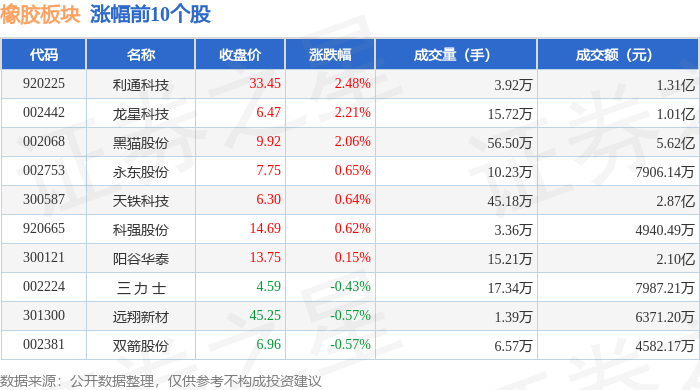
Market Overview - The rubber sector experienced a decline of 0.53% on November 11, with Kexin New Source leading the drop [1] - The Shanghai Composite Index closed at 4002.76, down 0.39%, while the Shenzhen Component Index closed at 13289.0, down 1.03% [1] Stock Performance - Notable gainers in the rubber sector included: - Litong Technology (code: 920225) with a closing price of 45.03, up 6.30% and a trading volume of 71,000 shares, totaling 312 million yuan [1] - Sanwei Equipment (code: 920834) with a closing price of 18.48, up 2.55% and a trading volume of 81,000 shares, totaling 146 million yuan [1] - Other stocks with minor gains included Yongdong Co., Ltd. (code: 002753) up 1.61% and Yuanchuang New Materials (code: 301300) up 0.64% [1] Fund Flow Analysis - The rubber sector saw a net outflow of 110 million yuan from main funds, while retail investors contributed a net inflow of 78.99 million yuan [2][3] - Key stocks with significant fund flow included: - Zhen'an Technology (code: 300767) with a main fund net inflow of 7.19 million yuan and a retail net outflow of 24.56 million yuan [3] - Haida Co., Ltd. (code: 300320) with a main fund net inflow of 6.71 million yuan and a retail net inflow of 1.74 million yuan [3] Individual Stock Highlights - Kexin New Source (code: 300731) closed at 42.57, down 3.25%, with a trading volume of 62,800 shares and a total transaction value of 271 million yuan [2] - Other notable decliners included Liangmao Co., Ltd. (code: 002068) down 1.85% and Yanggu Huatai (code: 300121) down 1.72% [2]
天然橡胶产业周报:弱预期的压力与偏强现实的支撑-20251111
Nan Hua Qi Huo· 2025-11-11 05:51
1. Report Industry Investment Rating - The report maintains a neutral view on the natural rubber industry in the medium to long term [2] 2. Core Viewpoints of the Report - Currently, the downstream automotive supporting production, sales, and exports are performing well, and the downstream operating rate is stable. The decline in rubber prices can drive manufacturers' rigid - demand purchases, providing effective support for the lower limit of rubber prices. However, the industrial chain inventory pressure is significant, leading to average downstream trading willingness, limited domestic demand growth, and existing export obstacles. In the medium to long term, the global total production capacity cycle has not fully reached its peak, and the supply pressure will increase. The stable demand expectation requires continuous macro - level benefits and actual implementation. The export growth, although resilient, still faces risks and challenges such as international situations and trade barriers [1][2] - In the future, rubber prices are expected to maintain a wide - range oscillation. In the short term, the valuation may increase with market fluctuations. The report suggests different trading strategies based on price trends and market conditions [1][14] 3. Summary According to Relevant Catalogs 3.1 Core Contradictions and Strategy Recommendations 3.1.1 Core Contradictions - The downstream automotive supporting production, sales, and exports are good, and the operating rate is stable. The decline in rubber prices can drive rigid - demand purchases, providing support for the lower limit of rubber prices. However, the industrial chain inventory pressure is large, domestic demand growth is limited, and export obstacles exist. The market expects an increase in natural rubber supply, and the abundant supply and weak cost of synthetic rubber drag down the overall valuation of the rubber system [1] - In the medium to long term, the global production capacity cycle has not peaked, and the supply pressure will increase. Stable demand requires continuous macro - level benefits. The export growth faces risks from international situations and trade barriers [2] 3.1.2 Trading Strategy Recommendations - **Price Range and Trend Judgement**: The short - term reference oscillation range for RU2601 is 14900 - 15300, and for NR2511 is 12000 - 12400. It is expected to maintain an oscillatory trend, with short - term sentiment possibly warming up, but the pressure from the weak supply - demand expectation still exists [14] - **Strategy Suggestions**: For the short - term, take a bullish view with a focus on upper pressure levels. Consider hedging strategies such as combining protective options or using a long - volatility strategy. Hold the RU spot - futures positive arbitrage and pay attention to warehouse receipt changes. For NR, pay attention to high - level reverse arbitrage opportunities. For the 01 combination of the depth - difference spread, adopt a strategy of expanding the spread when the price is low [15] 3.1.3 Industry Customer Operation Suggestions - **Price Forecast**: The predicted price range for rubber RU in the next two weeks is 14800 - 15700, and for 20 - grade rubber NR is 11900 - 12700 [18] - **Risk Management Strategy**: For inventory management, adopt strategies such as shorting rubber futures, buying out - of - the - money put options, and selling call options. For procurement management, consider buying rubber far - month futures, buying out - of - the - money call options, and selling put options [18] 3.2 Important Information and Focus Events 3.2.1 Last Week's Important Information - **Positive Information**: In October, the CPI and core CPI showed positive changes. The auto consumption index was high, and the sales of heavy - duty trucks and new - energy passenger vehicles increased. There were favorable weather conditions and positive progress in Sino - US economic and trade relations [20][21] - **Negative Information**: The EU launched an anti - subsidy investigation on Chinese tires. The rubber production in Thailand is expected to increase, and China's rubber imports increased. There were declines in the European replacement tire market and some negative macro - economic factors [22][24] 3.2.2 This Week's Focus Points - Pay attention to rainfall in rubber - producing areas and its impact on raw material supply, changes in dry - rubber imports and exports and social inventory, downstream tire export data and operating rate, and important macro - economic data and events [26] 3.3 Disk Interpretation 3.3.1 Price, Volume, and Capital Interpretation - **Unilateral Trend**: Last week, rubber prices stabilized and rebounded after falling to the lower limit of the range. RU01 stabilized around 15000, and NR01 returned to around 12000. RU positions increased steadily, and NR positions rebounded slightly [28] - **Capital Movement**: In terms of profitable positions on the disk, the long and short positions of RU were stable, while the short positions of NR made more profits with a decrease in positions [31] 3.3.2 Spot Market and Spread Analysis - **Spot Price Changes**: Last Friday, spot prices generally declined, with relatively large declines in whole - milk, Indian - standard, and Vietnamese No. 10 standard rubber [35] - **Term Structure Analysis**: - **Basis Changes**: Last week, the overall center of gravity of RU shifted downward, and the near - term contracts strengthened relatively. The 11 - 01 spread continued positive arbitrage. NR prices fell, and the back structure deepened [48][49] - **Month - spread Structure**: The Tocom RSS3 price decline led to a weakening of near - month contracts, and the C structure deepened. The Singapore TRES20 rubber price slightly increased, and the structure was flat [56] - **Internal - External Spread**: The spread between RU and Japanese smoked - sheet rubber futures narrowed, and the spread between NR and Singapore standard rubber oscillated and narrowed [59] - **Virtual - to - Physical Ratio and Sentiment Index**: Recently, the rubber market sentiment has fluctuated greatly, with a neutral sentiment last week. The downstream tire demand sentiment slightly improved. Currently, the RU warehouse receipts are low, and the virtual - to - physical ratio continues to rise, while the NR virtual - to - physical ratio has decreased compared to the previous period [64][65] - **Variety Spread Analysis**: - **Dry - rubber Spot Spread**: Last week, the depth - difference spread steadily widened, and the relative valuation of whole - milk rubber was further repaired. The supply pressure of standard products may increase in the future, and attention should be paid to domestic weather and downstream production and sales [66] - **Natural and Synthetic Rubber Spread**: Last week, the operating rate of high - cis butadiene rubber decreased, while the operating rates of butadiene and styrene - butadiene rubber recovered. The supply pressure of synthetic rubber was strong, and the spread between natural and synthetic rubber remained high [70] 3.4 Valuation and Profit Analysis 3.4.1 Industrial Chain Profit Tracking - **Raw Material Cost**: Last week, rain in Hainan and southern Thailand affected raw material prices, with prices remaining firm in Hainan and southern Thailand, and weakening in Yunnan. The water - cup price difference in Thailand rebounded [72] - **Processing Profit**: The delivery profit of whole - milk rubber was similar to last week, and the profit of TSR9710 slightly declined. The import profit of Thai smoked - sheet rubber was flat, while the profits of Thai standard rubber and mixed rubber decreased and then slightly recovered [81][83] 3.5 Supply - Demand and Inventory Deduction 3.5.1 Supply Side - **Production in Main Producing Countries**: The natural rubber production in Thailand, Indonesia, Malaysia, Vietnam, China, and India shows seasonal characteristics [86] - **Import Situation**: In October, China's imports of natural and synthetic rubber increased year - on - year but decreased month - on - month [87] 3.5.2 Demand Side - **Total Demand in Main Producing Countries**: In September, except for India, the total demand in main producing countries decreased month - on - month. The consumption in Malaysia and Indonesia in September was higher than the same period, but the cumulative volume remained low [90] - **Tire Production and Sales**: Last week, the operating rate of most tire enterprises returned to normal. The sales of all - steel and semi - steel tires showed different trends, and tire exports were resilient but faced challenges such as EU anti - subsidy investigations [93] - **Replacement Demand**: The domestic logistics industry has been stable this year, but the slowdown in fixed - asset investment may suppress the growth of replacement demand in the long term [98] - **Supporting Demand - Automobiles**: Domestic passenger car sales have been strong, and commercial vehicle sales have also increased year - on - year. Automobile exports have increased both month - on - month and year - on - year [100][102] - **Supporting Demand - Heavy - duty Trucks and Construction Machinery**: The production of heavy - duty trucks has increased this year, and the cumulative year - on - year growth of construction machinery's domestic sales and exports is 11.24%. In the long term, the growth of new demand for trucks may be limited [107] - **Overseas Tire Production**: Japan's tire production has been stable this year, and Thailand's tire shipment index has increased year - on - year [109] - **Overseas Tire Demand**: US tire imports have increased despite a decline in auto sales. European passenger car production and sales are stable, while commercial vehicle production has decreased significantly. The production and export of Japanese and South Korean automobiles show different trends [111] - **Other Rubber Product Demand**: In October, the operating rate of domestic conveyor belts decreased to a five - year low, while the operating rate of rubber hoses was relatively good year - on - year [127] 3.5.3 Inventory Side - **Futures Inventory**: Affected by weather, RU warehouse receipts continued to decline, while NR warehouse receipts increased due to stable rubber imports and high downstream wait - and - see sentiment [130] - **Social Inventory**: As of November 9, 2025, the total inventory of natural rubber in Qingdao increased slightly, with a decrease in bonded - area inventory and an increase in general - trade inventory [132]
化工日报:青岛港口库存环比继续回升-20251111
Hua Tai Qi Huo· 2025-11-11 02:57
1. Report Industry Investment Ratings - RU and NR: Neutral [12] - BR: Cautiously bearish [12] 2. Core Views of the Report - For natural rubber, the supply of raw materials is expected to increase significantly as rainfall decreases in major production areas, which may lead to a decline in raw material prices. Although the cost support is strong, the supply - demand drive is weak. The supply pressure of RU may be less than that of NR in the later stage, which is beneficial for the spread between RU and NR to continue to widen. [12] - For butadiene rubber, the supply is expected to increase this week, while the downstream demand is lackluster and the downstream production is restricted in some areas. The supply - demand situation has weakened, and the price is expected to follow the weak trend of butadiene. [12] 3. Summary by Related Catalogs Market News and Data - Futures: On the previous trading day, the closing price of the RU main contract was 15,110 yuan/ton, up 115 yuan/ton; the NR main contract was 12,165 yuan/ton, up 130 yuan/ton; the BR main contract was 10,275 yuan/ton, up 85 yuan/ton. [1] - Spot: The price of Yunnan - produced whole latex in the Shanghai market was 14,600 yuan/ton, up 100 yuan/ton. The price of Thai mixed rubber in Qingdao Free Trade Zone was 14,650 yuan/ton, up 100 yuan/ton. The price of Thai 20 - grade standard rubber in Qingdao Free Trade Zone was 1,850 US dollars/ton, up 20 US dollars/ton. The price of Indonesian 20 - grade standard rubber in Qingdao Free Trade Zone was 1,715 US dollars/ton, up 10 US dollars/ton. The ex - factory price of BR9000 of PetroChina Qilu Petrochemical was 10,200 yuan/ton, unchanged; the market price of BR9000 of Zhejiang Chuanhua was 10,200 yuan/ton, unchanged. [1] Market Information - Heavy - truck market: In October 2025, about 93,000 heavy - trucks were sold in China, a month - on - month decrease of about 12% and a year - on - year increase of about 40%. From January to October, the cumulative sales volume exceeded 916,000 vehicles, a year - on - year increase of about 22%, and it is expected to exceed 1 million vehicles after November. [2] - Global natural rubber: In September 2025, the global natural rubber production was expected to increase by 5% to 1.433 million tons, a month - on - month decrease of 1%; the consumption was expected to decrease by 3.3% to 1.274 million tons, a month - on - month increase of 1.2%. In the first three quarters, the cumulative production was expected to increase by 2.3% to 10.374 million tons, and the cumulative consumption was expected to decrease by 1.5% to 11.422 million tons. [2] - China's natural rubber imports: In September 2025, China's natural rubber imports were 595,900 tons, a month - on - month increase of 14.41% and a year - on - year increase of 20.92%. From January to September, the cumulative import volume was 4.7172 million tons, a cumulative year - on - year increase of 19.65%. [2] - Thailand's natural rubber exports: In the first three quarters of 2025, Thailand's natural rubber exports (excluding compound rubber) totaled 1.993 million tons, a year - on - year decrease of 8%. From January to September, the exports to China totaled 759,000 tons, a year - on - year increase of 6%. [3] - China's automobile production and sales: In September, China's automobile production and sales were 3.276 million and 3.226 million vehicles respectively, a month - on - month increase of 16.4% and 12.9%, and a year - on - year increase of 17.1% and 14.9%. [4] - China's rubber tire exports: In the first three quarters of 2025, China's rubber tire export volume reached 7.28 million tons, a year - on - year increase of 5%; the export value was 127.7 billion yuan, a year - on - year increase of 4.2%. [4] - EU passenger car market: In September 2025, the EU passenger car market sales increased by 10% to 888,672 vehicles. The cumulative sales in the first three quarters increased by 0.9% year - on - year to 8.06 million vehicles. [4] Market Analysis Natural Rubber - Spot and spreads: On November 10, 2025, the RU basis was - 510 yuan/ton (- 15), the spread between the RU main contract and mixed rubber was 460 yuan/ton (+ 15), the NR basis was 943.00 yuan/ton (+ 15.00). [6] - Raw materials: The price of Thai smoked sheets was 59.29 Thai baht/kg (+ 0.34), the price of Thai latex was 56.30 Thai baht/kg (unchanged), the price of Thai cup lump was 51.90 Thai baht/kg (- 1.40), and the spread between Thai latex and cup lump was 4.10 Thai baht/kg (+ 1.40). [7] - Operating rates: The operating rate of all - steel tires was 65.37% (+ 0.03%), and the operating rate of semi - steel tires was 72.89% (+ 0.77%). [8] - Inventories: The social inventory of natural rubber was 449,455 tons (+ 1,787), the inventory of natural rubber at Qingdao Port was 1,056,012 tons (+ 17,061), the RU futures inventory was 118,970 tons (- 1,930), and the NR futures inventory was 48,586 tons (+ 3,931). [8] Butadiene Rubber - Spot and spreads: On November 10, 2025, the BR basis was - 175 yuan/ton (- 185), the ex - factory price of butadiene from Sinopec was 6,900 yuan/ton (unchanged). [9] - Operating rates: The operating rate of high - cis butadiene rubber was 66.02% (- 0.88%). [10] - Inventories: The inventory of butadiene rubber traders was 3,520 tons (- 160), and the inventory of butadiene rubber enterprises was 25,770 tons (- 1,430). [11] Strategy - For RU and NR, the outlook is neutral. The supply of raw materials is expected to increase, but the cost support is strong, and the supply - demand drive is weak. It is recommended to pay attention to the reverse spread between RU01 and RU05. The spread between RU and NR is expected to widen. [12] - For BR, it is cautiously bearish. The supply is expected to increase, the downstream demand is lackluster, and the price is expected to follow the weak trend of butadiene. [12]
能源化工期权策略早报:能源化工期权-20251111
Wu Kuang Qi Huo· 2025-11-11 02:03
1. Report Industry Investment Rating - No information provided in the content 2. Core Viewpoints of the Report - The energy - chemical sector is divided into energy, alcohols, polyolefins, rubber, polyesters, alkalis, and others. Strategies are recommended for selected options in each sector [8]. - A seller - based options portfolio strategy and spot hedging or covered strategies are constructed to enhance returns [2]. 3. Summary by Relevant Catalogs 3.1 Market Overview of Underlying Futures - Information on the latest price, price change, percentage change, trading volume, volume change, open interest, and open interest change of various energy - chemical option underlying futures is presented, including crude oil, LPG, methanol, etc [3]. 3.2 Option Factors - Volume and Open Interest PCR - The volume PCR and open interest PCR of various energy - chemical options are provided, which can be used to analyze the strength of the underlying option market and the turning point of the market [4]. 3.3 Option Factors - Pressure and Support Levels - The pressure points, pressure point offsets, support points, support point offsets, maximum call option open interest, and maximum put option open interest of various energy - chemical options are given, which can help analyze the pressure and support levels of the underlying options [5]. 3.4 Option Factors - Implied Volatility - The at - the - money implied volatility, weighted implied volatility, change in weighted implied volatility, annual average implied volatility, call option implied volatility, put option implied volatility, 20 - day historical volatility, and difference between implied and historical volatility of various energy - chemical options are presented [6]. 3.5 Option Strategies and Recommendations 3.5.1 Crude Oil Options - Fundamental analysis shows that US refinery demand has stabilized and recovered, shale oil production has slightly increased, OPEC exports have increased, and European refinery demand is about to enter the peak season [7]. - The option implied volatility has decreased to near the average, the open interest PCR is below 0.80, indicating a weak market. The pressure level is 500 and the support level is 450 [7]. - Directional strategy: None. Volatility strategy: Construct a short - biased call + put option combination strategy. Spot long - hedging strategy: Construct a long collar strategy [7]. 3.5.2 LPG Options - The cost - end crude oil is under pressure from oversupply and geopolitical issues. LPG has shown a market trend of over - sold rebound and slight consolidation [9]. - The option implied volatility has dropped significantly to below the average, the open interest PCR is around 0.80, indicating a weak market. The pressure level is 4550 and the support level is 4200 [9]. - Directional strategy: None. Volatility strategy: Construct a neutral - biased call + put option combination strategy. Spot long - hedging strategy: Construct a long collar strategy [9]. 3.5.3 Methanol Options - Port and enterprise inventories are high and difficult to deplete significantly in the short term. Methanol has shown a weak downward trend [9]. - The option implied volatility fluctuates around the historical average, the open interest PCR is below 0.80, indicating a weak and volatile market. The pressure level is 2200 and the support level is 2050 [9]. - Directional strategy: Construct a bearish spread combination strategy of put options. Volatility strategy: Construct a short - biased call + put option combination strategy. Spot long - hedging strategy: Construct a long collar strategy [9]. 3.5.4 Ethylene Glycol Options - Port and downstream factory inventories are high, and the port inventory is expected to continue the accumulation cycle. Ethylene glycol has shown a weak market trend [10]. - The option implied volatility fluctuates below the average, the open interest PCR is around 0.70, indicating strong short - selling power. The pressure level is 4500 and the support level is 4050 [10]. - Directional strategy: Construct a bearish spread combination strategy of put options. Volatility strategy: Construct a short - volatility strategy. Spot long - hedging strategy: Hold a spot long position + buy a put option + sell an out - of - the - money call option [10]. 3.5.5 Polypropylene Options - PE and PP inventories have different trends. Polypropylene has shown a weak downward trend [10]. - The option implied volatility has decreased to near the average, the open interest PCR is around 0.70, indicating a weak market. The pressure level is 7000 and the support level is 6300 [10]. - Directional strategy: Construct a bearish spread combination strategy of put options. Volatility strategy: None. Spot long - hedging strategy: Hold a spot long position + buy an at - the - money put option + sell an out - of - the - money call option [10]. 3.5.6 Rubber Options - Exchange rubber warehouse receipts are at a ten - year low, and there is an expectation of inventory accumulation. Rubber has shown a weak consolidation trend [11]. - The option implied volatility has decreased to below the average after a sharp rise, the open interest PCR is below 0.60. The pressure level has dropped significantly to 16000 and the support level is 14500 [11]. - Directional strategy: None. Volatility strategy: Construct a short - biased call + put option combination strategy. Spot hedging strategy: None [11]. 3.5.7 PTA Options - PTA social inventory is accumulating, and although the polyester start - up will remain high, inventory accumulation is expected to continue. PTA has shown a rebound trend with pressure [11]. - The option implied volatility fluctuates at a relatively high level, the open interest PCR is around 0.70, indicating a volatile market. The pressure level is 4700 and the support level is 4300 [11]. - Directional strategy: None. Volatility strategy: Construct a neutral - biased call + put option combination strategy. Spot hedging strategy: None [11]. 3.5.8 Caustic Soda Options - The average utilization rate of caustic soda production capacity has increased. Caustic soda has shown a weak short - selling trend [12]. - The option implied volatility fluctuates at a relatively high level, the open interest PCR is below 0.80, indicating a weak and volatile market. The pressure level is 2600 and the support level is 2240 [12]. - Directional strategy: Construct a bearish spread combination strategy. Volatility strategy: None. Spot collar hedging strategy: Hold a spot long position + buy a put option + sell an out - of - the - money call option [12]. 3.5.9 Soda Ash Options - Soda ash factory inventory has increased. Soda ash has shown a low - level weak consolidation trend [1]. - The option implied volatility fluctuates at a relatively high historical level, the open interest PCR is below 0.60, indicating strong short - selling pressure. The pressure level is 1300 and the support level is 1100 [12]. - Directional strategy: Construct a bearish spread combination strategy. Volatility strategy: Construct a short - volatility combination strategy. Spot long - hedging strategy: Construct a long collar strategy [12]. 3.5.10 Urea Options - Enterprise inventory is at a high level, and port inventory has decreased. Urea has shown a low - level shock and rebound trend [13]. - The option implied volatility fluctuates around the historical average, the open interest PCR is below 0.60, indicating strong short - selling pressure. The pressure level is 1800 and the support level is 1600 [13]. - Directional strategy: None. Volatility strategy: Construct a neutral - biased call + put option combination strategy. Spot hedging strategy: Hold a spot long position + buy an at - the - money put option + sell an out - of - the - money call option [13].
能源化工日报-20251111
Wu Kuang Qi Huo· 2025-11-11 01:18
Report Industry Investment Rating No relevant content provided. Core Viewpoints of the Report - For crude oil, although the geopolitical premium has dissipated and OPEC's production increase is minimal with supply not yet surging, it's not advisable to be overly bearish on oil prices in the short - term. A range - trading strategy of buying low and selling high is maintained, but the current prices need to test OPEC's willingness to support prices through exports, so short - term waiting is recommended [3]. - For methanol, domestic production has increased, imports have risen, supply pressure has intensified, while demand has weakened. The high - inventory issue on the 01 contract will increasingly suppress spot prices. With no substantial short - term positive news from overseas supply, there may be further declines. However, the cost - effectiveness of short - selling after the sharp decline is low, and there is no clear driving force for long - positions, so waiting is advised [6]. - For urea, prices are consolidating at a low level with low volatility. The fundamentals lack a driving force. Supply has increased, demand is weak, and the supply - demand situation is relatively loose. Although the upside is limited, the downside is also restricted at these low prices, so waiting is recommended [9]. - For rubber, prices rebounded as expected. It's recommended to set a stop - loss and conduct short - term long - trades on pullbacks. A partial position for the hedging strategy of buying RU2601 and selling RU2609 is recommended [15]. - For PVC, the comprehensive profit of enterprises is at a low level this year, and valuation pressure is low in the short - term. However, supply is high, new devices are about to be commissioned, demand is weak, and exports are expected to decline, so there is a risk of continuous inventory accumulation. It's recommended to pay attention to short - selling opportunities in the medium - term [17]. - For pure benzene and styrene, the BZN spread is at a low level and has room for upward repair. The supply of pure benzene is relatively abundant, and the port inventory of styrene is decreasing significantly. Styrene prices may stop falling in the short - term [20]. - For polyethylene, OPEC+ plans to suspend production growth in Q1 2026, and the price of crude oil may have bottomed out. Although the downward space for PE valuation is limited, high - level warehouse receipts suppress the market. With the arrival of the seasonal peak season, demand may pick up, and prices are expected to fluctuate at a low level [23]. - For polypropylene, although the cost side indicates a potential increase in supply surplus, the downstream start - up rate has rebounded seasonally. With high inventory pressure and high - level warehouse receipts, the market may be supported when the supply - surplus situation on the cost side changes in Q1 next year [26]. - For PX, the current load is high, downstream PTA maintenance is frequent, and PTA processing fees are under pressure. It's expected to see a slight inventory increase in November, but it will be supported by aromatics blending and future supply - demand structure. It mainly follows crude oil fluctuations, and there may be opportunities for valuation increase in the medium - term [29]. - For PTA, supply is expected to increase due to new device commissioning and maintenance, and inventory is expected to accumulate in November. Although polyester demand may remain high, the upside is limited. Pay attention to the opportunity for PTA to strengthen driven by the increase in PXN in the medium - term [32]. - For ethylene glycol, domestic and overseas device loads are high, imports are increasing, and ports are starting to accumulate inventory. It's expected to see continuous inventory accumulation in Q4, and it's recommended to short - sell on rallies [34]. Summary by Related Catalogs Crude Oil - **Market Information**: The main INE crude oil futures closed up 4.90 yuan/barrel, or 1.07%, at 461.80 yuan/barrel. European ARA weekly data showed that gasoline, fuel oil, naphtha, and aviation kerosene inventories increased, while diesel inventory decreased. The total refined oil inventory increased by 1.73 million barrels to 45.27 million barrels, a 3.97% increase [2]. - **Strategy Viewpoint**: Although the geopolitical premium has dissipated and OPEC's production increase is minimal with supply not yet surging, it's not advisable to be overly bearish on oil prices in the short - term. A range - trading strategy of buying low and selling high is maintained, but the current prices need to test OPEC's willingness to support prices through exports, so short - term waiting is recommended [3]. Methanol - **Market Information**: The price in Taicang decreased by 30, in Inner Mongolia increased by 7.5, and in southern Shandong decreased by 10. The 01 contract on the futures market decreased by 11 yuan to 2101 yuan/ton, with a basis of - 41. The 1 - 5 spread was - 6, at - 107 [5]. - **Strategy Viewpoint**: Domestic production has increased, imports have risen, supply pressure has intensified, while demand has weakened. The high - inventory issue on the 01 contract will increasingly suppress spot prices. With no substantial short - term positive news from overseas supply, there may be further declines. However, the cost - effectiveness of short - selling after the sharp decline is low, and there is no clear driving force for long - positions, so waiting is advised [6]. Urea - **Market Information**: Spot prices in Shandong, Henan, and Hubei increased. The 01 contract on the futures market decreased by 7 yuan to 1660 yuan, with a basis of - 40. The 1 - 5 spread was - 5, at - 72 [8]. - **Strategy Viewpoint**: Prices are consolidating at a low level with low volatility. The fundamentals lack a driving force. Supply has increased, demand is weak, and the supply - demand situation is relatively loose. Although the upside is limited, the downside is also restricted at these low prices, so waiting is recommended [9]. Rubber - **Market Information**: The report previously suggested buying opportunities in rubber, and prices rebounded as expected. There are different views on the market. Bulls focus on factors such as limited production in Southeast Asia, seasonal trends, and improved demand expectations in China. Bears are concerned about uncertain macro - expectations, seasonal low demand, and potential under - performance of supply benefits. As of November 6, 2025, the operating rate of all - steel tires in Shandong increased, while that of semi - steel tires decreased. As of November 2, 2025, China's natural rubber social inventory increased. Spot prices of some rubber products increased [12][14]. - **Strategy Viewpoint**: Prices rebounded as expected. It's recommended to set a stop - loss and conduct short - term long - trades on pullbacks. A partial position for the hedging strategy of buying RU2601 and selling RU2609 is recommended [15]. PVC - **Market Information**: The PVC01 contract increased by 3 yuan to 4614 yuan. The spot price of Changzhou SG - 5 was 4520 yuan/ton, with a basis of - 94 yuan/ton. The 1 - 5 spread was - 295 yuan/ton. The overall operating rate of PVC increased, while the downstream operating rate decreased. Factory inventory decreased, and social inventory increased [15]. - **Strategy Viewpoint**: The comprehensive profit of enterprises is at a low level this year, and valuation pressure is low in the short - term. However, supply is high, new devices are about to be commissioned, demand is weak, and exports are expected to decline, so there is a risk of continuous inventory accumulation. It's recommended to pay attention to short - selling opportunities in the medium - term [17]. Pure Benzene and Styrene - **Market Information**: The spot and futures prices of pure benzene remained unchanged, with a stable basis. The spot and futures prices of styrene decreased, and the basis weakened. The upstream operating rate increased, and the port inventory decreased. The weighted operating rate of three S decreased, but the PS operating rate increased, while the EPS and ABS operating rates decreased [19]. - **Strategy Viewpoint**: The BZN spread is at a low level and has room for upward repair. The supply of pure benzene is relatively abundant, and the port inventory of styrene is decreasing significantly. Styrene prices may stop falling in the short - term [20]. Polyethylene - **Market Information**: The main contract closing price of polyethylene was 6802 yuan/ton, and the spot price was 6850 yuan/ton, both unchanged. The upstream operating rate decreased, and inventory increased. The downstream average operating rate decreased. The LL1 - 5 spread widened [22]. - **Strategy Viewpoint**: OPEC+ plans to suspend production growth in Q1 2026, and the price of crude oil may have bottomed out. Although the downward space for PE valuation is limited, high - level warehouse receipts suppress the market. With the arrival of the seasonal peak season, demand may pick up, and prices are expected to fluctuate at a low level [23]. Polypropylene - **Market Information**: The main contract closing price of polypropylene increased by 16 yuan to 6480 yuan, while the spot price remained unchanged. The upstream operating rate decreased, and inventory increased. The downstream average operating rate increased. The LL - PP spread narrowed [25]. - **Strategy Viewpoint**: Although the cost side indicates a potential increase in supply surplus, the downstream start - up rate has rebounded seasonally. With high inventory pressure and high - level warehouse receipts, the market may be supported when the supply - surplus situation on the cost side changes in Q1 next year [26]. PX - **Market Information**: The PX01 contract increased by 72 yuan to 6852 yuan. The PX CFR price increased by 5 dollars to 828 dollars. The basis was - 90 yuan, and the 1 - 3 spread was 24 yuan. The PX operating rate in China and Asia increased. Some domestic and overseas devices restarted. The PTA operating rate decreased. PX imports from South Korea to China increased in October, and inventory increased at the end of September [28]. - **Strategy Viewpoint**: The current load is high, downstream PTA maintenance is frequent, and PTA processing fees are under pressure. It's expected to see a slight inventory increase in November, but it will be supported by aromatics blending and future supply - demand structure. It mainly follows crude oil fluctuations, and there may be opportunities for valuation increase in the medium - term [29]. PTA - **Market Information**: The PTA01 contract increased by 40 yuan to 4704 yuan. The East China spot price increased by 30 yuan/ton to 4605 yuan. The basis was - 78 yuan, and the 1 - 5 spread was - 58 yuan. The PTA operating rate decreased, and the downstream operating rate decreased slightly. Social inventory increased in October [30]. - **Strategy Viewpoint**: Supply is expected to increase due to new device commissioning and maintenance, and inventory is expected to accumulate in November. Although polyester demand may remain high, the upside is limited. Pay attention to the opportunity for PTA to strengthen driven by the increase in PXN in the medium - term [32]. Ethylene Glycol (EG) - **Market Information**: The EG01 contract increased by 11 yuan to 3953 yuan. The East China spot price decreased by 10 yuan to 4003 yuan. The basis was 70 yuan, and the 1 - 5 spread was - 74 yuan. The supply - side operating rate decreased, and the downstream operating rate decreased slightly. Port inventory increased [33]. - **Strategy Viewpoint**: Domestic and overseas device loads are high, imports are increasing, and ports are starting to accumulate inventory. It's expected to see continuous inventory accumulation in Q4, and it's recommended to short - sell on rallies [34].