
公用事业

Search documents
25.32亿元资金今日流出公用事业股
Zheng Quan Shi Bao Wang· 2025-07-15 10:16
沪指7月15日下跌0.42%,申万所属行业中,今日上涨的有6个,涨幅居前的行业为通信、计算机,涨幅 分别为4.61%、1.42%。跌幅居前的行业为煤炭、农林牧渔,跌幅分别为1.92%、1.62%。公用事业行业 位居今日跌幅榜第三。 资金面上看,两市主力资金全天净流出411.86亿元,主力资金净流入的行业仅有3个,通信行业净流入 资金21.51亿元;计算机行业净流入资金18.39亿元;综合行业净流入资金178.56万元。 主力资金净流出的行业有28个,电力设备行业主力资金净流出规模居首,全天净流出资金50.55亿元, 其次是有色金属行业,净流出资金为45.08亿元,净流出资金较多的还有基础化工、医药生物、国防军 工等行业。 公用事业行业今日下跌1.60%,全天主力资金净流出25.32亿元,该行业所属的个股共131只,今日上涨 的有6只;下跌的有123只,跌停的有2只。以资金流向数据进行统计,该行业资金净流入的个股有29 只,其中,净流入资金超千万元的有6只,净流入资金居首的是新中港,今日净流入资金1.09亿元,紧 随其后的是长江电力、协鑫能科,净流入资金分别为9673.34万元、4901.54万元。公用事业行业 ...
2025年上半年经济数据点评:5.3%的预期与现实
Minsheng Securities· 2025-07-15 09:15
Economic Growth - China's GDP for the first half of the year reached 66,053.6 billion yuan, with a year-on-year growth of 5.3%[3] - The GDP growth rate for the second quarter was 5.2%, slightly lower than the first quarter's 5.4%[3] - A projected growth rate of 4.7% in the second half would still allow for achieving the annual target of around 5%[4] Trade and International Relations - China's GDP share relative to the US is expected to recover, which is crucial amid current international trade tensions[4] - The resilience shown in China's economy may provide leverage in trade negotiations, especially with the US increasing tariffs on other economies[4] Consumption Trends - Retail sales showed a decline in June, influenced by the end of the "618" shopping festival and high base effects from last year[5] - Restaurant income saw a significant drop in June, with a year-on-year decrease attributed to high base effects and competitive pressures from platforms like JD and Meituan[5] Industrial Performance - Industrial production exceeded expectations, with June's industrial value-added growth recorded at 6.8%, driven by a surge in exports[5] - However, the industrial capacity utilization rate fell to 74.0% in the second quarter, indicating potential pressures on future production[7] Investment Insights - Manufacturing investment growth slowed to 5.1% in June, reflecting weakened private sector confidence and investment activity[7] - Infrastructure investment growth decreased to 5.3% in June, primarily due to declines in public utilities and environmental sectors[8] Real Estate Market - The real estate market is under pressure compared to the previous year, with investment growth declining and sales in 30 cities dropping significantly[8] - Despite improvements in certain real estate indicators, the overall investment trend remains negative, indicating ongoing challenges in the sector[8]
大众公用:预计上半年净利润同比大增超145%,ESG优势铸就长期竞争力
Zheng Quan Shi Bao Wang· 2025-07-15 08:53
Group 1 - The company expects a significant increase in net profit for the first half of 2025, projecting a range of 300 million to 420 million yuan, representing a year-on-year growth of 145.59% to 243.82% [1] - The growth is driven by stable development in its main public utility business and positive impacts from fair value fluctuations of financial assets held through joint ventures [1][2] - The company has a strong market presence in the urban gas sector, holding nearly 40% and over 99% market shares in Shanghai and Nantong, respectively, showcasing its regional monopoly advantage [2] Group 2 - The company operates nine wastewater treatment plants in Shanghai and Jiangsu, with a total treatment capacity of 46.5 million tons per day, demonstrating its technical strength in the environmental sector [2] - The company has invested in over 1,500 enterprises through its stake in Shenzhen Capital Group, with a cumulative investment exceeding 120 billion yuan, ranking high in the domestic venture capital industry [2] - The company has received multiple awards for its excellence in ESG practices, including recognition for its leadership and environmental friendliness, reflecting its commitment to sustainable development [3] Group 3 - The company plans to continue its steady growth in public utility services while actively expanding into venture capital and other business areas, leveraging its ESG advantages to create greater value [4]

2025年上半年经济数据点评:5.3%的预期与现实相关研究
Minsheng Securities· 2025-07-15 07:01
Economic Overview - The GDP for the first half of 2025 is reported at 66,053.6 billion yuan, reflecting a year-on-year growth of 5.3%, with Q1 growth at 5.4% and Q2 at 5.2% [1][2] - The resilience of China's GDP against the backdrop of international trade tensions is expected to provide a strategic advantage, particularly in the context of tariff escalations by the US [1][2] Policy Implications - The current economic growth rate reduces the urgency for aggressive policy adjustments, as a projected growth of 4.7% in the second half would still meet the annual target of around 5% [2] - The report highlights a potential risk of economic divergence, with a repeat of last year's trend of strong production but weak consumption, particularly influenced by real estate price declines and reduced policy support [2][3] Consumption Trends - Retail sales showed signs of recovery, driven by the "trade-in" policy, particularly in categories like home appliances and automobiles, although there are concerns about base effects impacting growth in the latter half of the year [3][4] - A significant decline in restaurant revenues in June is attributed to high base effects from the previous year, changes in statistical methodologies, and increased competition among platforms like JD and Meituan [3][4] Industrial Performance - Industrial production exceeded expectations due to a surge in exports, with June's industrial value-added growth recorded at 6.8% [3][4] - However, the report notes a decline in capacity utilization rates across several industries, indicating potential pressures on future industrial output [6][22] Investment Insights - Manufacturing investment growth has slowed, with June's year-on-year growth at 5.1%, reflecting weakened private sector confidence and investment activity [6][25] - Infrastructure investment remains crucial, with a resilient performance in the first half of the year, although growth rates have recently declined [6][29] Real Estate Market - The real estate sector is under pressure compared to the previous year, with a clear trend of focusing on existing stock rather than new developments [6][34] - Despite improvements in sales and construction metrics compared to last year, recent data indicates a decline in transactions in major cities since July [6][34]
超4600只个股下跌
第一财经· 2025-07-15 04:10
Core Viewpoint - The market shows mixed performance with the Shanghai Composite Index declining while the ChiNext Index rises, indicating a divergence in sector performance and investor sentiment [1][2]. Market Performance - As of the midday close, the Shanghai Composite Index is at 3486.88 points, down 0.93%, the Shenzhen Component Index at 10657.22 points, down 0.26%, and the ChiNext Index at 2211.03 points, up 0.64% [1][2]. - Overall, more than 4600 stocks in the market are experiencing declines, reflecting a bearish sentiment [2]. Sector Performance - The CPO sector is performing strongly, with active performance in liquid-cooled servers and Nvidia-related concepts, while coal mining, energy metals, and the power sector are among the worst performers [4]. Capital Flow - Main capital flows show a net inflow into sectors such as telecommunications, electronics, and computers, while public utilities, pharmaceuticals, and food and beverage sectors are seeing net outflows [6]. - Specific stocks with significant net inflows include Xinyi Technology (26.96 billion), Leo Group (17.58 billion), and Zhongji Xuchuang (17.34 billion) [7]. - Conversely, stocks facing substantial net outflows include Kweichow Moutai (10.42 billion), Baosteel (7.35 billion), and Changshan Pharmaceutical (6.85 billion) [8]. Institutional Insights - Analysts from Zhongtai Securities suggest that the market's performance this week is better than expected, with active funds likely to return as mid-year reports are released. They recommend identifying sectors where institutional and active funds may converge [10]. - The investment director from Qianhai Boben Fund indicates that while the market is adjusting, the overall adjustment space is limited, with significant support around the 10 and 20-day moving averages. They advise buying on dips, focusing on sectors that are likely to rotate and rebound [10].


浙商证券浙商早知道-20250715
ZHESHANG SECURITIES· 2025-07-14 23:30
Market Overview - On July 14, the Shanghai Composite Index rose by 0.27%, the CSI 300 increased by 0.07%, the STAR 50 fell by 0.21%, the CSI 1000 rose by 0.02%, and the ChiNext Index decreased by 0.45% [4] - The best-performing sectors on July 14 were machinery equipment (+1.23%), comprehensive (+1.04%), public utilities (+1.04%), household appliances (+1.02%), and oil and petrochemicals (+0.86%). The worst-performing sectors were real estate (-1.29%), media (-1.24%), non-bank financials (-1.03%), retail (-0.94%), and computers (-0.88%) [4][3] - The total trading volume for the entire A-share market on July 14 was 1,480.9 billion yuan, with a net inflow of 8.243 billion Hong Kong dollars from southbound funds [4][3] Industry Insights - The report highlights the dual opportunities presented by HVDC (High Voltage Direct Current) and the AI wave, indicating a new investment trend in AIDC (Artificial Intelligence Data Center) [5] - HVDC is expected to open up growth opportunities, while the demand for backup power sources in the generator segment is on the rise due to supply shortages [5] - Investment opportunities include the high value of power supply systems and the increasing density of AI computing chips driving HVDC iterations, alongside the upward trend in generator backup power demand [5]
数据复盘丨PEEK材料、人形机器人等概念走强 37股获主力资金净流入超1亿元
Zheng Quan Shi Bao Wang· 2025-07-14 10:52
Market Overview - The Shanghai Composite Index closed at 3519.65 points, up 0.27%, with a trading volume of 623.1 billion yuan [1] - The Shenzhen Component Index closed at 10684.52 points, down 0.11%, with a trading volume of 835.6 billion yuan [1] - The ChiNext Index closed at 2197.07 points, down 0.45%, with a trading volume of 387.28 billion yuan [1] - The STAR Market 50 Index closed at 992.39 points, down 0.21%, with a trading volume of 22.92 billion yuan [1] - Total trading volume for both markets was 1458.75 billion yuan, a decrease of 253.38 billion yuan from the previous trading day [1] Sector Performance - Strong sectors included machinery, public utilities, oil and petrochemicals, textiles, chemicals, non-ferrous metals, and pharmaceuticals [2] - Active concepts included PEEK materials, humanoid robots, geothermal energy, and innovative drugs [2] - Weak sectors included real estate, media, securities, education, insurance, and retail [2] Fund Flow - The net outflow of main funds from the Shanghai and Shenzhen markets was 26.576 billion yuan [3] - The net outflow from the ChiNext was 12.112 billion yuan, and from the CSI 300 was 6.366 billion yuan [4] - Only four sectors saw net inflows: machinery (394 million yuan), home appliances (117 million yuan), coal (38 million yuan), and oil and petrochemicals (37 million yuan) [4] Individual Stock Performance - A total of 2089 stocks saw net inflows, with 37 stocks receiving over 100 million yuan in net inflows [5] - The stock with the highest net inflow was Zhongji Xuchuang, with 497 million yuan [6] - Conversely, 3048 stocks experienced net outflows, with 92 stocks seeing over 100 million yuan in net outflows [7] - BYD had the highest net outflow at 1.308 billion yuan [8] Institutional Activity - Institutions had a net buy of approximately 33.89 million yuan, with 17 stocks being net bought and 14 stocks net sold [9] - The stock with the highest institutional net buy was Xiangyang Bearing, with about 111 million yuan [10]



【14日资金路线图】两市主力资金净流出超260亿元 公用事业等行业实现净流入
证券时报· 2025-07-14 10:51
7月14日,A股市场表现分化。 截至收盘,上证指数收报3519.65点,上涨0.27%;深证成指收报10684.52点,下跌0.11%;创业板指收报2197.07点,下跌0.45%。两市合计 成交14587.39亿元,较上一交易日减少2533.8亿元。 2. 创业板主力资金净流出超120亿元 沪深300今日主力资金净流出63.66亿元,创业板主力资金净流出121.12亿元。 | | | 各板块最近五个交易日主力资金净流入数据(亿元) | | | --- | --- | --- | --- | | 日期 | 沪深300 | 创业板 | 科创板 | | 2025-7-14 | -63.66 | -121. 12 | -0. 09 | | 2025-7-11 | -18. 31 | -32. 61 | -13.56 | | 2025-7-10 | 4. 70 | -102. 46 | 2. 14 | | 2025-7-9 | -45. 53 | -148. 15 | 3.88 | | 2025-7-8 | 57.92 | 59. 68 | -7.82 | | | | 尾盘资金净流入数据(亿元) | | | 2025 ...

公用事业行业资金流入榜:晋控电力、华电辽能等净流入资金居前
Zheng Quan Shi Bao Wang· 2025-07-14 09:52
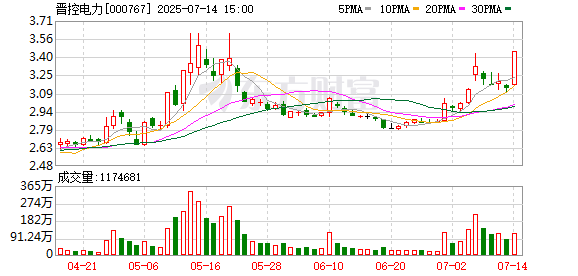
Market Overview - The Shanghai Composite Index rose by 0.27% on July 14, with 21 out of 28 sectors experiencing gains. The leading sectors were machinery and public utilities, with increases of 1.23% and 1.04% respectively. Conversely, the real estate and media sectors saw declines of 1.29% and 1.24% [2]. Fund Flow Analysis - The net outflow of capital from the two markets was 38.111 billion yuan, with six sectors experiencing net inflows. The machinery sector led with a net inflow of 539 million yuan, followed by public utilities with a net inflow of 336 million yuan [2]. - A total of 25 sectors experienced net capital outflows, with the computer sector leading at 8.506 billion yuan, followed by the non-bank financial sector at 7.029 billion yuan. Other sectors with significant outflows included metals, electronics, and media [2]. Public Utilities Sector Performance - The public utilities sector saw a rise of 1.04%, with a total net inflow of 336 million yuan. Out of 131 stocks in this sector, 109 rose, and six hit the daily limit. There were 19 stocks that declined [3]. - Among the stocks with net inflows, seven had inflows exceeding 50 million yuan, with Jin控电力 leading at 180 million yuan, followed by 华电辽能 and 建投能源 with inflows of 140 million yuan and 86.605 million yuan respectively [3]. - The stocks with the highest net outflows included 南网储能, 国电电力, and 中国广核, with outflows of 61.156 million yuan, 56.419 million yuan, and 48.944 million yuan respectively [3][6]. Top Gainers in Public Utilities - The top gainers in the public utilities sector included: - 晋控电力: +9.87%, net inflow of 179.634 million yuan [4] - 华电辽能: +9.92%, net inflow of 139.675 million yuan [5] - 建投能源: +9.97%, net inflow of 86.605 million yuan [5] Top Losers in Public Utilities - The top losers in the public utilities sector included: - 南网储能: -1.09%, net outflow of 61.156 million yuan [6] - 国电电力: +0.42%, net outflow of 56.419 million yuan [6] - 中国广核: +1.36%, net outflow of 48.944 million yuan [6]



大众公用:预计2025年上半年净利润同比增长145.59%-243.82%
news flash· 2025-07-14 08:21
大众公用(600635)公告,预计2025年半年度实现归属于母公司所有者的净利润为3亿元到4.2亿元,与 上年同期相比,将增加1.78亿元到2.98亿元,同比增加145.59%到243.82%。预计2025年半年度实现归属 于母公司所有者的扣除非经常性损益的净利润为2.1亿元到3亿元,与上年同期相比,将增加1.01亿元到 1.91亿元,同比增加92.94%到175.63%。本报告期内,公司公用事业等主营业务保持稳定发展,且直接 和间接通过联营公司持有的金融资产因公允价值波动,导致公司业绩较上年同期有较大幅度上升。 ...