债券

Search documents
ESG投资周报:本月新发8只ESG基金,流动性环比宽松-20250923
GUOTAI HAITONG SECURITIES· 2025-09-23 12:29
Fund Issuance - Eight new ESG funds were launched this month, with a total issuance of 3.749 billion units, primarily focused on social responsibility and environmental protection[9] - A total of 251 ESG public funds were issued in the past year, with a total issuance of 175.353 billion units[9] - The total net asset value of existing ESG funds reached 1,029.312 billion RMB, with ESG strategy funds accounting for the largest share at 50.46%[11] Market Performance - During the week of September 15-19, 2025, the CSI 300 index fell by 0.44%, while the ESG 300 index rose by 0.39%[5] - The average daily trading volume in the A-share market was approximately 2.52 trillion RMB, indicating a loosening of liquidity[5] Green Bonds - A total of 43 new green bonds were issued in the interbank and exchange markets last week, with a planned issuance scale of approximately 34.468 billion RMB[16] - In September 2025, 120 ESG bonds were issued, amounting to 54.2 billion RMB, with a total of 1,095 ESG bonds issued in the past year, totaling 1,189.9 billion RMB[16] Bank Wealth Management Products - 67 ESG bank wealth management products were issued this month, with a total of 1,102 existing products in the market[22] - Pure ESG products accounted for the largest share at 55.99% among existing ESG bank wealth management products[22] Risk Factors - Potential risks include insufficient policy support for ESG initiatives, lack of unified data reporting standards, and lower-than-expected product issuance scales[25]
罕见!黄金今年36次、美股28次,同创新高,什么信号?如何交易?
Sou Hu Cai Jing· 2025-09-23 11:54
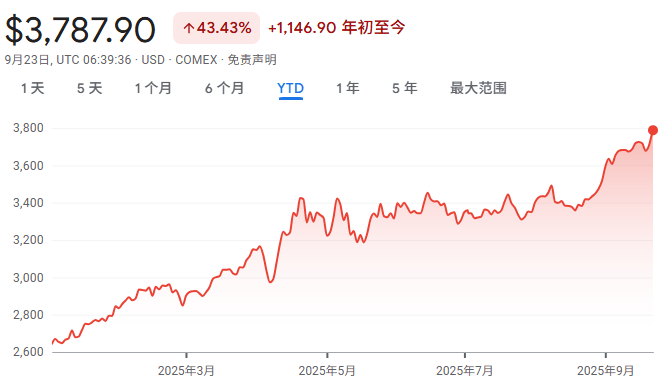
Core Viewpoint - The Federal Reserve is initiating interest rate cuts, leading to a surge in global asset prices, with significant movements in both risk and safe-haven assets [1][5]. Group 1: Market Performance - Nvidia's substantial investment in OpenAI has reignited the AI boom, pushing the three major U.S. stock indices to new highs, with the S&P 500 index hitting its 28th record high this year [2]. - COMEX gold prices closed at $3,775.10, marking the 36th record high of the year, with a year-to-date increase of approximately 43% [2]. Group 2: Market Dynamics - The simultaneous rise of risk and safe-haven assets has led to skepticism among investors regarding whether the market has reached "perfect pricing" [5]. - Bank of America strategist Michael Hartnett suggests that the combination of tariff cuts, tax reductions, and interest rate cuts creates a "run-it-hot" policy environment, providing implicit guarantees for the economy and stock market [5]. - Deutsche Bank's report indicates that the market has not yet reached a "perfect pricing" state, suggesting that concerns about future risks may actually provide room for potential market increases [5][6]. Group 3: Investment Strategies - Hartnett proposes a five-point trading strategy to navigate the current market conditions, including investing directly in bubble assets, constructing a "barbell" portfolio, shorting corporate bonds of bubble companies, shorting U.S. bonds, and trading volatility [10][11]. - The current market sentiment is characterized by a belief that "money is depreciating, and holding it is less favorable than consumption or investment," driving funds into risk assets [6]. Group 4: Gold Market Analysis - The rise in gold prices is attributed to geopolitical uncertainties, inflation concerns, and expectations of interest rate cuts, creating a "perfect storm" for gold [13][14]. - Deutsche Bank notes that the high gold prices reflect market fear rather than extreme optimism, indicating a typical sign of investors seeking safe-haven assets [13]. - Despite concerns about a potential bubble, key market indicators have not shown signs of irrational exuberance, suggesting that the current gold market may be in a sustained bull phase rather than a bubble [14][15].


美联储降息了!10 年美债利率却死扛 4%,三个原因在背后 “拖后腿”
Sou Hu Cai Jing· 2025-09-23 11:10
Core Viewpoint - The recent Federal Reserve interest rate cuts have not led to a significant decline in long-term U.S. Treasury yields, which is contrary to historical trends where such cuts typically result in lower yields [1][3][12]. Group 1: Historical Context - Over the past 50 years, there have been 12 interest rate cut cycles, which can be categorized into two distinct types: "preventive rate cuts" and "recessionary rate cuts" [3][6]. - Preventive rate cuts, such as those in 1995 and 2019, occur before economic downturns and typically result in smaller, short-lived declines in 10-year Treasury yields, averaging a drop of 167 basis points [6][7]. - Recessionary rate cuts, like those during the 2007 financial crisis, are more aggressive and prolonged, leading to larger declines in yields, but the rebound in rates occurs much later [7][9]. Group 2: Current Market Dynamics - The current situation is influenced by three main factors that are hindering the expected decline in long-term yields: limited rate cut capacity, rising term premiums, and reduced foreign investment demand [12][21]. - The long-term neutral interest rate in the U.S. has increased to 3%-3.5%, limiting the number of potential rate cuts to about 3-4 times, while the market anticipates 4-5 cuts [13][15]. - The term premium, which compensates for the risks of holding long-term bonds, has risen from negative to 0.9%, partly due to a significant increase in Treasury issuance [17][19]. - Foreign investors, particularly from Japan and Europe, are less inclined to purchase U.S. Treasuries due to competitive yields in their own markets, which diminishes demand for U.S. debt [19][21]. Group 3: Future Outlook - The outlook for U.S. Treasury yields suggests a likelihood of narrow fluctuations, with limited potential for significant declines or sharp increases [21][22]. - Key indicators to watch include the downward potential of yields, which may be constrained by the neutral rate and weak foreign demand, and the upward risks associated with increased political intervention and inflation pressures [23][24]. - Investors should focus on two critical timeframes: the outcomes of the upcoming rate cuts and the early 2024 Treasury issuance plans, as these will directly influence the term premium [27][28].

信用债周报:收益率多数上行,债券购回业务有助于平抑波动-20250923
BOHAI SECURITIES· 2025-09-23 11:06
1. Report Industry Investment Rating There is no information provided regarding the industry investment rating in the documents. 2. Core Viewpoints of the Report - During the period from September 15 to September 21, the issuance guidance rates announced by the National Association of Financial Market Institutional Investors mostly increased, with an overall change range of -5 BP to 5 BP. The issuance scale of credit bonds increased month - on - month, while corporate bonds remained at zero issuance, and the issuance amounts of other varieties increased. The net financing of credit bonds increased month - on - month, with an increase in the net financing of corporate bonds and commercial paper, and a decrease in the net financing of corporate bonds, medium - term notes, and private placement notes. The trading volume of credit bonds in the secondary market increased month - on - month, and the yields of most credit bonds rose. Credit spreads showed a differentiated trend, with short - to - medium - term spreads narrowing and long - term spreads widening. [1][61] - On September 19, the Shanghai, Shenzhen, and Beijing Stock Exchanges issued a notice to optimize bond repurchase business. When the closing price of corporate bonds drops by 5% compared to the 20th trading day before, the repurchaser can repurchase bonds to stabilize market fluctuations. [2][64] - The central and local governments are actively optimizing real estate policies, which are playing a positive role in stabilizing the real estate market. For real estate bonds, investors with high - risk tolerance can consider early layout, focusing on high - quality bonds of central and state - owned enterprises and some high - quality private enterprises. [2][65][66] - Against the background of stable growth and prevention of systemic risks, the probability of urban investment bond defaults is low, and they can still be a key allocation variety. However, during the process of local financing platform clearance and transformation, some urban investment bonds may face valuation fluctuations. [3][66] 3. Summary According to the Directory 3.1 First - level Market Situation 3.1.1 Issuance and Maturity Scale - From September 15 to September 21, a total of 407 credit bonds were issued, with an issuance amount of 326.433 billion yuan, a month - on - month increase of 25.20%. The net financing of credit bonds was 88.638 billion yuan, an increase of 17.911 billion yuan month - on - month. [12] - Corporate bonds remained at zero issuance, with a net financing of - 4.241 billion yuan, an increase of 2.288 billion yuan month - on - month. The issuance amount of corporate bonds, medium - term notes, commercial paper, and private placement notes increased, but the net financing of corporate bonds, medium - term notes, and private placement notes decreased. [12] 3.1.2 Issuance Interest Rates - The issuance guidance rates announced by the National Association of Financial Market Institutional Investors mostly increased, with an overall change range of -5 BP to 5 BP. The rate changes varied by term and rating. [14] 3.2 Second - level Market Situation 3.2.1 Market Trading Volume - From September 15 to September 21, the total trading volume of credit bonds was 896.955 billion yuan, a month - on - month increase of 22.76%. The trading volumes of all varieties increased. [17] 3.2.2 Credit Spreads - For medium - and short - term notes, corporate bonds, and urban investment bonds, the credit spreads showed a differentiated trend, with 1 - year and 3 - year spreads narrowing and 5 - year and 7 - year spreads widening. [20][28][38] 3.2.3 Term Spreads and Rating Spreads - For AA+ medium - and short - term notes, the 3Y - 1Y term spread narrowed, while the 5Y - 3Y and 7Y - 3Y spreads widened. For rating spreads, the 3 - year (AA - )-(AAA) and (AA)-(AAA) spreads remained unchanged, and the (AA+)-(AAA) spread narrowed. [45] - For AA+ corporate bonds, the 3Y - 1Y, 5Y - 3Y, and 7Y - 3Y term spreads widened. For rating spreads, the 3 - year (AA - )-(AAA) and (AA)-(AAA) spreads widened, and the (AA+)-(AAA) spread remained unchanged. [50] - For AA+ urban investment bonds, the 3Y - 1Y term spread narrowed, while the 5Y - 3Y and 7Y - 3Y spreads widened. For rating spreads, the 3 - year (AA - )-(AAA) and (AA)-(AAA) spreads widened, and the (AA+)-(AAA) spread remained unchanged. [53] 3.3 Credit Rating Adjustments and Default Bond Statistics 3.3.1 Credit Rating Adjustment Statistics - From September 15 to September 21, the rating of one company was downgraded. [57] 3.3.2 Default and Extension Bond Statistics - Wuhan Contemporary Science & Technology Investment Co., Ltd.'s credit bond "H20 Technology 4" defaulted, with a default balance of 650 million yuan. There were no credit bond extensions during this period. [59][60] 3.4 Investment Views - In terms of absolute returns, the supply shortage and strong allocation demand support the strength of credit bonds. Although fluctuations are inevitable, the conditions for a full - scale bear market in credit bonds are still insufficient. In the long run, yields will enter a downward channel, and the strategy of increasing allocation during adjustments is still feasible. [1][61] - In terms of relative returns, due to the low historical levels of rating spreads, credit risk - taking is not effective at present. High - grade long - term bonds have certain advantages, and the duration can be appropriately extended, but the rhythm needs to be grasped. [1][61] - For real estate bonds, with the market gradually stabilizing, investors with high - risk tolerance can consider early layout, focusing on high - quality bonds of central and state - owned enterprises and some high - quality private enterprises. [2][66] - For urban investment bonds, they can be a key allocation variety, but attention should be paid to the valuation fluctuations during the clearance and transformation of local financing platforms. [3][66]
固收 债市定价,谁在主导?
2025-09-23 02:34
Summary of Conference Call Notes Industry Overview - The conference call primarily discusses the bond market and its pricing dynamics, highlighting the differences in the current economic environment compared to the previous year [1][4][5]. Key Points and Arguments 1. **Policy Context**: The policy environment on September 22, 2025, differs from September 24, 2024, due to changes in deflation expectations, global financial conditions, and economic growth targets, leading to an expectation of no significant incremental policies [1][4]. 2. **Market Divergence**: The bond market is characterized by a lack of consensus among accounts based on risk preferences. Low-risk accounts focus on interest rate cuts and allocation opportunities, while high-risk accounts are more concerned with potential market risks [1][7]. 3. **Market Status**: The current market is in a state of fluctuation without a clear bull or bear trend, as there is no significant inflow of funds or negative feedback from asset management [1][9]. 4. **Investment Opportunities**: Three short-term investment opportunities are identified: - Steepening of the yield curve, contingent on institutional capabilities in managing long-term positions [10]. - Relative value recovery of national development bonds, limited to the short term [11]. - Secondary market value drop for 3 to 5-year bonds, provided redemption risks are covered [11][13]. 5. **Interest Rate Adjustments**: Recent changes in the 14-day operation interest rates aim to smooth the short-end curve, with a target range of 1.45% to 1.5% [12]. 6. **Liquidity Focus**: The upcoming quarter-end fiscal injections are crucial, as they will provide a stable environment for bank liabilities, suggesting a strategy of holding bonds through the holiday period [14][15]. Additional Important Content - **Market Influencing Factors**: The bond market is influenced by both fundamental economic data and institutional behaviors, with weak economic performance and expectations of central bank actions being significant drivers [3]. - **Expectations from Upcoming Meetings**: The upcoming meetings are expected to focus on the achievements of financial services to the real economy, support for capital market development, and the progress of RMB internationalization, with no major new policies anticipated [6]. - **Risk Management**: Different institutions have varying perspectives on market trends based on their liability stability, affecting their investment strategies [8]. This summary encapsulates the essential insights from the conference call, providing a comprehensive overview of the current bond market dynamics and strategic considerations for investors.
固收 利率 - 监管与海外双重冲击之后?
2025-09-23 02:34
Summary of Conference Call on Bond Market Dynamics Industry Overview - The conference call primarily discusses the bond market dynamics in the context of current financial regulations and macroeconomic conditions, particularly focusing on the impacts of U.S.-China negotiations and seasonal factors affecting market performance [1][4]. Key Points and Arguments - **Market Performance in September**: The bond market in September was negatively impacted by seasonal factors and two significant "black swan" events: regulatory changes leading to low market sentiment and unexpected progress in U.S.-China negotiations [1][4]. - **Comparison with Historical Context**: The current financial regulatory environment is compared to 2013, where GDP growth was below expectations, but infrastructure and real estate investments were high. Unlike 2013, current financial leverage is concentrated in standard bonds rather than non-standard assets [1][5][6]. - **Monetary Policy Outlook**: The monetary policy for 2025 is expected to be slightly tighter than in 2024, but overall remains accommodative. The first quarter is anticipated to have a loose funding environment, with limited pressure on the bond market due to inconsistent directions from the central bank and regulators [1][7]. - **Impact of U.S.-China Negotiations**: The unexpected progress in U.S.-China negotiations may reduce the domestic monetary policy stimulus, lowering the probability of rate cuts in the fourth quarter. However, there may still be easing measures in 2026 [1][8]. - **Interest Rate Trends**: The bond market may experience a final decline in the short term, with a potential rebound in the medium term. The 10-year government bond yield is currently above 1.8%, which is considered attractive [3][8]. Additional Important Insights - **Investment Recommendations**: Institutions are advised to seize current left-side opportunities and not miss the timing before the end of the year, with a medium-term bullish outlook [2][9]. - **Technical Market Analysis**: The technical shape of the bond market suggests continued volatility in the short term, but a positive outlook remains for the medium term [3][9]. This summary encapsulates the essential insights from the conference call, highlighting the bond market's current state, historical comparisons, and future expectations.
大类资产早报-20250923
Yong An Qi Huo· 2025-09-23 01:18
Report Information - Report Date: September 23, 2025 [2] - Report Type: Global Asset Market Performance and Futures Trading Data Report Global Asset Market Performance 10 - Year Treasury Yields of Major Economies - On September 22, 2025, the 10 - year Treasury yields of the US, UK, France, etc. were 4.148, 4.712, 3.559 respectively. The latest changes were 0.020, - 0.002, 0.006; weekly changes were 0.109, 0.080, 0.081; monthly changes were - 0.128, 0.021, 0.050; and annual changes were 0.473, 0.931, 0.710 [3]. 2 - Year Treasury Yields of Major Economies - On September 22, 2025, the 2 - year Treasury yields of the US, UK, Germany, etc. were 3.570, 3.976, 2.014 respectively. The latest changes were 0.050, 0.000, - 0.005; weekly changes were 0.050, 0.028, - 0.002; monthly changes were - 0.020, 0.038, 0.045; and annual changes were - 0.020, 0.161, - 0.206 [3]. US Dollar Exchange Rates Against Major Emerging - Market Currencies - On September 22, 2025, the US dollar exchange rates against the Brazilian real, South African rand, South Korean won, etc. were 5.335, 17.326, 1391.250 respectively. The latest changes were 0.21%, - 0.10%, - 0.43%; weekly changes were 0.35%, - 0.19%, 0.36%; monthly changes were - 1.41%, - 1.60%, 0.05%; and annual changes were - 5.16%, - 2.67%, 3.67% [3]. Stock Indices of Major Economies - On September 22, 2025, the S&P 500, Dow Jones Industrial Average, NASDAQ, etc. were 6693.750, 46381.540, 22788.980 respectively. The latest changes were 0.44%, 0.14%, 0.70%; weekly changes were 1.19%, 1.09%, 1.97%; monthly changes were 3.95%, 2.43%, 6.25%; and annual changes were 19.62%, 12.86%, 29.71% [3]. Credit Bond Indices - The latest changes of the US investment - grade credit bond index, euro - area investment - grade credit bond index, etc. were - 0.16%, 0.06%, etc.; weekly changes were - 0.53%, - 0.03%, etc.; monthly changes were 1.47%, 0.43%, etc.; and annual changes were 3.74%, 4.30%, etc. [3][4] Futures Trading Data Stock Index Futures Trading Data - The closing prices of A - shares, CSI 300, SSE 50, etc. were 3828.58, 4522.61, 2922.18 respectively, with percentage changes of 0.22%, 0.46%, 0.43%. The PE (TTM) of CSI 300, SSE 50, etc. were 13.97, 11.57, etc., with环比 changes of 0.01, - 0.01, etc. The latest values of capital flows in A - shares, the main board, etc. were - 336.93, - 447.76, etc. The latest trading volumes of the Shanghai and Shenzhen stock markets, CSI 300, etc. were 21214.83, 5631.49, etc., with环比 changes of - 2023.46, - 407.38, etc. The basis of IF, IH, IC were - 38.61, 0.82, - 211.93, with amplitudes of - 0.85%, 0.03%, - 2.93% [5]. Treasury Bond Futures Trading Data - The closing prices of T00, TF00, T01, TF01 were 107.975, 105.770, 107.620, 105.640 respectively, with percentage changes of 0.00%, 0.00%, 0.00%, 0.00%. The R001, R007, SHIBOR - 3M were 1.4749%, 1.5262%, 1.5620% respectively, with daily changes of - 5.00, 1.00, 0.00 BP [6]
多国抛售美债压力加剧,中方再减持257亿,特朗普难再强硬
Sou Hu Cai Jing· 2025-09-22 23:35
美债风云变幻:多国"削减"持仓,中国黄金储备"加码",特朗普的底气何在? 近期公布的7月TIC(美国国债海外持有者统计)数据显示,尽管美债海外持有总量触及9.16万亿美元的 历史新高,但市场内部却呈现出冰火两重天的分裂景象。这场数字游戏背后,是各国央行在复杂博弈中 的谨慎抉择,有人在悄然"撤离",有人在伺机而动,而"纸面上的繁荣"之下,涌动着真实的资本流动与 战略调整。 数据解读:冰山下的暗流涌动 TIC数据显示,7月美债总持有量微增319亿美元,相较于6月802亿美元的增幅,明显放缓。这看似平稳 的数字背后,却是各国持有者截然不同的操作: 英国: 强势增持413亿美元,总持仓飙升至8993亿美元。这并非简单的"信美",而是伦敦金融市场对美 联储明年降息的精准预判,意图通过债券价格反弹获利,并为脱欧后寻求避风港的英镑资金进行战略性 配置。 日本: 小幅加仓38亿美元,以1.1514万亿美元的规模继续稳居美债持有量首位。 中国: 连续减持257亿美元,持仓降至7307亿美元,创下自2009年以来的新低。这一举动并非一时兴 起,而是继2024年11月以来,央行持续增持黄金战略的延续。截至8月末,中国黄金储备已达约 ...

中方开始掀桌子,再抛257亿美债,美国大动脉被切,逼出2个接盘国
Sou Hu Cai Jing· 2025-09-22 18:00
Group 1 - China's significant reduction of US Treasury holdings by $25.7 billion in July, bringing total holdings down to $730.7 billion, the lowest since 2009 [1] - In 2013, China held over $1.3 trillion in US Treasuries, indicating a nearly halved position over the past decade [3] - The decline in US Treasury holdings is a long-term, planned adjustment rather than a sudden decision [5] Group 2 - The deterioration of the US fiscal situation, including rising government debt and increasing fiscal deficits, has weakened investor confidence in US Treasuries [7][8] - Rising yields on long-term US Treasuries, which have surpassed 4%, reflect increased risk perceptions regarding the US's ability to repay debt [10] - China's gradual reduction of US Treasury holdings is a rational choice to diversify risk, avoiding market volatility while ensuring asset safety [12] Group 3 - China is actively pursuing a strategy of de-dollarization, seeking alternatives to the US dollar in international trade [14][16] - Initiatives include promoting RMB settlements in energy trade and establishing currency swap agreements with various countries [16] - The creation of a cross-border RMB payment system provides a backup channel for international transactions, enhancing financial security [18] Group 4 - China's adjustments in foreign exchange reserves include increasing holdings in gold and strategic resources, aiming for a more robust reserve structure [20] - These measures contribute to a financial safety net for China and may serve as a model for other emerging market countries [21] - The declining attractiveness of US Treasuries raises questions about who will absorb the reduced demand, as countries like Japan and the UK continue to increase their holdings [23][25] Group 5 - Japan and the UK, despite previous reductions, are increasing their US Treasury holdings, suggesting political motivations behind these decisions [25][27] - The US Treasury market is increasingly influenced by political factors, with allies expected to demonstrate loyalty through financial commitments [27][29] - The shrinking pool of buyers for US Treasuries poses long-term risks, particularly if key allies face economic challenges [31]

东大持续抛售3800亿美债;特朗普公开警告:美国政府有可能停摆!
Sou Hu Cai Jing· 2025-09-22 15:00
Core Insights - The urgency of the U.S. in Sino-U.S. trade negotiations is highlighted by significant Chinese sales of U.S. Treasury bonds, with China selling approximately $53.7 billion (about 382 billion RMB) in the first seven months of the year [1][2][3] - In July alone, China sold $25.7 billion (approximately 182.9 billion RMB) in U.S. Treasuries, bringing its total holdings down to $730.7 billion, the lowest level since 2019 [1][3] Group 1 - China's large-scale reduction of U.S. Treasury holdings has reached a new low not seen since 2009, indicating a significant shift in international capital flows [2][3] - The reduction in U.S. Treasury holdings by China could exacerbate market fears and potentially trigger a wave of selling, impacting U.S. fiscal stability and the dominance of the dollar [5][6] - The U.S. government is facing budgetary challenges, with a potential government shutdown looming if bipartisan agreement on the budget is not reached by the October 1 deadline [5][6] Group 2 - The reliance of the U.S. on borrowing is acknowledged, with measures such as tariffs and budget cuts being proposed to address fiscal issues, but these may not be sufficient to resolve underlying economic problems [7] - A call for comprehensive domestic reform and a cooperative global approach is suggested as necessary for the U.S. to stabilize its economic situation [7]