证券业

Search documents
长信基金管理有限责任公司关于长信稳兴三个月定期开放债券型证券投资基金开放申购、赎回、转换业务的公告
Sou Hu Cai Jing· 2025-06-04 23:15
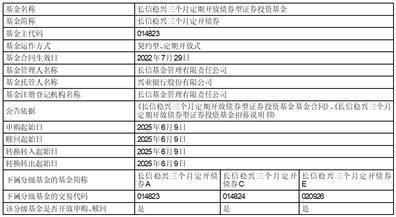
Group 1 - The fund is named "Changxin Stable Growth Three-Month Regular Open Bond Fund" with code 014523, and it operates as a regular open-end fund [1] - The fund management company is Changxin Fund Management Co., Ltd., and the custodian is China Industrial Bank Co., Ltd. [1] - The fund's contract became effective on July 29, 2022, and the first closed period lasts until March 8, 2025 [1][13] Group 2 - The fund's first open period for subscription, redemption, and conversion is from June 9, 2025, to June 13, 2025, after which it will enter a closed period until September 13, 2025 [13] - The minimum initial subscription amount is set at 1 yuan, with no upper limit on the additional subscription amount [3] - The fund has different fee structures for various classes, with A and E classes charging front-end fees, while C class has no subscription fee [4] Group 3 - Redemption requests must be for at least one fund share, and if the remaining balance is less than one share, it must be fully redeemed [5] - The conversion fee is based on the redemption fee of the outgoing fund and the subscription fee of the incoming fund [6] - The fund allows for conversions between specified funds during the open period, subject to restrictions if any fund is suspended [7] Group 4 - The fund's net asset value will be disclosed on the following day of each open day through designated websites and sales institutions [12] - The fund does not conduct sales through the market but utilizes direct sales and various non-direct sales institutions [11][10] - The company emphasizes that the final interpretation of the announcement belongs to the fund management company [14]

中国崛起的关键藏在这,制造业超美国2倍!GDP是美国66%,却…
Sou Hu Cai Jing· 2025-06-04 04:02
Core Insights - The rise of major powers is closely linked to the shift of global financial centers, influencing the trajectory of global dynamics over the past 500 years [1][4]. Historical Context - The Netherlands emerged as a global power from the 17th century, developing its transportation industry and establishing the first joint-stock company, with Amsterdam becoming the world's financial center [1][3]. - Following the Netherlands, Britain established its own East India Company and took control of New Amsterdam, renaming it New York, marking the beginning of British global dominance from 1714 to 1944 [3][4]. Transition of Financial Power - The Bretton Woods Conference marked a significant transition where the British pound was replaced by the US dollar as the international reserve currency, with the dollar pegged to gold at $35 per ounce [4][5]. - The US dollar's detachment from gold in 1971 and its subsequent linkage to oil solidified the US's financial dominance, which is projected to last until 2025, totaling 81 years [5][6]. Current Economic Landscape - The US GDP stands at $29.2 trillion, while China's GDP is approximately $18.4 trillion, indicating that China's economy is about 66% the size of the US economy [5][6]. - The total market capitalization of US securities markets is around $64 trillion, compared to China's approximately $12 trillion, highlighting a significant gap in financial market size [6]. Implications for China - China's rise is driven by a dual engine of manufacturing and finance, emphasizing the need for coordinated development in both sectors to achieve its goals [6]. - Historical patterns suggest that the success of rising powers is often tied to their financial systems, indicating that China must prioritize financial development to secure its position as a global power [6].

【钛晨报】2025年新能源汽车下乡,涉124款车型;总额500亿,中国太保发布战新并购基金与私募证券投资基金;小米汽车工厂正在试用机器人相关能力
Tai Mei Ti A P P· 2025-06-03 23:31
Group 1: New Energy Vehicle Promotion - The Ministry of Industry and Information Technology, along with other government bodies, launched the 2025 New Energy Vehicle (NEV) promotion campaign, featuring 124 models aimed at rural areas [2] - The campaign emphasizes "green, low-carbon, intelligent, and safe" transportation, targeting counties with high market potential for NEVs [2] - The initiative includes a combination of online and offline activities, with a focus on enhancing charging infrastructure and promoting a comprehensive service network for vehicle purchase and maintenance [2] Group 2: Model Participation and Market Expansion - This year's campaign includes 25 more models compared to 2024, notably adding Tesla's Model Y and Model 3, expanding the range of participating vehicles [3] - BYD has 11 models in the campaign, while other brands like Deep Blue, Aion, NIO, and Leap Motor have 5, 5, 4, and 2 models respectively [3] Group 3: Financial and Investment Developments - China Pacific Insurance announced a 500 billion yuan fund focused on mergers and acquisitions, with a target of 300 billion yuan for the new fund aimed at supporting Shanghai's industrial development [5] - NIO reported a revenue of 12.03 billion yuan in Q1, a year-on-year increase of over 21%, with a projected revenue of 19.51 to 20.07 billion yuan for Q2 [7] - Silyus reported May NEV sales of 39,982 units, a year-on-year increase of 17.15%, but a cumulative decline of 19.64% for the year [8] Group 4: Market Trends and Consumer Behavior - JD's 7Fresh plans to open 18 new stores in the Beijing-Tianjin region, indicating a rapid expansion in the instant retail sector [9] - The domestic tourism during the Dragon Boat Festival saw 119 million trips, a year-on-year increase of 5.7%, with total spending reaching 42.73 billion yuan [22]




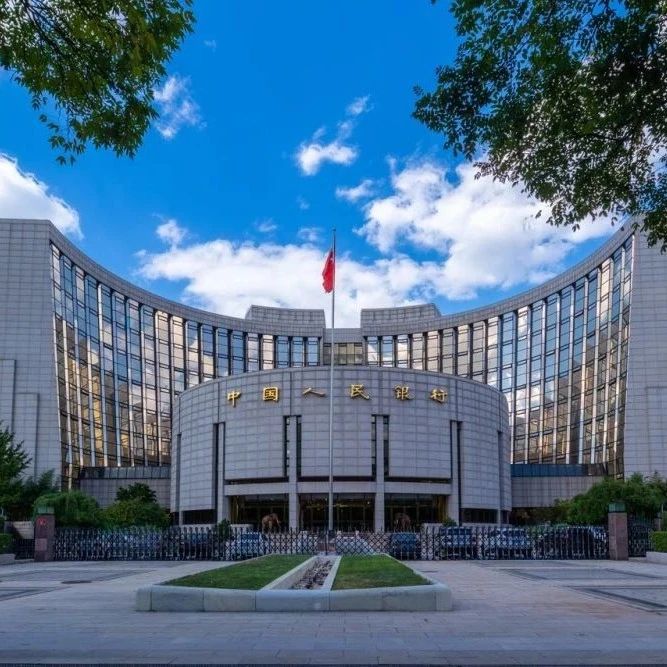
央行精准调控 年中时点流动性料合理充裕
Zhong Guo Zheng Quan Bao· 2025-06-03 20:34
Group 1 - The People's Bank of China (PBOC) shifted from net liquidity injection to net withdrawal, conducting a 454.5 billion yuan reverse repurchase operation, resulting in a net withdrawal of 375.5 billion yuan on June 3 [1] - Analysts expect the PBOC to maintain a reasonable liquidity level, utilizing various short- and medium-term liquidity management tools to ensure sufficient liquidity in the banking system as the mid-year approaches [1][2] - Historical trends indicate that June is a significant month for credit issuance, with banks likely to increase reserve requirements seasonally, impacting liquidity [1] Group 2 - The PBOC has room for further monetary policy easing, aiming for "appropriate looseness" while flexibly adjusting the implementation of policies based on domestic and international economic conditions [2] - The PBOC's liquidity management tools are becoming more balanced in terms of duration, allowing for precise liquidity adjustments through various instruments [2] - The PBOC may consider resuming government bond trading operations based on market conditions and yield changes, as indicated in the 2025 Q1 monetary policy report [2] Group 3 - There is limited pressure for tightening liquidity in the future, with the interbank market's 7-day bond repurchase rate expected to fluctuate around 1.5% [3] - The PBOC is committed to implementing an appropriately loose monetary policy while coordinating with fiscal policies to promote high-quality economic development [3]
宝城期货资讯早班车-20250603
Bao Cheng Qi Huo· 2025-06-03 09:51
1. Report Industry Investment Rating No relevant content provided. 2. Core Viewpoints of the Report - China's economic operation in Q2 is expected to continue in a stable manner with the continuous implementation of growth - stabilizing policies, but the foundation for economic recovery needs to be consolidated, and policies need further strengthening [2][16] - The US fiscal deficit in the 2026 fiscal year may reach $2.2 trillion, and the deficit rate may rise to 7%, which will increase the supply pressure of US Treasury bonds and may cause continuous fluctuations in US dollar assets [29] - It is expected that the monetary policy will be further relaxed in the second and third quarters, and investors are advised to actively allocate Chinese bonds [29] 3. Summary by Directory 3.1 Macro Data Overview - In Q1 2025, GDP grew by 5.4% year - on - year, the same as the previous quarter [1] - In May 2025, the manufacturing PMI was 49.5%, up 0.5 percentage points from the previous month; the non - manufacturing PMI was 50.3%, down 0.1 percentage points from the previous month [1][2][16] - In April 2025, the year - on - year growth rates of M0, M1, and M2 were 12.0%, 1.5%, and 8.0% respectively [1] - In April 2025, the new RMB loans of financial institutions were 280 billion yuan, a significant decrease from the previous month [1] - In April 2025, CPI was - 0.1% year - on - year, and PPI was - 2.7% year - on - year [1] - In April 2025, the cumulative year - on - year growth rates of fixed - asset investment (excluding rural households) and total retail sales of consumer goods were 4.0% and 4.7% respectively [1] - In April 2025, the year - on - year growth rates of export and import values were 8.1% and - 0.2% respectively [1] 3.2 Commodity Investment Reference 3.2.1 Comprehensive - China's manufacturing PMI improved in May, and the export container freight rate index rebounded, indicating an improvement in the manufacturing boom level [2][16] - The US core PCE price index in April increased by 2.5% year - on - year, and the "super core inflation indicator" dropped to the lowest in four years, leading traders to bet on a Fed rate cut in September [2] - US officials defended tariffs, stating that they would not disappear [3] - Fed's Daly is confident in the Fed's prediction of two rate cuts by the end of the year [3] 3.2.2 Metals - Platinum has seen a significant increase this year, with a maximum cumulative increase of 25%. JP Morgan predicts that the platinum price will reach $1200 per ounce in Q4 2025 and $1300 per ounce in Q2 2026 [5] - Chile expects its copper production to reach 5.67 million tons in 2025 [6] - Goldman Sachs predicts an increased possibility of US copper import tariffs, and has adjusted its aluminum price forecast [6] 3.2.3 Coal, Coke, Steel, and Minerals - Multiple regions in China are strengthening the management of strategic minerals to prevent illegal exports [8] - The US will raise the steel import tariff from 25% to 50% on June 4, and the EU is considering counter - measures [8][9][19] - The price of coking coal dropped by 1.17% in mid - May, reaching a record low [10] 3.2.4 Energy and Chemicals - OPEC+ agreed to increase oil production by 411,000 barrels per day in July [11] - Goldman Sachs expects OPEC+ to increase production by 410,000 barrels per day in August and maintains its oil price forecast [11] - The Russian central bank believes that the risk of financial instability is limited due to low debt levels and accumulated reserves [11] - India has lowered the natural gas price by 5% in June [12] 3.2.5 Agricultural Products - Malaysia's palm oil exports in May increased by 17.9% compared to the same period last month [13] - The price of soybeans increased by 1.18% in mid - May, reaching a new high since late September 2024 [14] 3.3 Financial News Compilation 3.3.1 Open Market - On May 30, the central bank conducted 291.1 billion yuan of 7 - day reverse repurchase operations, with a net investment of 148.6 billion yuan [15] - A total of 1.6026 trillion yuan of reverse repurchases will mature in the central bank's open market this week [15] - The central bank conducted 700 billion yuan of outright reverse repurchase operations in May, with a net withdrawal of 200 billion yuan [17] 3.3.2 Key News - China's economic data in May showed that the manufacturing PMI improved, and the import and export situation improved [2][16] - The 2025 Lujiazui Forum will be held from June 18 - 19, and several major financial policies will be announced [16] - It is expected that the central bank may resume buying government bonds in July or August [17] - The US has extended the exemption period for the 301 investigation against China [18] - Multiple cities' new home prices showed different trends in May, with first - and second - tier cities rising and third - and fourth - tier cities falling [21] - As of May 28, 119 market entities issued science and technology innovation bonds with a total issuance of 339.1 billion yuan [21] 3.3.3 Bond Market Summary - The domestic bond market rebounded, with the 30 - year Treasury bond futures rising by 0.56%, and major interest - rate bond yields falling [25] - The exchange bond market showed mixed performance, with some bonds rising and some falling [25] - The CSI Convertible Bond Index rose by 0.06%, and the trading volume was 58.988 billion yuan [25] - Most money market interest rates and bond yields in the US and Europe increased [26][27] 3.3.4 Foreign Exchange Market Express - The on - shore RMB against the US dollar closed at 7.1953, down 37 basis points from the previous trading day [28] - The US dollar index fell by 0.75%, and most non - US currencies rose [28] 3.3.5 Research Report Highlights - Huatai Securities predicts that the US fiscal deficit in the 2026 fiscal year may reach $2.2 trillion, and the deficit rate may rise to 7% [29] - CICC Fixed Income expects the monetary policy to be relaxed in the second and third quarters, and suggests investors to allocate Chinese bonds [29] - Huatai Securities believes that fiscal policies may be further strengthened to support economic growth [30] 3.4 Stock Market Key News - The Hang Seng Index fell by 0.57%, and pharmaceutical and real - estate stocks led the decline [32] - As of June 3, 28 listed companies have "removed stars and caps" this year, more than the same period last year [32] - As of May 31, private equity funds showed strong interest in ETFs, especially science - innovation and free - cash - flow themed ETFs [33] - *ST Hengli is under investigation by the CSRC for suspected false disclosure of financial data [33]
华尔街到陆家嘴精选丨美国核心通胀指标放缓至4年低位 降息快了吗?金价、油价齐上涨 投资者如何选择?美股还能延续5月涨势吗?
Di Yi Cai Jing· 2025-06-03 01:18
Group 1: Economic Indicators and Federal Reserve - The core PCE price index in the US decreased from 2.7% to 2.5%, marking the lowest level since April 2021 [1] - Federal Reserve Governor Waller supports a potential interest rate cut later this year, despite the uncertainty surrounding tariff impacts on inflation and employment [1] - The US GDP for Q1 was revised to a -0.2% growth rate, indicating economic stagnation, while consumer confidence has dropped significantly [1] Group 2: Gold Market Dynamics - Gold prices surged following Trump's announcement to double tariffs on steel and aluminum, with spot gold reaching $3,380 per ounce [2] - Gold mining stocks experienced significant gains, with Newmont rising nearly 5.5% and Barrick Gold over 6% [2] - Long-term demand for gold is driven by central bank purchases, making gold a safer investment compared to more volatile gold mining stocks [2] Group 3: Seagate Technology Developments - Seagate Technology's stock rose by 29.56% in May, driven by the delivery of 40TB hard drive samples and plans for larger capacities [3] - The company aims to produce a 100TB hard drive by 2030, addressing the growing demand for data storage in AI and data centers [3] - Seagate reported a 30% year-over-year revenue increase and a 12.6-fold increase in profit, highlighting its strong market position [3] Group 4: Oil Market Outlook - OPEC+ decided to maintain an increase of 411,000 barrels per day for July, consistent with previous months [5] - Morgan Stanley predicts continued OPEC+ production increases, potentially leading to lower oil prices, while Goldman Sachs expects a more cautious approach [5][6] - The overall supply-demand balance remains skewed towards oversupply, with US production growth impacting global oil prices [6] Group 5: US Stock Market Projections - After a 6.2% rebound in May, the US stock market is expected to enter a consolidation phase due to rising inflation and slowing economic growth [7] - The S&P 500 index has only increased by about 0.9% this year, underperforming compared to European markets [7] - Concerns over inflation and fiscal issues may lead to higher bond yields, affecting the attractiveness of US equities [7]

每日债市速递 | 美联储戴利:年内有望降息两次
Wind万得· 2025-06-02 22:56
Open Market Operations - The central bank conducted a reverse repurchase operation of 291.1 billion yuan for 7-day terms on May 30, with a fixed interest rate of 1.40%, resulting in a net injection of 148.6 billion yuan for the day after accounting for 142.5 billion yuan in reverse repos maturing [1][2]. Liquidity Conditions - Liquidity remains ample, with overnight weighted rates for deposit institutions below 1.5%. Non-bank institutions saw overnight borrowing rates initially rise above 1.8% but later settle around 1.6%. Shibor rates showed mixed performance, with overnight rates up 6.0 basis points to 1.471%, while 7-day rates rose 1.5 basis points to 1.617% [3][4]. Interbank Certificates of Deposit - The latest transaction for one-year interbank certificates of deposit in the secondary market is around 1.70% [7]. Government Bond Futures - The closing prices for government bond futures showed increases: 30-year contracts rose by 0.56%, 10-year by 0.21%, 5-year by 0.14%, and 2-year by 0.04% [11]. Key Financial Events - The 2025 Lujiazui Forum is scheduled for June 18-19, where major financial policies will be announced by leaders from various financial regulatory bodies [12]. - The Ministry of Housing, Ministry of Finance, and the People's Bank of China reported that over 1.3 trillion yuan in housing provident fund loans were issued last year, with total contributions reaching 36,317.83 billion yuan [12]. Global Macro Developments - The U.S. overnight financing rate is currently at 4.33% [4]. - The Federal Reserve's Daly indicated the possibility of two interest rate cuts within the year, while the Bank of Japan faces record losses on government bonds [16].

恒生指数止步周线七连阳,IPO市场持续火热|港股一线
2 1 Shi Ji Jing Ji Bao Dao· 2025-06-02 01:43
Market Overview - The Hong Kong stock market experienced a pullback last week, with major indices declining, including the Hang Seng Index which closed at 23,289.77 points, down 1.32% [1] - The volatility in the Hang Seng Index is expected to remain high due to fluctuating trade conditions, but there is optimism for a potential rise to the range of 24,000 to 26,000 points in the future [1] IPO Market - The IPO market in Hong Kong continues to thrive, with 28 companies successfully listing and raising over 76 billion HKD, a sevenfold increase compared to the same period in 2024 [2] - The number of companies waiting to go public has reached a record high, with over 140 applications submitted this year, marking a nearly 50% increase year-on-year [2] - Deloitte forecasts that around 80 new stocks will be listed in 2025, raising approximately 130 to 150 billion HKD, primarily from the AI and healthcare sectors [2] Trading Activity - The trading activity in the Hong Kong market has been notably high, with an average daily trading volume of 2,427 billion HKD in Q1 2025, a 144% year-on-year increase [3] - The Hong Kong Stock Exchange is focusing on three main categories of projects: companies already listed in Asia seeking financing, Chinese companies returning from the US market, and emerging unicorns and innovative enterprises [3] Company Spotlight: Jihong Co., Ltd. - Jihong Co., Ltd. officially listed on the Hong Kong main board on May 27, with a share price of 7.68 HKD, raising approximately 420 million HKD [4] - The company is the fifth A-share company to list on the Hong Kong Stock Exchange this year and became the first to be included in the Stock Connect on its listing day [5] - Jihong Co., Ltd. reported a revenue of 1.477 billion CNY in Q1 2025, an 11.6% increase from 1.325 billion CNY in the same period of 2024 [5] Credit Ratings - Major credit rating agencies, including S&P and Moody's, have maintained a stable outlook for Hong Kong, with Moody's upgrading its outlook from negative to stable [6] - The stability of Hong Kong's financial system is reflected in the growth of bank deposits and active capital markets, indicating strong investor confidence [6]
美元弱势周期下的全球资产配置新逻辑|财富与资管
清华金融评论· 2025-05-31 10:13
Core Viewpoint - The article discusses the ongoing weakening of the US dollar, which has fallen below the critical level of 100, and its implications for global asset allocation, particularly in Asia [3]. Group 1: Dollar Weakness and Global Impact - The US dollar is in a weak cycle due to the Federal Reserve's policy shifts, increasing fiscal deficits, and a global trend towards de-dollarization [3]. - There have been five instances of simultaneous declines in stocks, bonds, and the dollar this year, indicating deepening economic contradictions in the US [3]. - Asian currencies are experiencing collective appreciation, with the Japanese yen rising by 10%, the New Taiwan dollar by 9%, and other major Asian currencies increasing by 3%-7% [3]. Group 2: Hong Kong Market Dynamics - The Hong Kong dollar has seen significant liquidity injections from the Monetary Authority, with interbank borrowing rates dropping from 4% to 0.6%, encouraging leveraged investments in stocks and real estate [5]. - The influx of talent is evident as local universities expand enrollment, with the University of Hong Kong's business school increasing its master's program from 300 to 5,000 students annually [5]. - The IPO market in Hong Kong is recovering, with 70 new listings in Q1 2023, and expectations for the total IPO scale to exceed HKD 400 billion for the year [7]. Group 3: Global Asset Allocation Strategy - The S&P 500's forward P/E ratio remains high at 29, with tech giants at historical valuation premiums, suggesting a need to reduce exposure to US equities [9]. - The 10-year US Treasury yield has rebounded to 4.5%, with significant rollover pressures from maturing debt, leading to a recommendation to avoid short-term volatility risks in US Treasuries [9]. - Japanese assets are being revalued, with a 60% increase in core Tokyo property prices over three years, and a high employment rate among graduates attracting middle-class families [9]. Group 4: Investment Strategy Recommendations - In the current transition period, the recommended asset allocation includes 15% in insurance products, 5.2% yield Asian dollar bonds, and a focus on equities with 40% in Hong Kong stocks, 25% in Japanese stocks, and 20% in high-dividend A-shares [11]. - Alternative assets should include 10% in gold and 5% in Bitcoin, with a strategy to increase holdings in the Chinese yuan and yen while reducing US dollar exposure to below 30% [11].

央行5月开展7000亿元买断式逆回购!继续暂停国债买卖
证券时报· 2025-05-30 15:04
Core Viewpoint - The People's Bank of China (PBOC) is maintaining a moderately loose monetary policy despite a net withdrawal of liquidity through reverse repos in May, indicating a stable liquidity environment in the banking system [2][4]. Group 1: Reverse Repo Operations - In May, the PBOC conducted a total of 700 billion yuan in reverse repo operations, consisting of 400 billion yuan for 3-month terms and 300 billion yuan for 6-month terms, resulting in a net withdrawal of 200 billion yuan due to 900 billion yuan of 3-month reverse repos maturing [2]. - The reliance on Medium-term Lending Facility (MLF) has increased since the introduction of reverse repos, with MLF operations maintaining monthly net injections since March [4]. - Financial institutions are expected to benefit from the PBOC's increased use of MLF, which provides stable liquidity and meets diverse funding needs [4]. Group 2: Government Bond Transactions - The PBOC has paused government bond purchases since January to avoid impacting investor allocations, as the 10-year government bond yield fell below 1.6% [6]. - The central bank plans to resume government bond transactions in July or August, as the net financing of government debt is expected to peak during that period [7]. - Resuming government bond transactions is seen as urgent to enhance the central bank's holdings of government debt and to support the establishment of a sovereign credit model for currency issuance [7].