能源

Search documents
普涨!资金开始抢跑,节后稳了
Sou Hu Cai Jing· 2025-09-30 10:11
Core Viewpoint - The A-share and Hong Kong stock markets have shown synchronized gains, driven by technology growth sectors and resource products, reflecting a clear characteristic of "policy dividend release and industrial trend resonance" [1] Market Performance - A-share indices achieved five consecutive monthly gains, with the ChiNext Index rising over 12% this month, reaching a three-year high, and the Sci-Tech 50 Index increasing over 11%, marking a nearly four-year high [1] - The Hong Kong Hang Seng Technology Index surged 2.24%, hitting a nearly four-year high, with a monthly increase of 13.95%, indicating strong capital allocation towards technology [1] - A-share trading volume reached 2.2 trillion yuan, while Hong Kong's trading volume was 314.9 billion HKD, reflecting active market trading and increased risk appetite [1] Sector Highlights and Driving Logic - In the A-share market, technology and resource sectors led the gains, with the non-ferrous metals sector rising 3.22% and storage chip concepts experiencing a significant surge due to price increases from major players like Samsung and Micron [3] - The lithium battery electrolyte index rose 5.15%, supported by policy backing and technological advancements in the new energy industry [3] - In the Hong Kong market, the semiconductor and consumer electronics sectors performed well, with the semiconductor sector increasing by 4.73% due to rising storage prices and domestic substitution trends [3] Underperforming Sectors and Driving Logic - Traditional defensive sectors in the A-share market, such as banking and non-bank financials, experienced declines, with the banking sector down 0.74% amid doubts about profit recovery before interest rate changes [4] - In the Hong Kong market, cyclical and defensive sectors faced pressure, with energy stocks dropping 1.25% due to OPEC+ plans to increase oil production, leading to a decline in international oil prices [4] Investment Strategy Recommendations - The current market is at a critical juncture of "intensive policy implementation and accelerated industrial trends," with short-term focus on technology growth sectors showing significant profit potential [5] - Recommended short-term investment directions include storage chips and semiconductor equipment benefiting from price cycle reversals, non-ferrous metals supported by global liquidity and policy tools, and new energy sectors like lithium battery electrolytes [5] - For the medium to long term, the market focus will revolve around "artificial intelligence+" and high-end manufacturing, with suggestions to preemptively invest in the semiconductor supply chain, new energy, and defense industries [6]
广西企业“排头兵”:营收超过2300亿元,连续六年入围世界500强
Sou Hu Cai Jing· 2025-09-30 10:04
Core Insights - The 2025 Guangxi Top 100 Enterprises list was announced, with the entry threshold dropping to 3.764 billion yuan from 3.951 billion yuan last year. The total revenue of the 100 companies reached 216.3913 billion yuan, a year-on-year decrease of 2.26%, while net profits hit a record high of 72.9 billion yuan, up 42% year-on-year [1][3]. Group 1: Financial Performance - The total assets of the top 100 enterprises reached 7,175.754 billion yuan, maintaining a growth trend for ten consecutive years, with 58 companies exceeding 10 billion yuan in assets [1]. - The top 100 companies invested a total of 26.059 billion yuan in R&D, achieving a record R&D intensity of 1.20% [1]. - The total number of patents held by these companies reached 31,103, with invention patents accounting for 31.7% (9,850 patents), marking a new high [1]. Group 2: Industry Distribution - The manufacturing sector accounted for 53 of the companies, while the service sector had 35, and other industries contributed 12 [3]. - State-owned and controlling enterprises dominated the list, with representation from all 14 districts in Guangxi [3]. - The majority of the companies (54) are concentrated in the Western Land-Sea New Corridor (Guangxi) industrial belt, focusing on industries such as automotive, new energy vehicles, machinery, and electronic information [3]. Group 3: New Entrants and Rankings - The list featured 14 new entrants, including Guangxi Fudi Battery, Jinhai Stainless Steel, and Tian Gui Aluminum, with 5 state-owned and 9 private enterprises among them [5]. - Guangxi Fudi Battery ranked highest among the newcomers, being a key player in BYD's battery and energy storage systems, with a total investment of 14 billion yuan [5]. - The top five companies remained unchanged, with Guangxi Investment Group leading the list, followed by Southern Power Grid Guangxi Electric Power Company and Shenglong Metallurgy [9]. Group 4: Notable Company Highlights - SAIC-GM-Wuling achieved a revenue of 77.9334 billion yuan, with a net profit of 1.045 billion yuan, reflecting year-on-year growth of 2.53% and 12.24%, respectively [7]. - The company sold a total of 1,540,077 vehicles, with over half being new energy vehicles, and reported a 63% increase in sales to 800,000 units [7]. - Guangxi Investment Group, as the top service enterprise, reported a revenue of 237.258 billion yuan, a slight increase of 0.3% year-on-year, and has been listed among the Fortune Global 500 for six consecutive years [10].


国泰海通|海外策略:宽松预期降温,估值盈利双杀
国泰海通证券研究· 2025-09-30 08:18
Market Performance - Global markets mostly declined last week, with MSCI Global down by 0.2%, MSCI Developed Markets down by 0.2%, and MSCI Emerging Markets down by 0.6% [1] - The US 10Y Treasury yield saw a significant increase, while silver prices surged and gold prices increased at a slower rate [1] - The dollar strengthened against the pound, yen, and renminbi, with defensive sectors like energy materials and utilities performing well [1] Trading Sentiment - Overall trading volume weakened globally, with a rebound in short-selling ratio in Hong Kong stocks [1] - Major indices such as Hang Seng, Nikkei 225, S&P 500, Euro Stoxx 50, and Kospi 200 experienced a decline in trading volume [1] - Investor sentiment in Hong Kong and US markets decreased but remained at historically high levels, while volatility decreased in Hong Kong and US markets but increased in European and Japanese markets [1] Earnings Expectations - Global stock market earnings expectations were generally revised downwards, with some markets seeing upward revisions in energy materials [2] - The Hang Seng Index's 2025 EPS forecast was revised down from 2068 to 2063, while the S&P 500's EPS forecast was adjusted from 269 to 268 [2] - The Eurozone STOXX50's EPS forecast was also revised down from 337 to 333 [2] Economic Expectations - US economic expectations improved last week, with the Citigroup Economic Surprise Index rising due to fluctuating Fed policy expectations and better-than-expected tech earnings [2] - Conversely, the European Economic Surprise Index declined, likely due to rising geopolitical risks and weak manufacturing data [2] - China's Economic Surprise Index also fell, impacted by uncertain real estate policy effects and fluctuating external demand data [2] Capital Flows - The divergence in Fed policy signals intensified market speculation, with futures markets indicating an expected 1.8 rate cuts by the Fed this year [3] - Global liquidity trends shifted towards easing, with significant capital inflows into India, Europe, Hong Kong, and South Korea [3] - Hong Kong's stock connect and stable foreign capital inflows into the Hong Kong market were noted [3]

交易日历 | 国庆期间宏观&大宗商品重要数据事件预告
对冲研投· 2025-09-30 06:27
Group 1 - The USDA quarterly grain inventory report is scheduled for release, which is crucial for agricultural commodities [1] - The API crude oil inventory report for the week ending September 26 is expected to provide insights into oil market dynamics [1] - The Eurozone's CPI for September will be released, which is significant for macroeconomic analysis [1] Group 2 - The 62nd OPEC+ Joint Ministerial Monitoring Committee meeting will take place, impacting oil production policies [2] - Malaysia's palm oil production report will be published, which is important for the oilseed and fats market [2] - China's construction materials production and inventory data will be released, relevant for the building materials sector [2] Group 3 - The final manufacturing PMI for Germany and the Eurozone for September will be reported, indicating manufacturing sector health [3] - The U.S. non-farm payroll and unemployment rate for September will be released, critical for labor market assessment [3] - Malaysia's palm oil production data for September will be available, affecting the global palm oil market [3] Group 4 - The Buenos Aires Grain Exchange will release its crop report, which is vital for agricultural commodity forecasting [4] - The Baker Hughes active rig count will be published, providing insights into U.S. oil production trends [4] - OPEC+ will hold a meeting regarding oil production policies, influencing global oil supply [4] Group 5 - The Federal Reserve's comments on monetary policy will be made, which are significant for financial markets [5] - China's foreign exchange reserves for September will be reported, impacting currency and economic stability [5] - The EIA monthly report will provide updates on energy production and consumption trends [5]

关注行业稳增长方案推进
Hua Tai Qi Huo· 2025-09-30 05:53
Industry Investment Rating No information provided regarding the industry investment rating. Core Viewpoints - The Ministry of Industry and Information Technology and five other departments issued the "Work Plan for Steady Growth of the Machinery Industry (2025 - 2026)", aiming for the machinery industry to maintain a stable and positive development trend from 2025 to 2026, with an average annual revenue growth rate of about 3.5% and revenue exceeding 10 trillion yuan [1]. - The National Development and Reform Commission will focus on the science - technology and AI industries, formulating development guidelines for smart terminals and agents, opening up industry scenarios, and providing computing power subsidies. A new policy - based financial instrument worth 500 billion yuan will be used to supplement project capital [1]. Summary by Directory 1. Industry Overview Upstream - Black: Glass prices have rebounded significantly [2]. - Energy: International oil prices have rebounded [2]. Midstream - Chemical: The polyester operating rate is at a medium level [3]. - Energy: Coal consumption by power plants has remained stable [3]. Downstream - Real Estate: The sales of commercial housing in second - tier cities have slightly rebounded [4]. - Services: The number of domestic flights has increased [4]. 2. Key Industry Price Indicators | Industry Name | Indicator Name | Price on 9/29 | YoY Change | | --- | --- | --- | --- | | Agriculture | Spot price of corn | 2288.6 yuan/ton | 0.00% | | | Spot price of eggs | 7.4 yuan/kg | - 4.77% | | | Spot price of palm oil | 9248.0 yuan/ton | 3.08% | | | Spot price of cotton | 14982.5 yuan/ton | - 1.17% | | | Average wholesale price of pork | 19.3 yuan/kg | - 1.28% | | Non - ferrous Metals | Spot price of copper | 82271.7 yuan/ton | 2.54% | | | Spot price of zinc | 21618.0 yuan/ton | - 1.48% | | | Spot price of aluminum | 20700.0 yuan/ton | - 0.61% | | | Spot price of nickel | 122050.0 yuan/ton | 0.04% | | | Spot price of aluminum | 16856.3 yuan/ton | - 1.14% | | Ferrous Metals | Spot price of rebar | 3176.0 yuan/ton | 0.27% | | | Spot price of iron ore | 806.7 yuan/ton | - 1.51% | | | Spot price of wire rod | 3357.5 yuan/ton | - 1.54% | | | Spot price of glass | 15.4 yuan/square meter | 7.90% | | Non - metals | Spot price of natural rubber | 14775.0 yuan/ton | - 0.73% | | | China Plastic City price index | 790.0 | - 0.17% | | | Spot price of WTI crude oil | 65.7 dollars/barrel | 5.32% | | Energy | Spot price of Brent crude oil | 69.2 dollars/barrel | 4.82% | | | Spot price of liquefied natural gas | 3828.0 yuan/ton | 0.90% | | | Coal price | 793.0 yuan/ton | 1.02% | | | Spot price of PTA | 4612.5 yuan/ton | - 0.30% | | Chemical | Spot price of polyethylene | 7345.0 yuan/ton | - 0.14% | | | Spot price of urea | 1621.3 yuan/ton | - 2.04% | | | Spot price of soda ash | 1262.5 yuan/ton | 0.00% | | Real Estate | National cement price index | 135.1 | 0.63% | | | Building materials composite index | 113.3 points | - 1.19% | | | National concrete price index | 91.7 points | - 0.01% | [36]
刚刚!2025世界制造业大会成果发布
Shang Hai Zheng Quan Bao· 2025-09-30 05:01
Core Insights - The 2025 World Manufacturing Conference was successfully held in Hefei from September 20 to 23, achieving significant outcomes, including the highest number of participating countries and regions, and the largest proportion of emerging and future industry projects signed [1] Group 1: Key Features - The international participation expanded significantly, with Slovakia as the guest country and 659 foreign guests from 53 countries and regions attending, marking the highest attendance in the conference's history [2] - The participation of central enterprises was notably enhanced, with 50 central enterprises represented and a total investment scale of 27.5 billion yuan from 12 signed quality projects [2] Group 2: Technological Highlights - The conference showcased new technologies and products, with significant media coverage and online engagement, including 1,575 articles related to three innovative products, achieving a total viewership of 22.24 million [3] Group 3: Major Achievements - The conference attracted high-profile guests, including 53 leaders from national ministries and 142 foreign dignitaries, with a 47.9% increase in government representatives compared to the previous year [4] - A total of 35 specialized and promotional activities were held, resulting in over 120 cooperation agreements and 65 investment promotions [5] Group 4: Project Cooperation - A total of 735 cooperation projects were facilitated, with an investment total of 380.2 billion yuan, including 396 projects in the Yangtze River Delta region [7] Group 5: Promotion and Publicity - The conference achieved extensive publicity, with 68,000 pieces of information released, reaching 14.8 billion people, and significant coverage in both international and domestic media [8]
盾博:欧洲股市波动中何处寻确定性?医疗与消费板块显露韧性
Sou Hu Cai Jing· 2025-09-30 03:49
Group 1 - European stock markets show a mixed performance, with the pan-European STOXX 600 index rising slightly by 0.2%, but significant sectoral divergence is evident [2] - Defensive sectors like healthcare and luxury goods are performing well, with companies such as UCB and AstraZeneca driving positive sentiment; the luxury goods sector rebounded nearly 2%, indicating a recovery in high-end consumer expectations [2] - Conversely, banking and energy stocks are underperforming, with banks sensitive to overall economic sentiment and energy stocks impacted by a 2% drop in international oil prices [2] Group 2 - Current market sentiment is heavily influenced by uncertainties from the U.S., particularly the potential government shutdown, which could delay the release of key economic data, including the non-farm payroll report [3] - There are two prevailing views in the market regarding the government shutdown: one suggests a bipartisan agreement will be reached, while the other warns of ongoing risks that could lead to decision-making in an "information vacuum" for the Federal Reserve [3] - Investors are advised to focus on bottom-up stock selection during periods of macro data absence, as individual stocks or sectors can still show positive performance despite overall uncertainty [3]
金融期货早评-20250930
Nan Hua Qi Huo· 2025-09-30 03:02
1. Report Industry Investment Ratings - No industry investment ratings are provided in the report. 2. Core Views of the Report - The overall economic situation shows marginal improvement in the economic cycle, but there are still pressures in the future, and policy support is necessary. The new policy - based financial instruments can play a role in stabilizing growth and boosting investment. Overseas, the Fed's interest - rate decision depends on data [2]. - For different financial products: - Stock index: It is expected to be strong under the influence of positive factors, but due to the release of important data during the holiday, it is recommended to hold a light position [4]. - Treasury bond: There is a lack of positive drivers in the bond market, and it is recommended to close positions and wait and see before the festival [5]. - Container shipping: The futures price is likely to continue to fluctuate in the short term. The 12 - contract can focus on low - buying opportunities and mainly adopt a wait - and - see or intraday short - term trading strategy [6]. - Precious metals: They are strong in the medium - and long - term, but it is recommended to hold a light position during the holiday due to the approaching National Day and increased short - term positions [11]. - Copper: The supply - side problems of the Grasberg copper mine have a long - term impact on copper prices, and it is not recommended to chase the high price in the short term [13]. - Aluminum and related products: Aluminum is expected to fluctuate at a high level; alumina is expected to be weak; cast aluminum alloy is expected to fluctuate at a high level [16]. - Zinc: It is in a situation of mixed long and short factors, with a slow downward center of gravity, and it is recommended to buy in - the - money put options or sell out - of - the - money call options [18]. - Nickel and stainless steel: The market is difficult to have large fluctuations before the festival, and it is recommended to reduce positions [19]. - Tin: It is recommended to pay attention to the opportunity of buying on the callback [20]. - Carbonate lithium: It is expected to fluctuate between 70,000 - 75,000 yuan/ton [21]. - Industrial silicon and polysilicon: There is no significant change in the fundamentals, and the market sentiment is average [23]. - Lead: It is expected to fluctuate at a high level [24]. - Steel products (including rebar, hot - rolled coil, etc.): The market shows a pattern of double - increase in supply and demand and a small reduction in inventory, but the de - stocking pressure is still significant. The disk is expected to fluctuate weakly [26]. - Iron ore: It is under the dual influence of the exhaustion of macro - positive factors and the peak of fundamentals, and the price is in a weak - fluctuating pattern [29]. - Coking coal and coke: The coking coal supply is strong, and the coke price increase has been implemented. The short - term disk may face downward pressure, and the medium - and long - term needs to pay attention to policy and demand changes [31]. - Ferrosilicon and ferromanganese: There is cost support, and the term structure is gradually improving, but there is a contradiction between high supply and weak demand [33]. - Crude oil: The geopolitical boost to oil prices has faded, and there are still uncertainties in the market. Investors need to focus on risk control [35]. - PTA - PX: The price rebounds at a low level, but the polyester peak season is limited. It is recommended to try long positions cautiously or expand the TA - SC spread [40]. - MEG - bottle chips: The demand has improved marginally, but it is still in a pressured pattern. It is expected to fluctuate between 4100 - 4300 yuan [45]. - Methanol: It is not recommended to operate before the National Day, and the sold put options can continue to be held [46]. - PP: The downward space is limited, and it is recommended to pay attention to the start - up of marginal devices and the opportunity of buying at a low price [49]. - PE: It is in a weak - fluctuating pattern, and the upward space is limited [51]. - Pure benzene and styrene: They follow the cost side to decline, and it is recommended to wait and see on a single - side basis and consider expanding the price difference between pure benzene and styrene [53]. - Fuel oil: It is recommended to wait and see due to the limited upward driving force of cracking [54]. - Low - sulfur fuel oil: The supply is narrowing, the demand is weak, and the upward driving force is limited. It is recommended to wait and see [55]. - Asphalt: The peak season has no super - expected performance. It is recommended to try long - position allocation after the crude oil stabilizes, and pay attention to position control during the holiday [58]. - Rubber and 20 - number rubber: They are expected to fluctuate weakly in the short term. It is recommended to wait and see and consider short - term long positions at a low price [59]. - Urea: It is in a pattern of support at the bottom and suppression at the top, and the 01 - contract is expected to fluctuate between 1650 - 1850 [61]. - Glass, soda ash, and caustic soda: They are in a fluctuating pattern. Soda ash has a pattern of strong supply and weak demand; glass has a problem of high inventory and weak demand; caustic soda's supply - demand contradiction is limited [62][63]. - Livestock: For pigs, it is recommended to short at a high price; for oilseeds, they are in a weak - fluctuating pattern at the bottom; for oils, the far - month palm oil is promising; for soybeans, it is recommended to hold short - hedge positions; for corn and starch, the market is weak; for cotton, it is necessary to pay attention to the purchase during the National Day [65][66][67][68][69][70][71]. 3. Summaries According to Relevant Catalogs Financial Futures - **Macro**: There are various domestic and international policies and events, such as the new policy - based financial instruments of 500 billion yuan, and overseas events like the possible government shutdown in the US and the situation in the Middle East [1]. - **Stock Index**: The previous trading day's index was strong, and the capital inflow increased. Under the influence of positive factors, it is expected to be strong, but it is recommended to hold a light position during the holiday [3][4]. - **Treasury Bond**: The previous trading day's bond price fell, and the yield rose. The new policy - based financial instruments may delay the RRR cut and interest - rate cut, and it is recommended to close positions and wait and see [5]. - **Container Shipping**: The futures price fell, and the spot price was stable or increased. The price decline was affected by Trump's tariff increase and the price adjustment of some shipping companies. It is expected to fluctuate in the short term [5][6]. Commodities Non - ferrous Metals - **Gold & Silver**: The price continued to rise, driven by investment demand and short - term capital. It is recommended to hold a light position during the holiday due to the approaching National Day and increased short - term positions [9][11]. - **Copper**: The Grasberg copper mine accident led to a significant increase in copper prices. The accident will have a long - term impact on the global copper supply chain, and it is not recommended to chase the high price in the short term [12][13]. - **Aluminum and Related Products**: Aluminum is affected by supply and demand, and the price is expected to fluctuate at a high level; alumina has an oversupply problem, and it is recommended to sell out - of - the - money put options; cast aluminum alloy has a pattern of mixed long and short factors and is expected to fluctuate at a high level [15][16]. - **Zinc**: The price was weak, and the supply was in a surplus state. The short - term was affected by macro and gold prices, and the long - term was dominated by the supply - demand relationship. It is recommended to buy in - the - money put options or sell out - of - the - money call options [17][18]. - **Nickel and Stainless Steel**: The price fell, and the market was difficult to have large fluctuations before the festival. The supply and demand of nickel and stainless steel were affected by different factors, and it is recommended to reduce positions [19]. - **Tin**: The price rose due to the supply - side tightening caused by Indonesia's action to cut off illegal mining routes. It is recommended to pay attention to the opportunity of buying on the callback [20]. - **Carbonate Lithium**: The futures price increased slightly, and the spot market was cold. It is expected to fluctuate between 70,000 - 75,000 yuan/ton [21]. - **Industrial Silicon and Polysilicon**: The futures price decreased, and the spot market was stable. There is no significant change in the fundamentals, and the market sentiment is average [22][23]. - **Lead**: The price was weak, and the supply was affected by the production of primary and secondary lead. The demand was general, and there was some pre - holiday stockpiling. It is expected to fluctuate at a high level [24]. Black Metals - **Rebar and Hot - Rolled Coil**: The market showed a pattern of double - increase in supply and demand and a small reduction in inventory, but the de - stocking pressure was still significant. The disk was expected to fluctuate weakly [25][26]. - **Iron Ore**: The price declined, and the supply was loose. The demand was affected by the steel mill's profitability and the downstream inventory. The price was in a weak - fluctuating pattern [27][29]. - **Coking Coal and Coke**: The coking coal supply was strong, and the coke price increase was implemented. The short - term disk may face downward pressure, and the medium - and long - term needs to pay attention to policy and demand changes [30][31]. - **Ferrosilicon and Ferromanganese**: The price fell, and there was cost support. The term structure was gradually improving, but there was a contradiction between high supply and weak demand [32][33]. Energy and Chemicals - **Crude Oil**: The price fell significantly, and the geopolitical boost to oil prices faded. There are still uncertainties in the market, and investors need to focus on risk control [35]. - **PTA - PX**: The price rebounded at a low level, and the polyester peak season was limited. It is recommended to try long positions cautiously or expand the TA - SC spread [37][40]. - **MEG - Bottle Chips**: The demand improved marginally, but it was still in a pressured pattern. It is expected to fluctuate between 4100 - 4300 yuan [41][45]. - **Methanol**: The price was stable, and the inventory decreased. It is not recommended to operate before the National Day, and the sold put options can continue to be held [46]. - **PP**: The price increased slightly, and the supply and demand had their own characteristics. The downward space was limited, and it was recommended to pay attention to the start - up of marginal devices and the opportunity of buying at a low price [47][49]. - **PE**: The price increased slightly, and the supply was expected to increase. The demand recovery was slow, and the market was in a weak - fluctuating pattern [50][51]. - **Pure Benzene and Styrene**: The price fell, and the supply and demand situation was different. It is recommended to wait and see on a single - side basis and consider expanding the price difference between pure benzene and styrene [52][53]. - **Fuel Oil**: The price was stable, and the supply and demand situation was complex. The cracking upward driving force was limited, and it is recommended to wait and see [54]. - **Low - Sulfur Fuel Oil**: The supply was narrowing, the demand was weak, and the upward driving force was limited. It is recommended to wait and see [55]. - **Asphalt**: The price was stable, and the supply increased while the demand was affected by weather. The inventory structure improved, and it is recommended to try long - position allocation after the crude oil stabilizes and pay attention to position control during the holiday [57][58]. - **Rubber & 20 - Number Rubber**: The price declined, and the supply and demand situation was complex. It is recommended to wait and see and consider short - term long positions at a low price [59]. Agricultural Products - **Livestock**: The pig price continued to fall, and the market was in a situation of oversupply. It is recommended to short at a high price [65]. - **Oilseeds**: The market was affected by Sino - US and Sino - Canadian negotiations. The soybean supply and demand situation was different, and the rapeseed meal inventory was expected to decrease seasonally. It is recommended to hold short - call covered positions [66][67]. - **Oils**: The market was in a state of shock. The far - month palm oil was promising, and the supply and demand of different oils were affected by different factors [68]. - **Soybeans**: The price was stable, and the new - season soybean supply was expected to increase. It is recommended to hold short - hedge positions [69]. - **Corn and Starch**: The market was weak, and the new - season corn supply was expected to increase. The price was expected to be weak [70]. - **Cotton**: The price fell, and the market was worried about the US macro - environment. It is necessary to pay attention to the purchase during the National Day [71].

文字早评2025-09-30:宏观金融类-20250930
Wu Kuang Qi Huo· 2025-09-30 01:59
Report Industry Investment Rating There is no information provided in the text about the report industry investment rating. Core Views - The stock market's high - flying sectors like AI have shown divergence, and short - term indices face uncertainty due to reduced trading volume, but in the long - run, it's advisable to buy on dips as policy support remains unchanged [4]. - The bond market may improve in the fourth - quarter supply - demand pattern and is likely to oscillate. Attention should be paid to the stock - bond seesaw effect [7]. - Precious metals are likely to benefit from the Fed's future easing cycle, and it's recommended to buy on dips, especially for silver [9]. - For most metals in the non - ferrous sector, prices are affected by supply - demand fundamentals, trade situations, and Fed policy expectations, with different short - term trends [12][14][17]. - In the black building materials sector, prices are expected to remain weakly oscillating before the Fourth Plenary Session, but may have long - term potential [42]. - In the energy - chemical sector, different products have different trends based on supply - demand, inventory, and policy factors [54][56]. - In the agricultural products sector, different products' prices are influenced by supply, demand, and seasonal factors, and corresponding trading strategies are proposed [79][81]. Summary by Category Macro - Financial Stock Index - **Market News**: The Politburo met to discuss the 15th Five - Year Plan, and the NDRC is promoting a 500 billion yuan policy financial tool [2]. - **Base Ratio**: Different contracts of IF, IC, IM, and IH have specific base ratios [3]. - **Strategy**: After a continuous rise, high - flying sectors have diverged, and short - term indices face uncertainty, but long - term buying on dips is recommended [4]. Treasury Bond - **Market News**: TL, T, TF, and TS contracts had specific price changes on Monday, and relevant policies were announced [5]. - **Liquidity**: The central bank conducted 288.6 billion yuan of 7 - day reverse repurchase operations, with a net injection of 4.81 billion yuan [6]. - **Strategy**: The bond market may oscillate in the fourth quarter, and its performance is related to the stock - bond seesaw effect [7]. Precious Metals - **Market News**: Gold and silver prices in different markets had specific changes, and the US government faces a "shutdown" crisis [8]. - **Strategy**: It's recommended to buy on dips, especially for silver, and use put options for risk hedging during holidays [9]. Non - Ferrous Metals Copper - **Market News**: LME copper and SHFE copper prices changed, and inventory and premium data were provided [11]. - **Strategy**: Short - term copper prices may continue to oscillate strongly, with potential risks from trade situations [12]. Aluminum - **Market News**: LME aluminum and SHFE aluminum prices changed, and inventory and premium data were provided [13]. - **Strategy**: Aluminum prices have strong support at the bottom, affected by trade situations and Fed policy [14]. Zinc - **Market News**: SHFE zinc and LME zinc prices changed, and inventory and premium data were provided [15]. - **Strategy**: Short - term SHFE zinc is expected to be weakly running [17]. Lead - **Market News**: SHFE lead and LME lead prices changed, and inventory and premium data were provided [18]. - **Strategy**: SHFE lead is expected to show a wide - range oscillating pattern [19]. Nickel - **Market News**: SHFE nickel prices oscillated, and spot and cost data were provided [20]. - **Strategy**: Short - term observation is recommended, and buying on dips can be considered if prices fall enough [21]. Tin - **Market News**: SHFE tin prices oscillated, and supply, demand, and inventory data were provided [22]. - **Strategy**: Short - term tin prices may remain high and oscillate, and observation is recommended [23]. Carbonate Lithium - **Market News**: Carbonate lithium prices changed, and contract and spot data were provided [24]. - **Strategy**: Carbonate lithium is likely to oscillate within a range, and attention should be paid to supply and demand [24]. Alumina - **Market News**: Alumina index prices changed, and base and overseas price data were provided [25]. - **Strategy**: Short - term observation is recommended, and attention should be paid to supply - side policies [27]. Stainless Steel - **Market News**: Stainless steel contract prices changed, and spot and inventory data were provided [28]. - **Strategy**: Stainless steel prices may face downward pressure if supply - demand imbalance worsens [28]. Cast Aluminum Alloy - **Market News**: AD2511 contract prices changed, and inventory and price difference data were provided [29]. - **Strategy**: Cast aluminum alloy futures are expected to be weaker than spot, with support from scrap aluminum prices [30]. Black Building Materials Steel - **Market News**: Rebar and hot - rolled coil contract and spot prices changed, and inventory data were provided [32]. - **Strategy**: Steel prices are likely to remain weakly oscillating, and attention should be paid to the Fourth Plenary Session policies [33]. Iron Ore - **Market News**: Iron ore contract prices changed, and spot and base data were provided [34]. - **Strategy**: Short - term iron ore prices may be affected by supply, demand, and inventory after the holiday [35]. Glass and Soda Ash - **Market News**: Glass and soda ash contract and spot prices changed, and inventory and position data were provided [36][38]. - **Strategy**: Glass is recommended to be viewed bullishly in the short - term, and soda ash is expected to oscillate [37][39]. Manganese Silicon and Ferrosilicon - **Market News**: Manganese silicon and ferrosilicon contract prices changed, and spot and base data were provided [40]. - **Strategy**: Black building materials may first decline and then rise, and long - term buying opportunities may appear after the Fourth Plenary Session [42]. Industrial Silicon and Polysilicon - **Market News**: Industrial silicon and polysilicon contract prices changed, and spot and inventory data were provided [44][47]. - **Strategy**: Industrial silicon may oscillate in the short - term, and polysilicon may decline in the short - term [46][48]. Energy - Chemical Rubber - **Market News**: Rubber prices were affected by factors such as coal prices and expected reserve sales [50]. - **Strategy**: A medium - term bullish view is held, but short - term observation is recommended [54]. Crude Oil - **Market News**: Crude oil and refined oil contract prices changed, and inventory data were provided [55]. - **Strategy**: Short - term long - positions should be stopped, and observation is recommended [56]. Methanol - **Market News**: Methanol prices changed, and base and price difference data were provided [57]. - **Strategy**: Methanol fundamentals have improved marginally, and short - term long - positions can be considered on dips [58]. Urea - **Market News**: Urea prices changed, and base and price difference data were provided [59]. - **Strategy**: Urea is in a low - valuation and weak - driving situation, and long - positions can be considered on dips [60]. Pure Benzene and Styrene - **Market News**: Pure benzene and styrene prices changed, and supply, demand, and inventory data were provided [61]. - **Strategy**: Styrene prices may stop falling during the seasonal peak season [62]. PVC - **Market News**: PVC prices changed, and cost, supply, demand, and inventory data were provided [63]. - **Strategy**: PVC has a poor supply - demand situation, and short - term short - positions can be considered on rallies [64]. Ethylene Glycol - **Market News**: Ethylene glycol prices changed, and supply, demand, and inventory data were provided [65]. - **Strategy**: Ethylene glycol may accumulate inventory in the fourth quarter, and short - positions can be considered on rallies [66]. PTA - **Market News**: PTA prices changed, and supply, demand, and inventory data were provided [67]. - **Strategy**: Short - term observation of PTA is recommended [69]. p - Xylene - **Market News**: p - Xylene prices changed, and supply, demand, and inventory data were provided [70]. - **Strategy**: Short - term observation of p - Xylene is recommended [71]. Polyethylene (PE) - **Market News**: PE prices changed, and supply, demand, and inventory data were provided [72]. - **Strategy**: PE prices may oscillate upward [73]. Polypropylene (PP) - **Market News**: PP prices changed, and supply, demand, and inventory data were provided [74]. - **Strategy**: PP has a supply - demand imbalance, and short - term no prominent contradictions [76]. Agricultural Products Live Hogs - **Market News**: Hog prices continued to decline, and supply and demand were expected to be stable [78]. - **Strategy**: Short - term hog prices may remain weak, and short - positions on near - month contracts are recommended [79]. Eggs - **Market News**: Egg prices were stable or declined, and supply and demand were in a wait - and - see state [80]. - **Strategy**: Short - term observation of eggs is recommended, and long - positions on far - month contracts can be considered after price declines [81]. Soybean and Rapeseed Meal - **Market News**: Soybean meal prices were stable, and supply, demand, and inventory data were provided [82]. - **Strategy**: Soybean meal is in a weakly oscillating state, and short - term declines may occur [83]. Oils and Fats - **Market News**: Palm oil export and production data in Malaysia were provided, and domestic oils and fats oscillated [84]. - **Strategy**: Oils and fats may oscillate strongly in the medium - term, and buying on dips can be considered [85]. Sugar - **Market News**: Sugar futures prices oscillated, and spot prices and production forecasts were provided [86]. - **Strategy**: Sugar prices are expected to decline in the long - term, and short - term observation is recommended [87]. Cotton - **Market News**: Cotton futures prices declined, and spot prices and supply, demand, and inventory data were provided [88][89]. - **Strategy**: Cotton prices are affected by multiple factors, and short - term observation is recommended [90].
“旧经济”,正在缓缓落幕
Hu Xiu· 2025-09-30 01:27
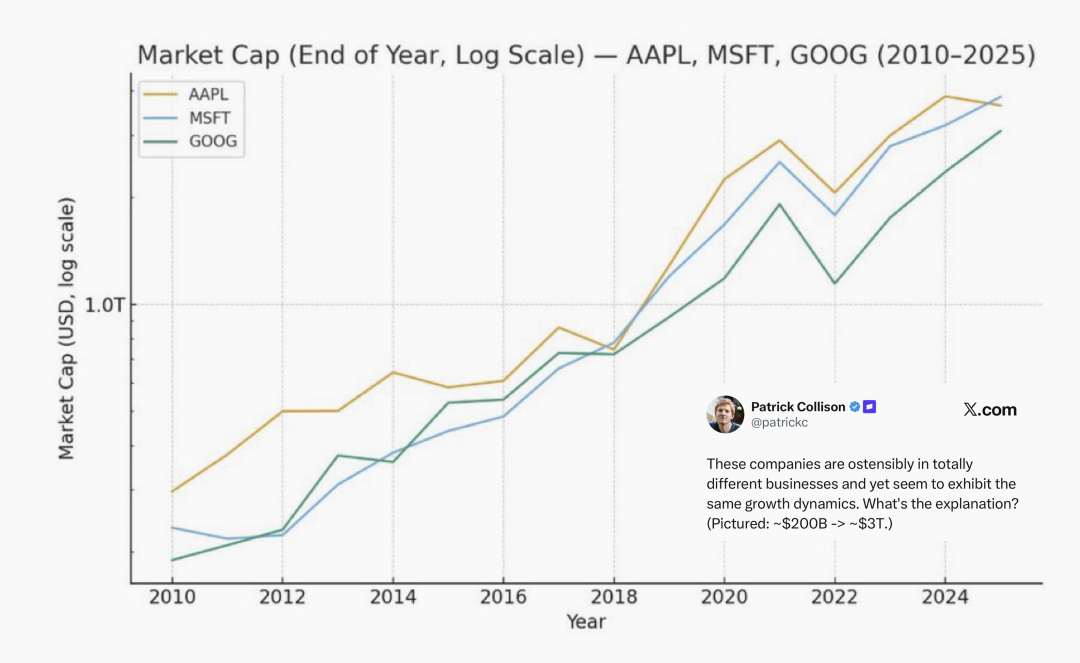
Core Insights - The growth trajectories of Apple, Microsoft, and Google from 2010 to 2025 show a parallel increase in market value, suggesting a unified growth dynamic despite their different business models [2][3] - Balaji Srinivasan posits that the traditional economy is fading while the internet economy is emerging, marking a significant economic shift [6][10] Group 1: Decline of the Traditional Economy - The traditional economy is characterized by physical entities and linear growth, heavily reliant on capital expenditure and regulatory frameworks [11][12][13] - Key sectors like manufacturing and energy are experiencing stagnation, with U.S. manufacturing worker productivity growth at approximately 2% since 2018, compared to 7% in the tech sector [17][16] Group 2: Rise of the New Economy - The internet economy exhibits exponential growth potential and is driven by network effects, allowing companies like Google and Meta to dominate their markets [20][22] - AI enables small teams to create significant value, with the potential for "one-person companies" to reach valuations of $1 billion [25][26] - The cost of adding users in digital services is negligible, allowing for global scalability without physical constraints [27][28] Group 3: Magnificent Seven as New Productivity Leaders - The "Magnificent Seven" (Apple, Microsoft, Alphabet, Amazon, Nvidia, Meta, and Tesla) now account for about 34% of the S&P 500's market capitalization, up from 12% in 2015 [31] - In 2023, these companies achieved a collective return rate of 75.71%, significantly outperforming the S&P 500's 24.23% [32] - Their platforms are integral to modern business activities, positioning them as infrastructure builders in the new economy [37] Group 4: Societal and Market Implications - The transition from traditional to new economy is reshaping societal structures and investment landscapes, presenting both opportunities and risks [40][41] - The concentration of wealth in technology sectors raises concerns about inequality and job losses in traditional industries [42] - The concept of "network states" may emerge, where communities based on shared values operate with their own currencies and governance, potentially replacing traditional nation-states [44][45]