油运

Search documents
港股异动 | 中远海能(01138)现跌超5% 油运市场多空交织 OPEC+暂停明年一季度增产
智通财经网· 2025-11-04 07:24
Core Viewpoint - The oil transportation market is experiencing mixed signals, with concerns over supply surplus leading to OPEC+ agreeing to a slight increase in oil production for December while pausing production increases for Q1 of next year [1] Group 1: Company Performance - China Ocean Shipping Company (中远海能) shares have dropped over 5%, currently trading at HKD 10.45 with a transaction volume of HKD 453 million [1] - Analysts indicate that the recent pause in 301 measures will effectively mitigate the risk of continued reduction in effective capacity for crude oil transportation [1] Group 2: Industry Outlook - The VLCC TCE has surged to over USD 120,000 due to increased sanctions against Russian oil, indicating a positive trend for oil transportation profitability [1] - It is projected that international crude oil transportation profits will see a significant year-on-year increase in Q3 2025, aligning with freight rate trends, and domestic tanker companies are outperforming the industry freight index [1] - Expectations for Q4 2025 and the entire year indicate that tanker profits will reach a ten-year high, with a favorable supply-demand outlook for oil transportation in 2026, suggesting a potential super bull market [1]
10月内地经济金融数据前瞻
citic securities· 2025-11-04 03:23
Market Overview - Chinese A-shares rose, with the Hainan sector experiencing significant gains, while Hong Kong's three major oil companies showed strong performance[3] - U.S. stock markets saw mixed results, with the Nasdaq rising due to Amazon's influence, but the Dow Jones fell by 0.48%[8] - European markets displayed varied performance, with the Eurozone manufacturing PMI remaining weak, impacting market sentiment[3] Economic Indicators - October's industrial output growth in China is expected to slow due to the holiday effect, with industrial value-added growth forecasted to decline[5] - Social financing growth in China is projected to decrease by 0.1 percentage points to 8.6% in October, influenced by government debt constraints[5] - The U.S. ISM manufacturing index has contracted for the eighth consecutive month, indicating ongoing economic challenges[5] Commodity and Currency Trends - Oil prices remained stable following OPEC+'s announcement to pause production increases, with WTI crude oil closing at $61.05 per barrel[24] - Gold prices fluctuated but ultimately rose above $4,000 per ounce after initial pressure from tax policy changes in China[24] - The U.S. dollar index increased slightly to 99.87, reflecting mixed views among Federal Reserve officials regarding inflation and employment risks[24] Fixed Income Market - U.S. Treasury yields rose across the board, with the 10-year yield reaching 4.11%, influenced by a significant supply of corporate bonds, including $25 billion from Alphabet[28] - The Chinese bond market showed strength, particularly in investment-grade bonds, while Asian markets remained relatively calm[28] Sector Performance - In the U.S., the materials sector saw the largest decline, dropping 0.56%, while non-core consumer goods led the market with a 1.70% increase[8] - In Hong Kong, the energy sector surged by 3.2%, driven by OPEC+ decisions, while local stocks faced downward pressure[11]

4000点后如何应对?结构性机会仍存,盘整震荡中布局再平衡
Zheng Quan Shi Bao Wang· 2025-11-03 03:05
Group 1 - The current index level is not as critical as the underlying quality of the market, with structural opportunities still present despite a focus on timing being less important [1] - The overall growth is entering a recovery phase, with improvements in net profit margins across various sectors, indicating a broadening of growth prospects [2] - The market is expected to experience a period of horizontal adjustment, suggesting a temporary pause in aggressive investment strategies [4] Group 2 - The recent U.S.-China trade discussions have alleviated external uncertainties, contributing to a favorable policy environment for the A-share market [5] - The focus is shifting towards internal structural optimization, with an emphasis on sectors like AI and cyclical industries that are expected to perform well in the coming year [7] - The market is likely to see a rotation in investment themes, with a potential focus on sectors benefiting from domestic demand and global supply chain dynamics [9] Group 3 - The technology sector remains a key focus, although there may be increased volatility in the short term due to high allocation levels and potential shifts in investment strategies [10] - The outlook for the market remains optimistic in the medium to long term, supported by clear economic growth targets and stable policy environments [8] - The recovery in profitability is expected to solidify the bull market, with a focus on sectors that can leverage both domestic and international opportunities [11][12]
周期论剑|三季报总结及展望
2025-11-03 02:35
Summary of Key Points from Conference Call Records Industry Overview - **Overall Performance**: The third quarter of 2025 showed improved growth across various sectors, with the ChiNext board leading in net profit and revenue growth. The growth style continues to lead equity profit recovery, while the consumer sector faces pressure [1][4] - **Investment Trends**: Active funds significantly increased allocations to TMT-related hardware, battery cells, non-bank financials, and high-performing sectors, while reducing exposure to consumer and large financial sectors. TMT sector holdings approached 40% [1][5] Key Industries and Companies Nonferrous Metals - **Performance**: Nonferrous metal companies saw substantial revenue and profit increases, with a 51% year-on-year profit growth and a 9% quarter-on-quarter increase. The nonferrous metal index rose by 41.82%, outperforming the CSI 300 [1][6][7] - **Future Outlook**: The long-term price trend for nonferrous metals is expected to rise due to macroeconomic improvements and demand driven by AI technology cycles [1][8] Chemical Industry - **Performance**: The chemical sector experienced a 4.1% revenue growth and approximately 7% profit growth in the first three quarters of 2025, benefiting from strong performance in potassium and phosphorus fertilizers, as well as fluorochemical sectors [1][11] - **Future Outlook**: The industry is expected to gradually improve in 2026, with recommendations for leading companies with cost advantages and growth potential [1][11] Transportation Sector - **Aviation**: The aviation sector showed growth, surpassing 2019 levels, with expectations for a profit upturn in 2026. Major airlines reported positive performance despite initial low expectations [1][12] - **Oil Shipping**: Oil shipping companies are projected to achieve record profits in 2025, with a bullish outlook for 2026 due to favorable supply-demand dynamics [1][13] Coal Industry - **Performance**: The thermal coal sector showed revenue and performance improvements, with a 30% increase in economies of scale. The price of coal is expected to rise, entering a new upward cycle [1][18][19] - **Future Outlook**: The coal price is projected to recover to above 600 RMB per ton by the end of 2026, with potential to reach over 800 RMB [1][20] Steel Industry - **Future Trends**: The steel industry is expected to continue recovering in 2026, with demand growth and supply contraction. Leading companies are anticipated to maintain excess profits due to management and structural advantages [1][24][26] Real Estate Market - **Current Data**: The real estate market is experiencing a downward trend but is expected to stabilize, with sales projected at approximately 8.4 to 8.5 trillion RMB in 2026 [1][29] Public Utilities - **Performance**: The thermal power sector showed significant growth, with some companies reporting up to 300% profit increases due to lower coal prices. The sector is expected to maintain a competitive edge in 2026 [1][34] - **Recommended Companies**: Key recommendations include major state-owned enterprises like Huaneng and Datang, which are undervalued and have stable fundamentals [1][35] Additional Insights - **Investment Recommendations**: Focus on companies with strong management capabilities and stable performance, particularly in the coal and public utility sectors [1][22][35] - **Market Dynamics**: The overall market is characterized by structural recovery and differentiation, with technology and growth sectors leading the way [1][2]
油运行业开始转强
Xin Lang Cai Jing· 2025-11-01 01:36
Market Overview - The market has shown significant adjustments recently, with a recommendation to remain patient and wait for a more stable range around 4000 points [1] Banking Sector - The banking sector, aside from Agricultural Bank's continuous rise, has shown generally weak performance, indicating that the logic for continued investment in banks is not strong under the current slow growth structure [1] Oil Shipping Sector - The oil shipping sector experienced a sudden surge, driven by a significant increase in freight rates, with September rates reaching the highest level for the same period since 1990 [1] - The oil shipping cycle is long, typically lasting 15 to 20 years, with the last peak occurring in 2008, suggesting a potential for a new uptrend due to supply-demand imbalances [1] - Current conditions show a sharp reduction in new shipping capacity, with many existing vessels facing gradual retirement, leading to expectations of a stronger industry outlook over the next five years [1] - OPEC's production cuts since April have contributed to lower oil prices, while strategic inventory replenishment by major countries has increased demand for oil transportation [1] - The growth of production capacity in Latin American countries has further increased the demand for super-large oil tankers, reinforcing the positive long-term outlook for the oil shipping industry [1]
焦点复盘沪指冲高回落终结7连阳,AI硬件端遭重挫,锂矿股逆势爆发
Sou Hu Cai Jing· 2025-10-30 09:40
Market Overview - A total of 46 stocks hit the daily limit, while 23 stocks faced limit down, resulting in a sealing rate of 67% [1] - The market experienced volatility, with the three major indices showing significant declines; the ChiNext index fell nearly 2%, and the Shanghai Composite Index dropped below 4000 points [1] - The trading volume in the Shanghai and Shenzhen markets reached 2.42 trillion yuan, an increase of 165.6 billion yuan compared to the previous trading day [1] Stock Performance - The number of stocks with consecutive limit up decreased to 41.66%, with notable performers including Shikong Technology achieving a 7-day limit up and Yashichuangneng reaching a 5-day limit up [3][4] - The market saw a broad decline, with 4100 stocks falling, while sectors such as energy metals, steel, quantum technology, and batteries showed gains [1][3] - Stocks like Xinhua Insurance and Baosteel Co. demonstrated resilience, rising over 2% despite the overall market downturn [3] Sector Analysis - The domestic energy storage leader, Sunshine Power, projected that new installations in the domestic energy storage sector could reach between 150 GWh and 200 GWh next year [5] - The lithium battery supply chain remains robust, with significant price increases in lithium hexafluorophosphate, which has exceeded 110,000 yuan per ton [17] - The launch of a new central enterprise strategic emerging industry fund with a scale of 51 billion yuan has positively impacted the quantum technology sector, leading to strong performances from stocks like Geer Software and Shenzhou Information [6][15] Future Outlook - The market is expected to see new speculative themes emerge following the completion of the third-quarter earnings disclosures, despite a significant number of stocks facing declines due to poor earnings reports [9] - The shift in market focus from previously leading technology stocks to dividend and consumer sectors indicates a potential reallocation of major funds [9] - The recent surge in oil tanker rates, reaching a five-year high, has led to increased activity in oil shipping stocks, suggesting a favorable outlook for the oil transportation sector [8]

中远海能(01138):油运龙头标的,基本面迎中长期改善
Shenwan Hongyuan Securities· 2025-10-20 11:24
Investment Rating - The report initiates coverage with a "Buy" rating for the company [9][11]. Core Views - The company is positioned as the world's largest oil tanker owner, with a robust fleet structure that allows it to capitalize on market cycles. The demand for oil transportation is expected to increase due to OPEC+ production boosts, while supply constraints are anticipated to maintain freight rate elasticity [9][10]. Financial Data and Profit Forecast - Revenue projections for 2025-2027 are estimated at 24.485 billion, 26.725 billion, and 27.233 billion RMB, reflecting year-on-year growth rates of 5.84%, 9.14%, and 1.90% respectively [8][10]. - Net profit attributable to ordinary shareholders is forecasted to be 4.462 billion, 5.803 billion, and 5.757 billion RMB for the same period, with growth rates of 10.51%, 30.05%, and -0.80% [8][10]. - The company’s gross profit is expected to be 6.660 billion, 8.336 billion, and 8.168 billion RMB, with gross margins of 27.2%, 31.2%, and 30.0% respectively [10]. Company Overview - The company controls a fleet of 158 vessels, including 54 VLCCs, making it the largest in the world. The fleet's structure provides significant operational flexibility and profit elasticity [19][23]. - The company has a strong focus on dividend distribution, maintaining a payout ratio around 50% since 2022, with a current dividend yield close to 7% [37][39]. Market Demand and Supply Dynamics - The demand for oil transportation is expected to be bolstered by OPEC+ production increases, with a projected supply increase of 214,000 to 411,000 barrels per day [9][46]. - The supply side is characterized by strong constraints, with the VLCC fleet not experiencing significant capacity scrapping for nearly 20 years, leading to a projected effective fleet growth rate of -0.3% to 1.8% from 2026 to 2027 [9][10][13]. Valuation - The company's reset cost is estimated at 55.43 billion RMB, with a current market value to reset cost ratio of 0.73, indicating potential for price appreciation [11][10]. - If benchmarked against comparable companies, the potential upside is estimated at 58%, with scenarios predicting price increases of 65% to 200% under various assumptions regarding ship prices [11][10].
中远海能午前涨逾6%机构指定增落地提升未来运力规模
Xin Lang Cai Jing· 2025-10-20 04:01
Group 1 - COSCO Shipping Energy's stock price increased by 5.99%, currently trading at HKD 9.91, with a trading volume of HKD 158 million [1] - On October 15, COSCO Shipping Energy announced the completion of its A-share issuance to specific investors, issuing 694,444,444 shares at a price of RMB 11.52 per share, raising a total of RMB 7,999,999,994.88 [1] - According to Huayuan Securities, the oil industry fundamentals are improving as OPEC+ has accelerated production since April, with a potential increase in production quotas by 2.2 million barrels per day in September, which may lead to a decline in oil prices and boost oil trade demand [1]
国泰海通:重视航空长逻辑 对美反制或驱动油运价上升
智通财经网· 2025-10-19 23:31
Group 1: Aviation Industry - The aviation sector is focusing on the recovery of business travel, with a high passenger load factor maintained during the post-holiday off-peak season. Domestic ticket prices continue to rise year-on-year [1] - The Civil Aviation Administration is strictly controlling the growth of flight slots, with a projected 1.6% reduction in flight slots for the winter season of 2025/26 compared to 2024/25, aligning with expectations of continued slot control [1] - Domestic flight slots are reduced by 1.8%, while international slots decrease by 1.6%. Domestic airlines are increasing flights by 1.8%, while foreign airlines are reducing flights by 7.2% [1] Group 2: Oil Shipping Industry - The VLCC-TCE rate on the Middle East to China route remains above $80,000, with shipowners feeling optimistic. China's countermeasures against the U.S. may lead to a preference for non-U.S. vessels, potentially reducing effective shipping capacity and increasing freight rates [2] - The outlook for oil shipping remains positive, with expectations for supply and demand to continue improving over the next two years. Profits for oil tankers are projected to reach new highs in Q3 2025 [2] Group 3: China-U.S. Trade Relations - China's countermeasures against U.S. 301 investigations aim to maintain fair competition in the international shipping and shipbuilding markets, encouraging the U.S. to correct its discriminatory practices [3] - Exemptions for Chinese-built vessels in the countermeasures are expected to enhance long-term confidence among Chinese shipping owners, preserving China's competitive edge in shipbuilding [3] - The countermeasures will directly impact U.S. shipping companies, with potential short-term disruptions but no significant increase in industry costs anticipated. Compensation measures may be introduced to alleviate operational pressures on Chinese shipping companies [3]

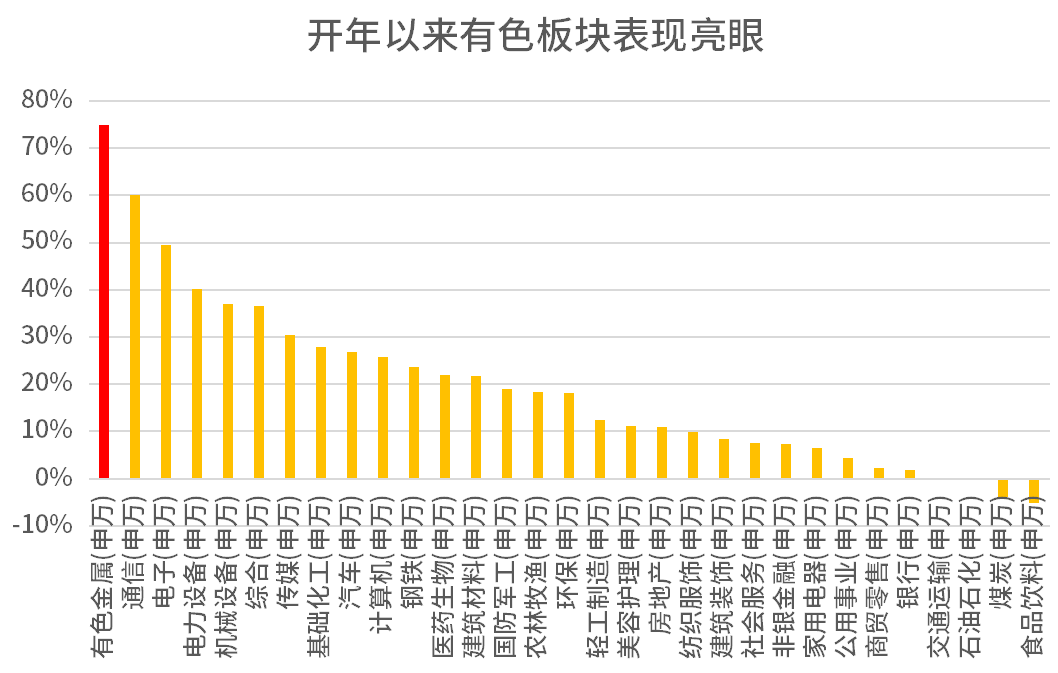
年内涨75%,从有色板块看周期机遇
Sou Hu Cai Jing· 2025-10-16 09:33
Core Viewpoint - The non-ferrous metals sector has shown outstanding performance in 2025, leading the market with a 75% increase year-to-date as of October 10, 2025, driven by various factors including the impact of interest rate cuts by the Federal Reserve [1][4]. Group 1: Performance Drivers - The strong performance of the non-ferrous sector is attributed to the rise in commodity prices across various sub-sectors, significantly influenced by the Federal Reserve's decision to cut interest rates by 25 basis points in September 2025, with expectations for further cuts [6]. - The anticipated continued rate cuts by the Federal Reserve are expected to further boost commodity prices in the non-ferrous sector, particularly for precious and industrial metals, which are sensitive to global interest rate environments [6]. Group 2: Investment Opportunities - There remains potential for investment in the non-ferrous sector, primarily due to the expected further rate cuts by the Federal Reserve, which could lead to additional price increases in the sector [6]. - Beyond the non-ferrous sector, other industries such as transportation (aviation, oil shipping), chemicals (pesticides, chlor-alkali), and construction materials (glass fiber, cement) are also approaching cyclical lows and turning points worth monitoring [10]. Group 3: Sector Comparisons - The non-ferrous sectors in Hong Kong and A-shares are fundamentally similar, with differences mainly in market conditions and investor types; currently, the valuation of the Hong Kong non-ferrous sector is relatively cheaper compared to A-shares [8]. Group 4: Investment Logic and Risks - The investment logic for the non-ferrous sector involves an initial phase driven by trading expectations based on macroeconomic conditions, followed by a second phase where actual commodity price increases may lead to stock price volatility [10]. - Key risks to monitor include potential price peaks, the pace of future Federal Reserve rate cuts, domestic macroeconomic conditions, and central bank gold purchasing activities [10].