金属冶炼

Search documents
银河期货每日早盘观察-20251127
Yin He Qi Huo· 2025-11-27 01:56
Report Summary 1. Investment Ratings The document does not provide specific industry investment ratings. 2. Core Views - **Financial Derivatives**: Stock index futures are expected to remain volatile, with leading stocks' attempts to rise making large - cap indexes perform strongly. Treasury bond futures may rebound in the short - term [17][22]. - **Agricultural Products**: Protein meal prices are generally supported, while sugar shows different trends internationally and domestically. The oil and fat sector continues to oscillate, and various agricultural products have their own supply - demand and price characteristics [24][27][33]. - **Black Metals**: Steel prices oscillate within a range, and the double - coking market sentiment is weak. Iron ore should be treated with a bearish mindset, and ferroalloys oscillate at the bottom [9]. - **Non - ferrous Metals**: Precious metals maintain a strong trend, and base metals such as copper, aluminum, and zinc have different price trends affected by factors like interest - rate cut expectations and supply - demand [11][12]. - **Energy and Chemicals**: Crude oil prices have rebounded after touching the bottom, and various chemical products have their own price trends based on supply - demand and other factors [16]. 3. Summary by Catalog Financial Derivatives - **Stock Index Futures**: On Wednesday, the market rebounded and then fell back. Indexes showed differentiation, and trading volume and open interest decreased. It is recommended to reduce positions and wait and see, conduct IM/IC long 2512 + short ETF cash - and - carry arbitrage, and use the double - buy option strategy [17][19][21]. - **Treasury Bond Futures**: On Wednesday, treasury bond futures fell sharply. The sharp adjustment may be due to rumors of new public - fund regulations. In the short - term, it is recommended to moderately bet on the oversold rebound and go long at low positions [22]. Agricultural Products - **Protein Meal**: CBOT soybean and soybean meal indexes rose. In the international market, the supply of soybeans is abundant, and domestic soybean meal has price support. It is recommended to lay out a small number of long positions in soybean and rapeseed meal [25][26]. - **Sugar**: International sugar prices continued to rise, and domestic sugar prices oscillated within a range. It is recommended to build long positions at low positions in the short - term and conduct long January and short May arbitrage [28][31][32]. - **Oil and Fat Sector**: The Malaysian palm oil has an expected increase in production and weak exports in November. Palm oil oscillates weakly, and soybean oil follows the overall trend. It is recommended to conduct short - term band operations or wait and see [34][35]. - **Corn/Corn Starch**: The spot is strong, and the futures oscillate at a high level. It is recommended to go long on the 12 - month corn on dips, wait and see for the 01 - month corn, and wait for dips for the 05 - and 07 - month corn [36][38]. - **Pigs**: The pressure of pig slaughter is still high, and it is recommended to wait and see and use the strategy of selling wide - straddle options [39][40]. - **Peanuts**: Peanut spot prices rose, and the futures rose significantly. It is recommended to short the 01 - month peanut lightly at high positions and conduct 15 - month peanut reverse arbitrage [41][42]. - **Eggs**: Egg demand is average, and prices are mainly stable. It is recommended to build long positions in the January contract at low positions [44][46][47]. - **Apples**: Apple demand is average, and prices are mainly stable. It is recommended to wait and see [49][50][51]. - **Cotton - Cotton Yarn**: The fundamentals have few contradictions, and cotton prices mainly oscillate. It is recommended to wait and see [53][54]. Black Metals - **Steel**: Steel prices oscillate within a range, and there is still room to reduce hot - metal production. It is recommended to maintain the oscillating trend and go long on the spread between hot - rolled and rebar futures [56][57]. - **Double - Coking**: The market sentiment is still weak, and it is recommended to gradually take profits on short positions and continue to hold the 1/5 coking coal reverse arbitrage [58][59]. - **Iron Ore**: It should be treated with a bearish mindset, and it is recommended to be bearish at high positions [60][61][63]. - **Ferroalloys**: Prices oscillate at the bottom under the trend of production reduction. It is recommended to expect bottom - oscillating and sell out - of - the - money straddle option combinations [64][65]. Non - ferrous Metals - **Precious Metals**: Gold and silver maintain a strong trend. It is recommended to hold long positions based on the 5 - day moving average and buy out - of - the - money call options [67][68][70]. - **Copper**: Copper prices are supported by the increasing expectation of US interest - rate cuts. It is recommended to hold long positions below 86,000 yuan/ton [71][72][74]. - **Alumina**: Substantial production cuts have not been realized. It is recommended to expect the price to be weak and wait and see [75][76]. - **Electrolytic Aluminum**: Aluminum prices rise with the external market. It is recommended to oscillate strongly with the external market and pay attention to the narrowing of the spread between East China and Central China [77][78][79]. - **Cast Aluminum Alloy**: It runs strongly with aluminum prices. It is recommended to run strongly with aluminum prices and wait and see [80][82][83]. - **Zinc**: It oscillates widely. It is recommended to hold profitable long positions and be vigilant about the impact of overseas funds [84][86]. - **Lead**: Pay attention to the impact of the capital side. It is recommended to take partial profits on previous profitable short positions and pay attention to the capital flow [87][88][89]. - **Nickel**: Production cuts stimulate the rebound of nickel prices, but inventory suppresses the height. It is recommended to be a short - position configuration [90][93]. - **Stainless Steel**: Supply and demand are both weak, and it follows the raw - material rebound. It is recommended to be a short - position configuration and sell out - of - the - money call options [91][94]. - **Industrial Silicon**: It oscillates within a range, and long positions should be held at this price. It is recommended to hold long positions, conduct Si2601, Si2602 cash - and - carry arbitrage, and sell put options [95][97]. - **Polysilicon**: It is strong in the short - term. It is recommended to try shorting after the price rises again and pay attention to stop - profit and stop - loss [98]. Energy and Chemicals - **Crude Oil**: Geopolitical uncertainties still exist, and oil prices have rebounded after touching the bottom [16]. - **Other Chemical Products**: Each chemical product has its own supply - demand and price characteristics, such as asphalt oscillating narrowly, fuel oil with different trends for high - sulfur and low - sulfur, etc. [16].
供应趋紧叠加美联储降息预期升温,伦铜现货升水创五周新高
Hua Er Jie Jian Wen· 2025-11-25 06:33
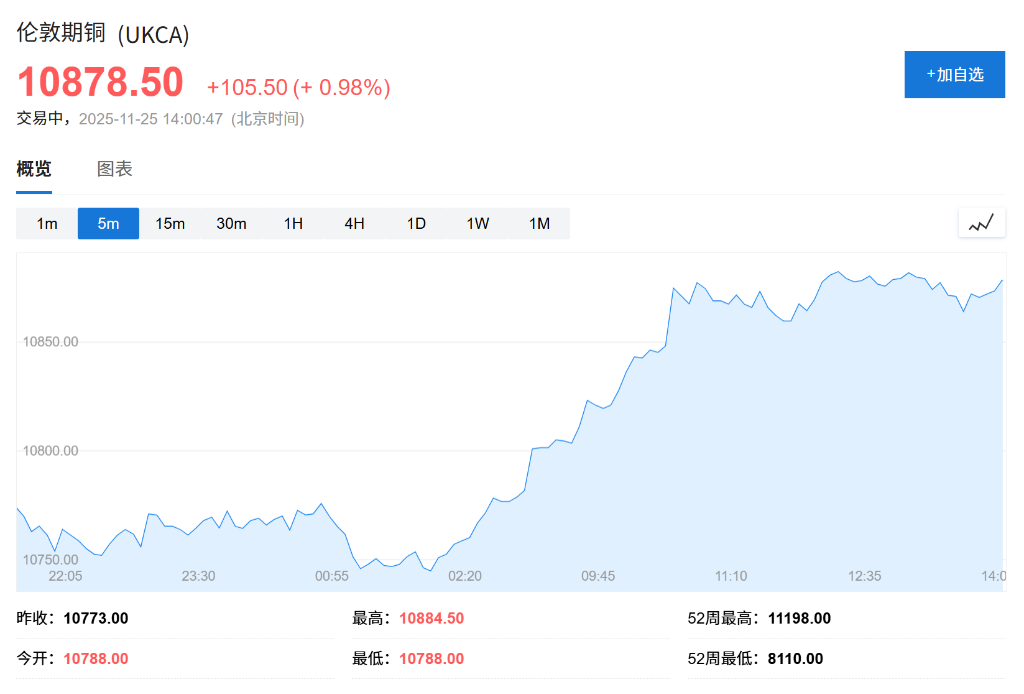
受现货供应趋紧和市场对美联储下月降息预期增强的双重提振,铜价走高,凸显了宏观经济前景与实体供需基本面的共同作用。 引发市场乐观情绪的主要催化剂是美联储官员的最新表态。美联储理事Christopher Waller以美国劳动力市场疲软为由,主张下调利率,这番言论 巩固了市场对于进一步货币宽松的信心。通常而言,更低的借贷成本对工业金属构成利好。 与此同时,实体市场的供应紧张信号愈发明确。伦敦金属交易所(LME)现货铜较三个月期期货的升水(cash-three-month spread)跃升至超过20 美元/吨,创下约五周新高,表明交易员愿意为即期交付的铜支付更高溢价。 受此影响,周二伦铜期货价格上涨0.98%至10878美元/吨,纽约商品交易所(Comex)的期铜价格同样走高。其他基本金属中,铝价上涨0.4%, 锌价上涨0.5%。 供应紧张加剧,冶炼费用跌至新低 | 概览 | 图表 | | | | | | | | | | | | --- | --- | --- | --- | --- | --- | --- | --- | --- | --- | --- | --- | | 1m | 5m | 15m | 30m ...

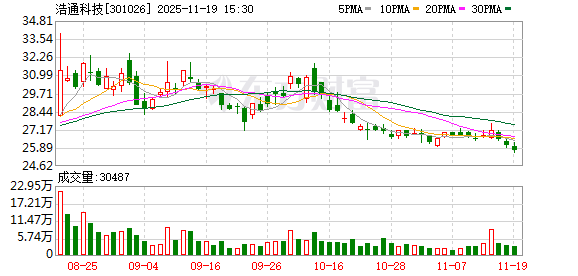
浩通科技:获批成为广州期货交易所铂、钯期货指定交割厂库
Zheng Quan Shi Bao Wang· 2025-11-24 08:07
Core Viewpoint - Haotong Technology (301026) has been approved as a designated delivery warehouse for platinum and palladium futures by the Guangzhou Futures Exchange, effective November 21, 2025 [1] Group 1 - The Guangzhou Futures Exchange issued notifications regarding the delivery business for platinum and palladium futures on November 21, 2025 [1] - The approval allows Haotong Technology to participate in the futures market for these precious metals, potentially enhancing its business operations and revenue streams [1]
宏观金融类:文字早评2025/11/24星期一-20251124
Wu Kuang Qi Huo· 2025-11-24 02:26
1. Report Industry Investment Ratings There is no information provided regarding the report's industry investment ratings. 2. Core Views of the Report - The stock market has a certain degree of short - term uncertainty due to previous rises and overseas market adjustments, but the medium - to - long - term strategy is to go long on dips [4]. - The bond market is expected to oscillate and recover in the fourth quarter, with attention to the stock - bond seesaw effect and the increasing allocation power [8]. - For precious metals, it is recommended to hold a bottom position and wait and see, with the Fed's easing policy expected to further drive prices in December [10]. - Most non - ferrous metals are expected to be in a state of shock in the short term, with different support and pressure factors [13][15][18]. - The steel market is expected to be weakly volatile in the short term, but demand may improve with policy implementation [36]. - The energy and chemical market shows different trends, with some products recommended for long - term strategies and others for short - term caution [56][58][60]. - The agricultural product market also has various trends, such as short - term weak operation for some and shock - based operation for others [81][86]. 3. Summary by Related Catalogs Macro - financial Category Stock Index - **Market Information**: The US government may allow NVIDIA to sell H200 chips to China; the SASAC held a central enterprise specialization integration promotion meeting; Changxin Storage released new DDR5 products; a Goldman Sachs partner said the US stock market may continue to sell off [2]. - **Strategy View**: After previous rises and influenced by overseas market adjustments, the short - term index is uncertain, but the medium - to - long - term strategy is to go long on dips [4]. Treasury Bond - **Market Information**: The main contracts of TL, T, and TF decreased on Friday, while TS remained unchanged. The Bank of Japan may raise interest rates, and the US PMI data showed mixed results. The central bank conducted a net injection of 1622 billion yuan [5]. - **Strategy View**: The bond market is expected to oscillate and recover in the fourth quarter, with attention to the stock - bond seesaw effect and the increasing allocation power [8]. Precious Metals - **Market Information**: Gold prices rose slightly, and silver prices fell. The US 10 - year Treasury yield and the US dollar index were reported. Fed officials' "dovish" remarks supported precious metal prices [9]. - **Strategy View**: It is recommended to hold a bottom position and wait and see, with the Fed's easing policy expected to further drive prices in December [10]. Non - ferrous Metals Category Copper - **Market Information**: The copper price rebounded after a decline, with LME copper inventory decreasing and domestic spot premiums rising [12]. - **Strategy View**: The copper price is expected to be in a state of shock in the short term, with strong support at the bottom [13]. Aluminum - **Market Information**: The aluminum price rebounded after a decline, with domestic and overseas inventory changes and improved downstream procurement sentiment [14]. - **Strategy View**: The aluminum price is expected to strengthen after an oscillatory adjustment, with strong support [15]. Zinc - **Market Information**: The zinc price rose slightly, with changes in inventory and basis [16]. - **Strategy View**: The zinc price is expected to be weakly volatile in the short term, with the zinc industry still in an over - supply cycle [18]. Lead - **Market Information**: The lead price fell, with changes in inventory and basis [19]. - **Strategy View**: The lead price is expected to be weakly volatile in the short term, with relatively loose supply [19]. Nickel - **Market Information**: The nickel price continued to fall, with changes in spot premiums and cost [20]. - **Strategy View**: The nickel price is expected to be under pressure in the short term, and it is recommended to wait and see [21][22]. Tin - **Market Information**: The tin price fell slightly, with changes in supply, demand, and inventory. The safety situation in the DRC may affect tin mines [23]. - **Strategy View**: The tin price is expected to oscillate in the short term, and it is recommended to wait and see [24]. Carbonate Lithium - **Market Information**: The carbonate lithium price fell, with changes in spot and futures prices [25]. - **Strategy View**: It is recommended to pay attention to potential disturbances and the reference range of the main contract [26]. Alumina - **Market Information**: The alumina price fell, with changes in inventory and basis [28]. - **Strategy View**: It is recommended to wait and see in the short term, with attention to supply - side policies [29]. Stainless Steel - **Market Information**: The stainless steel price rose slightly, with changes in inventory and cost [30]. - **Strategy View**: The stainless steel price is expected to continue to decline weakly, with an over - supply situation [30]. Cast Aluminum Alloy - **Market Information**: The cast aluminum alloy price fell, with changes in inventory and basis [31]. - **Strategy View**: The price is expected to be in a state of shock in the short term [33]. Black Building Materials Category Steel - **Market Information**: The steel price rose slightly, with changes in inventory and basis [35]. - **Strategy View**: The steel price is expected to be weakly volatile in the short term, but demand may improve with policy implementation [36]. Iron Ore - **Market Information**: The iron ore price fell slightly, with changes in inventory and basis [37]. - **Strategy View**: The iron ore price is expected to oscillate within a range, with strong supply and stable demand [38][39]. Glass and Soda Ash - **Market Information**: The glass price fell, and the soda ash price fell. There were changes in inventory and basis [40][41]. - **Strategy View**: The glass price is expected to oscillate at the bottom, and the soda ash price is expected to be weakly volatile [40][41]. Manganese Silicon and Ferrosilicon - **Market Information**: The manganese silicon price fell, and the ferrosilicon price rose slightly. There were changes in inventory and basis [42]. - **Strategy View**: It is recommended to pay attention to the inflection point of market sentiment and price, and to look for opportunities to rebound [44][45]. Industrial Silicon and Polysilicon - **Market Information**: The industrial silicon price fell, and the polysilicon price rose slightly. There were changes in inventory and basis [46][49]. - **Strategy View**: The industrial silicon price is expected to oscillate, and the polysilicon price is expected to oscillate within a wide range [48][50]. Energy and Chemical Category Rubber - **Market Information**: The rubber price oscillated and adjusted, with changes in tire factory start - up rates and inventory [52][54]. - **Strategy View**: It is recommended to have a bullish strategy with stop - loss settings and partial hedging [56]. Crude Oil - **Market Information**: The crude oil price fell, and there were changes in refined oil prices and inventory [57]. - **Strategy View**: It is recommended to wait and see in the short term and test OPEC's export price - support willingness [58]. Methanol - **Market Information**: The methanol price fell, with changes in inventory and basis [59]. - **Strategy View**: The methanol price is expected to continue to decline weakly, with high inventory pressure [60]. Urea - **Market Information**: The urea price rose slightly, with changes in inventory and basis [61]. - **Strategy View**: The urea price is expected to oscillate at the bottom, and it is recommended to go long at low prices [61]. Pure Benzene and Styrene - **Market Information**: The pure benzene price was unchanged, and the styrene price rose. There were changes in inventory and basis [62]. - **Strategy View**: The styrene price may stop falling in stages, with cost and demand factors [63]. PVC - **Market Information**: The PVC price was unchanged, with changes in inventory and basis [64]. - **Strategy View**: The PVC price is expected to be weak, and it is recommended to go short in the medium term [66]. Ethylene Glycol - **Market Information**: The ethylene glycol price fell, with changes in inventory and basis [67]. - **Strategy View**: The ethylene glycol price is expected to be weak, and it is recommended to go short in the medium term [68]. PTA - **Market Information**: The PTA price fell, with changes in inventory and basis [69]. - **Strategy View**: The PTA price is expected to be affected by supply, demand, and valuation factors [71]. Para - Xylene - **Market Information**: The para - xylene price fell, with changes in inventory and basis [72]. - **Strategy View**: The para - xylene price is expected to have a risk of valuation correction, with high supply and low demand [73]. Polyethylene (PE) - **Market Information**: The PE price fell, with changes in inventory and basis [74]. - **Strategy View**: The PE price is expected to oscillate at a low level, with cost and demand factors [75]. Polypropylene (PP) - **Market Information**: The PP price fell, with changes in inventory and basis [77]. - **Strategy View**: The PP price is expected to be affected by cost and demand factors, and may be supported in the first quarter of next year [78]. Agricultural Products Category Pig - **Market Information**: The pig price fluctuated, with normal supply and limited demand [80]. - **Strategy View**: It is recommended to go short on the near - month contract or do reverse spreads [81]. Egg - **Market Information**: The egg price was stable with partial increases, with reduced inventory pressure and increased replenishment willingness [82]. - **Strategy View**: The egg price is expected to oscillate in the short term, and it is recommended to go short after a rebound in the medium term [83][84]. Soybean Meal and Rapeseed Meal - **Market Information**: The soybean meal price was stable, with changes in import cost, inventory, and demand [85]. - **Strategy View**: The soybean meal price is expected to oscillate, with cost support and pressure on crushing margins [86]. Edible Oils - **Market Information**: The edible oil price fell, with weak palm oil export data and high supply [87]. - **Strategy View**: The palm oil price is recommended to be viewed with an oscillatory perspective, and turn to a bullish strategy if production decreases [88][89]. Sugar - **Market Information**: The sugar price fell, with an expected global surplus in the 2025/26 season and increased imports [90][91]. - **Strategy View**: It is recommended to wait for a rebound and then go short [91]. Cotton - **Market Information**: The cotton price oscillated narrowly, with changes in production, inventory, and demand [92][93]. - **Strategy View**: The cotton price is expected to oscillate in the short term, with no strong driving force [94].
奋进的河南 决胜“十四五”·三门峡篇丨天鹅之城 材料新城 ——三门峡市交出厚重“十四五”答卷
He Nan Ri Bao· 2025-11-24 01:56
Core Viewpoint - Sanmenxia is undergoing a transformation from a resource-dependent city to an innovation-driven city, showcasing significant economic growth and industrial upgrades during the "14th Five-Year Plan" period. Economic Growth - The city's GDP is projected to grow at an average annual rate of 4.8% from 2021 to 2024, with a per capita GDP exceeding 80,000 yuan in 2024, ranking 4th in the province [2] - In the first three quarters of 2025, the GDP grew by 5.6% year-on-year, indicating steady economic progress [2] - Major economic indicators show consistent improvement, with industrial added value and retail sales growing at annual rates of 7% and 5.8%, respectively [2] Innovation and Industrial Upgrade - R&D investment intensity has increased from 1.81% to 2.99%, maintaining a leading position in the province for five consecutive years [3] - The city has established 835 innovation platforms, including key laboratories and research bases, to support industrial innovation [3][4] - Breakthroughs in key technologies, such as ammonia-free molybdenum metallurgy and ultra-thin copper foil production, have been achieved [3] Structural Changes in Industry - The mining sector's contribution to the economy has decreased from nearly 40% to 20%, while manufacturing has increased from 50% to nearly 70% [5] - The city has invested 364 million yuan in special funds for industrial upgrades, resulting in an average production efficiency increase of 42% and cost reduction of over 26% for 846 industrial enterprises [5] Emerging Industries - The copper-based new materials sector has seen significant growth, with production capacity reaching 78,000 tons, making it the largest in the country [5] - New energy storage and superconducting materials are being developed, with projects like the energy storage equipment industrialization underway [6] Environmental and Ecological Initiatives - The city has implemented effective ecological governance, restoring 1.9 million mu of wetlands and achieving a forest coverage rate of 41.2% [8] - Air quality has improved, with PM10 and PM2.5 concentrations decreasing by 11.8% and 12.5%, respectively [8] Open Economy and Trade - Sanmenxia has enhanced its external trade capabilities, with a continuous increase in service trade by an average of 49.6% annually from 2021 to 2024 [9] - The establishment of the Sanmenxia Port and the operation of the Sanmenxia Customs have facilitated local trade [9] Social Development and Welfare - The per capita disposable income for rural residents is projected to reach 22,307 yuan in 2024, growing by 7.6% [10] - The city has implemented 105 key livelihood projects, expanding medical resources and improving social security [10] Governance and Leadership - The city emphasizes the role of party leadership in governance, enhancing grassroots organizational strength and promoting effective management [11][12] Future Goals - Sanmenxia aims to become a center for industrial strength, ecological sustainability, cultural richness, openness, and digital innovation, contributing to the modernization of the Central Plains [13]

有色:估值与交易间的博弈
2025-11-24 01:46
Summary of Conference Call on Non-Ferrous Metals Industry Industry Overview - The non-ferrous metals industry is currently experiencing a phase of price consolidation for industrial and precious metals, with limited upward momentum expected in the short term. [1][2] - The supply-demand dynamics for copper and aluminum are projected to shift towards a shortage in the coming year, making them worthwhile investments. [1][2] Key Insights and Arguments - **Short-term Price Outlook**: Industrial metals like copper and aluminum, as well as gold, are expected to remain in a consolidation phase for the next two months, lacking strong price increase momentum. [1][2] - **Mid-term Supply-Demand Dynamics**: The supply-demand balance for copper and aluminum is anticipated to be skewed towards shortage next year, suggesting a potential price increase. [1][2] - **Gold Price Forecast**: Gold is expected to oscillate above $4,000, with a need for volatility to decrease to 15-20 for stability confirmation. [1][3][5] - **Silver Price Outlook**: Silver is likely to fluctuate around $50, pending liquidity easing and economic recovery. [5] - **Copper Demand Drivers**: Approximately 60% of global copper demand is driven by battery cells, AI, and power grid-related sectors. [1][7] - **Aluminum Market Dynamics**: The global supply of electrolytic aluminum is expected to grow less than 2%, while demand is projected to increase by 2.3% to 2.4%, leading to a supply-demand imbalance. [2][9] Important but Overlooked Content - **Macroeconomic Influences**: Recent macroeconomic events, including unexpected unemployment rates and non-farm payroll data, have led to uncertainty in the Federal Reserve's interest rate decisions. [4] - **Impact of AI on Metal Demand**: While AI technology is expected to marginally increase copper demand, its overall impact on the market remains limited. [10] - **Lithium Market Trends**: The lithium carbonate market is projected to experience a 75% increase in demand in the energy storage sector next year, although a slight oversupply is expected in the short term. [11][12] - **Investment Strategy**: The current strategy suggests waiting for better trading opportunities, as many companies in the sector have attractive valuations despite the market's volatility. [13] Conclusion - The non-ferrous metals sector is poised for potential growth, particularly in copper and aluminum, driven by supply constraints and increasing demand from emerging technologies. Investors are advised to remain patient and strategically position themselves for future opportunities. [1][2][13]
恒指三季度季检结果出炉!信达生物染蓝 成份股增加至89只
Zhi Tong Cai Jing· 2025-11-21 10:35
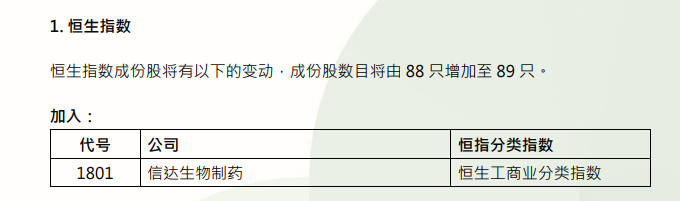
Group 1 - Hang Seng Index will include Innovent Biologics (01801), increasing the number of constituent stocks from 88 to 89 [1][4] - Hang Seng China Enterprises Index will include China Hongqiao (01378), Innovent Biologics, and Yum China (09987), while New Energy (02688) and New Oriental-S (09901) will be removed, maintaining a total of 50 constituent stocks [3][5] - Hang Seng Technology Index will include Leapmotor (09863), while ASMPT (00522) will be removed, keeping the number of constituent stocks at 30 [7][9] Group 2 - Hang Seng Composite Index will include FWD Group (01828), Hesai Technology-W (02525), Aux Group (02580), Geekplus Technology-W (02590), Yino Pharma (02591), and Chery Automobile (09973), increasing the number of constituent stocks from 503 to 509 [10][11][12]
恒邦股份:在冶炼过程中,稀散金属是复杂金精矿的伴生产品,毛利率较高,增加了公司的利润弹性
Mei Ri Jing Ji Xin Wen· 2025-11-20 15:32
Core Viewpoint - The company is focused on enhancing its profitability through continuous optimization of its business structure, particularly in its core smelting operations which yield higher profit margins from by-products like rare metals [1] Group 1 - The smelting business is identified as the company's core profit-generating segment [1] - Rare metals, as by-products of complex gold concentrates, contribute to higher profit margins, increasing the company's profit elasticity [1] - The company is actively implementing measures to improve its gross profit margin [1]

11月19日LME金属库存及注销仓单数据
Wen Hua Cai Jing· 2025-11-20 09:37
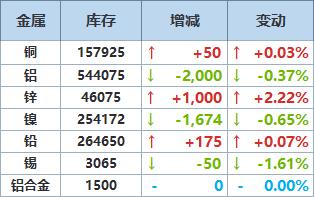
Group 1: Inventory Changes - Copper inventory increased by 50 tons, reaching a total of 157,925 tons, reflecting a 0.03% rise [1] - Aluminum inventory decreased by 2,000 tons to 544,075 tons, showing a 0.37% decline [1] - Zinc inventory rose by 1,000 tons to 46,075 tons, marking a 2.22% increase [1] - Nickel inventory decreased by 1,674 tons to 254,172 tons, a decline of 0.65% [1] - Tin inventory fell by 50 tons to 3,065 tons, representing a 1.61% decrease [1] Group 2: Registered and Cancelled Warrants - Registered copper warrants totaled 148,450 tons, with a cancellation rate of 6.00% [2] - Registered aluminum warrants were at 484,800 tons, with a cancellation rate of 10.89% [2] - Registered zinc warrants reached 42,475 tons, with a cancellation rate of 7.81% [2] - Registered nickel warrants were 244,476 tons, with a cancellation rate of 3.81% [2] - Registered tin warrants stood at 2,995 tons, with a cancellation rate of 2.28% [2] Group 3: Specific Warehouse Inventory Changes - The largest copper inventory was at Changxing with 68,925 tons, an increase of 300 tons [4] - The largest aluminum inventory was at Port Klang with 355,000 tons, a decrease of 2,000 tons [6] - The largest zinc inventory was at Kaohsiung with 9,450 tons, an increase of 800 tons [10] - The largest tin inventory was at Changxing with 3,065 tons, a decrease of 50 tons [12] - The largest nickel inventory was at Singapore with 76,752 tons, unchanged [14]
浩通科技:申请广州期货交易所铂、钯期货指定交割厂库的公告
Zheng Quan Ri Bao· 2025-11-19 13:35
Core Viewpoint - The company, Haotong Technology, has announced its intention to apply for the qualification of designated delivery warehouses for platinum and palladium futures at the Guangzhou Futures Exchange, which is expected to enhance its risk resistance and market competitiveness while improving profitability [2]. Group 1 - The company will hold the seventh board meeting on November 19, 2025, to review the proposal for applying for designated delivery warehouse qualifications [2]. - The application aims to integrate the spot market, futures market, and delivery warehouses, thereby strengthening the company's overall market position [2]. - The management has been authorized to submit the application materials and handle related matters [2].