半导体

Search documents
每日市场观察-20260302
Caida Securities· 2026-03-02 05:51
Market Performance - The Shanghai Composite Index rose by 0.39% while the Shenzhen Component Index fell by 0.06% on February 27, 2026[1] - The ChiNext Index and the STAR 50 Index showed weaker performance, with declines of 1.04% and an increase of 0.15%, respectively[1] - The cumulative increase for the Shanghai Composite Index in February was 1.09%, while the Shenzhen Component Index rose by 2.04% and the ChiNext Index fell by 1.08%[2] Capital Flow - On February 27, 2026, net inflows into the Shanghai Stock Exchange were 33.529 billion yuan, and 12.374 billion yuan into the Shenzhen Stock Exchange[4] - The top three sectors for capital inflow were IT Services, Minor Metals, and Electric Power, while the sectors with the highest outflows were Components, Communication Equipment, and Semiconductors[4] Policy and Economic Outlook - The Central Political Bureau emphasized the continuation of a more proactive fiscal policy and moderately loose monetary policy to strengthen reform measures and macro policy coordination[5] - The People's Bank of China announced a reduction of the foreign exchange risk reserve ratio for forward foreign exchange sales from 20% to 0% to support the development of the foreign exchange market[6] Industry Trends - The Ministry of Ecology and Environment plans to complete ultra-low emission transformations for 100 million tons of cement clinker and 50 million tons of coking capacity by 2026[9] - A total of 230 public funds were launched in the first two months of 2026, with a total scale exceeding 210 billion yuan, marking a historical high for the same period in the past four years[14]
交银国际每日晨报-20260302
BOCOM International· 2026-03-02 05:45
Core Insights - The report emphasizes a shift in trading logic for Hong Kong stocks from "expectation speculation" to "profit verification" due to the convergence of the National "Two Sessions" policy and corporate annual reports [1] - Key variables to watch in March include the effectiveness of policy implementation from the National "Two Sessions," annual performance guidance, and corporate buyback efforts, as well as the Federal Reserve's March FOMC meeting [1] - The industry allocation focuses on "profit certainty" and "policy resonance," with a balanced approach towards sectors such as internet and new economy growth, hard technology and overseas manufacturing, globally priced upstream resources, and low-volatility dividend assets [1] Company Summaries Nvidia (NVDA US) - Nvidia's long-term growth visibility has improved, with an upward revision of FY2027E/28E revenue to $354.5 billion and $455.7 billion, respectively, and Non-GAAP EPS to $8.06 and $10.52 [3][7] - The company expects FY1Q27 revenue guidance of $78 billion, with a Non-GAAP gross margin of 75% [3] - The revenue from network chips is highlighted as a significant growth driver, with a year-on-year increase of over 3.5 times [3] AMD (AMD US) - AMD has entered a partnership with META for a 6GW data center infrastructure development agreement, with potential revenue of $15-21 billion from the first GW [8] - The company maintains a buy rating with a target price of $275, reflecting a potential upside of 35% [8] - Revenue and Non-GAAP EPS forecasts for 2026-28 have been adjusted to $46.84 billion, $66.16 billion, and $80.62 billion, with Non-GAAP EPS of $6.65, $10.31, and $12.71 [9] BeiGene (6160 HK) - BeiGene reported strong product sales in Q4 2025, with a revenue guidance of $6.2-6.4 billion for 2026, indicating a growth rate of 16-20% [10][11] - The company achieved a Q4 2025 sales figure of $1.1 billion for its drug, with a gross margin of 90.5% [10] - The focus for 2026 includes multiple R&D initiatives across various therapeutic areas, with a slight downward adjustment in profit forecasts [12]


东吴证券晨会纪要2026-03-02-20260302
Soochow Securities· 2026-03-02 05:34
Macro Strategy - The geopolitical risks have intensified since February, particularly following the military conflict involving Iran, which has led to a surge in global financial markets driven by oil and gold prices, indicating strong risk aversion [1][14] - The core risks identified include: 1. The blockage risk of the Strait of Hormuz, which is crucial for global oil transport, with a daily transport volume of approximately 20 million barrels, accounting for about 20% of global oil consumption [1][14] 2. Disruption risks in the chemical supply chain, as Iran is the second-largest methanol producer globally, supplying over 60% of China's methanol imports [1][14] 3. Rising freight and insurance costs due to potential escalation of regional conflicts, which could significantly increase the costs of commodities passing through these routes [1][14] Foreign Exchange Market Impact - Short-term market risk aversion is expected to persist, with funds likely flowing into the US dollar and US Treasury markets, while the Chinese yuan may act as a "safe haven" [1][14] - The dollar index is anticipated to strengthen in the short term but may face pressure in the medium term if the situation escalates, potentially leading to a scenario of rising oil prices and inflation, prompting central banks to raise interest rates [1][14] - The yuan is expected to maintain a stable upward trend, supported by flexible domestic fiscal and monetary policies, with a projected trading range against the dollar of 6.80-6.95 in the short term [1][14] Commodity Market Impact - Short-term risk aversion is driving a synchronous rise in gold and oil prices, while medium-term supply chain disruptions and inflation pressures may reshape the global economic and financial landscape [1][14] - The potential for a prolonged regional conflict could lead to significant changes in global economic dynamics, with high oil prices and shipping costs potentially slowing global economic growth and increasing inflationary pressures [1][14] - Long-term geopolitical tensions are expected to enhance the strategic importance of energy and resources for national economies, with a shift from "efficiency-first" to "security-first" in resource supply [1][14] Stock Market Impact - Initial phases of geopolitical conflict typically pressure global stock markets, with the A-share market likely experiencing some downward pressure due to panic selling [1][14] - However, the impact on the A-share market may be pulse-like and not indicative of a systemic shift, as China's modern manufacturing system can help mitigate external shocks [1][14] - The A-share market is currently supported by domestic policies and trends, with sectors such as gold, oil, and military industries likely benefiting from the ongoing conflict [1][14] Bond Market Impact - Increased risk aversion is expected to drive funds into the bond market, particularly Chinese government bonds, which may attract safe-haven investments [1][14] - The primary drivers of the Chinese bond market will remain domestic fiscal and monetary policies, with expectations of continued liquidity support from the central bank [1][14]



Ark预测2030年定制芯片将占计算市场超三分之一份额,亚马逊将挑战英伟达主导地位
Xin Lang Cai Jing· 2026-03-02 05:18
Core Insights - Cathy Wood, known as "Wooden Sister," emphasizes the increasing competition faced by Nvidia, predicting that custom AI chips may capture over one-third of the computing market by the end of this decade [1][3]. Group 1: Market Predictions - Ark Invest's Director of Next Generation Internet, Frank Downing, forecasts that by 2030, more than one-third of the computing market will consist of custom chips, defined as non-GPU chips that serve as alternatives to Nvidia and AMD products [1][3]. - Downing notes that the boundaries within the industry are becoming "blurred," indicating a shift in market dynamics [3]. Group 2: Competitive Landscape - Downing highlights that while Google's TPU is well-known, Amazon is emerging as a significant competitor, referred to as a "sleeping giant" [4]. - A chart shared by Downing illustrates that traditional server market share is rapidly being consumed by accelerated computing, with Application-Specific Integrated Circuits (ASICs) expected to rival GPUs by 2030 [4]. Group 3: Strategic Partnerships - Prior to Wood's comments, Amazon and OpenAI announced a long-term partnership, with Amazon committing to invest up to $50 billion and expanding existing computing agreements to $100 billion over the next eight years [5][6]. - OpenAI is set to utilize Amazon's Trainium custom chips, including a next-generation version expected to launch in 2027, consuming approximately 2 gigawatts of Trainium computing power [6]. - Google continues to position its Tensor Processing Units (TPUs) as alternatives to Nvidia's GPUs, with reports indicating that Meta has agreed to lease TPUs for advanced AI development [6].

美以清除哈梅内伊是问题的开始还是结束,对资本市场影响几何?
私募排排网· 2026-03-02 03:48
以下文章来源于中欧瑞博 ,作者吴伟志 中欧瑞博 . 中欧瑞博,百亿老牌金牛私募,专注于证券二级市场投资,投资理念:坚持与伟大企业共同成长,尊重趋势 策略适配。在这里,读懂股市的春夏秋冬! 全文字数 | 3449字 阅读时长 | 9分钟 2026年2月28日周六,这必将成为载入史册的一天。伊朗时间上午9:50左右(北京时间14:20),美以发动了"史诗怒火"联合行动,再次发动了对伊朗的 袭击。在遭到袭击后,伊朗伊斯兰革命卫队迅速发动了"真实承诺-4"的全面反击,宣布开展无红线的反击。伊朗对以色列和美军在巴林、卡塔尔、阿联 酋、科威特等地至少14个美军基地和设施发动了导弹与无人机袭击。3月1日,西方媒体与伊朗媒体证实了伊朗最高精神领袖哈梅内伊以及一批重要军政官 员在前一天的袭击中遇袭身亡。 从事后各方信息汇总来看,这一段时间美伊在日内瓦举行的谈判彻头彻尾就是一个圈套,一方面释放和谈有可能达成协 议的烟雾弹,另一方面诱骗哈梅内伊到办公室与助手们开会听取谈判汇报讨论决策,准备已久的美以空军抓住这稍纵即逝的机会,成功实现一击致命 的"斩首"行动。 由于事情发生在周末,国际资本市场处于休市期间,周日,各卖方纷纷组织电话会 ...


为什么中证500能逆势领跑?指增布局良机已到? | 资产配置启示录
私募排排网· 2026-03-02 03:48
Core Viewpoint - The A-share market is experiencing a significant style shift, with the CSI 500 Index leading the way with a nearly 16% increase as of February 27, 2026, outperforming other major indices like the CSI 300 and CSI 1000, reaching a ten-year high [2]. Group 1: Performance of CSI 500 Index - The CSI 500 Index has a dual logic of technology growth and cyclical recovery, benefiting from multiple thematic rotations and market dividends [7]. - The top ten industries in the CSI 500 Index by weight include Electronics, Power Equipment, Nonferrous Metals, Machinery, Pharmaceuticals, Defense, Non-bank Financials, Basic Chemicals, Computers, and Automobiles [7]. - The CSI 500 Index's significant weight in sectors like Aerospace, Nonferrous Metals, and Semiconductors contributes to its strong performance [10]. Group 2: CSI 500 Index Enhancement Strategy - The CSI 500 Index enhancement strategy aims to achieve returns that exceed the benchmark index through active management while strictly tracking the index [12]. - The core advantage of the CSI 500 enhancement strategy lies in its "active enhancement" capability, distinguishing it from traditional index funds [11]. - The sources of returns in the CSI 500 enhancement strategy are divided into beta returns (market average returns) and alpha returns (excess returns from active management) [12]. Group 3: Advantages of CSI 500 Index for Enhancement - The CSI 500 Index is characterized by a balanced industry distribution, moderate market capitalization, ample liquidity, and significant alpha potential, making it an ideal candidate for enhancement strategies [18]. - The average market capitalization of CSI 500 constituent stocks is approximately 27 billion, with 97% of stocks between 10 billion and 49.9 billion, mitigating liquidity risks associated with small-cap stocks [21]. - The CSI 500 Index offers numerous mispricing opportunities due to less crowded research coverage compared to the CSI 300, allowing for greater potential excess returns [22]. Group 4: Future Value of CSI 500 Index Enhancement - As of February 27, 2026, the CSI 500 Index has shown strong performance, but the overall enhancement funds have underperformed the benchmark, with an average return of 9.80% as of February 13, 2026, and a negative excess return of -1.23% [25]. - The top five stocks in the CSI 500 Index contributed significantly to its gains, indicating a concentration in performance that challenges the ability of enhancement strategies to outperform the index [25]. - Understanding the core value of the CSI 500 enhancement strategy involves recognizing its potential for long-term beta returns from mid-cap growth stocks while continuously generating alpha through quantitative models [25].
巴菲特、段永平最新持仓出炉!都减持苹果!段永平大幅加仓英伟达
Sou Hu Cai Jing· 2026-03-02 03:45
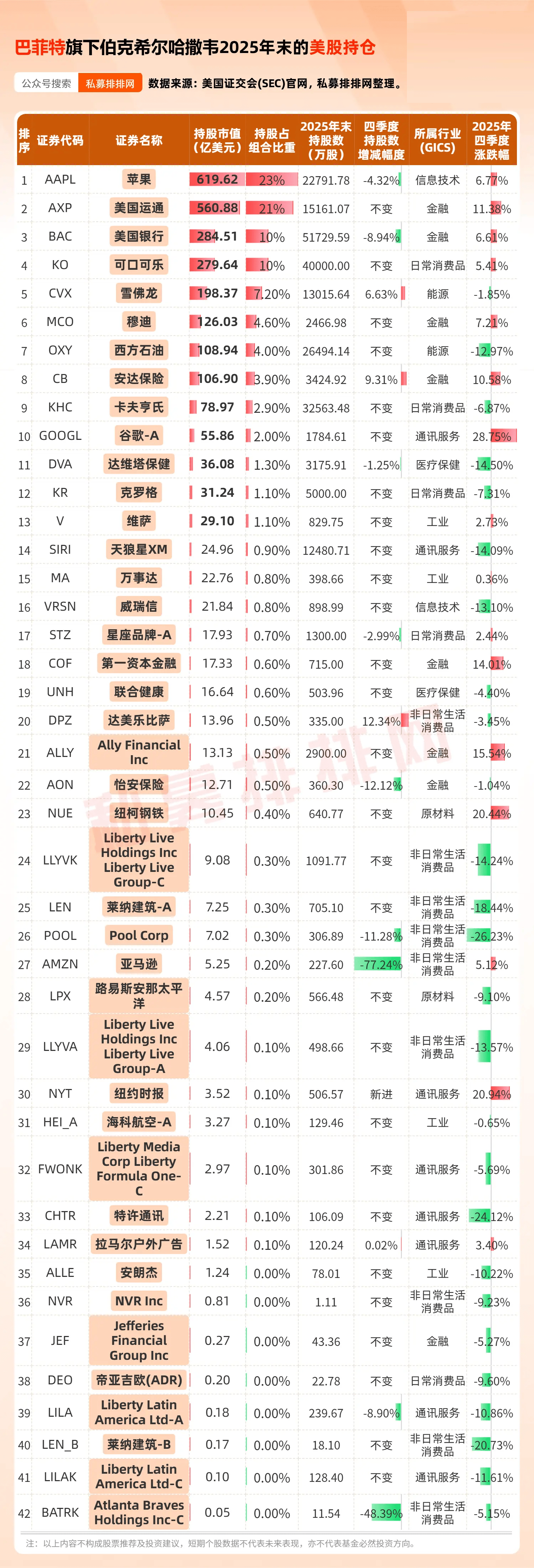
Group 1 - Berkshire Hathaway held a total of 42 US stocks with a market value of approximately $274.16 billion at the end of 2025, an increase of over $6.8 billion from the end of Q3 2025 [2] - The company has a significant focus on the financial sector, with a holding value close to $112.2 billion, accounting for about 41% of its total portfolio [2] - At the end of Q4 2025, Berkshire's largest holding remained Apple, valued at approximately $61.96 billion, representing about 23% of its total holdings, with a reduction of about 4.32% in shares [2][3] Group 2 - The second and third largest holdings are American Express and Bank of America, both financial companies, with a combined holding value exceeding $84.5 billion, accounting for about 31% of the total portfolio [2] - In Q4 2025, Berkshire maintained its position in 28 companies, reduced holdings in 9 companies, increased holdings in 4 companies, and initiated a position in 1 new company [2] Group 3 - Duan Yongping's investment firm held 14 US stocks with a total market value of approximately $17.49 billion at the end of 2025, an increase of over $2.8 billion from the end of Q3 2025 [8] - The focus of Duan's investments is primarily in the information technology sector, with a total holding value close to $11 billion, accounting for about 63% of his portfolio [9] - Duan's top three holdings are Apple, Berkshire Hathaway, and Nvidia, with Apple being the largest at approximately $8.8 billion, representing about 50% of his investment portfolio [9][10] Group 4 - Duan significantly increased his stake in Nvidia, with shares rising from approximately 597,800 to 7,237,100, marking an increase of over 11 times, and its market value reaching about $1.35 billion [9] - In Q4 2025, Duan initiated positions in three AI-related companies and increased holdings in six companies, while reducing positions in five [9]

苏州固锝(002079) - 002079苏州固锝投资者关系管理信息20260302
2026-03-02 03:35
Group 1: Financial Performance and Strategies - The company improved its operating cash flow significantly in 2025 and reduced its debt-to-asset ratio through enhanced collection efforts on overdue accounts and risk mitigation strategies for bad debts [1] - The company has adopted a "back-to-back" procurement model for silver powder, locking in silver prices upon receiving customer orders to mitigate the impact of silver price fluctuations [3] Group 2: Technology Development - The company has mastered two technical routes: silver-coated copper paste and pure copper paste, with the former being more readily accepted by customers due to current high silver prices [1][2] - The company has overcome the technical challenge of producing silver-coated copper paste with 10% silver content, and is currently testing products with 5% silver content [2] Group 3: Semiconductor Operations - The Malaysian semiconductor factory serves as the company's overseas packaging and testing base, addressing geopolitical challenges and enhancing competitiveness in the global market [4] - The company plans to focus on developing automotive-grade products and power devices, particularly small-signal devices, while gradually expanding its global presence [5] Group 4: Compliance and Governance - During the investor meeting, the company adhered strictly to regulations, ensuring no undisclosed significant information was leaked, and signed the required commitment letter as per the Shenzhen Stock Exchange [5]

未知机构:①3月1日据行业知情人士对媒体透露美国航空航天和半导体公司的供应商当-20260302
未知机构· 2026-03-02 02:40
Summary of Conference Call Records Industry or Company Involved - **Rare Earth and Tungsten Industry** - **Electric Power and AI Industry** - **Aerospace and Semiconductor Industry** - **Gas Turbine Market** - **Iranian Energy Sector** Key Points and Arguments Rare Earth and Tungsten Industry - Suppliers in the aerospace and semiconductor sectors are facing a severe shortage of rare earth materials, with at least two suppliers refusing to accept certain customer orders [1] - Tungsten powder prices have surged over 40% in one month, leading major tool manufacturers to ramp up production and initiate further price increases [2] - The price of neodymium oxide has increased by 45.92% year-to-date [3] Electric Power and AI Industry - The State Grid Corporation of China plans to enhance grid resource allocation and improve renewable energy capacity with ten initiatives for high-quality development [4] - During the 14th Five-Year Plan, the State Grid aims to complete 15 ultra-high voltage direct current projects, increasing inter-provincial transmission capacity by 35% and regional flexibility by over two times [5] - North America's aging power grid and high demand for AI electricity are causing a continuous energy shortage, with the gap in electricity supply widening [6] Gas Turbine Market - Siemens Energy reported a record order of €8.75 billion for gas turbines, driven by the demand for self-built power plants for large data centers [7] - The AI boom is significantly increasing the demand for natural gas power generation, leading to severe supply bottlenecks in the gas turbine market [8] Iranian Energy Sector - Iran has proven oil reserves exceeding 200 billion barrels, with a production capacity of approximately 3.2 to 3.3 million barrels per day by 2025, accounting for 3.2% to 4.5% of global supply [9] - Iran's natural gas reserves are about 34 trillion cubic meters, ranking second globally, with a production forecast of 262.9 billion cubic meters in 2024 [10] - Iran is a significant player in the global urea market, with an annual production capacity of 13 million tons, meeting 10% to 15% of global demand [11] Other Important but Possibly Overlooked Content - The establishment of the Suzhou Intelligent Computing Industry Innovation Center on March 1 [12] - OpenAI's announcement of purchasing 2GW of Amazon's AWSTrainium AI chip cloud computing power [13] - The upcoming 2026 World Mobile Communication Conference (MWC) where AI glasses will be launched [14] - The impact of geopolitical tensions on oil prices, with Brent crude potentially rising to $80 per barrel due to the U.S.-Iran conflict [15]
谁在制造存储芯片荒?
是说芯语· 2026-03-02 02:36
Core Viewpoint - The storage chip market is experiencing a significant price surge and supply constraints, driven by a combination of AI demand and strategic supply management by major manufacturers [4][6][12]. Group 1: Market Dynamics - Since mid-last year, storage chip prices have increased dramatically, with some models rising over tenfold [6]. - Major manufacturers like Samsung, Micron, and SK Hynix are exercising cautious supply strategies, prioritizing large clients and leaving smaller customers struggling to obtain chips [7][11]. - The price increase is affecting downstream markets, leading to higher prices for PCs and smartphones, as manufacturers adjust configurations to mitigate cost pressures [7][9]. Group 2: Price Trends - The price of DDR4 16Gb (2GX8)3200 storage chips rose from $6.2 in June 2025 to nearly $77 by February 2026 [10][11]. - The price structure in the storage industry consists of three tiers: chip prices, module/product prices, and end product prices, with the latter often not reflecting the same increases as chip prices [9][27]. Group 3: Manufacturer Strategies - Major manufacturers are adopting a strategy of price increases, production cuts, and prioritizing high-end clients, which is seen as a calculated supply restructuring rather than a reaction to market conditions [12][14]. - The demand for high-end storage products like HBM and DDR5 is surging due to AI applications, leading manufacturers to shift focus away from general-purpose storage [14][17]. Group 4: Supply Chain Issues - The market is characterized by a high degree of oligopoly, with the top three manufacturers controlling over 90% of supply, making it difficult for other players to ramp up production quickly [20][19]. - Current inventory levels are critically low, with DRAM and NAND inventory turnover significantly below healthy levels, exacerbating supply-demand imbalances [35][36]. Group 5: Price Escalation Cycle - The price increase cycle is driven by a combination of genuine demand and speculative behavior among distributors and resellers, creating a feedback loop that further inflates prices [22][28]. - The current market dynamics reflect a shift from a focus on volume sales to managing scarcity and pricing power, with manufacturers less inclined to increase production despite potential demand [18][34]. Group 6: Future Outlook - Predictions indicate that storage chip prices will continue to rise sharply into the first half of 2026, with significant increases expected due to ongoing supply constraints and high demand from AI applications [38]. - The current market conditions suggest that the storage chip shortage and price increases will persist until at least the end of 2026, with a potential turning point for HBM prices not expected until early 2028 [38].