
债券

Search documents
十年期国债收益率重上1.8%,国债买卖年内会重启吗
Hua Xia Shi Bao· 2025-09-12 04:12
Group 1: Bond Market Dynamics - Recent rise in government bond yields, with 10-year yields surpassing 1.8% and 30-year yields exceeding 2.1%, correlating with the strength of the A-share market, indicating a "stock-bond seesaw effect" [1] - The increase in yields is attributed to a shift in investor risk appetite, as regulatory policies aimed at reducing competition may lead to rising prices, diminishing the investment value of bonds [1] - The market is currently experiencing pressure on bond yields due to the potential resumption of government bond trading, which was previously halted by the central bank [4] Group 2: Inflation and Economic Indicators - August CPI showed a significant decline, entering negative territory with a year-on-year decrease of 0.4%, primarily driven by weak food prices, which fell by 4.3% [1][2] - Core CPI, however, rose by 0.9% year-on-year, marking the highest level in 18 months, indicating some resilience in core consumer prices [2] - PPI also showed a year-on-year decline of 2.9%, but this was an improvement from the previous value of -3.6%, suggesting some stabilization in producer prices [2] Group 3: Policy Implications - The central bank emphasizes the importance of promoting reasonable price recovery as a key consideration in monetary policy, with measures in place to control production in traditional industries [3] - Ongoing economic challenges include weak real estate sales and insufficient consumer demand, which limit the effectiveness of policy measures aimed at stabilizing prices [3] - The central bank's potential purchase of government bonds in the secondary market could support the struggling real estate market and consumer spending, countering the negative impact of rising yields on the stock market [5]
大类资产早报-20250912
Yong An Qi Huo· 2025-09-12 01:49
Report Summary 1. Report Date - The report was released on September 12, 2025, by the macro team of the research center [2] 2. Global Asset Market Performance 2.1 Government Bond Yields - **10 - year Government Bond Yields**: Yields showed various changes across different economies. For example, the US 10 - year yield on September 11, 2025, was 4.022, with a latest change of - 0.025, a one - week change of - 0.140, a one - month change of - 0.264, and a one - year change of 0.190 [3] - **2 - year Government Bond Yields**: The US 2 - year yield on September 11, 2025, was 3.540, with a latest change of 0.050, a one - week change of - 0.120, a one - month change of - 0.070, and a one - year change of - 0.370 [3] 2.2 Exchange Rates - **USD against Major Emerging Economies' Currencies**: The USD/Brazilian Real exchange rate on September 11, 2025, was 5.389, with a latest change of - 0.37%, a one - week change of - 1.06%, a one - month change of - 0.52%, and a one - year change of - 4.52% [3] - **Renminbi**: The on - shore RMB exchange rate on September 11, 2025, was 7.119, with a latest change of - 0.03%, a one - week change of - 0.32%, a one - month change of - 0.88%, and a one - year change of - 0.04% [3] 2.3 Stock Indices - **Major Economies' Stock Indices**: The S&P 500 index on September 11, 2025, was 6587.470, with a latest change of 0.85%, a one - week change of 1.31%, a one - month change of 1.84%, and a one - year change of 19.15% [3] - **Other Stock Indices**: The Hang Seng Index on September 11, 2025, was 26086.320, with a latest change of - 0.43%, a one - week change of 4.10%, a one - month change of 2.22%, and a one - year change of 47.79% [3] 2.4 Credit Bond Indices - The US investment - grade credit bond index on September 11, 2025, was 3529.910, with a latest change of 0.28%, a one - week change of 1.28%, a one - month change of 2.09%, and a one - year change of 5.49% [3][4] 3. Stock Index Futures Trading Data 3.1 Index Performance - The closing price of the A - share index was 3875.31, with a change of 1.65% [5] 3.2 Valuation - The PE (TTM) of the CSI 300 was 14.18, with a环比 change of 0.24 [5] 3.3 Risk Premium - The risk premium (1/PE - 10 - year interest rate) of the S&P 500 was - 0.37, with a环比 change of 0.00 [5] 3.4 Fund Flows - The latest value of fund flows into A - shares was 1342.66, and the 5 - day average was 30.55 [5] 4. Government Bond Futures Trading Data - The closing price of the T00 government bond futures was 107.880, with a change of - 0.31% [6] 5. Other Stock Indices - The Malaysian index on September 11, 2025, was 1582.850, with a latest change of - 0.50%, a one - week change of 0.30% [9]
9.12犀牛财经早报:公募机构大力布局增强指数型基金 太保发行超155亿港元零票息可转债
Xi Niu Cai Jing· 2025-09-12 01:40
Group 1: Enhanced Index Funds - Public fund institutions are increasingly favoring enhanced index funds, with over 100 new funds issued this year, surpassing the total for 2023 and 2024 combined [1] - The newly issued enhanced index funds have a combined issuance of 61.097 billion units, indicating strong market interest and performance [1] - In comparison, 42 and 59 enhanced index funds were issued in 2024 and 2023, with total issuance of 21.427 billion and 26.59 billion units respectively [1] Group 2: Bond Market Regulations - A total of 28 bond issuers have received disciplinary actions for failing to disclose periodic reports accurately and timely [1] - The focus of the regulatory bodies is on the compliance of fund usage and the responsibilities of senior executives in ensuring accurate information disclosure [1] Group 3: China Pacific Insurance - China Pacific Insurance has issued zero-coupon convertible bonds amounting to 15.556 billion HKD, achieving a premium issuance [2] - This issuance is noted as the largest zero-coupon convertible bond in history and the largest overseas refinancing project in the Asia-Pacific financial sector since 2025 [2] Group 4: A-Share Market - The A-share refinancing market has seen a significant increase, with total funds raised exceeding 800.214 billion CNY, a 258.7% increase from last year's total of 223.12 billion CNY [2] - The rise in refinancing activity is attributed to policy reforms and increased demand for capital in strategic sectors like new energy and semiconductors [2] Group 5: Power Equipment Industry - The Ministry of Industry and Information Technology has outlined a growth plan for the power equipment industry, targeting a 6% annual revenue growth for traditional power equipment [3] - The plan emphasizes the need for increased production and export of new energy equipment, with a goal of 7% annual revenue growth for advanced manufacturing clusters in the sector [3] Group 6: Wearable Devices Market - IDC forecasts that global shipments of wearable devices will reach 49.2 million units in Q2 2025, reflecting a year-on-year growth of 12.3% [4] - Major manufacturers like Huawei, Xiaomi, and Apple continue to dominate the market, although their growth rates vary significantly [4] Group 7: Robotics Industry - There has been a surge in the registration of companies related to embodied intelligence, with 86 new companies established in the last three months [5] - The registration of humanoid robot companies has exceeded 105 in the first half of this year, marking a 183.78% increase compared to the same period last year [5] Group 8: Banking Sector Consolidation - The consolidation of village and town banks is accelerating, with recent approvals for mergers, indicating a trend towards enhancing risk resilience and regional competitiveness [5] - This consolidation is driven by both policy guidance and the banks' own development motivations [5] Group 9: Corporate Governance and Legal Issues - West Restaurant's CEO has announced plans to sue a public figure for defamation regarding claims about their use of pre-prepared dishes [6] - The company aims to maintain its reputation by publicly showcasing its menu to counter the allegations [6] Group 10: Market Performance - The U.S. stock market indices have risen, with the S&P 500 up 0.85% and the Dow Jones up 1.36%, driven by favorable economic data [10] - The rebound in Chinese concept stocks has also been notable, with the index rising nearly 3% [11]
时报观察|债市延续震荡格局 投资者应保持定力
证券时报· 2025-09-12 00:30
近期国债市场出现一轮下跌行情,国债期货主力合约11日盘中再创近6个月以来新低,且30年 期国债期货加权指数距离年内新低仅一步之遥。同时,10年期国债活跃券收益率已升至1.8%以 上,Shibor利率品种集体上行。 这一波调整,从7月初至今,10年期国债活跃券收益率从1.63%上涨到最高1.83%,两个月时间上涨20个基 点,幅度不低,且1.80%是一个重要关口。这让债券投资者原来不如预期的收益率变得更加岌岌可危,担忧情 绪蔓延。 截至9月11日,中证综合债券指数(全部债券)今年以来累计收益仅为0.33%。刚刚过去的8月份,被动指数 型债券基金、中长期纯债型基金的平均净值均告负。 与以往债市调整不同,此次债市调整存在两大主因。一是股票市场持续走牛,赚钱效应不断释放,显著推升了 投资者的风险偏好,部分原本配置债券的资金随之流向权益市场,对债市形成直接分流压力;二是"反内卷"相 关政策逐步落地,政策预期持续升温,间接带动市场通胀预期抬头,进一步削弱了债券资产的配置吸引力。 往后看,本轮权益市场的风险偏好升温可能仍将继续,破除"内卷"已成为当前和未来一段时间的政策重心。在 这一政策预期下,沪深两市成交额连续76个交易 ...


每日债市速递 | 资金面向暖
Wind万得· 2025-09-11 22:51
Group 1: Open Market Operations - The central bank conducted a 7-day reverse repurchase operation on September 11, with a fixed rate and a total of 292 billion yuan, at an interest rate of 1.40%, with the same amount being bid and awarded [1] - On the same day, 212.6 billion yuan of reverse repos matured, resulting in a net injection of 79.4 billion yuan [1] Group 2: Funding Conditions - The funding environment improved, with the overnight repo weighted average rate for deposit-taking institutions falling over 5 basis points back below 1.4% [3] - The overnight quotes in the anonymous click (X-repo) system decreased to 1.35%, while non-bank institutions' pledging certificates and credit bonds were around 1.45% [3] - The latest overnight financing guarantee rate in the U.S. was reported at 4.40% [3] Group 3: Interbank Certificates of Deposit - The latest transaction for one-year interbank certificates of deposit in the secondary market was around 1.68% [9] Group 4: Bond Market Overview - The closing prices for government bonds showed a majority increase, with the 10-year main contract rising by 0.07% and the 5-year main contract increasing by 0.14% [13] Group 5: Recent Policy Developments - The State Council approved a two-year pilot program for market-oriented allocation of factors in ten regions, focusing on key areas and issues in factor market construction [14] - The pilot program aims to explore market-oriented allocation of talent and facilitate cross-border capital flows [14] Group 6: Global Macro Insights - U.S. President Trump criticized Federal Reserve Chairman Powell, urging for immediate significant interest rate cuts, claiming there is "no inflation" in the U.S. [16] Group 7: Bond Market Events - Longguang Group reached a revised agreement with creditors regarding offshore debt restructuring [18] - R&F Properties proposed an overall domestic bond restructuring plan for its domestic bondholders [18] - New Power Real Estate and its subsidiaries faced overdue debts totaling 15.66 billion yuan [18]

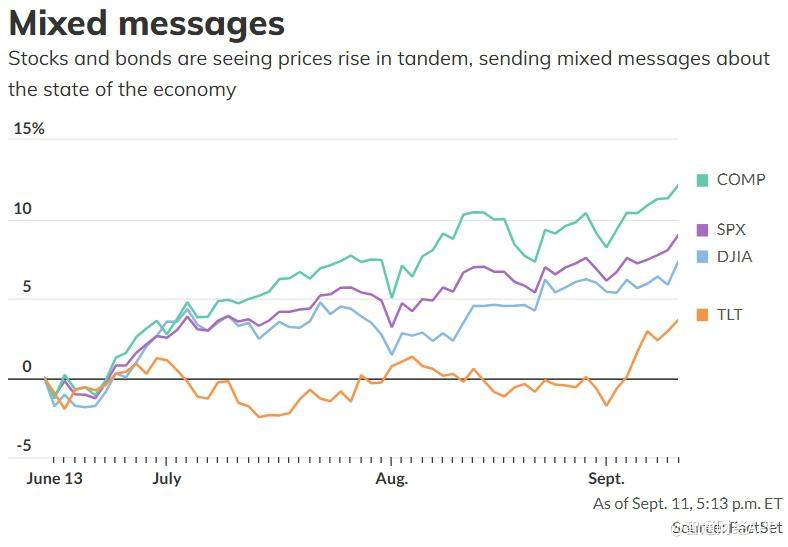
股债“冰火两重天”!一个创新高 另一个却发出经济预警信号
Zhi Tong Cai Jing· 2025-09-11 22:33
Group 1 - The U.S. stock market reached new historical highs driven by optimistic expectations of an upcoming interest rate cut by the Federal Reserve, with the S&P 500, Dow Jones Industrial Average, and Nasdaq Composite all setting closing records [1][4] - The bond market, in contrast, is signaling growing concerns about the economic outlook, as indicated by the drop in the 10-year Treasury yield, which fell below 4% for the first time since early April [4][5] - The August Consumer Price Index (CPI) showed an increase in goods prices due to tariff impacts, while service sector inflation remains above the Federal Reserve's ideal level, yet overall inflation is not expected to prevent a rate cut [4][5] Group 2 - The S&P 500 rose by 0.85%, the Dow increased by 1.36%, and the Nasdaq gained 0.72%, indicating strong market momentum despite expectations of a potential market correction [5] - The labor market is showing signs of weakness, with only 22,000 jobs added in August, and recent data revisions indicating a more challenging employment situation over the past year, which is a core reason for the Fed's potential rate cuts [5][6] - The actual tariff burden on U.S. consumers reached 17.7% in August, the highest level since 1934, posing challenges for the Federal Reserve in controlling inflation [5][6]
债市延续震荡格局 投资者应保持定力
Sou Hu Cai Jing· 2025-09-11 22:10
Group 1 - The recent decline in the national bond market has led to the main contract of bond futures hitting a six-month low, with the 30-year bond futures weighted index nearing its yearly low [1] - The yield on the 10-year active bond has risen above 1.8%, increasing from 1.63% to a peak of 1.83% over two months, marking a 20 basis points rise [1] - The cumulative yield of the China Securities Comprehensive Bond Index for the year is only 0.33%, with passive index bond funds and medium-to-long-term pure bond funds showing negative average net values in August [1] Group 2 - The current adjustment in the bond market is driven by two main factors: the continuous bull run in the stock market, which has increased investor risk appetite, and the implementation of anti-involution policies that have raised inflation expectations [1] - The equity market's rising risk appetite is expected to continue, with the Shanghai and Shenzhen stock exchanges seeing over 10 trillion yuan in trading volume for 76 consecutive trading days [2] - Despite the bullish expectations, the real economy still requires further improvement, with weak demand in real estate and exports limiting the upward pressure on prices [2]
时报观察 | 债市延续震荡格局 投资者应保持定力
Zheng Quan Shi Bao· 2025-09-11 18:01
Group 1 - The recent decline in the bond market has seen the main contract for government bond futures hit a six-month low, with the 30-year bond futures index nearing its yearly low [1] - The yield on the 10-year government bond has risen above 1.8%, increasing by 20 basis points from 1.63% to a peak of 1.83% over two months, raising concerns among bond investors [1] - The cumulative yield of the China Securities Comprehensive Bond Index for all bonds this year is only 0.33%, with passive index bond funds and medium-to-long-term pure bond funds showing negative average net values in August [1] Group 2 - The current adjustment in the bond market is driven by two main factors: the sustained bull market in equities, which has increased investor risk appetite, and the implementation of anti-involution policies that have raised inflation expectations [1] - The equity market's rising risk appetite is expected to continue, with the Shanghai and Shenzhen stock exchanges seeing over 10 trillion yuan in trading volume for 76 consecutive trading days [2] - Despite the bullish expectations in the equity market, the real economy still requires further improvement, with weak demand in real estate and exports limiting the upward pressure on prices [2]
时报观察 债市延续震荡格局 投资者应保持定力
Zheng Quan Shi Bao· 2025-09-11 17:52
Group 1 - Recent decline in the bond market, with the main contract for government bond futures hitting a six-month low and the 30-year bond futures index nearing its yearly low [1] - The yield on the 10-year government bond has risen above 1.8%, increasing from 1.63% to a peak of 1.83% over two months, representing a 20 basis points increase [1] - The cumulative yield of the China Securities Comprehensive Bond Index for the year is only 0.33%, with passive index bond funds and medium-to-long-term pure bond funds showing negative average net values in August [1] Group 2 - The current adjustment in the bond market is driven by two main factors: the sustained bull market in equities increasing investor risk appetite, and the implementation of anti-involution policies raising inflation expectations [1] - The equity market's risk appetite is expected to continue, with significant trading volumes in the Shanghai and Shenzhen markets and a notable increase in the non-ferrous metals industry index [2] - Despite the bullish expectations, the real economy still requires further improvement, with weak demand in real estate and exports limiting the upward pressure on prices [2]
两个疯狂加仓的板块
表舅是养基大户· 2025-09-11 14:06
Core Viewpoint - The article discusses the dynamics of the automotive parts industry in the Yangtze River Delta, highlighting a notable company that is a Tier 1 supplier for Tesla and its recent market activities, including a significant share reduction by its chairman after a public critique of competitors [1][2]. Group 1: Company Insights - The chairman of a prominent automotive parts company expressed confidence in the company's competitive position, claiming that the only significant gap with top global competitors is in chip technology [1][4]. - Following the chairman's critical remarks about five competitors, four of those companies experienced stock declines, with two dropping around 5% [2]. - The chairman's company announced a share reduction of over 13 million shares, valued at approximately 900 million yuan, shortly after the critical remarks [2]. Group 2: Industry Trends - The article emphasizes China's automotive industry as a significant player, suggesting that foreign car manufacturers are hesitant in their strategies [4]. - It points out that the automotive sector is a high-end manufacturing industry, second only to aerospace, and should receive more attention compared to the robotics sector [5]. - The article notes that while there are many fraudulent companies in the robotics field, the capital market remains interested in this sector [5]. Group 3: Market Movements - The market showed strong performance, with the ChiNext Index and the Science and Technology Innovation Board both rising over 5%, marking a significant milestone for the ChiNext Index [7]. - The article highlights a rebound in the stocks of companies criticized by the chairman, contrasting with the performance of his own company, which remained in the red [2][7]. Group 4: Broader Market Context - The article discusses the impact of Oracle's strong cloud business performance on the US stock market, which subsequently influenced the A-share market, leading to a total market capitalization increase of 2 trillion yuan [12][14]. - It mentions the volatility in the bond market, with significant trading activity observed, particularly in bond ETFs, indicating a shift towards these investment vehicles [20][22].
