
纺织服装

Search documents
【广发宏观郭磊】6月PPI低于预期的原因
郭磊宏观茶座· 2025-07-09 09:59
Core Viewpoint - The June CPI increased by 0.1% year-on-year, surpassing the previous value of -0.1%, while the PPI decreased by 3.6% year-on-year, lower than the previous value of -3.3%. The simulated deflation index based on CPI and PPI remains at -1.38%, consistent with May and at a low since February 2024 [1][5]. Summary by Sections CPI and PPI Analysis - The CPI data met expectations, with high-frequency data estimating a 0.14% year-on-year increase, while the PPI was significantly lower than the expected -3.0% [1][5]. - The PPI showed a base effect advantage with a 0.2% month-on-month recovery, but year-on-year figures continued to decline, indicating potential discrepancies in high-frequency data representation [1][7]. Price Movements in Industries - In June, the PPI for coal processing fell by 5.5% month-on-month, and the prices in coal mining and black metal industries also decreased, reflecting weaker performance compared to high-frequency data [1][7]. - The durable consumer goods segment of PPI fell from 0.1% to -0.1%, with notable declines in the computer and textile sectors, possibly influenced by tariff uncertainties and the "618" e-commerce promotions [2][8]. Positive Trends in PPI - The automotive manufacturing sector saw a month-on-month PPI increase of 0.2%, indicating initial positive effects of the "anti-involution" trend in production [3][9]. - The prices for complete vehicles and new energy vehicles rose by 0.5% and 0.3% respectively, suggesting a narrowing of year-on-year declines in these categories [10]. Notable CPI Details - Key details in CPI include a 0.3% month-on-month decrease in alcohol prices, a shift in clothing prices from increase to decrease during the "618" sales, and a 0.4% decline in transportation tools, indicating ongoing price reductions in the automotive retail sector [4][10]. - Medical service prices have shown a consistent upward trend, with a year-to-date increase of 0.7%, while pork prices fell by 1.2% month-on-month, although a rebound was noted post-June 26 [4][10]. Overall Price Stability and Future Outlook - The current task of stabilizing prices remains significant, with no signs of a turning point in the simulated deflation index. Various factors, including supply-demand fundamentals and external demand fluctuations, are influencing prices [4][13]. - Positive signs include a moderate rise in core CPI year-on-year, improvements in coal and meat prices since July, and initial positive signals in automotive manufacturing prices [4][13]. Key future indicators will be the recovery of local project starts and the continued effectiveness of the "anti-involution" trend [4][13].


国泰海通晨报-20250709
Haitong Securities· 2025-07-09 02:47
Group 1: Coal Industry - The introduction of the "430, 531" policies is expected to reduce the profitability of new energy projects, leading to a slowdown in new energy development after a surge in installations in early 2025, with a potential demand turning point for thermal coal expected around 2027 [2][5][6] - The rapid growth of new energy installations has significantly pressured thermal power demand, with the share of thermal power generation capacity decreasing from 66.75% in 2015 to 43.88% in 2024 [4] - The report recommends leading companies in the coal sector, including Shaanxi Coal and Chemical Industry, Jinkong Energy, China Shenhua, and others, as they are expected to benefit from the easing of pressure on thermal coal [3] Group 2: Beverage Industry - The tea beverage industry is experiencing high demand driven by competition in the takeaway market and the introduction of new product categories, with a forecasted revenue growth of 16% in 2025 [7][8] - The company anticipates a double-digit profit growth in the first half of 2025, with a significant increase in product launches and improvements in supply chain efficiency [8] - The competitive landscape is improving as price wars in the tea beverage sector have begun to stabilize, benefiting brand players [7] Group 3: Stablecoin Industry - The stablecoin market is projected to expand significantly, with potential growth to $3.5 trillion driven by applications in crypto asset trading, cross-border payments, consumer payments, and traditional capital markets [14][15] - Circle, a leading stablecoin issuer, is focusing on building an ecosystem around its USDC stablecoin, which has shown strong revenue growth but faces challenges related to profit margins and regulatory uncertainties [15][14] Group 4: Robotics Industry - The tactile sensor market is expected to see substantial growth, with the potential for a trillion-dollar market as humanoid robots become more prevalent [16][19] - The report highlights the importance of tactile sensors in the development of humanoid robots, indicating a significant market opportunity as production scales increase [19][16] - Various technological routes in tactile sensing are being explored, with a focus on integrating multiple technologies to overcome performance and cost barriers [17][19]
寻找下一个明星——港股通2025年9月调整名单预测
2025-07-09 02:40
Summary of Key Points from Conference Call Records Industry Overview - The Hong Kong stock market is experiencing a slow upward trend, driven by stable profit expectations, declining risk-free rates, and increased investor interest in high-dividend sectors. The implied equity risk premium (ERP) is currently around 5.4%, indicating some upward potential in sentiment indicators [1][2] - The coconut water industry is entering a rapid growth phase, with market size expected to grow from 2 billion to nearly 8 billion RMB from 2022 to 2024, driven by health consumption trends and lower raw material costs [33] Company Insights Hong Kong Stock Market - The Hong Kong Stock Connect has a significant impact on the market, contributing approximately 25% of total trading volume, which has nearly doubled in the past few years. This trend raises the importance of companies being included in the Stock Connect for investment opportunities [4][9] - Companies removed from the Stock Connect typically face significant stock price pressure, while those added see positive average price increases [9] East Beverage - East Beverage is the leading player in the coconut water market, achieving sales of 1.13 billion RMB in 2024, capturing over 30% market share. The industry remains competitive with over 200 suppliers [34] - The company is expected to maintain a compound annual growth rate (CAGR) of 20%-30% in the coming years, with a projected P/E ratio of around 30 times if 2025 performance grows by 30% [39][40] 康耐特光学 (Kangnate Optical) - 康耐特光学 has significant manufacturing advantages, including production scale, a rich SKU variety, and integrated supply chain capabilities. The company has a 50%-60% market share in the domestic 1.74 material segment [22] - The company is benefiting from domestic substitution and consumer downgrade trends, with a revenue CAGR exceeding 15% over the past six years [24] 周六福 (Chow Tai Fook) - Chow Tai Fook has performed well since its IPO, with gold jewelry sales ranking high in retail categories, driven by a 30% increase in gold prices this year. The company has a comprehensive national layout with 4,000 stores across 31 provinces [26][27] - The product matrix includes a variety of gold products, with gold jewelry accounting for 91% of sales in 2024, up from 72% in 2022 [28] 沪上阿姨 (Hushang Auntie) - Hushang Auntie holds a 4.5% market share in the ready-to-drink tea industry, ranking fourth by cup count and fifth by GMV. The company operates primarily through a franchise model, which offers lower gross margins but higher net profit margins [31] - Despite a projected revenue decline of 2% in 2024, the company expects a rebound with a 28% revenue increase in 2025 [32] Financial Performance - Chow Tai Fook's financial performance is stable, with cash flow steadily increasing and a healthy cash reserve supporting future expansion [30] - 康耐特光学's gross margin is currently at 39%, lower than competitors like SenseTime and iFlytek, primarily due to high R&D costs and reliance on third-party procurement [16] Market Trends and Predictions - The Hong Kong stock market is expected to see a narrow range of fluctuations before the mid-year reporting season, with a potential upward space of about 1,000 points based on current sentiment indicators [2][8] - The coconut water market is projected to reach 20 billion RMB by 2029, with significant growth potential due to low current per capita consumption compared to international levels [33]
2025年河南周口市新质生产力发展研判:产业体系构建取得新突破,主导优势产业加速集聚[图]
Chan Ye Xin Xi Wang· 2025-07-09 01:20
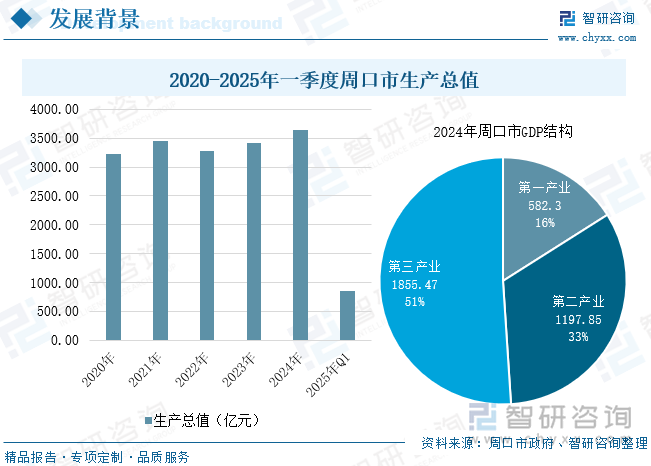
Core Viewpoint - Zhoukou City in Henan Province is accelerating economic recovery through the implementation of strategic plans, with a projected GDP of 363.56 billion yuan in 2024, reflecting a 6.5% year-on-year growth [1][3]. Economic Analysis - Zhoukou's GDP structure for 2024 is projected as follows: primary industry at 58.23 billion yuan (3.3% growth), secondary industry at 119.79 billion yuan (7.7% growth), and tertiary industry at 185.55 billion yuan (6.7% growth), with a per capita GDP of 42,038 yuan (7.6% growth) [3][5]. - The city's industrial output value is expected to grow by 10.1% in 2024, with heavy industry increasing by 8.2% and light industry by 11.7% [5]. Industrial Structure - Zhoukou's industrial system is evolving, focusing on food processing, textile and apparel, and pharmaceutical chemicals, supported by emerging industries like electronic information and equipment manufacturing [13][27]. - The six pillar industries in Zhoukou are projected to see an increase in output value by 12.6%, surpassing the overall industrial growth rate by 2.5 percentage points [1][19]. Key Enterprises - Zhoukou has three listed companies: Lianhua Holdings, Jindan Technology, and Kaiwang Technology, with Lianhua focusing on health products, Jindan on lactic acid production, and Kaiwang on electronic precision components [22][24]. - The city has over 200 large-scale enterprises in food processing and more than 290 in textiles, indicating a robust industrial base [26][22]. Investment and Consumption - Fixed asset investment in Zhoukou is expected to grow by 8.7% in 2024, with industrial investment increasing by 34.4% [9][11]. - The total retail sales of consumer goods are projected to reach 208.46 billion yuan, growing by 6.7% [11]. Policy Measures - Zhoukou has implemented several policies to enhance industrial growth, including plans to develop three 50 billion yuan industries and three 100 billion yuan industry clusters by 2025 [15][17]. - The city aims to achieve full coverage of intelligent application scenarios in manufacturing by 2026, promoting digital transformation [15][17]. Future Outlook - Zhoukou is committed to strengthening technological innovation and building a modern industrial system centered on advanced manufacturing, with a focus on cultivating high-quality enterprises [27][28].
福建泉州:民营经济站得稳活力足(走进产业地标·发展一线探变化)
Ren Min Ri Bao· 2025-07-08 22:19
Core Viewpoint - The article highlights the resilience and innovation of the private economy in Quanzhou, Fujian, showcasing how local enterprises adapt to market demands and technological advancements to maintain growth and competitiveness in a challenging environment [3][5][9]. Group 1: Industry Performance - Quanzhou's private sector has over 1.65 million operating entities, with private investment growing by 8% in the first five months of the year, surpassing the national average [3]. - The added value of large-scale private industry in Quanzhou increased by 8.7%, indicating steady growth despite external pressures [3]. Group 2: Innovation and Technology - Xintai (Fujian) Technology Co., Ltd. is set to launch a new weaving technology that combines advantages of existing methods, enhancing the value of shoe uppers by over 30% [4]. - Xunxing Zipper Technology Co., Ltd. has developed zippers for space suits that can withstand increased tensile strength, showcasing a commitment to innovation in niche markets [6]. - Xinheng New Materials Co., Ltd. has achieved a market share of over 70% in domestic nuclear power coatings, breaking foreign monopolies with products that last 30 to 50 years [7]. Group 3: Market Adaptation - Companies in Quanzhou are focusing on customized and differentiated products to capture market share, with Iron Tuo Machinery Co., Ltd. increasing its international market share to nearly 50% through tailored solutions [11]. - The food and beverage sector is also targeting niche markets, with companies like Panpan Foods and Shuhua Sports developing products that cater to health-conscious consumers [11]. Group 4: Smart Manufacturing - The implementation of smart manufacturing technologies has led to a 20% increase in production efficiency and a 10% reduction in labor costs for companies like Qipai Group [12]. - 87% of industrial enterprises in Quanzhou are undergoing digital transformation, maintaining the highest scale of industrial digitization in Fujian Province for five consecutive years [12]. Group 5: Government Support - The local government plays a crucial role in supporting the private economy, facilitating international trade opportunities and expediting intellectual property processes to enhance innovation [14][15]. - Initiatives such as the establishment of a rapid intellectual property rights protection center have significantly reduced the time for design patent approvals, fostering a more innovative environment [14][15].


波司登(03998):维持良好增长势头,期待新财年表现
Guosen International· 2025-07-07 15:06
Investment Rating - The report maintains a "Buy" rating for Bosideng with a target price of HKD 5.6 [1][4][7] Core Insights - Bosideng reported a revenue increase of 11.6% year-on-year to RMB 25.902 billion and a net profit increase of 14.3% to RMB 3.514 billion for FY25, with a high dividend payout ratio of 84.1% [1][2][4] - The company continues to focus on its main brand and product innovation to drive growth, with projected EPS for 2026-2028 at RMB 0.34, 0.38, and 0.42 respectively [1][4] Revenue and Profit Growth - For the fiscal year ending March 31, 2025, the group achieved a revenue of RMB 25.902 billion, up 11.6% year-on-year, and a net profit of RMB 3.514 billion, up 14.3% year-on-year, despite a slight decline in gross margin [2][5] - The main brand's revenue grew by 10.1% to RMB 18.481 billion, while the OEM business saw a significant increase of 26.4% to RMB 3.373 billion [2][3] Business Segment Performance - The down jacket business generated revenue of RMB 21.668 billion, with a gross margin decrease of 1.6 percentage points to 63.4% [2] - The women's wear segment faced challenges, with a revenue decline of 20.6% to RMB 0.651 billion and a gross margin drop of 4.3 percentage points to 63.2% [3] - The diversified business segment reported a revenue increase of 2.8% to RMB 0.209 billion, with the school uniform business growing by 3.0% [3] Financial Projections - The report forecasts revenue growth rates of 10.1% for FY26, 10.7% for FY27, and 10.2% for FY28, with net profit growth rates of 10.9%, 11.2%, and 11.1% respectively [5][10] - The projected gross margin is expected to stabilize around 57.3% for FY26 and beyond [5][11]
拼多多100w+爆款,揭开了行业的价格迷雾
阿尔法工场研究院· 2025-07-07 15:04
Core Viewpoint - The article argues that consumer downgrade is a myth, while information upgrade is the reality, highlighting how Pinduoduo exposes the true prices of products [1] Group 1: Cost and Pricing Insights - A sunscreen jacket priced at 299 yuan has a production cost of only about 40 yuan, with materials and labor costs detailed [2] - Pinduoduo has seen explosive sales of affordable sunscreen jackets, with sales figures reaching over 100,000 units, indicating a shift in consumer behavior towards value-based purchasing [3][10] - The cost of luxury goods, such as a 10,000 yuan handbag, can be as low as 100-200 yuan, revealing significant brand markups [6] Group 2: Changing Consumer Behavior - Consumers are increasingly moving away from the Veblen effect, focusing on cost-effectiveness rather than brand prestige, even among high-net-worth individuals [7] - The rise of Pinduoduo has led to a greater awareness among Chinese consumers of the strength and stability of the domestic manufacturing system [8] Group 3: Supply Chain and Business Model - Pinduoduo's model emphasizes direct manufacturer-to-consumer sales, eliminating middlemen and reducing marketing costs, which allows for lower prices and higher sales volumes [22][23] - The platform's low commission rates encourage merchants to offer quality products without compromising on materials and craftsmanship [23] - Pinduoduo's "hundred billion subsidy" initiative aims to support merchants and enhance local industry digital transformation, with a commitment to invest over 100 billion yuan in the next three years [28][31] Group 4: Industry Transformation - Pinduoduo is reshaping the domestic consumption market by integrating local manufacturing into the supply chain, creating jobs and revitalizing local economies [32][34] - The platform focuses on product value and real pricing rather than brand storytelling, positioning itself as an organizer of the supply chain [33] - As a result, consumers are discovering high-quality, affordable products on Pinduoduo, while manufacturers are realizing that success comes from genuine product quality rather than marketing [35][36]


广清纺织园2025创业扶持计划新进展 首个种子项目获500万元投资
Nan Fang Ri Bao Wang Luo Ban· 2025-07-07 08:22
Group 1 - The "VOCs Green Island" project in the Guangqing Textile and Apparel Industry Transfer Park has received an investment of 5 million yuan, marking it as the first seed project under the 2025 Entrepreneurship Support Plan [1] - The project aims to enhance the environmental support for the textile dyeing industry chain and provide specialized VOCs treatment services for enterprises in the park [1] - The initiative represents a new business model of "shared workshops," offering centralized production solutions for small and medium-sized enterprises [1] Group 2 - The investment is part of the "Textile Chain Gathering Energy, Weaving Dreams for the Future" 2025 Entrepreneurship Support Plan, which operates on a dual-driven model of "entrepreneurship fund + industry package" [2] - The plan includes a three-tier empowerment system: the newborn plan offers 200,000 to 1 million yuan in entrepreneurship funds, the cultivation plan provides 1 million to 5 million yuan in seed fund support, and the growth plan can grant up to 10 million yuan in industrial fund support [2] - The seed fund investment is a non-profit initiative established by the Guangqing Textile Park platform company, focusing on equity investment and convertible bond investment for seed and early-stage entrepreneurial companies [2]

中国行业:分化加剧,破局在途
Hua Tai Qi Huo· 2025-07-06 12:56
Report Summary 1. Investment Rating The provided content does not mention the industry investment rating. 2. Core Viewpoints - In 2025, the core contradiction throughout the upstream, midstream, and downstream industries is the "structural gap during the new - old kinetic energy conversion period." In the first half of the year, the industry was affected by external uncertainties, with intensified internal differentiation, and overall prosperity relied on policy support. In the second half of the year, with the "two new" policies further boosting domestic demand and upgrading the industrial structure, the industry is expected to achieve a systematic leap from "quantity" to "quality" expansion [2][7]. 3. Summary by Directory Market Overview - **Upstream Materials**: In H1 2025, raw material prices were under pressure due to weak demand and Sino - US trade conflicts, showing significant differentiation. In H2, the structural differentiation will continue. Enterprises should focus on capacity elimination, tariff negotiations, and climate risks [8]. - **Midstream Manufacturing**: In H1 2025, it presented a differentiated pattern of "traditional under pressure, high - tech doing well." In H2, policies will support both demand and supply - side reforms, and traditional manufacturing is expected to break through cost dilemmas through intelligent and digital transformation [8]. - **Downstream Consumption**: In H1 2025, it showed a "weak recovery" pattern. In H2, the consumption market will continue to be structurally differentiated, and the recovery highly depends on policy implementation efficiency and business model innovation [9][10]. Upstream: Raw Material Price Fluctuations - **H1 2025 Situation**: Raw material prices were under pressure. Metal mining showed a divergence between black and non - ferrous metals; chemical raw materials had multi - directional fluctuations; energy sources like crude oil and coal were more differentiated; most agricultural products were at near - five - year lows [8][15]. - **H2 2025 Outlook**: The price differentiation will continue. Traditional raw materials' rebound depends on supply - side reforms and policy support, while emerging demand - driven products are more resilient. Enterprises should focus on capacity elimination, tariff reviews, and extreme weather [15][16]. Midstream: Short - term Stabilization, Continued New - Old Kinetic Energy Conversion - **Overall Situation**: In H1 2025, the manufacturing industry was affected by external factors, with traditional manufacturing under pressure and high - tech manufacturing supported by policies. After the tariff war, there was short - term stabilization, and both external and internal demands recovered to some extent [43][53]. - **Traditional Manufacturing**: In H1 2025, profits declined due to over - capacity and weak demand. In H2, policies will expand to more traditional manufacturing sectors, promoting transformation and efficiency improvement [59][75]. - **High - tech Manufacturing**: In H1 2025, it recovered significantly compared to the beginning of the year, benefiting from strong policy support. In H2, it is expected to continue to improve [69][75]. Downstream: Intensified Retail Differentiation, Weak Real Estate Recovery - **Retail Industry**: In H1 2025, online e - commerce grew due to the "trade - in" policy, while traditional physical retail was under pressure. In H2, the differentiation will continue, with emerging formats having growth potential and traditional retail relying on policy and innovation [82][93]. - **Leasing Industry**: In H1 2025, it was in a downturn. In H2, the "price - for - volume" trend will continue, and the de - stocking of commercial land will continue [92][93]. - **Real Estate Industry**: In H1 2025, it achieved "weak stabilization" under policy support. In H2, it is expected to continue to recover slowly with further policy optimization and improved supply - demand balance [99][115].
山海同心谱新篇——新时代高质量开展对口援疆工作巡礼
Xin Hua She· 2025-07-06 06:46
Group 1 - The core viewpoint emphasizes the importance of targeted aid to Xinjiang as a national strategy for social stability and long-term peace, with a focus on high-quality development and community building [1] - The aid efforts have resulted in significant achievements, including the allocation of 80% of aid funds to grassroots levels and a focus on improving the livelihoods of local communities [1] - The introduction of modern industrial projects, such as a textile enterprise in Hotan, is creating thousands of jobs and boosting local industrial output by over 3 billion yuan annually [2][3] Group 2 - The shift from "human" aid to "intelligent" aid is highlighted, with a focus on developing local talent and utilizing advanced technology in various sectors, including healthcare and education [4][5] - The establishment of training programs and partnerships with local institutions has led to the cultivation of over 9,500 e-commerce talents in Aksu, significantly enhancing local employment opportunities [6] - The "group-style" aid mechanism in healthcare has improved clinical capabilities and management systems in Xinjiang hospitals, benefiting local populations [7][8] Group 3 - Cultural exchanges and economic cooperation between aid-providing provinces and Xinjiang are increasing, fostering a sense of unity and shared development among diverse ethnic groups [9][10] - Innovative collaboration models are being implemented, breaking traditional pairing restrictions to enhance resource sharing and mutual benefits, thus driving economic growth in Xinjiang [10][11]