
债券

Search documents
10年期国债活跃券收益率创新高
Sou Hu Cai Jing· 2025-09-10 09:00
Core Insights - The interbank major interest rate bond yields accelerated upward in the afternoon of September 10, with the 10-year government bond yield reaching a new high since its listing [1] - The 30-year government bond yield also hit a new high, indicating a significant increase in long-term interest rates [1] Summary by Category - **Government Bond Yields** - The 10-year government bond "25附息国债11" yield rose by 2 basis points to 1.82% [1] - The 30-year government bond "25超长特别国债02" yield increased by 3 basis points to 2.10% [1] - **Government Bond Futures** - All maturities of government bond futures closed lower, with the 30-year futures main contract dropping by 0.86% [1] - The 10-year futures main contract fell by 0.27% [1] - The 5-year futures main contract decreased by 0.15% [1] - The 2-year futures main contract declined by 0.04% [1]
美联储或9月降息,全球大类资产迎流动性红利?
Sou Hu Cai Jing· 2025-09-10 08:39
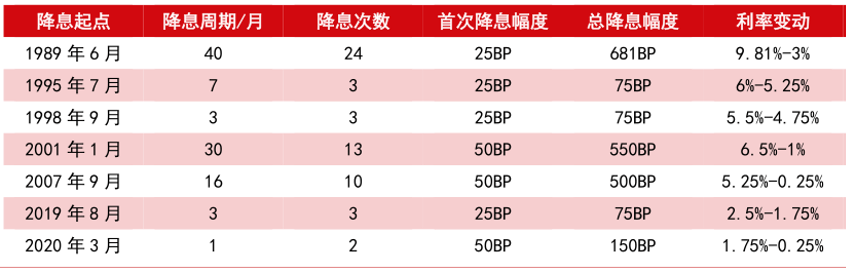
Core Viewpoint - The article discusses the potential for a shift in global asset classes due to the Federal Reserve's dovish stance and rising expectations for a rate cut in September, following a significant decline in U.S. employment data [1][5]. Historical Review: Federal Reserve Rate Cut Cycles - The article categorizes past Federal Reserve rate cut cycles into three scenarios: 1. **Preventive Rate Cuts** (1995-1996, 2019): Small and gradual cuts aimed at softening potential economic slowdowns [2]. 2. **Recessionary Rate Cuts** (2001-2004, 2007-2008): Large and rapid cuts in response to economic recessions or financial crises [3]. 3. **Crisis Response Rate Cuts** (1987, 1998): Quick measures taken to stabilize market sentiment during specific risk events [4]. Asset Performance During Rate Cut Cycles - **Equities**: Rate cuts typically boost risk appetite, leading to stock market gains. For instance, after the 2019 rate cut, the S&P 500 index rose nearly 10% over the following year [5][6]. - **Bonds**: The bond market often reacts first to rate cuts, with U.S. Treasury yields generally declining. Historically, 10-year Treasury yields have dropped by an average of 80-100 basis points during rate cut cycles [7]. - **Gold**: Gold tends to perform well during rate cut cycles due to lower holding costs and increased demand for safe-haven assets. Since 1990, gold has shown an 83% success rate in the 10 trading days following rate cuts [8][9]. Market Outlook and Strategy - The article suggests that if the Federal Reserve cuts rates, it may lead to a narrowing of the China-U.S. interest rate differential, potentially easing depreciation pressure on the RMB and allowing for more accommodative domestic monetary policy [7]. - It emphasizes the importance of maintaining diversified and flexible asset allocations to navigate market uncertainties, regardless of the rate cut outcome [10][11].

U.S. Marks Down Payroll Gains by 911K in Largest Benchmark Revision Ever
Yahoo Finance· 2025-09-09 14:41
Group 1 - The U.S. preliminary benchmark payrolls revision indicates a downward adjustment of 911,000 jobs for the one-year period ending March 2025, marking the largest revision on record, suggesting a weaker labor market than previously reported [1] - The Federal Reserve is expected to cut rates for the first time this year, with the possibility of a 50 basis point cut being considered instead of the previously forecasted 25 basis points due to the new labor market data [2] Group 2 - Rate-sensitive assets such as crypto, gold, and long-dated bonds experienced volatility, with gold futures initially surging past $3,700 before giving back gains and closing flat at $3,679 [3] - Bitcoin (BTC) saw a decline from $113,000 to $111,600, reflecting a 1% drop over the past 24 hours, while U.S. 10-year Treasury yields rose to 4.07%, threatening to dip below 4% for the first time since February [4]
渤海证券研究所晨会纪要(2025.09.08)-20250908
BOHAI SECURITIES· 2025-09-08 03:02
Macro and Strategy Research - The U.S. economy is experiencing a shift in the balance of risks between inflation and employment, with a potential monetary policy shift expected in September. The focus is on August's non-farm payroll and inflation data, as well as adjustments to the annual non-farm benchmark [2] - In Europe, economic expectations are improving, and stable inflation allows the European Central Bank (ECB) to maintain current policy rates. ECB President Lagarde indicated that trade negotiations are not posing significant threats to monetary policy [2] Domestic Economy - Domestic economic growth slowed in July due to extreme weather and policy expectations, characterized by strong external demand and weak internal demand. Future external demand growth is expected to be supported by a weakening U.S. demand and a reshaped long-term trade landscape [3] - The domestic policy environment emphasizes stabilizing market expectations and strengthening the domestic circulation, with structural monetary policies focusing on inclusive finance and technological innovation [3][4] Fixed Income Research - In August, the central bank injected a net liquidity of 386.5 billion yuan, maintaining low funding prices. The issuance of interest rate bonds decreased to 3 trillion yuan, with net financing increasing to 1.7 trillion yuan [6][7] - The bond market is expected to face pressure from external demand uncertainties and "anti-involution" measures, with a focus on the stability of the funding environment in September [8] Industry Research - The medical insurance payment management method was introduced in August, and the 11th batch of centralized procurement is progressing. The medical care CPI in July was 100.5, with a year-on-year increase of 0.5% [9][10] - The pharmaceutical manufacturing industry reported a cumulative revenue of 1,401.07 billion yuan from January to July, a year-on-year decrease of 1.7%, while cumulative profits fell by 2.6% [10] - The upcoming World Lung Cancer Conference (WCLC) is expected to provide opportunities for innovation in the pharmaceutical and medical device sectors, with a focus on companies benefiting from optimized procurement rules and the recovery of domestic demand [10]
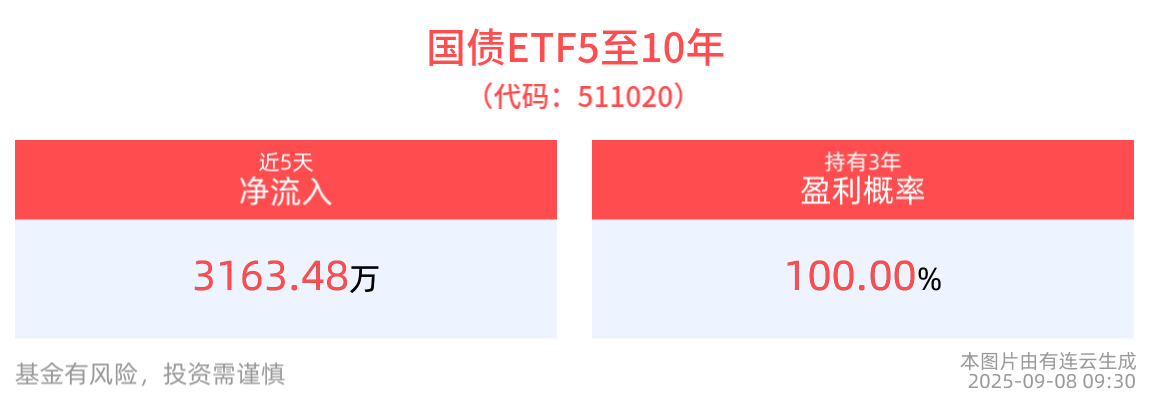
债市震荡期长久期国债看好,国债ETF5至10年(511020)近5个交易日净流入3163.48万元
Sou Hu Cai Jing· 2025-09-08 02:02
Core Insights - The government bond ETF (511020) for 5 to 10 years is experiencing a stalemate in trading, with the latest price at 116.83 yuan as of September 8, 2025, and a cumulative increase of 3.26% over the past year as of September 5, 2025 [3]. Trading Activity - The trading volume for the government bond ETF was 0% during the day, with a total transaction value of 23,400 yuan. Over the past week, the average daily trading volume was 1.047 billion yuan [3]. - The latest fund size for the government bond ETF reached 1.506 billion yuan [3]. Fund Flows - The fund flow for the government bond ETF is currently balanced, with a total inflow of 31.6348 million yuan over the last five trading days [3]. Performance Metrics - Over the past five years, the net value of the government bond ETF has increased by 21.53%. Since its inception, the highest monthly return was 2.58%, with the longest consecutive months of increase being 10 months and the maximum increase during that period being 5.81%. The win-loss ratio for monthly performance is 54/25, with an annual profit percentage of 100.00% and a monthly profit probability of 71.02%. The historical probability of profit over a three-year holding period is also 100.00% [3]. Drawdown Analysis - The maximum drawdown over the past six months for the government bond ETF was 1.25%, compared to a benchmark drawdown of 0.51%. The recovery time after the drawdown was 21 days [3]. Fee Structure - The management fee for the government bond ETF is 0.15%, while the custody fee is 0.05% [4]. Tracking Accuracy - As of September 5, 2025, the tracking error for the government bond ETF over the past month was 0.033%. The ETF closely tracks the CSI 5-10 Year Government Bond Active Index, which includes bonds with maturities of 5, 7, and 10 years, calculated using a non-market capitalization weighted method [5].
深交所:“金威转债”盘中临时停牌
Mei Ri Jing Ji Xin Wen· 2025-09-08 01:44
Group 1 - The Shenzhen Stock Exchange announced that the "Jinwei Convertible Bond" (127111) experienced a price increase of 30% or more compared to its issuance price for the first time [1] - As a result of this price movement, the Shenzhen Stock Exchange implemented a temporary suspension of trading for the bond starting at 9:30 AM on the same day [1] - Trading for the bond resumed at 2:57 PM after the temporary suspension [1]
浙商早知道-20250908
ZHESHANG SECURITIES· 2025-09-07 23:47
Group 1: Key Recommendations - The report highlights the transformation of Xinsida (002527) under Haier's leadership, focusing on integrated solutions and embodied intelligence, which is expected to enhance the company's competitive edge and financial performance [4][5] - The report anticipates that Xinsida's revenue will grow from 3543 million in 2025 to 4153 million in 2027, with a net profit forecasted to increase significantly from 13 million in 2025 to 190 million in 2027 [5] - The report emphasizes the potential of Henghe Precision (300539) as a high-quality precision manufacturing enterprise, particularly in the automotive parts sector, which is expected to see substantial growth [6][8] Group 2: Market Insights - The report indicates that the automotive intelligent cockpit market is projected to reach 1564 billion in China by 2025, with a growth rate of 21%, driven by the increasing demand for smart automotive components [7] - The report notes that the global automotive tailgate market is expected to reach 15 billion USD by the end of 2027, highlighting the trend towards lightweight automotive components [7][8] - The report discusses the overall positive outlook for the A-share market, suggesting a "slow bull" market with opportunities for strategic adjustments in investment portfolios [10][11] Group 3: Industry Trends - The report identifies AI as a key driver of growth in the technology sector, particularly in computing and communication industries, with significant profit growth expected [14] - The report highlights that the demand for electric two-wheeled vehicles is improving the profitability of the automotive industry, despite the limited number of companies in this sector [13][14] - The report suggests that the supply-demand dynamics in the market are continuously improving, with a notable focus on AI-related performance [14]


信用策略周报20250907:论信用“抗跌性”与“扛跌性”-20250908
Tianfeng Securities· 2025-09-07 23:41
Group 1 - The overall performance of credit bonds has shown structural differentiation, with short-term credit outperforming long-term and ultra-long-term credit [1][8] - The secondary market for credit bonds has seen a decline in trading duration since mid-July, particularly for public credit bonds, indicating a significant pressure on ultra-long credit [2][9] - Credit bonds have demonstrated enhanced "anti-drawdown" and "resilience" characteristics this year, with short-term credit showing independent performance during market adjustments [3][32] Group 2 - The current market sentiment remains cautious, with expectations of limited chances for significant overcorrection or negative feedback from redemptions [4][42] - Selected mid-to-short-term credit assets are recommended for consideration, with a focus on 3-5 year bonds that have adjusted to a favorable risk-return profile [4][42] - Caution is advised for ultra-long credit, as trading profitability is not evident and there is a tendency for increased allocation at high levels [4][42]
债券分析框架及应用
2025-09-07 16:19
Summary of Key Points from Conference Call Industry Overview - The Chinese bond market has surpassed the total GDP, indicating a significant increase in its influence and a more diversified investor structure, with non-bank institutions gaining a larger share [1][3][4]. Core Insights and Arguments - **Bond Market Growth**: Over the past 20 years, the bond market has grown from less than 20% of GDP in 2005 to 120% by 2025, highlighting its increasing importance in the economy [3]. - **Investor Structure Changes**: Initially dominated by banks, the bond market now includes a significant presence of non-bank institutions such as funds and insurance companies, necessitating a broader analysis approach [4]. - **Factors Influencing Bond Market**: Analysis of the bond market requires consideration of macroeconomic factors, funding conditions, policy impacts, supply-demand dynamics, and market sentiment, with varying importance at different stages [5]. - **Role of AI in Analysis**: While AI can assist in data processing, it cannot fully replace human analysts due to the complexity and variability of market narratives [6]. - **Interest Rates and Supply-Demand**: Interest rates are closely tied to the supply-demand relationship; higher demand leads to rising rates, while excess supply results in lower rates. The Taylor rule is referenced, but real-world complexities necessitate a simplified analysis approach [7]. - **Macroeconomic Price Analysis**: Price fluctuations in various markets, including bonds, can be understood through supply-demand contradictions, which are essential for effective price analysis [8]. - **Financing Demand and Supply**: The contradiction between financing demand and supply can be assessed using the loan demand index and M2 growth rates, providing insights into interest rate movements [9][10]. Important but Overlooked Content - **Economic Driving Forces**: China's economic model has evolved through four phases: export-driven, investment-led, household leverage, and government-led, reflecting shifts in borrowing entities [11][12]. - **Government Financing via Bonds**: Bonds are the only legal means for government borrowing, with their share in social financing rising from about 5% to nearly 50% over the past two decades [14][15]. - **Real Estate Market Impact**: The real estate sector's financing share peaked at 70-80% during its height but has since dropped significantly, indicating its critical role in the economy [17]. - **Inflation and Policy Stimulus**: Weak inflation expectations in the second half of the year suggest the need for continued policy stimulus, particularly through monetary measures [31][32]. - **Comparison of Fiscal Pressures**: Both China and the U.S. face rising fiscal pressures due to increased debt issuance, with China aiming to lower interest rates to alleviate this burden [33][34]. - **Bond Market Outlook**: The bond market is expected to perform better in the second half of 2025, with anticipated interest rate declines leading to rising bond prices and benefiting related financial products [36][37].
周周芝道 - 黄金和欧债怎么看?
2025-09-07 16:19
Summary of Key Points from Conference Call Industry Overview - The conference call discusses the performance and outlook of the Chinese stock market, global sovereign debt, gold, and the impact of U.S. monetary policy on overseas assets [1][2][6][7]. Core Insights and Arguments 1. **Chinese Stock Market Trends** - The Chinese stock market has rebounded after a short-term decline, with a strong confidence in the market's core logic of risk recovery and exiting deflation [1][6]. - Despite recent volatility, the underlying logic of the market remains intact, and confidence among investors is strong [6]. 2. **U.S. Monetary Policy Impact** - The Federal Reserve's monetary easing policy continues to dominate overseas asset pricing, with increasing expectations for interest rate cuts impacting U.S. stocks and bonds [2][7]. - Recent non-farm payroll data falling below expectations has further fueled rate cut anticipations, leading to a rebound in U.S. stocks and a decline in bond yields [2][7]. 3. **Global Sovereign Debt Concerns** - The rise in long-term bond yields in Europe and Japan has raised concerns about potential sovereign debt risks, but these fears are deemed manageable and not indicative of a full-blown crisis [4][10]. - Current fluctuations in sovereign debt rates are attributed to changes in fiscal policies post-pandemic, with high fiscal dependency exacerbating debt risk concerns [8][10]. 4. **Gold Market Dynamics** - Gold has shown strong performance due to increased demand for safe-haven assets amid international capital allocation [5][13]. - The primary drivers for the gold market in 2025 are expected to be inflows from European and American ETFs and the impacts of trade wars, creating a seesaw effect between U.S. stocks and gold [13][14]. 5. **Renminbi Exchange Rate Outlook** - The pace of Renminbi appreciation may slow down due to various factors, including U.S.-China relations and domestic economic conditions [3][17]. - Short-term rapid appreciation is unlikely, and the currency's movements will be influenced by macroeconomic factors and central bank policies [18][19]. Other Important Insights - The relationship between the U.S. dollar index and gold prices is complex, with no direct correlation; factors such as liquidity and economic conditions play a significant role in gold pricing [22]. - Future capital market flows will be influenced by differences in risk-free interest rates across countries, reflecting a shift from the low inflation and low interest rate environment seen from 2008 to 2019 [11]. - The gold pricing factors have evolved over the past few years, with geopolitical tensions and trade wars becoming significant influences [16]. This summary encapsulates the key points discussed in the conference call, providing insights into market trends, monetary policy impacts, and the dynamics of gold and currency markets.