
科技

Search documents
【锋行链盟】纳斯达克并购重组交易结构设计要点
Sou Hu Cai Jing· 2025-10-07 13:10
Core Viewpoint - The design of M&A structures in the Nasdaq market must balance U.S. capital market rules, tax efficiency, shareholder protection, regulatory requirements, and strategic goals while addressing the unique challenges of cross-border transactions [2]. Group 1: Strategic Alignment - The design of the transaction structure should start from the acquirer's strategic intent, such as industry consolidation, financial investment, or technology/IP acquisition [2]. - For industry consolidation, horizontal or vertical mergers should be chosen to quickly integrate businesses and retain the target company's core assets [2]. - Financial investments may involve minority equity acquisitions or convertible bonds for short-term gains [2]. - When acquiring technology or IP, stock or asset acquisitions are preferred to avoid assuming the target company's hidden liabilities [2][3]. Group 2: Legal Structure - The core legal structures for Nasdaq M&A are stock acquisition and asset acquisition, each with significant differences in liability, tax treatment, and processes [4]. - Stock acquisition involves purchasing a majority of the target company's shares, directly obtaining its assets and liabilities [5]. - Advantages of stock acquisition include simpler processes and the ability to inherit contracts and licenses, with potential tax deferral benefits [5]. - Asset acquisition allows for liability isolation, enabling the acquirer to select quality assets while avoiding historical debts [7][8]. Group 3: Payment Methods - Payment methods in Nasdaq M&A include cash, stock, or a combination, balancing cash flow pressures, shareholder valuation preferences, and stock price volatility risks [11]. - Cash payments provide immediate liquidity to target shareholders but require significant financing, increasing financial leverage [12][13]. - Stock payments reduce cash pressure but expose target shareholders to stock price fluctuations and dilute the acquirer's equity [14][15]. - Mixed payments balance risks for both parties, allowing for a predetermined ratio of cash and stock [16][17]. Group 4: Tax Optimization - U.S. tax law significantly impacts M&A tax treatment, aiming to minimize tax burdens for both parties [20]. - Stock acquisitions can qualify for tax-deferred treatment under IRC §368, allowing shareholders to defer capital gains taxes [20]. - Asset acquisitions can utilize §338(h)(10) elections to treat the transaction as a "deemed stock acquisition," providing tax benefits [22][23]. - Cross-border transactions require consideration of withholding taxes and compliance with transfer pricing rules [24][25]. Group 5: Information Disclosure and Shareholder Protection - Nasdaq imposes strict information disclosure and shareholder rights requirements in M&A transactions [26]. - Key documents include letters of intent, stock purchase agreements, and proxy statements, which must disclose critical terms and fairness analyses [26]. - Shareholder protection mechanisms include appraisal rights, golden parachutes, and poison pill strategies to prevent hostile takeovers [27]. Group 6: Regulatory Approval - Nasdaq M&A transactions require approval from federal and state regulatory agencies, focusing on antitrust and industry-specific regulations [28]. - Antitrust reviews by the FTC and DOJ assess whether mergers reduce market competition, with specific thresholds triggering detailed scrutiny [28]. - Industry-specific approvals are necessary for sectors like finance, healthcare, and technology, ensuring compliance with relevant regulations [29][30]. Group 7: Integration Support - The transaction structure should facilitate post-merger integration to ensure the realization of synergies [31]. - Retaining operational entities and designing debt structures are crucial for maintaining cash flow and avoiding defaults [31]. - Clear delineation of IP ownership is essential for technology acquisitions to support global strategies [31].


东亚联丰最新发声
Sou Hu Cai Jing· 2025-10-07 13:06
Group 1: Gold Market Insights - The price of gold has reached new highs, and there is a potential for a 70% increase under extreme conditions, driven by geopolitical risks and central bank policies [4][7]. - Global central banks have increased their gold reserves, surpassing U.S. Treasury holdings for the first time since 1996, with reserves valued at $4.5 trillion [6]. - The recent trend of significant ETF purchases of gold is expected to continue, especially with the Federal Reserve's anticipated interest rate cuts [5][7]. Group 2: U.S. Economic Outlook - The Federal Reserve is expected to implement one more rate cut this year, with the federal funds rate projected to be in the range of 3.75% to 4% [9]. - The U.S. economy is viewed optimistically, with resilient consumer spending and a projected core CPI of around 3% by year-end [9]. - Historical data suggests that U.S. stocks have a 100% probability of rising in the 12 months following the initiation of rate cuts [9]. Group 3: Emerging Markets and China - Emerging markets, including China, are expected to benefit from the Fed's rate cuts, as the pressure from dollar-denominated debt and currency appreciation will ease [10]. - The Chinese stock market is anticipated to experience a structural bull market, particularly in technology, materials, and healthcare sectors, while traditional sectors like banking and real estate may underperform [13]. - Foreign capital is projected to start flowing back into Chinese markets by the end of 2024, driven by favorable conditions in emerging markets and the correlation between Chinese and U.S. tech stocks [14]. Group 4: Technology Sector and AI - The technology sector in the U.S. is expected to continue its growth, with significant investments in AI leading to increased productivity [11]. - The current valuation of Chinese tech stocks is considered high, but there is optimism about their potential if technological challenges are addressed [11][12]. - The development of AI in China is progressing rapidly, with notable advancements in various sectors, although challenges remain in certain areas like semiconductor manufacturing [11].

交银国际:港股“慢牛”行情有望持续演绎 延续“高弹性”+“高股息”哑铃型策略
Zhi Tong Cai Jing· 2025-10-07 11:24
Group 1 - The Hong Kong stock market continued its upward trend in September, driven by the resumption of US-China trade negotiations and expectations of overseas interest rate cuts, along with a rotation in the technology sector [1][2] - The external environment is showing marginal improvement, with increased market risk appetite supported by ongoing US-China trade talks and stable macro policies in mainland China [2][3] Group 2 - Liquidity pressure in Hong Kong has eased with the resumption of overseas interest rate cuts, leading to accelerated inflows of southbound capital, with a net inflow exceeding 1.1 trillion HKD this year, setting a new historical high [3] - The market is expected to enter a "quiet season" due to the National Day and Mid-Autumn Festival holidays, alongside uncertainties related to the US government's short-term financing plan, which may amplify overseas disturbances [4] Group 3 - The investment strategy continues to focus on a "high elasticity" and "high dividend" approach, with adjustments based on policy catalysts [5] - In the technology growth sector, the valuation recovery logic for tech stocks is further strengthened under the interest rate cut environment, with strong demand from southbound capital for high-growth sectors like AI [5] - The biopharmaceutical sector is expected to see valuation recovery, with Chinese innovative drug companies accelerating their global expansion [5] - High dividend yielding sectors such as banks, insurance, and utilities are highlighted as stable components in investment portfolios, providing consistent dividend income amid market volatility [5]
浙商国际10月港股策略:港股市场资金面环境进一步改善 看好相对景气的创新药等行业
Zhi Tong Cai Jing· 2025-10-07 09:42
Core Viewpoint - The Hong Kong stock market has shown a strong upward trend, with a continuous rise for five months, despite underlying economic weaknesses [1][2]. Market Performance Review - In September, the Hong Kong stock market experienced a slight decline at the beginning, followed by a sustained rebound due to favorable factors such as the U.S. interest rate cut and significant inflows from the south. The Hang Seng Index reached a peak of over 27,000 points [2]. - The monthly performance of major indices as of the end of September was as follows: Hang Seng Composite Index +8.11%, Hang Seng Index +7.09%, and Hang Seng Tech Index +13.95% [2]. Macro Environment Analysis - **Fundamentals**: Economic data in August showed further weakening, indicating that the domestic economy is still in a bottoming phase [3]. - **Policy**: The policy stance has become more proactive to support economic stability and growth [3]. - **Capital**: There has been a significant acceleration of southbound capital inflows, and the external funding environment has improved, leading to increased investment in Hong Kong stocks [3]. - **Sentiment**: The strong market performance has driven bullish sentiment, although concerns about the fundamentals remain [3]. Market Outlook and Strategy - The Hong Kong stock market's fundamentals remain weak, but the capital environment is improving, and there is strong short-term bullish sentiment. The market trend has entered a right-side phase, and a cautious optimism is maintained for the short to medium term [4]. - Preferred sectors for investment include automobiles, new consumption, innovative pharmaceuticals, and technology, which are relatively prosperous and benefit from policy support [4]. - Additionally, low-valuation state-owned enterprises with stable performance and dividends, as well as local Hong Kong banks, telecommunications, and utility stocks that benefit from the interest rate cut cycle, are also favored [4]. - Attention should be paid to potential impacts from the U.S.-China trade disputes, with a recommendation to avoid sectors and companies with significant exposure to U.S. business [4].
纳指、标普500创新高,中国资产上涨
Zhong Guo Zheng Quan Bao· 2025-10-07 00:32
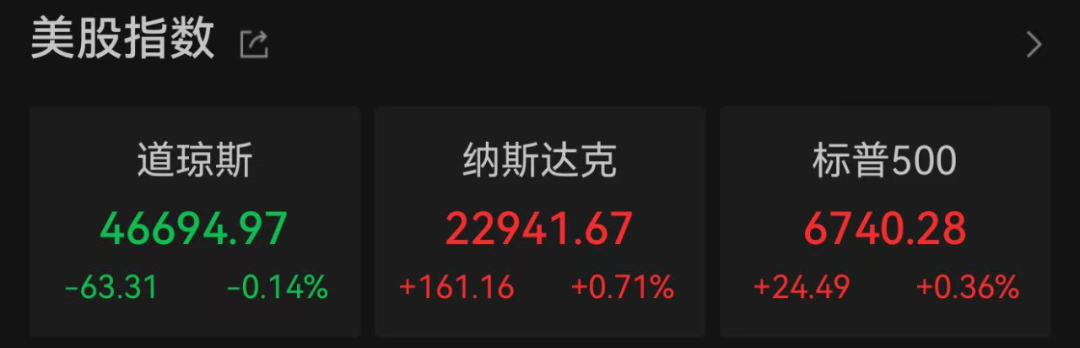
Market Performance - On October 6, US stock markets showed mixed results, with the Nasdaq and S&P 500 indices reaching new closing highs. The Dow Jones Industrial Average fell by 0.14%, while the Nasdaq rose by 0.71% and the S&P 500 increased by 0.36% [4] - The Nasdaq China Golden Dragon Index rose by 1% [1][8] Technology Sector - The US technology sector saw significant gains, largely driven by AMD's strategic partnership with OpenAI, which led to a 23.71% increase in AMD's stock price, peaking at over 36% during trading [6][8] - The "Magnificent Seven" tech stocks index rose by 0.86%, with notable performances from Tesla, which surged by 5.45%, and Microsoft, which increased by over 2% [6][7] Commodities - International oil prices and gold prices both experienced increases, with gold reaching a new historical high. As of October 7, spot gold prices rose by 0.16% [2][9] - On October 6, light crude oil futures for November delivery rose by $0.81 to $61.69 per barrel, marking a 1.33% increase, while Brent crude for December delivery increased by $0.94 to $65.47 per barrel, a rise of 1.46% [11] Chinese Stocks - Chinese assets showed an upward trend, with notable gains in popular Chinese stocks such as NIO, which rose by 23.01%, and NetEase Youdao, which increased by 7.08% [8]
创新药很坚挺~
Sou Hu Cai Jing· 2025-10-06 20:31
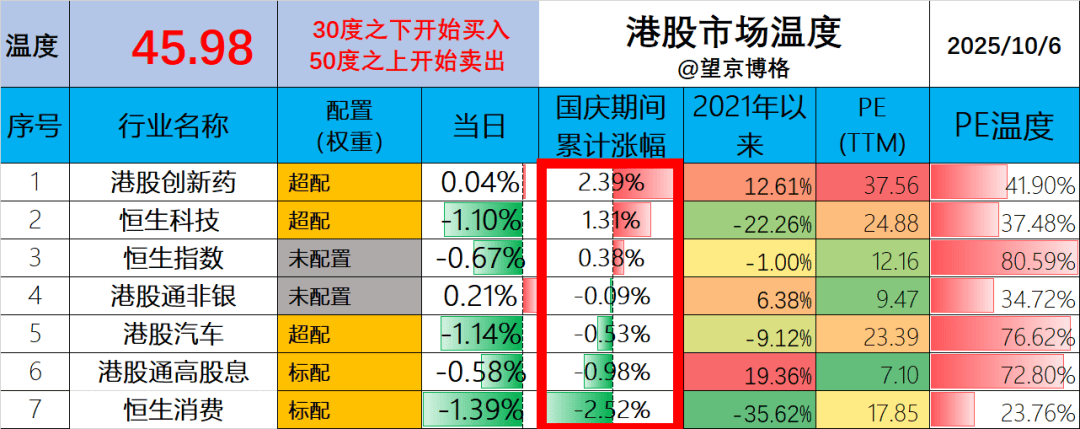
Core Viewpoint - The Hong Kong stock market is experiencing mixed performance during the National Day holiday, with the innovative pharmaceutical sector showing resilience while other sectors face declines [2][3]. Group 1: Market Performance - The Hong Kong stock market remains open on the day of the Mid-Autumn Festival but will close the following day [1]. - The innovative pharmaceutical sector in Hong Kong has shown a slight increase of 0.04% today, with a cumulative gain of 2.39% during the National Day holiday [2]. - The Hang Seng Technology index has experienced a decline of 1.10% today, with a cumulative gain of 1.31% during the holiday, indicating a weaker performance [3]. - Other sectors, including non-bank financials, automotive, and consumer sectors, have all seen declines during the holiday, with the consumer sector dropping by 2.52% [3]. Group 2: Commodity Prices - Gold and copper prices have reached new highs during the holiday, with London gold surpassing $3,940 per ounce, indicating strong demand [3]. - The rise in commodity prices is expected to lead to significant gains in gold and non-ferrous metal stocks post-holiday [3].
Oil Is Pushed Down as OPEC+ Raises Production
Yahoo Finance· 2025-10-06 12:31
Economic Indicators - The US services PMI was slightly lower than forecasted at 50 instead of 51, but still indicated positive development [1] - Despite the absence of official US labor market data, private sector indicators show a consolidation of hiring and new payrolls, maintaining a mildly positive sentiment among investors [2] Market Performance - The S&P 500 closed the week in green, indicating sustained market momentum [2] - Bitcoin reached a new all-time high at approximately $125,000, while crude oil prices fell to nearly $60 [2] Crude Oil Market - OPEC+ decided to modestly increase production, which is viewed as a bearish factor for crude oil prices [3] - Crude oil futures are trending downward, with potential support around the $59-60 area, where a breakout could trigger short selling [7] - The bearish sentiment in crude oil persists despite geopolitical concerns, as indicated by market reactions to US President Trump's warnings to Hamas [4] S&P 500 Analysis - The S&P 500 index is positioned above the upper line of the Bollinger Bands, showing signs of weakening momentum [8] - The tech sector faced pressure, which may indicate a normal sector rotation or a precursor to a broader market correction [8] Upcoming Events - Traders are anticipating the end of the government shutdown and developments from Israeli-Hamas talks [5] - Key economic publications to watch include the FOMC minutes and the Michigan Consumer Sentiment Index [5]
港股午评:恒生科技指数跌1.2% 黄金股逆势拉升
Zheng Quan Shi Bao Wang· 2025-10-06 04:23
Group 1 - The Hang Seng Index declined by 0.61% during the midday session [1] - The Hang Seng Tech Index fell by 1.2% [1] - Gold stocks experienced a rise, with Everest Gold increasing by over 15% and Zijin Mining International and Shandong Gold both rising by over 5% [1] Group 2 - Automotive stocks saw a downturn, with Li Auto dropping nearly 3% [1]
美国股市为何无视政府停摆危机,继续上涨并创下历史新高?
Sou Hu Cai Jing· 2025-10-05 22:40
内容提要: 尽管美国政府停摆引发经济担忧,股市却无视风险,道琼斯和标普500指数周五上涨创历史新高。原因在于:历史经验显示停摆对中长期 股市影响有限;企业强劲盈利、AI热情及美联储降息预期提振信心,数据真空或增加降息概率;特朗普考虑对美汽车生产提供关税减 免,刺激制造业乐观情绪。虽不确定性犹存,但投资者更关注积极因素。 历史上,市场通常能从政府停摆中迅速恢复,标普500指数在2018-2019年的停摆后就出现了反弹。但杰富瑞策略师警告称,与政策相关 的板块在此类事件期间往往经历更大波动,特别是如果僵局持续的话。而政府数据发布的暂停,包括 CPI、 GDP和就业报告,将在美联 储10月28-29日会议前造成"数据真空",从而打击投资者的信心。 但周五美国股市的表现出人意料,虽然纳斯达克综合指数略有下跌,但道琼斯工业平均指数和标准普尔500指数却意外上涨,可见投资者 事实上基本忽略了对政府停摆的担忧。 10月3日周五,道琼斯工业平均指数收高0.51%至46758.28点;标准普尔500指数收盘上涨0.44%至6715.79点。道指和标普均创历史新高。 以科技股为主的纳斯达克综合指数则下跌0.28%至22780.5 ...

积极信号!机构最新研判来了
Zhong Guo Zheng Quan Bao· 2025-10-05 05:37
Group 1 - Private equity institutions express optimism about the continuation of the A-share market after the National Day holiday, while also advising a balance between defensive and offensive strategies, particularly regarding the valuation pressure on certain technology stocks [1] - Fusheng Asset notes that aside from technology stocks, other sectors returned to a range-bound trend in September, with a cautious but optimistic outlook for the overall market performance, highlighting signs of marginal improvement in leading companies in "anti-involution" industries such as engineering machinery and chemicals [2] - Dushuquan Investment indicates that the recent fluctuations in the A-share market are a result of short-term local surges followed by a phase of adjustment in funds and sentiment, with current liquidity primarily driven by domestic institutions and existing investors [3] Group 2 - Dan Yi Investment emphasizes that the current market dynamics are driven by multiple structural forces rather than conventional economic cycles, with a focus on opportunities in AI cloud computing, domestic computing power supply chains, and edge applications [4] - Ning Shui Capital observes a recent decline in market trading activity and stresses the need to balance defensive and offensive strategies while monitoring the pre-increase direction of Q3 reports and being cautious of valuation pressures in certain technology stocks [4] - Yuan Lesheng Asset highlights a clear rotation in sectors this year, with new consumption, innovative pharmaceuticals, technology, and high-dividend sectors experiencing alternating surges, while also optimizing internal structures by reducing exposure to technology stocks and increasing positions in the manufacturing sector [4]