农产品加工

Search documents
菜籽类市场周报:贸易谈判消息影响,菜系品种相对震荡-20250905
Rui Da Qi Huo· 2025-09-05 09:38
1. Report Industry Investment Rating No relevant content provided. 2. Core Views of the Report - For rapeseed oil, it's recommended to take a bullish approach and monitor the China - Canada talks. This week, rapeseed oil futures fluctuated slightly higher. The temporary anti - dumping measures on Canadian rapeseed may impact its exports and put pressure on prices. However, the Canadian Prime Minister's involvement in resolving the tariff dispute, concerns about palm oil production and transportation in Indonesia, and strong palm oil export data in Malaysia support the market. Domestically, the terminal consumption boost from the start of school is limited, and the supply - demand of vegetable oils is still relatively loose. But the low oil mill operating rate and fewer near - month rapeseed purchases reduce supply pressure, and the anti - dumping measures weaken long - term supply. The rapeseed oil market is expected to maintain a narrow - range fluctuation in the near term [8][9]. - For rapeseed meal, it's advisable to hold a bullish view and focus on China - US and China - Canada economic and trade relations. This week, rapeseed meal futures fluctuated slightly higher. The Pro Farmer report shows a high expected US soybean yield, indicating supply pressure. However, the unexpected reduction in planting area supports the market. Domestically, the low near - month rapeseed arrivals, the peak season of aquaculture, and the anti - dumping measures on Canadian rapeseed reduce supply pressure. But the good substitution advantage of soybean meal weakens the demand expectation for rapeseed meal. The ongoing trade negotiations between China - Canada and China - US make the market cautious [11][12]. 3. Summary According to the Directory 3.1. Weekly Key Points Summary - Rapeseed oil: The 01 contract closed at 9,818 yuan/ton, up 29 yuan/ton from the previous week. It's recommended to be bullish and pay attention to China - Canada talks [8][9]. - Rapeseed meal: The 01 contract closed at 2,550 yuan/ton, up 37 yuan/ton from the previous week. It's recommended to be bullish and focus on China - US and China - Canada economic and trade relations [11][12]. 3.2. Futures and Spot Market - Futures market: This week, rapeseed oil futures fluctuated lower, with a total position of 249,260 lots, down 14,341 lots from last week; rapeseed meal futures fell from a high, with a total position of 396,574 lots, down 17,596 lots from the previous week [17]. - Top 20 net positions: This week, the top 20 net position of rapeseed oil futures changed from net long to net short (- 2,779); the top 20 net position of rapeseed meal futures changed from net short to net long (+ 2,999) [23]. - Registered warehouse receipts: The registered warehouse receipts of rapeseed oil are 6,028 lots; the registered warehouse receipts of rapeseed meal are 6,761 lots [29][30]. - Spot price and basis: The spot price of rapeseed oil in Jiangsu is 9,960 yuan/ton, slightly rising from last week, and the basis is + 142 yuan/ton; the spot price of rapeseed meal in Nantong, Jiangsu is 2,540 yuan/ton, with little change, and the basis is - 10 yuan/ton [36][42]. - Inter - month spread: The 1 - 5 spread of rapeseed oil is + 158 yuan/ton, at a medium level in recent years; the 1 - 5 spread of rapeseed meal is + 89 yuan/ton, also at a medium level in recent years [48]. - Futures - spot ratio: The ratio of rapeseed oil and rapeseed meal 01 contracts is 3.85; the average spot price ratio is 3.92 [51]. - Price difference between rapeseed oil and other oils: The 01 contract spread of rapeseed oil - soybean oil is 1,368 yuan/ton, with relative fluctuation this week; the 01 contract spread of rapeseed oil - palm oil is 292 yuan/ton, narrowing this week [61]. - Price difference between soybean meal and rapeseed meal: The 01 contract spread of soybean meal - rapeseed meal is 517 yuan/ton; as of Thursday, the spot spread is 430 yuan/ton [67]. 3.3. Industry Situation - Rapeseed supply: As of August 29, 2025, the total inventory of rapeseed in oil mills is 100,000 tons; the estimated arrivals in August, September, and October 2025 are 200,000, 130,000, and 150,000 tons respectively. As of September 4, the spot crushing profit of imported rapeseed is + 1,123 yuan/ton. By the 35th week of 2025, the crushing volume of rapeseed in coastal oil mills is 48,000 tons, up 3,000 tons from last week, and the operating rate is 11.74%. In July 2025, the total import volume of rapeseed is 176,000 tons, a year - on - year decrease of 56.63% and a month - on - month decrease of 0.85 tons [73][77][81]. - Rapeseed oil supply: By the end of the 35th week of 2025, the inventory of imported and crushed rapeseed oil is 737,000 tons, a month - on - month increase of 2.20%. In July 2025, the total import volume of rapeseed oil is 133,600 tons, a year - on - year increase of 16.86% and a month - on - month decrease of 16,700 tons [89]. - Rapeseed oil demand: As of June 30, 2025, the monthly output of edible vegetable oil is 476,900 tons; as of July 31, 2025, the monthly catering revenue is 450.41 billion yuan. By the end of the 35th week of 2025, the contract volume of imported and crushed rapeseed oil is 139,000 tons, a month - on - month increase of 43.61% [93][97]. - Rapeseed meal supply: By the end of the 35th week of 2025, the inventory of imported and crushed rapeseed meal is 19,000 tons, a month - on - month decrease of 9.52%. In July 2025, the total import volume of rapeseed meal is 183,100 tons, a year - on - year decrease of 3.00% and a month - on - month decrease of 87,200 tons [101][105]. - Rapeseed meal demand: As of July 31, 2025, the monthly output of feed is 2,827,300 tons [109]. 3.4. Options Market Analysis As of September 5, the implied volatility of rapeseed meal options is 21.53%, down 0.24% from last week, at a slightly medium level compared to the 20 - day, 40 - day, and 60 - day historical volatility of the underlying [113].
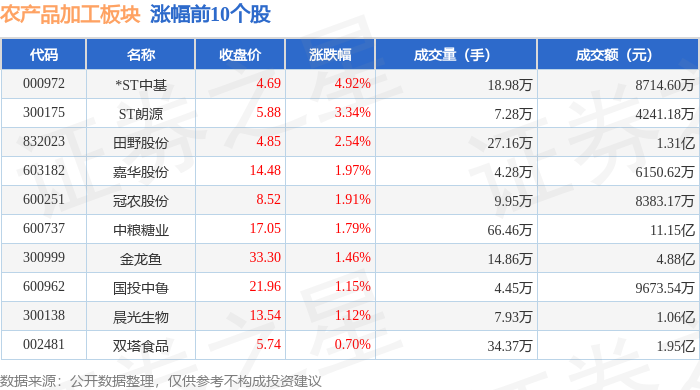
农产品加工板块9月5日涨1.02%,*ST中基领涨,主力资金净流出7368.22万元
Zheng Xing Xing Ye Ri Bao· 2025-09-05 08:50
Market Performance - The agricultural processing sector increased by 1.02% on September 5, with *ST Zhongji leading the gains [1] - The Shanghai Composite Index closed at 3812.51, up 1.24%, while the Shenzhen Component Index closed at 12590.56, up 3.89% [1] Individual Stock Performance - *ST Zhongji (000972) closed at 4.69, with a rise of 4.92% and a trading volume of 189,800 shares, totaling a transaction value of 87.146 million yuan [1] - ST Langyuan (300175) closed at 5.88, up 3.34%, with a trading volume of 72,800 shares and a transaction value of 42.4118 million yuan [1] - Tianye Co., Ltd. (832023) closed at 4.85, increasing by 2.54%, with a trading volume of 271,600 shares and a transaction value of 131 million yuan [1] - Xihang Co., Ltd. (603182) closed at 14.48, up 1.97%, with a trading volume of 42,800 shares and a transaction value of 61.5062 million yuan [1] - Guanyi Co., Ltd. (600251) closed at 8.52, increasing by 1.91%, with a trading volume of 99,500 shares and a transaction value of 83.8317 million yuan [1] - COFCO Sugar (600737) closed at 17.05, up 1.79%, with a trading volume of 664,600 shares and a transaction value of 1.115 billion yuan [1] - Jinlongyu (300999) closed at 33.30, increasing by 1.46%, with a trading volume of 148,600 shares and a transaction value of 488 million yuan [1] - Yuantou Zhonglu (600962) closed at 21.96, up 1.15%, with a trading volume of 44,500 shares and a transaction value of 96.7354 million yuan [1] - Chenguang Biological (300138) closed at 13.54, increasing by 1.12%, with a trading volume of 79,300 shares and a transaction value of 106 million yuan [1] - Shuangta Food (002481) closed at 5.74, up 0.70%, with a trading volume of 343,700 shares and a transaction value of 195 million yuan [1] Capital Flow - The agricultural processing sector experienced a net outflow of 73.6822 million yuan from institutional investors, while retail investors saw a net inflow of 28.2299 million yuan [2] - The sector's overall capital flow indicates a mixed sentiment among different investor types, with institutional investors withdrawing funds while retail investors increased their positions [2][3]





国投期货综合晨报-20250905
Guo Tou Qi Huo· 2025-09-05 05:40
Report Industry Investment Ratings - Not provided in the content Core Views - The overall market shows a complex and volatile situation, with different commodities having their own supply - demand dynamics and price trends. Some commodities are expected to be under pressure, while others may have opportunities for price increases or remain in a state of shock. Market participants need to pay attention to various factors such as economic data, policy changes, and geopolitical events [1][2][3] Summary by Commodity Category Energy - **Crude Oil**: Overnight international oil prices fell, with the Brent 11 - contract down 0.76%. The increase in US EIA crude oil inventories last week was bearish for the market. Considering the increase in OPEC+ production in September and the weakening demand after the peak season, the supply - demand balance may turn negative. It is recommended to hold short positions in the SC11 contract [1] - **Fuel Oil & Low - Sulfur Fuel Oil**: Singapore and Fujairah fuel oil inventories increased. The third - batch quota release was delayed, and the supply pressure of LU eased. FU lacks obvious drivers but may get geopolitical premium support [20] - **Liquefied Petroleum Gas**: After the end of the gas off - season, it shows certain resilience. Import cost increases and domestic demand rebounds, but high - level warehouse receipts pressure the market. The short - term market is strong in the near - term and weak in the far - term [22] - **Natural Gas**: Not mentioned in the content - **Coal**: - **Coke**: The price rebounded during the day. The first round of price cuts in the coking industry partially landed. The overall inventory decreased slightly, and the price is affected by policy expectations and is under short - term pressure [16] - **Coking Coal**: The price rebounded during the day. The production of coking coal mines increased slightly, and the total inventory decreased. The price is affected by policy expectations and is under short - term pressure [17] - **Urea**: The Indian NFL urea tender price was announced, and the supply in the domestic market is sufficient. The market is expected to operate in a shock. Attention should be paid to the actual impact of the Indian tender [23] - **Methanol**: The night - session price rose. Import volume remained high, and port and inland inventories increased. Although the current situation is weak, the market expectation is strong due to the expected increase in downstream demand [24] - **Pure Benzene**: The night - session price rebounded. The domestic supply increased, and the demand was weak. The supply - demand situation may improve in the third quarter, but the upside is limited [25] - **Benzene Ethylene**: The cost support is insufficient, and the supply - demand situation is average. There is high inventory pressure at the wharf [26] - **Polypropylene & Plastic & Propylene**: The demand for propylene is weak, and the supply of polyethylene and polypropylene is relatively loose. The market lacks a strong one - sided trend driver [27] - **PVC & Caustic Soda**: PVC is running weakly, with increasing supply and inventory. Caustic soda is in a wide - range shock, with low inventory but supply pressure [28] - **PX & PTA**: The night - session prices were in a weak shock. The terminal demand is improving, but the growth space of PX production is limited [29] - **Ethylene Glycol**: The price rebounded due to the news of postponed new - device production. The supply and demand are mixed, and the downward resistance increases [30] - **Short Fibre & Bottle Chip**: Short - fibre supply and demand are stable, and the price follows the cost. Bottle - chip profit is passively repaired, but there is long - term over - capacity pressure [31] - **Glass**: The price is in a shock. The factory inventory increased due to logistics control, and the demand improvement is limited [32] - **20 - Number Rubber & Natural Rubber & Butadiene Rubber**: The global natural rubber supply is in the high - yield period, and the demand is weak. The inventory decreased, and the market sentiment improved. It is recommended to wait and see [33] - **Soda Ash**: The price is in a shock. The industry inventory increased, and the long - term supply is under high pressure. It is advisable to short at high prices [34] Metals - **Precious Metals**: Overnight US economic data was mixed. The ADP employment number was lower than expected, while the ISM services PMI was higher. The precious metals market was strong, and attention should be paid to the US non - farm payroll data [2] - **Base Metals**: - **Copper**: The overnight copper price fell. The market is concerned about the US non - farm payroll data and copper demand. Short - term long positions can be held [3] - **Aluminium**: The overnight price continued to fluctuate. The downstream start - up rate increased seasonally, and the price is expected to test the resistance at 21,000 yuan [4] - **Alumina**: The operating capacity is at a historical high, and the supply is in surplus. The price is running weakly, and attention should be paid to the support at 2,830 yuan [5] - **Cast Aluminium Alloy**: It follows the trend of Shanghai Aluminium, and the price difference between spot and futures may narrow [6] - **Zinc**: The fundamentals are bearish, with increasing supply and weak demand. The price is expected to be under pressure, and it is recommended to short on rebounds [7] - **Lead**: The cost and consumption are in a game, and the market direction is unclear. The price is expected to fluctuate [8] - **Nickel & Stainless Steel**: The price of Shanghai Nickel is in a weak shock. The inventory of nickel and stainless steel decreased. The price may be affected by the political situation in Indonesia [9] - **Tin**: The overnight tin price fell. The inventory of LME tin increased slightly. The price of Shanghai Tin followed the decline, and short - term long positions can be held at low levels [10] - **Lithium Carbonate**: The price is in a low - level shock, and the market trading is dull. The downstream increased inventory, and the price is expected to fluctuate [11] - **Industrial Silicon**: The futures price is in a shock. The supply is expected to increase, and the demand is expected to decrease. The price is mainly driven by emotions [12] - **Polysilicon**: The futures price fluctuates around 52,000 yuan/ton. The market is dominated by emotions, and the price is expected to be under pressure [13] - **Iron Ore**: The overnight price fluctuated. Global shipments increased, and the demand from the steel industry decreased. The price is expected to fluctuate at a high level [15] - **Manganese Silicon**: The price opened low and rebounded. The demand from the iron and steel industry is high, and the production of manganese silicon increased. The price is expected to be supported [18] - **Silicon Iron**: The price opened low and rebounded. The demand is fair, and the supply increased. The inventory decreased slightly [19] Agricultural Products - **Soybean & Soybean Meal**: Due to Sino - US trade uncertainties, the market may continue to fluctuate in the short term. Long - term, the market is cautiously bullish [35] - **Soybean Oil & Palm Oil**: The prices fluctuate, waiting for new drivers. They can be considered for buying at low prices in the long term [36] - **Rapeseed & Rapeseed Oil**: Canadian rapeseed is under harvest pressure, and the domestic rapeseed market is in a tight - balance state. The futures price may stabilize in the short term [37] - **Soybean No. 1**: The price of domestic soybeans fluctuates. Pay attention to the new - season soybean opening price and trade policies [38] - **Corn**: The Dalian corn futures price rebounded. The new - season corn is expected to be a good harvest, and the price may be strong in the short term and weak at the bottom in the long term [39] - **Hogs**: The futures price decreased, and the supply pressure is dominant. The price may continue to decline, but demand may be supported during festivals [40] - **Eggs**: The futures price fluctuates. The spot price rose, and the industry is accelerating capacity reduction. Consider long positions in the far - month contracts [41] - **Cotton**: The US cotton price fluctuates, and the production may increase. The Zhengzhou cotton price may continue to fluctuate, and it is recommended to buy on dips [42] - **Sugar**: The US sugar price continued to fall, and the domestic sugar price is expected to fluctuate [43] - **Apples**: The futures price fluctuates. The short - term price may rise due to the good performance of early - maturing apples, but the long - term supply is not bullish [44] - **Timber**: The price is in a downward shock. The supply is expected to remain low, and it is recommended to wait and see [45] - **Pulp**: The futures price rose slightly. The supply is relatively loose, and the demand is average. It is recommended to wait and see or trade in a range [46] Financial Products - **Stock Index**: The stock market weakened yesterday, and the futures index contracts fell. The short - term market may change from a smooth upward trend to a shock - upward trend. It is recommended to increase the allocation of technology - growth sectors and pay attention to consumer and cyclical sectors [47] - **Treasury Bonds**: The futures price of treasury bonds rose. The bond supply in September is at a high level. The yield curve is expected to steepen [48]
需求支撑不足,猪价延续低位
Zhong Xin Qi Huo· 2025-09-05 05:17
1. Report Industry Investment Ratings - **Oils and Fats**: Expected to be volatile in the short term and likely to strengthen in the medium term [5] - **Protein Meal**: Expected to remain range - bound [5] - **Corn and Starch**: Short - term: Consider closing out short positions and look for short - selling opportunities on rebounds; Long - term: Support for low - buying in far - month contracts [6][7] - **Hogs**: Expected to be volatile. Spot and near - month prices are likely to be weak, while far - month contracts are supported by de - capacity expectations [1][7] - **Natural Rubber**: Expected to be volatile and slightly bullish in the short term [10] - **Synthetic Rubber**: Expected to be volatile and slightly bullish in the short term [11] - **Cotton**: Short - term: Range - bound; After new cotton is on the market: May face downward pressure [11][12] - **Sugar**: Expected to be volatile and slightly bearish in the long term; Short - term: Range - bound between 5500 - 5750 [15] - **Pulp**: Expected to be volatile [16] - **Logs**: Expected to be weak in the near term and stronger in the far term [18] 2. Core Views of the Report - The agricultural market shows a complex pattern with different trends for various products. The hog cycle is still in a downward phase in the short - to - medium term but may turn around in 2026 if de - capacity policies are implemented. Oils and fats are affected by factors such as weather, trade, and demand, with short - term volatility and medium - term upward potential. Protein meal is expected to remain range - bound. Other products like natural rubber, cotton, etc., also have their own supply - demand and market factors influencing their price trends [1][5] 3. Summary by Related Catalogs 3.1 Oils and Fats - **Logic**: Due to concerns about US soybean demand, US soybeans declined on Wednesday, and domestic oils continued to consolidate. The macro environment includes a weaker US dollar and falling crude oil prices. The US soybean growing area is affected by drought, and the export outlook is pessimistic. Domestic soybean imports are expected to decrease seasonally, and palm oil inventory accumulation may be limited. Rapeseed oil inventory is slowly falling but still high year - on - year [5] - **Outlook**: Short - term: Volatile adjustment; Medium - term: Likely to strengthen [5] 3.2 Protein Meal - **Logic**: International soybean prices are affected by weather, with a possible reduction in US soybean yields in the September report. Brazilian soybean premiums have adjusted, and US soybean exports are affected by the trade war. Domestically, the market is range - bound, and demand may improve as the temperature drops [5] - **Outlook**: Range - bound. Hold long positions at 2900 - 2910 and add positions on dips. Oil mills are advised to sell on rallies, and downstream enterprises can buy basis contracts or price at low levels [5] 3.3 Corn and Starch - **Logic**: Corn prices are generally stable, with local declines. Supply is affected by the release of old - crop inventory and the upcoming new - crop supply. Demand is weak as feed enterprises have sufficient inventory. The price difference between corn and wheat is increasing, and wheat substitution may decline [6][7] - **Outlook**: Short - term: Close out short positions and look for short - selling opportunities on rebounds; Long - term: Support for low - buying in far - month contracts [6][7] 3.4 Hogs - **Logic**: Supply is abundant in the short term, with an expected increase in the second half of the year. Demand shows a stable ratio of fat to lean pigs. Inventory weight has decreased slightly. In the long term, de - capacity policies may drive price increases in 2026 if implemented [1][7] - **Outlook**: Volatile. Spot and near - month prices are likely to be weak, while far - month contracts are supported by de - capacity expectations [1][7] 3.5 Natural Rubber - **Logic**: The price is range - bound between 157 - 161. There are many speculation themes, and the short - term supply is limited while demand is stable. The price may rise due to seasonality [10] - **Outlook**: Volatile and slightly bullish in the short term [10] 3.6 Synthetic Rubber - **Logic**: The price is range - bound, following natural rubber and supported by the cost of raw material butadiene. Butadiene supply is under no significant pressure, and demand is stable [11] - **Outlook**: Volatile and slightly bullish in the short term [11] 3.7 Cotton - **Logic**: The current low - inventory and improving - demand situation provides support for cotton prices. The expected increase in purchase prices is limited by the expected large increase in new cotton production. After new cotton is on the market, prices may face downward pressure [11][12] - **Outlook**: Short - term: Range - bound; After new cotton is on the market: May face downward pressure [11][12] 3.8 Sugar - **Logic**: International sugar production is expected to increase, and domestic imports are rising, resulting in downward pressure on prices [15] - **Outlook**: Long - term: Volatile and slightly bearish; Short - term: Range - bound between 5500 - 5750 [15] 3.9 Pulp - **Logic**: The decline is mainly due to the low acceptance of BCTMP pulp. After the 09 contract delivery, the pressure may be alleviated. The market shows a differentiated performance among different types of pulp [16] - **Outlook**: Volatile [16] 3.10 Logs - **Logic**: The price decline is due to lower foreign quotes and weaker domestic spot prices. The market is in a game between weak reality and peak - season expectations. Supply pressure will ease in the coming weeks [17][18] - **Outlook**: Weak in the near term and stronger in the far term [18]
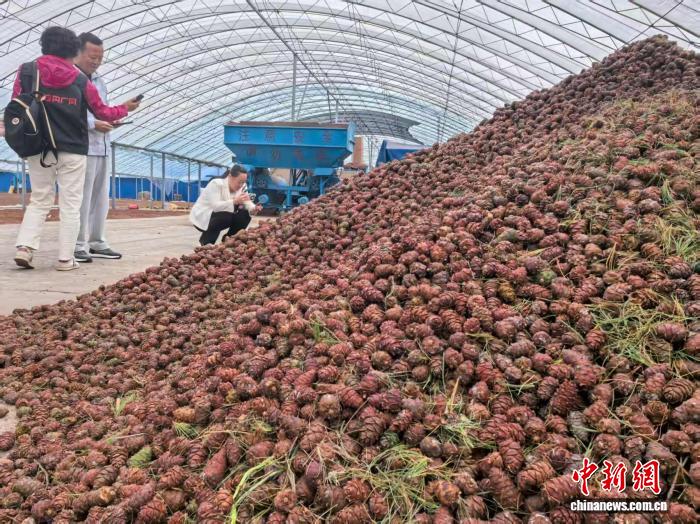
探访兴安林下经济:药丰果蓝松子香
Zhong Guo Xin Wen Wang· 2025-09-05 03:58
Core Insights - The article highlights the development of the forest economy in the Daxing'anling region, focusing on the harvesting and processing of various forest products such as pine nuts, medicinal herbs, and blueberries. Company Summary - Daxing'anling Impression Arctic Food Co., Ltd. processes pine nuts and has been operational since August 2020. The company achieved an industrial output value of 7.847 million yuan and main business revenue of 9.403 million yuan in the first five months of this year, with a profit of 643,000 yuan. It is projected to reach a main business revenue of 32.3 million yuan and a profit of 1.4 million yuan by the end of the year [2]. - The company specializes in the production of Yansong pine nuts, which are rare and have a higher price compared to regular pine nuts. The Yansong pine takes three years to mature, making it one of the longest-maturing tree species in the world [2]. Industry Summary - The Daxing'anling region is experiencing a boom in the forest economy, with a focus on sustainable practices that allow local residents to increase their income. The area has 2.91 million acres certified for green organic products, with 81 food processing enterprises and 346 certifications for green (organic) food products [6]. - The forest economy's output value is expected to reach 5.23 billion yuan in 2024, representing a year-on-year growth of 50.7% [6]. - The region is also seeing the cultivation of medicinal herbs, with a cooperative expecting to harvest over 50 tons of red peony seeds this year, generating an economic benefit of around 2 million yuan [4]. - Blueberry cultivation is also on the rise, with a local base producing approximately 30,000 pounds annually, significantly increasing income for farmers compared to traditional crops [6].
研究所晨会观点精萃:美国就业市场放缓强化降息预期,全球风险偏好继续升温-20250905
Dong Hai Qi Huo· 2025-09-05 01:09
1. Report Industry Investment Ratings - No information provided in the content 2. Core Views of the Report - Overseas, the US labor market is cooling, and Fed officials' remarks have strengthened the expectation of a Fed rate cut, leading to a continued rise in global risk appetite. Domestically, China's August official manufacturing PMI improved slightly but remained below the boom - bust line for the fifth consecutive month. The market is currently focused on domestic incremental stimulus policies and easing expectations, with a weakening short - term upward macro - drive. Attention should be paid to the progress of Sino - US trade negotiations and the implementation of domestic incremental policies [2]. - For assets, the stock index is expected to fluctuate in the short term, and it is advisable to wait and see cautiously. Treasury bonds will likely remain at a high level and fluctuate, also suggesting cautious waiting and seeing. In the commodity sector, black metals will be weakly fluctuating, and it is recommended to wait and see; non - ferrous metals will be fluctuating strongly, and it is advisable to go long cautiously; energy and chemicals will be fluctuating, and it is recommended to wait and see; precious metals will be strongly fluctuating at a high level, and it is advisable to go long cautiously [2]. 3. Summary by Relevant Catalogs 3.1 Macro - finance - Overseas: The US August "small non - farm" was below expectations, the number of initial jobless claims increased, and private enterprise recruitment slowed in August, indicating a cooling labor market. Fed officials said that a rate cut over time is appropriate, strengthening the rate - cut expectation [2]. - Domestic: China's August official manufacturing PMI rose to 49.4 but was below the boom - bust line for the fifth consecutive month. The Ministry of Commerce will introduce policies to expand service consumption in September. There is an enhanced expectation of US easing and domestic easing, but the domestic market sentiment has cooled [2]. - Asset performance: The stock index will fluctuate in the short term; treasury bonds will be at a high - level and fluctuate; black metals will be weakly fluctuating; non - ferrous metals will be strongly fluctuating; energy and chemicals will be fluctuating; precious metals will be strongly fluctuating at a high level. All suggest cautious operations [2]. 3.2 Stock Index - Affected by sectors such as semiconductors, artificial intelligence, and communications, the domestic stock market fell sharply. The fundamentals and policies are similar to the macro - finance situation. The short - term upward macro - drive is weakening. It is recommended to wait and see cautiously in the short term [3]. 3.3 Black Metals 3.3.1 Steel - The domestic steel spot market was stable on Thursday, and the futures price continued to be weak. In the traditional peak demand season, the actual demand was still weak, with the apparent consumption of five major steel products decreasing by nearly 300,000 tons and the inventory increasing by nearly 320,000 tons. Due to phased production restrictions, the steel output decreased by 236,800 tons this week, and the iron - water output is expected to decline slightly. The first round of coke price increase failed, and a price cut started. The steel market is likely to fluctuate within a range in the short term [4]. 3.3.2 Iron Ore - The futures and spot prices of iron ore were strong on Thursday. Phased production restrictions in the northern region reduced ore demand and affected port desilting volume. However, steel mills' profits are acceptable, and they are likely to resume production next week. The global iron ore shipping volume increased by 2.41 million tons to 35.56 million tons this week, and the arrival volume increased by 1.827 million tons. The iron ore price is expected to be strong in the short term [4][5]. 3.3.3 Silicon Manganese/Silicon Iron - The spot prices of silicon iron and silicon manganese were flat on Thursday, and the futures prices declined slightly. The production in Inner Mongolia was stable, with new high - silicon ignition this month and new capacity expected in October. In Ningxia, the operation was stable, and some southern factories were in losses. The silicon iron price has cost support, and the production reduction intention is not strong. The ferroalloy price is expected to fluctuate within a range in the short term [5]. 3.3.4 Soda Ash - The main soda ash contract fluctuated on Thursday. The supply decreased this week, but there is still supply pressure in the new capacity launch cycle, and the supply - surplus pattern remains unchanged. The demand was stable week - on - week, and the profit decreased. Soda ash has a pattern of high supply, high inventory, and weak demand, and it is expected to fluctuate within a range in the short term [6]. 3.3.5 Glass - The main glass contract fluctuated on Thursday. The supply increased slightly, the demand was stable, and the profit increased slightly. With the support of real - estate news, glass is expected to fluctuate within a range in the short term [6]. 3.4 Non - ferrous Metals and New Energy 3.4.1 Copper - US job openings in July dropped to the lowest level in 10 months, and domestic demand will weaken marginally. However, a Fed rate cut in September is almost certain, which may boost copper prices briefly [7]. 3.4.2 Aluminum - Aluminum prices were weak on Thursday, and the inventory continued to increase. Although it is the peak season, demand is poor. The mid - term upward space for aluminum prices is limited, and it is expected to fluctuate in the short term. A Fed rate cut in September may support the futures price [7][8]. 3.4.3 Aluminum Alloy - The supply of scrap aluminum is tight, and the demand is weak. Considering cost support, the price is expected to fluctuate strongly in the short term, but the upward space is limited [8]. 3.4.4 Tin - The combined operating rate in Yunnan and Jiangxi decreased by 0.21% to 59.43%. The supply of tin ore will be more abundant in the future. The terminal demand is weak, and the inventory decreased last week. The price is expected to fluctuate in the short term, with limited rebound space [8]. 3.4.5 Lithium Carbonate - The main lithium carbonate contract rose 1.05% on Thursday. The inventory is gradually being depleted. It is expected to fluctuate widely, and it is advisable to wait and see cautiously [9]. 3.4.6 Industrial Silicon - The main industrial silicon contract rose 0.12% on Thursday. Polysilicon is fluctuating at a high level, and industrial silicon is expected to fluctuate within a range [9]. 3.4.7 Polysilicon - The main polysilicon contract rose 0.55% on Thursday. There are expectations of capacity integration in the market. Polysilicon is facing a game between strong expectations and weak reality and is expected to fluctuate at a high level in the short term [10]. 3.5 Agricultural Products 3.5.1 US Soybeans - The November soybean contract on the CBOT rose 0.17% overnight. The USDA weekly export sales report was postponed. The market is waiting for the September 12 USDA report to see if it will revise the US soybean yield. The Midwest is experiencing drought, which has reduced the excellent - good rate [11]. 3.5.2 Soybean Meal and Rapeseed Meal - Domestic oilseeds have preventive procurement in the third quarter, with high import volumes and increasing operating rates, resulting in a large phased inventory pressure. The basis is difficult to repair in the short term. The price of US soybeans is likely to be under pressure after September 12 if the yield remains unchanged. Brazilian export quotes are rising. The future trend of rapeseed meal depends on Sino - Canadian trade policies [12]. 3.5.3 Oils - CBOT soybean oil futures rose overnight, and BMD palm oil futures also increased slightly. September palm oil exports are expected to be strong, but the future market depends on production data. The inventory of Malaysian palm oil in August is expected to increase to 2.2 million tons. Domestic palm oil imports have a deeper profit inversion, and it is expected to fluctuate in the short term [13]. 3.5.4 Corn - New - season corn has been slightly listed in Northeast China, and farmers are reluctant to sell at low prices. In North China, corn prices are stable, with tight channel inventories. The port inventory is low, and the futures market has rebounded, which is positive for the market [13]. 3.5.5 Pigs - The spot price of pigs has rebounded and is weakly stable. In September, both supply and demand of pigs will increase. The cost of secondary fattening is at a low - profit level, and there is support from the National Day and Mid - Autumn Festival stocking cycle. The pig price should not be overly pessimistic in September [14].
涪陵榨菜:榨菜销量下滑丨消费参考
2 1 Shi Ji Jing Ji Bao Dao· 2025-09-04 23:41
Group 1 - The core viewpoint is that Fuling Zhacai is reassessing its key pickled vegetable business due to changing market dynamics and consumer preferences [1][4] - In the first half of 2025, Fuling Zhacai reported a revenue increase of 0.5% year-on-year to 1.31 billion yuan, while net profit attributable to shareholders decreased by 1.7% to 440 million yuan [1] - Revenue from the pickled vegetable category was 1.12 billion yuan, with a year-on-year growth of 0.5%, while sales volume declined by 1.2% [1] Group 2 - The company is facing challenges in sales channels as consumer preferences shift towards alternative products, and urban population trends are affecting its market coverage [3] - Fuling Zhacai is implementing a strategy to expand product categories and market reach, focusing on new product development and channel expansion [3] - The company is adjusting its production plans by reducing conventional pickled vegetable production lines and increasing the production of multi-specification products and sauces [3] Group 3 - The stock price of Fuling Zhacai was reported at 13.24 yuan per share, with a slight increase of 0.76% [5] - The consumer index for the sector showed a decline, with the consumption index dropping by 2.21% [6]

金健米业股份有限公司关于召开2025年半年度业绩说明会的公告
Shang Hai Zheng Quan Bao· 2025-09-04 18:47
Core Viewpoint - The company, Jinjian Rice Industry Co., Ltd., is set to hold a half-year performance briefing on September 17, 2025, to discuss its operational results and financial status for the first half of 2025, allowing investors to engage in a Q&A session [3][4]. Group 1: Meeting Details - The performance briefing will take place on September 17, 2025, from 15:00 to 16:00 [5]. - The meeting will be conducted online through the Value Online and Eastmoney Roadshow platforms [5][6]. - Investors can submit questions before the meeting until September 16, 2025, at 16:00 through specified online links or via email [6][7]. Group 2: Participants - Key participants in the briefing will include Chairman Shuai Fucheng, Independent Director Zhou Zhifang, Chief Financial Officer Huang Simiao, and Board Secretary Hu Jing [5]. Group 3: Additional Information - After the briefing, investors can access the meeting's main content and outcomes through various online platforms [8].

金健米业:9月17日将召开2025年半年度业绩说明会
Zheng Quan Ri Bao Wang· 2025-09-04 13:17
Group 1 - The company Jin Jian Rice Industry (600127) announced that it will hold a 2025 semi-annual performance briefing on September 17, 2025 [1]
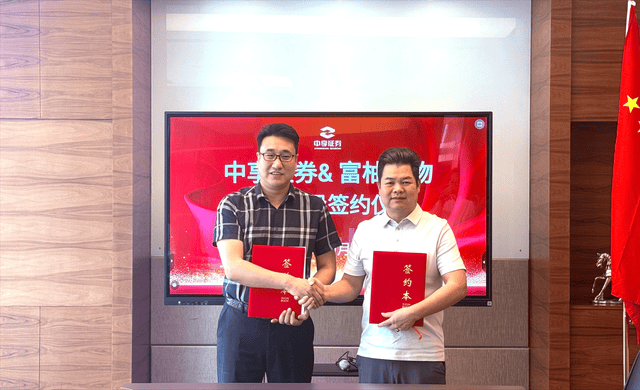
中享证券携手富柚生物科技 开启港股上市新征程,共创资本市场宏图
Sou Hu Cai Jing· 2025-09-04 10:40
Group 1 - The core viewpoint of the article highlights the partnership between Zhongxiang Securities and Fuyou Biotechnology, marking the company's journey towards listing on the Hong Kong capital market [1][10] - Fuyou Biotechnology, established in 2014, focuses on the deep processing of the pomelo industry, utilizing a unique development model that integrates companies, research institutions, ecological bases, and farmers [3] - The company has been recognized as a key agricultural leading enterprise in Guangdong Province in 2023, reflecting its significant growth and contribution to the local economy [3] Group 2 - Fuyou Biotechnology operates three fully automated production lines with independent intellectual property rights, ensuring high product quality through advanced processing techniques [5] - The company's pomelo beverage "Jinyou No. 1" has received accolades, including being named a "Guangdong Province Famous Brand Product" and designated as the reception beverage for the Sixth World Business Conference [5] - The company has achieved various certifications, including ISO9000 quality management system certification and recognition as a national high-tech enterprise [5] Group 3 - Zhongxiang Securities will assist Fuyou Biotechnology in restructuring its equity and assets to comply with legal and regulatory requirements for the Hong Kong listing [7] - The firm will help the company enhance its financial management and coordinate audits to meet international accounting standards [8] - Zhongxiang Securities will prepare the necessary listing documents and facilitate communication with regulatory bodies, ensuring a smooth transition to the capital market [8] Group 4 - The partnership is seen as a significant milestone for Fuyou Biotechnology, aiming to enhance brand influence, broaden financing channels, and accelerate the implementation of its development plans [10] - Zhongxiang Securities aims to provide comprehensive capital market solutions, ensuring an efficient and stable listing process for Fuyou Biotechnology [10]