
外汇

Search documents
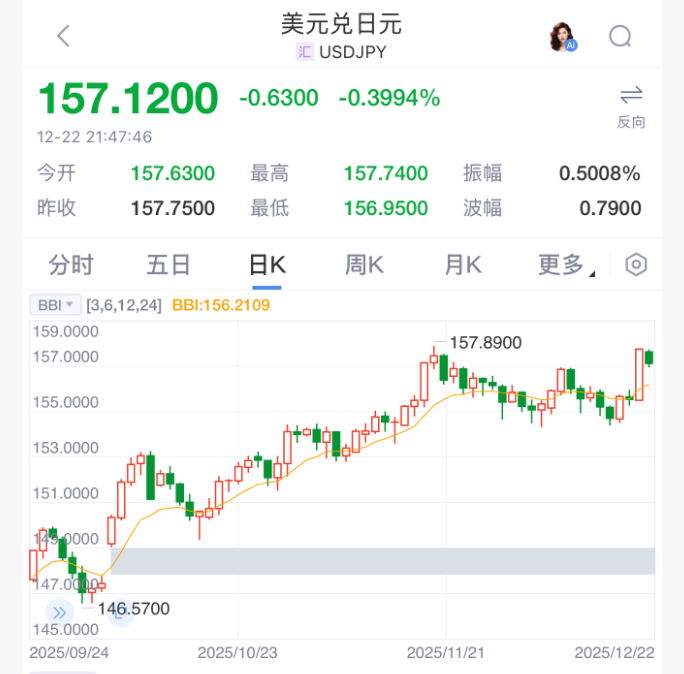
刚刚!日本,救市了!
Zhong Guo Ji Jin Bao· 2025-12-22 14:18
Core Viewpoint - The Japanese government signals a potential intervention in the foreign exchange market to stabilize the yen, which has been experiencing volatility not aligned with economic fundamentals [1][3]. Group 1: Government Actions and Statements - Japanese Finance Minister Shunichi Suzuki warns of decisive action against speculative movements in the yen's exchange rate, indicating that the recent depreciation does not reflect the country's economic fundamentals [1]. - The joint statement with the U.S. Treasury suggests that Japan has received tacit approval from Washington to intervene in the currency market without further consultation if necessary [3]. - The Finance Ministry previously intervened in the market, spending approximately $100 billion to support the yen when it traded around 160 yen per dollar [5]. Group 2: Economic Policies and Budget - The Japanese government is expected to announce an aggressive budget for the upcoming fiscal year, potentially exceeding a record 120 trillion yen (approximately $760 billion), up from an initial budget of 115 trillion yen [6]. - The recent supplementary budget of 18.3 trillion yen is the largest since the easing of pandemic restrictions, aimed at various expenditures including price relief and security enhancements [6]. - Concerns over public finances have led to a rise in the 10-year government bond yield to 2.1%, the highest in 27 years, although the Finance Minister believes this deterioration in fiscal indicators is temporary [6].

?揭秘2025年“东南亚最强货币”泰铢背后的双引擎:关税“意外助攻”与黄金潮汐
Zhi Tong Cai Jing· 2025-12-22 11:48
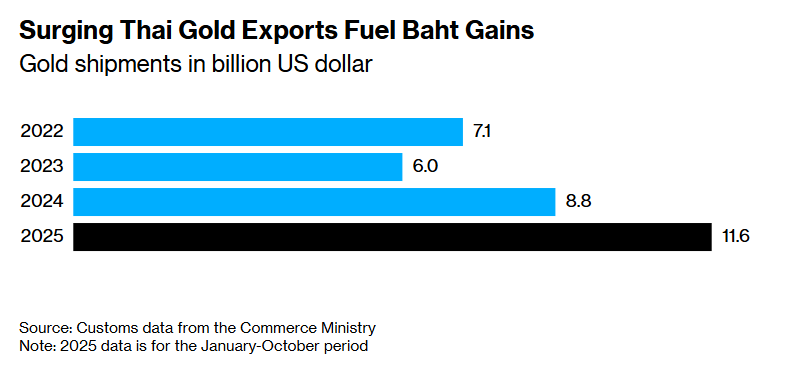
Core Insights - The Thai Baht is experiencing its largest annual appreciation against the US dollar in eight years, with a 10% increase in 2025, outperforming other Southeast Asian currencies [1][2] - The strong performance of the Baht is attributed to rising gold prices and unexpected benefits from US tariff policies, despite Thailand's economic challenges [1][2] - The appreciation of the Baht poses challenges for Thailand's export-driven economy and the new Prime Minister, who faces an election in February [1][5] Group 1: Factors Contributing to Baht Strength - The Baht's strength began in mid-2024, coinciding with government economic stimulus plans and traders selling dollars ahead of the Federal Reserve's interest rate cuts [2] - A significant portion of the Baht's appreciation is linked to a 60% increase in gold prices, driven by a weakening US labor market and seasonal peaks in Thailand's tourism [3] - The US tariffs have inadvertently boosted Thailand's economy by encouraging manufacturers to shift production to Thailand, benefiting from lower tariffs compared to Chinese goods [2][3] Group 2: Economic Implications of a Strong Baht - A strong Baht makes Thai products more expensive in international markets, leading to slower export growth [4] - The tourism sector is under pressure as the strong Baht diminishes Thailand's appeal as a low-cost destination, with a downward revision of foreign tourist arrivals expected [4] - While a stronger Baht reduces import costs for households, the overall impact on an economy reliant on exports and tourism is negative [4] Group 3: Government and Central Bank Responses - The Thai government is addressing concerns from export-oriented businesses regarding the Baht's appreciation, amidst political instability and upcoming elections [5] - The central bank has intervened in the foreign exchange market to manage excessive volatility and has proposed measures to increase flexibility for businesses managing offshore earnings [6] - Discussions are ongoing regarding potential taxation on physical gold transactions to mitigate the impact of gold prices on the Baht's strength [6]
揭秘2025年“东南亚最强货币”泰铢背后的双引擎:关税“意外助攻”与黄金潮汐
Zhi Tong Cai Jing· 2025-12-22 11:40
Core Viewpoint - The Thai Baht is experiencing its largest annual appreciation against the US dollar in eight years, with a 10% increase in 2025, outperforming other Southeast Asian currencies despite economic challenges [1][2]. Group 1: Factors Contributing to Baht Strength - The appreciation of the Baht began in mid-2024, coinciding with government economic stimulus plans and traders selling off the US dollar ahead of the Federal Reserve's latest interest rate cuts [2]. - A significant portion of the Baht's recent gains is attributed to a 60% increase in gold prices, driven by a weakening US labor market and seasonal peaks in Thailand's tourism industry [3]. - The Trump administration's import tariffs have unexpectedly boosted Thailand's economy by encouraging local manufacturing for exports to the US, as tariffs on Thai goods are lower than those on Chinese products [2][3]. Group 2: Economic Implications of a Strong Baht - A strong Baht makes Thai products more expensive in international markets, leading to the slowest export growth in over a year [5]. - The tourism sector is under pressure as the strong Baht diminishes Thailand's appeal as a low-cost vacation destination, with a downward revision of foreign tourist arrivals expected [6]. - While a stronger Baht can reduce inflation for imported goods, the overall impact on an economy heavily reliant on exports and tourism is negative [6]. Group 3: Government and Central Bank Responses - The Thai government is addressing concerns from export-oriented businesses regarding the Baht's appreciation, but political instability complicates fiscal policy direction [7]. - The Bank of Thailand has intervened in the foreign exchange market to manage excessive volatility and has proposed increasing the offshore income retention limit for businesses [8]. - Discussions are ongoing regarding measures to mitigate the impact of gold prices on the Baht, including potential taxation on physical gold transactions [8].
Moneta Markets外汇:比特币12个月目标看至14.3万美元
Xin Lang Cai Jing· 2025-12-22 11:07
12月22日,随着全球数字资产市场的波动加剧,Moneta Markets外汇持续关注主流金融机构对加密货币 走势的深度研判。近期,华尔街顶级银行发布的最新报告将比特币未来12个月的基准目标价定为143000 美元,这预示着该资产相较于目前约88000美元的价格水平,仍有约62%的潜在上涨空间。Moneta Markets外汇认为,尽管短期内市场经历了部分回调与震荡,但支撑比特币长期上行的底层逻辑依然稳 固,尤其是传统金融资本的持续介入正在重塑其估值体系。 在对市场节奏的把握上,Moneta Markets外汇表示,新年前后比特币的价格波动区间预计将维持在 80000美元至90000美元之间。分析师特别强调了70000美元这一关键支撑水平的重要性,认为这一位置 不仅是前期价格突破后的心理防御线,更是衡量多头信心的核心指标。根据相关机构的联合研究,第二 季度可能出台的数字资产立法将成为行业发展的里程碑,监管的明确性将显著提升机构投资者对数字资 产的采用率,从而为市场注入更具规模的流动性。 对于未来的走势推演,市场给出了三种不同的预期路径。在基准情景下,受现货ETF资金的持续流入以 及全球传统股市走强带来的溢出效 ...

中国外汇投资研究院:仅靠口头干预可能不足以逆转日元跌势
Xin Hua Cai Jing· 2025-12-22 09:32
新华财经北京12月22日电中国外汇投资研究院金融分析师张正阳表示,日元贬值的驱动因素是多方面 的。日本的财政扩张政策加剧了市场对日本财政状况的担忧,进而削弱日元价值。此外,全球能源价格 波动和地缘政治紧张局势,也放大了日元作为避险资产的波动性,这使得汇率更易受投机行为影响。从 经济影响来看,日元贬值虽有利于出口企业提升竞争力,但负面效应更为突出,进口成本上升直接推高 物价,尤其是能源和食品价格,加剧了家庭生活压力;企业生产成本增加,可能抑制投资和就业;更深 远的是,贬值若持续,会放大财政风险,因为政府债务以日元计价,但贬值可能通过通胀途径增加偿债 负担。 历史经验表明,日本货币当局常通过言论来引导市场预期,避免实际干预的高成本。然而,市场反应显 示,仅靠口头干预可能不足以逆转趋势,尤其在财政宽松预期强化的情况下。 (文章来源:新华财经) ...
宝钜证券周报-20251222
宝钜证券· 2025-12-22 08:29
Report Summary - **Report Title**: Baoju Securities Weekly Report - **Report Date**: December 22, 2025 Report Industry Investment Rating - No industry investment rating is provided in the report. Report Core View - Global economic slowdown and inflation trends affect various asset markets, including stocks, bonds, commodities, and foreign exchange. Market participants are closely watching central bank policies, economic data, and geopolitical events to assess investment opportunities and risks. Summary by Related Catalogs Global Stock Market - **European Stocks**: Economic slowdown and inflation concerns lead to fluctuations in European major stock indices. The European Central Bank maintains interest rates, and the market awaits PMI data to judge the possibility of a mild recovery in early 2026 [3][4]. - **Chinese Stocks**: Weak domestic demand and real - estate market issues pressure the Chinese market. Beijing may introduce new stimulus measures. Investors are looking for blue - chip stocks with clear profit prospects for portfolio layout [3][4]. - **Hong Kong Stocks**: The Hang Seng Index rebounds after being affected by the US inflation data. Market liquidity may improve with the expansion of regulations and IPO activities, but returns depend on foreign capital inflows and the stability of the RMB exchange rate [3][4]. - **US Stocks**: The decline in the November CPI data boosts expectations of interest rate cuts, leading to a rebound in the S&P 500 and Nasdaq indices. The market focuses on year - end spending and profit expectations, and the AI sector's technical changes increase market volatility [3]. Global Bond Market - **Government Bonds**: The FTSE World Government Bond Index falls 0.04%. Although the decline in the US CPI boosts interest - rate cut expectations, the hawkish stances of the Fed and the Bank of England limit gains. Prices remain range - bound due to year - end liquidity tightening and policy uncertainty [5]. - **High - Yield Bonds**: The Bloomberg Global High - Yield Bond Index rises 0.29%. Spreads narrow and economic optimism boost risk appetite. However, emerging - market debt faces challenges due to the strong US dollar, despite China's stimulus measures. High - yield bonds will remain popular in 2026, and emerging - market performance depends on exchange - rate stability and fiscal progress [5]. Commodities - **WTI Crude**: WTI crude oil falls 1.36% to $56.66 per barrel. The progress of Russia - Ukraine negotiations and global economic growth concerns lead to a second - consecutive - week decline. In 2026, expected production surpluses and stable OPEC+ output may put pressure on oil prices, and the market focuses on year - end inventory data [8]. - **Gold**: Gold prices rise 0.91% to $4338.88 per ounce. The decline in the US CPI boosts interest - rate cut expectations, and year - end hedging operations drive up gold prices. Interest - rate cuts and central - bank demand support gold prices moving towards $4400, but the Fed's hawkish remarks may trigger profit - taking [9]. - **Bloomberg Commodity Spot Index**: The index falls 0.16% to 580.08. Weak energy prices offset the rise of gold and soft commodities. The market is weighing 2026 growth expectations, and commodities will remain range - bound. Upcoming PMI data are crucial for assessing metal and energy demand [10]. Foreign Exchange - **US Dollar Index**: The US dollar index rises 0.20% to 98.60. Weak CPI data boost expectations of 2026 interest - rate cuts, but the Fed's hawkish remarks provide support. The index is expected to fluctuate around the current level, with technical support at 98.00 [11]. - **RMB against the US Dollar**: The RMB falls 0.20% to 7.0411. Weak domestic demand and the real - estate market pressure the RMB, but the optimistic 2026 fiscal expansion outlook limits the decline. The RMB's trend depends on the pace of fiscal stimulus and the overall strength of the US dollar [12]. Main Indices and Economic Data - **Main Indices**: The report provides price and cumulative return data of major global stock indices such as the Hong Kong Hang Seng Index, the Shanghai Composite Index, the US Dow Jones Index, etc., as of December 19, 2025 [16]. - **Economic Data**: It includes data on non - farm payrolls, unemployment rates, PMI, CPI, and other economic indicators in the US and Europe, with comparisons between previous values, market expectations, and actual values [17]. Bond/Foreign Exchange Index - **Bond Index**: It shows the price, change percentage, and yield of various government bonds such as US, Chinese, Japanese, German, and British bonds as of December 19, 2025 [18]. - **Foreign Exchange Index**: It provides price and cumulative return data of major currency pairs including the Hong Kong dollar, the US dollar, the euro, etc., as of December 19, 2025 [18].
高盛闭门会-全球市场26展望,股市波动性加剧ai主题扩散,利率新兴市场外汇
Goldman Sachs· 2025-12-22 01:45
Investment Rating - The report indicates a constructive outlook for the stock market, suggesting it may continue to rise despite increased volatility [1][2]. Core Insights - Current stock and credit market valuations are high, which contradicts the macroeconomic cycle that has not yet shown typical late-cycle characteristics [1][2]. - AI capital expenditure is expected to drive growth, while a weak labor market may prompt the Federal Reserve to adopt a more accommodative stance, creating a favorable environment for the stock market [1][4]. - The cyclical growth outlook has room for upward adjustment, with tight fiscal conditions potentially pushing long-term bond yields higher, resulting in a steep yield curve [5]. Summary by Sections Macroeconomic Background - The macroeconomic backdrop for 2025 is described as relatively mild, with steady economic growth and a clear trend towards disinflation [2]. - The stock and credit markets are experiencing high valuations, which do not align with the current macroeconomic cycle [2]. Stock Market Outlook - The S&P 500's risk-adjusted returns are expected to be slightly lower than the highs of the past three years, but short-term valuation constraints are not strong [4]. - The market is sensitive to earnings misses and inflation concerns, with AI capital expenditure expected to create more cyclical opportunities [4][3]. Bond Market Dynamics - The report anticipates that the process of disinflation will return to a positive trajectory, keeping front-end yields low in the U.S. and the U.K. [5]. - Long-term U.S. bond yields are expected to fluctuate within a range, with a favorable outlook for U.K. government bonds due to weak economic data and supportive central bank policies [5]. Currency Market Trends - The foreign exchange market in 2026 is expected to differ significantly from 2025, with the U.S. dollar projected to depreciate moderately due to expectations of interest rate cuts [8][9]. - The Chinese yuan is expected to gradually appreciate, with policymakers likely to accept this trend to maintain export competitiveness [9]. Emerging Market Opportunities - Emerging market equities are projected to deliver a total return of approximately 15%, supported by a favorable macro environment and declining inflation [10]. - Countries with hawkish central banks, such as Hungary and Brazil, are highlighted as having favorable conditions for local rate trades [10]. Hedging Strategies - In the current late-cycle environment, long-term stock holdings are recommended, with a focus on diversification and hedging strategies [11]. - Gold and commodity arbitrage strategies are suggested as effective diversification options, while long call options are recommended for managing stock risk [11].
Asian stocks gain as hopes for year-end rally grow
The Economic Times· 2025-12-22 00:51
Economic Growth - The U.S. economy is forecasted to show strong growth in the third quarter, with median annualized growth expected at 3.2%, attributed to a significant pullback in imports following earlier increases due to tariffs [1][12] Investor Sentiment - Investor sentiment has reached extreme bullish levels at 8.5, which historically precedes market pullbacks, with global equities typically declining a median of 2.7% over the following two months [2][3][13] - The Fund Manager Survey indicates the most bullish sentiment in 3.5 years, driven by expectations of rate, tariff, and tax cuts [3][13] Market Performance - S&P 500 futures increased by 0.2% and Nasdaq futures rose by 0.3%, reflecting a prevailing fear of missing out among investors [6][13] - Japan's Nikkei index rose by 1.5%, benefiting from a decline in the yen, which is expected to enhance export earnings for Japanese companies [7][13] Currency Movements - The yen reached record lows against the euro and Swiss franc, prompting concerns from Japan's currency officials about excessive declines and potential intervention [8][13] - The dollar was steady against a basket of currencies, having gained 0.3% recently, with a potential target of 158.00 for further upward movement [9][13] Equity Inflows - Equity markets experienced record inflows of $98 billion last week, primarily driven by U.S. equity funds, while Chinese equity funds saw significant inflows as well [10][13] Commodity Prices - Silver prices reached a new record at $67.48 per ounce, marking a year-to-date gain of nearly 134%, while gold rose to $4,362 per ounce [11][13] - Oil prices increased following U.S. actions against Venezuelan oil tankers, with Brent crude rising to $60.88 per barrel and U.S. crude to $56.89 per barrel [11][13]


美联储官员鹰派表态降息,中国国常会部署稳经济工作
Dong Zheng Qi Huo· 2025-12-22 00:41
日度报告——综合晨报 美联储官员鹰派表态降息,中国国常会部署 稳经济工作 [T报ab告le_日R期an:k] 2025-12-22 宏观策略(外汇期货(美元指数)) 美联储鹰派暗示不会降息 哈马克力主维持高利率更长时间 美联储鹰派官员表态不会降息,利率维持高位更长时间,表明 对于通胀担忧继续存在,美元短期震荡。 宏观策略(股指期货) 国常会要求加快部署中央经济工作会议安排 综 近期宏观空窗期,A 股走势波澜不惊,短暂的回调之势被国家队 等稳市资金阻断,市场再度震荡上行。展望后市,跨年行情或 将维持高位窄幅震荡的态势。 有色金属(铜) 1-10 月全球精炼铜市场供应过剩 12.2 万吨 合 宏观策略(国债期货) 晨 央行开展了 562 亿元 7 天期逆回购操作 报 超长端品种继续大幅下跌的概率在下降,市场有望温和修复。 农产品(棉花) 美棉出口周报(11.20-11.27):签约下滑 我国 11 月棉花棉纱进口环比同比双增,其中 11 月棉纱进口同比 增 25%至 15 万吨。配额短缺限制棉花进口,但进口纱竞争优势 增强,吸引部分企业加大采购。 黑色金属(螺纹钢/热轧卷板) 247 家钢厂高炉铁水日均产量 22 ...
国家外汇管理局:11月外汇市场供求延续基本平衡,跨境收支保持活跃
Sou Hu Cai Jing· 2025-12-19 10:51
Core Viewpoint - The foreign exchange market in China has maintained stability in November 2025, with a balanced supply and demand despite fluctuations in the international financial market and a weakening US dollar [1] Group 1: Foreign Exchange Market Performance - The foreign exchange market in China has continued to operate smoothly, with both bank foreign exchange settlement and sales remaining stable [1] - The foreign exchange settlement surplus in November was $15.7 billion, which is comparable to October's figures [1] Group 2: Cross-Border Capital Flows - Cross-border income and expenditure from non-bank sectors, including enterprises and individuals, totaled $1.3 trillion in November, reflecting an 8% month-on-month increase [1] - The cross-border capital flow surplus was $17.8 billion, lower than the average surplus of $24 billion observed in September and October [1] Group 3: Trade and Investment Insights - Goods trade remains the primary channel for net capital inflows, while service trade, investment income, and direct investment flows have remained stable [1] - Recent trends indicate that capital flows under securities investment have become more stable [1]