
通信

Search documents
估值周观察(12月第2期):日韩新领涨,成长重回升势
Guoxin Securities· 2025-12-14 09:57
Global Market Overview - The overseas markets showed mixed performance from December 8 to December 12, 2025, with Japan and South Korea leading gains, as the Korean Composite Index and the Tokyo Stock Exchange Index both rose over 1.5% [2][7] - The US stock market saw declines across all indices except for the Dow Jones Industrial Average, with the Nasdaq 100 leading the drop at -1.93% [2][7] - Overall valuation changes were moderate, with significant PE expansion observed only in the Nikkei 225 (+1.65x) and the Korean Composite Index (+3.83x), while other indices saw changes not exceeding 1x [2][7] A-share Market Analysis - A-shares exhibited mixed performance with slight valuation contraction from December 8 to December 12, 2025. The CSI 500 index was the only one to exceed a 1% increase at +1.01%, while the SSE 50 and CSI 100 saw minor declines of -0.25% and -0.13% respectively [2][30] - Growth stocks outperformed value stocks, with mid-cap growth leading at +1.46% and mid-cap value lagging at -1.94% [2][30] - As of December 12, 2025, major A-share indices' PE, PB, and PS ratios were positioned within the 72%-86% percentile range for the past year, indicating a favorable valuation for large-cap value stocks [2][31] Industry Performance - The week saw more declines than gains across primary industries, with upstream resources experiencing significant pullbacks and downstream consumption sectors declining across the board [2][52] - The TMT sector showed relative resilience, particularly in electronics (+2.63%) and telecommunications (+6.27%), while the materials and manufacturing sectors displayed notable internal divergence [2][52] - Valuations generally contracted alongside stock prices, with the computer and real estate sectors experiencing PE contractions exceeding 1x, while defense and military (+2.29x), electronics (+1.88x), and telecommunications (+2.88x) saw significant PE expansions [2][52] Valuation Comparisons - The telecommunications sector exhibited the highest valuation attractiveness, with rolling 1-year, 3-year, and 5-year valuation percentiles averaging 98.35%, 99.45%, and 99.67% respectively [2][31] - The consumer sectors, including social services, beauty care, food and beverage, and agriculture, displayed relatively high valuation attractiveness, with average valuation percentiles of 49.21%, 18.22%, 23.75%, and 49.28% respectively [2][52] Emerging Industries - Most emerging industries saw gains, with nuclear power leading at +4.44%. The digital economy sectors, particularly 5G (+4.19%) and IDC (+3.09%), also showed significant increases [2][52] - Valuations in these sectors generally expanded, with IDC and integrated circuits experiencing PE expansions exceeding 2x, while cloud computing and biotechnology sectors saw PE contractions over 1x [2][52]
“以投带引”撬动创新!“从1到100”实现产业化跨越 科创金融助力产业升级
Yang Shi Wang· 2025-12-14 09:53
Core Viewpoint - The central economic work conference emphasizes the integration of technological and industrial innovation to develop new quality productivity, with funding being a crucial element for both original innovation and industrialization [1] Group 1: Technological Innovation and Funding - Anhui province has made significant strides in its technological innovation landscape during the 14th Five-Year Plan period, ranking among the top in the country for regional innovation capabilities [1] - A new generation of aviation broadband communication systems, developed in Hefei High-tech Zone, has promising market prospects in civil aviation and aerospace information, transitioning from laboratory to production in just over two years [3] - The establishment of the Keda Silicon Valley platform, a collaboration between Anhui province, Hefei city, and the University of Science and Technology of China, has facilitated funding and support for enterprises [5] Group 2: Financial Support and Industry Growth - The Keda Silicon Valley Capital Empowerment Center has created mechanisms to support the transformation of scientific achievements into commercial enterprises, enabling scientists to become better entrepreneurs [7] - Collaboration with seven investment institutions has helped enterprises secure tens of millions in funding, driving technological advancements and product iterations, with applications in major airports like Shanghai Hongqiao and Guangzhou Baiyun [9] - Hefei has developed a comprehensive aerospace information industry chain with 165 enterprises generating over 10 billion in revenue, supported by a "fund jungle" involving over 170 state-owned funds with a registered scale exceeding 280 billion [11] Group 3: Scene Innovation and Application - The State Council has recognized scene cultivation as a key driver for developing new quality productivity, with Hefei actively helping tech products find suitable application scenarios [13] - The city's smart inspection system for rail transit, which utilizes quantum precision measurement technology, was developed with initial funding from Hefei's state-owned assets [15][18] - Hefei has published over 1,400 scene opportunity items and 1,500 scene capability items, serving over 4,100 tech enterprises and facilitating more than 1,200 cooperative projects [25]

负债行为跟踪:年末抢跑,布局科技
ZHONGTAI SECURITIES· 2025-12-14 09:45
Group 1: Report Summary - Forecasted incremental funds in 2026 from insurance, wealth management, and pensions amount to 3.1 trillion. End - of - year pre - positioning in technology is likely [4]. - This week, risk appetite rebounded, with the VIX index falling and the basis of near - month stock index futures contracts narrowing significantly. The A - share market showed a structural trend, with the technology sector leading the rise [4]. - End - of - year pre - positioning is occurring. Margin trading funds have been flowing back to technology for two weeks, and this week, southbound funds shifted from a hedging and balanced strategy to flowing into electronics [4]. Group 2: Asset Price Performance 2.1. Performance of Major Asset Classes - This week (2025/12/8 - 2025/12/12), US stocks rose, while A - shares and Hong Kong stocks fell. Technology stocks performed well, with the US Nasdaq, A - share ChiNext, and STAR 50 all rising. The bond market showed a differentiated performance, and the US dollar index fell by 0.6% [13]. 2.2. A - share Market - Among broad - based indices, micro - cap and dividend indices declined significantly, while the ChiNext and STAR 50 performed well. The ChiNext rose 2.7% and the STAR 50 rose 1.7% this week [19]. - Except for micro - cap stocks, the average daily trading volume of most broad - based indices increased, returning to the level of mid - August [23]. - The top five rising industries this week were communication (7.6%), national defense and military industry (5.1%), non - banking finance (4.3%), machinery and equipment (3.8%), and electronics (3.1%), with technology stocks leading the gains. Cyclical value stocks such as coal, oil and petrochemicals, real estate, and banks performed relatively poorly [29]. 2.3. Technology Sector - In October, the technology sector contracted significantly. In November, optical modules and optical communication rebounded. In the first two weeks of December, optical modules, optical communication, computing power, semiconductor equipment, and controllable nuclear fusion had excess returns [33]. - This week, the technology sector as a whole performed well. On Monday and Friday, most sub - sectors rose, and on Thursday, most sub - sectors fell, but it did not affect the overall upward trend [37]. Group 3: Fund Behavior Tracking 3.1. Margin Trading Funds - As of Thursday this week, the proportion of margin trading turnover in A - share turnover rebounded from 10.01% to 10.53%. The margin trading balance was approximately 2.51 trillion, and the proportion of margin trading balance to A - share free - float market capitalization was about 2.63% [48]. - From Monday to Thursday, margin trading funds continued to flow into major broad - based indices, while most broad - based ETF funds had net outflows, except for the STAR 50 and the Shanghai Composite Index, which had net inflows [53]. - This week, stocks with a market capitalization of over 3 billion added leverage. In stocks with a market capitalization of over 500 billion, industrial and commercial stocks such as Industrial and Commercial Bank of China, China Merchants Bank, Ping An of China, and Zhongji Innolight had large net margin purchases [57]. - Industries with a large proportion of net margin purchases to trading volume this week were banking, commerce and retail, coal, food and beverage, agriculture, forestry, animal husbandry, and fishery, and real estate. Non - banking finance added leverage this week after five consecutive weeks of de - leveraging [59]. - Some popular stocks in electronics, machinery, and non - ferrous metals added leverage this week. The average ratio of net margin purchases to trading volume of the top 35 popular stocks rose to 3.00% this week [71]. 3.2. Quantitative Funds - In the past two weeks (12/1 - 12/12), the excess returns of CSI 500 and CSI 1000 quantitative index enhancement strategies were - 0.5% and - 0.2% respectively [73]. 3.3. Stock Index Futures - This week, the basis of near - month stock index futures contracts narrowed significantly, but the basis of far - month contracts remained at a relatively high level since July. The number of "this month" contracts decreased, while the number of "next month", "current quarter", and "next quarter" contracts increased [83]. 3.4. Main Funds - Main funds in the CSI 300 and ChiNext and STAR markets continued to have net outflows, and the net outflows accelerated. Main funds in the CSI 300 and ChiNext had significant net outflows on Thursday, and main funds in the STAR market had net outflows for five consecutive days, with a large outflow on Friday [88]. - Main funds flowed into banking and steel industries and flowed out of electronics, computer, and communication industries [92]. 3.5. Northbound Funds - This week, the total trading volume of northbound funds rebounded, with the average daily trading volume rising from 192.7 billion to 232.5 billion, and the proportion in A - share trading volume rising from 11.34% to 11.85% [94]. - This week, the decline of heavy - position stocks in the Hong Kong - connected Shanghai and Shenzhen Stock Connect widened, and the median of the rise - fall ratio widened from - 0.39% to - 1.47%. The Hong Kong - connected Shanghai and Shenzhen Stock Connect 50 index failed to outperform the CSI 300 this week [101]. 3.6. Southbound Funds - This week, the average daily trading volume of southbound funds rose from 138 billion to 158.3 billion, and the proportion rose from 51.2% to 54.9%. The average daily net purchase amount decreased from 2.1 billion to - 0.6 billion [103]. - Southbound funds continued to flow into industries such as electronics, automobiles, and banking, but the single - week net inflow scale of the banking industry decreased significantly compared to November. Commerce and retail shifted from continuous net inflows to net outflows [109].
策略周报:聚焦AI算力和商业航天双主线-20251214
Bank of China Securities· 2025-12-14 09:28
Core Insights - The report emphasizes the initiation of a "spring surge" market, led by technology sectors, particularly focusing on AI computing power and commercial aerospace as dual main lines for investment opportunities [3][13][37] - The transition from a policy-driven market to one driven by fundamental earnings growth is highlighted, with expectations of a stable macroeconomic environment supporting this shift [13][22] - The report identifies key sectors for investment, including TMT (Technology, Media, and Telecommunications) and high-end manufacturing, while traditional sectors like real estate and energy remain under pressure [22][37] Policy and Economic Outlook - The Federal Reserve's recent interest rate cut and balance sheet expansion have positively impacted global risk assets, creating a favorable environment for A-shares to remain in an upward trajectory [12][13] - The Central Economic Work Conference has set priorities for 2026, emphasizing domestic demand and technological development, which are expected to bolster market confidence [12][13] Sector Performance - The technology sector, particularly AI hardware, is noted for its resilience and growth potential, with specific attention to the TPU (Tensor Processing Unit) supply chain and related components like optical modules and storage chips [27][31][32] - The commercial aerospace sector is experiencing a significant policy boost, with the establishment of a dedicated commercial aerospace department and supportive government actions expected to enhance market confidence and growth prospects [37] Market Trends - Recent market movements show a preference for growth-oriented sectors, with notable gains in communications and electronics, while traditional sectors face declines [22][34] - The report indicates a strong inflow of funds into electronic and communication sectors, reflecting investor confidence in these areas [34][35] Investment Recommendations - The report suggests focusing on the TPU industry chain, particularly in light of anticipated shortages in optical communication chips and the expected price increases in 2026 [28][31][32] - Key stocks in the TPU supply chain have shown significant price increases, indicating strong market performance and potential for further growth [32]
——策略周专题(2025年12月第2期):新一轮政策部署护航,A股跨年行情可期
EBSCN· 2025-12-14 08:49
Group 1 - The A-share market is expected to experience a cross-year rally supported by new policy deployments, with a focus on maintaining economic growth within a reasonable range and enhancing market confidence through policy incentives [4][22][26] - Major A-share indices mostly rose this week, with the ChiNext Index, Sci-Tech 50, and CSI 500 leading in gains, while the Shanghai Composite Index, SSE 50, and CSI 300 saw declines [1][13][15] - The current valuation levels of indices such as Sci-Tech 50 and Wind All A are relatively high, with their PE (TTM) percentile ranks exceeding 80% as of December 12, 2025 [1][14][27] Group 2 - The central economic work conference emphasized a stable yet progressive approach, continuing with a more proactive fiscal policy and moderately loose monetary policy, which is expected to support domestic economic growth [2][42][26] - Economic data shows that the social financing scale increased by 8.5% year-on-year as of the end of November, indicating reasonable growth in financial totals, while the CPI rose by 0.7% year-on-year [43][44] - The TMT (Technology, Media, and Telecommunications) and advanced manufacturing sectors are highlighted as key areas for investment, with TMT likely to lead in a liquidity-driven market, while advanced manufacturing may take precedence in a fundamentals-driven market [32][38][4] Group 3 - The report indicates a significant divergence in industry performance, with sectors such as telecommunications, defense, and electronics showing strong gains, while coal, oil and petrochemicals, and real estate faced declines [15][54] - The market is currently experiencing notable volatility due to a combination of domestic and international events, including the Federal Reserve's interest rate decisions and the release of key economic data [3][18][45] - Historical patterns suggest that the A-share market tends to perform well in the opening years of the 13th and 14th Five-Year Plans, indicating a potential for positive performance in 2026 as well [26][28]
如何看待年底成长主线反弹的持续性?
Xinda Securities· 2025-12-14 08:30
Group 1 - The report indicates a rebound in growth style driven by positive changes in liquidity and industrial catalysts, including the Federal Reserve's interest rate cut and the lifting of restrictions on H200 chip exports to China [2][10] - The AI industry is in a phase of rapid evolution, with infrastructure scaling up and application scenarios being implemented, leading investors to believe that technology growth may remain a key theme in the current bull market [2][10] - The report suggests that the growth sector may still be in a high-level oscillation phase, with various factors such as the uncertainty of the Fed's rate cut schedule and adjustments in overseas tech stocks potentially limiting the rebound space for the tech sector [2][10] Group 2 - The report highlights that during the year-end transition period, growth stocks typically benefit from ample liquidity, and the current macroeconomic expectations are weak, which may create a favorable environment for growth stock rebounds [3][11] - It is assumed that the current phase is still early in the growth stock bull market, with expectations of a second wave of accelerated growth driven by incremental capital in the later stages of the bull market [3][14] - The report emphasizes that high-quality segments within the growth stocks may offer better allocation value, with specific attention to sectors like consumer electronics, gaming, and renewable energy [3][26] Group 3 - The report provides a historical performance analysis of major sectors during year-end transitions, indicating that growth stocks generally outperform other sectors [11][12] - It notes that the internal rotation and expansion of growth stocks are likely to continue, with significant changes in leading sectors and fund holdings compared to previous bull market phases [21][24] - The report suggests that the valuation of growth stocks is generally not low, and high-cost performance segments may present better investment opportunities moving forward [3][26]
收益率超200%!时隔17年,公募再现“两倍基”
Xin Lang Cai Jing· 2025-12-14 07:25
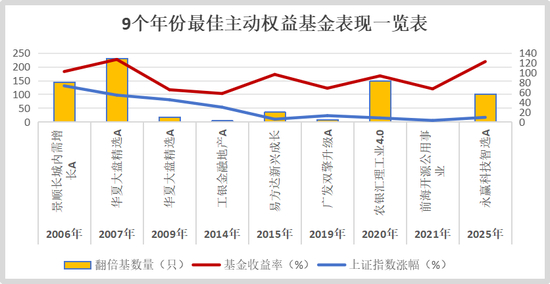
Core Insights - The active equity funds in the public offering sector have shown remarkable performance in 2025, with nearly 60 funds achieving "doubling" returns and the first fund since 2008 reaching over 200% returns [1][15] - If the leading fund maintains a cumulative return exceeding 7.84% in the remaining trading days of 2025, it will set a record for the highest annual return in public fund history [1][18] - The resurgence of active management capabilities is attributed to both market structural changes and advancements in research capabilities within public funds [1][9] Performance Highlights - As of December 12, 2025, the top-performing fund, Yongying Technology Smart Selection A, achieved a return of 218.40%, significantly outperforming the second-place fund by over 50 percentage points [4][18] - The number of funds with returns exceeding 100% reached 57, with 19 of those exceeding 120% [8][21] - Historical comparisons show that the highest number of "doubling" funds occurred in 2007, with 129 funds, while the current year has seen a resurgence in high-performing funds [21] Market Trends - The performance of active equity funds has been particularly strong in 2025, with a notable concentration in technology, high-end manufacturing, and innovative pharmaceutical sectors [9][22] - The market has shifted towards structural trends, with significant returns linked to concentrated holdings in popular stocks [9][24] - The current market environment is characterized by a longer duration and larger scale of structural trends compared to previous years [25] Industry Dynamics - The active management capabilities of public funds are being reaffirmed, with a shift away from short-term behaviors towards a focus on investor interests and research-driven strategies [13][26] - The talent pool within public funds has improved, ensuring stable output and continuity in research capabilities [11][25] - The industry is experiencing a cultural shift towards prioritizing long-term investment strategies over short-term gains, which has alleviated some pressures on fund managers [13][26]
美联储降息引爆A股,外资悄然抢筹四大黄金赛道
Sou Hu Cai Jing· 2025-12-14 07:11
Group 1 - The core point of the article is that the recent interest from foreign capital in the A-share market is driven by the Federal Reserve's interest rate cut, which has opened up new investment opportunities in China [1][3] - The Federal Reserve officially lowered the federal funds rate target range by 25 basis points to 3.5%-3.75% on December 10, 2025, in response to rising unemployment and signs of easing inflation [3] - The A-share market is currently seen as attractive due to its lower valuation compared to the US market, with a price-to-earnings ratio approximately 30% lower than that of US stocks [3] Group 2 - Foreign capital inflow into the Chinese stock market reached $50.6 billion in the first ten months of 2025, marking a new high in four years and more than tripling the total for 2024 [4] - As of the end of Q3 2025, northbound funds held a market value of A-shares amounting to 2.58 trillion yuan, with a cumulative increase of over 340 billion yuan in the first three quarters [4] - In September 2025, net inflow of northbound funds was $4.6 billion, the highest level since November 2024, indicating a growing confidence among foreign investors [4] Group 3 - The high-end manufacturing sector is a primary focus for foreign investment, supported by government policies aimed at promoting equipment upgrades and reducing financing costs [5] - In Q3 2025, foreign capital increased its holdings in the electronic industry by 1.82 billion shares, with a market value increase of 161.3 billion yuan, making it the most favored sector [5] - The Ministry of Industry and Information Technology plans to initiate a world-class advanced manufacturing cluster cultivation project by the end of 2024, further boosting foreign interest in this sector [5] Group 4 - The digital technology sector is another key area for foreign investment, driven by strong government support for digital economy initiatives [6] - In Q3 2025, foreign capital showed significant activity in the digital technology field, with substantial investments in semiconductor and communication sectors [7] - Northbound funds held a market value of 443.8 billion yuan in power equipment and 391.5 billion yuan in electronics, indicating a strong focus on technology-related industries [7] Group 5 - Satellite communication has emerged as a new investment focus for foreign capital, supported by government policies promoting the development of low-orbit satellite internet [8] - The Ministry of Industry and Information Technology has encouraged private enterprises to participate in the satellite communication industry, expanding application scenarios and investment opportunities [8] Group 6 - The consumer and pharmaceutical sectors are also attracting foreign investment due to their essential nature and government support for consumption upgrades [9] - The 2025 consumption upgrade policy includes subsidies for various household appliances, which is expected to stimulate market demand and attract foreign capital [9] - As of the end of Q3 2025, northbound funds held a market value of 183.9 billion yuan in the pharmaceutical and biotechnology sector, reflecting strong interest in stable demand and innovation [9]

量化市场追踪周报(2025W50):配置型基金仓位回落至7月末水平-20251214
Xinda Securities· 2025-12-14 07:04
1. Report Industry Investment Rating No relevant content provided. 2. Core Viewpoints of the Report - This week, the A - share market showed a significant differentiation pattern. The performance of broad - based indices was diverse, with the BeiZheng 50 and ChiNext Index leading the gains, while the Shanghai Composite Index and CSI 300 had slight pullbacks, and the CSI Dividend and China Securities Value Index had relatively large pullbacks. At the industry level, the communication sector was strong, while traditional energy and real - estate industrial chain - related sectors were under pressure. The margin trading balance reached a phased high on Wednesday and then declined, with the latest level on Thursday at 25079.82 billion yuan. [3][11] - Active equity funds' stock positions continued the downward trend, with the position of allocation - type funds falling back to the level around the end of July. In terms of industry allocation, in the short - term, the change in the allocation structure was relatively limited. From a medium - term perspective, the positions in the electronics and new energy industries continued to rise, and the exposure level of active equity funds to the large - cap growth style further increased. [3][11] - In the ETF market, A500 and Hong Kong - stock technology - related indices continued to receive net capital inflows, while indices such as the ChiNext Index, securities firms, CSI Bank, and convertible bonds had varying degrees of net capital outflows. [3][11] - In the context of a marginal increase in risk aversion, it is recommended to focus on structural allocation, moderately pay attention to sectors with mid - term prosperity advantages, maintain a relatively balanced allocation at the index level, and control the overall position. [3][11] 3. Summary According to Relevant Catalogs 3.1 This Week's Market Review - **Broad - based Index Performance**: The A - share broad - based indices showed a differentiated trend this week. The BeiZheng 50 and ChiNext Index led the gains, while the Shanghai Composite Index, CSI 300, CSI Dividend, and China Securities Value Index had pullbacks. As of December 12, 2025, the Shanghai Composite Index closed at 3889.35 points, with a weekly change of about - 0.34%; the Shenzhen Component Index closed at 13258.33 points, with a weekly change of about 0.84%; the ChiNext Index closed at 3194.36 points, with a weekly change of about 2.74%; and the CSI 300 closed at 4580.95 points, with a weekly change of about - 0.08%. [11][12] - **Industry Index Performance**: The performance of primary industries was also significantly differentiated. The communication sector led the gains, while coal and petroleum and petrochemical sectors had relatively large declines. The top - performing industries in terms of weekly change were communication (5.92%), national defense and military industry (3.57%), electronics (2.51%), power equipment and new energy (1.34%), and machinery (1.33%); the bottom - performing industries were coal (- 3.80%), petroleum and petrochemical (- 3.43%), textile and clothing (- 2.68%), real estate (- 2.62%), and steel (- 2.53%). [14] 3.2 Public Funds - **Public Fund Position Calculation**: Active equity funds' stock positions continued to decline, with the position of allocation - type funds falling back to the level at the end of July. As of December 12, 2025, the average position of active equity funds was about 88.41%. Among them, the average position of ordinary stock - type funds was about 91.71% (up 0.10 pct from last week), the average position of partial - stock hybrid funds was about 89.72% (down 0.05 pct from last week), the average position of allocation - type funds was about 85.03% (down 0.49 pct from last week), and the average position of "fixed - income +" funds was about 23.33% (up 0.03 pct from last week). [2][21] - **Style Trends of Active Equity Products**: The exposure to the large - cap growth style has significantly increased compared to three months ago, with little change this week. As of December 12, 2025, the large - cap growth position of active partial - stock funds was 42.77% (down 0.12 pct from last week), the large - cap value position was 6.61% (down 0.23 pct from last week), the mid - cap growth position was 7.67% (up 0.09 pct from last week), the mid - cap value position was 7.44% (up 1.43 pct from last week), the small - cap growth position was 26.82% (down 0.86 pct from last week), and the small - cap value position was 8.69% (down 0.31 pct from last week). [3][29] - **Industry Trends of Active Equity Products**: In the past three months, the positions in electronics and new energy have significantly increased, while the positions in medicine and banking have decreased. This week, the industries with relatively large increases in the allocation ratio of active equity funds were petroleum and petrochemical (about 0.92%, up 0.11 pct from last week), electronics (about 20.79%, up 0.11 pct from last week), real estate (about 0.63%, up 0.09 pct from last week), building materials (about 0.93%, up 0.08 pct from last week), and power equipment and new energy (about 8.57%, up 0.07 pct from last week). The industries with relatively large decreases in the allocation ratio were computer (about 4.51%, down 0.20 pct from last week), steel (about 1.12%, down 0.08 pct from last week), agriculture, forestry, animal husbandry and fishery (about 1.78%, down 0.08 pct from last week), transportation (about 1.21%, down 0.06 pct from last week), and medicine (about 10.20%, down 0.05 pct from last week). [3][32] - **ETF Market Tracking**: This week, equity indices with a net inflow of over 1 billion yuan included A500, Hang Seng Technology, Science and Technology Innovation 50, and Hong Kong Stock Connect Technology. Indices with a net outflow of over 1 billion yuan included the ChiNext Index, securities companies, CSI Bank, and CS Artificial Intelligence. The total net outflow of domestic stock - index ETF funds was about 9.893 billion yuan, with a total scale of 36740.46 billion yuan; the total net inflow of overseas index ETFs was about 10.139 billion yuan, with a total scale of 9385.21 billion yuan; the total net inflow of bond - index ETFs was about 2.954 billion yuan, with a total scale of 7208.3 billion yuan; and the total net inflow of commodity - index ETFs was about 0.121 billion yuan, with a total scale of 2435.63 billion yuan. [34] - **Newly Established Funds**: This week, there were 27 newly established domestic funds, including 3 active equity funds. The total newly - issued share of active equity funds was about 2.152 billion shares, which was at the 50% quantile in the past year. Since the beginning of this year, 312 active equity funds have been newly issued, with a total scale of about 156.326 billion yuan, exceeding the levels of last year and 2023. 574 passive equity funds have been newly issued, with a total scale of about 307.153 billion yuan, significantly exceeding the levels of previous years. [40] 3.3 Main/Active Capital Flows - Active funds had a net inflow into electronics and communication. The main funds had a net outflow from electronics, computer, and basic chemicals this week. In terms of individual stocks, stocks with main - fund net inflow and small - and medium - sized order net outflow included Dongshan Precision, Shenghong Technology, BYD, Lingyizao, and Xiangnong Core Creation; stocks with main - fund net outflow and small - and medium - sized order net inflow included ZTE, Sungrow Power Supply, Tianfu Communication, Industrial Fulin, and Aerospace Development. In terms of industries, industries with main - fund net inflow and small - and medium - sized order net outflow were not specified; industries with main - fund net outflow and small - and medium - sized order net inflow included electronics, computer, basic chemicals, communication, and medicine. The net main - buying amount this week was about - 280.694 billion yuan, and active funds had a net inflow into electronics and communication. Active funds were more optimistic about stocks such as New E - Sheng, Dongshan Precision, Ping An of China, Shenghong Technology, and Changxinbochuang, while stocks such as China Merchants Bank, Kweichow Moutai, ZTE, Yonghui Superstores, and Industrial Fulin were net - sold by active funds. The industries with the highest net main - buying amounts were electronics and communication; the industries with relatively large outflows were medicine, basic chemicals, computer, machinery, and non - ferrous metals. [5][50]
渤海证券:政策基调初步明晰 A股市场延续震荡特征
Xin Lang Cai Jing· 2025-12-14 06:58
Market Review - Major indices showed mixed performance in the past five trading days (December 5 - December 11), with the Shanghai Composite Index slightly down by 0.06% and the ChiNext Index up by 3.14% [1][5] - The CSI 300 Index rose by 0.12%, while the CSI 500 Index increased by 1.00% [1][5] - Trading volume increased, with a total of 9.30 trillion yuan traded, averaging 1.86 trillion yuan per day, an increase of 205.98 billion yuan compared to the previous five trading days [1][5] - Among the Shenwan first-level industries, telecommunications, comprehensive, and defense industries saw the highest gains, while coal, oil and petrochemicals, and steel industries experienced the largest declines [1][5] Economic Data - November exports increased by 5.9% year-on-year, significantly rebounding from October, influenced by multiple factors including a lower base, stable external demand, and the end of holiday disruptions [1][5] - Exports to the US saw a larger year-on-year decline, while exports to Japan, South Korea, and the EU experienced substantial rebounds, indicating a continued optimization of export structure [1][5] - The Consumer Price Index (CPI) rose by 0.7% year-on-year and fell by 0.1% month-on-month, primarily driven by food prices, particularly fresh vegetables, due to a lower base and supply-side disruptions [1][5] - The Producer Price Index (PPI) decreased by 2.2% year-on-year and increased by 0.1% month-on-month, with the year-on-year decline mainly influenced by a higher base [1][5] Policy Outlook - The Central Political Bureau of the Communist Party held a meeting to analyze and study economic work for 2026, maintaining a tone of "more proactive and effective" macro policies as emphasized in the 2024 Central Economic Work Conference [2][6] - Fiscal and monetary policies will continue to emphasize "more proactive" and "moderately loose" measures, with a focus on integrating existing and new policies [2][6] - The economic work for 2026 will focus on building a strong domestic market and cultivating new growth drivers among eight key areas, with more detailed plans to be revealed in the Central Economic Work Conference [2][6] Investment Strategy - The A-share market continues to exhibit a volatile characteristic, with positive signals from the Political Bureau meeting and confirmation of overseas liquidity easing due to the Federal Reserve's interest rate cuts [3][7] - The market is expected to regain strength driven by policy support and liquidity expectations, although some funds may delay allocation as the year-end approaches [3][7] - Investors are advised to remain patient and refine their strategies around policy and technology themes while waiting for sentiment to improve [3][7] - Investment opportunities are identified in the following sectors: 1. TMT sector and robotics, driven by ongoing capital expansion from domestic and international cloud vendors, accelerated domestic substitution of computing power, and potential application-driven growth [3][7] 2. Power equipment and non-ferrous metals sectors, benefiting from high global demand for energy storage and ongoing solid-state battery industrialization [3][7] 3. Social services and resource products, with policy focus on structural adjustments and "anti-involution" creating competitive opportunities [3][7] - Additionally, the banking sector presents allocation opportunities due to a low interest rate environment and a shift in public fund holdings towards performance benchmarks [3][7]