
服务消费

Search documents
国泰海通 · 晨报0911|策略:地产销售边际改善,耐用品增长乏力
国泰海通证券研究· 2025-09-10 14:41
Core Viewpoint - The article highlights a marginal improvement in real estate sales, while durable goods consumption shows signs of weakness, indicating a mixed economic outlook in various sectors [2][4]. Group 1: Real Estate and Construction - New home sales in major cities have shown a year-on-year increase of 4.4%, with first-tier cities experiencing a decline of 6.8%, while second and third-tier cities saw increases of 8.2% and 11.4% respectively [5]. - Despite the improvement in real estate sales, the impact on construction starts remains weak, and infrastructure demand continues to be subdued, leading to a decline in demand for construction materials [2][4]. Group 2: Consumer Durables - Retail sales of passenger vehicles increased by 4.6% year-on-year in August 2025, but the growth rate has significantly slowed down due to a high base from the previous year [5]. - The service consumption sector has shown a decline, with a notable drop in movie box office revenues by 51% week-on-week during the back-to-school period [5]. Group 3: Manufacturing and Technology - The construction demand remains weak, affecting the construction industry, while steel prices have slightly increased due to environmental production limits, and cement prices continue to decline [6]. - Global semiconductor sales have seen a robust year-on-year growth of 20.6% in July 2025, driven by strong demand in AI capital expenditures [6]. Group 4: Transportation and Logistics - Passenger transport demand has decreased significantly week-on-week, with a 17.6% drop in the migration scale index, although it remains up 5% year-on-year [7]. - Freight logistics have also shown a decline, with highway truck traffic and railway freight volume down by 1.0% and 1.2% respectively week-on-week [7].


财信证券宏观策略周报(9.8-9.12):调整之后更健康,慢牛行情仍将延续
Sou Hu Cai Jing· 2025-09-07 00:21
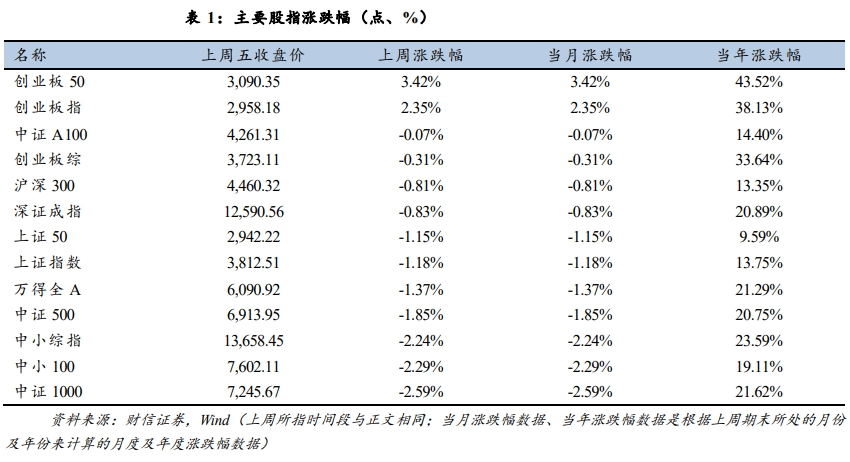
Market Overview - The market experienced its first significant adjustment last week due to profit-taking by event-driven funds, a healthy need for market rhythm adjustment after rapid index increases, and a structural shift from high-position sectors like computing power and semiconductors to lower-position sectors such as energy storage and new energy [1][4][6] - The long-term upward trend of the A-share index remains intact, supported by expectations of performance improvement from the "anti-involution" policy and liquidity improvement from household savings entering the market [1][5][9] Investment Recommendations - Focus on low-entry opportunities in high-prosperity sectors, particularly energy storage and new energy, which are expected to replace AI hardware as the main market growth driver [1][6][9] - Service consumption sectors such as tourism, dining, duty-free, and cinema are recommended for gradual layout in September [1][7][9] - Sectors benefiting from potential Federal Reserve interest rate cuts, including innovative pharmaceuticals and precious metals, should be monitored [1][8][10] Key Trends - Public fund sales fee reform is expected to encourage long-term investment behavior among investors, promoting stable long-term operation of the A-share market [2][5] - The energy storage and new energy sectors are seeing increased market attention, with significant growth in transaction volume and a potential to replace AI hardware as the new market growth line [2][6] - The Federal Reserve's interest rate cut expectations have risen, with a 71% probability of three rate cuts by the end of the year, which could benefit emerging markets and sectors like precious metals and innovative pharmaceuticals [2][8] Performance Metrics - The A-share market's valuation remains attractive, with the TTM price-to-earnings ratio at 21.87, placing it in the 88.03% historical percentile, indicating a low point in earnings performance [5][9] - Recent data shows a significant drop in household deposits, with a decrease of 1.11 trillion yuan in July, while non-bank financial institutions saw an increase of 2.14 trillion yuan, indicating a shift of household savings into the stock market [5][9]
如何看待后市宏观叙事的变化?
Western Securities· 2025-09-03 12:01
Group 1: Market Trends - The A-share market has recently experienced an upward trend despite weak economic data, driven by liquidity and risk premium factors[1] - The M1-M2 growth rate differential has widened, indicating that liquid funds are flowing into financial markets[1] - The expectation of a Federal Reserve interest rate cut and the stabilization of the RMB are key macroeconomic narratives influencing market dynamics[1] Group 2: Fund Inflows - Public and private fund participation in the current market rally is higher compared to previous trends, with the margin trading balance exceeding 2 trillion yuan[2] - Equity fund issuance has rebounded, with 1.7 trillion yuan issued from June to August, a nearly 300% increase year-on-year[2] - The net inflow into ETFs has been modest, with a notable shift towards Hong Kong stocks[2] Group 3: Market Sentiment - The A-share sentiment index reached 77.6 as of August 28, up 10.6 percentage points from August 22, indicating a recovery in market sentiment but not yet at extreme levels[3] - Structural overheating is observed in certain sectors, particularly TMT, suggesting potential opportunities for style rebalancing[3] Group 4: Economic Indicators - July economic data showed a decline in retail sales growth to 3.7%, with fixed asset investment and industrial output growth also slowing[1] - The decline in household deposits by 1.1 trillion yuan in July, alongside a 2.14 trillion yuan increase in non-bank deposits, suggests a significant shift of funds into financial markets[1] Group 5: Risks - Risks include potential economic downturns, the possibility of the Fed not cutting rates, and the slow pace of household deposit migration[3] - Overheating speculative sentiment in the market could lead to regulatory risks[3]
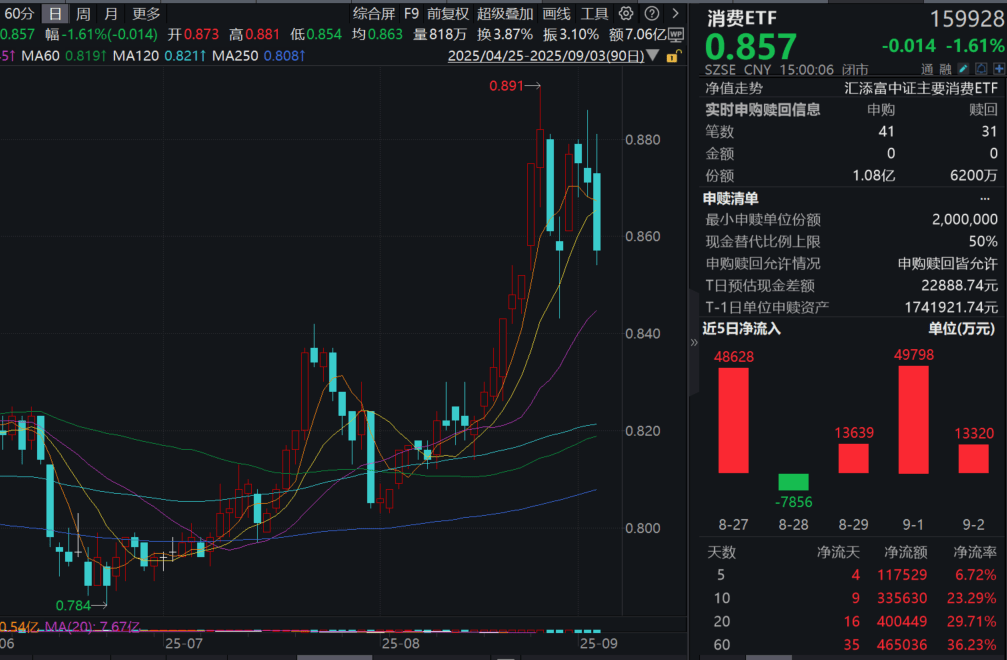
科技为矛,消费为盾!消费ETF(159928)跌1.6%连续第3日回调,全天净申购4600万份!机构:中报后新消费重拾上涨,白酒有望走出底部!
Sou Hu Cai Jing· 2025-09-03 09:29
Market Overview - The A-share market showed a mixed performance with the Shanghai Composite Index declining by 1.16% and the Consumer ETF (159928) falling by 1.61%, with a total trading volume exceeding 700 million yuan [1] - The Consumer ETF has seen a net subscription of 46 million units, indicating a strong inflow of funds, with a cumulative "capital absorption" exceeding 1.1 billion yuan over the past ten days [1] Consumption Policies - Shaoxing, Zhejiang Province announced a tiered subsidy for hotel banquets based on the number of tables and total expenditure, as part of its upcoming "2025 Shaoxing Consumption Promotion Policy" [3] - The policy focuses on three areas: integration of culture, commerce, and tourism; expansion of new consumption scenarios; and distribution of consumption vouchers, comprising 15 specific measures [3] Long-term Investment Trends - Long-term funds are adopting a high-dividend strategy, with a focus on technology as a growth driver and consumer sectors as a defensive shield [6] - There is a notable shift in fund allocation, with increased investments in technology sectors such as TMT and military-related ETFs, while also showing renewed interest in low-position domestic consumer goods [6] Consumer Sector Insights - The white liquor sector is currently in a bottoming phase, with companies actively adjusting their product channels, presenting potential bottom-fishing opportunities [7] - The consumer landscape is evolving with new demands for emotional and personalized products, particularly in categories like trendy toys and beauty products, which are experiencing significant growth [8][11] Service Consumption Growth - Service consumption is projected to account for 46.1% of household spending by 2024, contributing 63% to overall consumption growth, indicating a shift towards a more significant role in defining lifestyles and emotional connections [14] ETF Composition - The Consumer ETF (159928) has a strong resilience to economic cycles, with the top ten constituent stocks accounting for over 68% of its weight, including leading liquor brands and major consumer goods companies [17][18]
金融发力支持高品质服务消费供给
Jing Ji Ri Bao· 2025-09-01 22:27
Core Viewpoint - The People's Bank of China (PBOC) highlights a significant growth in consumer spending, particularly in service consumption, which is expected to drive economic growth and improve living standards in the coming years [1][2]. Group 1: Consumer Market Trends - In the first half of the year, retail sales in various sectors showed substantial growth: home appliances (30.7%), cultural and office supplies (25.4%), communication equipment (24.1%), and furniture (22.9%) [1]. - The total retail sales of consumer goods are steadily increasing, supported by consumption policies that are gradually taking effect [1]. Group 2: Service Consumption Growth - Service retail sales grew by 5.3% year-on-year, outpacing the growth of goods retail sales, indicating a shift towards service consumption [2]. - Currently, service consumption accounts for less than 50% of per capita consumption expenditure in China, suggesting significant room for growth [2]. Group 3: Challenges in Service Consumption - There are notable challenges in service consumption, including insufficient supply in high-demand areas such as elderly care and childcare, with the current childcare enrollment rate for children under three being less than 10% [2][3]. - The quality of service supply is also a concern, with an oversupply of low-end, homogeneous services and a lack of specialized, personalized offerings [3]. Group 4: Policy Support for Consumption - Recent policies, including the introduction of service consumption and elderly care refinancing tools, indicate a stronger focus on enhancing consumer welfare and stimulating consumption [4]. - The PBOC's report emphasizes the need for financial policies to improve the supply of high-quality services, thereby creating effective demand and unlocking consumption growth potential [4].
时报观察 着力真实需求方能扩大服务消费
Zheng Quan Shi Bao· 2025-09-01 18:47
Core Viewpoint - The Ministry of Commerce plans to introduce several policies to expand service consumption this month, reflecting a shift in macro policy focus towards balancing goods and service consumption in response to changing consumer behavior [1][2]. Group 1: Service Consumption Trends - Service consumption has higher income elasticity, meaning changes in residents' income expectations and growth have a greater impact on this sector [1]. - Recent trends indicate that there is demand and spending in the service consumption sector, but it requires appropriate scenarios and high-quality supply to match evolving consumer concepts [1]. - The youth consumer group, particularly Generation Z, is willing to spend on interests and emotional value, as seen in the phenomenon of "LABUBU," while also being conscious of cost-effectiveness, demonstrating a preference for "spending when necessary and saving when possible" [1]. Group 2: Policy Recommendations - To address the shortage of high-quality service supply, the focus should be on "opening up externally and loosening restrictions internally," which includes expanding pilot programs in telecommunications, healthcare, and education to attract mature and high-quality services [1]. - Additionally, reducing domestic market restrictions, such as easing market access and optimizing regulatory models, is essential to stimulate market competition and enrich service supply [1]. - Long-term reforms through "opening up" are necessary, but short-term counter-cyclical adjustment policies must also be implemented to demonstrate the government's commitment to boosting consumption [2]. - The recent "dual subsidy" policy from the Ministry of Finance aims to leverage fiscal resources to reduce financing costs for consumers and operators, guiding financial resources towards the consumption sector [2].
2025年秋季策略会速递:新模式、新场景,重塑消费新生态
HTSC· 2025-09-01 11:06
Core Insights - The report highlights the structural opportunities in the consumer sector driven by new demands, scenarios, and models, emphasizing emotional and personalized upgrades in consumer needs, particularly in high emotional value categories like trendy toys and beauty products [2][9] - The medical beauty industry is entering a new phase, with light medical beauty gaining traction due to its low risk and quick recovery, while domestic beauty brands are expected to accelerate their growth through innovative business models and enhanced channel efficiency [3][13] - The trend of emotional consumption is reshaping the market, with consumers increasingly motivated by personal connection and emotional resonance rather than mere necessity, leading to a shift in purchasing behavior [27] Consumer Sector Trends - The consumer market is experiencing a profound transformation, with service consumption becoming a primary growth engine, contributing significantly to overall consumption growth [4][28] - The service sector is evolving towards standardization and digitalization, with a focus on enhancing customer experience and operational efficiency, which is expected to drive industry consolidation [4][31] - The report anticipates three major trends in the consumer sector: simultaneous growth in high-end quality and cost-effective consumption, the rise of emotional value as a key decision factor, and the penetration of niche concepts like "green consumption" [10][28] Medical Beauty and Domestic Brands - The light medical beauty market is projected to grow at a CAGR of 10.9% from 2025 to 2028, driven by its appealing characteristics to price-sensitive consumers [13] - Domestic beauty brands are rapidly gaining market share, with a notable increase in the importance of content e-commerce channels, and are expected to leverage scientific narratives to strengthen consumer recognition [17][18] Trendy Toys and IP Economy - The trendy toy market is expanding across all age groups, with significant growth expected in the doll category, projected to increase from 26.8 billion in 2024 to 71.7 billion by 2029, reflecting a CAGR of 23.7% [22][23] - The industry is witnessing a shift towards immersive experiences and innovative marketing strategies, enhancing consumer engagement and loyalty [26][27] Service Consumption Evolution - Service consumption is transitioning from a supplementary role to a core driver of economic growth, with a significant increase in the proportion of service spending in total consumer expenditure [4][28] - The report identifies four key trends in the service sector: supply chain innovation, demand segmentation, ecological layout, and globalization, which are expected to reshape the competitive landscape [31][36]
若干政策措施9月将出台 我国服务消费新增量已在路上
Bei Jing Shang Bao· 2025-08-27 11:29
Core Insights - The Chinese consumption pattern is shifting towards a balanced focus on both goods and services consumption, with the Ministry of Commerce planning to introduce policies to expand service consumption in September [2][3][4] - Service retail sales increased by 5.2% year-on-year from January to July, indicating a growing importance of service and experience consumption in the economy [3][4] - By 2024, per capita service consumption expenditure is expected to account for 46.1% of total per capita consumption expenditure, contributing 63% to the growth of resident consumption expenditure [3][4] Service Consumption Growth - The service sector is identified as a key area for boosting consumption, with potential to enhance both life services and productive services, thereby optimizing industrial structure and increasing the value added by services [4][5] - Service consumption is directly linked to improving people's livelihoods, particularly in sectors like elderly care, healthcare, and childcare, which enhances overall happiness [4][5] - The service sector is projected to account for 48.8% of total employment in China by 2024, with significant growth in employment in hospitality, residential services, and cultural entertainment sectors [4][5] Policy Measures and Openings - The Ministry of Commerce aims to address the issue of insufficient high-quality service supply by increasing openness and reducing restrictions, particularly in telecommunications, healthcare, and education [5][6] - The introduction of more service sectors into the "Encouraging Foreign Investment Industry Directory" is expected to enhance the quality of service supply and stimulate market vitality [5][6] - Financial and fiscal incentives will be utilized to boost service consumption demand, alongside reducing restrictive policies to invigorate the service industry [6][7] Innovation and New Consumption Scenarios - High-quality, diversified, and composite innovative scenarios are crucial for enhancing service consumption [7] - The Ministry of Commerce will support the development of new consumption formats and scenarios, promoting integration across various sectors such as tourism, culture, and sports [7][8] - The upcoming China International Fair for Trade in Services (CIFTIS) in 2025 will showcase over 190 new service trade achievements and is expected to further promote the import of high-quality services [8]

系列促进服务出口、扩大服务消费政策将出!商务部最新发声
证券时报· 2025-08-27 07:47
Core Viewpoint - The article emphasizes the significant growth potential of service consumption in expanding domestic demand and international trade, with upcoming policies to promote service exports and consumption [2][4][6]. Summary by Sections Service Export Growth - In the first half of the year, China's total service import and export reached 3.9 trillion yuan, a year-on-year increase of 8%, outpacing the growth rate of goods trade by 5.1 percentage points [4]. - Service exports amounted to 1.7 trillion yuan, growing by 15%, with the share of service exports in total foreign trade exports rising to 11.5%, an increase of 0.7 percentage points from the previous year [4]. - The rapid growth in service exports is primarily driven by traditional service sectors such as transportation and travel, with transportation service exports at 418.5 billion yuan (up 23.9%) and travel service exports at 174.87 billion yuan (up 68.7%) [4]. Policy Measures for Service Exports - The Ministry of Commerce plans to introduce a series of policies to promote service exports, focusing on fiscal, financial, and facilitation measures [6][8]. - These policies will cover areas such as tax incentives, financial support for small and medium enterprises, and regulatory facilitation to enhance service trade [11]. Service Consumption Expansion - Service consumption is identified as a crucial component for expanding international trade and boosting domestic demand, with retail sales of social consumer goods reaching 28.4238 trillion yuan, a 4.8% increase year-on-year [10]. - The Ministry of Commerce aims to enhance service supply and stimulate consumption through various initiatives, including targeted policies for sectors like tourism, health, and green consumption [10][12]. Upcoming Events and Initiatives - The China International Fair for Trade in Services (CIFTIS) is set to take place from September 10 to 14, featuring nearly 2,000 exhibitors, including 500 Fortune 500 companies [14]. - The event will showcase over 190 new products and innovations, highlighting the focus on quality service supply and promoting high-value commercial applications [14].

大力发展服务消费 满足人民群众“新刚需”
Yang Guang Wang· 2025-08-17 02:39
Group 1 - The core viewpoint of the articles highlights the resilience and strong momentum of the consumption market in China, driven by policy support and supply innovation, with a retail sales total of 28.4238 trillion yuan from January to July, reflecting a growth of 4.8% [1] - Service retail sales have shown a year-on-year growth of 5.2%, with specific categories such as tourism consulting, transportation services, and cultural and recreational services experiencing double-digit growth [1] - The shift in consumption structure is evident as service consumption is becoming a significant driver of economic growth, with service consumption expected to account for 46.1% of per capita consumption expenditure in 2024, contributing 63% to the growth of resident consumption expenditure [1] Group 2 - The service consumption market is characterized by its diversity and personalization, indicating a larger space for supply market expansion, with traditional services like dining and housekeeping needing to enhance inclusivity and standards [2] - The government has introduced specific policies to promote high-quality service consumption, including the "Service Consumption Quality Improvement Action" as part of a broader initiative to stimulate consumption [2] - Recent policies have been implemented to support personal consumption loans and service industry loans, covering eight categories primarily within the service consumption sector, aiming to stimulate demand and expand domestic consumption [2] Group 3 - Service consumption is closely linked to the quality of life and happiness of the populace, with ongoing policy guidance and collaboration expected to enhance service supply and innovate consumption scenarios, thereby unlocking consumer potential [3]