能源

Search documents
能源化工期权策略早报-20250721
Wu Kuang Qi Huo· 2025-07-21 03:17
1. Report Industry Investment Rating - Not mentioned in the provided content 2. Core Viewpoints of the Report - The energy - chemical sector is divided into energy, alcohols, polyolefins, rubber, polyesters, alkalis, and others. Strategies mainly involve constructing option combination strategies with sellers as the main body, as well as spot hedging or covered strategies to enhance returns [3][9] 3. Summary by Relevant Catalogs 3.1 Futures Market Overview - The report presents the latest prices, price changes, price change rates, trading volumes, volume changes, open interests, and open interest changes of various energy - chemical option underlying futures contracts, including crude oil, LPG, methanol, etc [4] 3.2 Option Factors - Volume and Open Interest PCR - It shows the trading volume, volume change, open interest, open interest change, volume PCR, volume PCR change, open interest PCR, and open interest PCR change of various energy - chemical options, which are used to describe the strength of the option underlying market and the turning point of the underlying market [5] 3.3 Option Factors - Pressure and Support Levels - From the perspective of the strike prices with the largest open interest of call and put options, the pressure and support levels of option underlyings are analyzed, such as the pressure and support levels of crude oil, LPG, etc [6] 3.4 Option Factors - Implied Volatility - It provides the at - the - money implied volatility, weighted implied volatility, weighted implied volatility change, annual average, call implied volatility, put implied volatility, HISV20, and implied - historical volatility difference of various energy - chemical options [7] 3.5 Option Strategies and Recommendations 3.5.1 Energy - related Options - **Crude Oil**: Fundamentally, OPEC+ increases supply, and US supply follows the oil price rebound. The short - term market is weak. Option factors show that implied volatility fluctuates around the mean, and the short - term short - selling power increases. Strategies include constructing a neutral call + put option combination strategy and a long collar strategy for spot hedging [8] - **LPG**: Fundamentally, the futures price is weak, and the supply difference decreases. The demand side has potential risks. The short - term market is bearish. Option factors show that implied volatility fluctuates around the historical mean, and the short - selling power increases. Strategies include constructing a bearish call + put option combination strategy and a long collar strategy for spot hedging [10] 3.5.2 Alcohol - related Options - **Methanol**: Fundamentally, port inventory increases, and enterprise inventory is at a relatively low level. The market shows a weak rebound. Option factors show that implied volatility fluctuates below the historical mean, and the market is in a weak shock. Strategies include constructing a neutral call + put option combination strategy and a long collar strategy for spot hedging [10] - **Ethylene Glycol**: Fundamentally, port inventory decreases, and the downstream factory inventory days increase. The market shows a weak bearish shock. Option factors show that implied volatility fluctuates around the historical mean, and the market is weak. Strategies include constructing a short - volatility strategy and a long collar strategy for spot hedging [11] 3.5.3 Polyolefin - related Options - **Polypropylene**: Fundamentally, trader inventory decreases, and port inventory increases. The market shows a weak trend with short - selling pressure. Option factors show that implied volatility fluctuates around the historical mean, and the market weakens. Strategies include a long collar strategy for spot hedging [11] 3.5.4 Rubber - related Options - **Rubber**: Fundamentally, the domestic synthetic rubber production increases. The market shows a low - level consolidation. Option factors show that implied volatility fluctuates around the mean, and the short - selling power increases. Strategies include constructing a neutral call + put option combination strategy [12] 3.5.5 Polyester - related Options - **PTA**: Fundamentally, the PTA load is high, and the short - term maintenance plan is less. The market shows a weak trend with pressure. Option factors show that implied volatility fluctuates around the mean, and the market weakens. Strategies include constructing a neutral call + put option combination strategy [13] 3.5.6 Alkali - related Options - **Caustic Soda**: Fundamentally, the capacity utilization rate of large - scale enterprises changes. The market shows a bullish trend. Option factors show that implied volatility fluctuates around the mean. Strategies include a long collar strategy for spot hedging [14] - **Soda Ash**: Fundamentally, the inventory is at a historical high. The market shows a bullish trend. Option factors show that implied volatility fluctuates around the historical mean, and the market is in a weak shock. Strategies include constructing a neutral call + put option combination strategy and a long collar strategy for spot hedging [14] 3.5.7 Other Options - **Urea**: Fundamentally, port inventory increases, and domestic demand is weak. The market shows a shock under short - selling pressure. Option factors show that implied volatility fluctuates below the historical mean, and the market weakens. Strategies include constructing a neutral call + put option combination strategy and a long collar strategy for spot hedging [15]
研究所晨会观点精萃-20250721
Dong Hai Qi Huo· 2025-07-21 02:34
Report Industry Investment Rating No relevant content found. Core View of the Report Domestic market optimism continues to ferment, and risk appetite continues to rise. Overseas, the US dollar index and US bond yields have declined, and global risk appetite has cooled. In China, economic growth in the first half of the year was higher than expected, but consumption and investment slowed down significantly in June. Policies are expected to boost domestic risk appetite in the short term. Different asset classes have different trends and investment suggestions [2]. Summary by Relevant Catalogs Macro Finance - **Stock Index**: Driven by sectors such as small metals, energy metals, and trade, the domestic stock market rose slightly. The economy grew higher than expected in H1, but consumption and investment slowed in June. Policies may boost risk appetite. The market focuses on domestic stimulus policies and trade negotiations. Short - term macro - upward drivers have increased. Short - term cautious long positions are recommended [2][3]. - **Treasury Bonds**: Short - term high - level oscillations, with a suggestion of cautious observation [2]. Precious Metals - **Gold and Silver**: Last week, precious metals oscillated at high levels. Trump's tariff announcements and US economic data affected gold prices. The Fed's rate - cut expectations have slowed, and the US dollar's rise restricts the upside of gold prices. In the short term, gold is in a box - shaped oscillation range, while silver has a relatively strong technical - surface catch - up logic. In the medium and long term, the strategic allocation value of gold is prominent [4]. Black Metals - **Steel**: Apparent consumption declined, but steel futures and spot prices continued to be strong. The market expects policy support. Real - demand weakened, and supply decreased. Cost support is strong. Short - term, a slightly bullish oscillation is expected [2][5][6]. - **Iron Ore**: Futures and spot prices strengthened. Although it is the off - season for finished - product demand, high steel - mill profits led to a rebound in hot - metal production. After the end - of - quarter shipment rush, the shipping volume decreased. Short - term, a slightly bullish oscillation is expected [6]. - **Silicon Manganese/Silicon Iron**: Spot prices were flat, and futures prices rebounded slightly. The demand for ferroalloys decreased. The production of some factories in Inner Mongolia resumed, and the开工 rate increased slightly. Short - term, prices may follow the rebound of coal prices [7]. Chemicals - **Soda Ash**: The main contract was in a range - bound pattern. Supply increased, and demand weakened. Profits declined. The "anti - involution" policy supports the bottom price, but the long - term price is pressured by the supply - demand imbalance. Short - term, prices are supported [8]. - **Glass**: The main contract was in a range - bound pattern. Supply pressure increased during the off - season. The market expects production cuts due to the "anti - involution" policy. Demand remained weak, but profits increased. Short - term, prices are supported [9]. Non - ferrous Metals and New Energy - **Copper**: US inflation rebounded, and the Fed's rate - cut expectations decreased. The upcoming stable - growth plan for the non - ferrous industry is positive. The key to copper prices lies in the tariff implementation time [11]. - **Aluminum**: Social inventories are still increasing. The fundamentals of electrolytic aluminum have weakened. Short - term, there is support at 20200 - 20300, but the price may decline after oscillation [11]. - **Aluminum Alloy**: Scrap - aluminum supply is tight, and production costs are rising. It is the off - season for demand. Short - term, prices may oscillate slightly upward, but the upside is limited [11]. - **Tin**: Supply is gradually recovering, and demand is weak. Short - term, prices will oscillate, and the medium - term upside is restricted [12]. - **Lithium Carbonate**: Futures and spot prices rose. Production increased, and social inventories continued to accumulate. Although the fundamentals have not improved, short - term, prices are expected to oscillate slightly upward [13]. - **Industrial Silicon**: Futures and spot prices rose. Production remained stable, and the number of open furnaces decreased. Short - term, prices are expected to oscillate slightly upward [14]. - **Polysilicon**: Futures and spot prices rose. The exchange's regulatory measures led to a decline on Friday, but the sector remains strong. Short - term, prices are expected to oscillate slightly upward [15]. Energy and Chemicals - **Crude Oil**: Short - term trading has slowed slightly, but the spot is still tight. The market is concerned about tariffs and OPEC+ production increases. Mid - term, prices will continue to oscillate [16]. - **Asphalt**: Prices followed crude - oil costs and oscillated strongly. Demand is average, and inventory accumulation may occur. Short - term, prices will follow the crude - oil center but oscillate weakly [16]. - **PX**: The supply is tight after the commissioning of downstream PTA plants. The price has rebounded slightly. Short - term, prices will oscillate slightly upward, but the upside is limited [16]. - **PTA**: The basis has declined, and trading volume has increased slightly. Demand is in the off - season, and processing fees are low. Short - term, prices will oscillate [17]. - **Ethylene Glycol**: Port inventories have decreased slightly. Overseas plant outages and low import expectations have led to inventory reduction. Short - term, prices will oscillate [17]. - **Short - fiber**: Prices followed the polyester sector and oscillated weakly. Terminal orders are average, and inventories are high. Short - term, prices will continue to oscillate weakly [17]. - **Methanol**: Supply has increased, and demand has decreased. Inventories have risen, especially at ports. Short - term, prices will oscillate weakly [18][19]. - **PP**: Production is expected to increase, and demand is weak during the off - season. Inventories are expected to accumulate. Short - term, prices will move downward [19]. - **LLDPE**: Demand is in the off - season, and inventories are rising. Short - term, prices may rebound slightly but with limited upside [19]. Agricultural Products - **US Soybeans**: High - temperature warnings in the US soybean - producing areas increase the risk of yield reduction. The market's concern about US soybean exports has eased. Short - term, prices may have a phased rebound [20]. - **Soybean Meal/Rapeseed Meal**: Soybean meal is the leading protein product. The futures price has strengthened, and the spot price has risen. Short - term, prices will oscillate at high levels [21]. - **Soybean Oil/Rapeseed Oil**: Soybean oil has high inventory pressure, and rapeseed oil has a stable supply. Both are affected by palm oil. Short - term, prices will follow palm oil [22]. - **Palm Oil**: The Malaysian palm - oil export tax will increase. Indian demand for replenishment exists. Short - term, the market is bullish, but the resistance to rising prices has increased [22][23].
山海:周内黄金保持多趋势,继续看震荡上行空间!
Sou Hu Cai Jing· 2025-07-21 01:58
Group 1 - The overall trend for gold remains bullish, with a focus on the previous week's trading range of 3375/3310, which needs to hold for continuation [3][5][6] - Silver is maintaining support at 37.3, and as long as this level holds, the downside potential is limited, with a key focus on breaking the 39 high [3][7] - Domestic gold trading has seen profitable long positions, with expectations for further upward movement, targeting levels of 795 for沪金 and 790 for融通金 [7][8] Group 2 - The technical analysis indicates a tight consolidation in gold prices, with potential for a breakout if the 3375 level is breached, leading to a possible strong upward trend [6][5] - For silver, the strategy involves waiting for a pullback to the 37.5 support level to enter long positions, with a bullish outlook if the 39 level is broken [7][8] - The domestic oil market is also showing bullish signs, with expectations for prices to reach 3000 in the short term and 3200 in the medium term [8]


德林控股陈宁迪:“大而美”或将加速美降息,影响不容小觑
Sou Hu Cai Jing· 2025-07-21 01:23
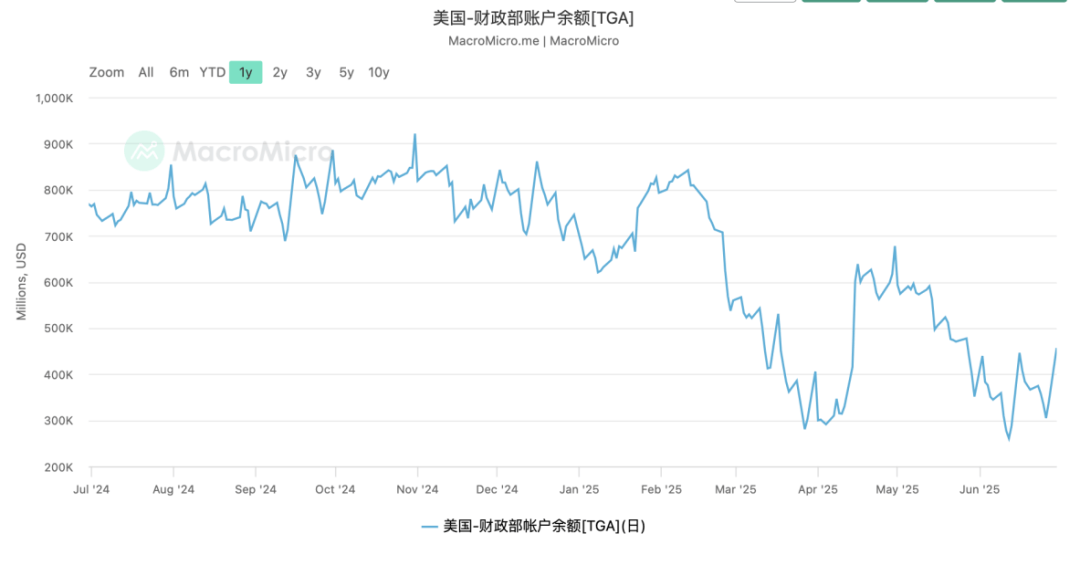
Group 1 - The "Big and Beautiful" Act passed by the U.S. Senate raises the debt ceiling by $5 trillion, addressing immediate liquidity pressures faced by the U.S. Treasury [1][2][4] - The Act fulfills Trump's campaign promises, including tax cuts, increased military spending, and stricter immigration policies, while also targeting Democratic support bases by cutting Medicaid and food assistance [7][9] - The Act is projected to increase federal debt by approximately $3.8 trillion over the next decade, which may necessitate accelerated interest rate cuts by the Federal Reserve [10][21] Group 2 - The U.S. Treasury's cash balance has significantly decreased from $800 billion at the beginning of the year to $456.7 billion by June 30, 2025, indicating potential liquidity challenges [2][4] - The Act's provisions include $460 billion for border wall construction, $450 billion for immigrant detention facilities, and $1.5 trillion in defense funding, reflecting a substantial increase in spending commitments [7][8] - The elimination of green energy subsidies and tax breaks for electric vehicles under the Act is expected to impact traditional automakers positively while disadvantaging electric vehicle manufacturers [9][11] Group 3 - The Federal Reserve is likely to accelerate interest rate cuts in response to the economic impacts of the "Big and Beautiful" Act, with current inflation at 2.4% and unemployment at 4.2% [13][15] - The Act's implementation may lead to a recession, prompting the Federal Reserve to adjust its policies to mitigate economic downturns [23] - The anticipated reduction in interest rates could stimulate the Hong Kong real estate market, as increased liquidity may lead to a recovery in property prices [17][23]
美国稳定币监管立法落地,中国工业经济韧性凸显:申万期货早间评论-20250721
申银万国期货研究· 2025-07-21 00:50
Group 1 - The core viewpoint of the article highlights the implementation of the U.S. stablecoin regulatory framework and the resilience of China's industrial economy [1] - The U.S. House of Representatives passed the "Genius Act" with a vote of 308 to 122, establishing a regulatory framework for stablecoins pegged to the U.S. dollar [1] - In China, the industrial and information sectors showed steady growth in the first half of the year, with industrial added value increasing by 6.4% year-on-year, and manufacturing's share of GDP remaining stable at 25.7% [1] Group 2 - Steel mills are currently maintaining profit margins, with iron water production slowly declining, leading to increasing supply pressure in the steel market [2] - Steel inventory continues to decrease, and while exports face tariffs and anti-dumping measures, billet exports remain strong, indicating a balanced supply-demand situation in the short term [2] - The overall steel market is expected to experience a strong and volatile price trend due to rising raw material costs and positive macroeconomic expectations [2] Group 3 - The U.S. stock market is primarily in a correction phase, with significant movements in the non-ferrous metals sector and a market turnover of 1.59 trillion yuan [3] - The financing balance increased by 7.073 billion yuan to 1.891157 trillion yuan, indicating a growing interest in capital allocation within the market [3] - A-shares are considered to have high investment value, particularly the CSI 500 and CSI 1000 indices, which are expected to benefit from supportive technology policies [3] Group 4 - Gold prices are experiencing fluctuations, while silver shows stronger performance, influenced by recent economic data and potential changes in U.S. monetary policy [4] - U.S. retail sales increased by 0.6%, significantly exceeding expectations, while the June CPI rose by 0.3% month-on-month, leading to a cooling of interest rate cut expectations [4] - The ongoing fiscal deficit in the U.S. and the People's Bank of China’s continued gold purchases provide long-term support for gold prices, despite short-term price hesitance [4] Group 5 - Domestic GDP data for the first half of the year shows that several provinces outperformed the national average, with Hubei province achieving a GDP growth of 6.2% [6] - The China Iron and Steel Association is advocating for strict control of capacity increases and the establishment of new mechanisms to prevent overcapacity in the steel industry [7]

博时基金赵宪成:资金面与基本面共振 港股后市可期
Shang Hai Zheng Quan Bao· 2025-07-20 15:54
Core Viewpoint - The Hong Kong stock market is gaining increasing attention from investors, with a positive outlook for the second half of the year driven by strong fundamentals and capital inflows [1][2]. Group 1: Market Performance - The Hong Kong stock market showed strong performance in the first half of the year, supported by a consensus among domestic and foreign investors on Chinese assets [1]. - As of July 17, net inflows from southbound capital reached over 720 billion yuan, nearly double that of the same period last year [1]. - Public funds are accelerating their investment in the Hong Kong market, with a noticeable increase in the number of Hong Kong-themed funds reported [1]. Group 2: Future Outlook - The EPS growth rate for the Hang Seng Tech Index is projected to be 35% by 2025, with a ROE of 14% [2]. - Despite the Hang Seng Index's valuation returning to a relatively high position after a rebound, there are still many quality investment targets available [2]. - The fundamental drivers for stock price increases are expected to become more apparent over time, with companies that have solid performance support likely to stand out [2]. Group 3: Investment Themes - The technology sector is favored, as it includes many mature and profitable internet giants with strong user bases and stable business models [2]. - The dividend sector, including banks, energy, utilities, and telecom operators, is highlighted for its strong risk resistance and stable cash flow, making it a focus for long-term capital allocation [2]. - The new consumption sector is also promising, with companies like Pop Mart and Lao Pu Gold benefiting from domestic consumption recovery and expanding into international markets [3].
匈牙利外长:将在基建、签证、能源等方面为中企提供更优服务
news flash· 2025-07-20 08:22
Group 1 - The Chinese Ambassador to Hungary, Gong Tao, attended a breakfast meeting organized by the Chinese Enterprises Chamber of Commerce and the Hungarian Ministry of Foreign Affairs, highlighting the fruitful economic cooperation between China and Hungary [1] - Ambassador Gong emphasized that Chinese investments have made significant contributions to Hungary's economic development and transformation, serving as a model for mutually beneficial cooperation [1] - Hungarian Foreign Minister Szijjarto expressed Hungary's firm opposition to bloc confrontation and support for East-West connectivity, noting that Chinese enterprises have brought jobs and high technology to Hungary, which is crucial for its economic development [1] Group 2 - The Hungarian government will continue to optimize policies to attract more Chinese enterprises to invest in Hungary [1] - Chinese enterprise representatives actively discussed their investment cooperation progress, with the Hungarian Foreign Minister responding that better services will be provided in areas such as infrastructure, visas, and energy [1]
宏观周报(7月14日-20 日):反内卷成效初现,美国加密货币法案通过-20250720
Yin He Zheng Quan· 2025-07-20 06:49
Domestic Macro - Demand Side - The travel market is heating up during the summer, with domestic flight numbers averaging 14,500 per day, a 13.08% increase month-on-month and a 2.28% increase year-on-year[2] - Retail sales of passenger cars reached 571,000 units in the first two weeks of July, a year-on-year increase of 5.7%, but a month-on-month decrease of 6.7%[2] Domestic Macro - Production Side - The average operating rate of blast furnaces decreased by 0.3 percentage points to 83.35% as of July 20, while the operating rate of coke ovens fell by 0.94 percentage points to 72.93%[2] - The operating rate of asphalt plants increased by 6.58 percentage points to 32.4%, indicating significant growth in real estate infrastructure[2] Price Performance - As of July 18, the average wholesale price of pork rose by 0.2% week-on-week, while the average wholesale price of 28 monitored vegetables fell by 0.09%[2] - The PPI showed a decline in oil prices, with WTI and Brent crude oil prices dropping by 1.44% and 1.05%, respectively[3] Fiscal and Investment - This week saw the issuance of special government bonds increase significantly, with 123 billion yuan in new special bonds and 1,315 billion yuan in new special bonds (excluding debt relief) issued, marking a notable acceleration in issuance[3] - The cement shipment rate has rebounded, indicating an increase in construction activity, particularly in water conservancy and public facilities projects[3] Overseas Macro - The U.S. inflation rate for June was 2.7% year-on-year, with core inflation at 2.9%, indicating manageable inflation levels despite tariff impacts[4] - The U.S. "GENIUS Act" and other cryptocurrency-related bills have passed the House, supporting the development of private sector digital currencies and reinforcing the dollar's position[3]
美股市场速览:市场高位缓涨,结构分化明显
Guoxin Securities· 2025-07-20 05:15
Market Overview - The S&P 500 index increased by 0.6% this week, while the Nasdaq rose by 1.5%[3] - Growth stocks outperformed value stocks, with Russell 1000 Growth up by 1.5% and Russell 1000 Value down by 0.2%[3] Sector Performance - The automotive and auto parts sector led gains with an increase of 4.3%, followed by semiconductors at 3.1% and software and services at 2.1%[3] - The energy sector experienced the largest decline, down by 3.8%, followed by healthcare equipment and services at -2.9%[3] Fund Flows - Estimated fund inflows for S&P 500 components were $4.55 billion this week, reversing last week's outflow of $0.57 billion[4] - Semiconductor products and equipment saw the highest inflow at $2.35 billion, while healthcare equipment and services faced an outflow of $1.37 billion[4] Earnings Forecast - The dynamic F12M EPS forecast for S&P 500 components was revised up by 0.6% this week, following a 0.3% increase last week[5] - The banking sector saw the most significant upward revision at +2.7%, while healthcare equipment and services were revised down by -1.0%[5] Risk Factors - Key risks include uncertainties in economic fundamentals, international political situations, U.S. fiscal policy, and Federal Reserve monetary policy[5]





国泰海通海外:港股迎来增配时机 下半年有望跑赢A股
智通财经网· 2025-07-20 02:37
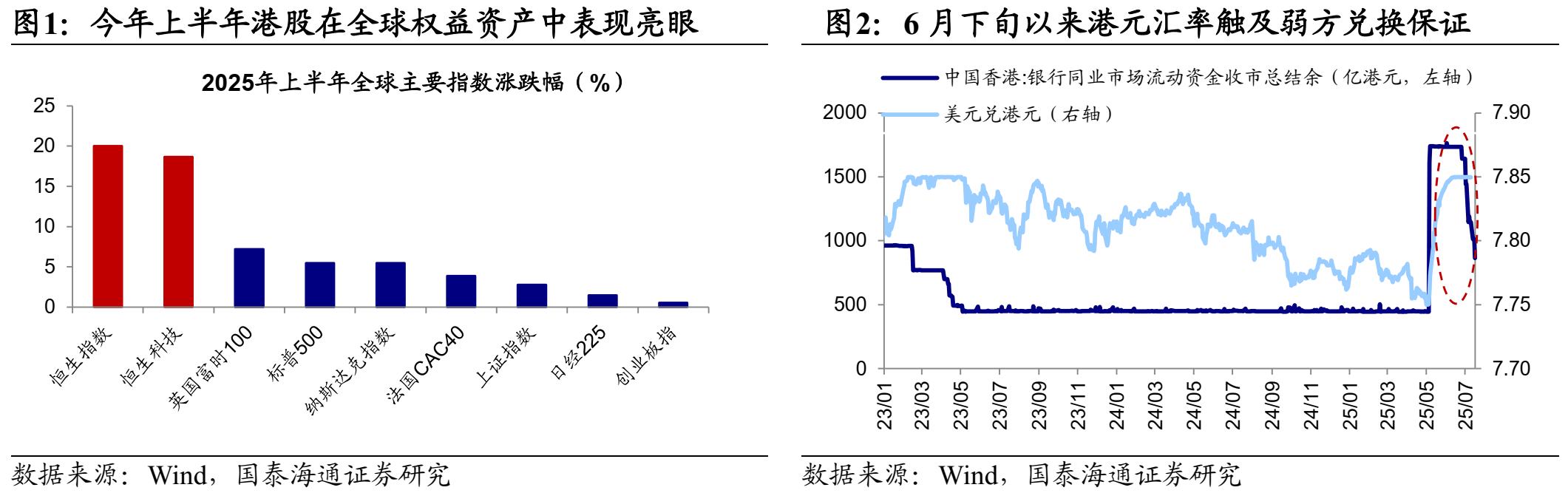
Core Viewpoint - The Hong Kong stock market has experienced fluctuations since the end of June due to tariffs and exchange rate impacts, but is expected to outperform the A-share market in the second half of the year as positive factors accumulate [1][3][13]. Market Performance - Since the end of June, the Hong Kong stock market has shown weaker performance compared to the A-share market, primarily influenced by U.S. tariff policies and the Hong Kong dollar's exchange rate [4][7]. - The Hang Seng Index rose by 20% in the first half of the year, outperforming major global indices, including the S&P 500 (5.5%) and the Shanghai Composite Index (2.8%) [3][4]. Sector Analysis - The technology and dividend sectors in Hong Kong are currently less active compared to A-shares, with the overall market heat slightly below historical averages [7][8]. - The healthcare and consumer sectors in Hong Kong show higher activity levels compared to A-shares, with the healthcare sector's heat at 91%, significantly above A-shares' 77% [9][8]. Investment Opportunities - The easing of U.S. chip export restrictions and the acceleration of AI applications are expected to benefit the Hong Kong technology sector, which is well-positioned to capitalize on the AI industry transformation [17]. - The dividend sector in Hong Kong, despite lower heat compared to A-shares, still holds value due to high dividend yields relative to risk-free rates, making it an attractive option for long-term investors [18]. Future Outlook - The Hong Kong stock market is entering a favorable allocation period, with expectations of continued upward movement in the second half of the year driven by supportive policies and improved capital inflows [13][14]. - The anticipated increase in capital expenditure by Hong Kong internet giants in AI infrastructure is expected to enhance the performance of the technology sector [17].