
纺织服装服饰

Search documents
数据点评 | 12月PMI回升的四大支撑(申万宏观·赵伟团队)
赵伟宏观探索· 2025-12-31 17:40
Core Viewpoint - The December PMI index shows a recovery driven by new momentum and the consumer goods sector, with a reduction in the debt-extraction effect and resilient exports supporting the index [1][4][53]. Group 1: PMI Recovery - The manufacturing PMI rose by 0.9 percentage points to 50.1%, marking a return to the growth line after nine months, despite a decline in high-frequency indicators such as blast furnace operations and freight volume [1][5][53]. - The production and new orders indices increased by 1.7 and 1.6 percentage points, respectively, indicating improved manufacturing activity [1][5][53]. Group 2: Support from New Momentum - PMI in sectors related to new momentum showed significant improvement, although the sustainability of this trend requires further observation due to a lack of corresponding high-frequency indicators [1][12][54]. - Traditional industries like black metal rolling and chemical fibers saw a decline in PMI, while emerging sectors such as electrical machinery and pharmaceuticals experienced a rise [1][12][54]. Group 3: Consumer Sector Improvement - The overall consumer goods sector PMI increased by 1 percentage point to 50.4%, with notable recovery in areas less affected by demand exhaustion risks, such as textiles and apparel, which rose by 4.5 percentage points [2][15][54]. Group 4: Construction Sector Recovery - The construction PMI rose by 3.2 percentage points to 52.8%, indicating a reduction in the marginal impact of debt-extraction on investment, supported by the easing of special refinancing bond issues and the implementation of incremental policies [2][18][54]. - Both housing and civil engineering activities improved, with respective increases of 4.8 and 1.2 percentage points [2][18][54]. Group 5: Export Resilience - The domestic order index rose by 1.6 percentage points to 51.1%, while the new export orders index improved by 1.4 percentage points to 49%, indicating ongoing resilience in exports [2][22][55]. - High-frequency indicators showed a year-on-year increase of 0.6 percentage points in port foreign trade freight volume, maintaining a high level [2][22][55]. Group 6: Economic Growth Outlook - The combination of accelerating new momentum and proactive incremental policies suggests that economic growth will remain resilient, despite traditional momentum facing downward pressure [3][27][55]. - The manufacturing PMI's recovery, driven by new momentum and consumer sectors, alongside improvements in the construction PMI, indicates a positive outlook for economic activity [3][27][55].

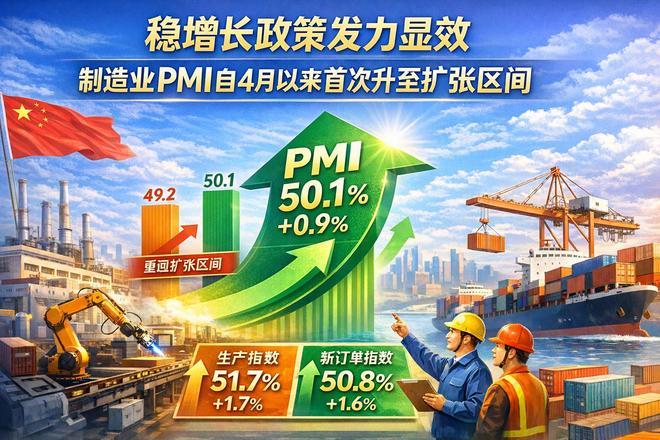
稳增长政策发力显效 制造业PMI自4月以来首次升至扩张区间
Zhong Guo Jing Ying Bao· 2025-12-31 15:45
Core Viewpoint - The manufacturing PMI has returned to the expansion zone, indicating a recovery in both production and demand in the manufacturing sector, driven by steady growth policies and resilient exports [2][3]. Manufacturing PMI Overview - In December, the manufacturing PMI was reported at 50.1%, an increase of 0.9 percentage points from the previous month, marking the first return to the expansion zone since April [2]. - The non-manufacturing business activity index also improved to 50.2%, up by 0.7 percentage points from the previous month, reflecting a simultaneous improvement in non-manufacturing activity [2]. Factors Driving Recovery - The recovery in the manufacturing PMI is attributed to the ongoing implementation of growth-stabilizing policies and resilient export performance [2]. - The "two 500 billion" growth-stabilizing policies introduced in late September and early October have begun to show effects, with 500 billion yuan in new policy financial tools fully deployed by October, boosting infrastructure and manufacturing investments [2][4]. Production and Demand Indices - The production index and new orders index for December were reported at 51.7% and 50.8%, respectively, both showing significant increases of 1.7 and 1.6 percentage points from the previous month [2][3]. - The new orders index has risen above the critical point for the first time since the second half of the year, indicating expansion in both production and demand [3]. Enterprise Size Analysis - Large enterprises saw a PMI of 50.8%, up by 1.5 percentage points, returning to the expansion zone, while medium-sized enterprises had a PMI of 49.8%, up by 0.9 percentage points, indicating a slight recovery [4]. - Small enterprises, however, experienced a decline in PMI to 48.6%, down by 0.5 percentage points, reflecting greater pressure due to weak consumer demand [4][5]. Future Outlook - The production and business activity expectation index rose to 55.5%, an increase of 2.4 percentage points, indicating growing confidence among manufacturing enterprises regarding market development [5]. - The support from growth-stabilizing policies is expected to continue to bolster manufacturing sentiment, with projections suggesting that the manufacturing PMI may remain in the expansion zone into January 2026 [5].
2025年12月PMI数据点评:中国经济“开门红”具备有利条件
Ping An Securities· 2025-12-31 14:04
Economic Overview - The overall economic sentiment in China is improving, with the composite PMI output index at 50.7%, up 1 percentage point from the previous month[3] - Manufacturing PMI returned to the expansion zone for the first time in 8 months, with indices for production and new orders rising by 1.7 and 1.6 percentage points, respectively[3] Sector Performance - Manufacturing PMI for December shows significant growth, with 16 out of 21 surveyed industries reporting an increase[3] - High-tech manufacturing saw the most notable improvement, with a PMI of 52.5%, up 2.4 percentage points from the previous month[3] Construction and Services - The construction sector's PMI rose significantly, with a business activity index at 52.8%, indicating a recovery driven by favorable weather and pre-holiday construction activities[3] - Service sector sentiment showed a slight recovery, but retail and catering industries remain under pressure, with business activity indices in contraction zones[3] Price Indices - The purchasing price index for raw materials fell slightly by 0.5 percentage points, while the factory price index increased by 0.7 percentage points, indicating a narrowing gap between supply and demand[3] - The PPI year-on-year decline is expected to narrow to between -2.1% and -2% as the PMI remains above negative territory for five consecutive months[3] Risks and Recommendations - Risks include potential underperformance of growth stabilization policies, unexpected severity of overseas economic downturns, and escalation of geopolitical conflicts[2][13] - Investment recommendations suggest a strong buy for stocks expected to outperform the market by over 20% in the next six months[14]
固定收益点评报告:制造业PMI重返扩张区间
Huaxin Securities· 2025-12-31 10:33
Report Overview - The report is a fixed - income review report focusing on the PMI data in December 2025 [1] Industry Investment Rating - No industry investment rating is provided in the report Core Viewpoints - In December, the manufacturing PMI reached 50.1, rising by 0.9 and returning to the expansion range for the first time since April; the non - manufacturing PMI was 50.2, up 0.7 month - on - month. The PMI data shows that under the influence of pre - holiday effects, domestic demand expansion policies, and price transmission due to anti - involution deepening, enterprises' operating pressure, production expectations, demand side, and production expansion willingness have all improved. It is necessary to continuously monitor the sustainability of domestic demand improvement and policy strength [2][4] Section Summaries Manufacturing - **Business Conditions**: The production index increased significantly by 1.7 to 51.7, and the new order index rose by 1.6 to 50.8, with the new export order index up 1.4 to 49. Enterprises' production and operation enthusiasm increased notably, with the raw material inventory rising 0.5 to 47.8, the procurement volume up 0.6 to 51.1, and the production and operation activity expectation up 2.4 to 55.5. From an industry perspective, industries such as农副 food processing, textile and clothing, and computer communication and electronic equipment had both production and demand above 53, while industries like non - metallic mineral products and ferrous metal smelting and rolling processing had both indexes below the critical point [3] - **Profitability**: The purchase price of raw materials decreased by 0.5, and the ex - factory price index increased by 0.7, indicating marginal improvement in corporate profits [3] - **Enterprise Size**: The business conditions of large enterprises rebounded above the boom - bust line. In December, the PMIs of large, medium, and small enterprises changed by 1.5, 0.9, and - 0.5 respectively, reaching 50.8, 49.8, and 48.6 [3] - **Key Industries**: The PMIs of high - tech manufacturing, equipment manufacturing, consumer goods industries, and raw material industries changed by 2.4, 0.6, 1.0, and 0.5 respectively, reaching 52.5, 50.4, 50.4, and 48.9 [3] Non - manufacturing - **Construction Industry**: In December, the business activity index of the construction industry was 52.8, up 3.2 month - on - month, and returned above the boom - bust line, showing strong resilience [3] - **Service Industry**: The business activity index of the service industry was 49.7, up 0.2, indicating some pressure [3] Investment Suggestions - The December PMI data shows comprehensive improvement in enterprises' operating pressure, production expectations, demand side, and production expansion willingness. It is recommended to continuously monitor the sustainability of domestic demand improvement and policy strength [4]
数据点评 | 12月PMI回升的四大支撑(申万宏观·赵伟团队)
申万宏源宏观· 2025-12-31 10:03
Core Viewpoint - The December PMI index shows a recovery driven by new momentum and the consumer goods sector, with a reduction in the debt-extraction effect and resilient exports supporting the index [1][4][53]. Group 1: PMI Recovery - The manufacturing PMI rose by 0.9 percentage points to 50.1%, marking a return to the growth line after nine months, despite a decline in high-frequency indicators such as blast furnace operation and freight volume [1][5][53]. - The production and new orders indices increased by 1.7 and 1.6 percentage points, respectively, reaching 51.7% and 50.8% [5][30]. Group 2: Support from New Momentum - PMI in sectors related to new momentum showed significant improvement, although the sustainability of this trend requires further observation due to a lack of corresponding high-frequency indicators [12][54]. - Traditional industries like black metal rolling and chemical fibers saw a decline in PMI, while emerging sectors such as electrical machinery and pharmaceuticals experienced increases, with high-tech and equipment manufacturing PMIs rising by 2.4 and 0.6 percentage points to 52.5% and 50.4% respectively [12][54]. Group 3: Consumer Sector Improvement - The overall consumer goods sector PMI increased by 1 percentage point to 50.4%, despite a significant drop of 5.8 percentage points in the automotive sector PMI, reflecting the impact of reduced government subsidies and demand risks [15][54]. - The textile and apparel sector PMI rose by 4.5 percentage points, correlating with improvements in travel data [15][54]. Group 4: Construction Sector Recovery - The construction PMI rose by 3.2 percentage points to 52.8%, indicating a marginal weakening of the debt-extraction effect on investment due to the alleviation of special refinancing bond issues and the implementation of incremental policies [18][54]. - Activities in housing construction and civil engineering increased by 4.8 and 1.2 percentage points, respectively, with the business activity expectation index remaining high at 57.4% [18][54]. Group 5: Export Resilience - The domestic order index rose by 1.6 percentage points to 51.1%, while the new export orders index improved by 1.4 percentage points to 49% [22][55]. - High-frequency indicators showed a year-on-year increase of 0.6 percentage points in port foreign trade freight volume, maintaining a high level [22][55]. Group 6: Economic Growth Outlook - The recovery in manufacturing PMI, driven by new momentum and consumer sectors, suggests continued economic resilience, despite traditional momentum facing downward pressure [27][55]. - The implementation of incremental fiscal policies and service consumption-related policies is expected to enhance domestic demand [27][55].
三大指数均升至扩张区间 经济景气水平总体回升——透视12月PMI数据
Xin Hua Wang· 2025-12-31 07:29
Group 1: Economic Indicators - In December, the Manufacturing Purchasing Managers' Index (PMI) reached 50.1%, marking the first time since April that it has entered the expansion zone [2] - The Non-Manufacturing Business Activity Index rose to 50.2%, indicating an improvement in the non-manufacturing sector's economic conditions [4] - The Composite PMI Output Index increased to 50.7%, reflecting an overall expansion in business activities compared to the previous month [6] Group 2: Manufacturing Sector Insights - In December, 16 out of 21 surveyed industries reported an increase in PMI, indicating improved production and operational conditions [2] - The Production Index and New Orders Index were recorded at 51.7% and 50.8%, respectively, both showing significant increases from the previous month [2] - High-tech manufacturing PMI was at 52.5%, indicating a positive growth trend in this sector [3] Group 3: Non-Manufacturing Sector Insights - The Non-Manufacturing Business Activity Index showed a recovery, with the New Orders Index rising to 47.3%, the highest level this year [4] - The Services Business Activity Index was at 49.7%, indicating a slight recovery in the service sector, although still below the expansion threshold [4] - The Construction Business Activity Index surged to 52.8%, reflecting a significant improvement in the construction sector's economic conditions [5]
什么信号?时隔8个月,制造业景气度重回扩张区间!
券商中国· 2025-12-31 06:18
Core Viewpoint - The overall economic sentiment in China is improving, as indicated by the rise in manufacturing and non-manufacturing Purchasing Managers' Indices (PMI) in December, signaling a recovery in market demand and a more proactive economic policy [1][2]. Manufacturing PMI Analysis - The manufacturing PMI for December stands at 50.1%, marking a 0.9 percentage point increase from the previous month, breaking an eight-month streak below 50% and entering the expansion zone [3]. - Among the 13 sub-indices, production, new orders, new export orders, backlogs, finished goods inventory, purchasing volume, ex-factory prices, raw material inventory, supplier delivery times, and production expectations all showed increases ranging from 0.1 to 2.4 percentage points [3]. - The new orders index has risen above the critical point for the first time since the second half of the year, with specific industries like food processing, textiles, and electronics showing production and new orders indices above 53.0% [3]. Industry-Specific Insights - In the 21 manufacturing sectors surveyed, 16 sectors reported a rise in PMI compared to the previous month, indicating improved operational conditions [5]. - High-tech manufacturing PMI reached 52.5%, up 2.4 percentage points, while equipment manufacturing and consumer goods sectors both recorded PMIs of 50.4%, indicating expansion [5]. - However, industries such as non-metallic mineral products and black metal smelting remain under pressure, with their indices below the critical point [4]. Financial Sector Performance - The financial sector's business activity index and new orders index both rose for two consecutive months, exceeding 60%, indicating enhanced financial support for the real economy [6]. - The construction sector's business activity index increased to 52.8%, up 3.2 percentage points, ending a four-month period below 50% and signaling a rebound in construction activities [6][7]. Business Expectations - The manufacturing production and business activity expectation index rose to 55.5%, the highest since April 2024, while the service sector's expectation index reached 56.4% [8]. - The positive outlook is supported by clear policy signals and a stable trade environment, suggesting a solid foundation for the upcoming year [8]. Future Economic Outlook - The economic policies outlined in the 14th Five-Year Plan are expected to provide strategic direction for the next five years, with the recent Central Economic Work Conference setting clear goals for 2026 [9]. - The manufacturing sector is anticipated to achieve steady growth in both quality and quantity in 2026, driven by multiple positive factors [9].

50.1%!时隔8个月,重回扩张区间
证券时报· 2025-12-31 05:55
Core Viewpoint - The overall economic sentiment in China is improving, as indicated by the rise in manufacturing PMI, non-manufacturing business activity index, and comprehensive PMI output index, all entering the expansion zone in December [1][3]. Manufacturing PMI - In December, the manufacturing PMI reached 50.1%, an increase of 0.9 percentage points from the previous month, marking its first rise above 50% after eight consecutive months [3]. - Among the 13 sub-indices, production index, new orders index, new export orders index, backlog orders index, finished goods inventory index, purchasing volume index, ex-factory price index, raw materials inventory index, supplier delivery time index, and production and business activity expectation index all showed increases ranging from 0.1 to 2.4 percentage points [3]. - The new orders index rose above the critical point for the first time since the second half of the year, indicating a positive trend in market expectations [3]. Key Industries - High-tech manufacturing PMI was 52.5%, up 2.4 percentage points, indicating a favorable growth trend [4]. - Equipment manufacturing and consumer goods industries both recorded PMIs of 50.4%, rising by 0.6 and 1.0 percentage points respectively, also entering the expansion zone [4]. - High-energy-consuming industries had a PMI of 48.9%, up 0.5 percentage points, continuing to show recovery [4]. Financial Sector Activity - The financial sector's business activity index and new orders index both rose for two consecutive months, exceeding 60%, indicating enhanced financial support for the real economy [6]. - The construction industry business activity index increased to 52.8%, up 3.2 percentage points, ending a four-month period below 50% [6]. Business Expectations - The manufacturing production and business activity expectation index reached 55.5%, up 2.4 percentage points, the highest since April 2024 [8]. - The service industry business activity expectation index rose to 56.4%, up 0.5 percentage points, while construction firms maintained optimistic market expectations with their index above 57% for two consecutive months [8]. Economic Outlook - The manufacturing PMI is expected to average 49.6% in 2025, remaining stable compared to 2024, with December's rise indicating a positive end to the year and a solid foundation for the new year [9]. - The "14th Five-Year Plan" provides strategic direction for economic and social development, with recent policy signals and the Central Economic Work Conference outlining clear deployments for 2026, which are expected to inject momentum into macroeconomic development [9].

大利好!刚刚发布
Zhong Guo Ji Jin Bao· 2025-12-31 05:40
Core Viewpoint - In December 2025, China's Purchasing Managers' Index (PMI) for manufacturing, non-manufacturing, and composite output all rose above the expansion threshold, indicating an overall recovery in the economic climate [2][6]. Manufacturing PMI - The manufacturing PMI reached 50.1%, marking its first rise above the expansion threshold since April, with 16 out of 21 surveyed industries showing improvement [3][7]. - The production index and new orders index were at 51.7% and 50.8%, respectively, both showing significant increases of 1.7 and 1.6 percentage points from the previous month [3][10]. - Large enterprises saw a PMI of 50.8%, up 1.5 percentage points, while medium and small enterprises reported PMIs of 49.8% and 48.6%, indicating varying levels of economic recovery [3][10]. Non-Manufacturing PMI - The non-manufacturing business activity index was 50.2%, an increase of 0.7 percentage points, indicating a return to expansion [5][19]. - The construction sector's business activity index rose to 52.8%, up 3.2 percentage points, reflecting significant improvement due to favorable weather and pre-holiday construction activity [5][16]. - The service sector's business activity index was at 49.7%, showing a slight increase but remaining below the expansion threshold [5][19]. Composite PMI - The composite PMI output index reached 50.7%, an increase of 1.0 percentage point, indicating overall expansion in production and business activities [6][24]. - The manufacturing production index and non-manufacturing business activity index were 51.7% and 50.2%, respectively, contributing to the composite index's rise [6][24]. Industry-Specific Insights - High-tech manufacturing PMI was at 52.5%, indicating a positive growth trend, while energy-intensive industries reported a PMI of 48.9%, still below the expansion threshold [4][10]. - The expectation index for production and business activities rose to 55.5%, reflecting increased confidence among manufacturing enterprises regarding market development [4][21].
2025年12月中国制造业PMI重返扩张区间
Zhong Guo Xin Wen Wang· 2025-12-31 04:41
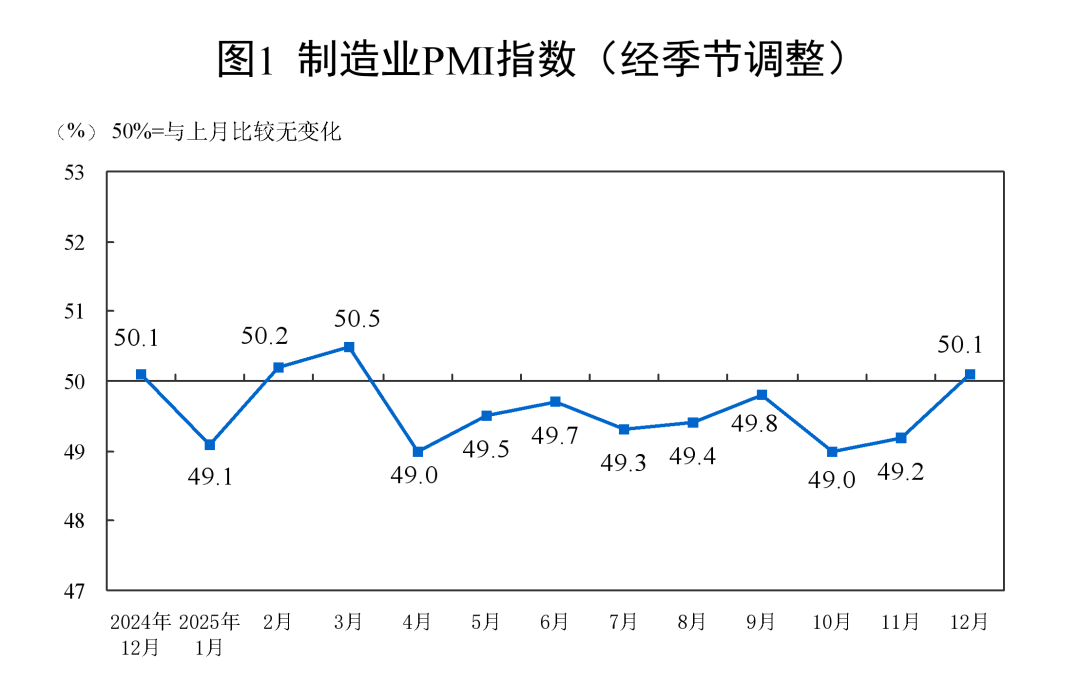
国家统计局服务业调查中心首席统计师霍丽慧表示,12月份,生产指数和新订单指数分别为51.7%和 50.8%,比上月上升1.7个和1.6个百分点,特别是新订单指数下半年以来首次升至临界点以上,制造业 产需两端均较上月明显扩张。 中新社 北京12月31日电 (记者 王恩博)中国国家统计局2025年12月31日公布,12月份,中国制造业采购 经理指数(PMI)为50.1%,4月份以来首次升至扩张区间。在调查的21个行业中有16个行业PMI较上月回 升。 值得注意的是,12月份重点行业PMI均高于上月。高技术制造业PMI为52.5%,比上月上升2.4个百分 点,行业增长态势向好。装备制造业和消费品行业PMI均为50.4%,分别比上月上升0.6个和1.0个百分 点,双双升至扩张区间。高耗能行业PMI为48.9%,比上月上升0.5个百分点,景气水平继续回升。 12月份,生产经营活动预期指数为55.5%,比上月上升2.4个百分点,制造业企业对市场发展信心继续增 强。受节前备货等因素带动,农副食品加工、食品及酒饮料精制茶等行业生产经营活动预期指数均升至 60.0%以上高位景气区间,相关企业对近期行业发展更为乐观。(完) 【责 ...