AI产业

Search documents
\十五五\规划建议的产业体系布局与有色金属产业格局展望
Chang Jiang Qi Huo· 2025-12-01 10:08
Report Summary 1. Report Industry Investment Rating No relevant information provided. 2. Core View of the Report During the 15th Five - Year Plan period, the development of non - ferrous related industries will prioritize high - quality development, resolve supply - side involution, reduce ineffective supply, and control smelting - end production capacity. Copper, aluminum and other non - ferrous metals and new energy materials will continue to benefit from the optimization and upgrading of traditional industries and the booming development of emerging and future industries. The industrial pattern of non - ferrous and new energy varieties will be further improved and optimized, and price trends will be more boosted by the supply and demand sides [1][2]. 3. Summary by Directory 3.1 "Importance of the 15th Five - Year Plan Period" The 15th Five - Year Plan period is crucial for basically realizing socialist modernization, serving as a connecting link between the past and the future. It is necessary to consolidate advantages, break through bottlenecks, and strengthen weak points. Adhering to high - quality development is particularly important for the non - ferrous metal industry pattern [6]. 3.2 "Main Goals and Industrial System Planning of the 15th Five - Year Plan" - **Main Goals**: The main goals include significant achievements in high - quality development, a substantial increase in the level of scientific and technological self - reliance, new breakthroughs in further comprehensive deep - seated reforms, a notable improvement in social civilization, continuous improvement in people's living standards, new major progress in building a beautiful China, and a more solid national security barrier. High - quality development is prioritized, and the non - ferrous metal industry will focus on high - quality development, addressing supply - side issues and strengthening effective demand. The goal of a substantial increase in scientific and technological self - reliance highlights the importance of science and technology, which will drive the high - quality development of the non - ferrous new energy industry [8][11][12]. - **Industrial System Planning Clues for Non - Ferrous Metals**: In the industrial system planning, traditional industries such as mining and metallurgy related to non - ferrous metals will continue supply - side reforms. Emerging and future industries, such as new energy and quantum technology, will drive the demand for non - ferrous and new energy materials. Non - ferrous metals and new energy materials will benefit from the development of both traditional and emerging/future industries [14][15][16]. 3.3 "Prospects for Non - Ferrous Metal Terminal Industries in the 15th Five - Year Plan" - **Wind Power, Photovoltaic and Grid Energy Storage**: The 15th Five - Year Plan aims to accelerate the construction of a new energy system. The scale of new energy installations is expected to reach a new high, and the demand for energy storage and grid investment will increase to support the consumption and stable operation of new energy [17][20]. - **New Energy Vehicles**: The 15th Five - Year Plan emphasizes green development. The penetration rate of new energy vehicles in China is expected to further increase. Although the growth rate may decline, new energy vehicles will remain an important driver of the domestic economy [21][23]. - **AI Industry**: The 15th Five - Year Plan has higher requirements for scientific and technological self - reliance. The development of the AI industry will drive the growth of semiconductor chips and increase the demand for energy storage in AI data centers, becoming a new growth engine for non - ferrous and new energy materials [24].
中短期宏观研判:国内外经济态势与财政货币政策走向
Mei Ri Jing Ji Xin Wen· 2025-11-25 14:29
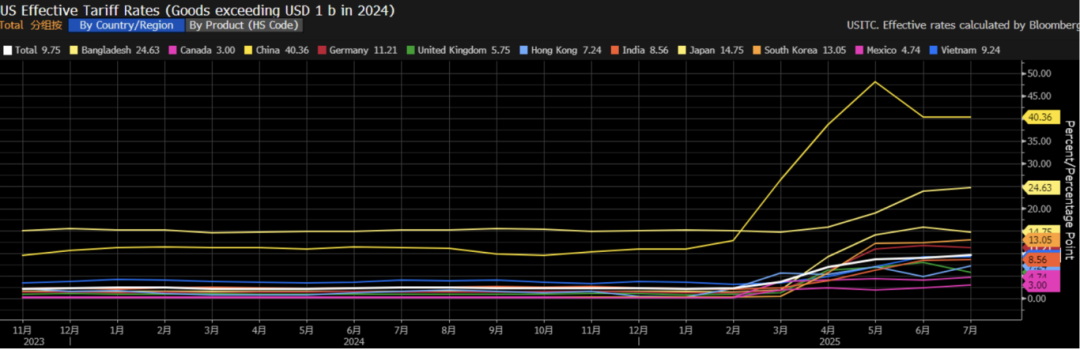
Economic Overview - The US economy is experiencing a slow downward trend, with overall inflation remaining stable and limited transmission effects from tariffs on inflation [1] - Recent data from Harvard's Pricing Lab indicates that the price increase of Chinese goods imported to the US has been limited, even after tariff hikes [1] - The US has recently reduced tariffs on Chinese imports by 10%, further diminishing the impact of tariffs on inflation [1] - There is a potential concern regarding rising electricity prices due to significant investments in the AI industry, which may affect the US CPI [1] Labor Market Insights - The US is currently in a government shutdown, leading to a lack of official economic data, with reliance on private statistics like the ADP report [2] - The latest ADP data shows a rebound in job creation to over 40,000 in October, but this is still below the previous average of over 100,000, indicating a weak labor market [2] - The stable inflation and weakening labor market create conditions for potential monetary policy easing, with expectations for a rate cut by the Federal Reserve in December [2] China-US Trade Relations - Despite the recent reduction of tariffs on Chinese goods, China still faces significant tariff pressures, with its goods having the highest tariff rates among countries exporting to the US as of July [3] Domestic Economic Conditions - China's economy is showing a diverging trend compared to the US, with stable high growth in exports, social financing, and industrial value added, while retail sales and fixed asset investment face uncertainties [5] - The GDP growth rate for the fourth quarter is expected to decline further, potentially falling between 4.4% and 4.6% [5] - The impact of previous economic stimulus measures is leading to a decline in consumer purchasing power, with some sectors experiencing negative sales growth [5] Inflation and Price Trends - The fourth quarter is expected to see a "bottoming out and recovery" in inflation, influenced by base effects, with gold's rising weight in the CPI contributing to this trend [6] - Gold's weight in the CPI has increased to 4%, indicating its significant impact on overall inflation metrics [6] - Core CPI is projected to remain stable between 0.5% and 1.6% [6] Social Financing Trends - Social financing growth is expected to gradually decline towards the end of the year due to a lack of large-scale debt issuance compared to the previous year [7] - The recent discussions from the Fourth Plenary Session indicate a cautious approach to economic policy, with no expectation of large-scale stimulus measures [7] Fiscal and Monetary Policy Developments - There has been a noticeable decrease in fiscal bond issuance in October, with expectations for a potential rebound in November or December [8] - The government has implemented incremental policies to address the economic downturn, including the issuance of local government bonds [8] - Policy-oriented financial tools have been fully utilized to counter economic pressures, with a focus on supporting key sectors [9] Market Outlook - The bond market is expected to experience a narrow fluctuation pattern, with potential for policy-driven movements in early next year [10] - The ten-year government bond is highlighted as a stable investment option, suitable for both long-term allocation and short-term trading strategies [10]

选票驱动经济!特朗普放双宽政策大招,2026年美国要结束软着陆?
Sou Hu Cai Jing· 2025-11-24 09:05
Group 1 - The U.S. economy is at a critical juncture, transitioning from a "soft landing" to potential expansion, influenced by upcoming midterm elections and AI industry growth [4][6][34] - The Federal Reserve has shifted its focus from controlling inflation to preserving employment, with expectations of multiple interest rate cuts from December 2025 to December 2026 [6][8] - Fiscal policy is projected to boost GDP by 0.43% in Q4 2026, with potential for further increases if additional measures are implemented [10] Group 2 - AI investments are becoming a significant growth driver, contributing 1.4% to GDP in early 2025, surpassing private consumption [14][20] - Major tech companies are increasing capital expenditures on AI, supported by strong cash flows, indicating a more sustainable investment environment compared to the 1990s tech bubble [16][19] - The wealth effect from rising stock prices, driven by AI-related investments, is providing new support for consumer spending, despite concerns over income inequality [22][24] Group 3 - Inflation risks are a major concern, with predictions of a potential CPI increase to 3.4% by May 2026, influenced by loose fiscal and monetary policies [25][28] - The uncertainty surrounding AI growth and potential declines in tech companies' cash flows could negatively impact both the stock market and the economy [30] - The bond market is expected to experience fluctuations, with 10-year Treasury yields projected to range between 3.2%-4.5%, affecting corporate investment and the real estate market [31][32]

兴业证券:中国资产有望迎来修复
智通财经网· 2025-11-23 08:32
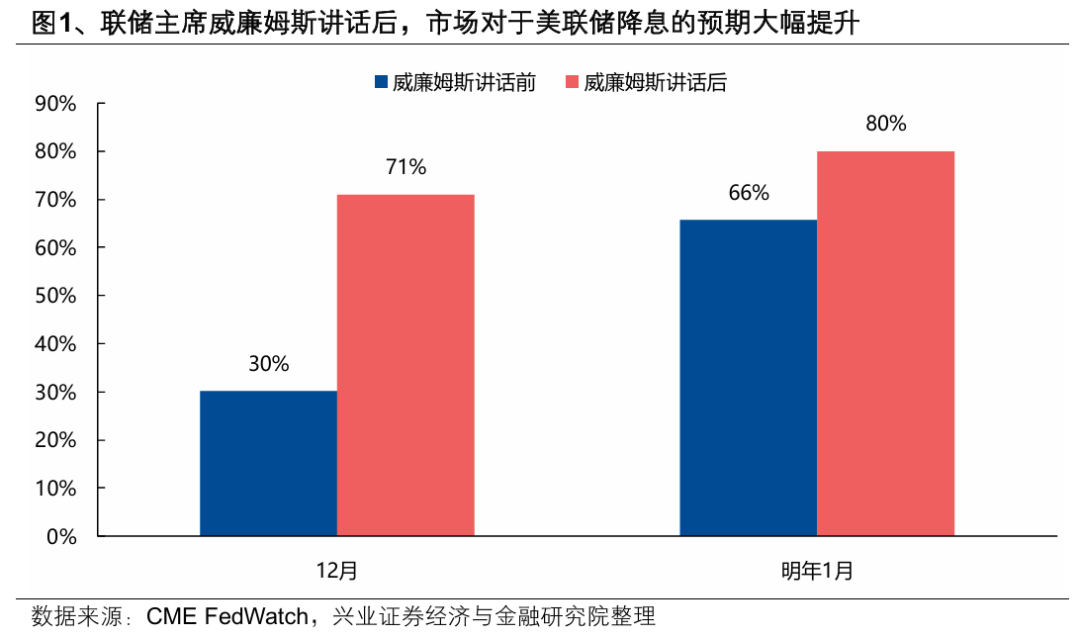
Group 1 - The core viewpoint is that Chinese assets are expected to recover due to their adjusted cost-effectiveness amidst global market fluctuations and the release of overseas risks [1][5][8] - The recent dovish comments from the Federal Reserve Chairman have led to a significant increase in the market's expectations for a rate cut in December, rising from 30% to 71%, which is easing the pressure on global risk appetite [2][5] - The concerns regarding the "AI bubble" are likely to ease as liquidity expectations improve and major tech companies continue to invest in AI applications, which are translating into actual productivity [5][8] Group 2 - The current market conditions indicate that the Hong Kong stock market, which has experienced earlier and deeper declines, presents a favorable entry point due to its high short-selling ratio and the valuation of the Hang Seng Tech Index returning to levels seen during "equal tariffs" [1][6][8] - Historical data shows that when the entire A-share market falls below the 60-day moving average, the subsequent recovery is often limited, suggesting that the market is likely to rebound after a short-term digestion period [5][6] - The independent logic supporting the recovery of Chinese assets includes enhanced national competitiveness, the release of new economic drivers, clear policy direction, and stable economic fundamentals, which are not affected by external disturbances [8][9] Group 3 - The focus for the year-end market layout should be on sectors with high growth expectations for the next year, particularly those that have adjusted to cost-effectiveness due to overseas shocks [9][10] - Key sectors identified for potential growth include AI industry trends, advantageous manufacturing, "anti-involution" sectors, and structural recovery in domestic demand [9][10][11] - For technology growth sectors, opportunities are seen in narrative shifts and internal "high-cut-low" strategies, particularly in AI applications, innovative pharmaceuticals, and military industries [14][18]

【明日主题前瞻】内需消费的重要增长点,冰雪产业市场规模快速增长
Xin Lang Cai Jing· 2025-11-19 12:01
Group 1: Ice and Snow Industry Growth - The ice and snow industry in China is expected to reach a market size of 980 billion yuan in 2024, with a year-on-year growth of 10.8%, and is projected to exceed 1 trillion yuan in 2025 [2] - The industry is transitioning from niche sports consumption to mainstream consumption, with travel combined with skiing becoming a new leisure and vacation trend [2] - Companies like Xue Ren Group are leading in manufacturing ice and snow equipment, while Changbai Mountain is upgrading its tourism offerings to include more diverse recreational experiences [2] Group 2: Baidu's AI Business Performance - Baidu reported a total revenue of 31.2 billion yuan for Q3 2025, with core revenue at 24.7 billion yuan, and for the first time disclosed AI business revenue, which grew over 50% year-on-year [3] - AI cloud revenue increased by 33%, while AI application revenue reached 2.6 billion yuan, and AI native marketing service revenue surged by 262% to 2.8 billion yuan [3] - The domestic AI industry is expected to enter a sustainable growth cycle, driven by the demand for self-sufficient technology and advancements in AI chips [3] Group 3: Semiconductor and Memory Market Trends - Xiaomi indicated that the current rise in memory prices is a long-term trend driven by increased demand for HBM due to AI, rather than traditional market fluctuations [4] - The storage industry has entered an accelerated upward cycle, with expectations of significant profit growth for domestic storage module companies by the second half of 2025 [4] - Companies like Shikong Technology are focusing on semiconductor memory products, including memory bars and solid-state drives, with advanced testing capabilities [5] Group 4: Commercial Space and Rocket Technology - Tianbing Technology successfully completed key tests for its "one rocket, 36 satellites" capability, marking a significant milestone in China's commercial space sector [6] - The year 2025 is seen as a pivotal year for validating reusable rocket technology, with several private companies planning their first flights [6] - Companies like Shanghai Port Bay are supporting satellite launches and contributing to satellite internet constellation development [7] Group 5: Lithium Carbonate Supply and Demand - Strong demand has led to a monthly shortage of lithium carbonate, with supply at approximately 115,000 tons and demand at 128,000 tons, resulting in a shortfall of about 13,000 tons [8] - The market outlook for energy storage is optimistic, with significant agreements indicating a sustained growth cycle for China's energy storage industry over the next 3-5 years [8] - Companies like Jiangte Electric have developed an integrated industry chain for lithium salt production, with significant production capacity planned for the coming years [9] Group 6: Liquid Cooling Industry Potential - The liquid cooling industry is expected to experience explosive growth driven by AI demand and supportive policies, with new data centers required to meet specific energy efficiency standards [10] - The penetration rate of liquid cooling technology in global data centers is projected to rise from 10% in 2024 to over 30% by 2025 [10] - Companies like Invid and Keda are positioned to benefit from the growing demand for liquid cooling solutions in data centers [11] Group 7: Solid-State Battery Development - CATL is committed to investing in all-solid-state batteries, with expectations for small-scale production by 2027 [12] - The solid-state battery industry is experiencing rapid advancements, supported by national policies and emerging application demands [12] - Companies like Xian Dao Intelligent are leading in providing comprehensive solutions for solid-state battery production, with increasing orders and customer engagement [12]


松下中国进博会首发AI战略 加码中国AI市场
Xin Lang Cai Jing· 2025-11-06 08:24
Core Insights - Panasonic has launched its AI strategy in China, focusing on a "dual empowerment" approach to enhance competitiveness and contribute to China's modernization efforts [1][2] - The company aims to leverage the opportunities presented by China's AI industry and digital economy, integrating AI technology into smart home appliances and services while also developing AI infrastructure [1] - Panasonic is promoting a "full AI" corporate culture in China, implementing a common AI platform that connects various AI models to enhance employee productivity [1] Business Performance - In the fiscal year 2024, Panasonic's sales in China increased by 3% year-on-year, with profits rising by 12% [2] - For the first half of fiscal year 2025 (April to September), the company continued its growth trajectory, with sales up by 3% and profits up by 24% [2] - Panasonic's CEO emphasized the importance of succeeding in the Chinese market as a prerequisite for global success [2]

“申”度解盘 | 市场震荡加大,热点有所切换
申万宏源证券上海北京西路营业部· 2025-10-21 02:52
Market Overview - The A-share market experienced significant fluctuations this week, with technology stocks undergoing corrections and some funds flowing back into consumer and dividend sectors [7] - The market opened sharply lower due to escalating Sino-U.S. trade tensions but stabilized later, driven by sectors such as self-sufficiency, rare earth permanent magnets, and banking [8] - The AI industry chain showed signs of stabilization in the latter half of the week, influenced by optimistic expectations for the industry's future from the 2025 OCP Global Summit, although individual stock performances varied [8][10] Sector Performance - The solid-state battery and nuclear fusion sectors saw rebounds this week, indicating a recovery in new energy technology stocks [8] - The robotics sector was notably active, with rumors of a major order for humanoid robots from a core supplier in Tesla, leading to a significant rise in the sector despite subsequent clarifications from listed companies [8] - The banking sector performed well, with Agricultural Bank's stock price returning to historical highs near early September levels [9] Investment Outlook - Investors are advised to monitor the progress of Sino-U.S. trade negotiations, as the index has accumulated a certain level of gains since the beginning of the year [10] - The upcoming third-quarter report disclosures at the end of October are expected to influence market performance, with the banking sector likely to lead the Shanghai Composite Index in the short term [10] - In the medium term, sectors such as AI, new energy, and innovative pharmaceuticals are anticipated to remain the main themes for future market trends [10]

周期论剑 -三季报展望
2025-10-13 01:00
Summary of Key Points from Conference Call Records Industry Overview - **Financial Conditions**: Domestic financial conditions are stabilizing, with loose fiscal and monetary policies aimed at stabilizing the capital market, which helps to build consensus, boost expectations, and attract foreign capital [1][3] - **Investment Focus**: The main investment themes include technology, particularly AI innovation and semiconductor equipment, as well as adjusted financial sectors and industries like non-ferrous metals, chemicals, steel, and new energy [1][4] Company Insights - **Aviation Industry**: During the 2025 National Day holiday, air passenger traffic significantly increased, with ticket prices rising beyond expectations. The aviation industry is expected to see profits surpassing 2019 levels in Q3 2025, contingent on the recovery of business travel demand [1][5] - **LNG Shipping Market**: The LNG shipping market is expected to perform well in Q4 2025, benefiting from OPEC's production increase and additional supply from South America and West Africa, indicating a rebound in profitability for shipping companies [1][7] - **Coal Market**: The coal market is experiencing a dual improvement in supply and demand, with prices expected to rise gradually starting in the second half of 2026. The focus on coal stocks is increasing due to supply constraints and unexpected demand [1][14][15][16] Key Industry Trends - **Oil Prices**: Recent declines in oil prices are attributed to geopolitical factors, tariffs, and OPEC+ production increases. Future price movements will depend on the attitudes of oil-producing countries and geopolitical developments [1][8][9] - **Steel Industry**: The steel sector is expected to perform well in Q4, with historical data suggesting that policy-related factors can lead to year-end rallies. The industry is also seeing a shift towards a more stable supply-demand balance, with potential profit increases in the coming years [1][19][20] Recommendations - **Investment Recommendations**: - **Aviation**: Focus on companies that can capitalize on the recovery of business travel and rising ticket prices [1][5] - **LNG Shipping**: Companies like China Merchants Energy and China Ship Leasing are recommended due to expected profitability rebounds [1][7] - **Coal**: Companies like China Shenhua and other major state-owned enterprises are highlighted for their strong market positions and potential for profit growth [1][18][17] - **Steel**: Recommended companies include Baosteel and Hualing Steel, which have cost advantages and strong market positions [1][20] Additional Insights - **Geopolitical Impact**: The current geopolitical landscape is influencing market dynamics, with clearer boundaries around trade risks compared to earlier in the year. This clarity is seen as an opportunity for investors to increase their holdings in Chinese assets [2][3] - **Consumer Building Materials**: The consumer building materials sector is showing signs of recovery, with leading companies expected to perform well despite a challenging market environment [1][24][25] This summary encapsulates the key insights and recommendations from the conference call records, providing a comprehensive overview of the current state and future outlook of various industries and companies.
展望四季度 险资看好看好科技、周期板块
Jing Ji Guan Cha Wang· 2025-10-07 18:05
Group 1 - The macroeconomic stability and supportive policies are expected to lead to a steady A-share market, with institutional investors, including insurance funds, likely to increase their equity asset allocation, becoming a significant source of incremental capital [1] - Investment opportunities in the technology growth sector are favored, particularly in the AI industry, including domestic computing power supply chains and AI applications [1] - A balanced allocation between technology and cyclical sectors is anticipated, with cyclical industries like petrochemicals currently showing low valuations and investment value [1] Group 2 - The focus on investment opportunities in the technology sector remains strong, with particular attention on domestic innovation and localization [1] - Opportunities in cyclical industries such as non-ferrous metals and petrochemicals are being considered, driven by supply-side capacity optimization and demand-side economic growth [1]
你的资产正被鲍威尔改变!不管炒不炒股 这份美国降息生存指南必看
Sou Hu Cai Jing· 2025-09-25 07:14
Group 1: Monetary Policy Mechanism - The core of monetary policy involves increasing or decreasing the money supply, primarily executed by central banks [4] - Interest rate adjustments aim to regulate the money supply, with lower rates leading to more dollars being injected into the economy [4] - Changes in reserve requirements and open market operations are crucial tools for influencing market liquidity [4] Group 2: Impact of Rate Cuts on Global Markets - Federal Reserve rate cuts can lead to significant capital outflows from the U.S., impacting global asset prices [6] - The expectation of rate changes drives capital flows, often resulting in market movements before the actual rate cut occurs [9] - A lower dollar value due to rate cuts can benefit importers by reducing procurement costs, while exporters may face challenges as their products become more expensive abroad [10][11] Group 3: Sector-Specific Implications - Technology-intensive industries, such as AI and robotics, may benefit from lower financing costs in a low-interest environment [12] - Export-oriented companies need to enhance product value to mitigate the adverse effects of currency fluctuations [15] - The real estate market typically benefits from lower interest rates, providing opportunities for first-time homebuyers [15] Group 4: Strategic Recommendations - Investors should focus on anticipated changes rather than actual events, positioning themselves during the expectation phase [15] - Companies should utilize financial instruments to manage currency risks effectively [15] - Entrepreneurs are encouraged to leverage low-interest periods for financing, particularly in government-supported innovation sectors [15]