
机电

Search documents
主动应变市场多元化见效 中国外贸稳中向好“面貌”清晰、抗压能力显现
Yang Shi Wang· 2025-10-14 07:49
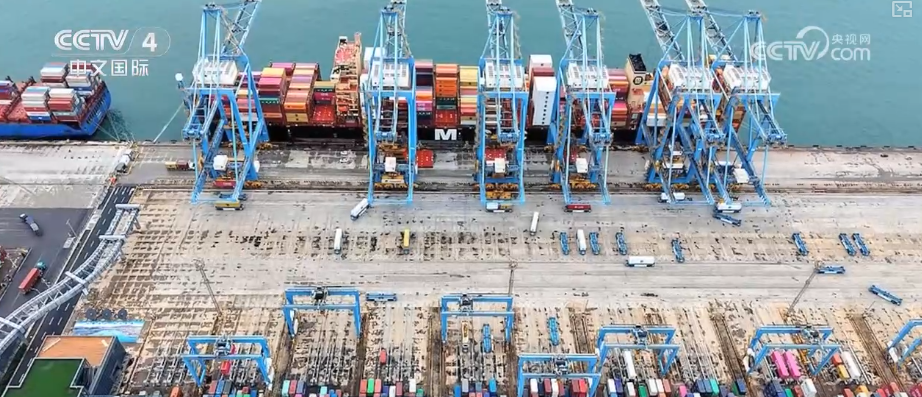
Core Insights - China's goods trade imports and exports increased by 4% year-on-year in the first three quarters of 2025, with a notable acceleration in growth rate [1] - In September, the import and export growth reached 8%, marking the highest monthly growth rate of the year [1] - Despite global economic challenges, China's foreign trade shows a clear trend of stability and resilience [1] Group 1: Export Performance - China's exports of mechanical and electrical products reached 12.07 trillion yuan, growing by 9.6% and accounting for 60.5% of total exports [4] - High-tech products, including electronic information and advanced equipment, saw strong export growth [4] - The overall performance of China's foreign trade reflects strong resilience, driven by the steady expansion and upgrading of the manufacturing sector [6] Group 2: Market Diversification - Chinese exporters are actively exploring new markets in Asia, Africa, and Latin America as the share of exports to the U.S. declines [9] - The strategic shift towards emerging markets has resulted in record-high exports to India, Africa, and Southeast Asia [9] - Market diversification and targeted domestic support are key strategies for maintaining export growth momentum [9] Group 3: Impact of Tariffs - Despite facing U.S. tariff pressures, China's export performance remains robust, indicating limited overall impact from the trade conflict [12] - This resilient trade performance supports China's economic development and strengthens its position in U.S.-China trade negotiations [12]

宏观金融数据日报-20251014
Guo Mao Qi Huo· 2025-10-14 03:29
Report Summary 1. Report Industry Investment Rating - No information provided in the given content. 2. Core Viewpoints - China's foreign trade has shown strong resilience in the face of Sino-US tariff policy disturbances in 2025, with the export value from January to September increasing by 7.1% year-on-year, and a growth rate of 8.4% in September, driven by the base effect and the strong performance of mechanical and electrical products [6]. - Mechanical and electrical products have become the core driver of China's foreign trade, with cumulative exports in the first three quarters reaching 12.07 trillion yuan, a year-on-year increase of 9.6%, accounting for 60.5% of the total export value. High-tech products in the mechanical and electrical products segment have seen significant export growth, while traditional labor - intensive products have generally declined [6]. - After the rapid escalation of Sino - US tariff policies on Friday, Trump's "TACO" expectation resurfaced. A - shares opened lower and closed higher, with "domestic substitution" related sectors leading the rise. In the short term, the stock index is expected to fluctuate, and attention should be paid to the possible Sino - US leaders' meeting at the APEC meeting in South Korea at the end of this month [6]. 3. Summary by Relevant Catalogs 3.1 Macro - financial Data - **Interest Rates**: DR001 closed at 1.31 with a 0.29bp increase, DR007 at 1.45 with a 5.50bp increase, GC001 at 1.35 with a 12.00bp decrease, GC007 at 1.49 with a 1.50bp decrease, SHBOR 3M at 1.58 with a 0.10bp decrease, and LPR 5 - year remained unchanged at 3.50 [3]. - **Bond Yields**: The 1 - year Treasury bond yield was 1.35 with a 0.50bp increase, the 5 - year at 1.59 with a 1.75bp increase, the 10 - year at 1.76 with a 1.70bp increase, and the 10 - year US Treasury bond at 4.06 with a 4.00bp increase [3]. - **Central Bank Operations**: The central bank conducted 1378 billion yuan of 7 - day reverse repurchase operations with an operating rate of 1.40%. There were no reverse repurchase maturities on the day, resulting in a net injection of 1378 billion yuan [3]. 3.2 Market Repurchase and Deposit Maturities - This week, there will be 10210 billion yuan of reverse repurchase maturities in the central bank's open market, with 6120 billion yuan and 4090 billion yuan maturing on Thursday and Friday respectively. Additionally, there will be 1500 billion yuan of treasury cash fixed - term deposits maturing on Wednesday and 8000 billion yuan of 91 - day outright reverse repurchases maturing on Tuesday [4]. 3.3 Stock Index Futures and Spot Market - **Stock Index Spot**: The CSI 300 fell 0.5% to 4594, the SSE 50 fell 0.26% to 2967.2, the CSI 500 fell 0.29% to 7376.6, and the CSI 1000 fell 0.19% to 7519.8. Most industry sectors declined, with rare earth permanent magnets, precious metals, energy metals, electronic chemicals, and semiconductors rising, while auto parts, consumer electronics, motors, games, and cultural media falling [5]. - **Stock Index Futures**: IF当月 fell 0.6% to 4586, IH当月 fell 0.3% to 2966, IC当月 fell 0.4% to 7350, and IM当月 fell 0.5% to 7477. IF trading volume increased by 3.8% to 168279, IH trading volume decreased by 0.5% to 73530, IC trading volume increased by 3.7% to 176728, and IM trading volume increased by 22.7% to 286550. IF open interest increased by 1.7% to 283359, IH open interest decreased by 2.1% to 103523, IC open interest increased by 2.9% to 267579, and IM open interest increased by 4.0% to 371285 [5]. - **Stock Index Futures Premium/Discount**: IF升贴水 was 0.00% for the current - month contract, 4.40% for the next - month contract, 3.72% for the current - quarter contract, and 2.65% for the next - quarter contract. IH升贴水 was 3.09% for the current - month contract, 1.45% for the next - month contract, 1.03% for the current - quarter contract, and 0.41% for the next - quarter contract. IC升贴水 was 32.86% for the current - month contract, 12.51% for the next - month contract, 10.75% for the current - quarter contract, and 9.92% for the next - quarter contract. IM升贴水 was 52.13% for the current - month contract, 15.53% for the next - month contract, 15.50% for the current - quarter contract, and 13.58% for the next - quarter contract [6].
我国进出口实现“八连增”
Ke Ji Ri Bao· 2025-10-14 03:01
Core Insights - China's total goods trade import and export reached 33.61 trillion yuan in the first three quarters of this year, with exports at 19.95 trillion yuan, growing by 7.1%, and imports at 13.66 trillion yuan, declining by 0.2% [1][2] - The continuous growth in imports and exports has been observed for eight consecutive quarters, with a notable increase in the export of high-tech products [1] Group 1: Trade Performance - In the first three quarters, China's exports of mechanical and electrical products reached 12.07 trillion yuan, growing by 9.6%, accounting for 60.5% of total exports, an increase of 1.4 percentage points [1] - High-tech product exports, including electronic information, high-end equipment, and instruments, grew by 8.1%, 22.4%, and 15.2% respectively [1] - The export of industrial robots surged by 54.9%, while wind power equipment exports increased by 23.9% [1] Group 2: Role of Private Enterprises - Private enterprises accounted for 19.16 trillion yuan in imports and exports, a year-on-year increase of 7.8%, demonstrating their role as a mainstay in stabilizing foreign trade [2] - Exports of high-tech products from private enterprises grew by 15.3%, making up 54.2% of the total high-tech product exports, an increase of 1.6 percentage points [2] - Approximately 80% of high-end machine tools, over 70% of lithium batteries, and nearly 60% of medical devices are exported by private enterprises [2] Group 3: Processing Trade - Processing trade, which connects domestic and international dual circulation, maintained an annual import and export scale of over 7 trillion yuan since 2010, with 6.18 trillion yuan in the first three quarters, growing by 6.9% [2] - Processing trade accounted for 18.4% of China's total foreign trade, contributing over 30% to the growth of imports and exports [2] - The proportion of high-tech products in processing trade exports reached 32.6%, an increase of 0.4 percentage points compared to the previous year, indicating a shift towards higher value-added segments [2]
人民财评:新动能澎湃,中国外贸量质齐升
Ren Min Wang· 2025-10-14 02:57
Core Viewpoint - China's foreign trade has shown a steady and positive trend in the first three quarters of this year, achieving a total import and export value of 33.61 trillion yuan, a year-on-year increase of 4% [1] Group 1: Trade Performance - In the first three quarters, China's total import and export value reached 33.61 trillion yuan, with a growth of 4% year-on-year; in September alone, the import and export value was 4.04 trillion yuan, growing by 8% [1] - China's share of global goods trade stood at 11.8% in the first seven months, maintaining its position as the world's largest goods trading nation [1] - Trade with countries involved in the Belt and Road Initiative reached 17.37 trillion yuan, an increase of 6.2%, accounting for 51.7% of total trade [1] Group 2: Export Structure and Growth - The export structure is shifting towards high-tech and high-value-added products, with mechanical and electrical products reaching 12.07 trillion yuan, a growth of 9.6%, making up 60.5% of total exports [2] - The "new three items" (electric passenger vehicles, lithium batteries, solar cells) and green products like electric locomotives have seen double-digit growth [2] Group 3: Role of Private Enterprises - Private enterprises have become the core driving force behind China's foreign trade growth, with 613,000 private enterprises involved in import and export activities, achieving a total of 19.16 trillion yuan, a growth of 7.8% [2] - Many private enterprises are focusing on niche markets, building distinctive brands, and leveraging e-commerce and market procurement to expand their global customer base [2] Group 4: Policy and Market Expansion - China has opened its doors wider to share development opportunities with more trade partners, with 135 new agricultural and food products approved for import from 50 countries [3] - The implementation of zero tariffs on 100% of product categories for least developed countries has led to a 9.7% increase in imports from these nations [3] - The ongoing benefits from RCEP and the growth of new business models like cross-border e-commerce are expected to help China seize opportunities in the global supply chain restructuring [3]
进出口高增,谁的贡献
HUAXI Securities· 2025-10-14 01:18
Import Data Insights - In September 2025, total imports reached $238.1 billion, a year-on-year increase of 7.4%, exceeding market expectations of 1.37%[1] - The increase in imports was driven by significant growth in bulk commodities and electromechanical products, with contributions of 2.5, 3.7, and 3.4 percentage points respectively[1] - Notably, crude oil, soybeans, and iron ore imports saw acceleration in growth rates by 7.6, 10.2, and 19.0 percentage points compared to the previous month[2] Export Data Insights - Total exports in September 2025 amounted to $328.6 billion, reflecting a year-on-year growth of 8.3%, surpassing the market forecast of 5.65%[1] - The increase in exports was influenced by the Mid-Autumn Festival's timing, resulting in more working days, which contributed to a higher export volume[3] - Exports to Africa and Latin America improved significantly, with year-on-year growth rates of 56.8% and 15.8%, contributing 2.7 and 1.2 percentage points to overall export growth[4] Product Category Contributions - Electromechanical and high-tech products were major contributors to export growth, with contributions of 7.7 and 3.1 percentage points respectively[5] - In contrast, automotive exports saw a decline, negatively impacting overall export performance by approximately 0.2 percentage points[5] Market Outlook - The strong import and export data may lead to an upward revision of GDP growth forecasts for Q3 2025, potentially reaching 4.8% or higher[6] - However, the fourth quarter may face challenges due to high base effects, with export growth expected to slow to below 5%[8]
民生证券:9月进出口:为何又超预期?
Xuan Gu Bao· 2025-10-13 10:33
Core Viewpoint - The unexpected performance of September's export data reflects a combination of structural improvements in China's export landscape, including market diversification and industrial upgrades, rather than merely low base effects [1][8]. Export Performance - September's export value increased month-on-month, indicating a genuine recovery supported by China's diversified market strategies and industrial chain upgrades [1]. - The export structure has innovated under trade conflicts, with significant growth in high-tech product exports and expansion into emerging markets like Africa and Latin America, where exports to Africa surged by 56.4% [3][4]. - The trend of "anti-involution" has led to price recovery in exports, with many products showing a "stable volume and rising price" pattern [1][5]. Import Dynamics - September saw a notable rebound in import growth, driven primarily by rising commodity prices, although the recovery in domestic demand-related products remains weak [1][10]. - The increase in imports was largely concentrated in technology sectors, such as aircraft and integrated circuits, with the growth in raw materials like copper and iron ore being influenced more by price increases than by volume improvements [10]. Future Outlook - Despite ongoing trade tensions, exports are expected to maintain resilience due to diversified market strategies and industrial upgrades, supported by a marginal recovery in the global economy [8]. - The sustainability of the recent import growth is questioned, as it appears to be influenced by short-term price fluctuations rather than a robust recovery in domestic demand [10].

中国9月出口增长超预期
Ge Lin Qi Huo· 2025-10-13 09:36
Group 1: Overall Trade Performance - China's September exports denominated in US dollars increased by 8.3% year-on-year, exceeding the forecast of 5.7% and the previous value of 4.4%; imports increased by 7.4% year-on-year, exceeding the forecast of 1.4% and the previous value of 1.3%; the trade surplus was $90.45 billion, compared with a previous surplus of $102.33 billion [1][4]. - From January to September, China's cumulative export amount increased by 6.1% year-on-year, compared with a 5.82% increase for the whole of last year; the cumulative import amount decreased by 1.1% year-on-year, compared with a 1.03% increase for the whole of last year [4]. Group 2: Export by Region - In September, China's exports to ASEAN increased by 15.6% year-on-year (14.7% from January to September, 12% for the whole of last year); exports to the EU increased by 14.2% year-on-year (8.2% from January to September, 3.0% for the whole of last year); exports to the US decreased by 27.0% year-on-year (-16.9% from January to September, 4.9% for the whole of last year); exports to South Korea increased by 7.0% year-on-year (-0.3% from January to September, -1.8% for the whole of last year); exports to Japan increased by 1.8% year-on-year (4.4% from January to September, -3.5% for the whole of last year) [2][5]. - In September, China's exports to countries and regions other than the top five export destinations increased by 16.5% year-on-year, faster than the overall export growth rate of 8.3% [2][5]. - In the first nine months of this year, China's exports to countries participating in the Belt and Road Initiative increased by 11.4% year-on-year; exports to Africa from January to September increased by 28.3% year-on-year, compared with a 3.5% increase for the whole of 2024; exports to Latin America from January to September increased by 6.9% year-on-year, compared with a 13.0% increase for the whole of 2024 [2][5]. Group 3: Export by Product Category - In the first nine months, China's exports of mechanical and electrical products reached $1.55 trillion, a year-on-year increase of 8.6% (8.1% from January to August, 7.5% for the whole of last year); high-tech product exports increased by 7.1% year-on-year (6.4% from January to August, 4.8% for the whole of last year); integrated circuit exports increased by 23.3% year-on-year (22.1% from January to August, 17.4% for the whole of last year); exports of automobiles (including chassis) increased by 10.8% year-on-year (10.8% from January to August, 15.5% for the whole of last year); exports of ships increased by 21.4% year-on-year (18.3% from January to August, 57.3% for the whole of last year) [2][8]. - In the first nine months, exports of household appliances decreased by 2.2% year-on-year (-1.2% from January to August, 14.1% for the whole of last year); exports of mobile phones decreased by 9.8% year-on-year (-11.5% from January to August, -3.1% for the whole of last year); exports of clothing and clothing accessories decreased by 2.5% year-on-year (-1.7% from January to August, 0.3% for the whole of last year); exports of toys decreased by 8.3% year-on-year (-5.2% from January to August, -1.7% for the whole of last year); exports of furniture and parts decreased by 4.8% year-on-year (-5.3% from January to August, 5.8% for the whole of last year); exports of luggage and similar containers decreased by 11.5% year-on-year (-11.5% from January to August, -3.2% for the whole of last year) [2][8]. Group 4: Import Performance - In September, China's imports exceeded expectations. The import of integrated circuits was 55.5 billion units, a year-on-year increase of 12%, with an amount of $41 billion, a year-on-year increase of 14%; the import of copper ore concentrates was 2.59 million tons, a year-on-year increase of 6%, and the amount spent was $7.3 billion, a year-on-year increase of 24% due to the year-on-year increase in copper prices; the import of iron ore concentrates was 116 million tons, a year-on-year increase of 12%, and the amount spent was $11.3 billion, a year-on-year increase of 13% as the price was slightly higher than the same period last year; the import of crude oil was 47.25 million tons, a year-on-year increase of 4%, and the amount spent was $23.8 billion, a year-on-year decrease of 7% as the crude oil price fell compared with the same period last year; the import of automobiles (including chassis) was 41,000 units, a year-on-year decrease of 26%, and the amount spent was $2 billion, a year-on-year decrease of 36% [3][9][10]. - In September, the largest year-on-year increase in imports was for aircraft with an empty weight of more than 2 tons. 27 were imported, a year-on-year increase of 93%, and the amount spent was $2 billion, a year-on-year increase of 201% [10]. Group 5: International Trade Environment and Outlook - In September, South Korea's exports increased by 12.7% year-on-year (1.3% in August), and Vietnam's exports increased by 24.7% year-on-year (14.5% in August), indicating that the overall international trade environment in September was good [3][11]. - In September, the eurozone's manufacturing Purchasing Managers' Index (PMI) was 49.5, falling below the boom - bust line again, indicating that the eurozone's manufacturing industry was in recession; the US ISM manufacturing PMI new orders index in September was 48.9, falling back below the boom - bust line, and the US ISM services PMI index in September was 50.0 [3][11]. - In the fourth quarter, China's year-on-year export growth rate is expected to slow down due to the high base last year, and the results of a new round of Sino - US trade negotiations will also have a certain impact on China's exports [3][11]. - The World Trade Organization raised its forecast for global goods trade growth in 2025 from 0.9% to 2.4% on October 7, and significantly lowered its forecast for global goods trade growth in 2026 to 0.5%, compared with 1.8% in August [11].
中美经贸再生波澜,前三季度出口逆增7.1%
Sou Hu Cai Jing· 2025-10-13 09:22
Core Points - Despite complex international circumstances, China's exports achieved a growth rate of 7.1% in the first three quarters, marking eight consecutive quarters of growth [2][3] - The U.S. announced a new round of tariffs on Chinese imports, potentially raising average tariffs to over 150% [2][8] Group 1: Export Performance - In the first three quarters, China's total goods trade reached 33.61 trillion yuan, with exports at 19.95 trillion yuan and imports at 13.66 trillion yuan [2] - High-tech product exports amounted to 3.75 trillion yuan, growing by 11.9% and contributing over 30% to overall export growth [3] - Mechanical and electrical products accounted for 60.5% of total exports, with a growth of 9.6% [3] Group 2: Product Composition - Exports of industrial robots surged by 54.9%, while wind power equipment exports grew by 23.9% [4] - Traditional cultural products like dragon boats and paper-cutting crafts have gained popularity in international markets [4] - Exports of holiday goods and toys exceeded 50 billion yuan, showcasing the influence of Chinese traditional culture [4] Group 3: Regional Performance - The western region of China saw significant export growth, with traditional manufacturing products like home appliances and motorcycles growing over 20% [4] - High-tech product exports from the western region exceeded 450 billion yuan, growing by 26.4% [4] Group 4: E-commerce and Market Diversification - Cross-border e-commerce exports reached 1.09 trillion yuan, growing by 11.6% [5] - Trade with Belt and Road Initiative countries totaled 17.37 trillion yuan, growing by 6.2% and accounting for 51.7% of total trade [5][6] - ASEAN remains China's largest trading partner, with trade volume reaching 5.57 trillion yuan, a 9.6% increase [6] Group 5: Business Confidence and Market Expansion - Export enterprise confidence index has risen for five consecutive months, indicating a positive outlook for future trade [7] - The number of foreign trade entities exceeded 700,000 for the first time, with private enterprises leading in market expansion [7] - Private enterprises accounted for 54.2% of high-tech product exports, highlighting their significant role in the export sector [7]

国际贸易数据点评(2025.9):低基数下出口回升,四季度能否延续?
Huafu Securities· 2025-10-13 09:21
Export Performance - In September, China's exports rebounded significantly, with a year-on-year increase of 8.3%, up 3.9 percentage points from August, attributed mainly to a low base effect[2] - Exports to the US, EU, and UK improved by 6.1, 3.8, and 2.0 percentage points respectively, although exports to ASEAN dropped by 6.9 percentage points to 15.6%[3] - Key export categories showed strong performance, particularly in capital goods, which contributed 2.1 percentage points to the overall export improvement[4] Import Trends - Imports in September saw a year-on-year increase of 7.4%, marking the highest monthly growth rate of the year, driven by a significant narrowing of declines in commodities like crude oil and soybeans[5] - Capital goods imports surged by 13.8% year-on-year, contributing to the overall import growth[5] Trade Balance - The trade surplus slightly narrowed to $90.45 billion in September due to the simultaneous increase in both exports and imports[2] Economic Outlook - The ongoing uncertainties in US-China trade relations, including potential new tariffs and export controls, remain critical factors influencing future export performance[6] - Despite the challenges, there is a possibility of reaching a mutually acceptable long-term agreement between the US and China, as both sides appear to be preparing for more serious negotiations[6] Risk Factors - Increased global trade policy uncertainties could lead to lower-than-expected export growth, posing risks to the overall economic outlook[7]
2025年9月贸易点评:9月进出口:加速回升的成色?
Minsheng Securities· 2025-10-13 08:03
Group 1: Trade Performance Overview - In September, China's exports increased by 8.3% year-on-year (in USD), up 3.9 percentage points from the previous month[4] - Imports rose by 7.4% year-on-year (in USD), an increase of 6.1 percentage points compared to August[4] - The overall trade data for September exceeded expectations, indicating a potential for sustained recovery despite ongoing trade tensions with the US[5] Group 2: Export Dynamics - The growth in exports is supported by diversification into non-US markets and upgrades in the industrial chain, with significant contributions from the EU and emerging economies[5] - High-tech products, including integrated circuits and transportation equipment, led the export growth, reflecting a shift towards higher value-added sectors[6] - The "de-involution" policy has positively impacted export prices, with noticeable price recovery in steel and electronics, while labor-intensive products saw price declines[6] Group 3: Import Insights - The surge in import growth was primarily driven by rising international commodity prices, particularly in technology-related sectors like aircraft and integrated circuits[7] - Although there was a marginal recovery in the import of raw materials, the increase was largely price-driven rather than volume-driven, indicating potential short-term volatility[7] - The sustainability of the import growth remains uncertain, as domestic demand recovery appears weak[7] Group 4: Risks and Considerations - Future risks include potential policy changes that may not meet expectations and unexpected shifts in the domestic economic landscape[8] - Export fluctuations could also pose risks to the overall trade outlook, necessitating close monitoring of external factors[8]