
锂离子电池制造

Search documents
中国经济稳定增长势头没有改变(锐财经)
Ren Min Ri Bao Hai Wai Ban· 2025-06-16 22:13
Economic Overview - In May, China's industrial added value above designated size grew by 5.8% year-on-year, while the service production index increased by 6.2% and retail sales of consumer goods rose by 6.4% [1][2] - The overall economic operation is stable, with some indicators continuing to improve, showcasing strong resilience and vitality in China's economy [1][5] Economic Characteristics - The industrial production saw a rapid increase due to supportive policies, with the added value of the equipment manufacturing industry growing by 9%, contributing 54.3% to industrial production [2] - Employment remained stable, with the urban unemployment rate at 5%, a decrease of 0.1 percentage points from the previous month [2] - Consumer price index (CPI) showed a slight year-on-year decline, indicating stable market supply and demand [2] New Growth Drivers - High-tech manufacturing added value increased by 8.6%, and digital product manufacturing grew by 9.1%, both outpacing overall industrial growth [4] - Production of new energy vehicles and solar batteries surged by 31.7% and 27.8%, respectively, indicating robust growth in these sectors [4] Policy Impact - The implementation of proactive macro policies has effectively supported economic stability, with significant contributions to demand expansion and production growth [6] - Retail sales of home appliances and communication equipment saw substantial year-on-year growth, driven by policies encouraging consumption upgrades [6] - Investment in equipment and tools rose by 17.3% in the first five months, contributing 2.3 percentage points to overall investment growth [6] Economic Trends - Despite external challenges, China's economic foundation remains strong, with stable growth momentum and a commitment to high-quality development [8][9] - The first five months of 2023 saw a 9.5% year-on-year increase in high-tech manufacturing added value, with industrial robot production up by 32% [8] - The government has a robust policy toolkit to ensure economic stability and can dynamically adjust measures in response to changing conditions [8]


【新华解读】5月份消费引擎强势发力 国民经济稳中有进
Xin Hua Cai Jing· 2025-06-16 13:04
Core Viewpoint - The strong performance of consumption in May has significantly contributed to the stability and progress of China's national economy, showcasing the immense potential of the Chinese market [1][9]. Consumption Performance - In May, China's total retail sales of consumer goods reached 41,326 billion yuan, a year-on-year increase of 6.4%, which is 1.3 percentage points higher than the previous month and the highest growth rate since early 2024 [1][2]. - The growth rate of 6.4% exceeded market expectations, which were around 5% [1][2]. - The month-on-month growth rate was 0.93%, marking the highest rate since May 2023 [1]. Factors Driving Consumption Growth - Several factors contributed to the acceleration of consumption in May, including the "old-for-new" policy for consumer goods, the "6·18" online shopping promotion, and favorable holiday consumption trends [2]. - During the "May Day" and "Dragon Boat Festival" holidays, domestic tourism increased significantly, with a 6.4% year-on-year rise in the number of travelers during the "May Day" holiday [2]. - Retail sales of major household appliances and communication equipment saw substantial year-on-year growth, with increases of 53%, 33%, 30.5%, and 25.6% respectively, contributing 1.9 percentage points to the total retail sales growth [2]. Economic Stability Indicators - From January to May, the retail sales of services increased by 5.2%, with May's service production index growing by 6.2% year-on-year [4]. - The unemployment rate in urban areas was 5% in May, a slight decrease of 0.1 percentage points from the previous month, indicating a stable employment situation [8]. - The Consumer Price Index (CPI) showed a slight year-on-year decrease, but the core CPI, excluding food and energy, indicated a stable market supply and demand relationship [8]. Industrial Production and Trade - In May, the industrial added value for large-scale enterprises grew by 5.8% year-on-year, maintaining a relatively high growth rate despite a slight decrease from the previous month [6][7]. - The total import and export volume in May increased by 2.7% year-on-year, with exports growing by 6.3%, reflecting the diversified development of foreign trade [6]. Future Economic Outlook - The overall economic operation is expected to remain stable in the first half of the year, with GDP growth projected to exceed 5.0% in the second quarter [10]. - The government is advised to implement more proactive macroeconomic policies to stimulate investment and consumption growth [10][11].
新华全媒+丨顶压前行 向优向新——透视5月份我国经济运行态势
Xin Hua She· 2025-06-16 10:59
Economic Overview - In May, China's economy demonstrated resilience under pressure, with stable production and demand growth, and a focus on high-quality development [2][3] - The industrial production increased by 5.8% year-on-year, with equipment manufacturing and high-tech manufacturing growing by 9% and 8.6% respectively [2] - The service sector's production index rose by 6.2% year-on-year, indicating a faster growth rate compared to the previous month [2] Demand and Consumption - Retail sales of consumer goods increased by 6.4% year-on-year in May, driven by policies promoting consumption and online sales [2][4] - Fixed asset investment (excluding rural households) grew by 3.7% year-on-year from January to May, with a notable 7.7% growth when excluding real estate development [2] Employment and Prices - The urban surveyed unemployment rate in May was 5%, a slight decrease of 0.1 percentage points from the previous month [3] - The Consumer Price Index (CPI) saw a minor decline, but the core CPI, excluding food and energy, increased by 0.6%, indicating underlying inflationary pressures [3] Trade Performance - China's foreign trade maintained stable growth, with total goods import and export value increasing by 2.7% year-on-year in May, and exports rising by 6.3% [3] Policy Impact - Recent macroeconomic policies have focused on stabilizing employment, businesses, and market expectations, leading to improved economic performance [4] - The "old for new" consumption policy significantly boosted sales in various categories, with home appliances and communication equipment seeing retail sales growth of 53% and 33% respectively [4] New Growth Drivers - Emerging sectors such as high-end manufacturing, digital economy, and new energy industries are showing robust growth, contributing to economic stability [5] - The manufacturing value added in the digital products sector grew by 9.1%, with significant increases in the production of new energy vehicles and solar cells [5] Future Outlook - The economic foundation remains strong, with expectations for stable growth and continued high-quality development despite external challenges [6][7] - The manufacturing Purchasing Managers' Index (PMI) rose by 0.5 percentage points, indicating a recovery in manufacturing activity [4]
5月份宏观政策持续发力 支撑经济平稳运行
Yang Shi Xin Wen Ke Hu Duan· 2025-06-16 08:09
Group 1 - The macro policies have been effective in enhancing market vitality and improving corporate profitability and expectations [2] - In the first four months of the year, profits of industrial enterprises above designated size increased by 1.4% year-on-year, accelerating by 0.6 percentage points compared to the first quarter [2] - In April alone, profits grew by 3%, which is an acceleration of 0.4 percentage points from the previous month [2] Group 2 - In May, the retail sales of home appliances and audio-visual equipment, communication equipment, cultural and office supplies, and furniture saw year-on-year growth between 25.6% and 53%, contributing 1.9 percentage points to the total retail sales of consumer goods [1] - Investment in equipment and tools increased by 17.3% in the first five months, contributing 2.3 percentage points to overall investment growth, with a contribution rate of 63.6% [1] - The production of industries such as lithium-ion battery manufacturing, shipbuilding, and boiler manufacturing saw significant year-on-year increases of 28.6%, 12.8%, and 11.8% respectively in May [1]
【招银研究|宏观点评】能源拖累——中国物价数据点评(2025年5月)
招商银行研究· 2025-06-10 12:25
Core Viewpoint - The article discusses the inflation trends in May, highlighting a slight decrease in CPI and a more significant drop in PPI, with implications for future economic conditions and policy responses [1][10]. Group 1: CPI Inflation - May CPI inflation was reported at -0.1% year-on-year, matching the previous value and exceeding market expectations of -0.2% [1][2]. - Energy prices have significantly dragged down CPI inflation, while core CPI showed slight upward support [2][6]. - Food prices experienced a mild decline, with a 0.2% drop month-on-month, which is less than the average decline of 1.4% over the past five years [5]. - Core CPI inflation rose slightly by 0.1 percentage points to 0.6% year-on-year, although month-on-month momentum has weakened [6][7]. - Service prices remained resilient, with travel prices increasing by 0.8% month-on-month, surpassing the five-year average of 0.2% [6]. Group 2: PPI Inflation - May PPI inflation was reported at -3.3% year-on-year, a decrease of 0.6 percentage points from the previous month, and -0.4% month-on-month, which is weaker than the historical average since 2017 [10][12]. - The decline in PPI is attributed to weak oil prices affecting the entire industrial chain and a slowdown in the construction sector due to adverse weather conditions [10][12]. - Despite the overall decline, there are signs of recovery in prices related to exports and new growth sectors, with textile prices narrowing their decline and some electronic prices turning positive [12][15]. Group 3: Forward Outlook - Looking ahead, energy prices are expected to remain weak, with Brent crude oil projected to fluctuate between $60 and $70 [9]. - The overall pace of CPI recovery is anticipated to be slow, influenced by policies aimed at boosting domestic demand and consumption [16]. - For the second quarter, CPI inflation is expected to stabilize around 0%, while PPI inflation may drop to approximately -3.0% [16].
核心CPI企稳的三个特征?——5月通胀数据点评(25.05)(申万宏观·赵伟团队)
申万宏源宏观· 2025-06-10 03:59
Core Viewpoints - The improvement in consumer demand stabilizes the core CPI, but supply-side factors significantly suppress inflation readings [3][68] Group 1: Key Features of Core CPI Stabilization - Feature 1: The core commodity PPI shows a significant rebound, primarily due to improved demand and a lack of further tariff impacts. In May, the core commodity PPI increased by 0.3 percentage points to -1.4% [3][68] - Feature 2: Consumption promotion policies combined with rising gold prices lead to an increase in core commodity CPI. In May, the core commodity CPI rose by 0.1 percentage points to 0.2% [4][19] - Feature 3: The increase in holiday days in May allows for a more substantial release of service demand, pushing the core service CPI higher. The service CPI rose by 0.2 percentage points to 0.5% in May [4][22] Group 2: Outlook and Regular Tracking - The combination of policy reinforcement and recovery in domestic demand is expected to alleviate inflationary pressures, but supply-side changes must be monitored for their impact on price readings [5][33] - The overall CPI in May was -0.1%, slightly better than market expectations, with food supply showing a mixed performance [5][27] - The non-food CPI saw improvements in transportation and communication, while fuel prices for transportation significantly declined [51][71]
我国5月份核心CPI同比上涨0.6%
Qi Huo Ri Bao Wang· 2025-06-09 16:08
Group 1: CPI Analysis - In May, the Consumer Price Index (CPI) decreased by 0.2% month-on-month and 0.1% year-on-year, with energy prices dropping by 6.1% year-on-year, contributing approximately 0.47 percentage points to the CPI decline [1][2] - Core CPI increased by 0.6% year-on-year, with the growth rate expanding by 0.1 percentage points compared to the previous month, indicating resilience in domestic consumption [2][3] - Prices of gold jewelry, household textiles, and durable entertainment goods rose by 40.1%, 1.9%, and 1.8% respectively, while fuel and new energy vehicle prices fell by 4.2% and 2.8%, showing a narrowing decline [2][3] Group 2: PPI Analysis - The Producer Price Index (PPI) fell by 0.4% month-on-month and 3.3% year-on-year, with the year-on-year decline widening by 0.6 percentage points [1][3] - The decline in PPI is primarily attributed to weak commodity prices and significant input price pressures, particularly in the coal, steel, and cement sectors due to seasonal demand fluctuations [3][4] - Some sectors, such as high-end equipment manufacturing, saw price increases, with integrated circuit packaging and testing prices rising by 3.6% [3] Group 3: Future Outlook - The outlook for domestic prices suggests a likely moderate recovery in CPI, with food prices expected to remain stable and energy prices potentially rebounding [4] - PPI is anticipated to show marginal improvement, but it may take time to exit negative territory, influenced by external trade dynamics and domestic demand recovery [4] - Key areas to monitor include ongoing input price pressures, recovery in domestic demand, particularly in real estate, and trends in core consumption [4]
新华全媒+|物价总体稳定 供需有所改善——5月份物价数据透视
Sou Hu Cai Jing· 2025-06-09 09:31
Group 1 - The overall consumer price index (CPI) showed a slight decline in May, with a month-on-month decrease of 0.2% and a year-on-year decrease of 0.1%, influenced by seasonal factors and falling oil prices [1][2] - Core CPI, excluding food and energy, increased by 0.6% year-on-year, indicating a strengthening demand in certain sectors, supported by holiday consumption and a recovery in travel services [2][3] - Energy prices fell by 1.7% month-on-month, contributing significantly to the overall CPI decline, with a year-on-year decrease of 6.1% [1][2] Group 2 - Food prices decreased by 0.2% month-on-month, with fresh vegetable prices dropping by 5.9%, while some fresh fruits and fish saw price increases due to supply constraints [2][3] - The producer price index (PPI) decreased by 0.4% month-on-month and 3.3% year-on-year, but some sectors showed positive price trends, particularly in consumer goods [3][4] - Prices in high-tech industries, such as integrated circuits and wearable devices, increased year-on-year, reflecting a shift towards high-end, intelligent, and green production [4][5] Group 3 - The demand for high-tech products is growing, leading to price increases in related industries, while the prices in the solar and lithium battery sectors showed a narrowing decline [5] - The positive impact of macroeconomic policies is expected to further stimulate domestic demand and promote reasonable price recovery in the future [5]
能源价格拖累,5月份CPI环比下降0.2%
Di Yi Cai Jing· 2025-06-09 03:11
Core CPI and Economic Policy - The core CPI shows a steady upward trend, reflecting the effectiveness of macroeconomic policies and the increasing impact of domestic demand on prices [1][5] - In May, the core CPI excluding food and energy prices rose by 0.6% year-on-year, an increase of 0.1 percentage points from the previous month [2][4] CPI and PPI Trends - In May, the CPI decreased by 0.2% month-on-month and 0.1% year-on-year, while the PPI fell by 0.4% month-on-month and 3.3% year-on-year, with the year-on-year decline widening by 0.6 percentage points [2][7] - Energy prices dropped by 6.1% year-on-year, contributing approximately 0.47 percentage points to the CPI decline [4] Food Prices and Consumer Demand - Food prices decreased by 0.4% year-on-year, with pork prices rising by 3.1% but showing a decline in growth rate compared to the previous month [4] - The analysis indicates that consumer demand is in a critical recovery phase, with expectations of gradual improvement in consumption as counter-cyclical policies take effect [4][5] Sector-Specific Price Movements - Certain sectors are experiencing marginal price improvements, with some consumer goods seeing price stabilization or increases [8] - High-tech product demand is expanding, leading to price increases in sectors such as integrated circuits and aircraft manufacturing [8] Future Price Outlook - Short-term inflation may face dual pressures, with expectations of continued negative growth in CPI and PPI in the second and third quarters [9] - Recent financial policies may signal the start of a new round of incremental policies aimed at stabilizing employment, businesses, and market expectations [9]
国家统计局城市司首席统计师董莉娟解读2025年5月份CPI和PPI数据
Guo Jia Tong Ji Ju· 2025-06-09 01:44
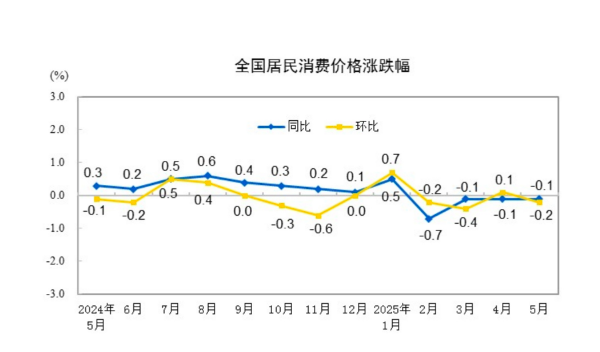
Group 1: CPI Analysis - In May, the Consumer Price Index (CPI) decreased by 0.2% month-on-month and by 0.1% year-on-year, while the core CPI, excluding food and energy, increased by 0.6%, with the growth rate expanding by 0.1 percentage points compared to the previous month [1][2][3] - The month-on-month decline in CPI was primarily driven by a 1.7% decrease in energy prices, which accounted for approximately 70% of the total decline in CPI [2] - Food prices fell by 0.2%, with seasonal vegetables seeing a 5.9% price drop, while prices for eggs, pork, and poultry slightly decreased by 0.3% to 1.0% [2][3] Group 2: PPI Analysis - The Producer Price Index (PPI) decreased by 0.4% month-on-month and by 3.3% year-on-year, with the year-on-year decline expanding by 0.6 percentage points compared to the previous month [1][4][5] - The month-on-month PPI decline was influenced by international factors, including a 5.6% drop in oil and gas extraction prices and a 3.5% decrease in refined oil product manufacturing prices [4] - Some sectors showed marginal price improvements, with consumer demand policies positively impacting prices in certain industries, such as a 12.8% increase in the price of arts and crafts and a 0.8% rise in footwear manufacturing [5]