
社会服务

Search documents
主力资金丨尾盘主力资金大幅抢筹2股
Zheng Quan Shi Bao Wang· 2025-11-04 10:49
Market Overview - The main funds in the Shanghai and Shenzhen markets experienced a net outflow of 575.34 billion yuan on November 4, with the ChiNext board seeing a net outflow of 258.43 billion yuan and the CSI 300 index stocks a net outflow of 200.36 billion yuan [1] Industry Performance - Among the 5 major industries tracked by Shenwan, only 2 saw net inflows of main funds. The light industry manufacturing sector led with a net inflow of 1.05 billion yuan, followed by the comprehensive sector with a net inflow of 47.99 million yuan [1] - The banking sector had the highest increase at 2.03%, while the power equipment sector saw the largest decline at 3.04% [1] Individual Stock Movements - 51 stocks had net inflows exceeding 100 million yuan, with 14 stocks seeing inflows over 200 million yuan. The top stock, Xue Ren Group, had a net inflow of 4.95 billion yuan [2] - Dongshan Precision, a PCB stock, had a net inflow of 4.62 billion yuan following its announcement of acquiring 100% of the French GMD Group for approximately 1 billion euros (about 8.14 billion yuan) [2][3] - Wanlima, a textile and apparel stock, also saw significant inflows, with a net inflow of 4.09 billion yuan [3] Notable Outflows - Over 160 stocks experienced net outflows exceeding 100 million yuan, with 19 stocks seeing outflows over 500 million yuan. The top outflow was from Sunshine Power, which had a net outflow of 1.608 billion yuan [5] - Other notable outflows included Sanhua Intelligent Control, Changshan Pharmaceutical, and Yiwei Lithium Energy, each with outflows exceeding 1.1 billion yuan [5] End-of-Day Trading - At the end of the trading day, the main funds had a net outflow of 41.65 billion yuan, with the ChiNext board seeing a net outflow of 9.39 billion yuan [6] - BlueFocus and Wanlima led the end-of-day net inflows, each exceeding 2.5 billion yuan [7]

美护商社行业周报:黄金税收新政落地,泡泡玛特中东首店开业-20251104
Guoyuan Securities· 2025-11-04 10:42
Investment Rating - The report maintains an "Overweight" rating for the industry, with a focus on new consumption sectors such as beauty care, IP derivatives, and gold jewelry [5][32]. Core Insights - The report highlights the recent tax policy changes regarding gold, which exempts value-added tax for standard gold transactions, potentially boosting market activity [3][22]. - The beauty care sector shows mixed performance, with some companies reporting significant revenue growth while others face declines [4][25]. - The report emphasizes the importance of domestic brands in the beauty market, with notable rankings in the Douyin beauty list indicating a shift towards local products [22][23]. Market Performance - During the week of October 27 to October 31, 2025, the retail trade, social services, and beauty care sectors experienced changes of +1.63%, +0.45%, and -2.21% respectively, ranking 8th, 17th, and 30th among 31 primary industries [13][15]. - The cosmetics sector faced a decline of -2.57%, while segments like trade and e-commerce performed well with increases of +3.44% and +2.97% [15][18]. Key Company Announcements - Shanghai Jahwa reported a revenue of 4.961 billion yuan for the first three quarters of 2025, a year-on-year increase of 10.8%, with a net profit growth of 149.1% [25]. - Proya Cosmetics achieved a revenue of 7.098 billion yuan, reflecting a modest growth of 1.89% [25]. - The opening of Pop Mart's first store in the Middle East marks a significant expansion for the brand [29]. Investment Recommendations - The report suggests focusing on companies such as Shiseido, Giant Bio, Marubi, Runben, Proya, Chaohongji, and Furuida as potential investment targets within the recommended sectors [5][32].





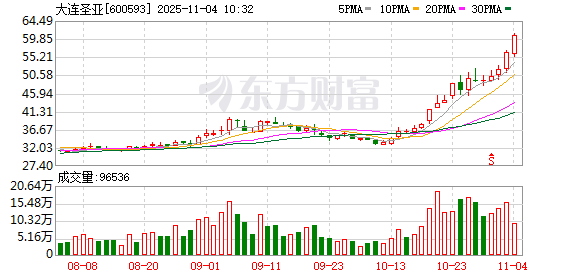
大连圣亚涨2.32%,股价创历史新高
Zheng Quan Shi Bao Wang· 2025-11-04 02:32
Group 1 - Dalian Shengya's stock price reached a historical high, increasing by 2.32% to 57.80 yuan, with a trading volume of 2.4968 million shares and a transaction value of 142 million yuan, resulting in a turnover rate of 1.94% [2] - The company's latest A-share total market capitalization is 7.54 billion yuan, while the A-share circulating market capitalization is 7.4445 billion yuan [2] - In the social services industry, Dalian Shengya is among the 27 stocks that increased in price, with notable gains from other companies like Sanxia Tourism and Xigao Hospital [2] Group 2 - For the first three quarters, the company reported an operating income of 429 million yuan, reflecting a year-on-year growth of 0.38%, while net profit was 65.9671 million yuan, showing a decline of 37.27% [2] - The basic earnings per share stood at 0.5122 yuan, and the weighted average return on equity was 36.43% [2]

姚记科技(002605):收入结构优化,盈利能力改善,关注公司短视频中心等新业态建设
GUOTAI HAITONG SECURITIES· 2025-11-03 12:00
Investment Rating - The investment rating for the company is "Accumulate" with a target price of 36.25 CNY, while the current price is 25.94 CNY [5]. Core Insights - The company experienced a decline in revenue and profit year-on-year in Q3 2025, but structural optimization of revenue has led to improved profitability. The long-term outlook remains positive, particularly regarding the development of new business areas such as the short video center [2][11]. Financial Summary - Total revenue for 2023 is projected at 4,307 million CNY, with a year-on-year growth of 10.0%. However, a significant decline of 24.0% is expected in 2024, followed by a recovery with growth rates of 6.2%, 4.5%, and 4.1% in the subsequent years [4]. - Net profit attributable to the parent company for 2023 is estimated at 562 million CNY, with a substantial increase of 61.4% compared to the previous year. A slight decrease of 4.2% is anticipated in 2024, followed by growth in the following years [4]. - The earnings per share (EPS) for 2025 is projected to be 1.45 CNY, with subsequent increases to 1.54 CNY in 2026 and 1.62 CNY in 2027 [4][12]. Business Development - The gaming business is developing steadily, with core products expected to maintain a long lifecycle. The company is focusing on upgrading existing mobile games and developing a matrix of high-quality mobile games to enhance product efficiency [11]. - The establishment of the Shanghai International Short Video Center aims to create a full industry chain ecosystem around short videos and short dramas. This includes a fund to support high-potential creators and projects, promoting content innovation and commercialization [11].

锦江酒店(600754):2025Q3业绩点评:直营进入改善区间,低基数下业绩高增
GUOTAI HAITONG SECURITIES· 2025-11-03 06:00
Investment Rating - The investment rating for the company is "Accumulate" with a target price of 30.35 CNY [5]. Core Insights - The company's performance met expectations, with high growth in the current quarter attributed to a low base from the previous year. Direct operations have shown improvement in both data and profits, although overseas losses still need to be addressed [2][11]. Financial Summary - Total revenue for 2023 is projected at 14,649 million CNY, with a year-on-year increase of 29.5%. However, a decline of 4.0% is expected in 2024, followed by further declines in 2025 and 2026 [4]. - Net profit attributable to the parent company is expected to be 1,002 million CNY in 2023, reflecting a significant increase of 691.1% year-on-year, but a decrease of 9.1% is anticipated in 2024 [4]. - Earnings per share (EPS) for 2025 is estimated at 0.86 CNY, with a gradual increase to 1.16 CNY by 2027 [4]. Operational Performance - In Q3 2025, the company achieved revenue of 3,715 million CNY, a year-on-year decrease of 4.71%, while the net profit attributable to the parent company was 375 million CNY, showing a year-on-year increase of 45.45% [11]. - The overall RevPAR (Revenue per Available Room) decreased by 1.99% year-on-year in Q3 2025, but the decline was less severe compared to Q2 [11]. - The company opened 343 new stores and closed 131, resulting in a net increase of 212 stores in the quarter [11]. Market Position - The company is positioned as an industry leader with significant potential for performance improvement, particularly in direct operations and overseas loss reduction [11]. - The financial outlook suggests that the company will benefit from operational efficiency improvements and a recovery in market expectations, which may positively impact its valuation [11].

三季报集中发布,关注细分优势赛道,期待内需整体回暖
Ping An Securities· 2025-11-03 03:24
Investment Rating - The industry investment rating is "stronger than the market" indicating an expected performance exceeding the market by more than 5% over the next six months [25]. Core Insights - The report highlights that traditional domestic demand leaders are facing short-term operational pressures, while niche segments like functional beverages and snacks continue to see growth [3][4]. - The report emphasizes the importance of monitoring dynamic changes in the market, particularly in stable growth segments and areas showing operational recovery [3]. - The report suggests focusing on companies with strong market share potential and improving operational performance, particularly in the gold and jewelry sector [3]. Summary by Relevant Sections Social Services - Companies in niche segments, such as RuYuchen and Keri International, are maintaining steady growth through incremental business despite pressures on traditional domestic demand leaders [3]. - The introduction of supportive policies for duty-free shops aims to stimulate consumption and enhance competitiveness among leading companies [6]. Textile, Apparel, and Jewelry - The report expresses optimism about investment opportunities in the gold and jewelry accessories sector, recommending attention to brands like Chao Hong Ji [3]. - The report notes that leading jewelry brands are expected to continue improving their market share and operational performance [3]. Cultural Communication - The report suggests that media companies can benefit from understanding consumer sentiment and emotional fluctuations, recommending brands with strong performance certainty like Pop Mart [3]. Food and Beverage - Alcohol - The report indicates that most liquor companies are experiencing a deeper decline in net profit compared to the previous quarter, with a focus on leading companies that are expected to enhance market share through better brand management [3]. - It identifies three main lines of focus: high-end liquor with relatively strong demand, mid-range liquor with national expansion, and local wines with solid market bases [3]. Food and Beverage - Mass Market - The functional beverage sector continues to expand, with Dongpeng Beverage showing steady growth despite high base figures [3]. - The snack sector is experiencing performance differentiation, with the konjac category still showing significant growth potential [3]. - The dairy sector is seeing a gradual recovery in demand, with leading companies like Yili expected to enter a profit recovery phase [3]. - The report notes that the restaurant supply chain is stabilizing, with industries like condiments and frozen foods emerging from a downturn [3].
上证补缺,市场持续活跃
Tebon Securities· 2025-10-31 13:50
Market Analysis - The A-share market remains active with a strong profit-making effect despite the Shanghai Composite Index experiencing a decline of 0.81% to 3954.79 points on October 31, 2025 [3] - The trading volume for the day was 2.35 trillion yuan, indicating robust market activity with 3759 stocks rising against 1548 stocks falling [3] Sector Performance - Notable gains were observed in sectors such as biomedicine, media, retail, social services, and textiles, driven by a new policy aimed at enhancing duty-free shopping to stimulate consumption [5] - Conversely, sectors that previously saw significant gains, such as telecommunications, electronics, and non-ferrous metals, experienced pullbacks [5] PMI Data Insights - The manufacturing PMI for October was reported at 49.0%, a decrease of 0.8 percentage points from the previous month, while the non-manufacturing PMI rose slightly to 50.1% [5][6] - Despite the decline in manufacturing PMI, key industries such as high-tech manufacturing and consumer goods remain in expansion territory, indicating underlying economic stability [5][6] Bond Market Trends - The 30-year government bond futures rose by 0.42%, reflecting a positive trend in the long-term bond market, while short-term bonds showed mixed performance [8] - The central bank's net injection of liquidity through reverse repos indicates a continued accommodative monetary policy, supporting the bond market [8] Commodity Market Overview - The commodity index saw a slight decline of 0.17%, with significant drops in lithium carbonate and other products, while precious metals like gold and silver showed price recoveries [8] - The adjustment in lithium carbonate prices is attributed to cautious purchasing behavior from downstream companies amid stable demand and declining inventories [8] Investment Strategy Recommendations - Continued focus on technology sectors and industries aligned with the 14th Five-Year Plan is advised, despite the recent PMI reading indicating a contraction in manufacturing [10][11] - The bond market is expected to remain supported by the central bank's actions, while precious metals are recommended for gradual accumulation as their investment value becomes more apparent [10][11]
汇安基金吴尚伟:后市有望震荡再平衡,重点或可关注六大线索
Quan Jing Wang· 2025-10-31 08:36
Core Viewpoint - The market is experiencing rapid shifts in focus and sector rotation, prompting investors to seek stability amidst fluctuations, particularly around the key 4000-point level of the Shanghai Composite Index [1] Group 1: Market Analysis - The fourth quarter is expected to see a phase of oscillation and rebalancing, with a significant portion of industry valuations deemed reasonable, suggesting that the 4000-point level may serve as a temporary peak [2] - The technology sector is under pressure to meet performance expectations, leading to a concentration of investment in leading tech firms, while cyclical stocks are gaining attention due to positive PPI forecasts [2][3] Group 2: Investment Opportunities - Four potential investment opportunities are identified: 1. Anticipated improvements in liquidity by 2026 due to economic characteristics and strategic national initiatives [3] 2. The consumer sector may see stabilization in core CPI and improvements in consumer loan interest rates [3] 3. Precious metals and resource stocks are likely to benefit from external interest rate cuts and low valuations [3] 4. Increased growth support from government initiatives and new industry themes emerging from the 14th Five-Year Plan [3] Group 3: Sector Insights - The consumer sector is experiencing structural highlights despite overall pressure, with potential recovery in sectors like liquor and dining if regulatory pressures ease [4] - The innovative drug sector is currently in a correction phase after a strong performance earlier in the year, with a focus on companies with established business development (BD) assets [5] - The cosmetics industry is showing robust growth driven by domestic brand development and online channel expansion [6] Group 4: Growth Sectors - The internet media sector is seen as resilient due to domestic demand and neutral tariffs, with gaming identified as a particularly attractive investment area [7][8] - The gaming industry is characterized by stable demand and a favorable regulatory environment, suggesting long-term investment potential beyond short-term trends [8] - In the renewable energy sector, leading companies are expected to see significant growth driven by new capacity and market share gains [9]
光大证券晨会速递-20251031
EBSCN· 2025-10-31 02:04
Group 1 - The report highlights the significant advantages of Solid State Transformers (SST) over traditional transformers, indicating a shift in power distribution architecture towards SST technology to meet the increasing power demands of servers [2] - For China Petroleum & Chemical Corporation (Sinopec), the report notes a slight improvement in net profit for Q3 2025, with total revenue of 2,113.4 billion yuan, down 10.7% year-on-year, and a net profit of 30 billion yuan, down 32.2% year-on-year [3] - China Oilfield Services Limited (COSL) reported a 3.5% year-on-year increase in total revenue for Q3 2025, amounting to 34.85 billion yuan, with a net profit increase of 31.3% year-on-year to 3.21 billion yuan [4] Group 2 - Source Pet's Q3 2025 revenue reached 490 million yuan, up 26.6% year-on-year, with a net profit of 56.05 million yuan, up 22.3% year-on-year, indicating strong performance in both domestic and international sales [5] - Huali Group reported a slight decline in revenue of 0.3% year-on-year for Q3 2025, with a net profit decrease of 20.7% year-on-year, highlighting challenges in the footwear segment [6] - Agricultural Bank of China achieved a revenue of 550.9 billion yuan in Q3 2025, with a net profit of 220.9 billion yuan, reflecting a 3% year-on-year growth [10] Group 3 - The report indicates that the macroeconomic environment is affecting various sectors, with a focus on the ongoing US-China trade tensions impacting negotiations in multiple industries [8] - The bond market is experiencing a contraction in scale, with active bond funds adopting defensive strategies to mitigate risks amid a weakening market [9] - The report emphasizes the resilience of the banking sector, with several banks reporting stable growth in revenue and net profit, alongside strong risk mitigation capabilities [11][12][13]
国金资管:A股有望维持强势格局,风格或迎阶段性转换
Xin Hua Cai Jing· 2025-10-30 13:54
Core Viewpoint - The A-share market is currently experiencing a coexistence of new index highs and structural differentiation, indicating a complex market environment [1] Market Outlook - The low interest rate environment is expected to continue enhancing the attractiveness of equity assets for investors [1] - Economic fundamentals are showing positive signals of steady recovery, which will provide strong support for the market [1] - The overall A-share market is likely to maintain a strong trend in the fourth quarter, although sector styles may further differentiate and experience phase transitions [1] Sector Opportunities - The technology sector's growth momentum is highlighted as a key area of focus [1] - There is an optimistic outlook for overseas AI capital expenditure growth in the next two months, alongside ongoing advancements in the domestic AI industry [1] - The explosive growth in global AI large model training demand is driving sustained orders for hardware suppliers such as high-speed optical modules and storage chips, making the profit realization pace of related companies a core focus [1] - Under the "Consumption Boost Special Action" policy, sectors like home appliances, social services, and automobiles are expected to release recovery elasticity driven by policy implementation and terminal demand recovery [1]