电气机械器材

Search documents
财政部:7月份全国一般公共预算收入增幅为年内最高
Sou Hu Cai Jing· 2025-08-19 08:43
Group 1 - In July, the national general public budget revenue reached 202.73 billion yuan, a year-on-year increase of 2.6%, marking the highest monthly growth this year [1] - From January to July, the total general public budget revenue was 1,358.39 billion yuan, with a growth rate of 0.1%, improving by 0.4 percentage points compared to the first half of the year [1] - Tax revenue showed a significant narrowing of decline, with July tax revenue at 180.18 billion yuan, a year-on-year increase of 5%, continuing to recover since April [1] Group 2 - National general public budget expenditure grew by 3.4% year-on-year, totaling 1,607.37 billion yuan from January to July, with key areas such as social security and employment seeing a 9.8% increase [2] - Expenditure on education grew by 5.7%, while health and wellness spending increased by 5.3% [2] - Local government special bonds and other financial instruments contributed to a 31.7% increase in government fund budget expenditure, with 2.89 trillion yuan spent in the first seven months [2]
前7个月铁路船舶航空航天设备税收收入增长33%
Zheng Quan Shi Bao Wang· 2025-08-19 08:14
Group 1 - The core viewpoint of the article highlights the positive tax revenue performance in various industries, particularly in equipment manufacturing and modern services during the first seven months of the year [1] Group 2 - Tax revenue from the equipment manufacturing industry showed significant growth, with railway, shipbuilding, and aerospace equipment increasing by 33%, computer and communication equipment by 10.1%, and electrical machinery and equipment by 8% [1] - The scientific research and technical service industry experienced a tax revenue increase of 12.7% [1] - The cultural, sports, and entertainment industry saw a tax revenue growth of 4.1% [1]
7月PMI点评:政策持续提振高技术行业生产经营预期
Orient Securities· 2025-08-05 05:44
Economic Indicators - July manufacturing PMI recorded at 49.3%, down from 49.7% in the previous month[5] - Service industry business activity index at 50.1%, a decrease from 50.5%[5] - New export orders PMI at 47.1%, down from 47.7% last month, indicating continued pressure on exports[5] High-Tech Industry Performance - High-tech industry PMI at 50.6%, slightly down from 50.9%, remaining above the threshold[5] - Production and new orders PMI for high-tech sectors at 50.5% and 49.4%, respectively, showing resilience compared to traditional industries[5] - Confidence in high-tech sectors bolstered by "anti-involution" policies, leading to increased expectations for production activities, with PMI rising to 52.6%[5] Market Dynamics - "Anti-involution" policies have positively impacted prices in high-tech industries, with significant increases in factory and raw material purchase price indices[5] - Service sector maintained above the threshold, driven by summer holiday effects, with indices for related sectors like rail and air transport exceeding 60.0%[5] - The ongoing economic transition emphasizes the importance of domestic demand as export momentum weakens post-Geneva negotiations[5]
上半年上海三大先导产业产值同比增长9.1%
Ren Min Ri Bao· 2025-08-04 19:08
Core Insights - Shanghai's GDP reached 2.62 trillion yuan in the first half of the year, with a year-on-year growth of 5.1% [1] Economic Performance - The industrial added value of Shanghai's large-scale enterprises grew by 5.1% year-on-year, an increase of 1.4 percentage points compared to the first quarter [1] - The city is actively promoting the construction of world-class high-end industrial clusters, implementing policies for industries such as smart terminals and commercial aerospace [1] - The output value of shipbuilding, aerospace, and electrical machinery manufacturing increased by 18.1% and 13.3% year-on-year, respectively [1] - The three leading industries saw a year-on-year output value growth of 9.1%, with integrated circuits, artificial intelligence, and biomedicine growing by 11.7%, 12.3%, and 4.4%, respectively [1] Consumer Market - Shanghai has implemented national measures to boost consumption, organizing a series of activities to expand consumer spending [1] - The city issued 500 million yuan in "2025 Le. Shanghai" service consumption vouchers [1] - The "old-for-new" subsidy program for consumer goods has accelerated, with the program directly driving social consumption exceeding 54 billion yuan in the first half of the year [1]
21评论丨短期扰动不改经济向好趋势
2 1 Shi Ji Jing Ji Bao Dao· 2025-07-31 22:57
Group 1 - The manufacturing PMI in July was 49.3%, a decrease of 0.4 percentage points from the previous month, indicating a return to below the critical point after two months [1] - The non-manufacturing business activity index and comprehensive PMI output index were 50.1% and 50.2% respectively, both remaining in the expansion zone despite a slight decline [1] - The decline in manufacturing PMI is attributed to seasonal factors and extreme weather, with production index at 50.5%, down 0.5 percentage points, indicating weakened production momentum but still in the expansion zone [1][3] Group 2 - The non-manufacturing business activity index remains at 50.1%, supported by stable service sector performance, although the construction industry faced challenges due to extreme weather [2] - The service sector showed structural differentiation, with some areas like transportation and entertainment performing well due to summer consumption, while real estate-related activities remained weak [2] - The service industry business activity expectation index rose to 56.6%, indicating optimistic market expectations overall [2] Group 3 - New growth drivers continue to emerge, with sectors like equipment manufacturing and high-tech manufacturing maintaining good expansion levels, supporting economic structure optimization [3] - Industries such as railway, aerospace, and electronics are showing strong production and new order indices, indicating robust growth momentum [3] - The overall economic operation remains stable, with internal demand recovering and new growth drivers countering downward pressures from old drivers [3] Group 4 - The recent Central Political Bureau meeting highlighted the resilience and vitality of the economy, while acknowledging ongoing risks and challenges [4] - The meeting emphasized the need for macro policies to remain effective and stable, with potential targeted policies to be introduced if significant economic fluctuations occur [4]
制造业PMI低于荣枯线 国常会部署贴息政策促消费
Di Yi Cai Jing· 2025-07-31 13:51
Economic Overview - The Central Political Bureau emphasized the need to enhance macroeconomic policy effectiveness and stimulate internal economic growth [1] - The State Council reiterated the implementation of personal consumption loan interest subsidy policies to better stimulate consumption potential [1][7] Manufacturing Sector - The manufacturing Purchasing Managers' Index (PMI) for July was reported at 49.3%, a decrease of 0.4 percentage points from the previous month, marking the fourth consecutive month below the growth threshold [1][4] - The new orders index for manufacturing fell to 49.4%, down 0.8 percentage points, indicating a contraction in market demand [6] - Despite the decline in demand, the production index remained at 50.5%, indicating continued expansion in manufacturing activities [6] Price Trends - The manufacturing raw material purchase price index rose to 51.5%, an increase of 3.1 percentage points, indicating a recovery in raw material prices [6] - The ex-factory price index increased to 48.3%, up 2.1 percentage points, marking the second-highest point this year [6] Business Confidence - The production and business activity expectation index rose to 52.6%, reflecting increased confidence among manufacturing enterprises regarding market development [8] - Large enterprises maintained a PMI of 50.3%, while medium-sized enterprises improved to 49.5%, indicating a mixed outlook across different enterprise sizes [8] Non-Manufacturing Sector - The non-manufacturing business activity index was reported at 50.1%, a decrease of 0.4 percentage points, but still within the expansion range [10] - The construction business activity index fell to 50.6%, influenced by seasonal weather conditions, while infrastructure-related activities continued to show robust growth [10] Consumer Behavior - The summer consumption effect began to show, with retail and postal service indices rising above 50%, indicating strong consumer spending intentions [11] - However, the accommodation and catering sectors remained below 50%, suggesting that summer consumption has not yet significantly impacted these areas [11][12] Policy Implications - The Central Political Bureau's meeting highlighted the importance of releasing internal demand potential and implementing consumption-boosting actions [12] - The focus on service consumption is expected to play a crucial role in meeting public needs and driving consumption industry upgrades [12]

制造业PMI短期有所波动 我国经济总体产出保持扩张——解读7月份PMI数据
Xin Hua She· 2025-07-31 08:53
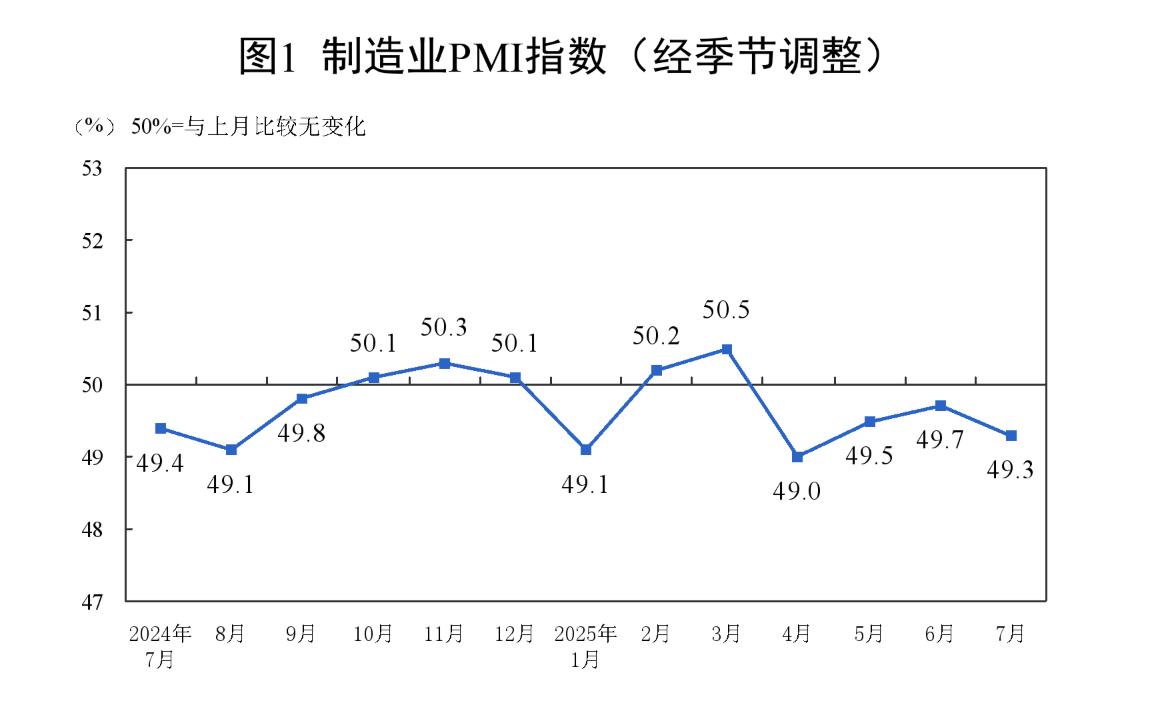
Core Viewpoint - The manufacturing PMI in July showed a short-term fluctuation, dropping to 49.3%, while the overall economic output remains in an expansion phase, supported by non-manufacturing indices above 50% [1][2]. Manufacturing Sector - In July, the manufacturing PMI was 49.3%, a decrease of 0.4 percentage points from the previous month, influenced by seasonal production slowdowns and extreme weather conditions [1]. - The new orders index for manufacturing was 49.4%, down 0.8 percentage points, and the new export orders index was 47.1%, down 0.6 percentage points [1]. - Despite weak market demand, the production index was at 50.5%, indicating continued expansion for the third consecutive month [1]. Key Industries - The equipment manufacturing PMI was 50.3%, down 1.1 percentage points but still in the expansion zone; high-tech manufacturing PMI was 50.6%, maintaining expansion for six months [2]. - Large enterprises showed stable expansion with a PMI of 50.3%, while medium-sized enterprises improved to 49.5%, and small enterprises decreased to 46.4% [2]. Price Indices - The raw material purchase price index for manufacturing was 51.5%, up 3.1 percentage points, returning to the expansion zone after four months below 50% [2]. - The factory price index was 48.3%, up 2.1 percentage points, marking the second-highest point this year [2]. Market Expectations - The manufacturing production and operation activity expectation index rose to 52.6%, indicating increased confidence among manufacturers [3]. - The non-manufacturing business activity index was 50.1%, with the service sector at 50% and construction at 50.6%, both remaining in the expansion zone [3]. - The non-manufacturing business activity expectation index was 55.8%, reflecting optimism among most non-manufacturing enterprises [3]. Future Outlook - It is anticipated that construction activities will rebound as the rainy season ends, supported by policies aimed at boosting investment and consumption [4].
7月中国制造业PMI为49.3% 汽车等行业预期较强
Zhong Guo Xin Wen Wang· 2025-07-31 05:27
Group 1 - In July, China's manufacturing Purchasing Managers' Index (PMI) dropped to 49.3%, influenced by seasonal production slowdowns and adverse weather conditions [1] - The production index and new orders index for July were 50.5% and 49.4%, respectively, indicating a slowdown in market demand despite continued expansion in manufacturing activities [1] - Major raw material purchase price index rose to 51.5%, marking the first increase above the critical point since March, while the factory price index was at 48.3% [1] Group 2 - Large enterprises' PMI was 50.3%, down 0.9 percentage points, while medium-sized enterprises' PMI improved to 49.5%, indicating a continued recovery in sentiment [1] - Key industries such as equipment manufacturing and high-tech manufacturing maintained PMIs above the critical point at 50.3% and 50.6%, respectively [2] - The production and business activity expectation index rose to 52.6%, reflecting increased confidence among manufacturing enterprises [2]
制造业PMI季节性回落至49.3%,下阶段走势如何
Di Yi Cai Jing Zi Xun· 2025-07-31 03:29
Economic Overview - The manufacturing Purchasing Managers' Index (PMI) for July is reported at 49.3%, a decrease of 0.4 percentage points from the previous month, indicating a slight contraction in manufacturing activity [1] - The non-manufacturing business activity index stands at 50.1%, also down by 0.4 percentage points, reflecting a slowdown in growth [1] - The composite PMI output index is at 50.2%, down 0.5 percentage points, but still above the critical point, suggesting overall expansion in business activities [1] Manufacturing Sector Insights - The new orders index for manufacturing is at 49.4%, a decline of 0.8 percentage points, indicating a tightening in market demand [3] - The new export orders index is reported at 47.1%, down 0.6 percentage points, further highlighting weak demand [3] - Despite the demand weakness, the production index remains at 50.5%, indicating continued expansion in manufacturing activities for the third consecutive month [3] - The raw material purchase price index has risen to 51.5%, an increase of 3.1 percentage points, suggesting a recovery in raw material prices [3] Price Trends - The ex-factory price index for manufactured goods is at 48.3%, up 2.1 percentage points, marking the second-highest point this year [3] - The basic raw materials sector is driving the stabilization and recovery of market prices, with the purchase price index rising over 7 percentage points to 52% [4] Business Confidence and Expectations - The production and business activity expectation index is at 52.6%, an increase of 0.6 percentage points, indicating improved confidence among manufacturing enterprises [4] - Large enterprises maintain a PMI of 50.3%, while medium-sized enterprises show improvement with a PMI of 49.5%, and small enterprises have a PMI of 46.4%, indicating varying levels of economic health across different company sizes [4] Non-Manufacturing Sector Performance - The non-manufacturing business activity index is at 50.1%, reflecting a slowdown but still within the expansion range [8] - The construction sector's business activity index is at 50.6%, down 2.2 percentage points, indicating a slowdown due to seasonal weather impacts [8] - Consumer spending during the summer shows positive trends, with retail and postal service indices rising above 50% and 60%, respectively, indicating strong consumer purchasing intentions [9] Future Outlook - The construction sector is expected to rebound post-rainy season, with infrastructure activities projected to continue steady growth [8][9] - The overall economic foundation remains solid, with expectations for continued stable expansion and quality improvement in the second half of the year, supported by ongoing macroeconomic policies [5]
制造业苦内卷久矣
Hu Xiu· 2025-06-13 08:32
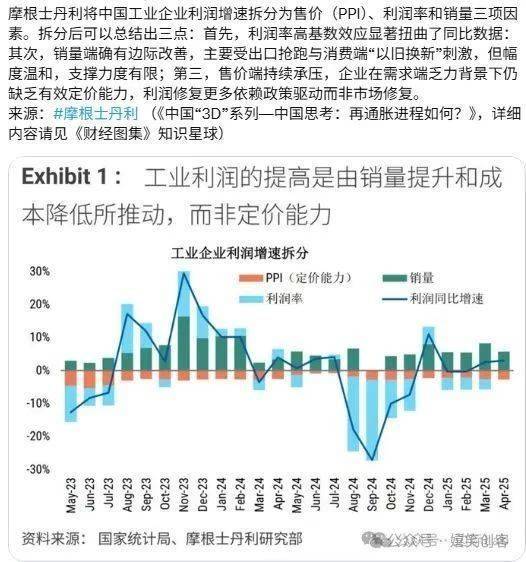
Core Insights - The automotive industry is facing regulatory scrutiny due to its significant investment growth despite shrinking profits [1][15] - Overall industrial profits have improved in the first four months of the year, with volume contributions outpacing price contributions [2] - There are notable differences in performance across various industries, particularly when comparing fixed asset investment growth and profit growth [3][6] Industry Analysis - A clear correlation exists where higher investment growth often corresponds with lower profit growth, with some industries even experiencing negative profit growth [6] - The automotive and textile industries are exceptions, showing profit shrinkage while still accelerating investment [9] - Most other industries, such as instrumentation, electrical machinery, and specialized equipment, are improving with reduced investment and increased profits [10] - The power, gas, and water supply sectors are also facing challenges, with profits declining but investments increasing to support growth [13] Specific Industry Observations - The automotive sector's situation is particularly concerning, as it has the second-lowest profit growth while exhibiting the highest investment growth [14] - Leading companies in the automotive industry are expanding production to outcompete smaller firms, benefiting from increased output and volume, but this growth comes at a cost to the supply chain [14]