
建筑业

Search documents
2025年11月PMI数据点评:制造业景气水平小幅回升,市场预期仍保持乐观
KAIYUAN SECURITIES· 2025-12-02 03:58
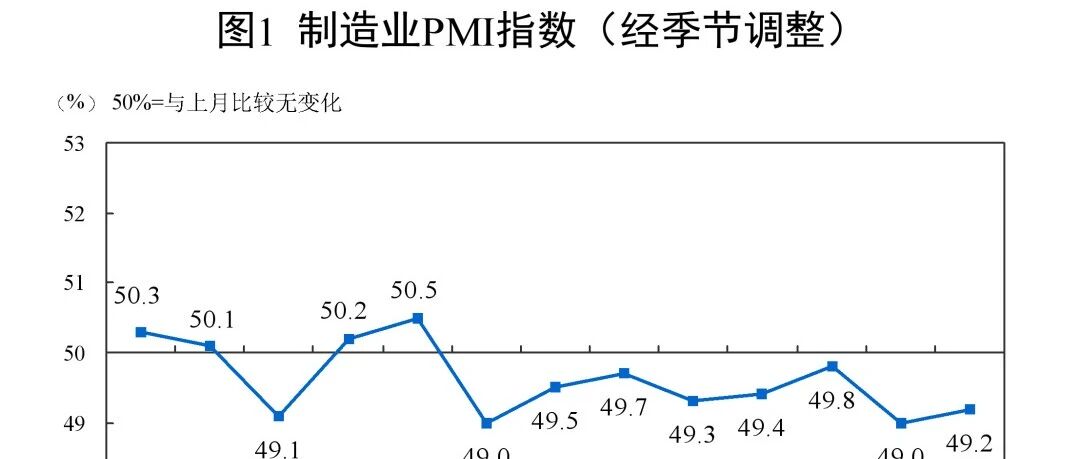
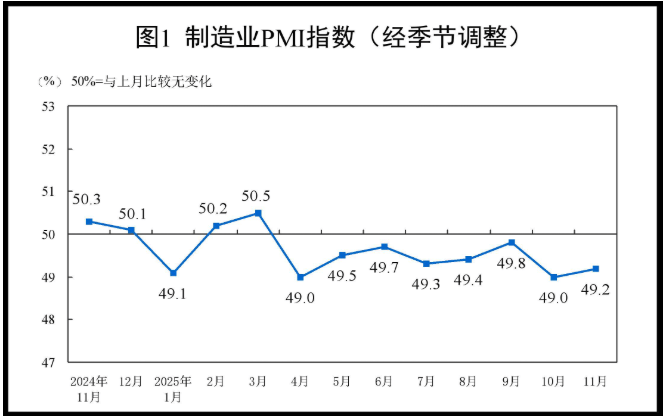
Group 1: Report Summary - The report is a commentary on the November 2025 PMI data, titled "Manufacturing Sentiment Improves Slightly, Market Expectations Remain Optimistic" [1] - The analysts are Chen Xi and Wang Shuaizhong, with contact information and certificate numbers provided [2] Group 2: PMI Data Overview - In November 2025, the manufacturing PMI was 49.2%, up 0.2 pct month-on-month and down 1.1 pct year-on-year; the non-manufacturing PMI was 49.5%, down 0.6 pct month-on-month; the composite PMI was 49.7%, down 0.3 pct month-on-month [2][3] Group 3: Manufacturing PMI Analysis - The manufacturing sentiment improved slightly due to export improvement, but it remained in the contraction range for eight consecutive months. New export orders rose 1.7 pct, on-hand orders rose 1.0 pct, and the production index rose 0.3 pct month-on-month [3] Group 4: Non-manufacturing PMI Analysis - The decline in the service PMI dragged the non-manufacturing PMI into the contraction range. In November, the service PMI was 49.5%, down 0.7 pct month-on-month and 0.6 pct year-on-year, the first time in 2025 to fall into the contraction range [4] - New export orders rose, but new orders fell, indicating insufficient domestic demand. Policy measures for new consumption scenarios and promoting domestic demand and consumption may be in the works [4] Group 5: Structural Highlights - High-tech manufacturing remained in expansion, with a PMI of 50.1%. Equipment manufacturing, consumer goods, and basic raw materials industries also had PMIs above the overall manufacturing level, despite some declines [5] - Price indices improved. The purchase price of major raw materials and the ex-factory price of manufacturing rose 1.1 pct and 0.7 pct respectively, and the input price and sales price of non-manufacturing rose 1.0 pct and 1.3 pct respectively [5] Group 6: Construction PMI - The construction PMI rose to 49.6%, up 0.5 pct month-on-month. The business activity expectation index was 57.9%, up 1.9 pct month-on-month, indicating improved confidence [6] Group 7: Market Expectations - Expectations for both manufacturing and non-manufacturing improved. The manufacturing production and operation activity expectation was 53.1%, up 0.3 pct, and the non-manufacturing business activity expectation was 56.2%, up 0.1 pct [6] Group 8: Bond Market View - Bond yields are expected to rise trendily as economic expectations are revised. For stock and bond allocation, the view is that economic growth may not decline significantly in H2 2025, structural issues like prices will improve, and the stock-bond allocation will continue to shift [7]
渤海证券研究所晨会纪要(2025.12.02)-20251202
BOHAI SECURITIES· 2025-12-02 01:44
Group 1 - The core viewpoint of the report indicates that the manufacturing sector is experiencing a recovery in November 2025, driven by improvements in both production and demand, with the manufacturing PMI rising to 49.2% and the production index increasing by 0.3 percentage points to 50.0% [2][3] - The new orders index also saw an increase of 0.4 percentage points to 49.2%, while new export orders rose by 1.7 percentage points to 47.6%, reflecting a positive impact from the recent US-China trade discussions [3] - The report highlights that large enterprises' manufacturing PMI fell by 0.6 percentage points to 49.3%, remaining below the threshold, while medium and small enterprises showed improvements, with medium enterprises rising by 0.2 percentage points to 48.9% and small enterprises increasing by 2.0 percentage points to 49.1%, marking the second-highest level this year [3] Group 2 - The non-manufacturing business activity index decreased by 0.6 percentage points to 49.5%, the lowest level since 2023, with the construction sector showing a slight recovery while the service sector declined due to the end of holiday effects [4] - The comprehensive PMI output index fell by 0.3 percentage points to 49.7%, indicating a contraction, primarily due to the decline in the non-manufacturing sector offsetting the manufacturing recovery [4] - Overall, the report suggests that the improvement in manufacturing sentiment is mainly attributed to a stabilizing external environment, with expectations for continued improvement in December due to forthcoming policy deployments [4]
产需修复持续性有待观察——11月PMI点评
Changjiang Securities· 2025-12-01 23:30
1. Report Industry Investment Rating No relevant content provided. 2. Core View of the Report In November 2025, the manufacturing PMI showed a marginal improvement with synchronized recovery in production and demand and accelerated destocking, but the asymmetric recovery of raw material and finished product prices may still restrict corporate profit repair, and the sustainability of external demand contribution remains to be verified. The decline in service - sector sentiment indicates that the resilience of domestic demand also needs to be observed. The bond market has adjusted, and the impact of PMI data is expected to be limited. It is recommended to allocate 10 - year Treasury bonds with a taxable coupon yield above 1.8% when there are adjustments [2]. 3. Summary by Related Catalogs Manufacturing PMI - **Overall situation**: In November 2025, the manufacturing PMI was 49.2%, up 0.2 pct from the previous month, still seasonally weak but with marginal improvement. Production, procurement, and import indices on the supply - side increased, and new order and backlog order indices on the demand - side rose. Inventory destocking accelerated, and some predictive indicators showed improved supply - demand relationships [5][9]. - **External demand contribution**: The new export order index rose 1.7 pct to 47.6%, and the new export order indices of four major manufacturing industries and large, medium, and small enterprises all increased. However, the asymmetric recovery of raw material and finished product prices may pressure corporate profit repair [9]. - **Enterprise size and industry differences**: Small and medium - sized enterprises' sentiment improved, especially small enterprises which rose 2 pct to a nearly 6 - month high of 49.1%, while large enterprises' sentiment declined 0.6 pct to 49.3%. High - tech manufacturing with a high proportion of small and medium - sized enterprises remained in expansion, while the sentiment of equipment and consumer goods manufacturing declined, and their production sides may be stronger than the demand sides [9]. Non - manufacturing PMI - **Overall situation**: The non - manufacturing business activity index was 49.5% in November 2025, down 0.6 pct from the previous month, the first time below the boom - bust line since 2023. The service - sector sentiment was dragged down by factors such as the fading holiday effect, while the construction industry's sentiment improved [5][9]. - **Sub - item structure**: The inventory and new order indices of non - manufacturing declined, while the new export order index rose. The sales price and input price indices increased for two consecutive months. In the service sector, the financial industry and some new - energy industries showed good performance. The construction industry's business activity index increased, possibly boosted by financial activities and policy support [9]. Investment Suggestion The bond market has adjusted, and the impact of PMI data is expected to be limited. It is recommended to allocate 10 - year Treasury bonds with a taxable coupon yield above 1.8% when there are adjustments [2][9].
【权威解读】11月份制造业采购经理指数小幅回升 非制造业商务活动指数有所回落
中汽协会数据· 2025-12-01 12:41
Group 1: Manufacturing Purchasing Managers Index (PMI) - In November, the manufacturing PMI rose to 49.2%, indicating a slight improvement in economic conditions [2] - Both production index and new orders index improved, reaching 50.0% and 49.2% respectively, with production index crossing the critical point [2] - Small enterprises showed significant recovery with PMI at 49.1%, marking a 2.0 percentage point increase, the highest in six months [2][3] Group 2: Non-Manufacturing Business Activity Index - The non-manufacturing business activity index decreased to 49.5%, down 0.6 percentage points from the previous month, indicating a decline in non-manufacturing economic conditions [4] - The service industry index fell to 49.5%, influenced by the end of holiday effects, while certain sectors like railway transport and financial services remained robust [5] - The construction industry index improved to 49.6%, with a business activity expectation index of 57.9%, reflecting increased confidence in the sector [5] Group 3: Comprehensive PMI Output Index - The comprehensive PMI output index fell to 49.7%, a decrease of 0.3 percentage points, with manufacturing production index at 50.0% and non-manufacturing business activity index at 49.5% [6]


【数据发布】2025年11月中国采购经理指数运行情况
中汽协会数据· 2025-12-01 12:41
Group 1: Manufacturing PMI Overview - In November, the Manufacturing Purchasing Managers' Index (PMI) was 49.2%, an increase of 0.2 percentage points from the previous month, indicating an improvement in economic conditions [1] - The PMI for large enterprises was 49.3%, a decrease of 0.6 percentage points, while small and medium-sized enterprises had PMIs of 48.9% and 49.1%, increasing by 0.2 and 2.0 percentage points respectively, all below the critical point [4] - The production index was at 50.0%, up by 0.3 percentage points, indicating stable manufacturing production overall [4] - The new orders index rose to 49.2%, an increase of 0.4 percentage points, suggesting an improvement in market demand [4] - The raw materials inventory index remained at 47.3%, indicating a continued decrease in the inventory of major raw materials [5] Group 2: Non-Manufacturing PMI Overview - In November, the Non-Manufacturing Business Activity Index was 49.5%, a decrease of 0.6 percentage points from the previous month [9] - The construction industry business activity index was 49.6%, up by 0.5 percentage points, while the service industry index was 49.5%, down by 0.7 percentage points [12] - The new orders index for non-manufacturing was 45.7%, a decline of 0.3 percentage points, indicating a drop in market demand [14] - The input price index rose to 50.4%, an increase of 1.0 percentage point, indicating a rise in the overall price level of inputs used in business activities [14] - The business activity expectation index was 56.2%, reflecting a generally optimistic outlook among non-manufacturing enterprises [15] Group 3: Comprehensive PMI Overview - The Comprehensive PMI Output Index was 49.7% in November, a decrease of 0.3 percentage points from the previous month [21]
中国房地产业信用指数连续3个月呈环比上升态势
Zhong Guo Xin Wen Wang· 2025-12-01 12:35
Core Insights - The core viewpoint of the article is that China's enterprise credit index for October is 161.56, indicating a stable credit level for businesses, with the real estate sector showing a consistent upward trend for three consecutive months [1]. Summary by Categories Overall Credit Index - In October, China's enterprise credit index decreased by 0.73 points compared to September, but overall reliability, operational, compliance, and relational indicators remained stable [1]. - Financial and regulatory indicators saw a slight decline, yet the proportion of low credit risk enterprises increased, and consumer complaints decreased, indicating a solid foundation for enterprise credit levels [1]. Regional Performance - The top five provinces in credit index rankings are Beijing, Anhui, Tianjin, Chongqing, and Shaanxi, with Beijing showing a strong growth trend and ranking first nationally [1]. - Most regions in the country experienced a high-level adjustment in their credit indices, with notable improvements in Tianjin, Shanghai, and Tibet, reflecting enhanced compliance and stability among enterprises [1]. Industry Performance - The top five industries in credit index rankings are finance, electricity, heat, gas, and water production and supply, water conservancy, environment and public facilities management, scientific research and technical services, and construction [1]. - In October, half of the industries reported a month-on-month increase in their credit indices, with the cultural, sports, and entertainment industry showing the highest growth rate [1]. - The real estate sector's credit index has been on a steady rise for three consecutive months, demonstrating resilience in its development [1].
价格传导扭曲制约企业利润修复,非制造业景气度收缩
China Post Securities· 2025-12-01 11:02
Economic Indicators - The November manufacturing PMI is at 49.2%, showing a slight increase of 0.2 percentage points from the previous value, but still below the expansion threshold[9] - The non-manufacturing business activity index fell to 49.5%, down 0.6 percentage points, indicating a contraction in the service sector[21] - The construction sector's PMI improved to 49.6%, up 0.5 percentage points, reflecting a recovery driven by policy support[22] Price Dynamics - The PMI input price index for raw materials is at 53.6%, indicating strong price pressures, while the output price index is at 48.2%, below the expansion threshold, highlighting a disconnect in price transmission[14] - The PPI year-on-year growth is estimated to be around -2.5%, down 0.4 percentage points, indicating a divergence from the output price index[19] Profitability and Market Outlook - Industrial profits turned negative at -5.5% in October, primarily due to rising production costs and insufficient demand, which limits the ability to pass on costs to consumers[14] - The short-term economic outlook favors the bond market, with expectations of a moderate decline in interest rates due to the central bank's resumption of bond purchases[28] - Without new policy measures such as rate cuts, the equity market's recovery in industrial profits is expected to remain under pressure[28] Risks - Key risks include rising sovereign debt risks abroad, escalating geopolitical conflicts, and the potential for policy effects to fall short of expectations[3]
11月中国综合PMI探底:中国经济在调整中孕育新机(一)
Sou Hu Cai Jing· 2025-12-01 09:19
Core Viewpoint - China's economy is experiencing a temporary turbulence amidst a complex global economic environment, with the composite PMI output index dropping to 49.7%, a decrease of 0.3 percentage points from the previous month, marking a new low in nearly a year. However, this decline reflects a structural adjustment and accumulation of strength rather than a comprehensive economic downturn [1]. Group 1: Manufacturing Sector - The manufacturing sector shows resilience with a PMI of 49.2%, a slight increase of 0.2 percentage points from the previous month, indicating a glimmer of hope amidst overall economic pressure [2]. - Small and medium-sized enterprises (SMEs) demonstrate strong vitality, with the PMI for medium-sized enterprises rising by 0.2 percentage points and small enterprises surging by 2.0 percentage points, highlighting the robust resilience of the grassroots economy [2]. - The production index has returned to the critical point of 50.0%, up by 0.3 percentage points, indicating overall stability in manufacturing production [3]. - The new orders index has improved to 49.2%, an increase of 0.4 percentage points, suggesting a gradual recovery in market demand and an increase in enterprise orders [3]. - The employment index has slightly risen, indicating an improvement in the employment situation within manufacturing, providing a human resource guarantee for stable production [3]. Group 2: Non-Manufacturing Sector - The non-manufacturing business activity index stands at 49.5%, down by 0.6 percentage points, becoming a major drag on the composite index, yet it reflects significant industry differentiation rather than a complete downturn [4]. - The service sector experiences short-term volatility, with real estate and residential services remaining at low levels, while sectors like railway transportation, finance, and telecommunications maintain high prosperity levels, illustrating a mixed performance [4]. - The construction sector shows signs of stabilization and recovery, with an increase in the new orders index indicating a growing demand for construction projects [4]. - Changes in input prices and sales prices in the construction sector reflect proactive responses to cost control and price adjustments, enhancing profitability and market competitiveness [4]. Group 3: Economic Outlook - Despite the temporary decline in the composite index, the fundamentals of China's economy remain solid, with stable manufacturing production, revitalized SMEs, and a high expectation level of 56.2% among non-manufacturing enterprises for the future [5]. - The current data drop is viewed as a short-term adjustment rather than a trend of decline, suggesting that the economy is seeking balance in a more nuanced and stable manner [5]. - The ongoing transformation and upgrading of the economy may be filled with challenges, but each step is directed towards a healthier and more sustainable direction [5].
2025年10月中国企业信用指数基本平稳
Zhong Guo Xin Wen Wang· 2025-12-01 09:00
Group 1 - The core viewpoint of the news is that China's corporate credit index remained stable in October 2025, with a slight decrease of 0.73 points from September, indicating a solid foundation for corporate credit levels despite short-term fluctuations [1] - The overall corporate credit level in China is stable, with improvements in the proportion of low credit risk enterprises and a decrease in consumer complaints, suggesting a resilient credit environment [1] - The regional corporate credit levels show structural optimization, with Beijing leading the index growth, while other regions like Tianjin and Shanghai also saw significant improvements in their credit indices [1] Group 2 - The industry credit levels are showing progress, with the top five industries in credit index being finance, electricity, water supply, environmental management, and construction, indicating a diverse range of sectors performing well [2] - Half of the industries reported a month-on-month increase in credit indices, with the cultural, sports, and entertainment industry showing the highest growth rate [2] - The real estate industry has experienced a continuous upward trend in credit indices for three consecutive months, reflecting its stable recovery and ongoing resilience [2]
港股收评:恒指涨0.67%、科指涨0.82%,有色金融、航运股走高,加密货币及新消费概念股走低
Sou Hu Cai Jing· 2025-12-01 08:49
Market Overview - The Hong Kong stock market showed a slight upward trend, with the Hang Seng Index rising by 0.67% to close at 26,033.26 points, and the Hang Seng Tech Index increasing by 0.82% to 5,644.76 points [1] - Major technology stocks mostly rose, with Alibaba up 2.24%, Tencent up 1.31%, and JD Group up 0.52%. However, Xiaomi fell by 1.76% and Meituan dropped by 2.88% [1] - The metals sector saw significant gains, with China Nonferrous Mining rising over 13% [1] - Cryptocurrency-related stocks generally declined, with New Fire Technology Holdings down over 9% [1] Company News - Meituan reported Q3 revenue of 95.5 billion yuan, a year-on-year increase of 2%, but its core local business operating profit turned negative, resulting in a loss of 14.1 billion yuan [2] - China Gas reported revenue of 34.481 billion HKD and a profit of 1.334 billion HKD for the six months ending September 30, 2025 [3] - Yingtong Holdings reported a revenue of 1.028 billion RMB, a year-on-year decrease of 3.42%, but net profit increased by 15.4% to 133 million RMB [3] - Jihai Resources reported a revenue of 450 million RMB, a year-on-year increase of 23.41%, with a net profit of 88.127 million RMB, up 2.98% [3] - Yuhua Education reported annual revenue of 2.497 billion RMB, a year-on-year increase of 5.4%, and a net profit of 930 million RMB, up 133.2% [3] - Huitai Textile reported mid-term revenue of 2.524 billion HKD, a year-on-year decrease of 6.72%, and a net profit of 79.322 million HKD, down 25.77% [3] - Huaxin Handbag International reported revenue of 432 million HKD, a year-on-year increase of 22.55%, and a profit of 48.262 million HKD, up 78.88% [4] Institutional Insights - GF Securities noted that the foundation for a bull market in Hong Kong stocks remains intact, but the evolution may present a "volatile upward, gradually rising" characteristic rather than a rapid increase [12] - Dongwu Securities indicated that short-term risk factors in Hong Kong stocks are decreasing, but a catalyst is needed for confirmation of a rebound [12] - Everbright Securities suggested that compared to previous bull markets, there is still significant room for index growth, but the duration of the bull market may be more important than the magnitude of the increase [12] - CICC highlighted that dividends have become a preferred choice in the current market environment, with the banking sector rebounding nearly 10% since the end of September [13]