
低空经济

Search documents
甘肃开展大规模职业技能提升培训
Ren Min Ri Bao· 2026-01-21 04:40
方案提出,培训将围绕甘肃产业发展需要,聚焦先进制造、数字经济、低空经济、交通运输、农业农 村、生活服务等重点领域市场需求,围绕企业职工、高校毕业生、农民工等重点群体,兼顾加强新兴行 业技能人才培养和提高普通劳动者技能水平。方案明确,甘肃将加强产业链技能人才培育,聚焦现代寒 旱特色农业产业集群,打造以行业企业为主体,普通高等学校、职业院校、行业协会等共同参与的"产 教评"技能人才培育生态链。(记者曾亦辰) 人民日报兰州1月20日电 甘肃省政府办公厅日前印发《甘肃省开展大规模职业技能提升培训实施方案 (2025—2027年)》,明确以深入实施"技能照亮前程"培训行动为牵引,开展大规模职业技能提升培 训,推行"岗位需求+技能培训+技能评价+就业服务"的项目化培训模式。 ...
重磅信号,国家级并购基金要来了
3 6 Ke· 2026-01-21 02:52
Group 1 - The Chinese government is planning to promote significant projects in high-tech industries, indicating a favorable signal for mergers and acquisitions (M&A) [1] - The National Development and Reform Commission (NDRC) aims to establish a national-level M&A fund to enhance government investment and support innovation and entrepreneurship [1][2] - The number and average scale of newly established M&A funds are expected to significantly increase by 2025, marking a key sign of structural adjustment in China's private equity investment market [1] Group 2 - In 2025, 305 listed companies participated in the establishment of 321 industry M&A funds, with a total funding scale of approximately 297.51 billion yuan, showing a notable increase from 2024 [2] - Newly established M&A funds are highly concentrated in strategic sectors such as advanced manufacturing, healthcare, artificial intelligence, automotive, new materials, and semiconductors, indicating their role in implementing national industrial policies [2] - The increase in fund numbers and participation in emerging sectors like aerospace and low-altitude economy reflects a critical phase of professional and systematic integration in the technology industry [2] Group 3 - M&A funds are positioned as key vehicles for promoting industrial upgrades and are tasked with integrating local industrial chain resources [3] - The market is focusing on building a new exit ecosystem centered around M&A due to tightening IPO exit channels and increasing demand for revitalizing existing assets [3] - The year 2025 is anticipated to be a significant year for the rise of a new wave of M&A funds, further validating their role as a hub connecting capital and industry [3]
香港多措并举创造更多机会——为港青逐梦大湾区提供广阔舞台
Huan Qiu Wang· 2026-01-21 02:17
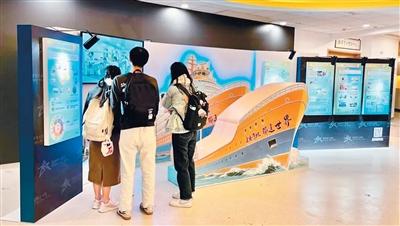
来源:人民日报海外版 香港青年在参观"粤港澳大湾区巡回展览"。 香港特区政府新闻处供图 粤港澳大湾区建设不断提速,为港澳青年创造了更广阔的发展空间。香港特区政府和社会各界共同努 力,持续推出各类计划、创造更多机会,为有志到大湾区内地城市发展的香港青年提供更大舞台。近 日,由香港特区政府举办的"粤港澳大湾区巡回展览"启动,走进香港8所大专院校及青年广场公民教育 资源中心,为青年介绍大湾区建设带来的重要机遇。 "特区政府极为重视青年的发展,在多个领域持续推出多项政策措施,支持香港青年把握在大湾区实 习、就业及创业的机遇,鼓励他们在更广阔舞台尽展所长。"香港特区政府政制及内地事务局粤港澳大 湾区发展办公室发言人表示。 提供各类资讯 助力成长成才 为全方位支持香港青年实现更好发展,特区政府于2022年底推出《青年发展蓝图》,如今已超额完成 160多项惠及青年的措施,未来还将持续推出新设施、新政策助力青年成长。 "粤港澳大湾区巡回展览"于1月12日启动,将持续至3月下旬。目前,该展览已走进香港中文大学、香港 浸会大学、香港教育大学、香港科技大学4所高校及青年广场公民教育资源中心,吸引不少香港青年学 生参观。展览内容丰富 ...

坐拥九大万亿级产业集群,谁会成为广东的第十张王牌?
Sou Hu Cai Jing· 2026-01-21 01:58
Group 1: Overview of Guangdong's Manufacturing Industry - Guangdong's manufacturing industry is supported by trillion-level industrial clusters, with nine major clusters established, including new-generation electronic information and new energy vehicles [2] - In 2022, the automotive industry in Guangdong achieved revenue exceeding 1 trillion yuan, marking it as the eighth trillion-level industry, with the new energy industry expected to follow in 2024 [2] - The ultra-high-definition video display industry is projected to surpass 900 billion yuan in revenue by 2024, positioning it as a potential candidate for the next trillion-level industry [2] Group 2: Strategic Importance of Trillion-Level Clusters - The development of trillion-level industrial clusters is a strategic focus for Guangdong to adapt to global economic changes and technological revolutions, aiming to build a modern industrial system [3] - The existing trillion-level clusters are predominantly traditional industries, indicating a need for increased representation of strategic emerging industries [3] - Trillion-level clusters are characterized by significant scale effects, strong innovation capabilities, and resilient supply chains, serving as key drivers for economic growth [3] Group 3: Policy Support and Development Plans - The success of the new energy industry in Guangdong is attributed to strategic policies and frameworks established since 2020, aiming to develop it into a strategic emerging industry cluster [5] - The "Guangdong Province Action Plan for the Development of Ultra-High-Definition Video Industry" aims for the industry to achieve over 1 trillion yuan in revenue by 2025 [8] - The semiconductor and integrated circuit industry is a focus area, with plans to enhance its scale and capabilities, targeting over 4 trillion yuan in revenue by 2025 [10][12] Group 4: Emerging Industries and Growth Projections - The new energy storage industry is expected to reach 600 billion yuan in revenue by 2025, with an annual growth rate exceeding 50% [13] - The low-altitude economy is projected to become a trillion-level industry, with significant market potential and a comprehensive policy framework to support its development [18] - The ultra-high-definition video industry has shown remarkable growth, with a revenue of 900 billion yuan in 2024 and a significant increase in 4K program production [9] Group 5: Infrastructure and Market Development - Guangdong has established a robust infrastructure for the low-altitude economy, including numerous general airports and drone flight routes, facilitating industry growth [21][22] - The new energy storage sector has seen rapid advancements, with major projects being launched and significant increases in installed capacity [17] - The semiconductor industry in Guangdong is experiencing rapid growth, with a projected revenue of over 320 billion yuan in 2024 and a clear path towards achieving 400 billion yuan by 2025 [11]




“eVTOL五小龙”齐聚 上海争夺低空经济“制空权”
Zhong Guo Jing Ying Bao· 2026-01-20 17:37
Core Viewpoint - Shanghai is actively developing the low-altitude economy and commercial aerospace sectors, aiming to establish itself as a global hub for electric vertical takeoff and landing (eVTOL) aircraft by implementing supportive policies and infrastructure development [1][3][2]. Group 1: Policy Initiatives - Shanghai has introduced multiple policies to support the low-altitude economy, including a target to reach a core industry scale of approximately 80 billion yuan by 2028 [3]. - The city aims to build a complete industrial chain for new low-altitude aircraft and establish a national advanced manufacturing cluster for the low-altitude economy [3]. - Financial incentives are provided, with up to 10 million yuan in support for eVTOL manufacturing projects, encouraging investment in low-altitude and commercial aerospace sectors [3][6]. Group 2: Industry Development - As of December 2025, Shanghai is home to at least 251 startups in the low-altitude economy, with 66 companies focused on eVTOL and drones, representing over 50% of the leading eVTOL firms in China [5]. - Companies like Volant, Peak Aviation, and Shide Technology are recognized as key players in the eVTOL sector, achieving significant milestones in flight testing and certification [6][9]. - The city has also attracted several commercial aerospace companies, contributing to a robust ecosystem for low-altitude economic activities [6]. Group 3: Infrastructure and Ecosystem - Infrastructure development is identified as a critical challenge, with calls for improved facilities for flight testing and operational deployment of eVTOLs [7][8]. - Experts suggest enhancing the layout of takeoff and landing points, particularly in transportation hubs and business districts, to facilitate low-altitude operations [7]. - The establishment of a comprehensive regulatory framework and streamlined approval processes is essential for the successful implementation of low-altitude economic initiatives [7][8]. Group 4: Talent and Experience - Shanghai's aviation industry benefits from a wealth of talent and experience, with a strong background in civil aviation and aircraft certification processes [4][5]. - The city has produced a skilled workforce through successful projects like the domestically developed C919 aircraft, which supports the growth of the low-altitude economy [5]. - The presence of experienced regulatory bodies enhances the industry's ability to develop and implement eVTOL technologies effectively [4].
广州市长政府工作报告:创新,宜居,美丽,韧性,文明,智慧 是对一个现代化超大城市的精准定位,也是人民的期盼
Zhong Guo Fa Zhan Wang· 2026-01-20 10:46
Group 1: Government Work Report Highlights - The Guangzhou government work report outlines a vision for the city in five years, emphasizing innovation, livability, beauty, resilience, civilization, and intelligence as key attributes of a modern mega-city [2] - The report indicates a clear focus on integrating healthcare into urban planning, highlighting the importance of medical services in enhancing the quality of life for citizens [2][3] - The report emphasizes the need for resilient medical service supply and infrastructure as critical components of urban livelihood security [3] Group 2: Future Industry Development - The report identifies future industries as crucial for Guangzhou's development, advocating for a shift from merely providing policies to establishing mechanisms that support long-term growth [4] - It suggests a transition from issuing opportunity lists to creating comprehensive engineering plans that facilitate business operations [4] - The report calls for a focus on building ecosystems rather than just supporting leading enterprises, proposing pilot projects for future industry micro-clusters [4] Group 3: Automotive Industry Insights - The automotive sector is highlighted as a pillar of Guangzhou's economy, with a strong emphasis on the development of smart and connected vehicles [5][6] - The report outlines specific goals for the smart connected vehicle industry, including expanding application scenarios and promoting autonomous driving demonstrations [6] - Guangzhou aims to leverage technological innovations, such as solid-state batteries, to enhance its competitive edge in the automotive industry [6] Group 4: Legal and Governance Framework - The report underscores the importance of legal governance and efficiency in administration, reflecting Guangzhou's commitment to building a rule-of-law government [7] - The establishment of Guangzhou as a national model for legal governance is noted as a significant achievement, with plans for continued advocacy and research in legal matters [7]

三省“双子星”抢龙头,透视区域经济新格局|城市论
Sou Hu Cai Jing· 2026-01-20 10:23
Group 1: Economic Competition in Northeast China - In 2024, the GDP of Dalian and Shenyang surpassed 900 billion yuan, with Dalian reaching 951.69 billion yuan and Shenyang at 902.71 billion yuan, marking a significant competition for the title of "Northeast Champion" [3] - The gap between Shenyang and Dalian has narrowed to 489.8 billion yuan, with Shenyang showing a growth rate of 6.1% compared to Dalian's 6.0%, indicating a strong catching-up momentum [3][6] - Dalian's economic strength is rooted in its industrial base and port advantages, while Shenyang is leveraging its transportation hub status and rich educational resources to transition towards high-end manufacturing [5][6] Group 2: Economic Dynamics in Southeast China - The competition between Fuzhou and Quanzhou has been ongoing for over 20 years, with Fuzhou recently reclaiming its position as the leading city in Fujian province [7][8] - Fuzhou's economic growth has been bolstered by its digital economy, which exceeded 450 billion yuan, accounting for over 45% of its GDP by 2020 [7][8] - Quanzhou, while facing challenges in traditional manufacturing, is focusing on upgrading its industries and developing strategic emerging sectors such as artificial intelligence and new materials [8] Group 3: Economic Developments in Hebei Province - The competition between Shijiazhuang and Tangshan has lasted for 20 years, with Tangshan initially surpassing Shijiazhuang in GDP due to its strong industrial base [12][13] - In 2024, Tangshan's GDP reached over 1 trillion yuan, while Shijiazhuang's GDP was 820.34 billion yuan, indicating a shift towards a "dual trillion city" dynamic in Hebei [13][15] - Both cities are focusing on integrating with the Beijing-Tianjin-Hebei region and developing new industries, with a shared goal of enhancing their economic growth potential [15][16]

“十四五”没达成3.5万亿GDP的广州,提出10年后要突破6万亿
Sou Hu Cai Jing· 2026-01-20 10:18
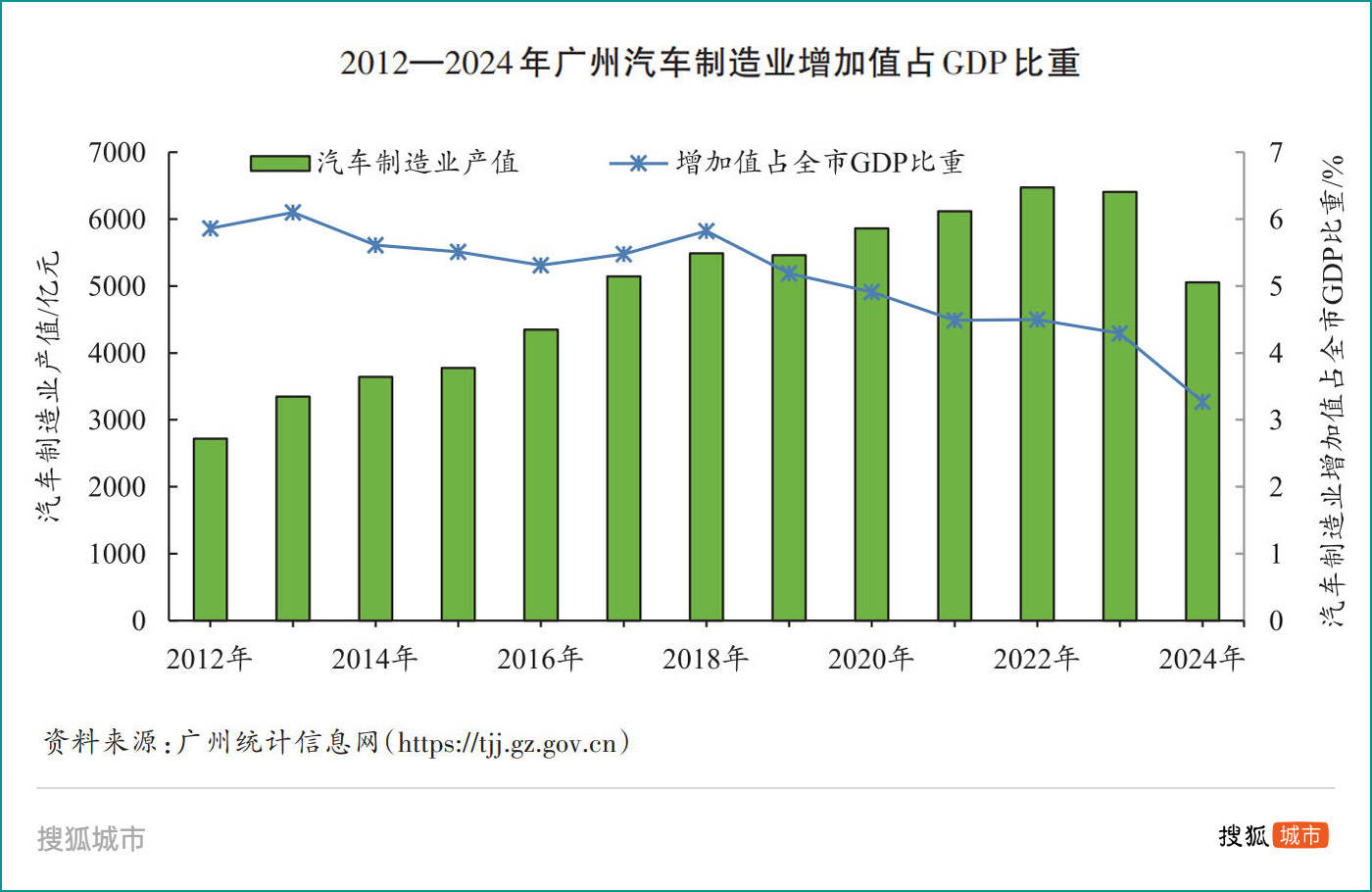
Core Viewpoint - Guangzhou's government work report projects a GDP growth of around 5% for 2026, with a long-term goal of reaching 6 trillion yuan by 2035, necessitating an average annual growth rate of 6.5% over the next decade [1][10]. Economic Growth and Projections - The GDP increment for Guangzhou during the "14th Five-Year Plan" is approximately 700 billion yuan, with a projected GDP of 3.2 trillion yuan by 2025, falling short of the 3.5 trillion yuan target by about 300 billion yuan [1]. - The economic trajectory of Guangzhou over the past five years can be described as a "U-shape," with GDP growth peaking at 8.1% in 2021, dropping to 1% in 2022, and recovering to 4.1% by the third quarter of 2025 [2]. Industrial Investment - Industrial investment in Guangzhou has increased from 103 billion yuan in 2020 to 171.1 billion yuan in 2024, marking a 66% growth over four years [3]. - During the "14th Five-Year Plan," Guangzhou achieved over 730 billion yuan in industrial investment, a 64.6% increase compared to the "13th Five-Year Plan" [3]. Manufacturing Sector Challenges and Developments - The automotive sector, which has been a stronghold for Guangzhou, faced a production decline to 2.54 million units in 2024, with a value-added decrease of 18.2% [5]. - However, the production of new energy vehicles surged by 20.6% in the first three quarters of 2025, indicating a shift towards more sustainable automotive solutions [5]. - The city has established six advanced manufacturing clusters, with strategic emerging industries contributing 35.2% to GDP growth, reflecting a gradual adjustment in industrial structure [6]. Trade and Consumption - Guangzhou has become the third city in China to surpass 1 trillion yuan in both consumption and foreign trade, with retail sales exceeding 1.1 trillion yuan and total import-export value surpassing 1.2 trillion yuan [7]. - The city's logistics and trade infrastructure, including Baiyun Airport and Guangzhou Port, supports its resilience in consumption, despite challenges in the industrial sector [9]. Future Growth Strategies - To achieve the ambitious GDP target of 6 trillion yuan by 2035, Guangzhou must enhance its growth rate from 5% to 6.5%, necessitating investments in advanced industries such as high-end integrated circuits and AI [10][11]. - The city aims to transform its integrated circuit manufacturing from downstream assembly to core manufacturing, with a reported 37.4% increase in the value-added of the integrated circuit sector in the first three quarters of 2025 [11].
“十五五”开局之年定下“实干实绩攻坚”基调 巴中画定今年经济发展“施工图”
Si Chuan Ri Bao· 2026-01-20 08:20
Group 1: Economic Goals and Strategies - The core goal for Bazhong is to achieve a rapid economic growth rate while aiming for a total economic output of 100 billion yuan by 2026, marking it as a year of practical achievements [1] - The annual economic work focuses on six key tasks, emphasizing the importance of expanding domestic demand and boosting consumption as primary objectives [2][3] Group 2: Investment and Industrial Development - Bazhong plans to combine investments in physical infrastructure and human resources, focusing on industries with sustainable tax sources and effective investments [3] - The city aims to strengthen its industrial foundation by developing key industries such as energy and chemicals, advanced materials, food and beverage, electronic information, and healthcare [5][6] Group 3: Urban-Rural Integration and Social Welfare - The city is committed to enhancing urban planning and development, promoting urban-rural integration, and improving the quality of life for residents [7][8] - Specific initiatives include creating modern urban spaces and improving employment services, education, and healthcare, with a focus on enhancing public cultural services [8]
金元证券每日晨报-20260120
Jinyuan Securities· 2026-01-20 06:31
Core Insights - The report highlights the performance of major stock indices, indicating a slight decline in the U.S. markets with the Dow Jones Industrial Average down by 0.17% and the S&P 500 down by 0.06% in the recent trading day [1] - The report also notes the international economic outlook, with the IMF raising China's economic growth forecast for 2025 to 5% and for 2026, reflecting resilience despite global uncertainties [12] - Significant developments in the electric vehicle sector are noted, with Germany reintroducing electric vehicle purchase subsidies ranging from €1,500 to €6,000, applicable to all manufacturers including Chinese brands [13] International News - The European Union is engaged in intensive discussions regarding countermeasures to U.S. tariff threats, with a special summit scheduled to address these issues [11] - The IMF's updated World Economic Outlook indicates a global economic growth rate of 3.3% for 2026, driven by improvements in major economies like the U.S. and China [12] Domestic News - The Chinese government emphasizes high-quality development and reform policy coordination in a recent meeting, aiming to address uncertainties in the development environment [15] - A preliminary report indicates that China's GDP is projected to grow by 5% in 2025, with significant contributions from the service sector and a decline in fixed asset investment [16] Company News - Micron Technology warns of an unprecedented shortage of memory chips due to surging demand from artificial intelligence infrastructure, which is expected to persist beyond 2026 [19] - Tesla is set to restart the development of its Dojo 3 supercomputer project, which is crucial for its autonomous driving and AI capabilities [19] - Cainiao reports a 32% year-on-year increase in order processing volume at its global overseas warehouses, with plans for further expansion in key markets [19] Industry Reports - The low-altitude economy sector is highlighted with Wuhan's release of a standard system construction guide, indicating growth potential in this emerging industry [20] - The computer industry report notes a 3.82% increase in the industry index, outperforming the broader market, with significant developments in AI healthcare applications [20]