
汽车制造

Search documents
吉利汽车(00175):2025年业绩符合预期,单车表现逐季提升
ZHONGTAI SECURITIES· 2026-03-19 12:44
Investment Rating - The investment rating for Geely Automobile is "Buy" (maintained) [2][8] Core Views - The company is expected to achieve a revenue of 345.2 billion yuan in 2025, with a year-on-year growth of 25.1% [5] - The core net profit for 2025 is projected to be 144.1 billion yuan, reflecting a year-on-year increase of 35.9% [5] - The company aims to sell 3.45 million vehicles in 2026, representing a year-on-year growth of 14% [5] Financial Performance Summary - Revenue Forecast: - 2024A: 240.2 billion yuan - 2025A: 345.2 billion yuan - 2026E: 482.3 billion yuan - 2027E: 551.0 billion yuan - 2028E: 615.5 billion yuan - Year-on-year growth rates: 34%, 44%, 40%, 14%, 12% [2] - Net Profit Forecast: - 2024A: 16.5 billion yuan - 2025A: 16.9 billion yuan - 2026E: 20.4 billion yuan - 2027E: 26.1 billion yuan - 2028E: 31.8 billion yuan - Year-on-year growth rates: 219%, 2%, 21%, 28%, 22% [2] - Earnings Per Share (EPS): - 2024A: 1.52 yuan - 2025A: 1.56 yuan - 2026E: 1.88 yuan - 2027E: 2.41 yuan - 2028E: 2.93 yuan [2] - Price-to-Earnings (P/E) Ratio: - 2024A: 10.6 - 2025A: 10.4 - 2026E: 8.6 - 2027E: 6.7 - 2028E: 5.5 [2] Market Position and Strategy - The company is focusing on high-end vehicle offerings and expanding its export capabilities, with a target of 640,000 units for exports in 2026, a year-on-year increase of 52.7% [5] - The introduction of new models, such as the Galaxy M7 and Zeekr 9X, is expected to drive sales and profitability [5] - The average selling price (ASP) of vehicles is steadily increasing, with the ASP for Q4 2025 reaching approximately 124,000 yuan [5]

直击吉利汽车2025年业绩会:规模效应遇上利润释放,吉利“下半场”怎么打?
Xin Lang Cai Jing· 2026-03-19 12:06
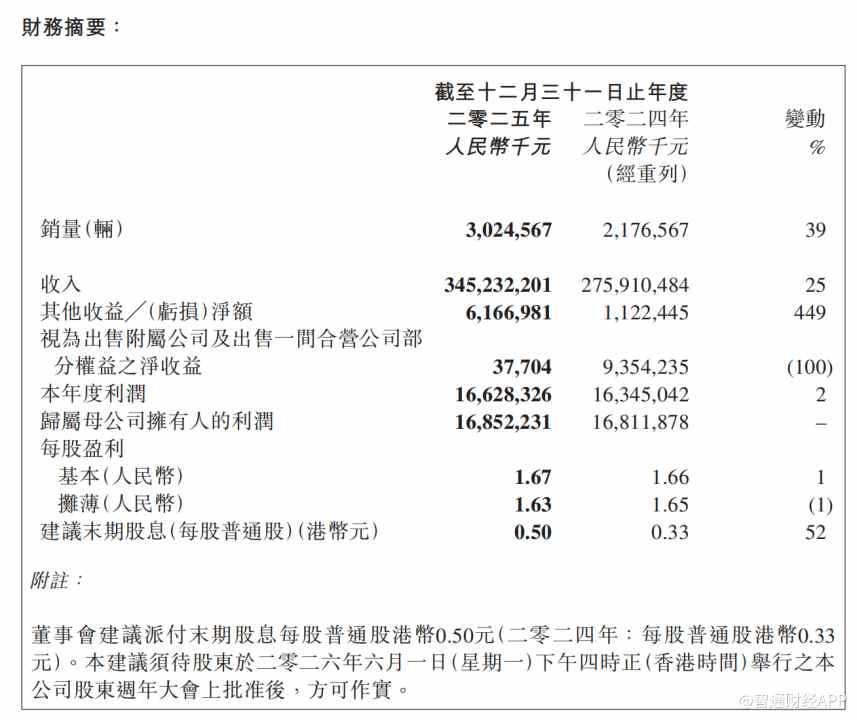
Core Viewpoint - Geely Auto has demonstrated strong financial performance in 2025, achieving significant revenue and profit growth amidst a competitive automotive market, marking its "high-quality development year" [1][6]. Financial Performance - Geely Auto reported a revenue of 345.2 billion yuan, a 25% increase year-on-year, and a core net profit of 14.41 billion yuan, up 36% year-on-year, indicating a robust financial position [1][6]. - The company exceeded its sales target with over 3.02 million vehicles sold, achieving an overall gross margin of 16.7% and a total gross profit of 57.3 billion yuan [1][6]. - Total cash levels rose to 68.2 billion yuan, a 46% increase year-on-year, with a low debt-to-asset ratio compared to industry standards [1][6]. Shareholder Returns - Geely's board proposed a 51.5% increase in dividends to 0.5 HKD per share, totaling 5.39 billion HKD, setting a new historical high for shareholder returns [2][6]. Strategic Integration - The company's strategic integration, guided by the "Taizhou Declaration," has led to clearer brand positioning and reduced operational costs through shared technology and joint procurement [2][7]. - Geely completed a significant stock swap between its U.S. and Hong Kong shares in just over 200 days, enhancing brand synergy among its various divisions [2][7]. Research and Development - Geely's R&D investment reached 21.8 billion yuan, an 8.3% increase, with improved efficiency due to shared AI technology across its brands, avoiding redundancy in development [3][8]. - The profitability of the Zeekr brand, which sold over 224,000 units, has positively impacted Geely's overall profit margins, with the average transaction price exceeding 530,000 yuan [3][8]. Technological Advancements - Geely aims to achieve a level of intelligent driving comparable to Tesla's Full Self-Driving (FSD) by 2026, having received EU certification for its advanced driving assistance system [4][9]. - The company is collaborating with Nvidia to define the next generation of smart mobility technology, enhancing its competitive edge in the market [4][9]. International Expansion - Geely's overseas sales reached 420,000 units in 2025, with a 240% increase in new energy vehicle exports, indicating a shift from trade-based to localized international operations [5][10]. - The company plans to prioritize resources for international business, targeting 640,000 units in 2026, with a focus on establishing significant markets in Europe, Eastern Europe, and ASEAN [5][10].
零跑汽车(09863):2025年首次实现全年盈利
HTSC· 2026-03-19 11:53
Investment Rating - The report maintains a "Buy" rating for the company with a target price of HKD 70.52 [6]. Core Insights - The company achieved its first annual profit in 2025, with a revenue of RMB 64.73 billion (up 101.3% year-on-year) and a net profit of RMB 540 million, marking a significant turnaround from a loss of RMB 2.82 billion in 2024 [1][2]. - The company delivered 597,000 vehicles in 2025, leading the new energy vehicle sector, and aims to challenge a sales target of 1 million vehicles in 2026 with the launch of four new models [1][3]. - The gross margin reached a record high of 15.0% in Q4 2025, driven by economies of scale and cost reductions from in-house production [2][3]. Summary by Sections Financial Performance - In 2025, the company reported a revenue of RMB 64.73 billion, with automotive and parts contributing RMB 62.01 billion (up 96.0% year-on-year) and services contributing RMB 2.72 billion (up 413.2%) [2]. - The gross margin for the year was 14.5%, with Q4 achieving a peak of 15.0% [2]. - The adjusted net profit for 2025 was RMB 1.08 billion, aligning with the company's guidance of RMB 500 million to RMB 1 billion [1][2]. Product Development - The company plans to launch four new models in 2026, covering a price range of RMB 80,000 to RMB 300,000, which is expected to enhance its market presence [3]. - The company has already launched its city navigation feature and aims to complete its AI driving model by the end of 2026 [3]. International Expansion - The company exported 67,000 vehicles in 2025, leading the sector, and aims to double its overseas sales to 100,000-150,000 vehicles in 2026, focusing on South America and Asia-Pacific markets [4]. - The company is also advancing local production initiatives, with plans for a CKD project in Spain to commence production in October 2026 [4]. Profit Forecast and Valuation - The profit forecast for 2026-2028 has been adjusted, with expected sales of 910,000, 1.19 million, and 1.35 million vehicles respectively, and revenues of RMB 109.9 billion, RMB 144.7 billion, and RMB 164 billion [5]. - The estimated net profit for 2026 is RMB 4.2 billion, with a PE ratio of 21 times for 2026, reflecting a cautious outlook amid increasing competition [5].

吉利汽车(00175):“一个吉利”驱动业绩新高,新能源、高端、全球化全面进击
智通财经网· 2026-03-19 10:37
Core Viewpoint - In 2025, Geely Auto successfully navigated a challenging market characterized by price wars by implementing the "One Geely" strategy, which focuses on resource integration, technology sharing, streamlined channels, and brand collaboration, demonstrating that profitability can be achieved without engaging in price competition [1][12]. Financial Performance - Geely Auto reported a total revenue of 345.2 billion RMB in 2025, marking a 25% year-on-year increase, with sales reaching 3.025 million units, a 39% increase, and a market share exceeding 10% for the first time [2][3]. - The core net profit attributable to shareholders was 14.41 billion RMB, reflecting a 36% increase, significantly outpacing revenue growth [2][3]. - The company proposed a final dividend of 0.5 HKD per share, a 52% increase compared to the previous year [2][3]. Sales and Product Structure - In 2025, sales of new energy vehicles reached 1.688 million units, a 90% increase, with a penetration rate exceeding 55%, becoming the main growth driver [4]. - Traditional fuel vehicle sales remained strong, with the Geely China Star fuel series selling 1.214 million units, maintaining the top position in sales for self-owned fuel vehicles for nine consecutive years [4]. Operational Efficiency - The "One Geely" strategy led to a significant reduction in administrative expenses, R&D investment ratio, and sales expenses by 17.1%, 13.5%, and 0.7% respectively, enhancing profitability without merely cutting costs [6][5]. - R&D investment totaled 21.8 billion RMB, an 8.3% increase, with shared technology across four brands improving efficiency [7]. Brand and Market Positioning - The average transaction price for the Zeekr brand exceeded 300,000 RMB, with flagship models achieving prices above 530,000 RMB, indicating a successful penetration into the high-value market segment [9]. - Geely's global sales reached 420,000 units in 2025, with significant performance in Europe and ASEAN markets, marking a transition to high-quality growth in international operations [10]. Future Outlook - For 2026, Geely Auto set a sales target of 3.45 million units, with an overseas sales goal of 640,000 units, supported by new product launches and enhanced global operations [11].

跨国车企,正拱手把电动车市场让给比亚迪们
Di Yi Cai Jing· 2026-03-19 09:47
Core Insights - Major multinational automakers have collectively announced a pause in their electrification transitions due to disappointing growth, resulting in nearly 500 billion yuan in losses for companies like Stellantis, Ford, General Motors, Honda, and Porsche by 2025 [2] - Despite the setbacks, the global automotive industry is moving towards electrification and smart technology, with the penetration rate of new energy vehicles expected to rise from 13% in 2022 to 23.5% by 2025 [2] - The automotive market is experiencing significant regional disparities, with China's new energy vehicle penetration expected to reach 45.5% by 2025, while the U.S. and Europe lag behind at 9.7% and 23.4%, respectively [3] Group 1: Market Dynamics - The U.S. market, despite being the third largest for new energy vehicles, has a low penetration rate due to weak policy support and limited infrastructure [3] - Changes in U.S. policy, such as rejoining the Paris Agreement, have influenced the strategies of major automakers like Honda and Ford, which primarily rely on the North American market [4] - The withdrawal of favorable policies under the Trump administration and the EU's abandonment of aggressive plans to ban gasoline and diesel cars have further complicated the situation for multinational automakers [4] Group 2: Competitive Landscape - By 2025, Honda's global electrification penetration is projected to be below 9%, while Ford's electric models have seen significant sales declines [4] - The imbalance between the pace of electric vehicle scaling and substantial R&D investments has led to increasing losses for multinational automakers, forcing them to revert to traditional combustion engine vehicles [4] - The market for hybrid electric vehicles (HEVs) remains strong, allowing traditional automakers to leverage their existing strengths in engine and transmission technology [4] Group 3: Future Challenges - The global penetration rate of new energy vehicles is projected to reach 23.6% by 2025, with significant growth in Europe and North America [5] - Multinational automakers face increasing competition from Chinese companies, which have advanced in battery technology and are expected to dominate the global market [5] - Chinese automakers have rapidly expanded their new energy vehicle offerings and are increasing exports, with projections showing a rise from 1.203 million units in 2023 to 2.615 million units by 2025 [6] Group 4: Strategic Responses - In response to competitive pressures, multinational automakers are seeking partnerships with Chinese companies to accelerate their electrification and smart technology initiatives [6] - Companies like Ford have acknowledged the competitive edge of Chinese manufacturers in terms of cost control and vehicle quality, indicating a potential shift in strategy [6] - The competitive landscape is shifting, with companies like BYD and Geely making significant strides in global sales rankings, highlighting the urgency for multinational automakers to adapt [7]



零跑汽车(09863):25年报点评:毛利率创新高,A+D新品周期将至
ZHONGTAI SECURITIES· 2026-03-19 09:22
Investment Rating - The report maintains a "Buy" rating for the company, indicating an expected relative performance increase of over 15% against the benchmark index within the next 6 to 12 months [12] Core Insights - The company achieved a revenue of 64.73 billion yuan in 2025, representing a year-on-year growth of 101.3%. The gross margin reached a record high of 14.5%, up by 6.1 percentage points year-on-year, with a quarterly gross margin of 15% in Q4 2025 [5][6] - The company turned profitable in 2025 with a net profit of 540 million yuan, marking a significant turnaround from previous losses [5][6] - The company is set to launch new models in 2026, including the A series and D series, which are expected to fill gaps in the current product lineup and contribute to increased sales [8] Financial Performance Summary - Revenue projections for the company are as follows: 32.16 billion yuan in 2024, 64.73 billion yuan in 2025, 100.81 billion yuan in 2026, 138.68 billion yuan in 2027, and 163.5 billion yuan in 2028, with growth rates of 92%, 101%, 56%, 38%, and 18% respectively [4] - The company’s net profit is projected to reach 4.82 billion yuan in 2026, 7.35 billion yuan in 2027, and 9.25 billion yuan in 2028, with year-on-year growth rates of 796%, 52%, and 26% respectively [4] - The earnings per share (EPS) is expected to be 0.38 yuan in 2025, 3.39 yuan in 2026, 5.17 yuan in 2027, and 6.51 yuan in 2028 [4] Market Position and Expansion - The company ranked first among new energy vehicle manufacturers in terms of export volume, with 67,000 vehicles exported in 2025 and over 100,000 cumulative exports by February 2026 [7] - The company is actively expanding into the South American market, with new models launched in Brazil and plans for further growth in this region [7] Future Outlook - The introduction of the A and D series models is anticipated to drive domestic sales upward, while the new factory in Spain is expected to commence production of the B10 model in October 2026 [8] - Despite adjustments in profit forecasts due to industry challenges, the company is expected to maintain strong growth driven by new vehicle cycles and international expansion [8]
长城汽车董事长魏建军谈中国汽车未来发展方向
Bei Jing Ri Bao Ke Hu Duan· 2026-03-19 08:53
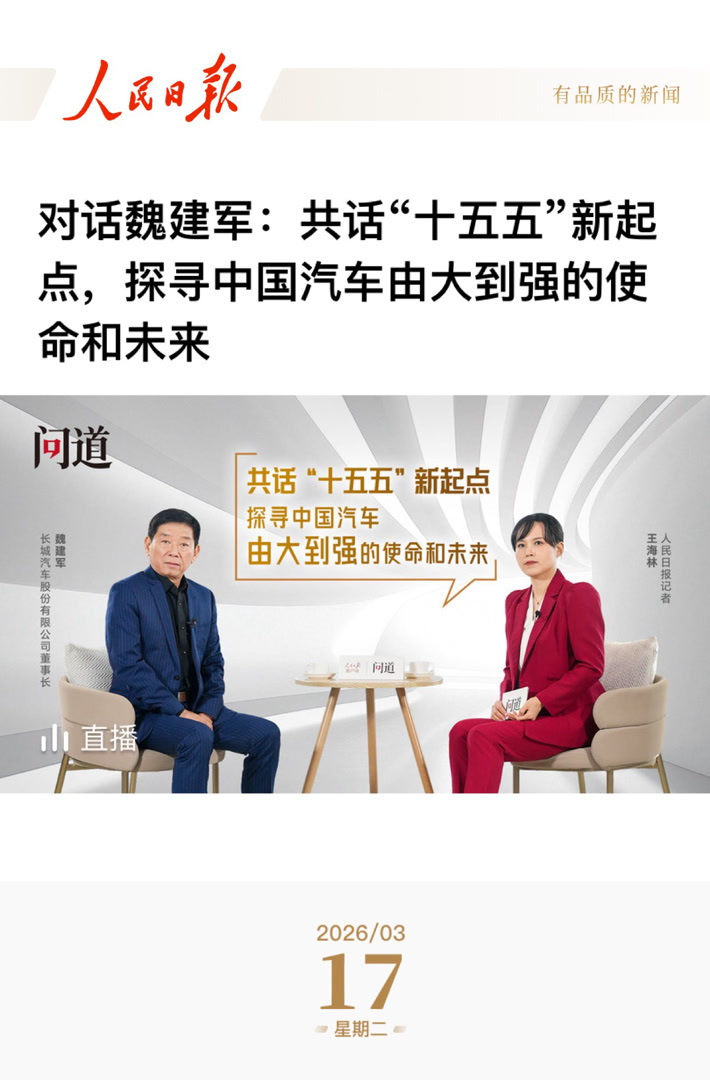
Core Viewpoint - The interview with Wei Jianjun, Chairman of Great Wall Motors, emphasizes the importance of building trust in the automotive industry as China transitions from a major automotive nation to a strong one, advocating for a comprehensive approach to quality, collaboration, and action to establish credibility [1][6]. Group 1: Industry Development - China has been the world's largest automotive producer and seller for several consecutive years [4]. - The transition from being a "big automotive country" to a "strong automotive country" requires a shift from "product export" to "industry output," integrating the entire industrial chain globally [6]. Group 2: Trust Issues - Wei Jianjun identifies four major trust concerns in the industry: 1. Returning car manufacturers to value creation 2. Restoring consumer confidence in products 3. Ensuring competition is based on real capabilities 4. Building trust in the industry for global expansion [6]. Group 3: Trust-Building Strategies - Great Wall Motors outlines three key paths for establishing trust: 1. Building trust with users by maintaining quality standards and being accountable for products 2. Building trust within the industry by promoting symbiotic relationships between manufacturers and suppliers, with independent operations of parts companies reinforcing industry credibility 3. Building global trust through "ecological outbound" strategies, localizing production and sales in countries like Thailand and Brazil to integrate deeply into local societies and earn respect in global markets [6].

【快讯】每日快讯(2026年3月19日)
乘联分会· 2026-03-19 08:38
Domestic News - Jiangsu plans to support over 300 typical application scenarios for urban models and intelligent agents by 2030, focusing on digital transformation of infrastructure and smart city applications [7] - In Shaanxi, the industrial added value above designated size grew by 4.1% year-on-year in the first two months of the year, with fixed asset investment increasing by 1.9% [8] - Shanghai has recognized 30 new regional headquarters of multinational companies and 15 foreign-funded R&D centers, primarily in key industries such as biomedicine and high-end equipment [9] - Chery Automobile's solid-state battery is expected to achieve a range of over 1500 km, with plans for vehicle validation by 2027 [10] - Zhiji released the IM Ultra Agent, the first super intelligent agent in the industry, which integrates advanced AI capabilities into vehicles [11] - Geely's CFO stated that the impact of rising upstream commodity prices is manageable, and the company aims to achieve autonomous driving capabilities comparable to Tesla's within the year [13] - Xiaomi's ultra-strong steel has won a national innovation award, with applications in new vehicle models [14] - Pony.ai and Ruqi Mobility have established a Robotaxi fleet, with over 100 vehicles delivered and operational in major cities [15] International News - Germany plans to double its general data center computing power by 2030, with AI-specific computing power expected to increase fourfold [16] - Japan's exports to the U.S. have declined for three consecutive months, with a notable drop in automotive exports [17] - Hyundai Motor Group has launched an autonomous taxi service in Las Vegas in partnership with Uber, utilizing the IONIQ 5 model [18] - Vietnam's fuel vehicle sales have significantly decreased, while hybrid vehicle sales have increased, indicating a shift in consumer preferences [19] Commercial Vehicles - Shenzhen has announced restrictions on diesel trucks starting April 6, 2026, to improve air quality [22] - Jiangling Motors has been awarded the title of National Excellent Intelligent Factory, recognizing its advancements in smart manufacturing [23] - Dongfeng and Cummins have signed a memorandum of cooperation to enhance their strategic partnership and focus on sustainable development in commercial vehicles [24] - Yuanmeng and Anbang have signed a strategic agreement to launch a methanol electric super VAN for security transport, emphasizing green and intelligent innovations [25]

理想汽车-W(02015):2025年四季报点评:25Q4净利转正,后续新车型及管理改善有望迎来底部反转
Huachuang Securities· 2026-03-19 08:05
Investment Rating - The report maintains a "Recommendation" rating for Li Auto-W (02015.HK) [1] Core Views - Li Auto reported a net profit of 0.2 billion yuan in Q4 2025, marking a year-on-year decline of 35 billion yuan but a quarter-on-quarter increase of 6.4 billion yuan. The total revenue for Q4 2025 was 28.8 billion yuan, down 35% year-on-year but up 5.2% quarter-on-quarter. For the full year 2025, revenue was 112.3 billion yuan, a 22% decline year-on-year, with a net profit of 1.1 billion yuan, down 69 billion yuan year-on-year [1][7] Financial Performance Summary - **Revenue and Profitability**: - Q4 2025 revenue was 28.8 billion yuan, with a year-on-year decrease of 35% and a quarter-on-quarter increase of 5.2%. The full-year revenue for 2025 was 112.3 billion yuan, down 22% year-on-year. The net profit for Q4 2025 was 0.2 billion yuan, a decrease of 35 billion yuan year-on-year but an increase of 6.4 billion yuan quarter-on-quarter [1][7] - **Sales Volume**: - In Q4 2025, the sales volume was 109,000 vehicles, down 31% year-on-year but up 17% quarter-on-quarter. The average selling price (ASP) for vehicles was 250,000 yuan, down 19,000 yuan year-on-year and 28,000 yuan quarter-on-quarter [1][7] - **Gross Margin**: - The gross margin for Q4 2025 was 17.8%, a decrease of 2.4 percentage points year-on-year but an increase of 1.5 percentage points quarter-on-quarter. The vehicle gross margin was 16.8%, down 2.9 percentage points year-on-year but up 1.3 percentage points quarter-on-quarter [1][7] - **Cost and Expenses**: - R&D expense ratio was 10.5%, up 5.0 percentage points year-on-year, while SG&A expense ratio was 9.2%, up 2.2 percentage points year-on-year [1][7] Future Outlook - **New Model Launches**: - The company plans to launch a new generation of L9 and a new version of L9 Livis in Q2 2026, with the L9 Livis priced at 559,800 yuan. The i6 model is expected to contribute significantly to sales in 2026, with monthly delivery capacity projected to reach 20,000 units [1][7] - **Organizational Improvements**: - Li Auto has restructured its R&D organization to enhance efficiency and reduce the iteration cycle for AI model training from two weeks to one day. Sales channel reforms are also underway to improve operational quality [1][7] - **Sales and Revenue Forecasts**: - The sales forecasts for 2026-2027 have been adjusted down to 500,000 and 520,000 vehicles, respectively. Revenue forecasts for the same period have been revised to 131.3 billion and 140.2 billion yuan. Net profit forecasts have also been adjusted to 0.96 billion and 3.81 billion yuan for 2026 and 2027, respectively [1][7]

跨国车企,正拱手把电动车市场让给比亚迪们|琳机一动
Di Yi Cai Jing Zi Xun· 2026-03-19 07:06
Core Insights - Major multinational automakers have collectively announced a pause in their electrification transitions due to disappointing growth, resulting in significant financial losses totaling nearly 500 billion yuan for companies like Stellantis, Ford, General Motors, Honda, and Porsche by 2025 [1] - Despite the setbacks, the shift towards electrification and smart technology remains an irreversible trend in the global automotive industry, with the penetration rate of new energy vehicles (NEVs) expected to rise from 13% in 2022 to 23.5% by 2025 [1] - The disparity in NEV penetration rates across regions is stark, with China projected to reach 45.5% by 2025, while the U.S. and Europe lag at 9.7% and 23.4%, respectively, highlighting the impact of regional policies [1] Group 1: Market Dynamics - The U.S. market, despite being the third-largest for NEVs, has a low penetration rate due to weak policy support, inadequate infrastructure, and limited model availability, with only 59 NEV models sold in 2020 compared to 300 in China and 180 in Europe [2] - Changes in U.S. policy, such as rejoining the Paris Agreement and subsequent incentives for NEVs, initially benefited automakers like Honda and Ford, but the reversal of these policies has hindered their strategic progress [2] - By 2025, Honda's global electrification penetration is expected to be below 9%, while Ford's F-150 Lightning and Mustang Mach-E have seen sales drop by over 70% and 50%, respectively, indicating significant challenges for these companies [2] Group 2: Industry Challenges - The imbalance between the pace of electrification and substantial R&D investments has led to increasing losses for multinational automakers, forcing them to revert to traditional combustion engine strategies [3] - The hybrid electric vehicle (HEV) market remains viable, with significant demand, and traditional automakers can leverage their strengths in engine and transmission technologies to adapt more cost-effectively [3] - However, the choice to delay full electrification poses risks, as competition intensifies, particularly from Chinese automakers, which are rapidly advancing in the NEV sector [3] Group 3: Competitive Landscape - Chinese companies have gained a competitive edge in key technologies for NEVs, with their market share in global power battery installations expected to rise from 60.4% to 70.4% between 2022 and 2025 [4][5] - The number of NEV sub-brands in China has exceeded 50, and exports of Chinese NEVs are projected to double from 1.203 million to 2.615 million between 2023 and 2025, showcasing their growing global presence [5] - As traditional automakers revert to established practices, Chinese firms are advancing in smart technology, creating a robust ecosystem for intelligent vehicles, further widening the gap with multinational competitors [5] Group 4: Strategic Collaborations - To accelerate their electrification and smart technology goals, many multinational automakers are forming partnerships with Chinese NEV companies, such as Volkswagen's $700 million investment in Xpeng and Stellantis's collaboration with Leap Motor [6] - Chinese automakers like BYD and Geely have made significant strides, with BYD ranking fifth in global vehicle sales and Geely also entering the top ten, indicating a shift in the competitive landscape [6] - The ongoing transformation in the global automotive market is reshaping competitive dynamics, with multinational companies facing a narrowing window to adapt to the rapid advancements in NEVs [6]